WLTP Emissions Figures Still Not Totally Available Causing Confusion

Friday, 21. February 2020

The latest emission figures are measured by attaching equipment to cars and physically driving cars on public roads to simulate real-world driving conditions. This is fine for standard cars but the manufacturers should also assess the emissions when fitted with options and extras.


For example if a car has bigger wheels fitted the emissions can increase. But without that information drivers could be exposed to higher Benefit In Kind tax and Road Tax could increase.


Businesses should therefore consider reviewing their fleet policies due to a lack of WLTP CO2 data for some cars, says the British Vehicle Rental and Leasing Association.


The WLTP CO2 value, derived from the new emissions test, will be used for tax purposes from April, but a shortage of reliable data threatens to disrupt the move to a new VED and company car tax regime, it says.


VED and company car tax for newly registered vehicles will use CO2 figures based on the more accurate WLTP standard from April 1 and 6 respectively.


However, many vehicle manufacturers are struggling to provide WLTP data for their cars, with the result that BVRLA members currently only have accurate CO2, electric mileage range or RDE2 compliance (latest NOx emissions standard) information for around 80% of base (pre-option) models.


With average lead times for cars at around 9-12 weeks from ordering, this data gap is hindering the leasing sector’s ability to provide accurate quotes on many different vehicles and their various configurations and options.


“The introduction of WLTP-based motoring taxes is adding yet another layer of complexity and confusion to a fleet sector that is already having to cope with a deluge of new automotive technology and local authority air quality measures,” said BVRLA chief executive, Gerry Keaney.


“The BVRLA and its members are working with OEMs and third-party data providers to bridge this gap, but in the meantime, we would recommend customers consult with their lease providers to assess the impact on their fleet policies and procurement.”


WLTP CO2 data is available for the entire BMW range at www.bmw.co.uk. Rob East, general manager of Corporate Sales at BMW UK, said: “With the BIK tax liability a key consideration for many company car drivers when choosing a new vehicle, it’s imperative that we provide our customers with this information.


“This transparency allows them quickly to make an informed decision as to whether their favoured BMW works for them from a tax point of view. Without WLTP details, they simply have no way of knowing.”


He added: “Ensuring the easy availability of these details underlines our drive to make it as straightforward as possible for business customers to purchase a new BMW.


“It also reflects the increased level of interest that there is in our key corporate models such as the new 1 Series and new 3 Series.”


The BVRLA has contacted the SMMT, which represents vehicle manufacturers, to offer its support in addressing the WLTP data shortage. It is also working with HMRC on its forthcoming WLTP communications plan. By Graham Hill thanks to Fleet News

Share My Blogs With Others: These icons link to social bookmarking sites where readers can share and discover new web pages.
  • MisterWong
  • Y!GG
  • Webnews
  • Digg
  • del.icio.us
  • StumbleUpon
  • Reddit
  • Alltagz
  • Ask
  • Bloglines
  • Facebook
  • YahooMyWeb
  • Google Bookmarks
  • LinkedIn
  • MySpace
  • TwitThis
  • Squidoo
  • MyShare
  • YahooBuzz
  • De.lirio.us
  • Wikio UK
  • Print
  • Socializer
  • blogmarks

Government Electric Car Grant To Be Withdrawn At The End Of March

Friday, 21. February 2020

The future of the plug-in car and van grant is expected to be revealed by the new Chancellor in the Budget in March.


The electric car and van subsidy was cut in 2018 by £1,000 and fleets were told it would no longer apply to hybrid cars with a range of less than 70 zero emission miles.


The Government said the reduction in funding – from £4,500 to £3,500 – for the cleanest cars, and withdrawing the grant completely for the likes of the Mitsubishi Outlander PHEV and the Toyota Prius Plug-in, was a sign of its success.


Talking to delegates at the ICFM’s annual conference last summer, deputy head of the Office for Low Emission Vehicles (OLEV), Phil Killingley, acknowledged that incentives will be of continued importance beyond 2020, but stressed the detail was still being “talked through”.


Meanwhile, the Treasury told the Telegraph that “consumers incentives will continue to play a role beyond 2020”.


A Whitehall source said: “We have always said we would phase out the subsidies gradually, but there are other ways we can help people to go electric.”


BVRLA chief executive, Gerry Keaney, says that the Budget on March 11 will be an opportunity to set the tone for a new decade in which the transition to decarbonised road transport will be won or lost.


“Fleets are being asked to invest billions of pounds in new electric vehicle technology and infrastructure, which comes at a hefty price premium to its petrol and diesel alternatives,” he said.


“To achieve these goals the Government must provide a clear support package through to at least 2025. It must preserve the Plug in Car and Van Grants, maintain a strong set of tax incentives and tackle the huge and often arbitrary costs associated with fleet charging infrastructure.”  By Graham Hill thanks to Fleet News

Share My Blogs With Others: These icons link to social bookmarking sites where readers can share and discover new web pages.
  • MisterWong
  • Y!GG
  • Webnews
  • Digg
  • del.icio.us
  • StumbleUpon
  • Reddit
  • Alltagz
  • Ask
  • Bloglines
  • Facebook
  • YahooMyWeb
  • Google Bookmarks
  • LinkedIn
  • MySpace
  • TwitThis
  • Squidoo
  • MyShare
  • YahooBuzz
  • De.lirio.us
  • Wikio UK
  • Print
  • Socializer
  • blogmarks

Public Transport Deficiencies Fuels Greater Use Of Cars

Friday, 21. February 2020

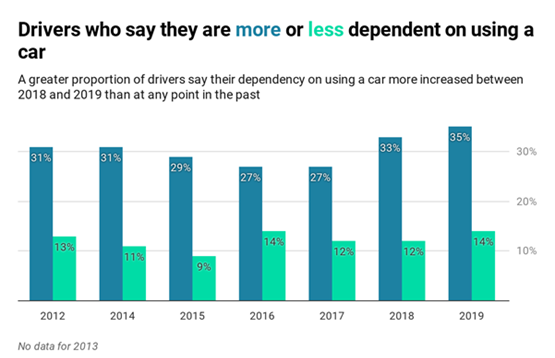
One in three drivers (35%) say they are more dependent on using their car than 12 months ago, with public transport seen as an expensive and unreliable alternative.


The data, released as part of the latest RAC Report on Motoring, shows that most drivers would use their cars less if public transport was better.


At a time when the Government and local councils are keen for drivers to use their cars less frequently to improve air quality and cut congestion, the RAC believes the findings are a stark reminder that many people, especially those who live outside the biggest cities, remain dependent on their cars for many types of journeys.


Just 14% of drivers say they have become less dependent than a year ago, though this has also increased from 12% in 2018 indicating a small rise in those saying they are less dependent on their vehicles.


The top reasons drivers give for using their cars more are a greater need to transport family members (28%), family and friends moving further away (24%) and, perhaps most strikingly, a reduction in the provision or quality of public transport (25%) – with drivers in the North East (42%) significantly more likely to call this out as a reason for them increasingly turning to the car.


Drivers are particularly frustrated by the lack of feasible alternatives to the car for the journeys they need to make, according to the data.


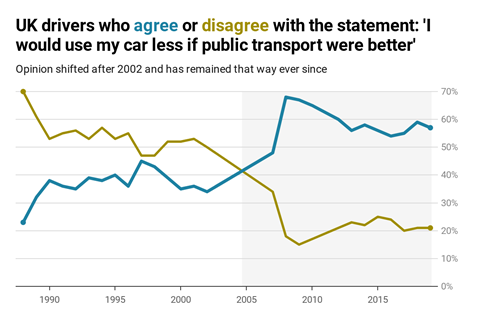
More than half (57%) say they would be willing to use their cars less if the quality of public transport was better, and agreement with this statement has been high for an incredible 11 consecutive years.


Around half of drivers (53%) say they are frustrated by the lack of feasible alternative modes of transport for long journeys, with a similar proportion (52%) saying the same about short journeys. These figures both rise to 55% for drivers aged between 25 and 44.


Frustrations with public transport


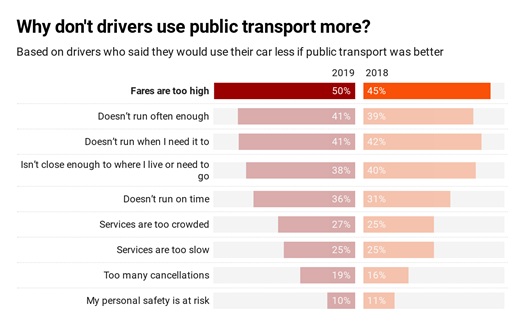
Among drivers who would be willing to use public transport more, half (50%) say the reason they don’t use public transport more is that fares are too high – up by five percentage points on last year – while 41% say services are not frequent enough.


Meanwhile, a growing number of people (36% – up from 31% in 2018) say that a lack of punctuality is a significant barrier to them using public transport as an alternative to driving, and 38% say services don’t run where they need them to.


Of those who would be willing to consider using public transport if services were better, almost a third (31%) say they would make more use of it if there was greater availability of services – a figure that rises to 40% for rural motorists, reflecting to some extent the significant cuts that were made to rail services following the Beeching Report and, more recently, to rural bus services as highlighted last year by the Parliamentary Transport Committee.


The RAC’s findings also show that motorists who live in London are more likely to use alternatives to their cars compared to drivers elsewhere in the UK.


In the capital, on average 38% of each driver’s weekly journeys are made either by public transport, walking or cycling, compared with a national average of just 24%.


For those who live in villages or other rural areas, cars typically account for an enormous 85% of all journeys, with just 15% currently represented by public transport, cycling or walking.


RAC data insight spokesman Rod Dennis said: “These findings present the stark reality for so many people in the UK – that for good or bad, in 2020 the car remains an essential means of getting about whether that is for commuting, dropping off and collecting children or going to visit family and friends.


“While the car might be the obvious choice for many people’s journeys, especially for those who have already invested a lot of money in buying or leasing one, it is also clear just how frustrated many drivers are with the lack of decent alternatives for some of their trips.


“For more than a decade now, drivers have been saying that they are willing to use their cars less if public transport was better – and this year’s figures indicate it’s the high cost and low frequency of services that are the biggest problems cited by drivers. At the same time,


“The ongoing challenge for national and local government, and combined authorities, is therefore to deliver credible alternatives to the car for specific journeys that are regularly completed by a lot of people.


“Connecting large residential areas with popular locations for work would surely be a good starting point – giving drivers the opportunity to swap sitting in daily traffic jams for a fast, frequent alternative.


“Greater investment in walking and cycling infrastructure could also go a long way to encouraging drivers to use of their cars less, especially for short journeys that make up around a quarter of all drivers’ trips.


“But it remains the case that short of cheap, reliable and integrated public transport systems operating all over the UK, it is very difficult to see things changing radically in the years ahead.


“The car remains an integral part of so many people’s lives, whether that is for carrying heavy shopping, transporting family members or going to visit friends in all the corners of the UK.”


In charts and tables: car dependency in the UK

Source: RAC Report on Motoring 2019


  More dependent Less dependent No change
All drivers
Drivers aged 17-24
Drivers aged 25-44
Drivers aged 45-64
Drivers aged 75+
Drivers in towns and cities
Drivers in rural areas

The problems with public transport: insights into bus and rail use

At the end of last year, the Campaign for Better Transport’s Future of Rail report indicated that the cost of rail fares has increased by 47% over the last 10 years, with motoring costs having gone up by 32% over the same period.

The same organisation’s Future of the Bus report also found that national and local funding for buses is now almost £400m a year lower than it was a decade ago.

The last National Travel Survey also showed that bus use is falling across much of England.

Last May meanwhile, the Parliamentary Transport Committee published a report which called for the introduction of a national bus strategy to address the paucity of services available outside of London, where bus provision is regulated by Transport for London.

The committee said that more than 3,000 bus routes had been reduced, withdrawn or altered since 2010-11.

By Graham Hill Thanks To Fleet News

Share My Blogs With Others: These icons link to social bookmarking sites where readers can share and discover new web pages.
  • MisterWong
  • Y!GG
  • Webnews
  • Digg
  • del.icio.us
  • StumbleUpon
  • Reddit
  • Alltagz
  • Ask
  • Bloglines
  • Facebook
  • YahooMyWeb
  • Google Bookmarks
  • LinkedIn
  • MySpace
  • TwitThis
  • Squidoo
  • MyShare
  • YahooBuzz
  • De.lirio.us
  • Wikio UK
  • Print
  • Socializer
  • blogmarks

Ban On The Sale Of Petrol & Diesel Vehicles Brought Forward To 2035

Thursday, 6. February 2020

The ban on the sale of new petrol and diesel cars and vans will be brought forward to 2035 and will now include hybrids.


The Government had previously announced they would end the sale of new fossil fuel vehicles from 2040 but would still allow the sale of hybrid vehicles that had a zero-emission capability.


However, speaking at the Conservative party conference last October, transport secretary Grant Shapps hinted at bringing the date forward.


Launching the next UN climate conference COP26 today (Tuesday February 4), the Prime Minister Boris Johnson will confirm the much tougher, stricter timetable.


Shapps said: “This Government’s £1.5 billion strategy to make owning an electric vehicle as easy as possible is working – last year alone, a fully electric car was sold every 15 minutes.


“We want to go further than ever before. That’s why we are bringing forward our already ambitious target to end the sale of new petrol and diesel cars to tackle climate change and reduce emissions.”


The Government says it will continue to work with all sectors of industry to accelerate the rollout of zero emission vehicles.


But, the Society of Motor Manufacturers and Traders (SMMT), which represents car and van makers in the UK, says the Government has set the new target without a plan showing how it intends to get there.


Mike Hawes, SMMT chief executive, said: “Manufacturers are fully invested in a zero emissions future, with some 60 plug-in models now on the market and 34 more coming in 2020. However, with current demand for this still expensive technology still just a fraction of sales, it’s clear that accelerating an already very challenging ambition will take more than industry investment.


“This is about market transformation, yet we still don’t have clarity on the future of the plug-in car grant – the most significant driver of EV uptake – which ends in just 60 days’ time, while the UK’s charging network is still woefully inadequate.


“If the UK is to lead the global zero emissions agenda, we need a competitive marketplace and a competitive business environment to encourage manufacturers to sell and build here.


“A date without a plan will merely destroy value today. So we therefore need to hear how government plans to fulfil its ambitions in a sustainable way, one that safeguards industry and jobs, allows people from all income groups and regions to adapt and benefit, and, crucially, does not undermine sales of today’s low emission technologies, including popular hybrids, all of which are essential to deliver air quality and climate change goals now.”


Helen Clarkson, CEO of the international non-profit The Climate Group, welcomed the “more ambitious” target from the Government.


However, she said: “We believe that this could still be sooner – and that to be a global leader, especially post-Brexit, a 2030 phase-out commitment is required; without this, we risk being out of step with our international peers.


“Our business campaign for the 100% adoption of electric vehicles by 2030, EV100, has 62 corporate members, many of which are British, including AstraZeneca, BT, Centrica, Foxtons, Mitie, RBS, SSE and Unilever. Businesses are showing what is possible and The Climate Group would love to see this level of ambition matched.”


Through EV100, the UK has the second highest number of corporate fleet vehicles committed to switching to electric, after Germany.


Government policy must be strong and consistent to accelerate this transition, and to help the UK become a world leader on electric vehicles, it says.


So far, eight countries have already committed to more ambitious phase-out dates than the UK, while Scotland has had a 2032 phase-out date for new petrol and diesel vehicles in place since 2017.


The RAC was not surprised by the Government’s plan to bring forward the date to ban the sale of petrol and diesel vehicles.


RAC head of policy Nicholas Lyes said: “A more ambitious target should be the catalyst for faster change, but there are clearly many hurdles to cross.


“Manufacturers face a great challenge in switching their production from conventional powertrains to cleaner electric technology.


“More electric vehicles (EVs) will also require a great deal of investment in charging infrastructure – particularly for those who rely on on-street parking outside their homes.”


Lyes also believes that we should not overlook the role plug-in hybrid vehicles could play in bridging the gap to going completely electric.


“In the meantime we urge the Government to extend the plug-in car grant for at least another three years to help those that want to go electric, but who are put off by the high initial costs,” he said.


“At a local level, authorities should also incentivise their use with cheaper parking rates and lower residents’ parking permit fees.” By Graham Hill thanks to Fleet News

Share My Blogs With Others: These icons link to social bookmarking sites where readers can share and discover new web pages.
  • MisterWong
  • Y!GG
  • Webnews
  • Digg
  • del.icio.us
  • StumbleUpon
  • Reddit
  • Alltagz
  • Ask
  • Bloglines
  • Facebook
  • YahooMyWeb
  • Google Bookmarks
  • LinkedIn
  • MySpace
  • TwitThis
  • Squidoo
  • MyShare
  • YahooBuzz
  • De.lirio.us
  • Wikio UK
  • Print
  • Socializer
  • blogmarks

Could Vegans Be Forcing A Ban On Leather Interiors?

Friday, 24. January 2020

Could a vegan steak bake change the car industry? It might sound tenuous, but the phenomenal success of the unlikely offering from Greggs, along with myriad other vegan products from national chains that have been rolled out for ‘Veganuary’ this month, demonstrate that catering to the growing demand for animal-free products is big business.


The growing interest in veganism is driven by animal welfare, health and environmental concerns. It’s not just about eating only plant-based food but entirely avoiding using animal-based products – such as leather upholstery in cars.


Leather has long been used as a luxury material for car interiors – and it remains a popular choice among many. But the past few years have seen a major push by premium car firms to develop vegan leather alternatives, with some firms in the process of phasing out leather options entirely.


There are growing public calls for car firms to offer vegan options: six-time Formula 1 world champion Lewis Hamilton, for example, recently asked his employer Mercedes-Benz to phase out leather entirely.


Non-animal-based leather alternatives aren’t a new concept: for example, Mercedes has offered a synthetic material called Artico since 2003, Toyota uses a material called Softex and Ferrari offers Mycro Prestige as a vegan leather option on some models.


Yvonne Taylor, the director of corporate projects for animal rights organisation People for the Ethical Treatment of Animals (PETA), told Autocar that, compared to industries such as fast food, fashion, aviation and hospitality, the car industry “has been slower to capitalise on the demand for vegan products”, adding: “this is ironic, given that many of the biggest companies has been using vegan leather for its high quality and durability for years.”


Taylor wants car firms to offer entirely vegan interior options for every model, saying that leather isn’t a byproduct of the meat industry, as many people think, but a “global, $100 billion-a-year industry that slaughters more than one billion cows, sheep, goats and pigs [annually].”


According to Taylor, a PETA investigation into cattle ranchers in Brazil who supply leather producers that sell producs to car firms, found evidence of factory farming, extreme crowding and animal cruelty.


For the car firms, it’s been a question of market demand: Mercedes says that leather remains the most popular choice for upholstery in its cars, although it is developing new vegan leather alternatives. And other premium firms are reacting to the change in consumer demand, too.


Land Rover has been one of the leaders in this area, working with partners on a range of non-leather fabrics: the Evoque and Velar are offered with a premium wool-polyester blend from Kvadrat, a synthetic suede by Miko and a eucalyptus fibre textile. In a recent interview, Land Rover’s chief colours and materials designer Amy Fascella said: “Premium car customers still love luxury, but they’re also dialling back the consumerism and doing some good if they can.”


Tesla has phased out the use of leather entirely from its upholstery options, in part because of pressure brought by PETA after it bought shares in the California-based EV maker. And Volvo’s new sister brand Polestar will offer only leather-free interiors, using a water-based PVC material called Weavetech that was developed in-house. Polestar boss Thomas Ingenlath says it demonstrates that “our care for the environment goes beyond the electric drivetrain”, with the aim to “promote and accelerate the shift of the car industry towards leather-free interiors.”


The drive by the car industry towards reducing carbon emissions is also prompting a move away from leather – and that’s partly why the forthcoming Volkswagen ID 3 and Ford Mustang Mach-E EVs will use only animal-free materials.


Taylor says the production of animal-derived materials such as leather is “as toxic to the Earth as it is cruel to animals.” Indeed, the UN estimates animal agriculture – including the leather and wool industries – creates 14.5% of global greenhouse gas emissions.


Taylor refers to cattle and sheep as “the Humvees of the animal kingdom”, due to the volume of methane they produce, and adds that turning animal skin into leather involves using environmentally harmful toxic materials.


The leather industry believes its product has a strong and necessary future, however.


The director of Leather UK, Dr Kerry Senior, said: “The reality is that more than 90% of the world’s population eat meat, and that consumption is rising. While this is the case, more than seven million tonnes of hides and skins will be produced every year, which will need to be dealt with. The most efficient and elegant solution to that problem is the production of leather. Leather is unarguably a byproduct of the meat industry.”


He also pointed out that vegan alternatives to leather all use synthetic chemicals themselves in their production.


The challenge for car firms is finding premium materials that they can produce in volume and that feel similar to and can be as durable as leather over potentially a decade or more of hard use in a car. To test its Weavetech fabric, Polestar artificially aged it for 6000 hours, including submerging it in a ‘boiling water-like environment’ for four weeks.


New production processes are creating new options, too, with new materials often shown on new concept cars.


With demand for leather remaining strong, the car industry is unlikely to stop offering such interiors in the immediate future – just as Greggs still sells real steak bakes. But as demand for vegan and similar ethical products grows, car firms will be keen to stake a claim on that business.


Some of the ideas being developed:


Volkswagen ID Roomzz – apple skin leather:  This electric large SUV concept features a leather-style fabric made by mixing polyurethane with apple skin left over from juice production.


Bentley EXP 100GT – grape leather: Red wine and upholstery don’t usually mix well, but Bentley’s 100th anniversary concept used a material made from grape skins that are a waste product from wine production.


Mercedes-Benz Vision AVTR – recycled bottles: The futuristic Vision AVTR features Dinamica microfibre, a material made from old clothing, plastic bottles and flags. Similar fabrics are already in use in some production cars, including a number of Volvos and the new Renault Zoe.  By Graham Hill thanks to Autocar

Share My Blogs With Others: These icons link to social bookmarking sites where readers can share and discover new web pages.
  • MisterWong
  • Y!GG
  • Webnews
  • Digg
  • del.icio.us
  • StumbleUpon
  • Reddit
  • Alltagz
  • Ask
  • Bloglines
  • Facebook
  • YahooMyWeb
  • Google Bookmarks
  • LinkedIn
  • MySpace
  • TwitThis
  • Squidoo
  • MyShare
  • YahooBuzz
  • De.lirio.us
  • Wikio UK
  • Print
  • Socializer
  • blogmarks

Mitsubishi Suspected Of Emissions Cheating In Germany

Friday, 24. January 2020

Mitsubishi has come under investigation in Germany amid reports that some of its models are fitted with an emissions cheating device.


German police raided 10 sites in several locations including Frankfurt, Hanover and Regensburg as part of the investigation. Among the companies being investigated is parts supplier Denso, producer of diesel injectors and pumps for Mitsubishi models, which is said to be co-operating with investigators.


Three properties searched belong to manufacturing group Continental AG, which is reported to be listed as a witness in the case.


An official statement from German prosecutors said: “There is a suspicion that the engines are equipped with a so-called shutdown device.” A similar component identified on 11 million Volkswagen Group models in 2014 sparked the notorious Dieselgate scandal.


A Mitsubishi spokesman in Germany confirmed to motoring magazine Automobilwoche that the company was under investigation but emphasised that Mitsubishi Europe, as an importer, isn’t involved in development or production of new cars.


An official statement said: “Mitsubishi Motors will of course collaborate and contribute to this investigation.”


The engines in question are 1.6-litre and 2.2-litre four-cylinder diesel units that were sold as conforming to Euro 5 and Euro 6 emissions requirements. German police have asked anyone who has acquired a car with either motor since 2014 to contact them. By Graham Hill thanks to Autocar

Share My Blogs With Others: These icons link to social bookmarking sites where readers can share and discover new web pages.
  • MisterWong
  • Y!GG
  • Webnews
  • Digg
  • del.icio.us
  • StumbleUpon
  • Reddit
  • Alltagz
  • Ask
  • Bloglines
  • Facebook
  • YahooMyWeb
  • Google Bookmarks
  • LinkedIn
  • MySpace
  • TwitThis
  • Squidoo
  • MyShare
  • YahooBuzz
  • De.lirio.us
  • Wikio UK
  • Print
  • Socializer
  • blogmarks

Diesel Uncertainty – One Reason Why Jaguar Land Rover Is Shedding Jobs.

Friday, 24. January 2020

Jaguar Land Rover (JLR) will make 500 job cuts at its Evoque and Discovery Sport SUV-producing Halewood manufacturing plant on Merseyside.


In what Unite the union described as “a further blow to the UK car industry” the premium carmaker will cut jobs as part of a move from a a three-shift system to a two-plus shift system, in April, in an effort to deliver flexibility efficiencies and enable sustainable growth.


The move is part of its Project Charge programme which, it claimed, had achieved a total of £1.7 billion of a £2.5bn operational savings as it reported losses in August last year – seven months after the announcement of 4,500 job cuts across the business.


Quoted in the Liverpool Echo newspaper, a JLR spokeswoman claimed that the decision to restructure shift patterns at the Halewood plant would deliver “significant operating efficiencies at the plant, while enabling us to meet the growing customer demand for our new Range Rover Evoque and Land Rover Discovery Sport”.


The manufacturing plant currently employs 4,000 people with around 500 agency staff.


Unite said that the proposed job losses would comprise a mixture of permanent employees and agency staff and accounts for over 10% of the plant’s workforce.


The union has negotiated that the loss of the permanent employees will be through an enhanced voluntary redundancy scheme.


Unite national officer, Des Quinn, said: “This is a further blow to the UK car industry in general and to our members at Halewood in particular.


“Unite will be ensuring that the commitment to limit job losses to voluntary redundancies is fully honoured.


“The challenges being faced at JLR are also being experienced by other UK car factories.


“The UK’s car industry has plummeted from being the jewel in the crown of the UK’s manufacturing sector in a few short years, directly as a result of government inaction.


“Until the government ensures that there is long-term frictionless trade and no tariffs with the European Union along with meaningful investment in the infrastructure to ensure the success of electric vehicles, the UK’s car industry will continue to experience severe challenges.”


In July last year JLR announced its plan to spend close to £1bn installing electric tooling in its Castle Bromwich factory to build three new electrified models, the first of which will be the next generation all-electric Jaguar XJ EV.


JLR said that its free cash flow was negative £719 million after £795 million of investment spending in the quarter, but added that this represented a £954 million improvement year-on-year.


The UK Government has announced that it would underwrite JLR’s EV programme spending to the tune of £500 million as part of a £625 million loan facility expected to be completed in the coming months and amortize over five years.


Global sales fell by 5.9% for the OEM in 2019 as 557,706 vehicles were sold worldwide.


Overall sales were hit particularly hard by a 13.5% decline in registrations in China.


In the UK Jaguar sales declined 2.6% to 36,069 (2018: 37,019) as Land Rover declined 1.7% from 77,906 in 2018 to 76,546. By Graham Hill thanks to Automotive Management On-Line

Share My Blogs With Others: These icons link to social bookmarking sites where readers can share and discover new web pages.
  • MisterWong
  • Y!GG
  • Webnews
  • Digg
  • del.icio.us
  • StumbleUpon
  • Reddit
  • Alltagz
  • Ask
  • Bloglines
  • Facebook
  • YahooMyWeb
  • Google Bookmarks
  • LinkedIn
  • MySpace
  • TwitThis
  • Squidoo
  • MyShare
  • YahooBuzz
  • De.lirio.us
  • Wikio UK
  • Print
  • Socializer
  • blogmarks

Call For All Motorists To Have An Eye-Test In 2020

Friday, 17. January 2020

Drivers should book an eyesight test in 2020, says GEM Motoring Assist.


This, according to the road safety organisation, would help in reducing collisions and injuries on the UK’s roads.


GEM road safety officer Neil Worth, said: “What better time than the year 2020 to get your vision checked properly and ensure the risks you face as a driver or rider are as low as possible?


“You should only drive when you’re sure you can see properly.


“After all, poor eyesight is linked to more than 3,000 fatal and serious injury collisions every year.


“We continue to be concerned that there are too many people driving whose eyesight has deteriorated to a dangerous level.


“This puts their own safety at risk, as well as the safety of others sharing the same road space.”


The eyesight test was introduced to the driving test in 1937 and has only been changed in minor ways over the years to reflect changing number plate sizes.


It is the only eyesight test drivers are required to take until they reach the age of 70.


Opticians should examine a driver’s field of view, as is done in America, to check whether motorists can see and react to what’s happening around them, according to GEM.


Worth added: “So this year we are encouraging drivers to ensure their eyesight goes beyond 20/20.


“After all, 20/20 is only an expression of normal visual acuity, but the requirements for safe driving go beyond clarity of central vision.


“A detailed professional eye examination will mean any problems can be identified and – in the vast majority of cases – corrected, meaning the risks are reduced considerably.


“So many people are staying behind the wheel into their eighties and beyond.


“This, coupled with the greater volume of traffic and an increase in distractions, both inside and outside the vehicle, points to the clear need for more regular and detailed eyesight testing.”


“Asking someone to read a number plate at 20.5 metres (67 feet) cannot on its own be a measure of their fitness to continue driving.


“A proper eye test will also measure peripheral awareness, eye coordination, depth perception, ability to focus and colour vision.”


GEM has called for drivers to have an eye test every two years, ensuring there are no safety concerns about their vision and to deal with any issues at an early stage.


The organisation is also calling for every new driver to produce evidence of a recent eye test when first applying for a licence, and to obtain a mandatory vision test every 10 years in line with licence renewal. By Graham Hill thanks to Fleet News

Share My Blogs With Others: These icons link to social bookmarking sites where readers can share and discover new web pages.
  • MisterWong
  • Y!GG
  • Webnews
  • Digg
  • del.icio.us
  • StumbleUpon
  • Reddit
  • Alltagz
  • Ask
  • Bloglines
  • Facebook
  • YahooMyWeb
  • Google Bookmarks
  • LinkedIn
  • MySpace
  • TwitThis
  • Squidoo
  • MyShare
  • YahooBuzz
  • De.lirio.us
  • Wikio UK
  • Print
  • Socializer
  • blogmarks

What Should You Do If You Hit An Animal Whilst Driving?

Friday, 17. January 2020

More than half of all drivers have either hit or had a near miss with an animal on UK roads, new research from GoCompare Car Insurance suggests.


Two-thirds (68%) of respondents, meanwhile, said they would not know what to do if they hit a larger animal, such as a deer or a badger while driving.


The animals most likely to be involved in an incident with a car are:


  • Bird e.g. pigeon (27%)
  • Cat (23%)
  • Large game bird e.g. pheasant (20%)
  • Deer (18%)
  • Dog (17%)
  • Rabbit (17%)


When asked what kind of road the accident happened on, two-thirds (68%) of drivers said they had been on a country road, followed by one in four (24%) on a town or city road.


While the animal running out into the road was the biggest reason for the incident (66%), driving at night was blamed by 22% of drivers. Driving too fast or being distracted contributed to 8% of the incidents.


The research also showed that animal-related accidents can happen at any time of day with broad daylight (32%) being the most common of the driving conditions, followed by evening/dusk (29%).


When asked what action they took, 39% of drivers admitted to driving on after hitting an animal, with those living in Scotland (47%) being the least likely to stop.


What is clear from the research, however, is the impact that hitting an animal or having a near-miss can have on the driver and the car.


When asked how they felt after hitting or nearly hitting an animal, only 16% of the drivers involved said they weren’t affected by the incident at all.


Men were nearly three times more likely to feel unaffected (21%) than women (8%). More than half (55%) admitted they were shaken by the incident, while 28% said they have slowed their driving down as a result. Fewer than one in ten (8%) said the incident had affected their confidence when driving.


In terms of vehicle damage, 18% of drivers who hit an animal sustained damage to their vehicle, with 10% resulting in an insurance claim.


Comparing genders, men were twice as likely to badly damage their car after hitting an animal compared to women.


Animal involved with car incident Percentage of drivers reporting
Bird 27.5%
Cat 22.7%
Gamebird 20.0%
Deer 17.8%
Rabbit 17.1%
Dog 16.9%
Squirrel 16.0%
Fox 15.7%
Hedgehog 11.9%
Sheep 10.3%
Badger 8.9%
Cattle 6.6%
Horse 6.6%
Other or unidentified 5.8%


Lee Griffin, founder and CEO of GoCompare said: “Sadly, as our research shows, accidents and near misses with animals on our roads are something most drivers have experienced.


“While some encounters may not be dangerous, a close call with an animal on the road can happen anywhere and at any time. They can leave drivers badly shaken or worse, lead to accidents and expensive repair bills.


“Animals are unpredictable and as a result, these incidents are unexpected but are increasingly common, as we all spend more time in our cars.


“Often the type of animal isn’t the issue. The action taken by a driver to avoid a bird can be just as dangerous as hitting a large mammal.


“Drivers on country roads need to take particular care, especially when driving at dusk or in the dark at this time of year when daylight time is shorter.


“But the reality is that we all need to be more aware of the likelihood of meeting an animal of some kind on the road.


“Being mindful of our speed and the distractions around us will help reduce the risk of a serious accident if the worst does happen.”


What is clear is that many drivers wouldn’t know what to do in the event of an accident involving an animal, but GoCompare has spoken to Adam Grogan, head of wildlife at the RSPCA.


He said: “Each year the RSPCA receives and attends several thousand calls regarding road traffic accidents involving deer. As a result of this, we always urge people to be cautious when driving in an area with known wildlife nearby and pay heed to warning signs indicating that wild animals may be around.


“If you do hit an animal while driving, we would advise people to stop and check (if it’s safe to do so), as the animal may be more seriously injured than they appear.


“If you find an injured wild animal, contact the RSPCA’s 24-hour emergency line on 0300 1234 999 for further advice on what to do.


“Always report any deer-vehicle collisions to the police and try to remember to record any deer-vehicle incidents at Deer Aware.


“Animals can scratch and bite when frightened, particularly if they are injured, so be cautious and apply common sense.


“Please do not try to handle or transport any injured deer, foxes, badgers, otters, swans, geese or birds of prey; keep a safe distance from them and call our emergency line for assistance.


“Always wear gloves when handling all other animals and please take them to a vet for treatment where possible.


“We also urge people to take care in dangerous locations, like a busy road, and ask people to always report any animal obstructing a highway to the police and call for help if you can’t reach the animal safely.”


Find out more about what to do if you find an injured wild animal on the RSPCA’s website.


Richard Leonard, head of road safety at Highways England, added: “We urge drivers to look out for animal warning signs which let you know that animals are known to be about in the area, or likely to be roaming across the road.


“You may be well-travelled and on a known route where you’ve never seen an animal before – but there may one in nearby foliage or woodlands.


“We want everyone to reach their destination safely – so my top tip is if you see an animal warning signs slow down, remain vigilant and keep your distance.”


Key points


  • By law, you are required to tell the police if you’ve hit a dog, horse, cattle, sheep, pig or goat.
  • If you hit any animal, it’s best to report it to the police, particularly if it could be a pet, so that the owner can be informed.
  • If you see a dead animal by the roadside, you can contact the local council


By Graham Hill thanks to Fleet News and GoCompare

Share My Blogs With Others: These icons link to social bookmarking sites where readers can share and discover new web pages.
  • MisterWong
  • Y!GG
  • Webnews
  • Digg
  • del.icio.us
  • StumbleUpon
  • Reddit
  • Alltagz
  • Ask
  • Bloglines
  • Facebook
  • YahooMyWeb
  • Google Bookmarks
  • LinkedIn
  • MySpace
  • TwitThis
  • Squidoo
  • MyShare
  • YahooBuzz
  • De.lirio.us
  • Wikio UK
  • Print
  • Socializer
  • blogmarks

Car Manufacturers Likely To Be Fined £12.5bn For Missing Emissions Targets

Friday, 17. January 2020

CO2 is the main contributor to global warming so the switch from low CO2 diesels to higher CO2 petrol cars was always going to cause a problem. Diesel SUV’s will always kick out far less CO2 than their petrol equivalents but with little guidance from the Government I’ve seen a major switch to petrol cars with big petrol engines. We need some proper information from the Government if we are to improve the atmosphere before we arrive at a total UK car parc of electric vehicles.


On to the report.


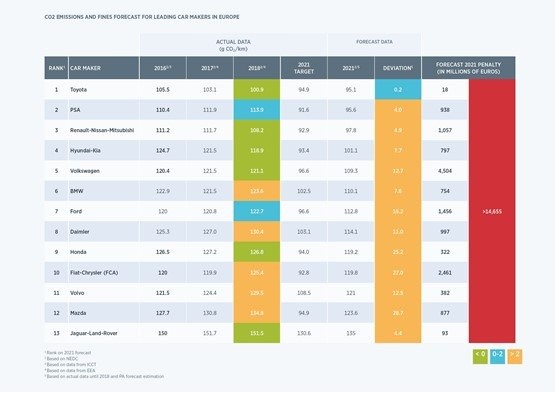
Europe’s 13 top car manufacturers are predicted to miss their 2021 CO2 emissions targets and face fines of more than €14.5bn (£12.5bn), according to analysis by PA Consulting.


The latest figures suggest a backwards step on previous predictions.


Average CO2 emissions have increased across the board, mainly due to an increase in the sale of SUVs, higher-powered and heavier cars, a lack of low-emission options in showrooms and a shifting preference for petrol cars after the diesel scandal.


Michael Schweikl, automotive expert at PA Consulting, says: “Despite this ‘four steps forward, one step back’ situation, the good news is that there are many options open to car makers to reduce emissions and minimise future fines. But the urgency of the situation means they have to act quickly.


“Car makers are running out of time to improve performance quickly enough to avoid fines. Marketing, sales and pricing strategies that increase the take-up of low-emissions vehicles will be essential in getting manufacturers closer to the targets.”


Volkswagen could be fined as much as €4.5bn (£3.86bn) due to its high sales volumes across Europe.


Renault-Nissan-Mitsubishi and Volvo also look set to fall short.


Jaguar Land Rover would face the biggest impact from fines, according to PA’s analysis, facing a bill worth 400% of its 2018 profit.


Manufacturers face a number of options, which include discounting electric and plug-in hybrid vehicles to boost their sales, taking high-polluting vehicles off the market, developing service schemes that increase low-emission vehicle use, exploring mergers with other car makers and developing open platforms to extend electric tech.


PA ranks each manufacturer by its CO2 performance forecast for 2021.


Toyota remains the best performer, PSA is now second, overtaking Renault-Nissan-Mitsubishi. Volvo, Volkswagen, Daimler and BMW are further from their target than last year. Jaguar Land Rover still has the highest CO2 emissions and is now in danger of missing its specific target.


PA’s analysis suggests that car brands would need to sell more than 2.5 million extra battery electric vehicles to stand any chance of meeting their targets, a 1,280% increase by 2021.


Production capacity constraints make this almost impossible – Volkswagen’s new production lines for the ID3, for example, have a capacity to produce 100,000 units in 2020.


From a country perspective, the report reveals all except Norway and the Netherlands saw a worsening in their overall figures.


Norway has reduced emissions from 83.7g CO2/km in 2017 to 72.4g CO2/km in 2018 and sales of electric vehicles accounted for 31.2% of new car sales.


The Netherlands was the second-best performer, but a long way behind Norway, with emissions of 106g CO2/km and sales of fully electric vehicles making up six per cent of the total.


The UK saw a decline in emissions performance from 120.8 CO2/km to 125.1 CO2/km but an increase in electric vehicles sales to 0.7% of all new registrations.


Schweikl added: “Car makers will need to adapt to an enormous change in what they do as they move from the technology of combustion engines to low-emission electric vehicles. While much exciting technological development is already underway, manufacturers cannot underestimate the complexity, cost and cultural change required.”   By Graham Hill thanks to Fleet News

Share My Blogs With Others: These icons link to social bookmarking sites where readers can share and discover new web pages.
  • MisterWong
  • Y!GG
  • Webnews
  • Digg
  • del.icio.us
  • StumbleUpon
  • Reddit
  • Alltagz
  • Ask
  • Bloglines
  • Facebook
  • YahooMyWeb
  • Google Bookmarks
  • LinkedIn
  • MySpace
  • TwitThis
  • Squidoo
  • MyShare
  • YahooBuzz
  • De.lirio.us
  • Wikio UK
  • Print
  • Socializer
  • blogmarks