Survey Reveals The Top Ten Worst Driving Habits

Friday, 17. January 2020

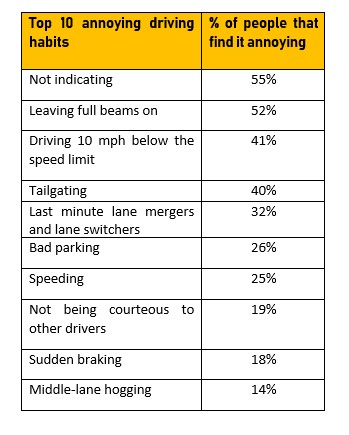
UK drivers have revealed that ‘not indicating’ is the most annoying driving habit.


In a survey compiled by Click4Reg, drivers outlined the top 10 things that regularly irritate them on the road.


Not indicating was voted as the worst driving habit by 55% of respondents.


More than half (52%) also felt that ‘leaving full beams on’ was annoying, placing it second. The study shows that women find this habit more annoying than men (55% of women stated it annoyed them, compared to only 49% of men).


Driving 10 mph below the speed limit seems to infuriate many UK drivers, with 39% finding it frustrating.


Of those that voted in the survey, 87% also admitted doing at least one of the annoying habits.


Looking at the difference between genders, 39% of females stated that their worst driving habit was bad parking while nearly half of men (43%) admitting their worst habit was speeding.


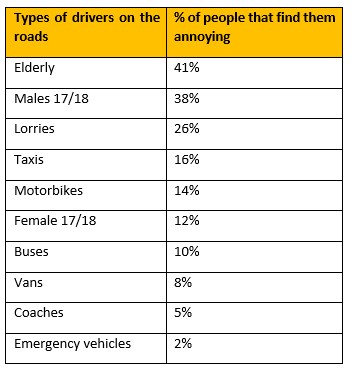
The study also asked its participants which drivers they found most annoying on the roads. Elderly drivers were picked as the most irritating, despite young drivers being much more likely to cause a crash.


Young male drivers were rated the second most annoying and lorry drivers appeared in third, with 26% finding them irritating.


By Graham Hill with thanks to Fleet News and Click4Reg.

Share My Blogs With Others: These icons link to social bookmarking sites where readers can share and discover new web pages.
  • MisterWong
  • Y!GG
  • Webnews
  • Digg
  • del.icio.us
  • StumbleUpon
  • Reddit
  • Alltagz
  • Ask
  • Bloglines
  • Facebook
  • YahooMyWeb
  • Google Bookmarks
  • LinkedIn
  • MySpace
  • TwitThis
  • Squidoo
  • MyShare
  • YahooBuzz
  • De.lirio.us
  • Wikio UK
  • Print
  • Socializer
  • blogmarks

Electric Vehicles Battery Storage To Ease Consumer Electric Peak Demand

Friday, 17. January 2020

The Electric Vehicle Energy Taskforce has made a series of recommendations to enable the efficient integration of electric vehicles (EVs).


The Electric Vehicle Energy Taskforce, which is comprised of 350 organisations, was established in September 2018, following the Zero Emission Vehicle Summit, held in Birmingham.


The Low Carbon Vehicle Partnership was asked to convene and facilitate the work of the Taskforce.


It was charged with making suggestions to Government and industry to ensure that the energy system is ready for and able to facilitate and exploit the mass take up of EVs.


Yesterday, it submitted 21 key proposals to enable the efficient integration of EVs in a new report.


The proposals include:


  • Placing consumer needs at the centre of the EV transition.


  • Providing financial incentives to EV drivers to ensure that the potential energy storage capacity of millions of electric vehicles is used to reduce peak demand.


  • Prioritising ease of access to public charge points and introducing greater standardisation across the charging network to provide easy access for all.


  • Establishing an independent body to promote the benefits of smart charging through a major publicity campaign to ensure EV drivers are confident and well informed.


  • Co-ordinating energy and transport planning to ensure we have the right infrastructure in the right place.


  • An AA Populus survey of more than 17,000 motorists found that the vast majority underestimate their potential monthly savings from running an EV.


The survey found that the average car driver thinks they can save around £30 a month; less than half the actual saving possible.


The same survey found that an overwhelming majority of car drivers believe that easy inter-operability between charge points is a key factor in deciding whether or not drivers will buy an EV.


Philip New, chief executive of the Energy Systems Catapult and the EV Energy Taskforce chair, said: “Ensuring that the mass roll-out of electric vehicles delivers benefits for both drivers and the wider energy system requires actions from industry, Government and the regulator, including creating the new markets and policies that can unlock EVs’ huge potential.”


In order to meet climate change targets, the Government has already announced that conventionally powered cars will be phased out by 2040.


The Committee on Climate Change estimates that the new net zero target could mean that this date will be brought forward. National Grid ESO’s Future Energy Scenarios show that 11.9 million vehicles could be electric by 2030.


The Taskforce expects electric vehicles to become ubiquitous on Britain’s roads, providing a significant challenge – and opportunity – for the UK’s electricity network.


Coordinating the introduction of a smart charging infrastructure will enable network operators to balance demand and supply through an electricity grid increasingly incorporating intermittent renewable energy sources, it says.


EV drivers willing to charge their vehicles during periods of low electricity demand or when surplus renewable energy is being generated will benefit from lower fuel costs in the transition ahead.


Three important recommendations also relate to the correct use of consumers’ personal data and the means to ensure people’s privacy is properly protected and smart charging of EVs is secure.


Minister for the future of transport George Freeman said: “Government commissioned the Taskforce to advise how we can best work with industry to make sure the energy system is ready for the transition to electric vehicles. This report provides important evidence to shape the next stage of our Road to Zero roadmap.”


Business Minister Nadhim Zahawi added: “This report takes us a step closer towards the mass uptake of electric vehicles on our streets – providing guidance to ensure our energy system is prepared for an electric transport revolution and helping consumers top-up their vehicle more cheaply and conveniently on the go.”


Andy Eastlake, LowCVP’s managing director, concluded: “Developing a multi-stakeholder co-ordinated view on what is needed to liberate the electric vehicle smart charging sector has been vital in providing ‘no regret’ proposals to government and industry.”   By Graham Hill thanks to Fleet News

Share My Blogs With Others: These icons link to social bookmarking sites where readers can share and discover new web pages.
  • MisterWong
  • Y!GG
  • Webnews
  • Digg
  • del.icio.us
  • StumbleUpon
  • Reddit
  • Alltagz
  • Ask
  • Bloglines
  • Facebook
  • YahooMyWeb
  • Google Bookmarks
  • LinkedIn
  • MySpace
  • TwitThis
  • Squidoo
  • MyShare
  • YahooBuzz
  • De.lirio.us
  • Wikio UK
  • Print
  • Socializer
  • blogmarks

Electric & Hybrid Car Registrations Exceed 72,000 In 2019

Friday, 17. January 2020

More than 72,000 electric and plug-in hybrid cars were registered in 2019, marking the eighth consecutive year of growth.


Pure electric models accounted for 37,850 registrations, overtaking plug-in hybrids for the first time in the annual sales figures. But still make up less than 2% of the total registrations in 2019.


Combined, alternatively fuelled vehicle (AFV) registrations achieved a record 7.4% market share. However, it was hybrid electric vehicles (HEVs) that were the most popular, with registrations of 97,850 units.


Poppy Welch, head of Go Ultra Low, said: “In the context of the wider new car market, it is encouraging to see plug-in car registrations continue to go from strength-to-strength. Looking at the year ahead, 2020 is set to be another fantastic year for electric car uptake.


“With even more new models being released, ongoing government support, as well as the continued expansion of the public charging infrastructure, we’re confident that the next 12 months will be a landmark year for the nation’s switch to electric.”


2020 has the potential to be another strong year for registrations as a host of models are set to be introduced, including the Peugeot e-208, Volkswagen ID3, Vauxhall Corsa-e, Skoda Citigo-e, and Mini Electric just some of the new cars due to hit the roads.


It is also the year that Benefit-in-kind tax is due to drop to 0% for company car drivers choosing a zero-emission vehicle, increasing demand for EVs among fleet customers substantially.


Grant Shapps, Transport Secretary, said: “I want 2020 to be the year electric cars go mainstream. That’s why we are doubling-down our efforts to make owning an electric vehicle the new normal.”


Towns and cities with the highest electric car registrations


Exeter has been revealed as the UK’s greenest motoring hotspot, with the fastest growth in ultra-low emission vehicle (ULEV) ownership since 2018, up more than 150%, according to registration data analysed by Motorway.co.uk.


According to the data, seven of the top ten local authorities for ULEV registrations since 2018 are London boroughs, with Newham and Waltham Forest seeing annual growth of 114% and 82% respectively.


At the bottom of the green motoring table are Sunderland and Wychavon, a district in Worcestershire, where ULEV numbers have grown less than 7% over the past 12 months.


“These figures show a huge disparity between areas that are embracing greener motoring and areas where take-up of ULEVs is in the slow lane. They highlight the need to focus not just at a national level, but also to confront issues at a regional level in areas where ULEV take-up is lagging behind.


“The government is now under tremendous pressure to encourage motorists to move to electric cars and other forms of ultra-low emissions vehicles in time for the 2040 switchover,” said Alex Buttle, director of Motorway.co.uk.


Top 10 local authorities that have seen the fastest growth in ULEV registrations:


Local Authority Number of ULEVs registered

(Q3-2018)

Number of ULEVs registered

(Q3-2019)

% Increase in ULEVs
Exeter 464 1,194 157.3%
Warwick 414 943 127.8%
Newham 307 657 114.0%
Waltham Forest 330 602 82.4%
Redbridge 525 948 80.6%
Islington 570 1,026 80.0%
Tower Hamlets 559 1,003 79.4%
South Northamptonshire 320 571 78.4%
Barking & Dagenham 255 449 76.1%
Enfield 549 958 74.5%


By Graham Hill with thanks to Fleet News

Share My Blogs With Others: These icons link to social bookmarking sites where readers can share and discover new web pages.
  • MisterWong
  • Y!GG
  • Webnews
  • Digg
  • del.icio.us
  • StumbleUpon
  • Reddit
  • Alltagz
  • Ask
  • Bloglines
  • Facebook
  • YahooMyWeb
  • Google Bookmarks
  • LinkedIn
  • MySpace
  • TwitThis
  • Squidoo
  • MyShare
  • YahooBuzz
  • De.lirio.us
  • Wikio UK
  • Print
  • Socializer
  • blogmarks

We Are Moving Closer To Green Number Plates

Thursday, 9. January 2020

A consultation was launched in October 2019 into the merits of issuing zero emission cars with green number plates. The idea was to be able to identify the greenest of vehicles so that local authorities could, as an incentive, offer drivers cheaper or free parking, possible use of bus lanes etc.


The plates may be all green, have a green verticle bar down one edge or have a large green dot on one side of the plate. Simple plate recognition could identify the cars. Now where did I put my pot of green reflective paint? And that could be the problem. Drivers either modifying their number plates to appear like a ‘green’ number plate or buy a set of dodgy plates made up as though the car is zero-emission.


If the Government gets it right the new plates could also capture snob appeal making drivers of cars with green number plates ‘Holier than though’ to impress the neighbours and work colleagues.


A big boost to the sale of zero-emission cars will be lower lease rates which a couple of manufacturers and leasing companies have already addressed. So far in 2020 we have seen the VW eGolf at its lowest ever rate as well as the Nissan Leaf. Contact GHA Finance for the latest deals and offers.


A personal view from Graham Hill:


As part of this study, the Government is proposing to invest £1.5 billion into the drive towards total zero-emission cars. This includes home chargers built into every new house and increasing the number of charge points.


Now I’m not being funny but I don’t have a tank and pump installed at home to top up my petrol car. Why, because I can pop into my local petrol station and top up in a matter of minutes. The average time is 8-12 minutes. The latest BP 150kW Ultra Fast Chargers take, according to BP and independent checkers around 15 – 20 minutes to provide a complete charge. 10 minutes should provide about 100 miles of charge.


So why are we hell-bent on creating a national network of  home, street and car park chargers when all we should be doing is investing in even faster chargers and batteries capable of withstanding the fast charging. Inevitably there will be many who will charge at home or in car parks as the cost of charging will be cheaper so even if cars are a little longer at charge points it won’t cause congestion as fewer cars will use them as many will be charging at home.


My idea would be a set of charge pads that drivers drive over. The number recognition system tells the charge point whether you have an account or not and a screen entry on the dashboard allows you to select the charge and cost. If you don’t have an account you enter card details into the charge pod.


You then sit in the car for say 10-15 minutes whilst the car is charged. A screen drops down in front of you with advertising on it. The charge to the advertisers could subsidise the cost of electricity. Doesn’t sound like rocket science to me! By Graham Hill

Share My Blogs With Others: These icons link to social bookmarking sites where readers can share and discover new web pages.
  • MisterWong
  • Y!GG
  • Webnews
  • Digg
  • del.icio.us
  • StumbleUpon
  • Reddit
  • Alltagz
  • Ask
  • Bloglines
  • Facebook
  • YahooMyWeb
  • Google Bookmarks
  • LinkedIn
  • MySpace
  • TwitThis
  • Squidoo
  • MyShare
  • YahooBuzz
  • De.lirio.us
  • Wikio UK
  • Print
  • Socializer
  • blogmarks

We Need Honesty & Clear Direction Over Diesel From The Government

Thursday, 2. January 2020

Only one in 10 new car sales could be diesel in as little as five years, says a leading academic.


Currently, one-in-four of new cars sold is powered by the fuel, a dramatic decline from the parity with petrol it enjoyed just a few years ago.


Its popularity is also on the wane in the company car market, where it has traditionally dominated thanks to its tax-friendly CO2 performance.


New figures show that the proportion of diesel cars on the FN50 fleet – the UK’s top 50 leasing companies by risk fleet size – fell from almost two-thirds (63.4%) to close to half (50.5%) over the past 12 months.


In terms of vehicles they had ordered in the past year, the flight from diesel was still more pronounced. Almost half of the cars ordered in 2019 were petrol (47.6%), while only two-fifths (38.8%) were diesel.


David Bailey, Professor of Business Economics at the Birmingham Business School, said: “There seems to be no end to the decline in diesels.”


Overall, diesel new car sales are down by more than a fifth in the past year. Some 515,000 units have been sold year-to-date, compared with 650,000 during the previous 12 months, data from the UK automotive trade body, the Society of Motor Manufacturers and Traders (SMMT), shows.


Forecasters say that, with the sharp falls seen in the sale of new diesel cars since 2017, it could lead to an undersupply of used vehicles in 2020 and 2021, which would help sustain residual values. However, it’s unclear whether the decline in new diesel car sales will be mirrored in the used car market. The most recent figures from the SMMT show that demand for used diesels grew by 1.4% in the third quarter, with some 858,442 changing hands.


“A big shift away from diesel is still taking place,” said Bailey. “In late 2015, diesel accounted for more than 50% of the market, by March last year it was down to 32% and it has fallen further since then.”


The UK is not alone in turning its back on the fuel; its decline is being seen across Europe. In the key market of Germany, diesel’s share has fallen below 30% from having accounted for half the market and to a similar level in France, where three-quarters of new car sales were once diesel.


Bailey said: “We are seeing this continuing decline and, while I originally thought the market share for diesel by 2025 would be down to 15%, I now think that’s quite optimistic – it may be as low as 10%.”


Despite its popularity in Europe, diesel has not enjoyed similar market penetration in other countries. “It’s negligible in North America, it’s only 4% at best in China and virtually insignificant elsewhere,” he said.


“If you go back to the turn of the century, diesel as a share of the market in Europe was only 10-15%. We then gave (the fuel) loads of tax breaks, because we thought it was good for the environment.”


Dieselgate followed however, and concerns over the fuel’s impact on air quality has put its market share on a downward trajectory.


Bailey told delegates at a recent Vehicle Remarketing Association (VRA) seminar the trouble is “people are completely freaked out over diesels”.


He said: “They are concerned about falling resale values, they are worried about tighter regulations in cities, higher taxes and its impact on the environment.”


He says Government policy has not helped either, labelling it a “complete shambles”.


“One part of Government has been saying ‘clean diesels are good’, while another part whacks a load of tax on them.”


Government has, however, introduced tax breaks for diesel company cars, which meet strict emissions limits defined by the RDE2 standard.


Company car drivers are exempt from the 4% benefit-in-kind (BIK) diesel surcharge, while fleets benefit from not having to pay the higher first-year rate of VED on new diesel cars.


The NOx limit for the RDE2 standard, which is measured on the road, is up to 1.43 times the Euro 6 lab limit of 80mg/km for diesel and 60mg/km for petrol. Cars achieving this limit are labelled Euro 6d.


Cars achieving RDE1, which allows for a margin of error two times the actual limit, are classified as Euro 6d-temp.


RDE2 will apply to all new registrations from January 1, 2021, before the margin for error – the conformity factor – is removed by 2023.


Peter Golding, managing director at FleetCheck, believes that 2020 could turn out to be a make or break year for diesel, with the success of Euro 6d cars key. However, he acknowledges the outlook is not promising when Bristol’s proposed diesel city centre car ban will not apply to older petrol vehicles, with potentially worse emissions than the latest RDE2 diesels.


“RDE2, effectively, puts diesel on a roughly equal footing with petrol from an emissions point of view,” he said. “The question is whether everyone from legislators to the general public are willing or able to make that distinction.”  By Graham Hill Thanks To Fleet News.

Share My Blogs With Others: These icons link to social bookmarking sites where readers can share and discover new web pages.
  • MisterWong
  • Y!GG
  • Webnews
  • Digg
  • del.icio.us
  • StumbleUpon
  • Reddit
  • Alltagz
  • Ask
  • Bloglines
  • Facebook
  • YahooMyWeb
  • Google Bookmarks
  • LinkedIn
  • MySpace
  • TwitThis
  • Squidoo
  • MyShare
  • YahooBuzz
  • De.lirio.us
  • Wikio UK
  • Print
  • Socializer
  • blogmarks

RAC Warns About The Busiest Breakdown Day Of The Year

Thursday, 2. January 2020

Thousands of cars left unused over the holiday period are in danger of not starting when the majority of fleet drivers return to work, says the RAC.


This year the RAC is expecting to be called out to around 12,000 breakdowns on Monday 6 January with nearly a third of those call-outs likely to be flat batteries, it said.


on Monday 7 January 2019, RAC patrols dealt with 3,600 battery-related breakdowns, which represented 31% of all its call-outs that day. Wednesday 2nd January 2019 was also busy a day for flat batteries with 2,422, or 26% of all RAC breakdowns.


New research carried out with 3,480 members of the RAC Opinion Panel shows 6% of drivers have suffered a post-Christmas flat battery. Of those, 58% say it was due to the vehicle not being used for several days and 13% claim to have fallen victim twice.


As many as 40% who have suffered this problem say the last time it happened they were on the way to work, and 17% say it “caused a big problem for them”.


The RAC has published a list of tips to minimise the chance of battery-related issues:


  • Park your vehicle in a garage whenever possible
  • Ensure everything is switched off when you finish your journey including lights, heater, fan, heated rear windscreen, and the radio. Sat-navs and other devices can also drain the battery if left connected
  • Check the battery connections, ensuring that they are tight and free from any corrosion
  • It’s worth getting your battery tested, particularly if it is over four years old
  • Take your vehicle for a decent drive to get your battery well charged, and get the engine to its proper operating temperature, before you really need it – ideally several days before. Don’t just check that it starts as this is likely to drain the battery more


By Graham Hill Thanks To Fleet News

Share My Blogs With Others: These icons link to social bookmarking sites where readers can share and discover new web pages.
  • MisterWong
  • Y!GG
  • Webnews
  • Digg
  • del.icio.us
  • StumbleUpon
  • Reddit
  • Alltagz
  • Ask
  • Bloglines
  • Facebook
  • YahooMyWeb
  • Google Bookmarks
  • LinkedIn
  • MySpace
  • TwitThis
  • Squidoo
  • MyShare
  • YahooBuzz
  • De.lirio.us
  • Wikio UK
  • Print
  • Socializer
  • blogmarks

Will 2020 Be The Last Chance For Diesel To Prove Its Environmental Friendliness?

Wednesday, 18. December 2019

Only one in 10 new car sales could be diesel in as little as five years, says a leading academic.


Currently, one-in-four of new cars sold is powered by the fuel, a dramatic decline from the parity with petrol it enjoyed just a few years ago.


Its popularity is also on the wane in the company car market, where it has traditionally dominated thanks to its tax-friendly CO2 performance.


New figures show that the proportion of diesel cars on the FN50 fleet – the UK’s top 50 leasing companies by risk fleet size – fell from almost two-thirds (63.4%) to close to half (50.5%) over the past 12 months.


In terms of vehicles they had ordered in the past year, the flight from diesel was still more pronounced. Almost half of the cars ordered in 2019 were petrol (47.6%), while only two-fifths (38.8%) were diesel.


David Bailey, Professor of Business Economics at the Birmingham Business School, said: “There seems to be no end to the decline in diesels.”


Overall, diesel new car sales are down by more than a fifth in the past year. Some 515,000 units have been sold year-to-date, compared with 650,000 during the previous 12 months, data from the UK automotive trade body, the Society of Motor Manufacturers and Traders (SMMT), shows.


Forecasters say that, with the sharp falls seen in the sale of new diesel cars since 2017, it could lead to an undersupply of used vehicles in 2020 and 2021, which would help sustain residual values. However, it’s unclear whether the decline in new diesel car sales will be mirrored in the used car market. The most recent figures from the SMMT show that demand for used diesels grew by 1.4% in the third quarter, with some 858,442 changing hands.


“A big shift away from diesel is still taking place,” said Bailey. “In late 2015, diesel accounted for more than 50% of the market, by March last year it was down to 32% and it has fallen further since then.”


The UK is not alone in turning its back on the fuel; its decline is being seen across Europe. In the key market of Germany, diesel’s share has fallen below 30% from having accounted for half the market and to a similar level in France, where three-quarters of new car sales were once diesel.


Bailey said: “We are seeing this continuing decline and, while I originally thought the market share for diesel by 2025 would be down to 15%, I now think that’s quite optimistic – it may be as low as 10%.”


Despite its popularity in Europe, diesel has not enjoyed similar market penetration in other countries. “It’s negligible in North America, it’s only 4% at best in China and virtually insignificant elsewhere,” he said.


“If you go back to the turn of the century, diesel as a share of the market in Europe was only 10-15%. We then gave (the fuel) loads of tax breaks, because we thought it was good for the environment.”


Dieselgate followed however, and concerns over the fuel’s impact on air quality has put its market share on a downward trajectory.


Bailey told delegates at a recent Vehicle Remarketing Association (VRA) seminar the trouble is “people are completely freaked out over diesels”.


He said: “They are concerned about falling resale values, they are worried about tighter regulations in cities, higher taxes and its impact on the environment.”


He says Government policy has not helped either, labelling it a “complete shambles”.


“One part of Government has been saying ‘clean diesels are good’, while another part whacks a load of tax on them.”


Government has, however, introduced tax breaks for diesel company cars, which meet strict emissions limits defined by the RDE2 standard.


Company car drivers are exempt from the 4% benefit-in-kind (BIK) diesel surcharge, while fleets benefit from not having to pay the higher first-year rate of VED on new diesel cars.


The NOx limit for the RDE2 standard, which is measured on the road, is up to 1.43 times the Euro 6 lab limit of 80mg/km for diesel and 60mg/km for petrol. Cars achieving this limit are labelled Euro 6d.


Cars achieving RDE1, which allows for a margin of error two times the actual limit, are classified as Euro 6d-temp.


RDE2 will apply to all new registrations from January 1, 2021, before the margin for error – the conformity factor – is removed by 2023.


Peter Golding, managing director at FleetCheck, believes that 2020 could turn out to be a make or break year for diesel, with the success of Euro 6d cars key. However, he acknowledges the outlook is not promising when Bristol’s proposed diesel city centre car ban will not apply to older petrol vehicles, with potentially worse emissions than the latest RDE2 diesels.


“RDE2, effectively, puts diesel on a roughly equal footing with petrol from an emissions point of view,” he said. “The question is whether everyone from legislators to the general public are willing or able to make that distinction.”  By Graham Hill Thanks To Fleet News

Share My Blogs With Others: These icons link to social bookmarking sites where readers can share and discover new web pages.
  • MisterWong
  • Y!GG
  • Webnews
  • Digg
  • del.icio.us
  • StumbleUpon
  • Reddit
  • Alltagz
  • Ask
  • Bloglines
  • Facebook
  • YahooMyWeb
  • Google Bookmarks
  • LinkedIn
  • MySpace
  • TwitThis
  • Squidoo
  • MyShare
  • YahooBuzz
  • De.lirio.us
  • Wikio UK
  • Print
  • Socializer
  • blogmarks

Long Delays Predicted On Major Motorways Over Christmas

Wednesday, 18. December 2019

Drivers are planning more than 31 million getaway trips by car before Christmas Eve bringing gridlock to UK roads, according to the RAC.


The roadside recovery company says 31.2 million separate leisure journeys will be taken between today (Tuesday, December 17) and Christmas Eve – the highest number since drivers were first asked about their festive travel plans in 2013.


As a result, the RAC is warning of pre-Christmas panic on the roads as many drivers look to complete their journeys to see family and friends well ahead of the big day.


It says that 25 million leisure trips by car are predicted to be taken between today and the end of Sunday, with Wednesday and Thursday set to be the worst for traffic delays as leisure and everyday commuter traffic combine.


Looking forward to the start of next week, an estimated 5.6 million getaway trips are planned for December 23 and Christmas Eve, and, with fewer commuters on the roads these days, motorists will be hoping for trouble-free journeys as they drive home for Christmas.


Data provided by transportation analytics specialists Inrix indicates the M1 in Bedfordshire and Northamptonshire, the northern and western sections of the clockwise M25 and M6 in the West Midlands are set to bear the brunt of the festive traffic.


Two of the longest delays are expected on Sunday, with drivers facing queues of more than an hour and a half northbound between Flitwick and Daventry, and nearly an hour on the M25 clockwise between the junctions for the M23 and M40.


RAC patrol of the year Ben Aldous said: “Our figures suggest many more drivers are planning leisure trips by car in the run-up to this Christmas this year, so bumper-to-bumper traffic on some motorways and major A-roads is going to be near-guaranteed.


“While Christmas Day is still a little way off, it looks as though millions of drivers are planning to complete their getaway trips this week.


“Unfortunately, when you add in the prospect of unsettled weather, with heavy rain and strong winds in some parts, these are likely to be pretty unpleasant drives for many of us.”


INRIX transportation analyst Trevor Reed added: “It does look as though this week is going to see a marked rise in traffic volumes on major roads in the UK, with Thursday expected to see the largest increase in vehicles compared to a normal December day.


“Drivers desperate to get away for Christmas are going to find themselves competing with commuters and shoppers for road space, so we recommend keeping tuned in to the changing traffic conditions on local radio and via in-car apps.”


Highways England says that more than 800 miles of roadworks will be completed or lifted for the festive period.


The vast majority of roadworks will be removed from the motorway and major A-road network from 6am on Friday (December 20) until 12.01am on Thursday, January 2.


Highways England’s customer service director Melanie Clarke said: “We’re doing everything we can to make journeys as smooth as possible and that’s why we’re keeping around 98% of the road network we manage, free from roadworks.”


Looking ahead to traffic between Christmas Day and New Year’s Day


A separate RAC survey of drivers’ intentions suggests as many as 33 million separate leisure journeys will be taken by car between Christmas Day and the last day of the year, as people criss-cross the country to meet up with friends and family members, wherever they happen to live.


Boxing Day and December 27 look to be the busiest, with nearly 6m trips by car expected each day, followed by Saturday with 5.6 million and Sunday with 5.3 million journeys.


Check for delays by going online or downloading the various congestion apps. By Graham Hill Thanks To Fleet News

Share My Blogs With Others: These icons link to social bookmarking sites where readers can share and discover new web pages.
  • MisterWong
  • Y!GG
  • Webnews
  • Digg
  • del.icio.us
  • StumbleUpon
  • Reddit
  • Alltagz
  • Ask
  • Bloglines
  • Facebook
  • YahooMyWeb
  • Google Bookmarks
  • LinkedIn
  • MySpace
  • TwitThis
  • Squidoo
  • MyShare
  • YahooBuzz
  • De.lirio.us
  • Wikio UK
  • Print
  • Socializer
  • blogmarks

A Staggering 25% Of Cars Have Been Damaged By Potholes Or Speedbumps

Wednesday, 18. December 2019

One in four drivers have had their car damaged by a speedhump or pothole, according to new research by Insurethegap.com.


In urban areas the damage rate was even higher, with one in three of those surveyed stating that their car had suffered damage.


Ben Wooltorton, COO at InsuretheGap.com, said, “Damage to cars caused by speedhumps and potholes, in particular, is becoming a big problem as councils struggle with the cost of repairing them. This cold snap will see more potholes and, as we can see from the research, repairs can run into hundreds of pounds. It really is worth avoiding them if possible, and going a different way if the road is particularly bad.”


More than a quarter (26%) said the average cost of repairing the damage ranged from £51 to £100. A third (35%) paid between £101 and £250 to rectify damage and 8% said it cost more than £250.


Two fifths (39%) of affected drivers complained to the council about the potholes or speedhumps and more than half of them (55%) said their compliant was ignored, but 39% said action was taken as a result. One in ten (10%) went so far as to send their bill to the council.


A fifth (21%) said they had considered complaining “but didn’t see the point as nothing would change”, and 12% complained to Highways England/Transport Scotland/Traffic Wales or the Northern Ireland Department for Infrastructure.


Instead of complaining, one in six (17%) now take a longer route to avoid potholes.


In 2017 – 2019, more than 905,000 potholes were reported on UK roads according to Confused.com.


The Transport Select Committee’s latest report, Local roads funding and maintenance: filling the gap, addresses ‘the extreme state of disrepair of the English local road network’. It identifies a drop in local government revenue funding of around 25% since 2010, resulting in funds for local roads no longer being ring-fenced. As a result ‘cash-strapped authorities have diverted their highways and transport budgets to fund core services’.


The findings state that a deteriorating local road network undermines local economic performance, results in direct costs to taxpayers, damages vehicles and causes injuries to passengers, ‘particularly those with existing medical conditions’. By Graham Hill Thanks To Fleet News

Share My Blogs With Others: These icons link to social bookmarking sites where readers can share and discover new web pages.
  • MisterWong
  • Y!GG
  • Webnews
  • Digg
  • del.icio.us
  • StumbleUpon
  • Reddit
  • Alltagz
  • Ask
  • Bloglines
  • Facebook
  • YahooMyWeb
  • Google Bookmarks
  • LinkedIn
  • MySpace
  • TwitThis
  • Squidoo
  • MyShare
  • YahooBuzz
  • De.lirio.us
  • Wikio UK
  • Print
  • Socializer
  • blogmarks

Winter Advice For Electric Vehicle Drivers

Wednesday, 18. December 2019

Venson Automotive Solutions is offering fleet managers advice on how to help their drivers maintain a healthy winter-ready electric vehicle (EV) battery.


Alison Bell, marketing director at Venson Automotive Solutions, said: “With weather forecasts predicting freezing conditions this winter, EV drivers face a different set of challenges to keep their vehicles in tip-top condition.


“For example, the batteries that power EVs are very temperature sensitive, so bad weather can reduce a car’s range and increase the length of time needed to recharge the battery. However, there are many steps that drivers can take to maximise range if a big freeze sets in.


“Whatever powertrain vehicle you are driving this winter, it is important to prepare your vehicle, so it functions efficiently in adverse driving conditions.


“Not only does it reduce wear and tear, it also helps mitigate against the chances of having an accident due to driving a poorly maintained vehicle.”


Here’s Venson’s safety and risk management EV winter-wear tips:


  1. Use the vehicle’s precondition function. This allows the driver to heat or cool the battery and cabin as needed, allowing the stored energy in the battery to be used as its main purpose, to power the vehicle.
  2. Be Battery Kind. Batteries like consistency, so when possible, avoid running your battery super low. Aim to stay between 20 and 80 percent charged whenever you can to maximise battery efficiency and longevity.
  3. Plug-in. By making sure the car is plugged in while preconditioning means you are not draining the battery. Tesla and the new Jaguar I-Pace electric for example, will let you do this remotely via an app.
  4. Regenerative Braking. When the battery is very cold using the regenerative braking system will be less effective. Therefore, friction brakes will need to be used more until the battery warms up.
  5. Use the Eco Mode. Eco Mode generally reduces the amount of power supplied to the drive motor and features, like the cabin heater. Used in the winter, it can reduce the power to the motor, so the car accelerates more slowly – not a bad thing as it reduces the possibility of wheel spin.
  6. Properly inflated tyres. As the temperature drops, tyre pressure falls and under-inflated tyres create more road friction, which impacts on the vehicle’s efficiency. Drivers need to check tyre pressure and general tyre health regularly as properly inflated and safe tyres are an easy way to help maximise winter range.


Last year, Venson urged van operators to consider adopting electric vehicles, saying that fears over a lack of charging points is misplaced. By Graham Hill Thanks To Fleet News

Share My Blogs With Others: These icons link to social bookmarking sites where readers can share and discover new web pages.
  • MisterWong
  • Y!GG
  • Webnews
  • Digg
  • del.icio.us
  • StumbleUpon
  • Reddit
  • Alltagz
  • Ask
  • Bloglines
  • Facebook
  • YahooMyWeb
  • Google Bookmarks
  • LinkedIn
  • MySpace
  • TwitThis
  • Squidoo
  • MyShare
  • YahooBuzz
  • De.lirio.us
  • Wikio UK
  • Print
  • Socializer
  • blogmarks