Drivers In The UK Spend More Time Stuck In Traffic

Wednesday, 11. March 2020

Latest Government statistics have revealed that UK drivers spent more time stuck in traffic in 2019 than the year before.

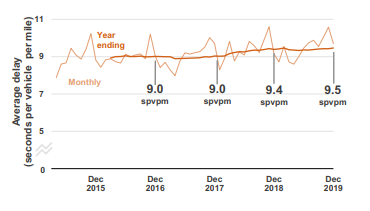
In 2019, the average delay on the Strategic Road Network increased by 0.1 seconds per vehicle per mile (up 0.9% on 2018). The average delay on local ‘A’ roads increased by 0.8 seconds per vehicle per mile (1.8% increase on 2018), according to statistics from the Government’s latest statistical release.

The findings from the Department for Transport’s Travel time measures for the Strategic Road Network and local ‘A’ roads, England: January to December 2019 show that on the Strategic Road Network (SRN) in 2019, the average delay is estimated to be 9.5 seconds per vehicle per mile compared to speed limits, a 0.9% increase on the previous year.


The statistical release also shows that the average speed of drivers was 58.8mph, down 0.5% from 2018.

The reliability of travel times is measured using the Planning Time Index which shows 67.3% of additional time is needed compared to speed limits on average, on individual roads sections to ensure on time arrival. This figure is up 1.1 percentage points in comparison to 2018.

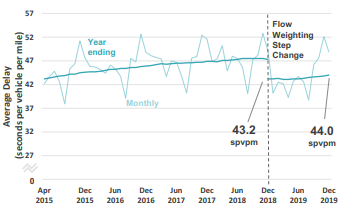
On local ‘A’ roads in 2019, the average delay is estimated to be 44.0 seconds per vehicle per mile compared to free flow, up 1.8% compared to 2018.

The average speed on local ‘A’ roads was 25.3 mph, no change compared to the previous year.

If you want to read the full document, you can find it here: https://assets.publishing.service.gov.uk/government/uploads/system/uploads/attachment_data/file/870292/travel-time-measures-srn-local-a-roads-2019.pdf   By Graham Hill thanks to Fleet News.

Share My Blogs With Others: These icons link to social bookmarking sites where readers can share and discover new web pages.
  • MisterWong
  • Y!GG
  • Webnews
  • Digg
  • del.icio.us
  • StumbleUpon
  • Reddit
  • Alltagz
  • Ask
  • Bloglines
  • Facebook
  • YahooMyWeb
  • Google Bookmarks
  • LinkedIn
  • MySpace
  • TwitThis
  • Squidoo
  • MyShare
  • YahooBuzz
  • De.lirio.us
  • Wikio UK
  • Print
  • Socializer
  • blogmarks

European New Car CO2 Emissions Reach An Unexpected High

Wednesday, 11. March 2020

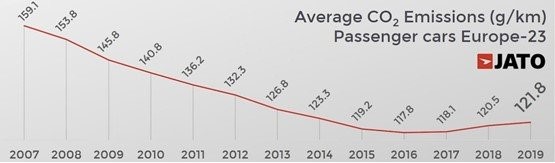
New car CO2 emissions have continued to rise and have hit the highest average since 2014. Only a rapid increase in electric vehicles will reverse this trend, says JATO Dynamics.


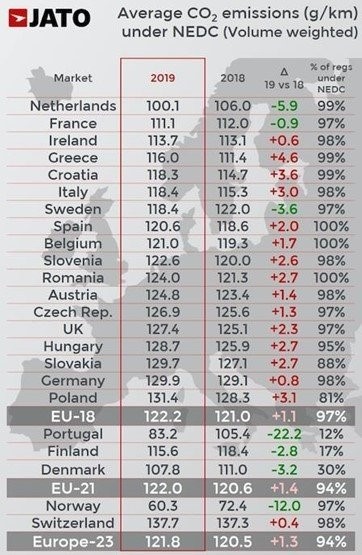
Data from the business has revealed that, last year, the volume weighted average CO2 emissions for European markets were at their highest levels since 2014. The average for the 23 European markets totalled 121.8g/km under the NEDC regime.


Felipe Munoz, JATO Dynamics’ global analyst, said: “As expected, the combination of fewer diesel registrations and more SUVs continued to have an impact on emissions. We don’t anticipate any change to this trend in the mid-term, indeed these results further highlight the industry’s need to adopt EVs at a rapid pace to reach emissions targets.”


Average CO2 emissions (NEDC) measured in 2019 increased for the third year running, despite new regulation designed to curtail this.


The data also shows that although last year’s average was 1.3g/km higher than in 2018, the increase was in fact lower than the difference between the 2017 and 2018 results – where the growth was 2.4g/km.


Despite an increase of electric vehicle (EV) models contributing positively on emission levels, the move away from diesel had a negative impact.


Munoz said: “The average emissions of electrified vehicles, was 63.2g/km, almost half that produced by diesel and petrol vehicles. The problem arose because EVs only accounted for 6% of total registrations, which is not yet a high enough figure to create a positive change.”


Four of the five major markets in Europe posted higher averages in 2019 than in 2018. Average emissions for Germany, Britain, Italy, and Spain increased, ranging from a rise of 0.8g/km for Germany to an increase of 3.0g/km for Italy.


JATO believes this was in part caused by marked changes in attitude and regulations around the use of diesel fuels, pushing people to drive higher CO2 emitting petrol vehicles.


France was the only market to see better results, as its average fell from 112.0g/km in 2018, to 111.1g/km last year. Despite this positive change, its emission levels were still higher than the averages they recorded in 2016 and 2017.


Pure electric cars have a 2% market share in France, the highest share among all five major markets.


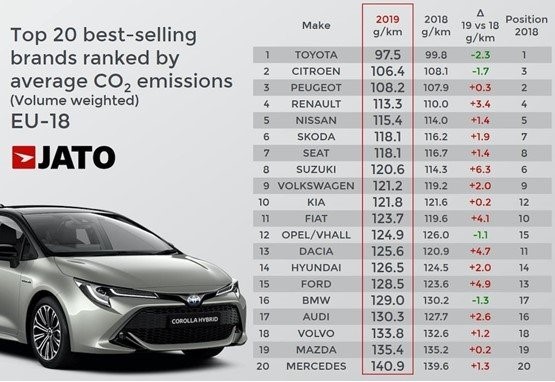
Toyota holds its position as the top 20 best-selling brand with the lowest average CO2 emissions in Europe, as well as seeing the largest decrease since 2018, with its average failing by 2.3g/km.


JATO says Toyota’s success is based on its popular hybrid range, with registrations making up 60% of the brand total volume in 2019.


In the group ranking, Toyota was behind Tesla. Along with Lexus brand, Toyota posted an average of 99.0g/km of CO2 in 2019, 14.3g/km less than the next best in the ranking, PSA. At group level, Nissan Group, Renault Group, Mitsubishi and Suzuki posted average emissions lower than the total market’s average of 121.8g/km. Volkswagen Group recorded an average of 123.6g/km.

Citroen was the brand with the second-lowest average emissions and was the second-best performer.


The average CO2 emissions for SUVs was 131.5g/km, higher than emissions posted from city-cars (107.7g/km), subcompacts (109.2g/km), compacts (115.3g/km), midsize (117.9g/km), and executive cars (131g/km).


“The SUV segment of the market urgently needs more electrified models. To date, the focus for EVs has been on traditional hatchbacks and sedans, leaving very few choices in the SUV market. If these vehicles want to keep gaining traction and avoid future sanctions, they need to be electrified” says Munoz. By Graham Hill thanks to Fleet News

Share My Blogs With Others: These icons link to social bookmarking sites where readers can share and discover new web pages.
  • MisterWong
  • Y!GG
  • Webnews
  • Digg
  • del.icio.us
  • StumbleUpon
  • Reddit
  • Alltagz
  • Ask
  • Bloglines
  • Facebook
  • YahooMyWeb
  • Google Bookmarks
  • LinkedIn
  • MySpace
  • TwitThis
  • Squidoo
  • MyShare
  • YahooBuzz
  • De.lirio.us
  • Wikio UK
  • Print
  • Socializer
  • blogmarks

Tyre Pollution 1,000 Times Worse Than Exhaust Emissions

Wednesday, 11. March 2020

Pollution from tyre wear can be 1,000 times worse than what comes out of a car’s exhaust, according to a new study by Emissions Analytics.


Harmful particle matter from tyres – and also brakes – is being exacerbated by the increasing popularity of large, heavy vehicles such as SUVs, and growing demand for electric vehicles, which are heavier than standard cars because of their batteries.


Exhaust emissions have been rapidly reduced by car makers as a result of the pressure placed on them by European emissions standards. New cars now emit very little in the way of particulate matter but there is growing concern around ‘non-exhaust emissions’.


Non-exhaust emissions (NEE) are particles released into the air from brake wear, tyre wear, road surface wear and resuspension of road dust during on-road vehicle usage. No legislation is in place to limit or reduce NEE, but they cause a great deal of concern for air quality.


Richard Lofthouse, senior researcher at Emissions Analytics, said: “It’s time to consider not just what comes out of a car’s exhaust pipe but particle pollution from tyre and brake wear. Our initial tests reveal that there can be a shocking amount of particle pollution from tyres – 1,000 times worse than emissions from a car’s exhaust.


“What is even more frightening is that while exhaust emissions have been tightly regulated for many years, tyre wear is totally unregulated – and with the increasing growth in sales of heavier SUVs and battery-powered electric cars, non-exhaust emissions are a very serious problem.”


NEEs are currently believed to constitute the majority of primary particulate matter from road transport, 60% percent of PM2.5 and 73% percent of PM10 – and in its 2019 report ‘Non-Exhaust Emissions from Road Traffic’ by the UK Government’s Air Quality Expert Group (AQEG), it recommended that NEE are immediately recognised as a source of ambient concentrations of airborne particulate matter, even for vehicles with zero exhaust emissions of particles – such as EVs.


To understand the scale of the problem, Emissions Analytics performed some initial tyre wear testing. Using a popular family hatchback running on brand new, correctly inflated tyres, it found that the car emitted 5.8g/km of particles.


Compared with regulated exhaust emission limits of 4.5mg/km, the tyre wear emission is higher by a factor of more than 1,000.


Emissions Analytics notes that this could be even higher if the vehicle had tyres which were underinflated, or the road surfaces used for the test were rougher, or the tyres used were from a budget range – all very recognisable scenarios in ‘real world’ motoring.


Nick Molden, CEO of Emissions Analytics, said: “The challenge to the industry and regulators is an almost complete black hole of consumer information, undone by frankly out of date regulations still preoccupied with exhaust emissions. In the short term, fitting higher quality tyres is one way to reduce these NEEs and to always have tyres inflated to the correct level.


“Ultimately, though, the car industry may have to find ways to reduce vehicle weight too. What is without doubt on the horizon is much-needed regulation to combat this problem. Whether that leads to specific types of low emission, harder wearing tyres is not for us to say – but change has to come.”


Mike Hawes, SMMT chief executive responded to the findings: “Making sensationalist claims based on testing of a single vehicle is not credible and, quite frankly, irresponsible. Emissions from safety-critical brakes, tyres and road surfaces are very difficult to measure, and a challenge already taken seriously by the sector, governments and a UN global group, which are working together to better understand, and agree, how to test them in a scientific way. Further, there is no evidence to suggest that electric vehicles have a propensity to emit more non-exhaust particulates than any other – in fact, their regenerative braking systems mean wear is significantly reduced.” By Graham Hill with thanks to Fleet News

Share My Blogs With Others: These icons link to social bookmarking sites where readers can share and discover new web pages.
  • MisterWong
  • Y!GG
  • Webnews
  • Digg
  • del.icio.us
  • StumbleUpon
  • Reddit
  • Alltagz
  • Ask
  • Bloglines
  • Facebook
  • YahooMyWeb
  • Google Bookmarks
  • LinkedIn
  • MySpace
  • TwitThis
  • Squidoo
  • MyShare
  • YahooBuzz
  • De.lirio.us
  • Wikio UK
  • Print
  • Socializer
  • blogmarks

New Code Of Practice For EV Home Charge Points

Thursday, 5. March 2020

The first electric vehicle (EV) code of practice has been launched to ensure that consumers receive fair treatment from domestic charge point installers.


The Electric Vehicle Consumer Code (EVCC) aims to reduce the mis-selling of home energy generating systems such as photovoltaic (PV) and battery storage and improve installation quality.


The code is a voluntary scheme which domestic charge point installation businesses can subscribe to, identifying them as reputable.


The code draws on experience from the Renewable Energy Consumer Code (RECC) for small-scale renewable technologies. Both the Electric Vehicle Consumer Code and the Renewable Energy Consumer Code are administered by Renewable Energy Assurance Limited (REAL).


Virginia Graham OBE, chief executive of Renewable Energy Assurance, said: “RECC has played a foundational role in enforcing high consumer protection standards in the small-scale renewable energy industry since 2006.


“We aim to extend the lessons learnt from that sector into the rapidly-growing world of EV home charge points.”


The launch of the code follows the Government’s announcement made in February that intends to consult on bringing forward the date banning the sale of new internal combustion engine cars and vans from 2040 to 2035.


Transport minister Rachel Maclean said: “Zero emission vehicles are cutting transport emissions and improving air quality, making our communities healthier, better places to live. Having the right rules and regulations on charge point installation standards is important and we want to see industry showing leadership in this area.


“We welcome the Electric Vehicle Consumer Code which aims to protect both people and installers of electric charge points in homes across the UK.”


There are currently around 1,000 businesses in the UK authorised to install domestic charge points through the Government’s Electric Vehicle Homecharge Scheme – one in four of these are also a RECC member.


Nina Skorupska CBE, chief executive at the Renewable Energy Association (REA), said: “The EV charging industry is committed to best practice. Decarbonisation of the UK transport sector is our aim, but to achieve this we need to bring consumers with us on the journey and ensure they are confident about the low-carbon products and services on the market.”


Installer Joju Solar supports the introduction of the Electric Vehicle Consumer Code.


Chris Jardine, technical director of Joju Solar, said: “As an experienced installer of EV home charge points, Joju is well-placed to support this important consumer protection initiative. With the EV charge point sector set to grow exponentially we need to ensure consumers have the confidence they need to play their full part.”  By Graham Hill thanks to Fleet News

Share My Blogs With Others: These icons link to social bookmarking sites where readers can share and discover new web pages.
  • MisterWong
  • Y!GG
  • Webnews
  • Digg
  • del.icio.us
  • StumbleUpon
  • Reddit
  • Alltagz
  • Ask
  • Bloglines
  • Facebook
  • YahooMyWeb
  • Google Bookmarks
  • LinkedIn
  • MySpace
  • TwitThis
  • Squidoo
  • MyShare
  • YahooBuzz
  • De.lirio.us
  • Wikio UK
  • Print
  • Socializer
  • blogmarks

Electric Vehicle Charge Points At Supermarkets Increases Substantially

Thursday, 5. March 2020

For years I’ve suggested that supermarket car parks are the best place for EV chargers to be installed. Unlike street parking and normal car parks visitors to supermarket car parks are very short term ranginf from just 15 minutes to an hour and a half.


From the supermarket’s point of view it generates extra income, keeps shoppers in the shop for longer and at times when the shops would be fairly empty, in the evenings, those wanting to charge their cars would be encouraged to shop outside of peak times, so I’m pleased to see the increase.


Here’s the report:


The number of electric vehicle (EV) charge points at supermarkets has doubled in the last two years, according to data analysed by Zap-Map and the RAC.


Research shows 542 EV charger units were installed by supermarkets from the end of October 2017 to the end of 2019, taking the total on their sites to 1,115 – a growth of 95%.


This means 6.5% of all the UK’s public charge points are located at supermarkets, with growth in-line with the overall growth of public charge points.


The number of stores offering charging facilities has also doubled with 608 supermarket sites now catering for battery electric and plug-in hybrid vehicles which equates to 5% of all supermarkets.


When looking at each supermarket’s store portfolios, Asda has the greatest proportion of locations where an EV can be charged – 122 of its 633 sites (19%).


Morrisons is in second spot with EV charging available at 89 of its 494 stores (18%), while Waitrose comes in third place with 14% – 49 of 349 stores.


Tesco currently only has 4% of stores with charging capability but it has highest total number of stores with charging facilities (142 of 3,961 stores).


An initiative by Volkswagen, Tesco and Pod Point has seen its free to use EV charging points installed in 100 stores.


Launched last year, the partnership aims to install around 2,400 complimentary charging points for electric vehicles (EVs) installed in Tesco store carparks.


Currently, 15% of supermarket charge points are capable of rapid charging. Morrisons leads the way with 84 rapid chargers, making for 59% of its total number of chargers. Lidl is second with 63% of its 76 units (48) equipped with rapid charging. Co-op is in third with 18% of 88 chargers (16) capable of delivering its EV-owning customers with a rapid charge.


Melanie Shufflebotham, co-founder of Zap-Map, said: “It is very encouraging to see supermarkets increasingly embracing electric vehicle charging at their stores with a dramatic shift in the number of chargers being installed over the course of the last two years.


“Our research shows that while the majority of charging is done at home, most EV drivers use the public network more than once a month. While a robust rapid infrastructure across the country is essential for longer journeys, having charge points in supermarkets provides EV drivers an excellent way to ‘graze‘ energy while doing an everyday task.


“With 89% of EV drivers taking the availability of charge points into account when selecting their parking, providing charging can be a real differentiator locally in the competitive supermarket sector. This seems to be recognised by some supermarkets, notably Tesco and Sainsbury’s, providing EV charging for free.”  By Graham Hill thanks to Fleet News

Share My Blogs With Others: These icons link to social bookmarking sites where readers can share and discover new web pages.
  • MisterWong
  • Y!GG
  • Webnews
  • Digg
  • del.icio.us
  • StumbleUpon
  • Reddit
  • Alltagz
  • Ask
  • Bloglines
  • Facebook
  • YahooMyWeb
  • Google Bookmarks
  • LinkedIn
  • MySpace
  • TwitThis
  • Squidoo
  • MyShare
  • YahooBuzz
  • De.lirio.us
  • Wikio UK
  • Print
  • Socializer
  • blogmarks

Government To Give Cash To Local Authorities To Fix Roads

Thursday, 5. March 2020

Just as I noticed that a lot of our local pot holes had been filled I read, not before time, that the Government has finally taken some action, albeit nothing like enough.


The Government has awarded 32 local authorities a share of £93.4 million to repair roads and bridges.


A further £900,000 will fund scientists, innovators, academics and tech-focused start-ups to research new ways to future proof the UK’s roads.


One of the projects to receive funding for tech projects will see the development of a new AI-powered app to detect potholes in real-time, using mobile phone sensors to measure when cyclists ride over or swerve to avoid them.


It is hoped the app will help local authorities to quickly identify when potholes are forming and take quicker action to fill them.


Another project known as Shape-Pot will create 3D pothole models to create a fully autonomous repair platform capable of automatic, uniform repairs – accelerating the transport network of the future.


Senior lecturer at the University of Liverpool Paolo Paoletti said: “The Shape-Pot project has the potential to change the way roads and their defects are managed, promoting a data-driven approach to management and improving efficiency – making roads safer and more accessible.


“Thanks to the T-TRIG funding, the team will create a proof-of-principle autonomous robotic platform to characterise road surface, a first step toward autonomous maintenance of roads.”


The Freight Transport Association (FTA) welcomed the investment. Christopher Snelling, head of UK policy at FTA, said: “Businesses within the logistics sector rely on efficient, effective road networks to keep goods moving across the UK, but too often, these operators are forced to travel along damaged, congested roads which increase journey times and can cause costly damage to vehicles.


“These businesses are paying the price for an ongoing lack of investment in the road network; the performance of the UK economy has also suffered as a result.”


However, he said it was “disappointing” that the funding package fell short of being able to tackle the poor state of roads across the nation.


“Taxes on UK road transport are the highest in Europe,” continued Snelling. “HGVs alone pay enough tax to fund more than 90% of the current amount spent on road maintenance in the UK.


“More investment is needed urgently and we hope that this is the first step in the creation and completion of a more comprehensive road improvement strategy.” By Graham Hill Thanks To Fleet News.

Share My Blogs With Others: These icons link to social bookmarking sites where readers can share and discover new web pages.
  • MisterWong
  • Y!GG
  • Webnews
  • Digg
  • del.icio.us
  • StumbleUpon
  • Reddit
  • Alltagz
  • Ask
  • Bloglines
  • Facebook
  • YahooMyWeb
  • Google Bookmarks
  • LinkedIn
  • MySpace
  • TwitThis
  • Squidoo
  • MyShare
  • YahooBuzz
  • De.lirio.us
  • Wikio UK
  • Print
  • Socializer
  • blogmarks

The Truth About The Cost Of Charging Electric Vehicles, – Shocking (get it?)

Thursday, 27. February 2020

The cost of using a public charge point can vary by as much as nine times depending when and where the vehicle is recharged, research from the RAC Foundation suggests.


The analysis, available here, shows overnight charging at home can typically be done for as little as 8p per kWh but can be as high as 69p per kWh at a public rapid charge point.


This means that the fuel costs for a 100-mile journey in a 2018 Nissan Leaf could be anywhere between £2.67 and £23.


By comparison – based on official fuel consumption figures – the same journey in a 1.5 litre petrol-engine Ford Focus would cost around £12 in fuel, while a similar Ford Focus with a diesel engine might do it using around £10 of fuel.


The RAC Foundation research comes as What Car? reveals its own analysis. It found that a driver would pay £45.89 to charge an Audi E-tron from 10% to 80% at an Ionity ultra-rapid charger.


However, do the same charge on a domestic charger at an average night-time energy tariff of 7p per kWh and it would cost £4.66.


Using the Ionity charging network makes the E-tron even pricier to run than an equivalent diesel Audi Q7, says What Car?


The E-tron costs 34p per mile, while a Q7 50 TDI, which averages 27.2mpg, costs 22p per mile.


Ionity is one of a small number of extremely fast 350kW charging networks, capable of replenishing an EVs batteries in 30-40 minutes.


However, some slower public charging networks are also far pricier than charging at home, says What Car?


Getting the same battery boost for an E-tron at both a 50kW Shell Recharge point and a 50kW Ecotricity socket costs £25.94, although Ecotricity rates are cheaper for its home energy customers.


What Car? found that car owners who regularly need to use public charging networks could save money by signing up for a scheme with a one-off or a monthly fee because these often have a lower energy usage rate.


Sign up for a Source London Full plan and it will cost £4 a month, but just £6.32 every time you charge your car up.


Consumers also need to watch out for the hidden costs of using public chargers. Some EV-charger equipped car parks in London charge £9 per hour for parking with no discount for those using the chargers, and What Car?’s research found overstay fees levied by charging networks to discourage that ranged from £10 to £21 per hour.


Steve Gooding, director of the RAC Foundation, said: “Consumers are so sensitive to the cost of filling-up that petrol and diesel prices are routinely displayed to the tenth of a penny.


“Even at the extremes there is unlikely to be more than a 30-40% price differential between the keenest supermarket and the most expensive motorway service area. Not so with electricity. The cost of recharging your battery-powered car can differ dramatically with prices highly dependent on where and when you plug-in, what speed you recharge at and who is operating the facility and providing the power.


“The good news is that overnight charging at domestic rates at home can cost as little as a few pence per kilowatt hour.


“However, contrast that with the dizzying news that you could pay as much as ten times that if you decide to ‘fill up’ at certain ultra-rapid chargepoints on the motorway network.


“The canny consumer is going to have a good deal more homework to make sure their electric car delivers the scale of savings they’re expecting.”


What Car? editor Steve Huntingford added: “Although there are still a lot of slow (3kW) public charging points that are free to use, you’ll have to pay if you want a quick energy fix. And this is where the costs can rack up if you don’t research the various networks in advance.”


What Car? examples of public charging costs for an Audi E-tron


Network Cost per kWh 10-80% charge
Ionity (350kW) £0.69 £45.89
Polar Contactless (150kW) £0.40 £26.60


Ecotricity (22kW, 43kW, 50kW) £0.39 £25.94
Shell Recharge (50kW, 150kW) £0.39 £25.94
Instavolt (50kW to 125kW) £0.35 £23.28
Polar Instant (150kW) £0.35 £23.28
Genie Point (43kW, 50kW) £0.30 £20.95^
Polar Contactless (43kW, 50kW) £0.30 £19.95
ESV EV Solutions (43kW, 50kW) £0.29 £19.29
ESV EV Solutions (43kW, 50kW) £0.25 £16.63<
Polar Instant (43kW, 50kW) £0.25 £16.63
Pod Point (43kW, 50kW) £0.23 £15.30
Charge Your Car*** (43kW, 50kW) 25p per min £13.85*
Ubitricity (5.5kW) £0.20 £13.45>
Polar Plus (150kW) £0.20 £13.30**
Ecotricity domestic customers £0.19 £12.64
Polar Plus (43kW, 50kW) £0.15 £9.98**
Source London Flexi (22kW) £0.12 £7.91***
Source London Full (22kW) £0.10 £6.32


^ includes £1.00 fee per charge; < £4.00 monthly fee; *kWh rates vary depending on location; > £9.99 monthly fee, plus £0.15 per charge; ** £7.85 monthly fee; ***£10.00 sign-up fee.


By Graham Hill thanks to Fleet News

Share My Blogs With Others: These icons link to social bookmarking sites where readers can share and discover new web pages.
  • MisterWong
  • Y!GG
  • Webnews
  • Digg
  • del.icio.us
  • StumbleUpon
  • Reddit
  • Alltagz
  • Ask
  • Bloglines
  • Facebook
  • YahooMyWeb
  • Google Bookmarks
  • LinkedIn
  • MySpace
  • TwitThis
  • Squidoo
  • MyShare
  • YahooBuzz
  • De.lirio.us
  • Wikio UK
  • Print
  • Socializer
  • blogmarks

Frightening Increases in CO2 Emissions Following WLTP Findings Will Cause Changes To Car Choices.

Thursday, 27. February 2020

I mentioned last week that as of the 1st April 2020 the new WLTP emissions ratings come into force. This will affect drivers’ benefit in kind tax if you drive a company car but it could also affect the 1st year road fund licence costs which could also increase the rental costs as this is part of the ‘on the road’ cost of the car. So if you’ve been quoted on a car that will be delivered after 1st April you could be paying a little more per month.


Some company cars could disappear from choice lists as new emissions test results put them beyond CO2 thresholds used by fleets.


Data published by manufacturers show some vehicles that were below 130g/km or 110g/km, using the NEDC-correlated CO2 figure, now fall outside those key benchmarks, thanks to the tougher testing regime.


The new CO2 values, derived from the Worldwide harmonised Light vehicle Test Procedure (WLTP), will be used for tax purposes for all new cars registered from April.


However, as manufacturers begin to publish the data, fleets are finding that the new test has seen CO2 values for some cars increase.


For example, the BMW 520d M Sport originally had a NEDC-correlated CO2 figure of 108g/km, but under WLTP it has risen to 131g/km.


It’s a similar story for the Volvo XC40 D3 R Design, which will increase from 127g/km to 144g/km, and the Volkswagen Tiguan 2.0 TDI SE L, which will rise from 122g/km to 156g/km.


“We’re seeing a lot of vehicles breaching the 110g/km and even the 130g/km cap,” said David Bushnell, principal consultant at Alphabet GB.


It means some familiar models on today’s choice lists will have to be replaced by more tax-efficient, hybrid or fully electric versions.


Bushnell says the impact of WLTP on fleets will be comparable to the “re-set” of company car policies in 2002, when taxation moved from mileage to CO2.


Emissions caps for vehicles used by some fleets have followed the downward trajectory of the threshold for capital allowances and lease rental restrictions.


The main threshold for capital allowances and lease rental restrictions was reduced from 130g/km to 110g/km in 2018, after originally being cut from 160g/km in 2013.


Under capital allowance rules, cars bought by companies that emit up to 50g/km are eligible for 100% write-down in the first year; for those emitting 51-110g/km, it’s 18% a year; and for more than 110g/km it is 6% a year.


Under the lease rental restriction, new cars with emissions of 110g/km or less are eligible for 100% of their lease payments to be offset against corporation tax. For those with emissions of 111g/km or more, only 85% is claimable.


The Government refused to consider the impact of WLTP on capital allowances and the lease rental restriction when last year it launched a consultation on what it should do to mitigate its effect on company car tax and vehicle excise duty (VED).


Bushnell called for their inclusion at the time but says Treasury “weren’t prepared to talk about the (110g/km) derogation and now we’re seeing a lot of vehicles impacted”.


Fleets have used the CO2 thresholds to benchmark their emissions cap to ensure they are as tax efficient as possible.


Nick Hardy, sales and marketing director at Ogilvie Fleet, says 130g/km became the norm for many companies, with an increasing number choosing the lower 110g/km cap.


Faced with some cars potentially falling outside company car policies, because of an increase in CO2, he urged fleets not to be tempted to increase their cap to simply maintain vehicle choice.


He explained: “It’s not the right thing to do; it completely defeats what we’re all trying to achieve.”


However, in the short term, while WLTP CO2 data is still missing on many models (see page 4), Bushnell thinks fleets could consider a temporary removal of CO2 caps.


He said: “It’s not exactly palatable, but the issue is we could be delivering a car that we perceive is below the cap, but then by the time it’s configured and registered, it’s actually over the cap.”


Not only are large swathes of CO2 data missing for base models, but the impact of vehicle options on the final figure is also an issue for fleets.


Bushnell urged fleet operators to allow wholelife costs to guide vehicle choice.


Wholelife costs take account of several factors, including fuel, employer Class 1A National Insurance Contributions, service, maintenance and repair, and insurance, as well as any cash allowances paid to employees.


Bushnell said: “You’ve got to be looking at your choice list on a wholelife cost basis, but there are still a lot of businesses that don’t.”


PricewaterhouseCoopers (PwC) has previously reported that just 32% of employers offering company cars use wholelife costs to determine the vehicles available.

Share My Blogs With Others: These icons link to social bookmarking sites where readers can share and discover new web pages.
  • MisterWong
  • Y!GG
  • Webnews
  • Digg
  • del.icio.us
  • StumbleUpon
  • Reddit
  • Alltagz
  • Ask
  • Bloglines
  • Facebook
  • YahooMyWeb
  • Google Bookmarks
  • LinkedIn
  • MySpace
  • TwitThis
  • Squidoo
  • MyShare
  • YahooBuzz
  • De.lirio.us
  • Wikio UK
  • Print
  • Socializer
  • blogmarks

Massive Drop In Emission Peaks In London Shows The Controls Are Working.

Thursday, 27. February 2020

Efforts to clean up the air in London appear to be paying off according to the latest figures revealed by the Mayor of London.


Data from air quality monitoring sensors around the Capital show a 97% reduction in the number of hours that air quality exceeded legal limits.


In 2019, London’s air quality exceeded the hourly legal limit for around 100 hours. This compares favourably to the 4000 hours recorded in 2016.


However, there are still many locations where pollution levels remain high – including for particulate matter – for example at the monitoring site in Vauxhall, which preliminary research indicates may be being impacted by a nearby ventilation shaft from the Tube.


The Mayor of London Sadiq Khan said: “Toxic air is a national health crisis contributing to thousands of premature deaths ever year. I have taken bold action in London with measures such as the world’s first Ultra Low Emission Zone and Low Emission Bus Zones, and it’s undeniable that these are making a difference to the air we breathe.


“We’re doing all we can in the capital, with proven results, so there are no excuses left for the Government’s failure to match our levels of ambition.”


Between 2004 to 2017, London breached the permitted number of exceedances for NO2 within the first week of the year. In 2019, only one site breached and it did not occur until July.


There have also been significant reductions in Londoner’s long-term exposure to air pollution, with every monitoring site in the capital recording a reduction in annual average NO2 levels. Londonwide, there has been an average reduction of 21% between 2016 and 2019.


Significant NO2 reductions have occurred where the Mayor has introduced Low Emission Bus Zones – areas where only buses that meet the cleanest emission standards can operate.


At Putney High Street in Wandsworth, NO2 levels have stayed within legal limits so far this year, compared to 1,279 hours of illegal levels in 2016.


At Brixton Road in Lambeth NO2 levels remained within legal limits for the entirety of 2019 and so far this year, compared to 530 hours above the legal limit in 2016. In 2017, this site saw London’s first breach of annual pollution limits just five days into the new year, and in 2018 it occurred within a month.


On Oxford Street in Westminster, NO2 exceeded legal limits for 168 hours in 2016. In 2019 monitors did not record a single hour above legal limits. However, there is also an annual average legal limit which Oxford Street did not meet, which is why further action is needed. By Graham Hill thanks to Fleet News.

Share My Blogs With Others: These icons link to social bookmarking sites where readers can share and discover new web pages.
  • MisterWong
  • Y!GG
  • Webnews
  • Digg
  • del.icio.us
  • StumbleUpon
  • Reddit
  • Alltagz
  • Ask
  • Bloglines
  • Facebook
  • YahooMyWeb
  • Google Bookmarks
  • LinkedIn
  • MySpace
  • TwitThis
  • Squidoo
  • MyShare
  • YahooBuzz
  • De.lirio.us
  • Wikio UK
  • Print
  • Socializer
  • blogmarks

New European Project To Design Next Generation Lithium-Ion Batteries

Thursday, 27. February 2020

I’ve said it many times that it is my belief that the panic over electric vehicle charging infrastructure is unfounded. We can already super fast charge an electric car up to 80% capacity in about the same time that it takes to fill up a petrol or diesel car and pay for it.


At the same time the new purpose built electric cars are increasing their ranges dramatically so within a short period of time we will no longer need charging ponts attached to lamp posts and trees.


On to the report.


A European battery research project aims to develop the next generation of batteries for electric vehicles (EVs).


The Coventry University’s Centre for Advanced Low Carbon Propulsion Systems (C-ALPS) is involved in the Sense project, which includes five research institutes and six industrial companies from seven European countries working together over the next four years.


Swedish company Northvolt, which intends to set up two large-scale production facilities (gigafactories) for vehicle batteries in Europe in the next few years, is also a partner on the project.


The research project is coordinated by Empa researcher Corsin Battaglia and his team. Coventry University’s work on the project is led by Tazdin Amietszajew, assistant professor in battery diagnostics at C-ALPS. The EU is funding Sense with 10 million euros (£8.3m).


The demand for batteries for electric cars will increase dramatically in the next few years. At present, more than 90% of these batteries come from Asia.


In response, the EU Commission set up the European Battery Alliance in 2017 to build up competences and production capacities for this key technology in Europe.


Experts estimate that the European demand for lithium-ion batteries alone will require 10 to 20 so-called ‘gigafactories’ – large-scale production facilities for batteries.


The research in the Sense project is part of this European Battery Alliance initiative and is supported by the EU research funding programme Horizon 2020.


The 11 research partners of Sense – five research institutes and six industrial companies – are conducting research on next-generation lithium-ion batteries – the so-called ‘Generation 3b’.


In contrast to current traction batteries, this next generation will have higher energy density and improved cell chemistry and battery management system: instead of pure graphite anodes, the aim is to use silicon-graphite composites.


The content of critical cobalt in the cathode will be further reduced. New additives in the electrolyte and interphase design approaches will slow down battery aging and extend cycle life.


New sensors will also contribute to a longer service life and improve fast charging capability by supplying data from inside the battery cells to the battery management system. This data should allow a much more refined temperature management compared to today’s lithium-ion cells.


The sustainability of Generation 3b cells is also expected to exceed that of the current generation.


The cathode will be manufactured without the use of flammable and toxic solvents, which will greatly simplify the series production of the cells and reduce their cost, it says.


All aspects of Sense re-search are geared towards producing the next generation of cells in European gigafactories.


To be competitive in the future, cost-effective and raw material-saving production methods are therefore crucial.


The Sense project also considers the second life use of decommissioned vehicle batteries as stationary storage units and, finally, the recycling of the batteries.


The research partners of Empa, which is leading the project, are the Westfälische Wilhelms-Universität Münster, the Forschungszentrum Jülich, Coventry University, the Austrian Institute of Technology, and the companies Solvionic, FPT Motorenforschung, Lithops, Northvolt, Enwires and Huntsman Advanced Materials.


The Swedish company Northvolt plays a decisive role in the research project. The company was co-founded in 2016 by two former Tesla employees, who were involved in the construction of the Tesla gigafactory in Nevada (USA).


Northvolt is currently planning the first European gigafactory with a production capacity of 32 GWh per year to be built in Sweden.


A further gigafactory with an annual production of 16 GWh is to be built as a joint venture with Volkswagen in Salzgitter (Germany). For comparison, the Tesla Gigafactory in Nevada currently produces around 30 GWh of batteries per year, according to management.


Experts from Northvolt will advise the Sense researchers through regular briefings.


By the end of the project, a series of battery cell prototypes will have been developed.


A demonstrator with 1 kWh storage capacity will demonstrate the capabilities of the battery cell Generation 3b.


At the end of the project, the production technology developed will find its way into industry in the form of patents.


The four-year Sense research project ends in spring 2024.


Corsin Battaglia’s team at Empa is involved in another European research project called Solidify. It looks even further into the future and is developing future-generation batteries – so-called solid-state lithium-metal batteries.


In contrast to today’s lithium-ion batteries and those of Generation 3b, these solid-state batteries will no longer contain any liquid, flammable components.


They are therefore safer and more tolerant to elevated temperatures, can deliver higher power, and can be charged and discharged faster, it says.


According to experts, these batteries – called Generation 4b – could be ready for the market in about 10 years.


At half the weight and half the size, they should deliver the same storage capacity as today’s lithium-ion batteries. Production costs are also expected to be cut in half.


New electrode architectures are necessary, as are cost-effective innovative production methods for the cathode of these batteries, it says. The anode will consist of metallic lithium.


The Solidify research project started on January 1 and will also run for four years. By Graham Hill thanks to Fleet News

Share My Blogs With Others: These icons link to social bookmarking sites where readers can share and discover new web pages.
  • MisterWong
  • Y!GG
  • Webnews
  • Digg
  • del.icio.us
  • StumbleUpon
  • Reddit
  • Alltagz
  • Ask
  • Bloglines
  • Facebook
  • YahooMyWeb
  • Google Bookmarks
  • LinkedIn
  • MySpace
  • TwitThis
  • Squidoo
  • MyShare
  • YahooBuzz
  • De.lirio.us
  • Wikio UK
  • Print
  • Socializer
  • blogmarks