Traffic Jams Return As Rush Hours Return

Tuesday, 6. October 2020

The school-run appears to be behind a peak in morning traffic, according to black box data from the RAC.

New Government statistics, published last week, suggested that the traditional morning and evening rush hours had disappeared.

The latest figures for June from the Department for Transport (DfT) showed that in the morning peak there was a 21.4 second delay per vehicle mile travelled on local A roads, compared to 56.7 seconds in February.

It was the same for the evening peak, which reported a 25.8 second delay per vehicle mile travelled, less than half of the 63.6 seconds reported before the pandemic in February.   

However, analysis of hundreds of thousands of trips taken by RAC Insurance customers has revealed that the beginning of the school year in England has led to a marked rise in cars on the road, particularly at what appears to be the peak drop-off time of between 8am and 9am.

Looking at average weekday traffic between Monday, September 7, and Wednesday, September 16, between these hours there were the same number of cars being driven as on a weekday in January.

Car volumes during these times were also up 55% compared to the period before most schools had returned (week beginning August 24).

The figures appear to show that the UK’s morning rush hour is caused more by people dropping children off at schools and nurseries than it is by commuters heading to places of work, given that many people are still working from home.

The fact that many schools are operating staggered drop-off times in light of the coronavirus may also be having the effect of extending the rush hour as well as changing the morning routine for some families.

At the other end of the day, car volumes are now at around the same level between the end of school ‘rush’ of 3pm and 4pm and evening ‘rush’ of between and 5pm and 6pm as was the case before the first coronavirus lockdown in March, suggests the RAC data.

RAC Insurance spokesperson Rod Dennis said: “What’s abundantly apparent is how dependent parents are on the car for getting children to their places of study or play during the week – and with fewer people prepared to take public transport at the moment, the reliance on the car as the transport mode of choice has increased.

“Workers that used to drop children off and then carry on to offices or other workplaces are clearly still using their cars for these trips, but just returning home again instead.

“It may also be the case that many are opting for the car so they can be back at their desks to start work as promptly as possible.

“The staggered ‘drop-off windows’ introduced by many schools as a result of the pandemic to cope with large movements of children may be another reason for the rise.”

Daily RAC breakdown figures also show a ‘return to normal’, with mid-week call-outs in particular only a little below those seen during the first few winter months of the year.

But interestingly, since the schools returned patrols have on average been called out to more rush-hour breakdowns than expected with this being balanced out by fewer later in the day.

Dennis continued: “The million-dollar question, of course, is what happens next and whether morning road traffic continues to rise in the autumn, or whether it stays at the sort of level we’re seeing now.

“The rising number of coronavirus cases, together with the introduction of local lockdowns and the threat of new nationwide restrictions, may also have an impact on people’s willingness to return to public transport.

“But while there is a huge number of possible scenarios that have the potential to change our travel habits, what does appear clear is that millions of us will continue to rely on the car for completing the journeys we have to make.”  By Graham Hill thanks to Fleet News

Share My Blogs With Others: These icons link to social bookmarking sites where readers can share and discover new web pages.
  • MisterWong
  • Y!GG
  • Webnews
  • Digg
  • del.icio.us
  • StumbleUpon
  • Reddit
  • Alltagz
  • Ask
  • Bloglines
  • Facebook
  • YahooMyWeb
  • Google Bookmarks
  • LinkedIn
  • MySpace
  • TwitThis
  • Squidoo
  • MyShare
  • YahooBuzz
  • De.lirio.us
  • Wikio UK
  • Print
  • Socializer
  • blogmarks

Business Travel Peaked In August Post-Lockdown.

Tuesday, 6. October 2020

Business travel hit a post-lockdown peak in August with every sector of the UK economy enjoying its highest weekly increase at some point, according to new data from Allstar Business Solutions.

The analysis of its customer data found average fuel consumption peaked in the week beginning August 17 at 125% above the lockdown baseline.

However, fuel consumption for August overall dropped 4.4% compared to July, which Allstar attributes to the August bank holiday, although last year the fall was more significant at 9% for the same month.

Allstar’s latest Business Barometer Monthly Snapshot, which is tracking business mileage and credit card data as an economic indicator of recovery by sector, found the long-term trajectory also remains upwards, with businesses travelling 1.06 billion more miles in August than June.

Paul Holland, managing director of UK Fuel at Fleetcor, Allstar’s parent company, said: “Although at first glance seeing a drop in business fuel consumption in August may suggest a slowdown, this followed a sharp rise in June and July.

“The decrease in business travel can also be attributed to August traditionally being a quiet month thanks to the bank holiday weekend, as well as increased domestic and foreign holidays as some coronavirus regulations were eased.

“Early indicators seem to suggest a stronger start to September as children return to school.

“It’s encouraging to see all sectors witnessing their highest weekly growth spikes during the last month; highlighting a continued hunger for businesses to get back on the road as the recovery continues.

“While the number of people on holiday clearly had a downward impact towards the end of the month, it doesn’t appear this will have a long-lasting effect.”

The week commencing August 17 was, on average, the most active for businesses on the road since the start of lockdown.

Arts, entertainment and recreation witnessed a 407% increase in mileage – just days after government lockdown restrictions were eased for some leisure businesses.

Manufacturing (161%), construction (141%) and financial services (106%) also saw their most significant post-lockdown growth during that week.

In comparison, hospitality and catering saw its largest weekly growth (211%) during the week commencing August 24, potentially due to people becoming increasingly comfortable with returning to restaurants towards the end of the ‘Eat Out to Help Out’ scheme.

The same is true of wholesale and retail businesses (161%), while education saw its largest spike in business travel (258%) during the week commencing August 31, likely due to preparations for students returning to the classroom. By Graham Hill thanks to Fleet News

Share My Blogs With Others: These icons link to social bookmarking sites where readers can share and discover new web pages.
  • MisterWong
  • Y!GG
  • Webnews
  • Digg
  • del.icio.us
  • StumbleUpon
  • Reddit
  • Alltagz
  • Ask
  • Bloglines
  • Facebook
  • YahooMyWeb
  • Google Bookmarks
  • LinkedIn
  • MySpace
  • TwitThis
  • Squidoo
  • MyShare
  • YahooBuzz
  • De.lirio.us
  • Wikio UK
  • Print
  • Socializer
  • blogmarks

Renault To Campaign For Clean Air Around Schools

Tuesday, 6. October 2020

Renault has launched ‘Be Mindful, Don’t Idle’ education campaign to improve air quality around schools after new research showed the scale of the problem.

More than 8,500 schools, nurseries and colleges in England, Scotland and Wales are located in areas with dangerously high levels of pollution, but the return to school could see the problem intensify with 62% of parents saying they are more likely to drive their children to and from school as a result of the recent pandemic.

The increased dependency on the car comes as more than a quarter (27.2%) admit to leaving their engines running – known as idling – during the school run, according to a detailed new study by Renault. Men are 50% more likely to do it than female drivers, representing 32.7% and 22% respectively.

Renault studied the habits and attitudes of more than 4,000 ‘school run’ parents and motorists. Of the reasons given for leaving their engines running nearly a third cited doing so because they are only stationary for ‘a short while’ and 26% wanted to keep the heater or air-con on.

Almost two-thirds (60%) of all drivers said they were unaware that it is illegal under Rule 123 of the Highways Code. Authorities can now issue £80 fixed penalties under Road Traffic Regulations 2002 and Section 42 of the Road Traffic Act 1988 in Scotland.

A lack of parking near schools is the biggest infrastructural challenge to idling.

Overall 23% said they needed to be ready to move their car into a suitable parking space. Naturally, this issue is worse in urban areas – 60.9% – compared to rural locations with just 11.5%.

The report underlined the reasons for the ‘school run’, with 30% dropping their children off by car because it’s on their way to work, 18% because of safety concerns and 12% have no other means of getting them to school.

The issue of idling is greatest within built-up urban and suburban areas according to Renault. Half of those live in cities, yet 12% of those in rural areas admit to doing it regularly. Idling for just 10 seconds wastes more fuel than restarting the engine.

A 2019 study by Kings College London revealed that children in London travelling to schools across the capital are exposed to air pollution five times higher than at any other time of the day.

Renault found that London accounted for the highest number of idling offenders – 22.5%.

“The fact that the majority of people don’t realise that idling is illegal just highlights the scale of the problem,” explained Matt Shirley, senior manager, electrification and new mobility.

“Every minute a car is idling it produces enough emissions to fill 150 balloons. It goes without saying, if the 27% of school run journeys stop idling, there would be a significant improvement in the air quality for their children.

“This is not about demonising the school run, our study underlines the importance, even more so since lockdown, of the car. We just want parents and guardians to be mindful of the detrimental impact of idling, and to alter their behaviours for their own children and those around them.”

New analysis by Queen Mary University of London (QMUL), on behalf of Global Action Plan (GAP) and the Philips Foundation, shows that if outdoor air pollution is halved, there could be up to a 20-50% reduction in the number of children with poor lung function across the UK and Republic of Ireland. 

The analysis also finds the reduction in air pollution seen during the country-wide lockdown lead to asthma attacks in children all but disappearing. 

Given the most positive improvements to children’s lung resilience is likely to be realised if changes are enacted around the 2,000 schools in the most polluted hotspots across the country, a coalition has formed comprised of Global Action Plan, the Philips Foundation, Living Streets, Modeshift Stars and Mums for Lungs, with the support of Philips, the National Education Union, and NAHT.

The group is calling for nationwide action by the Government and local authorities to improve air quality at schools, driven by a legally binding target to meet World Health Organization limits. 

To support the movement, Global Action Plan and the Philips Foundation, with the endorsement of Philips, have launched “The Clean Air Schools Framework”. The framework is a free online tool that gives teachers, headteachers, parents and local authorities a bespoke blueprint of actions for tackling air pollution in and around the school from its database of 50 actions. 

The coalition is especially urging all local authorities to use the framework, highlighting actions taken in the London Borough of Hackney, which is one of the leading community grassroots initiative proactively tackling air pollution and pioneer of School Streets (one of the framework’s key actions).

The first four School Streets launched in the borough showed that traffic reduced by an average of 68%, the number of children cycling to school increased by 51% and vehicle emissions outside schools (NOx, PM10 and PM2.5) are down by 74% as a result of the schemes.  By Graham Hill thanks to Fleet News

Share My Blogs With Others: These icons link to social bookmarking sites where readers can share and discover new web pages.
  • MisterWong
  • Y!GG
  • Webnews
  • Digg
  • del.icio.us
  • StumbleUpon
  • Reddit
  • Alltagz
  • Ask
  • Bloglines
  • Facebook
  • YahooMyWeb
  • Google Bookmarks
  • LinkedIn
  • MySpace
  • TwitThis
  • Squidoo
  • MyShare
  • YahooBuzz
  • De.lirio.us
  • Wikio UK
  • Print
  • Socializer
  • blogmarks

No Deal Brexit – The Effect On The Motor Industry

Monday, 28. September 2020

Automotive companies from across the UK and EU are calling for an ambitious free trade deal, warning that ‘no deal’ will have a catastrophic impact on the industry.

If no deal is reached and ratified before December 31, World Trade Organisation (WTO) non-preferential rules, including a 10% tariff on cars and up to 22% on vans and trucks would apply.

Such tariffs – far higher than the small margins of most manufacturers – would almost certainly need to be passed on to consumers, making vehicles more expensive, reducing choice, and impacting demand. Furthermore, automotive suppliers and their products will be hit by tariffs, they say.

New calculations, published on Monday, September 14 by the Society of Motor Manufacturers and Traders (SMMT), suggest that a reduction in demand resulting from a 10% WTO tariff for cars and vans could reduce EU and UK factory output over the next five years by three million units.

That would equate to losses worth €52.8 billion (£48.7bn) to UK plants and €57.7bn (£53.2bn) to those based across the EU. Suppliers would also suffer from these changes, it says.

The lead organisations representing vehicle and parts makers across the EU, the European Automobile Manufacturers Association (ACEA) and the European Association of Automotive Suppliers (CLEPA), along with 21 national associations, including the SMMT, have joined forces to warn that this combined loss in trade value would seriously harm one of Europe’s most valuable assets.

Collectively, the EU27 and UK automotive sector is responsible for 20% of global motor vehicle production and spends some €60.8bn (£56bn) on innovation each year, making it Europe’s largest R&D investor.

The SMMT’s chief executive, Mike Hawes, said:  ”These figures paint a bleak picture of the devastation that would follow a ‘no deal’ Brexit.

“The shock of tariffs and other trade barriers would compound the damage already dealt by a global pandemic and recession, putting businesses and livelihoods at risk.

“Our industries are deeply integrated so we urge all parties to recognise the needs of this vital provider of jobs and economic prosperity, and pull out every single stop to secure an ambitious free trade deal now, before it is too late.”

The industry says that any deal should include zero tariffs and quotas, appropriate rules of origin for both internal combustion engine and alternatively fuelled vehicles, plus components and powertrains, and a framework to avoid regulatory divergence.  

Crucially, it says that businesses need detailed information about the agreed trading conditions they will face from January 1, 2021, to make preparations. This, combined with targeted support and an appropriate a phase-in period that allows for greater use of foreign materials for a limited period of time, will ensure businesses are able to cope with the end of the transition period.

Eric-Mark Huitema, ACEA director general, said: “The stakes are high for the EU auto industry – we absolutely must have an ambitious EU-UK trade agreement in place by January. Otherwise our sector – already reeling from the COVID crisis – will be hit hard by a double whammy.”  By Graham Hill thanks to Fleet News

Share My Blogs With Others: These icons link to social bookmarking sites where readers can share and discover new web pages.
  • MisterWong
  • Y!GG
  • Webnews
  • Digg
  • del.icio.us
  • StumbleUpon
  • Reddit
  • Alltagz
  • Ask
  • Bloglines
  • Facebook
  • YahooMyWeb
  • Google Bookmarks
  • LinkedIn
  • MySpace
  • TwitThis
  • Squidoo
  • MyShare
  • YahooBuzz
  • De.lirio.us
  • Wikio UK
  • Print
  • Socializer
  • blogmarks

Motorways To Have Speed Limits Dropped To 60mph To Cut Polution

Monday, 28. September 2020

Speed limits on parts of four motorways are to be cut before October in a trial to reduce pollution.

Highways England said the limit will be reduced from 70mph to 60mph in areas that have seen higher than recommended levels of nitrogen dioxide.

The reduced speed limit will be introduced on M6 junctions 6 to 7 by Witton, M1 junctions 33 to 34 by Rotherham, M602 junctions 1 to 3 by Eccles and M5 1 to 2 by Oldbury.

Each locations is up to 4.5 miles long and the new speed limits will be operational 24 hours a day.

The reduced speed limits will be assessed after 12 months to see if they are having an impact, or if the air quality level is compliant.

Ivan Le Fevre, head of environment at Highways England told the BBC: “Ultimately the air quality challenge will be solved ‘at the tailpipe’ by vehicle manufacturers and changes in vehicle use.

“Until this happens we will continue our extensive programme of pioneering research and solutions.”

Recent Department for Transport figures show the proportion of cars sticking to the speed limit is at its highest on 60mph roads.

The data measures speed and compliance at sites where the road conditions are free-flowing, for example roads with no junctions, sharp bends, speed enforcement cameras or other traffic calming measures.

In 2019, 50% of cars were found to exceed the speed limit on motorways, 54% on 30mph roads and just 9% where limits were 60mph.

The DfT says the statistics provide insights into speeds at which drivers choose to travel when free to do so, but are not estimates of average speeds across the whole network.

It notes that the average car speeds under free flow conditions were close to the speed limit on motorways (69mph) and 30mph roads (31mph) – and under the speed limit on 60mph roads (50mph).  By Graham Hill thanks to Fleet News

Share My Blogs With Others: These icons link to social bookmarking sites where readers can share and discover new web pages.
  • MisterWong
  • Y!GG
  • Webnews
  • Digg
  • del.icio.us
  • StumbleUpon
  • Reddit
  • Alltagz
  • Ask
  • Bloglines
  • Facebook
  • YahooMyWeb
  • Google Bookmarks
  • LinkedIn
  • MySpace
  • TwitThis
  • Squidoo
  • MyShare
  • YahooBuzz
  • De.lirio.us
  • Wikio UK
  • Print
  • Socializer
  • blogmarks

New Report Shows That EV Chargers Not Needed On Every Street

Monday, 28. September 2020

A new study by Field Dynamics has found that fewer on-street electric vehicle (EV) chargepoints may be required than previously expected, to support a mass uptake of EVs.

Working in partnership with Zap-Map, the Net Zero data consultancy has found that better residential charging services can be achieved by siting chargers in more focused locations.

Field Dynamics’ managing director Ben Allan said: “Placing public chargers is a difficult process as it requires the balancing of many conflicting priorities.  But now there is a bedrock of robust data that planners can use to select their sites, placing fewer chargers at lower cost while providing a much more inclusive service”

The research found that there are around eight million households, outside of London, that do not have off-street parking and 90% of those are more than a five-minute walk from the nearest public EV chargepoint.

Field Dynamics said such proximity from a chargepoint could reduce the appeal of switching to e-mobility for those households, due to inconvenience or impracticality.

Brighton and Hove Council have achieved 67% coverage of households that require on-street charging provision by placing just 139 chargers, however.

This suggests that most councils will require a few hundred charger sites to ensure there is access to a charger within a five-minute walk for those residents who will need to access this critical service, rather than placing them on every street.

Zap Map COO and joint MD of Zap Map Melanie Shufflebotham said: “Providing convenient public charging for households with no off-street parking is a key element in the mass uptake of electric vehicles (EVs).

“This unique analysis combining the Zap-Map and Field Dynamics data sets provides both a high-level comparison between towns and also identifies down to a street level where there is a real gap in charging provision. We believe this data will be a great tool for organisations when making decisions on where to install additional charge points.” By Graham Hill thanks to Fleet News

Share My Blogs With Others: These icons link to social bookmarking sites where readers can share and discover new web pages.
  • MisterWong
  • Y!GG
  • Webnews
  • Digg
  • del.icio.us
  • StumbleUpon
  • Reddit
  • Alltagz
  • Ask
  • Bloglines
  • Facebook
  • YahooMyWeb
  • Google Bookmarks
  • LinkedIn
  • MySpace
  • TwitThis
  • Squidoo
  • MyShare
  • YahooBuzz
  • De.lirio.us
  • Wikio UK
  • Print
  • Socializer
  • blogmarks

UK To Lead The World In Development Of Hydrogen Power.

Monday, 28. September 2020

The UK government is working on a new hydrogen strategy that will “deliver a world-leading hydrogen market”, according to a top civil servant.

During an Environmental Audit Committee session yesterday (September 10), business secretary Alok Sharma confirmed that the forthcoming energy white paper will include plans for hydrogen and that will be followed by a detailed strategy early next year – ahead of the UK hosting the 26th UN Climate Change Conference (COP 26) in Glasgow in November.

Julian Critchlow, director general for Energy Transformation and Clean Growth at the Department for Business Energy and Industrial Strategy (BEIS), said that the strategy will bring together the supply and demand side, and answered criticism that the UK is lagging behind other countries, such as Germany, Japan and Australia, in hydrogen development.

He said: “Far from being behind we believe that we’re actually putting the detailed and specific policy levers in place to be able to deliver a world-leading hydrogen market.”

However, for the UK to achieve its goal of net zero greenhouse gas emissions by 2050 it will need to achieve hydrogen capacity of about 270 terawatt-hours, up from 27-terawatt-hours today.

Critchlow said that from a transport point of view, the Government sees hydrogen “having a big role”, especially for heavier vehicles.

He highlighted the £23 million programme with OLEV, which is looking at funding vehicles and refuelling stations, and the ultra-low emission bus scheme for hydrogen buses, along with the Prime Minister’s commitment for 4,000 new zero emission buses.

Business leaders have been campaigning for the Government to clarify its future hydrogen strategy and believe more needs to be done.

Jonny Goldstone, MD of Green Tomato Cars, one of the businesses backing the Hydrogen Strategy Now campaign, said that businesses need confidence in the development of the infrastructure.

Currently, there are six hydrogen refuelling stations across the South East, with only one of those located in East London.

Goldstone, who has hydrogen, electric and hybrid vehicle in his 250-strong company-owned fleet, said: “We want London to lose its reputation as the ‘Big Smoke’.

“Our hydrogen vehicles emit zero CO2 emissions, whereas other vehicles are pumping out high volumes of carbon emissions every day. A widespread take-up of zero-emission hydrogen and battery electric vehicles is essential to improving air quality across the capital.

“We have 50 hydrogen cars and we’re looking to expand that number. But we want to have the confidence that the infrastructure will be there to allow us to operate consistently and efficiently for our drivers and customers.

“The refuelling network needs to expand to enable demand for hydrogen vehicles to increase, which in turn will lead to manufacturers producing more and greater customer uptake.”  By Graham Hill thanks to Fleet News

Share My Blogs With Others: These icons link to social bookmarking sites where readers can share and discover new web pages.
  • MisterWong
  • Y!GG
  • Webnews
  • Digg
  • del.icio.us
  • StumbleUpon
  • Reddit
  • Alltagz
  • Ask
  • Bloglines
  • Facebook
  • YahooMyWeb
  • Google Bookmarks
  • LinkedIn
  • MySpace
  • TwitThis
  • Squidoo
  • MyShare
  • YahooBuzz
  • De.lirio.us
  • Wikio UK
  • Print
  • Socializer
  • blogmarks

Railway Station Car Parks Being Targetted By EV Charging Companies.

Monday, 28. September 2020

Two major electric vehicle charging hubs have opened at railway stations in Hatfield and Norton.

Transport secretary Grant Shapps opened a Pod Point-installed hub with 27 charge points at Hatfield Station, while RAW Charging has completed installation of 26 smart charging points at the new Worcestershire Parkway Railway Station in Norton.

The installation at Hatfield station marks a milestone in a wide-ranging station improvements programme being undertaken by Govia Thameslink Railway, which encompasses more than 230 stations and over 1,000 individual projects.

In partnership with Pod Point, Hatfield’s new hub has been opened to meet the increasing consumer demand for electric vehicles, while also demonstrating the company’s commitment to sustainability.

The EV installation at Hatfield – which sees a 150% in public EV charging devices in the Welwyn Hatfield district – will provide additional accessibility and convenience for customers using the Great Northern and Thameslink station.

As part of the project, 12 charging points have also been installed at Haywards Heath station.

Shapps said: “We’re taking great strides towards our goal of having one of the best electric vehicle infrastructure networks in the world.

“This means a network for current and future electric vehicle drivers that is affordable, reliable, accessible and secure.

“Today’s landmark announcement ticks all those boxes and will make journeys on road and rail much greener for local residents, commuters and businesses.”

The Worcestershire Parkway station was opened to increase connectivity to London, the Midlands and South Wales and is the county’s first new railway station for more than 100 years.

Neil Broadbank, key account manager at RAW, said: “We approached the project two-fold: initially by installing a larger number of charging points to meet future demand, rather than installing on a reactive basis; and secondly, configuring and trialling the combination of several different pricing and access structures on the ChargePoint platform.

“For example, we have looked at standard per kWh fees, combined with parking fees, flat rates or connection fees for extended periods of time; and different rates for customers, different groups of chargers on site, and lots of other options, all of which can be run simultaneously and changed or scheduled remotely.

Using the same EV charging platform that is tried and tested by some of the world’s largest organisations provided GWR with the comfort that this new ‘critical infrastructure’ operated without a hitch from the start.”

In another project, Swarco eVolt has installed six charging stations at a new charging hub at Strathclyde Country Park, just outside Glasgow, for Project PACE.

Project PACE represents an EV Strategic Partnership and a new collaboration approach between the Scottish Government and SP Energy Network to test a new, more efficient approach to planning and delivering EV charging infrastructure.

It is being facilitated by North and South Lanarkshire Councils which will benefit from Transport Scotland’s £5.3m funding and receive 40 new charging hubs by April 2021, starting with Strathclyde Country Park.

Project PACE is expected to deliver almost 180 new public EV charge points which will join the ChargePlace Scotland network.

The charge points will be supplied, installed and maintained by Swarco eVolt under a framework agreement that was awarded in July.

Justin Meyer, general manager of Swarco eVolt, said: “From a driver’s perspective, the network of charging hubs will provide multiple charge points at each well-chosen location, including our rapid chargers.

“This will provide better access to charging with less waiting time, which in turn radically improves the customer experience and enjoyment of driving an EV.”  By Graham Hill thanks to Fleet News

Share My Blogs With Others: These icons link to social bookmarking sites where readers can share and discover new web pages.
  • MisterWong
  • Y!GG
  • Webnews
  • Digg
  • del.icio.us
  • StumbleUpon
  • Reddit
  • Alltagz
  • Ask
  • Bloglines
  • Facebook
  • YahooMyWeb
  • Google Bookmarks
  • LinkedIn
  • MySpace
  • TwitThis
  • Squidoo
  • MyShare
  • YahooBuzz
  • De.lirio.us
  • Wikio UK
  • Print
  • Socializer
  • blogmarks

CBI Makes Huge Health Related Claims If We Improve Air Quality In The UK

Saturday, 26. September 2020

The UK economy could be boosted by £1.6 billion a year if it met World Health Organisation guidelines for air pollution, a report by CBI Economics has found.

Meeting these guidelines, which are stricter than current UK legal limits, could also prevent 17,000 premature deaths per year, and prevent the loss of three million working days which can be attributed to air pollution.

As a result, Clean Air Fund, which commissioned the ‘Breathing Life into the UK economy’ report, is urging the Government to include a legally-binding commitment to meet WHO air pollution standards by 2030 in the Environment Bill, which is due to be debated in Parliament in the autumn.

Jane Burston executive director of the Clean Air Fund, said: “We know clean air makes us healthier, but our research shows it can make us all wealthier too. If businesses and government work together to ensure clean air for all, we can protect our health and re-energise the economy at this critical time. Ministers must commit to binding targets to cut air pollution in line with WHO guidelines by 2030.”

The Clean Air Fund is echoing calls by 16 other campaigning groups, part of the Healthy Air Campaign.

Currently, the Environmental Bill mentions ‘a target’ for particulate matter (PM2.5), but does not specify what that target will be, or when it will be met.

Other pollutants, such as nitrogen dioxide (NO2) are not mentioned in the Environment Bill and the target for PM2.5 will only be presented to parliament in October 2022.

Studies have found road transport is responsible for 27% of the UK’s CO2 emissions, with cars and taxis accounting for 55% of that.

The Government is banning the sale of any new petrol, diesel or hybrid car or van by 2040 in its Road to Zero strategy, and recently held a consultation about bringing that date forward to 2035.

Some local authorities have announced the introduction of Clean Air Zones with the aim of improving air quality locally.

Clean Air Zones were due to be launched in Bath, Bristol, Birmingham, and Leeds in 2020 but have since been postponed until at least 2021, possibly indefinitely, while Greater Manchester’s plans have been delayed until 2022.

Sadiq Khan, the Mayor of London, said: “I am doing everything in my power to stop Londoners breathing air so filthy that it damages children’s lungs and causes thousands of premature deaths.

“The Ultra Low Emission Zone has already cut toxic air by a third. We want to go further and will be expanding the ULEZ up to the North and South circular roads in 2021.

“We know there is still more to do. Pollution isn’t just a central London problem, which is why I have consistently demanded that the government match my ambition and improve the Environment Bill to include legally binding World Health Organization recommended limits, to be achieved by 2030, and to give cities the powers they need to eradicate air pollution.

“The CBI’s new report shows that cleaner air could boost the economy by £1.6 billion – we have a once-in-a-generation opportunity to rebuild our cities and economies to be greener, fairer, and more sustainable.”  By Graham Hill thanks to Fleet News

Share My Blogs With Others: These icons link to social bookmarking sites where readers can share and discover new web pages.
  • MisterWong
  • Y!GG
  • Webnews
  • Digg
  • del.icio.us
  • StumbleUpon
  • Reddit
  • Alltagz
  • Ask
  • Bloglines
  • Facebook
  • YahooMyWeb
  • Google Bookmarks
  • LinkedIn
  • MySpace
  • TwitThis
  • Squidoo
  • MyShare
  • YahooBuzz
  • De.lirio.us
  • Wikio UK
  • Print
  • Socializer
  • blogmarks

All You Need To Know About Charging Your Electric Car

Thursday, 17. September 2020

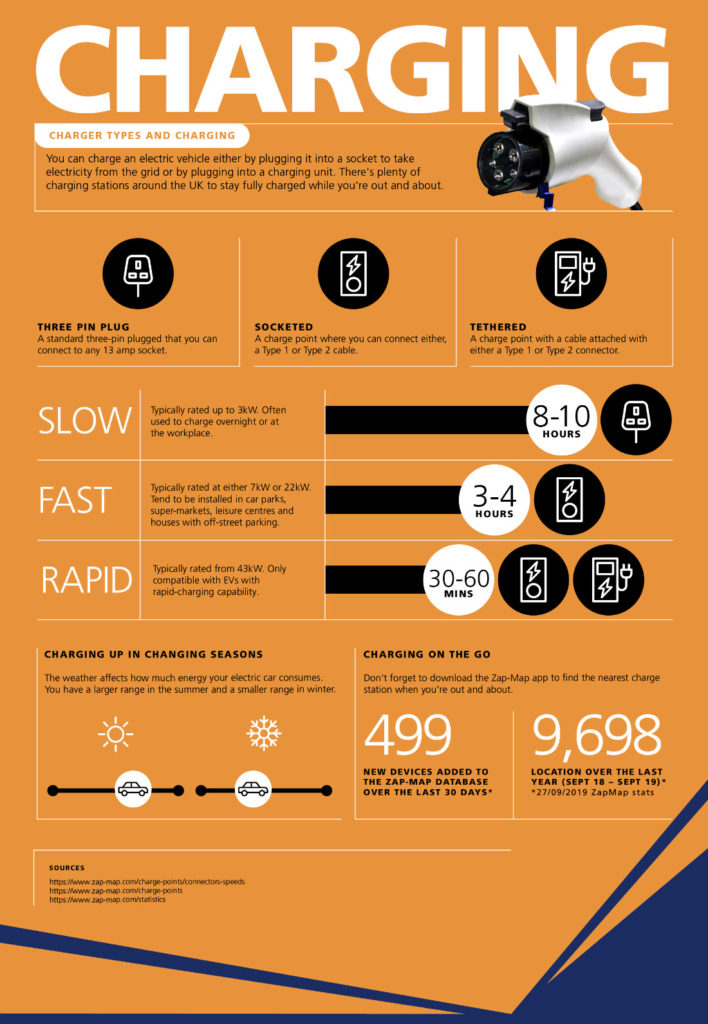
There are now more than 30,000 charge points across the UK in over 11,000 locations – that’s more public places to charge than petrol stations, with around 10,000 charge points added in 2019 alone.

There are thousands of free electric car charge points in the UK, often located in supermarkets, shopping centres, public car parks, hotels and sometimes service stations.

Be aware there could be restrictions such as a set period of time or a requiring a purchase in-store, so it’s best to check.

There is an app called zap-map.com that shows all of the charge-points in the UK and also allows you to plan journeys if you are concerned about the range of your car and your ability to reach your destination without charging your car en-route.

How long does it take to charge an electric car?

How long it takes to charge an electric car is one of the most frequently asked questions. Whilst filling up with gasoline takes a few minutes, the time it takes to charge an EV from low to full is much longer.

However, it can be more convenient. Typically electric cars are charged when the car’s not in use, like overnight at home, in the same way you would a mobile phone, or during the day whilst you’re working.

How much you charge, or need to charge, will also change – with gasoline, the majority of people drive their cars until the fuel gauge shows low on fuel and we fill the tank up to full again.

This behaviour stems from the inconvenience of having to go to a petrol station. With electric cars and the convenience of charging at home, you may find you ‘top up’ the battery each day as it’s used rather than waiting for it to get low – again similar to a mobile phone.

Another factor that may impact the number of times you need to charge your electric car or van is temperature.

Lithium-ion batteries perform better in warm weather, so you might notice a slight drop in the range your EV can travel in the colder winter months.

In summary, how long it takes to charge an electric car depends on:

  • Your car’s battery size
  • How many miles you do between charges
  • Your charging behaviour, i.e. topping up often vs charging from low to full less often
  • The power rating of the charger you’re using – you can read more below on different types of chargers and their kWh ratings

To give you an idea of how long it takes to charge a specific car’s battery from zero to full, try this handy charging calculator:

Did you know?

Electric vehicles often come with battery warranties based on the number of charging cycles (1 cycle is equal to 1 full charge and 1 full discharge), with many manufacturers offering anything from 60,000 to 100,000 miles on their battery warranties as standard.

Half price evenings and weekends

Exclusive to electric car drivers, the 100% renewable(1) GoElectric tariff offers half price electricity evenings and weekends for both your household and your electric car.

This is a scheme offered by EDF Energy, there will be others available if you shop around.

Charging Point Socket Type And Speeds

Slow chargers

Slow chargers have a maximum of 3.6 kW available, and typically take between 6-12 hours to recharge a pure electric car. These chargers are ideal for overnight charging.

Fast chargers

Fast chargers are rated at 7-22 kW and usually take between 3-7 hours to recharge an EV depending on the battery size of the car.

7 kW chargers are a popular choice for the workplace and at home and there are several models available to buy and lots of different installers who can fit them for you.

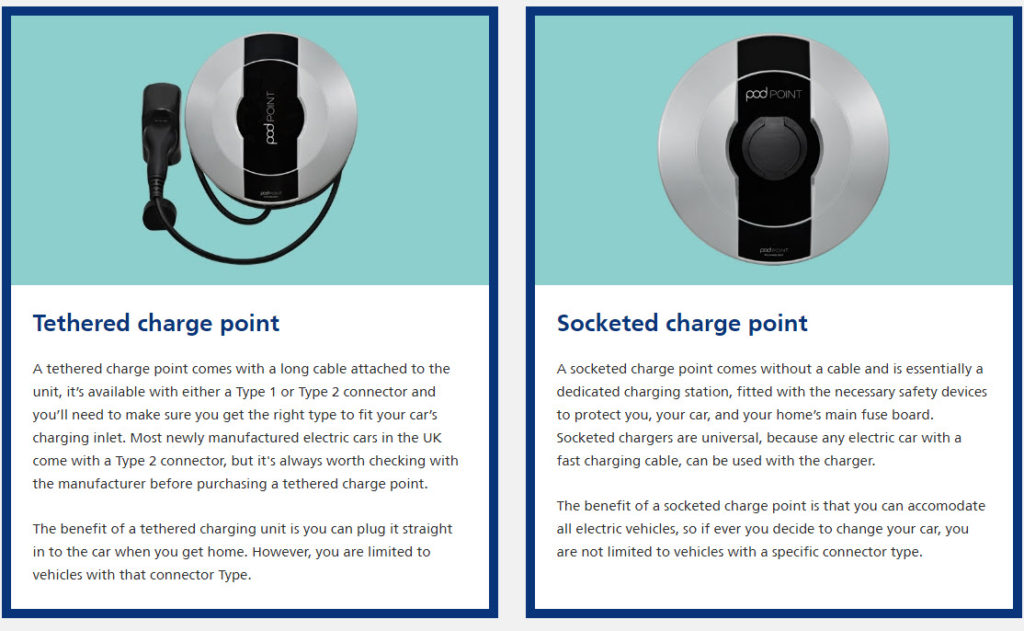
It can be confusing, but all you need to do is decide what power rating you want and choose either a tethered or socketed charge point.

Rapid chargers

Rapid are the quickest (43 kW+), generally capable of charging cars to 80% in 20-40 minutes, depending on how big the battery is and how much charge it’s holding to start with, so they’re a great way to top up during long journeys.

You can often find them in motorway service car parks, petrol stations, larger shopping centres and supermarkets.

Wireless chargers

Wireless charging is super convenient and allows for the transfer energy between a pad on the ground and a compatible EV – no need for cables at all.

While it’s not in the UK yet, Norway will install the world’s first wireless electric car charging stations for Oslo taxis and BMW is due to release their new wireless charging solution with their new plug-in hybrid 530e iPerformance very soon.

What power rating should I use for my home socket?

When it comes to home charging, 3-7 kW chargers are the most popular and are widely recommended for the UK market.

Many UK households have a single-phase (AC) electricity supply and can support the additional 7 kW load. Some households, with three-phase (AC) supply can support a more powerful fast charger up to 22 kW.

However, this is far more common in countries like Germany with a more robust electricity network.

Always check with the installer that your fuse board has enough spare capacity to support the additional load of a home charging station.

If there is not enough spare capacity, then you may have to pay to upgrade your distribution board.

Rapid chargers offer you a much quicker charge, perfect for longer journeys, when a quicker charge is needed, but it’s not advisable to only use rapid charging because this can increase the degradation of your battery over time.

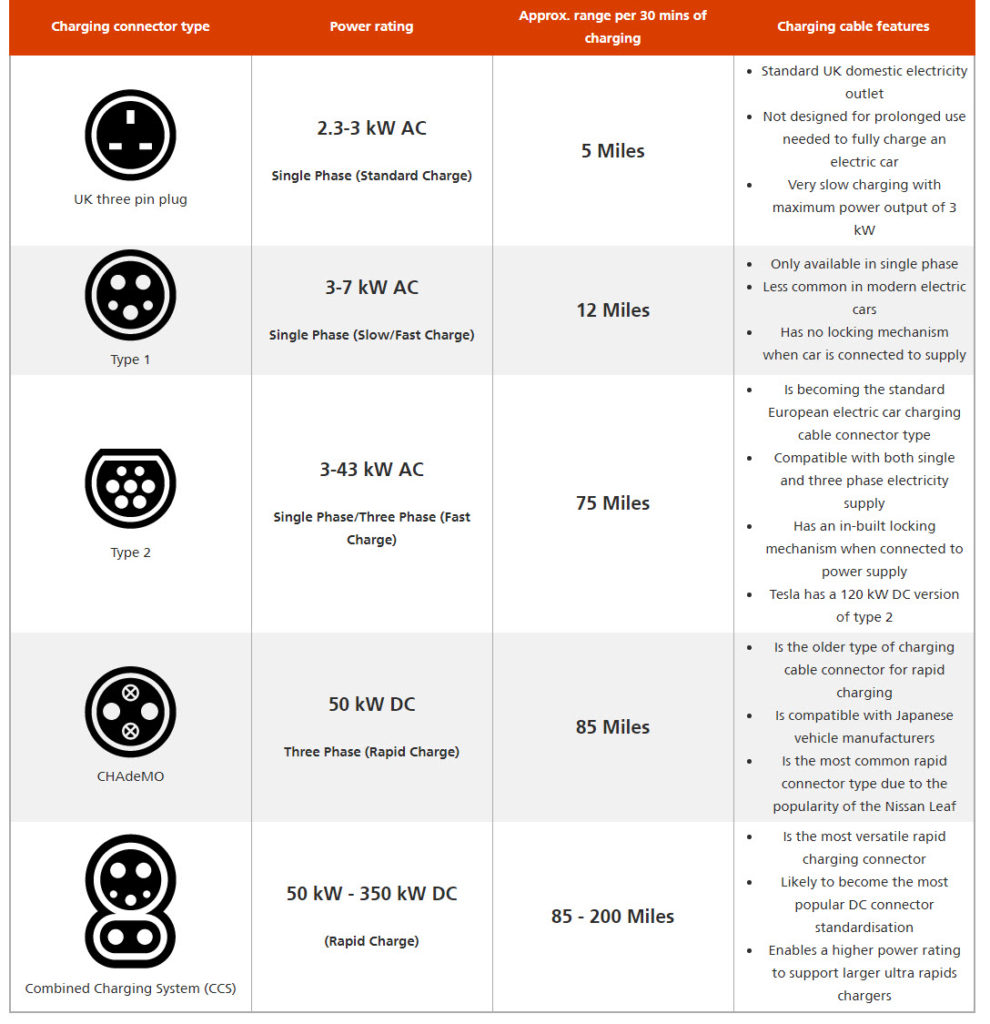
Electric car charging cables

Charging cables have connectors you plug into the vehicle and/or the charge point. The type of charging connector depends on the vehicle and the power rating of the charge point.

Electric car charging points grant

The Electric Vehicle Homecharge Scheme (EVHS), contributes up to 75 per cent towards the cost of buying and installing an electric charger, up to a maximum of £500, if you have a home with off-street parking suitable for an electric car charger and an eligible electric vehicle.

Similarly the Workplace Charging Scheme (WCS), contributes up to 75 per cent to a maximum of £500 for each socket, for up to 20 charge points across all of the sites they operate.

By Graham Hill with huge thanks to EDF Energy

Share My Blogs With Others: These icons link to social bookmarking sites where readers can share and discover new web pages.
  • MisterWong
  • Y!GG
  • Webnews
  • Digg
  • del.icio.us
  • StumbleUpon
  • Reddit
  • Alltagz
  • Ask
  • Bloglines
  • Facebook
  • YahooMyWeb
  • Google Bookmarks
  • LinkedIn
  • MySpace
  • TwitThis
  • Squidoo
  • MyShare
  • YahooBuzz
  • De.lirio.us
  • Wikio UK
  • Print
  • Socializer
  • blogmarks