Birmingham Follows Bath By Announcing A Start Date For Their Clean Air Zone

Thursday, 22. October 2020

Birmingham has joined Bath in announcing a start date for its charging clean air zone (CAZ) after the schemes were approved by Government.

Birmingham’s CAZ will start from June 1, 2021, while Bath will start charging non-compliant vehicles from March 15, 2021.

Birmingham’s zone will cover an area of the city inside the inner ring road (A4540 Middleway) and once live will mean that the owners of non-compliant vehicles, which account for around 25% of the vehicles on Birmingham’s roads, will need to pay a daily charge to drive into or through the CAZ.

Birmingham was meant to introduce a CAZ last year, along with Leeds, but both were postponed until 2021 due to the coronavirus pandemic.

Cars, taxis and vans will pay £8 per day to drive into the CAZ in Birmingham, while HGVs, coaches and buses will be charged £50 per day.

Birmingham Council says it is providing a range of exemptions and financial incentives worth some £35 million to help residents, city centre workers and businesses prepare for the introduction of the CAZ.

Applications and expressions of interest for all of these schemes are now open with more information available at the website: BrumBreathes.co.uk.

Councillor Waseem Zaffar, cabinet member for transport and environment at Birmingham City Council, said: “The majority of drivers on Birmingham’s roads will not need to pay the daily charge but if you do then you may be eligible for an exemption or one of the financial incentives.  So, I would encourage everyone to check the Brum Breathes website today.”

Bath’s CAZ had been due to be switched on in November but was delayed due to the coronavirus pandemic.

Bath & North East Somerset Council says it considered air quality, traffic levels and the impacts of Covid-19 on local businesses and the economy, before agreeing the new start date of March 15, with the Government.

However, it said that the date will be monitored to account for any significant developments during the ongoing coronavirus pandemic.

The council is currently contacting more than 9,000 local businesses to help them establish whether charges will apply to their vehicles, and how to access the support on offer.

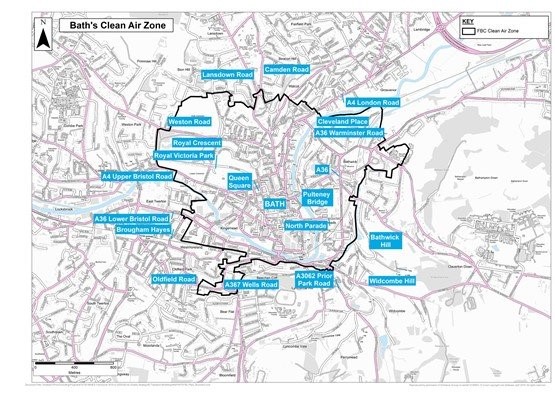
The CAZ will operate in the city centre 24 hours a day, seven days a week, 365 days a year.

Charges will apply to pre-euro 6/VI diesel and pre-euro 4 petrol vehicles, except cars and motorbikes.

Non-compliant vans, taxis and minibuses will be charged £9, while non-compliant trucks and lorries, and coaches and buses face a daily charge of £100.

The council has also announced financial support to help fleets upgrade to compliant vehicles. Local businesses including those in neighbouring authorities that have premises and/or regularly drive in the zone, can apply.

For example, it says that eligible van drivers could receive up to £4,500 in grants, plus interest-free finance, to help them upgrade to a similar, compliant vehicle.

Larger grants are available of up to £20,000 for HGVs and £35,000 for buses and coaches.

In light of Covid-19, the council has also amended the scheme so that if eligible businesses fail their initial credit check, they can re-apply once their finances have improved.

In addition, these drivers would be able to apply for exemptions on their non-compliant vehicles for up to two years.

There are also a wide range of exemptions available for hard-to-replace or special vehicles, and to support disadvantaged groups and vital services in the city, it said.

Furthermore, discounts will be available for drivers of larger, higher emission motorhomes and horse-transporters (private heavy goods vehicles) who can pay £9 instead of £100 provided they register with the council. Applications for all local exemptions and discounted vehicles will open in November. 

Leader of the council, councillor Dine Romero, said: “In 2017, the government directed us to reduce levels of nitrogen dioxide in the city in the shortest possible time. Technical work showed that a charging zone was the only measure that could achieve compliance in the time frame we were given.

“The council consulted widely on this and agreed to introduce a class C charging CAZ with traffic management at Queen Square, charging all higher emission vehicles, except private cars and motorcycles, to drive in Bath’s city centre.

“However, there is no getting away from the fact that Covid-19 has had a significant impact on many businesses and this will be an additional cost that they have to consider.

“We have worked hard to secure a considerable package of financial and other support to help business owners and I would urge them to get in touch, talk to us and find out how we can help.

“We all want clean air and the zone is a step towards our wider ambitions for Bath and North East Somerset to address air quality and tackle the climate emergency.”

Chris Yarsley, policy manager at Logistics UK, welcomed the clarity which today’s announcement provides on the date for the introduction of the CAZs in Bath and Birmingham, which the business group has been working on with the local authority for some time. This will allow logistics operators time to plan new business practices and speed vehicle replacement timelines where necessary, he said.

“News that support packages will be available for operators to assist with the acquisition of Euro VI standard vehicles is also positive encouragement for a sector which has been impacted by the downturn of the economy caused by the Covid-19 pandemic, and is only now starting to return to pre-pandemic levels of trading.

“Logistics operators remain committed to cleaning up urban air but it is important that other contributory factors to air quality are also considered in the longer term, including improvements to traffic flow patterns, retiming of deliveries and the introduction of alternatively fuelled vehicles, as well as other sources of air pollution, to the benefit of all.”  By Graham Hill thanks to Fleet News

Share My Blogs With Others: These icons link to social bookmarking sites where readers can share and discover new web pages.
  • MisterWong
  • Y!GG
  • Webnews
  • Digg
  • del.icio.us
  • StumbleUpon
  • Reddit
  • Alltagz
  • Ask
  • Bloglines
  • Facebook
  • YahooMyWeb
  • Google Bookmarks
  • LinkedIn
  • MySpace
  • TwitThis
  • Squidoo
  • MyShare
  • YahooBuzz
  • De.lirio.us
  • Wikio UK
  • Print
  • Socializer
  • blogmarks

Renault Increases Air Quality Awareness Resulting From Idling Cars At School Crossings

Thursday, 22. October 2020

Renault has demonstrated the dangers of unnecessary idling outside schools with a new school crossing lollipop that measures air quality.

The custom lollipop is part of the brand’s “be mindful, don’t idle” campaign that launched in September.

One side of the Renault lollipop displays the exact concentration of fine particulates – known as PM2.5 – in the atmosphere thanks to in-built air sensor technology.

The reverse features simple iconography that shows whether it is ‘Good’, ‘Okay’ or ‘Poor’ allowing both parents and children to see the quality of the air they are breathing in real time as they enter the school gates.

“The lollipop has been the symbol of road safety for decades. Today, safety is not just about how to cross a road, it is also about how safe the air is that our children breathe going in and out of schools on a daily basis,” explains Matt Shirley, senior manager – Electrification & New Mobility at Renault UK. “The adoption of electric vehicles is a journey, but in the meantime, it’s important that we all do our bit and don’t leave our engines running unnecessarily.”

Renault demonstrated the new device outside Castle Newnham school in Bedford, recording air pollution figures in excess of 25.7μg/m3 at peak times.

The World Health Organisation recommends that the air we breathe should not exceed 10μg/m3 of fine particulate matter, but the legal limit in the UK is double that figure.

An idling engine contributes the equivalent of 150 party balloons-worth of emissions unnecessarily into the atmosphere every minute. Renault found idling is more common in urban areas – with 50.1% admitting to doing it – compared to 12% in rural locations. More than 28% of people said they leave their engines running for 6-10 minutes.

According to research by the British Lung Foundation and Asthma UK, in excess of 8,500 schools, nurseries and colleges in England, Scotland and Wales are located in areas with dangerously high levels of pollution.

More than 8,500 schools, nurseries and colleges in England, Scotland and Wales are located in areas with dangerously high levels of pollution.

Renault studied the habits and attitudes of more than 4,000 ‘school run’ parents and motorists. Of the reasons given for leaving their engines running nearly a third cited doing so because they are only stationary for ‘a short while’ and 26% wanted to keep the heater or air-con on.

Almost two-thirds (60%) of all drivers said they were unaware that it is illegal under Rule 123 of the Highways Code. Authorities can now issue £80 fixed penalties under Road Traffic Regulations 2002 and Section 42 of the Road Traffic Act 1988 in Scotland.  By Graham Hill thanks to Fleet News

Share My Blogs With Others: These icons link to social bookmarking sites where readers can share and discover new web pages.
  • MisterWong
  • Y!GG
  • Webnews
  • Digg
  • del.icio.us
  • StumbleUpon
  • Reddit
  • Alltagz
  • Ask
  • Bloglines
  • Facebook
  • YahooMyWeb
  • Google Bookmarks
  • LinkedIn
  • MySpace
  • TwitThis
  • Squidoo
  • MyShare
  • YahooBuzz
  • De.lirio.us
  • Wikio UK
  • Print
  • Socializer
  • blogmarks

Bath To Become First City To Introduce Clean Air Zone Outside Of London

Thursday, 22. October 2020

Bath will launch the first charging clean air zone (CAZ) outside London in March, next year.

The announcement comes as new data, released by the UK Government and analysed by environmental law charity ClientEarth, reveal that three quarters of air quality reporting zones still chart illegal levels of air pollution.

Bath’s CAZ had been due to be switched on in November but was delayed due to the coronavirus pandemic.

Bath & North East Somerset Council says it considered air quality, traffic levels and the impacts of Covid-19 on local businesses and the economy, before agreeing the new start date of March 15, with the Government.

However, it said that the date will be monitored to account for any significant developments during the ongoing coronavirus pandemic.

The council is currently contacting more than 9,000 local businesses to help them establish whether charges will apply to their vehicles, and how to access the support on offer.

The CAZ will operate in the city centre 24 hours a day, seven days a week, 365 days a year.

Charges will apply to pre-euro 6/VI diesel and pre-euro 4 petrol vehicles, except cars and motorbikes.

Non-compliant vans, taxis and minibuses will be charged £9, while non-compliant trucks and lorries, and coaches and buses face a daily charge of £100.

The council has also announced financial support to help fleets upgrade to compliant vehicles. Local businesses including those in neighbouring authorities that have premises and/or regularly drive in the zone, can apply.

For example, it says that eligible van drivers could receive up to £4,500 in grants, plus interest-free finance, to help them upgrade to a similar, compliant vehicle.

Larger grants are available of up to £20,000 for HGVs and £35,000 for buses and coaches.

In light of Covid-19, the council has also amended the scheme so that if eligible businesses fail their initial credit check, they can re-apply once their finances have improved.

In addition, these drivers would be able to apply for exemptions on their non-compliant vehicles for up to two years.

There are also a wide range of exemptions available for hard-to-replace or special vehicles, and to support disadvantaged groups and vital services in the city, it said.

Furthermore, discounts will be available for drivers of larger, higher emission motorhomes and horse-transporters (private heavy goods vehicles) who can pay £9 instead of £100 provided they register with the council. Applications for all local exemptions and discounted vehicles will open in November. 

Leader of the council, councillor Dine Romero, said: “In 2017, the government directed us to reduce levels of nitrogen dioxide in the city in the shortest possible time. Technical work showed that a charging zone was the only measure that could achieve compliance in the time frame we were given.

“The council consulted widely on this and agreed to introduce a class C charging CAZ with traffic management at Queen Square, charging all higher emission vehicles, except private cars and motorcycles, to drive in Bath’s city centre.

“However, there is no getting away from the fact that Covid-19 has had a significant impact on many businesses and this will be an additional cost that they have to consider.

“We have worked hard to secure a considerable package of financial and other support to help business owners and I would urge them to get in touch, talk to us and find out how we can help.

“We all want clean air and the zone is a step towards our wider ambitions for Bath and North East Somerset to address air quality and tackle the climate emergency.” 

https://cdn.fleetnews.co.uk/web/1/root/fbc-plain-boundary-small_w555_h555.jpg

The council secured a total funding package of £23.4m to implement the scheme and provide supporting measures, such as the financial assistance scheme.

This is made up of £18.4m of capital funding, comprising £7.1m for implementation of the scheme and £11.3m for supporting measures.

This total funding award aligns with the earlier settlements received by both Leeds and Birmingham.

Bath’s decision to plough ahead with its CAZ, however, comes as other local authorities pause their plans.

Bristol City Council may yet still reverse its plan to introduce CAZ and is looking at alternative options to improve air quality.

It follows a decision by Leeds City Council to rethink its CAZ plans.

As a result of the coronavirus pandemic, Bristol’s mayor Marvin Rees said travel habits in the city are changing and its pollution levels are lower.

“Our plans have always been about cleaning up our air in the fastest possible time and not being anchored to one method,” explained Rees.

ClientEarth, however, has highlighted new figures that show that in 2019, the Government was still breaching legal limits for nitrogen dioxide (NO2) pollution – limits that should have been met in 2010 – in 33 out of the 43 national reporting zones.

While it acknowledges the lockdown led to a decrease in NO2 levels in some areas, traffic and pollution levels are already back on the rise in many towns and cities, it says.

ClientEarth lawyers are urging the Government and local authorities not to rely on temporary dips experienced during lockdown to evade action.

Katie Nield, UK clean air lawyer at ClientEarth, said: “It is clear that the pandemic will not solve the problem in the long-term, with pollution already lurching back to pre-lockdown levels.

“Government evidence shows that clean air zones are the most effective way of quickly slashing illegal pollution levels.

“We know that when backed by help and support for people and businesses to move to cleaner forms of transport, these schemes can really make a difference.”

Mark Footman, operations director at same day delivery business CitySprint, said:“As a consequence of the reduction in traffic and vehicles on the road, there has been some temporary improvement in pollution and air quality in urban areas. But despite this, it’s really vital that these important issues do not slip down the agenda.

“As we look towards economic recovery, it’s essential that we do not lose sight of the progress that has been made around sustainability. As such, it is concerning to read of the potential delay or abandonment of some of the proposed clean air zones being rolled out across the country.

“With ULEZ, London has shown that this can work and make a tangible positive difference.

“We know sustainability remains a big focus for UK businesses, and the logistics industry has long understood the importance of reducing the impact of its operation on the environment.

“However, the high price of green vehicles is slowing down progress. And, with the sales ban on carbon dioxide-emitting engines potentially being brought forward, it is crucial that these high costs are addressed.

“Indeed, a push to make greener vehicles more affordable, further investment in infrastructure and the encouragement of better consolidation of deliveries will help to reduce emissions in the industry.”

The British Vehicle Rental and Leasing Association (BVRLA) wants the Government to introduce a nationwide digital payment platform that provides a clear, consistent and proactive way for fleets to manage multiple vehicles entering multiple zones on a daily basis.

A similar ‘auto pay’ function to that used on the Dart Crossing is essential, because it would enable fleets to register their vehicles and have them charged automatically as they enter a CAZ, it says.

Furthermore, it wants local authorities must provide targeted financial assistance to firms that need support in upgrading their vans or trucks. These funds should be accessible for leased or rented vehicles – which thousands of businesses and individuals rely on for their transport needs.

BVRLA chief executive, Gerry Keaney, said: “Our members have a fleet of CAZ-compliant cars, vans and trucks ready to help businesses or individuals upgrade their vehicles to cleaner alternatives. We would advise people to consider their options now, to ensure that they can get the right vehicles in place at the right time.”  By Graham Hill thanks to Fleet News

Share My Blogs With Others: These icons link to social bookmarking sites where readers can share and discover new web pages.
  • MisterWong
  • Y!GG
  • Webnews
  • Digg
  • del.icio.us
  • StumbleUpon
  • Reddit
  • Alltagz
  • Ask
  • Bloglines
  • Facebook
  • YahooMyWeb
  • Google Bookmarks
  • LinkedIn
  • MySpace
  • TwitThis
  • Squidoo
  • MyShare
  • YahooBuzz
  • De.lirio.us
  • Wikio UK
  • Print
  • Socializer
  • blogmarks

Warnings Issued As More Employees Use Their Own Cars For Work

Thursday, 22. October 2020

More people are wanting to travel on their own in their own vehicle due to Covid-19, leading to an increase in private car usage for business journeys, says Jaama.

As a result, the fleet software company believes the management of grey fleet drivers should be a priority for employers.

As mentioned below if employees are now working from home then travelling to the office will now be classed as a business trip.

“Duty of care information needs to be captured and managed properly to ensure drivers are only using grey fleet vehicles which are safe, legal and appropriate for business use,” explained Martin Evans, managing director of Jaama, and director of the Association of Fleet Professionals (AFP).

“Companies who just pay allowances and mileage reimbursements without any diligence do so at their peril.”

Jaama says the buoyancy of the used car sector for four to seven-year- old sub-£10,000 cars, suggests more people are updating their own car to carry out more journeys for work purposes.

Evans continued: “Many fleet managers need to make a concerted effort to ensure they gain control of their grey fleet to avoid big problems in the future. All the signs are that the grey fleet car parc will continue to grow over the coming years.”

Fleet News has previously reported how long-term changes to the way people work could result in more employees becoming grey fleet drivers.

Paul Hollick, co-chair of the Association of Fleet Professionals (AFP), warned that this could have significant consequences for fleets, with more employees joining the ranks of those that drive their car for work, the so-called grey fleet.

Employers have a legal obligation to ensure that grey fleet vehicles are reasonably safe to use, are fit for purpose and are lawfully on the road.

Companies also typically pay Approved Mileage Allowance Payments (AMAPs) to reimburse fuel used in the course of a work trip at 45p per mile.

“Grey fleet could become a bit of a battleground, because of Covid-19,” warned Hollick. “Employees won’t be office-based (in the future), they’ll be home-based, which means their contract of employment might be changed.

“If the employee is classed as home-based rather than office-based a journey from home to the office will then become a business trip.”  By Graham Hill thanks to Fleet News

Share My Blogs With Others: These icons link to social bookmarking sites where readers can share and discover new web pages.
  • MisterWong
  • Y!GG
  • Webnews
  • Digg
  • del.icio.us
  • StumbleUpon
  • Reddit
  • Alltagz
  • Ask
  • Bloglines
  • Facebook
  • YahooMyWeb
  • Google Bookmarks
  • LinkedIn
  • MySpace
  • TwitThis
  • Squidoo
  • MyShare
  • YahooBuzz
  • De.lirio.us
  • Wikio UK
  • Print
  • Socializer
  • blogmarks

Cab-hailing Firm Ola Could Be Forced Out Of London

Thursday, 22. October 2020

A number of failures that could have risked public safety have resulted in ride-hailing firm Ola not being granted a new licence to operate in the capital.

Transport for London (TfL) has refused to grant Uber’s rival a private hire vehicle (PHV) operator’s licence saying it cannot find it fit and proper.

Ola, which started operating in the capital in February, said it will appeal the decision. It has 21 days to appeal and can operate in the meantime, according to the appeal rules.

TfL says that private hire operators must meet rigorous regulations, and demonstrate to TfL that they do so, in order to operate.  Before granting a licence, TfL must be satisfied that an operator is fit and proper to hold a private hire operator’s licence.

Ola recently made TfL aware of a number of failures, including historic breaches of the licensing regime that led to unlicensed drivers and vehicles undertaking more than 1,000 passenger trips on behalf of Ola.

There was also a failure to draw these breaches to TfL’s attention immediately when they were first identified.

Helen Chapman, TfL’s director of licensing, regulation and charging, explained the reasons behind its decision. “Our duty as a regulator is to ensure passenger safety,” she said. “Through our investigations we discovered that flaws in Ola’s operating model have led to the use of unlicensed drivers and vehicles in more than 1,000 passenger trips, which may have put passenger safety at risk

“If they do appeal, Ola can continue to operate and drivers can continue to undertake bookings on behalf of Ola. We will closely scrutinise the company to ensure passengers safety is not compromised.”

Ola was granted a 15-month licence on July 4, 2019, which expired on 3 October 2020.

In a statement, Marc Rozendal, Ola’s UK managing director, said: “We have been working with TfL during the review period and have sought to provide assurances and address the issues raised in an open and transparent manner.”

“Ola will take the opportunity to appeal this decision and in doing so, our riders and drivers can rest assured that we will continue to operate as normal, providing safe and reliable mobility for London.”

Uber has been granted an 18-month extension to continue operating in London after a Westminster court ruled in its favour at appeal.  By Graham Hill thanks to Fleet News

Share My Blogs With Others: These icons link to social bookmarking sites where readers can share and discover new web pages.
  • MisterWong
  • Y!GG
  • Webnews
  • Digg
  • del.icio.us
  • StumbleUpon
  • Reddit
  • Alltagz
  • Ask
  • Bloglines
  • Facebook
  • YahooMyWeb
  • Google Bookmarks
  • LinkedIn
  • MySpace
  • TwitThis
  • Squidoo
  • MyShare
  • YahooBuzz
  • De.lirio.us
  • Wikio UK
  • Print
  • Socializer
  • blogmarks

You And Your Dashcam Could Make UK Roads Safer

Thursday, 22. October 2020

The following article appeared in Commercial Fleet but it applies not just to fleet or company car drivers, all drivers can take part to help keep the roads safer although I have my fears about drivers becoming part of a police state. But if it saves lives I guess it’s a good thing.

Fleet operators and their drivers are being urged to share dashcam footage with police to help prosecute dangerous drivers and improve road safety.

More than 10,000 clips have already been uploaded to the National Dash Cam Safety Portal since its launch last year. The platform allows road users to report serious road incidents and securely upload video footage to the appropriate police force.

In-cab camera manufacturer Nextbase, which developed the portal, told Commercial Fleet more than half (52%) of the uploads have been followed up by police, with drivers being taken to court, having to attend awareness courses, sent warning letters or fined.

“This demonstrates the success of the platform in identifying the most severe incidents and linking motorists with police in a bid to crackdown on this behaviour,” said Nextbase’s Bryn Brooker.

“The whole idea behind it (the platform) was to make the roads a safer place; it was built to remove the most dangerous drivers from our roads.”

Drivers uploading a video must first tick a box that says ‘I am willing to go to court and testify’ if required. Brooker explains this “filters out those people uploading a video of their neighbour running a red light, for example, and ensures that focus is on only the worst of the worst motorists”.

FLEET ROLE

TRL – formerly the Transport Research Laboratory – wants to increase the role of dashcams, and other filming devices such as smartphones, in a bid to reduce the amount of dangerous driving on UK roads by encouraging drivers to upload footage.

Dashcams can provide crucial evidence to TRL’s expert witness and investigations team, but senior consultant Victoria Eyers told Commercial Fleet that working in collision investigation, the “ultimate aim is improving road safety”.

She believes commercial fleet operators using the technology could play a vital role in improving road safety by sharing video footage of dangerous driving, which is witnessed by their drivers.

Eyers explained: “It’s about volume; the more miles of driving you record, the greater the chance of recording examples of bad driving.

“Fleet operators that are covering much higher mileages than a private motorist have the potential to record more instances (of dangerous driving).

“They could, potentially, be a vital source of footage as long as it can be dealt with within the 14-day limit for some offences.”

Auto Windscreens began using the technology across its commercial fleet in 2016 with 340 commercial vehicles and 59 cars fitted with devices from sister company VisionTrack.

Group fleet manager, Shaun Atton, said: “We use the 24/7 managed service; there is a team which specifically reviews our footage and events. If one of our vehicles is involved in an RTI (road traffic incident) then the team raise the FNOL (first notification of loss) with our insurers. This allows us to control costs by having early access to the footage and sharing with relevant parties.”

Furthermore, Auto Windscreens’ drivers can make use of an alert button should they witness any kind of event, which automatically uploads a video for the teams to review.

POLICE RESOURCE

Currently, the majority of police forces – 33 of 45 in the UK – have signed up to the Nextbase initiative, with many individual forces also having their own portals on individual websites.

They have been promoted through Operation Snap, in an effort to encourage more people to upload examples of dangerous driving.

Her Majesty’s Inspectorate of Constabulary and Fire and Rescue Services (HMICFRS), in a recent report on roads policing, said that video footage recorded on dashcams and helmet cameras was a “cost-effective way” in which forces can deal with road traffic offences.

However, it found examples of forces that had adopted the scheme without enough consideration of potential demand and the resources needed to meet it.

In some forces, it said, “support functions were overwhelmed by the number of submissions”.

This resulted in some being unable to meet the legal requirement to notify registered keepers of vehicles of potential prosecutions.

In others, the process for submitting footage was difficult and there was little or no contact with the people who had been motivated enough to provide it.

The report concluded: “There are obvious benefits to the scheme, but it must be properly resourced and there should be clarity on how and when submitted footage will be used.”

Eyers agrees that resourcing is an issue, despite the National Dash Cam Safety Portal reducing the amount of time it takes police to process clips. Nextbase estimates it saves an average of eight-10 hours of police time for each case.

“If resources could improve in the future then the police could potentially increase the number of prosecutions that result from them,” said Eyers.

Responding to findings of the HMICFRS report, the National Police Chiefs’ Council lead for roads policing, Chief Constable Anthony Bangham, said: “Forces are working hard to target those who use our roads dangerously or to commit crime, but we know there is more to do.”

FLEET BENEFITS

The presence of vehicle technology in general has increased significantly in the past decade, with telematics now said to be in more than 60% of commercial vehicles.

“This data can be used effectively to improve driver performance and reduce claims costs by identifying higher risk drivers so interventions can be provided to change driver behaviours and reduce risk,” explained Jon Dye, director of underwriting for Motor at QBE Europe.

“Now we see technologies merging together to the new trend of video telematics. This provides the fleet with a single box solution, and for the insurer it provides a wealth of valuable data for risk management and claims purposes.

“The hope is that as the use of the technology improves, we can drive down the frequency and severity of claims.”

Dashcams have fundamentally changed the way motor claims can be handled. Dye said: “In the past, we had to take the driver’s word for what happened in an incident, which presents challenges. We were often confronted with a pencil sketch of road layouts and positions of third-party vehicles, which also had its challenges.”

Dashcam footage, however, allows insurers to view the incident exactly as it happened, applying the industry’s technical expertise to consider road conditions, speed of travel, visibility, reactions and behaviour of drivers.

“This is factual primary evidence which enables us to make accurate and fair liability decisions,” said Dye. “Dashcam footage also provides additional insights such as parties involved, passenger numbers and speed of impact so we can consider injury likelihood and extent which gives us an added layer of counter-fraud claims management.

“In seconds, we can often see exactly what happened and who was at fault, which means we can settle claims significantly faster and, therefore, at less cost.”

By using video telematics technology, Dye says QBE’s customers also raise the “effectiveness of their fleet and gain valuable intelligence about their employees’ driving”.

“This can be used to inform driver training, improve fuel economy, reduce wear, reduce accident risk and enhance productivity.”

Furthermore, it can be reflected in lower premiums, bringing additional savings to a fleet’s bottom line. By Graham Hill thanks to Commercial Fleet

Share My Blogs With Others: These icons link to social bookmarking sites where readers can share and discover new web pages.
  • MisterWong
  • Y!GG
  • Webnews
  • Digg
  • del.icio.us
  • StumbleUpon
  • Reddit
  • Alltagz
  • Ask
  • Bloglines
  • Facebook
  • YahooMyWeb
  • Google Bookmarks
  • LinkedIn
  • MySpace
  • TwitThis
  • Squidoo
  • MyShare
  • YahooBuzz
  • De.lirio.us
  • Wikio UK
  • Print
  • Socializer
  • blogmarks

EV Drivers Should Be Worried By The Latest Energy Provision Proposals

Thursday, 15. October 2020

Ofgem is considering introducing new rules, which would allow power companies to switch of electric vehicle (EV) home-chargers during times of high demand.

The measure, which official papers suggest would be implemented as a “last resort”, was discussed at a working group meeting hosted by the Distribution Connection and Use of System Agreement (DCUSA), last month (August 24).

It was attended by Ofgem and representatives from the major energy providers, including EDF Energy, SSE, British Gas and Northern Power Grid.

The Distribution Connection and Use of System Agreement (DCUSA) was established in October 2006 as a multi-party contract between the licensed electricity distributors, suppliers and generators of Great Britain.

A DCUSA report, quoted by Auto Express, argues that, because the electricity network was not designed to accommodate the “significant additional demand” expected from the likes of EV chargers, allowing distributors the “control of consumer devices (such as electric vehicles) connected to smart meter infrastructure” should be allowed, though only as a “last resort, emergency measure”.

A consultation is likely to be released next month (October) to seek industry views and a decision is expected next year.

By 2050, up to 45% of households will actively provide vehicle to grid (V2G) services, according to National Grid Electricity System Operator (ESO)’s Future Energy Scenarios.

The rapid growth in the numbers of EVs will mean more demand on local electricity networks if EVs are all plugged in at the same time, such as during the peak between 5pm and 7pm in the evening.

Smart charging, or ‘V1G’, which allows management of the time when EV charging occurs – as trialled by the original Electric Nation project – will help to avoid this situation.

However, V2G charging will be more effective than smart charging. This is due to the ability to link EVs together and put significant levels of energy back into the grid at peak times, like a huge decentralised power station.

V2G therefore aims to help reduce the grid’s need for additional energy generation, typically supplied by fossil fuels at peak times, as well as reducing demand on electricity networks, and allowing EV drivers to use greener and cheaper electricity. By Graham Hill thanks to Fleet News

Share My Blogs With Others: These icons link to social bookmarking sites where readers can share and discover new web pages.
  • MisterWong
  • Y!GG
  • Webnews
  • Digg
  • del.icio.us
  • StumbleUpon
  • Reddit
  • Alltagz
  • Ask
  • Bloglines
  • Facebook
  • YahooMyWeb
  • Google Bookmarks
  • LinkedIn
  • MySpace
  • TwitThis
  • Squidoo
  • MyShare
  • YahooBuzz
  • De.lirio.us
  • Wikio UK
  • Print
  • Socializer
  • blogmarks

Electrified Cars See A Massive Growth In Europe In August

Thursday, 15. October 2020

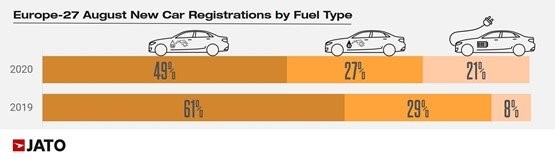
Electric and hybrid cars continued to grow in popularity across Europe in August, representing more than one in five cars sold in the continent.

It’s a new record, according to data analysis firm Jato, and represents a growth of 121% year-on-year.

Hybrids accounted for 49% of electrified vehicle registrations in August, with their volume increasing by 86% thanks to the mild-hybrid technology available in some Ford, Suzuki and Fiat models.

Pure electric cars followed this success, with 48,800 units, an increase of 111%.

https://cdn.fleetnews.co.uk/web/1/root/august3_w555_h555.jpg

Plug-in hybrid electric vehicles (PHEV) found 44,700 new customers, with registrations up by 283%. This huge increase amounted from the success of premium brands, accounting for 55% of their volume, and the new Ford Kuga.

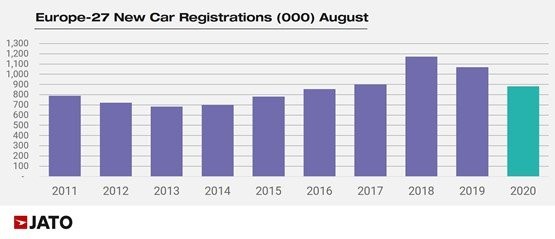
The Coronavirus pandemic continued to rock the industry in August, however, with the overall number of new cars registered across Europe some 18% behind August 2019.

In total, 881,897 new cars were registered in August 2020, leaving the sector 33% down year-to-date.

https://cdn.fleetnews.co.uk/web/1/root/august6_w555_h555.jpg

Felipe Munoz, global analyst at JATO Dynamics, said: “We continue to say that it is still too early to talk about recovery and the results last month indicate that there are still big issues that need to be addressed in the industry.

Fortunately, the larger drop seen in August was mostly caused by business/fleet registrations, as private registrations only fell by 4%. This is a good indicator that the situation is not as dire as it might seem.”

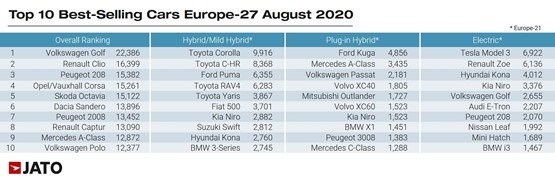
SUVs accounted for 41% of all registrations in August, with the Peugeot 2008 the best-seller.

Overall, the VW Golf was the most popular car in Europe, amassing more than 22,000 registrations. The Audi A6 topped the executive car segment, while Renault’s Clio was the best-selling supermini.

https://cdn.fleetnews.co.uk/web/1/root/august5_w555_h555.jpg

By Graham Hill thanks to Fleet News

Share My Blogs With Others: These icons link to social bookmarking sites where readers can share and discover new web pages.
  • MisterWong
  • Y!GG
  • Webnews
  • Digg
  • del.icio.us
  • StumbleUpon
  • Reddit
  • Alltagz
  • Ask
  • Bloglines
  • Facebook
  • YahooMyWeb
  • Google Bookmarks
  • LinkedIn
  • MySpace
  • TwitThis
  • Squidoo
  • MyShare
  • YahooBuzz
  • De.lirio.us
  • Wikio UK
  • Print
  • Socializer
  • blogmarks

Is The Proposed Ban On The Sale Of Petrol & Diesel Vehicles In 2030 Realistic?

Thursday, 15. October 2020

By Steve Nash, CEO of the Institue of the Motor Industry (IMI)

There is much speculation that the government is planning to move forward the ban on the sale of new petrol and diesel cars to 2030, with hybrids given a reprieve to 2035.

I admire the confidence of those feeding this speculation – apparently there are assurances that the infrastructure will be ready by this date.

But there is so much more to consider than simply the charging infrastructure.

Indeed, in some ways the charging network issue is relatively simple to resolve… It just needs investment, and rather a lot of it!

However, we won’t get the network we need if the government leaves it largely to private businesses to solve the problem, as it has done up to now.

The investments made by our government are paltry compared to other countries.

But I worry that a much bigger piece of the jigsaw has been forgotten.

What about the technicians to service and repair this new automotive technology which, in turn, will give motorists the essential confidence they need?

The automotive sector has seen – much like many other industries – massive falls in sales over the last 6 months as a result of Covid-19.

Right now, therefore, the appetite for recruitment and training is low as recent data attests.

Yet training of the existing workforce on these new drivetrains, as well as recruitment of the next generation of workers is vital.

The latest Department for Education (DoE) data shows that apprenticeship starts in the Automotive sector in July 2020 fell by 59% compared to the same period in 2019.

And the latest ONS data shows that approximately 2% of jobs in the sector have been made permanently redundant with potentially an additional 7,200 planned before the end of September.

Further underlying the financial pressures facing the automotive sector, over half (56%) stated that Covid-19 had increased the risk of insolvency of their business; an increase of 3% since last reporting.

Against this backdrop, and with so much of the country waiting to hear if new restrictions may impact business income further, does it really make sense to heap the pressure on an already beleaguered sector?

As we advance towards a zero-emission future, the technology that technicians will be coming into contact with is changing – resulting in high voltage electrics becoming commonplace.

Motorists driving electrified vehicles want to know that they are handing over their vehicle to someone who has the right skills.

Those who aren’t properly trained or equipped to work on electrified vehicles would be risking serious injury or potentially fatal shock.

The IMI TechSafe standards, endorsed by OLEV at the end of 2019, mean that electrified vehicle users can access the IMI Professional Register to check the electric vehicle technical competencies of technicians at their local garage.

This is a crucial step in giving car buyers confidence that their electric vehicle can be serviced, maintained and repaired by a garage with the right skills – and that removes a key barrier to EV adoption.

But it’s also important that government looks at investment in skills training to support a sector that is currently severely depleted by Covid-19, to ensure its zero emissions goals can be achieved. By Graham Hill thanks to Fleet News

Share My Blogs With Others: These icons link to social bookmarking sites where readers can share and discover new web pages.
  • MisterWong
  • Y!GG
  • Webnews
  • Digg
  • del.icio.us
  • StumbleUpon
  • Reddit
  • Alltagz
  • Ask
  • Bloglines
  • Facebook
  • YahooMyWeb
  • Google Bookmarks
  • LinkedIn
  • MySpace
  • TwitThis
  • Squidoo
  • MyShare
  • YahooBuzz
  • De.lirio.us
  • Wikio UK
  • Print
  • Socializer
  • blogmarks

Hybrid Cars Being Targetted By Catalytic Converter Thieves.

Tuesday, 6. October 2020

Thefts of catalytic converters from vehicles in England and Wales were six times higher in 2019 than the previous year.

Official figures show that last year, almost 13,000 devices were reported stolen, with London particularly badly hit. There were just 2,000-plus thefts in 2018.

Criminals sell the parts as desirable spares or simply for the value of the precious metals they contain – rhodium, palladium and platinum.

Assistant Chief Constable Jenny Sims, car crime lead for the National Police Chiefs’ Council (NPCC), said police were committed to tackling the thefts and the organised gangs behind them.

“Police forces across the country are involved in planning and undertaking intelligence-led operations, at both the regional and national level, to stop converters from being stolen, as we recognise the devastating impact these crimes can have upon the lives of victims,” she told the BBC.

Stolen vehicle recovery expert Tracker suggests that hybrid vehicles are at a particular risk. Clive Wain, head of police liaison at Tracker, explained:

“Plug-in and self-charging hybrid vehicles are a highly desirable target for thieves as their catalytic converters are less corroded than those in petrol and diesel vehicles which rely on them more.”

Wain says that there are simple actions that drivers can take to protect their vehicle, including physical barriers to make thieves think twice before targeting their car.

“Installing an alarm that activates if the vehicle is lifted or tilted are particularly effective and owners should consider investing in a catalytic converter protection device or marking system,” he said.

“Fitting a stolen vehicle recovery device, such as those on offer from Tracker will ensure that if a car is stolen, it will be located and recovered quickly before the essential parts are removed for re-sale.”

Tracker’s top tips for safeguarding your vehicle:

  • Park your car in a safe spot – a secure garage is the best option, but a well-lit and overlooked parking spot is also a great – it doesn’t take long to steal a catalytic converter, but it’s certainly not a quiet job so the more visible the car, the better the deterrent.
  • Install cameras – Thieves don’t want to be caught on camera. Installing CCTV to keep an eye on your car or parking in areas covered by public CCTV is good protection.
  • Install a vehicle tracker system – If a car is stolen, the police are far more likely to be able to find and return it safely if it has a device fitted.

Police forces across the country have also issued the following advice and information to help drivers protect their vehicles:

  • Consider installing a Thatcham approved alarm to your vehicle. Ones that activate if your vehicle is lifted or tilted are particularly effective.
  • Use a catalytic converter protection device or marking system.Catalytic converters control and convert exhaust emissions from your vehicle into less toxic substances. If yours is stolen, you will know because your vehicle’s engine will sound different. If you suspect your catalytic converter has been stolen, report it immediately by calling 101.

By Graham Hill thanks to Fleet News

Share My Blogs With Others: These icons link to social bookmarking sites where readers can share and discover new web pages.
  • MisterWong
  • Y!GG
  • Webnews
  • Digg
  • del.icio.us
  • StumbleUpon
  • Reddit
  • Alltagz
  • Ask
  • Bloglines
  • Facebook
  • YahooMyWeb
  • Google Bookmarks
  • LinkedIn
  • MySpace
  • TwitThis
  • Squidoo
  • MyShare
  • YahooBuzz
  • De.lirio.us
  • Wikio UK
  • Print
  • Socializer
  • blogmarks