The Government has agreed a six-month £1.8 billion funding deal with Transport for London (TfL), but a suggestion the congestion charge zone could be expanded has been taken of the table.
TfL had asked for a £5.7bn package to prop up services for the next 18 months, after passenger numbers and revenues have fallen after the March lockdown.
However, after an interim funding measure was agreed a couple of weeks ago, the possibility of TfL having to expand London’s congestion charge zone to the north and south circular appeared to be conditional to this latest financial deal.
An initial bailout from the Government in the wake of the coronavirus crisis has already seen prices increased and its hours of operation extended.
It now applies from 7am to 10pm, seven days a week, while drivers must pay £15, rather than £11.50, to enter the zone.
At the time, TfL described that as a ‘temporary’ price increase as a result of a funding agreement between the Government and the transport authority.
It secured a £1.6bn bailout from the Government after warning it could have to cut services.
The proposed extension to the £15 congestion charge zone, which was mooted as part of this latest deal, would have gone live in October next year, when the expanded ULEZ is also introduced due to be introduced covering the same area.
The Mayor of London, Sadiq Khan, labelled the plans “ill-advised and draconian”, and warned it would “punish Londoners for doing the right thing to tackle Covid-19”.
Talking after this latest round of funding was agreed, he said: “These proposals from the Government (if given the go-ahead) would have hammered Londoners by massively expanding the congestion charge zone, scrapping free travel for older and younger Londoners and increasing TfL fares.”
The deal makes around £1.8bn of Government grant and borrowing available on current projections to TfL in the second half of this financial year.
TfL will itself make up through cost savings the £160 million gap the deal leaves from the nearly £2bn the organisation projects it will need to run the tube, bus and other TfL services for the remainder of this financial year.
As part of the deal, London will also have to raise extra money in future years. Decisions about how this additional funding will be raised are yet to be made by Khan, but some of the options that he and the Government have agreed to be looked at include a modest increase in council tax, pending the appropriate consultation, as well as keeping in place the temporary changes to the central London Congestion Charge that were introduced in June 2020, subject to consultation.
Khan said: “This is not a perfect deal, but we fought hard to get to the best possible place. The only reason TfL needs Government support is because almost all our fares income has dried up since March as Londoners have done the right thing.”
Two Government special representatives will continue to sit on TfL’s board.
A new Government-chaired Government oversight group will monitor the implementation of the agreement and the sustainability plan.
Transport secretary Grant Shapps said: “This deal is proof of our commitment to supporting London and the transport network on which it depends. Just as we’ve done for the national rail operators, we’ll make up the fare income which TfL is losing due to Covid-19. Londoners making essential trips will continue to be able to use tubes, buses, and other TfL services, thanks to this Government funding.
“At the same time, the agreement is fair to taxpayers across the country. The Mayor has pledged that national taxpayers will not pay for benefits for Londoners that they do not get themselves elsewhere in the country.
“Over the coming months, as we look to move beyond the pandemic, I look forward to working with London’s representatives to achieve a long-term settlement, with London given more control over key taxes so it can pay more costs of the transport network itself. This agreement marks the first step towards that, potentially allowing a longer-term, sustainable settlement for TfL when the course of the pandemic becomes clearer.”
Logistics UK, formerly the Freight Transport Association (FTA), welcomed the decision not to go-ahead with the expansion of the congestion charge zone.
David Wells, chief executive of Logistics UK, said: “The Government’s decision to… refrain from expanding the London Congestion Charge is a huge relief to logistics businesses, many of whom continue to struggle financially and operationally as a result of the Covid-19 crisis.
“Now, Logistics UK is urging Government to reconsider whether logistics activity should still be included in the temporary conditions added in June 2020, which saw a significant increase in the fee and longer operating hours.
With little alternative to using lorries and vans to keep London stocked with all the goods the population needs, it simply amounts to an additional tax on those charged with supporting the capital during the pandemic, and beyond.”
Peter Hogg, London city executive and UK cities director at Arcadis, also welcomed the deal between Government and TfL.
However, he said what the settlement illustrated was the need for a “new, long term funding model for TfL”.
“More than ever, London and national government as well as business and citizens have to protect London’s status as a global economic powerhouse. That is impossible to achieve without a correspondingly world class transport network.
“Both Government and the GLA will know that a twice yearly Punch and Judy show to agree a short term funding settlement is not a sustainable way to achieve a world class network.
“It is important that central Government and the GLA use the next months to develop a robust long term funding model for TfL that allows for capital investment, effective operation and – above all – a genuinely world class network that bolsters London’s global competitive advantage.” By Graham Hill thanks to Fleet News
Share My Blogs With Others:These icons link to social bookmarking sites where readers can share and discover new web pages.
Fiat Chrysler Automobiles (FCA) is the latest manufacturer to face an emissions-based legal battle in the UK, as law firm PGMBM claims the manufacturer misled customers through the use of emissions ‘defeat’ devices.
PGMBM, which has also launched legal action against Mercedes-Benz and the Renault Nissan Alliance, says up to half a million of vehicles with FCA Group engines, manufactured since 2008, could be affected in England and Wales, .
Owners could be due £10,000 in compensation, if the claim is successful.
PGMBM managing partner Tom Goodhead said: “Fiat Chrysler Automobiles have misled drivers about the true diesel emissions that many of their vehicles produce. This is yet another instance of a huge automotive firm conning consumers – with a significant impact on the environment and our collective wellbeing.
“FCA must be held to account for these practices, and this case will give consumers the opportunity to pursue some justice and be compensated for being misled by a company that they may have trusted.
“Legally, consumers could be entitled to anything up to the full cost of the affected vehicles. But based on similar legal actions around the world, we believe that £10,000 per claimant should be expected.”
The car maker’s offices, including those of truck maker CNH, in Germany, Switzerland and Italy were raided in July, following claims that some of the company’s engines produced illegal levels of emissions.
According the PGMBM, potentially illegal software was used in the engine management systems used in Alfa Romeo, Jeep, Fiat and Suzuki cars, plus Iveco and Fiat commercial vehicles.
Affected engines, highlighted in the investigation, include Euro 5 and 6 variants of the 1.3-litre, 1.6-litre and 2.0-litre Multijet diesel engine.
A full list of potentially affected models can be viewed below.
In 2019, FCA agreed to a settlement worth $800 million to resolve claims from the US Justice Department and the state of California relating to the use of illegal software that produced false results on diesel-emissions tests.
The new claim alleges that FCA committed fraud by manufacturing vehicles whose true diesel emissions far exceeded the limits imposed by EU and UK laws.
An FCA spokesperson said: “FCA believes this claim to be totally without merit and we will vigorously defend ourselves against it.”
Potentially affected vehicles with FCA’s diesel engine:
Make / Model
1.3 litre
1.6 litre
2.0 litre
3.0 litre
3.0 litre (V6)
Fiat
500 500C 500L 500X Doblo Fiorino Panda Punto Punto Evo Grande Punto Qubo Tipo
500L 500X Bravo Doblo Grande Punto Punto Evo Scudo Talento Tipo
500X Bravo Doblo Ducato Scudo Talento
Ducato
–
Alfa Romeo
MiTo
Guilietta MiTo
159 Brera Guilietta Spider
–
–
Jeep
–
Compass Renegade
Cherokee Compass Renegade
–
Grand-Cherokee Commander
Suzuki
–
SX4 Vitara S-Cross
–
–
–
Iveco
All models
By Graham Hill thanks to Fleet News
Share My Blogs With Others:These icons link to social bookmarking sites where readers can share and discover new web pages.
The following article was created for large fleet users but the same advice equally applies to consumers and small companies who drive electric vehicles
How long does an electric car battery last? Use the free Geotab EV Battery Degradation Tool to compare the average battery degradation over time for different vehicle makes and model years.
Geotab developed the tool based on an analysis of 6,300 fleet and consumer electric vehicles. Read on to learn about EV battery health and get key takeaways on real-world battery performance.
See also: To what degree does temperature impact EV range?
The importance of EV batteries
If you’re thinking about buying an electric vehicle (EV), there are some important factors to consider. These three questions are probably at the top of your list:
How much will the EV cost?
What is its range?
How long will the battery last?
From a life-cycle perspective, battery performance and health really are the key to it all. As the battery is an EV’s most expensive component, the degree of degradation will affect the vehicle’s residual value (which helps answer the cost question from above), and will also have a direct impact on maximum usable range over time.
See also: Podcast: EV myths and management with Charlotte Argue
How long will an EV battery last?
You might have noticed that it is tough to get a straight answer to questions about an EV’s battery lifespan. What you may find instead are assurances that batteries are covered by warranty should something go wrong. Typically, battery coverage is 8 years or 100,000 miles, but this will vary by manufacturer and country.
Warranties are reassuring, and so too is the fact that battery costs are decreasing significantly year over year. Since 2010, the price of an average Lithium-ion battery pack has dropped by over 80%.
An automaker’s guarantee of their battery technology and the promise of decreasing costs should inspire some confidence. However, most of us would find more comfort knowing how quickly our batteries are expected to degrade, and how to minimize this loss.
See also: Preparing for EVs: Charge the North EV study findings for fleet operators
What is EV battery degradation?
Battery degradation is a natural process that permanently reduces the amount of energy a battery can store, or the amount of power it can deliver. The batteries in EVs can generally deliver more power than the powertrain components can handle. As a result, power degradation is rarely observable in EVs and only the loss of the battery’s ability to store energy matters.
A battery’s condition is called its state of health (SOH). Batteries start their life with 100% SOH and over time they deteriorate. For example, a 60 kWh battery that has 90% SOH would effectively act like a 54 kWh battery.
Keep in mind, this is not the same as vehicle range (distance the vehicle can travel on those kWhs), which will fluctuate on a daily or trip-by-trip basis, depending on a number of factors including charge level, topography, temperature, auxiliary use, driving habits and passenger or cargo load.
Common factors impacting Lithium-ion battery health:
Time
High temperatures
Operating at high and low state of charge
High electric current
Usage (energy cycles)
While there has been plenty of research done on battery health, there has been very little data following the real-world performance of EVs over time, let alone comparisons across different makes and models. Until now.
See also: J1939: Why having electric trucks and buses speak the same language is good for fleets
Introducing the EV Battery Degradation Tool
Geotab created the EV Battery Degradation Tool to assess how batteries have been holding up and to consider the relative importance of the above factors on EV battery life under real-world conditions.
We analyzed the battery health of 6,300 fleet and consumer EVs, representing 1.8 million days of data. From the telematics data processed, we have gained insight into how real-world conditions influence the battery health of electric vehicles, providing aggregated average degradation data for 21 distinct vehicle models, representing 64 makes, models and years.
Notes about the tool:
The degradation curves displayed below are the average trend line from the data analyzed.
These graphs can offer insight into average battery health over time, but should not be interpreted as a precise prediction for any specific vehicle.
A subset of vehicle makes, models and years are not available in the visualization tool – we have excluded vehicles with insufficient data, so don’t be alarmed if your car of choice is missing.
First and foremost, based on data from over 6,000 electric vehicles, spanning all the major makes and models, batteries are exhibiting high levels of sustained health. If the observed degradation rates are maintained, the vast majority of batteries will outlast the usable life of the vehicle.
Like us, health declines with age
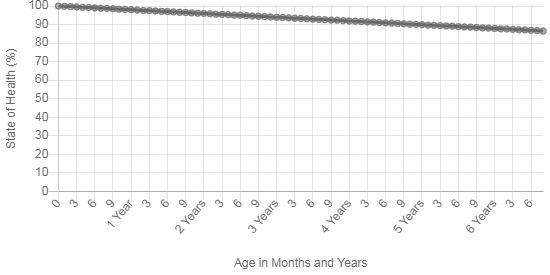
As you might expect, the older a vehicle is, the more likely its battery has deteriorated. However, when looking at average decline across all vehicles, the loss is arguably minor, at 2.3% per year.
This means that if you purchase an EV today with a 150 mile range, losing about 17 miles of accessible range after five years is unlikely to impact your day-to-day needs.
Is EV battery degradation linear?
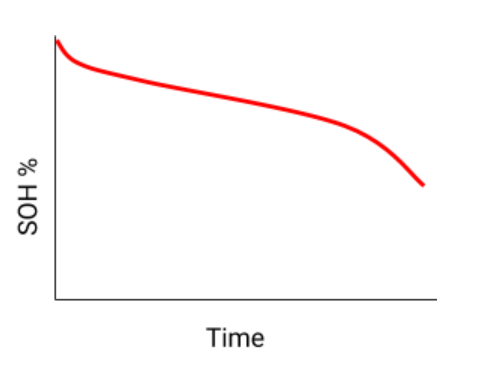
While this tool shows more or less linear degradation, as a general rule, EV batteries are expected to decline non-linearly: an initial drop, which then continues to decline but at a far more moderate pace. Towards the end of its life a battery will see a final significant drop, as seen below.
Figure 1: A normal degradation curve is expected to look something like this.
Fortunately for the drivers, too few batteries we’ve observed have reached the end-of-life drop for us to predict at what point this is likely to occur. We will continue to monitor to see when the non-linear degradation (also known as the “heel”) begins.
There is a measurable difference between makes, models and years
From our data, it appears that vehicle batteries respond differently to the test of time, depending on their make and model-year. Why do some vehicle models seem to, on average, degrade faster than others? Two potential contributors are battery chemistry and thermal management of the battery pack.
While EVs use Lithium-ion batteries, there are many different variations of Lithium-ion chemistries (the most prominent difference being the materials used for the electrodes). A battery’s chemical make-up will influence how it responds to stress. In addition to cell chemistry, temperature control techniques differ across vehicle models. A major distinction is if the battery pack is cooled and/or heated by air or by liquid.
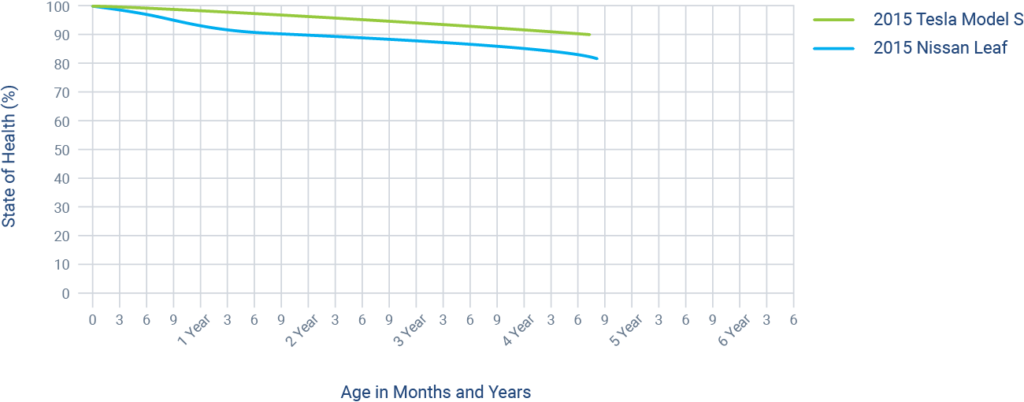
Let’s compare a vehicle with a liquid cooling system to one with a passive air cooling system: the 2015 Tesla Model S and the 2015 Nissan Leaf, respectively. The Leaf has an average degradation rate of 4.2%, while the Model S is 2.3%. Good thermal management means better protection against degradation.
Figure 2: Battery degradation comparison of the 2015 Tesla Model S (liquid cooling) vs. the 2015 Nissan Leaf (passive air cooling).
State of charge (SOC) and the buffer effect
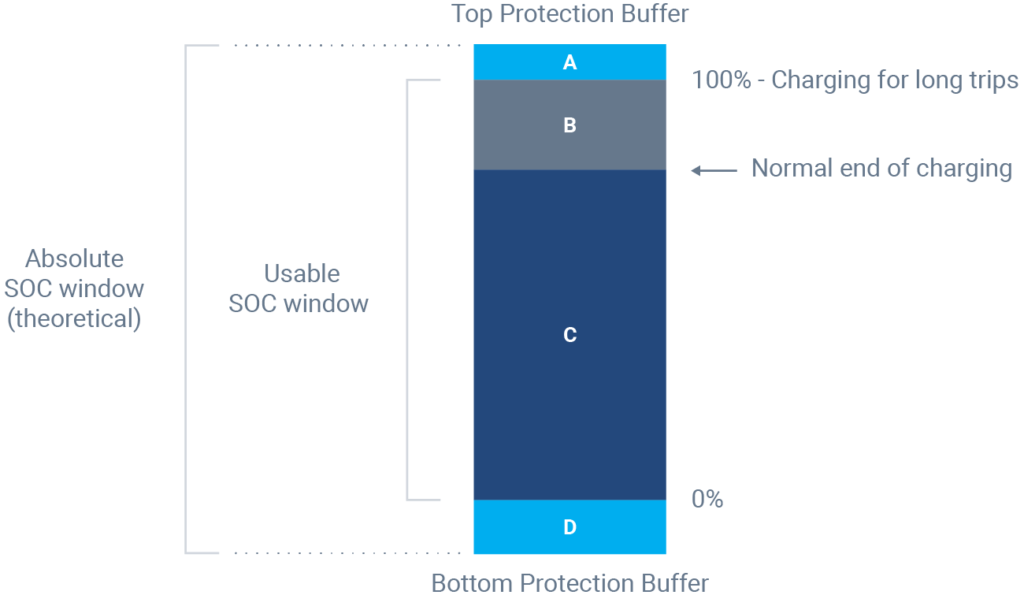
Another anticipated reason for the differences in battery health between manufacturers is how SOC is controlled. Operating a battery at near full or empty has implications on battery health. To limit this effect, many manufacturers add a buffer, effectively preventing access to the extreme ends of the SOC window (shown in the image below).
In addition to the protection buffers at the top end and bottom end of the battery range, many vehicles provide the EV owner the option to stop normal daily charging at a level below 100%.
Figure 3: Battery protection buffers control the usable state of charge window for an EV.
Did you know?
Removing the extremes is not only done for battery health but also for safe vehicle operation. At the extreme ends the battery wouldn’t be able to accept or deliver full power and the driving experience would be impacted. In essence, a battery at 100% isn’t completely charged from a pure battery chemistry standpoint.
Similarly, 0% isn’t completely empty. Since the vehicle owner is unable to access these parts of the battery range for safety and battery life reasons, it is likely that many are unaware of it.
Thanks to over-the-air software upgrades, it’s possible that the size of the buffer can change over time, as discovered by some Tesla owners in 2019 when they noticed a decrease in their top range. Tesla confirmed the upgrade was “to protect the battery and improve longevity.”
In addition, some automakers have adjustable charge ceilings, where the user can pre-set at what point the battery stops charging (e.g., they can tell the vehicle to stop charging at 75% instead of 100%).
This owner-discretionary region (B in the graphic above) works in combination with the non-discretionary buffer (A) to limit battery operation in areas of higher degradation. In later updates to the degradation tool we intend to include the impact of owner’s operation within this discretionary (B) region and the resulting impact on degradation rates.
Let’s consider an example:
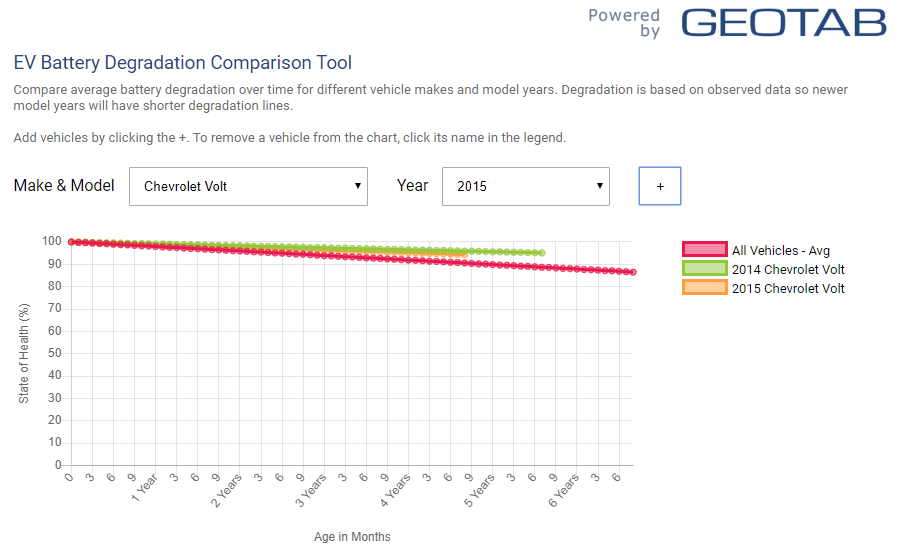
The Chevrolet Volt, especially the early model years, has comparatively large top and bottom protection buffers (regions A and D) that dynamically change as the battery ages. While the larger buffers mean less energy for driving, it should result in a longer lasting battery pack.
Given the larger SOC buffers, liquid thermal management, and dynamic (decreasing) buffer size, slower than average degradation rates should be expected on the Volt.
Figure 4: Battery degradation over time for a Chevrolet Volt vs. all vehicles.
What additional factors appear to influence battery health?
Based on the telematics data available, we were able to evaluate battery degradation by different factors the vehicles were exposed to and see if there was any correlation with health decline. These factors included:
Use
Extreme climates
Charging type
Over time, we hope to develop these insights into a degradation tool that can better predict EV state of health.
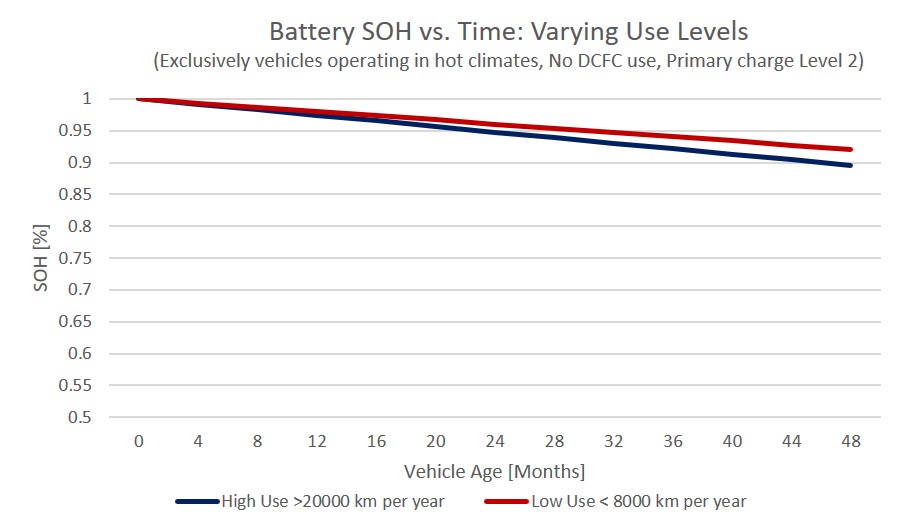
High vehicle use does not equal higher battery degradation
One exciting piece of information we were able to glean from the data was that vehicles with high use did not show significantly higher battery degradation. This should come as welcome news, since you don’t get the benefit of an EV if it’s just sitting in the fleet yard.
The takeaway? Don’t be afraid to put your EVs in high-use duty cycles. As long as they are within their daily driving range, their battery life won’t be negatively impacted.
One caveat: if high use requires routine DC fast charging, be sure to read the section on the impact of charging type.
Figure 5: Amount of use doesn’t appear to have much impact on degradation rates.
Vehicles driven in hot temperatures show faster decline in battery SOH
A battery exposed to very hot temperatures will be prone to more damage, but by how much? Will an EV in Arizona have a different battery life than the same car driven in Norway? To find out, we grouped the vehicles based on the following climate conditions:
Temperate: Fewer than 5 days per year over 80 F (27 C) or under 23 F (-5 C).
Hot: More than 5 days per year over 80 F (27 C).
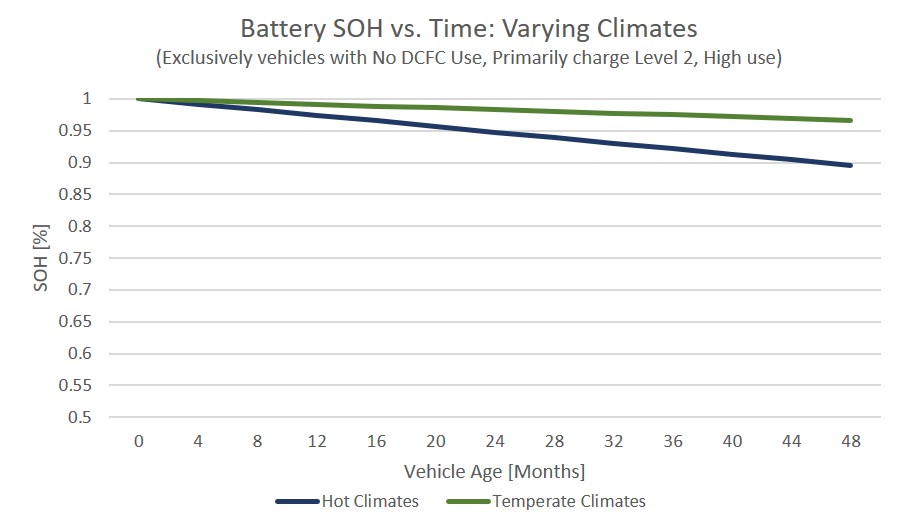
As illustrated below, vehicles driven in hot climates showed a notably faster rate of decline than those driven in moderate climates. This is not great news if you and your fleet toil under the hot sun.
Heat and cold weather also impacts your day-to-day range. To understand how, take a look at our Temperature Tool for EV Range.
Figure 6: Batteries exposed to hot days degrade faster than those in temperate climates.
Taking a look at charge type
We were able to look at the predominant charging level used for the EVs in our system. North American EV charging stations are categorized in three common types:
Level 1: 120 volt – a regular home outlet in North America.
Level 2: 240 volt – typical for home or fleet charging.
Direct current fast charger: DCFC – for faster top ups.
Charging in most of Europe is referred to as AC charging (which is generally equivalent to Level 2 in North America) and DC charging (DCFC, as described above).
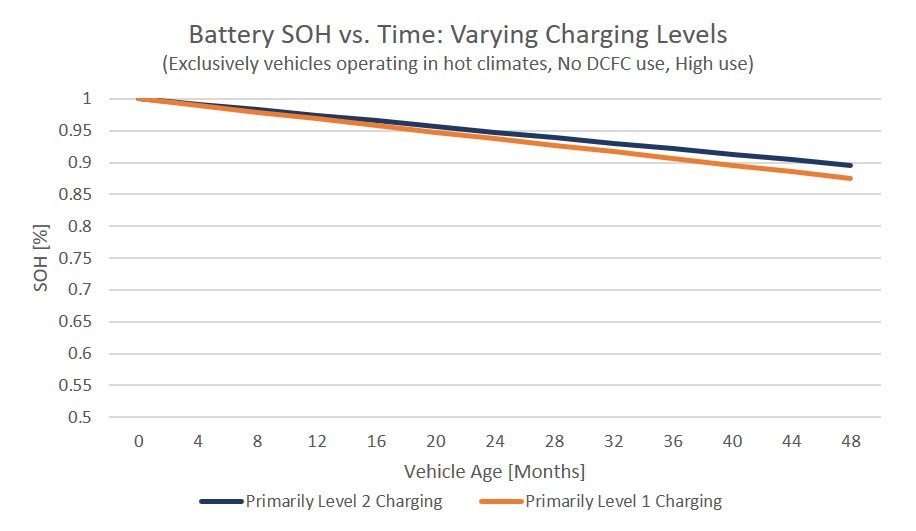
While Level 2 is often cited as the optimal way to charge an EV, the difference in battery health between cars that routinely charged on Level 2 as compared to those who used Level 1 appeared to be observable but was not beyond the level of statistical significance.
Figure 7: Battery degradation for vehicles that primarily charge on Level 1 compared with Level 2.
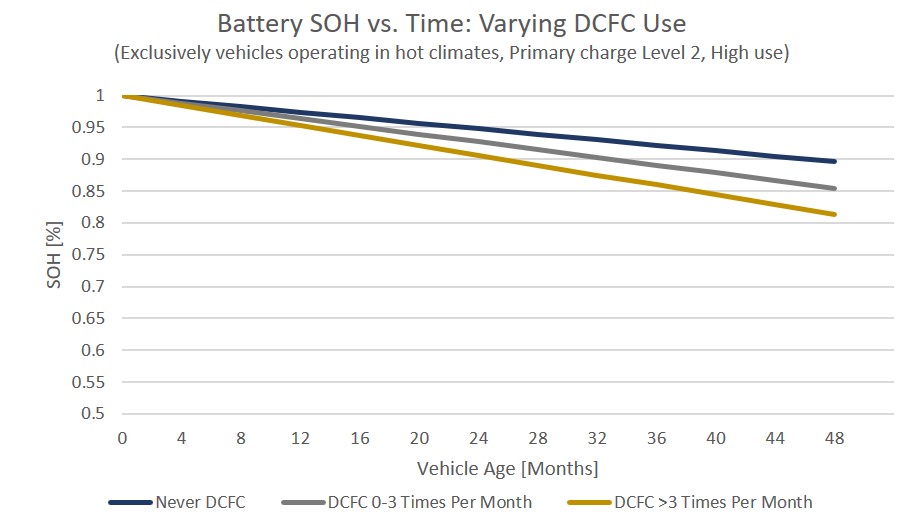
The use of DCFCs, however, does appear to impact the speed that batteries degrade. Rapidly charging a battery means high currents resulting in high temperatures, both known to strain batteries. In fact, many automakers do suggest limiting the use of DCFC in order to prolong their vehicles’ battery life.
Here we look at all battery electric vehicles in the same climate group (we chose to look at the most susceptible group – those operating in extreme climate conditions), and categorized them based on how frequently they used a DCFC: Never, occasionally (1–3 times per month) and frequently (more than 3 times per month).
Figure 8: Battery degradation appears to be strongly correlated with DCFC use for vehicles in seasonal or hot climates.
The difference between those vehicles that never used DCFC and those that used it even occasionally in seasonal or hot climates was notable. While there may be other factors at play (we want to stress that this wasn’t a controlled experiment), charging via lower power Level 2 charging should be prioritized.
Tips to prolong your EV battery’s life
While battery degradation varies by model and external conditions – such as climate and charging type – the majority of vehicles on the road today have not experienced significant decline. In fact, overall degradation has been very modest, with an average capacity loss of just 2.3% per year. Under ideal climate and charging conditions, the loss is 1.6%.
While some things are out of an operator’s control, there are ways you can extend the life of your EV’s battery.
Some tips for operating your EVs:
Avoid keeping your car sitting with a full or empty charge. Ideally, keep your SOC between 20–80% particularly when leaving it for longer periods, and only charge it fully for long distance trips.
Minimize fast charging (DCFC). Some high-use duty cycles will need a faster charge, but if your vehicle sits overnight, level 2 should be sufficient for the majority of your charging needs.
Climate is out of an operator’s control, but do what you can to avoid extreme hot temperatures, such as choosing shade when parked on hot days.
High-use is not a concern, so fleets shouldn’t hesitate to put them to work. An EV isn’t useful sitting idle in the fleet yard, and putting on more miles per vehicle is overall a better fleet management practice.
Final thought
Don’t sweat the small stuff. As vehicles come out with larger battery packs, losing some capacity may not impact your day-to-day driving needs, and shouldn’t overshadow the many benefits EVs have to offer. By Graham Hill thanks to Geotab
Share My Blogs With Others:These icons link to social bookmarking sites where readers can share and discover new web pages.
City of Edinburgh Council, Heriot-Watt University and Flexible Power Systems (FPS) have secured funding worth £1.6 million to investigate the benefits of wireless electric vehicle (EV) charging.
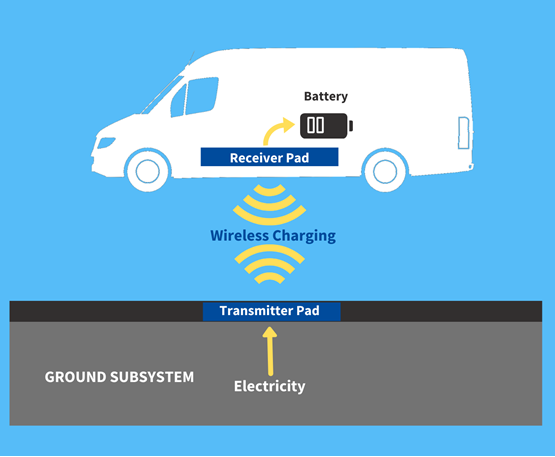
Wireless charging allows EVs to recharge while parked on charging pads instead of using cables that need to be manually plugged in by a driver.
In what is being claimed as the UK’s first wireless charging hub for light commercial vehicles (LCVs), devices will be installed at Heriot Watt University’s Edinburgh campus in early 2021 to service specially adapted vans from both City of Edinburgh Council and Heriot-Watt’s fleet.
The technology has already been proven for mass transit applications and will be supplied by specialist firm, Momentum Dynamics.
The project is being funded by the Office for Low-Emission Vehicles (OLEV) and delivered through Innovate UK.
A similar six-month trial of wireless charging technology for electric taxis in Nottingham was announced by the Government at the start of the year.
The Department for Transport (DfT) said that the £3.4m scheme could pave the way for a revolution in EV charging.
This latest project aims to accelerate the transition to EV in commercial vehicle fleets by reducing the cost of charging the vans.
The project team says that high-powered wireless electric vehicle charging is expected to have considerable benefits for commercial vehicle users, including: faster starts to charging sessions with no downtime for plugging in to improve vehicle use and create bigger benefits from opportunity charging sessions; no cables to cause trip hazards or require maintenance; and future proofing for the advent of autonomous vehicles (which will not have a driver to plug them in).
The project ultimately aims to apply wireless charging to shared logistics hubs where fulfilment functions can be combined with charging.
Wireless charging technology will be applied to improve vehicle turnaround times and staff productivity at the hubs enhancing cost savings, it says
FPS’ managing director, Michael Ayres explained: “Productivity drivers and longer journeys mean commercial vehicles may need to charge away from the depot or at high speeds during the day.
“Rapid and ultra-rapid chargers required for a fast turnaround make up less than 25% of publicly available chargers and can be difficult to access if they are in use or out of service.”
High-power rapid chargers can be expensive both in terms of the chargers themselves and the electricity network infrastructure required to support them, says Ayres.
Sharing the cost of the charger and the connection through a shared charging hub can mitigate a portion of these costs.
He continued: “The project is testing sharing of the charging hubs between logistics, retailer, local government, and university owned commercial vehicles.
“These charging hubs require high use to be economically viable. The project uses powerful wireless charging to shorten the length of time vehicles need to be in the charging hubs.
“At the same time, we are investigating adding basic fulfilment capabilities to improve the productivity of logistics vehicles visiting the hubs.”
Professor Phil Greening, a co-director of the Centre for Sustainable Road Freight, based at Heriot-Watt University added: “While highly utilised shared infrastructure and collaboration have great potential to reduce the costs of decarbonising road freight, there are complex scheduling and commercial trade-offs to be considered.
“The modelling tools and approaches developed in our Engineering and Physical Sciences Research Council (EPSRC) funded research at the Centre, combined with the collaboration we’ve undertaken with FPS over the last two years will both be key to untangling these challenges and making sure this potential is realised.”
The charging hub concept has the potential to contribute to decarbonising commercial vehicles in the City of Edinburgh.
City of Edinburgh Council’s transport and environment convener councillor, Lesley Macinnes, said: “We’re delighted to be working with Heriot-Watt University on this innovative project, helping to facilitate the use of electric vehicles across our fleet.
“We are committed to supporting the use of sustainable, low emission travel and continue to replace vehicles with cleaner models wherever possible.
“Our own Electric Vehicle Action Plan will result in a significant increase in charging points across the city which, alongside projects such as this, will help encourage the take-up of electric vehicles as a low carbon, environmentally-friendly transport choice.”
Scott Millar, fleet and workshops Manager for The City of Edinburgh Council, added: “We are already deploying electric vehicles across our fleet and we’re looking at ways we can drive adoption in the wider community.
“Providing charging infrastructure like shared hubs has the potential to play a key part of removing barriers to uptake for both the council and the community.
“We’re excited to take a leadership role here as a successful project in Edinburgh could present a model for other councils to use to reduce transport emissions in cities.” By Graham Hill thanks to Fleet News
Share My Blogs With Others:These icons link to social bookmarking sites where readers can share and discover new web pages.
Car manufacturers are achieving significant reductions in average emissions levels, putting them on track to hit targets set by the European Commission.
That’s despite new car registrations being severely affected by the Covid-19 pandemic, according to new research from Jato Dynamics.
Looking at the data for 21 countries in Europe, the average CO2 emissions totalled 102.2g/km – under the New European Driving Cycle (NEDC) between January – August 2020.
By these calculations, the European automotive market is currently 6.5g/km over their combined target for 2020.
Despite overall registrations falling by 29% between January and September this year – when contrasted with the same period in 2019 – registrations for electric vehicles (EVs) increased by 67% through September to 1.54 million units.
This remarkable increase goes some way to explain the double-digit drops seen in demand for gasoline and diesel cars, and the increase in market share for EVs from 7.8% in January – September 2019, to 18.1% in January – September 2020, says Jato.
At the start of the year, Europe’s 13 top car manufacturers were predicted to miss their 2021 CO2 emissions targets and face fines of more than €14.5bn (£12.5bn), according to analysis by PA Consulting.
It shows the dramatic change achieved in average emissions in the past year.
In the UK, the Government has set out tough carbon emissions targets for carmakers based on similar regulations to those in the EU from January 1, 2021.
Currently, the European Commission sets an EU fleet average target that must be met by the EU fleet. For cars, this target is currently 95g/km in 2020. For vans, the target is 147g/km in 2020.
These targets will be converted into WLTP CO2 emissions targets in 2021 following the change in the vehicle CO2 test procedure, and the 2021 actual emissions will represent the new baseline.
Manufacturers will then have to meet a 15% reduction for cars and vans by 2025, and a 37.5% reduction for cars and a 31% reduction for vans by 2030, both against this 2021 baseline.
From these, manufacturers receive individual targets that are set according to the mass of their fleet. Manufacturers with heavier fleets receive individual targets above the EU target; manufacturers with lighter fleets receive targets below the EU target.
Manufacturers will be fined for missing their targets. The new UK rules will mirror those in the EU, including fine an £86 fine for each g/km above the target multiplied by the number of vehicles registered in the year.
Jato’s analysis shows that in Europe, Geely Group has secured pole position in race for CO2 rankings and smashed its target. Outperforming Toyota – which has traditionally led by brand in the CO2 race – the owner of Volvo (which accounts for 99% of Geely Group’s volume in Europe), Polestar, LEVC and Lotus, met the target by August, four months ahead of the deadline.
Geely’s CO2 target for 2020 was an average of 110.3g/km, but by August 31 its average was 103.1g/km – making Geely the only manufacturer to outperform the target.
A consistent focus on EVs is behind this achievement, with electrified vehicles accounting for almost half of its registrations in August, and 38% in January – August 2020, says Jato.
BMW is next in line to meet the target. With an average of 103.5g/km in August, they are only 0.54g/km above their target of 102.9g/km.
If this average remained the same, the German carmaker would only have to pay a minimal penalty at the end of the year, says Jato.
Meeting its target is more than achievable due to their mix of two strategies: increasing the share of EVs on sale, and the relatively low emissions generated by their diesel cars.
Toyota seems to be in a good position, only 2.2 grammes away from its target. However, its hybridisation objectives (which started some years ago) are now stalling, claims Jato.
For the past three years, hybrids have accounted for around two third of Toyota’s registrations in Europe, yet they are still not meeting the targets.
Furthermore, Jato says that its pure EVs have also taken a long time to arrive in Europe – with the new Lexus UX 300e, the first fully electric vehicle of the group, finally hitting the market this year.
The strategy of Korea’s largest maker, Hyundai, has been to boost its small SUVs and green compact cars, explains Jato. While hybrids accounted for 65% of Toyota Group volume in August, they only made up 13% for Hyundai.
However, pure electric cars represented 8% of registrations for the Korean manufacturer, while Toyota has been unable to put any on sale this year.
Jato says that his perfectly demonstrates how pure EVs are much more strongly placed to meet emissions targets, perhaps more so, than hybrid vehicles. By Graham Hill thanks to Fleet News
Share My Blogs With Others:These icons link to social bookmarking sites where readers can share and discover new web pages.
A deal to provide emergency funding to Transport for London (TfL) could rely on the expansion of London’s congestion charge zone.
Currently, the congestion charge operates in central London, covering the same area as the capital’s ultra-low-emission zone (ULEZ).
However, an initial bailout from the Government in the wake of the coronavirus crisis has already seen prices increased and its hours of operation extended.
It now applies from 7am to 10pm, seven days a week, while drivers must pay £15, rather than £11.50, to enter the zone.
At the time, TfL described that as a ‘temporary’ price increase as a result of a funding agreement between the Government and the transport authority.
It secured a £1.6 billion bailout from the Government after warning it could have to cut services.
TfL has asked for a £5.7bn package to prop up services for the next 18 months, after passenger numbers and revenues have fallen after the March lockdown.
An interim funding measure was agreed for the next fortnight with ministers last Friday, but the Mayor of London, Sadiq Khan, has hit out at Government proposals for further TfL funding.
He labelled the plans “ill-advised and draconian”, and warned it would “punish Londoners for doing the right thing to tackle Covid-19”.
The extension to the £15 congestion charge zone would go live in October next year, when the expanded ULEZ is also introduced due to be introduced covering the same area.
It would see the zone expanded to cover approximately four million more Londoners.
The Mayor also says that the Government wants to increase TfL fares by more than RPI+1%.
A further Government proposal is to introduce a new council tax precept charge in the capital – effectively increasing council tax by an as yet unspecified amount for all Londoners, regardless of whether they use public transport, claims Khan.
He said: “I simply cannot accept this Government plan, which would hit Londoners with a triple whammy of higher costs at a time when so many people are already facing hardship.
“The Government should be supporting Londoners through this difficult time – not making ill-advised and draconian proposals which will choke off our economic recovery.
“Ministers already forced TfL to bring forward proposals to increase the cost and hours of the congestion charge in May – now they want to expand it to cover four million more Londoners.
“They also want to significantly increase fares in London and hit all Londoners with a regressive new tax.
“It is clear that difficult choices lie ahead to plug the huge gap the pandemic left in TfL’s finances. I have been ready to talk with Government about how the necessary funds can be raised – but a proposal which singles out Londoners for punishment is completely unacceptable, as well as making no economic sense.
“I urge Ministers to come back to the table with a revised proposal which does not punish Londoners for doing the right thing to tackle Covid-19 – and to publish their review into TfL’s finances in full. I remain ready to talk.”
The Department for Transport (DfT) says talks over a settlement were ongoing. By Graham Hill thanks to Fleet News
Share My Blogs With Others:These icons link to social bookmarking sites where readers can share and discover new web pages.
The Government has set out tough carbon emissions targets for carmakers after a warning a lack of legislation could threaten electric vehicle (EV) supply in 2021.
Environmental campaign group Transport and Environment (T&E) claimed that the UK could face long lead times for EV orders in 2021, with manufacturers having to meet targets to reduce the average emissions of the cars they sell in Europe or pay fines.
However, the Department for Transport (DfT) has now tabled similar regulations for manufacturers from January 1, 2021.
Currently, the European Commission sets an EU fleet average target that must be met by the EU fleet. For cars, this target is currently 95g/km in 2020. For vans, the target is 147g/km in 2020.
These targets will be converted into WLTP CO2 emissions targets in 2021 following the change in the vehicle CO2 test procedure, and the 2021 actual emissions will represent the new baseline.
Manufacturers will then have to meet a 15% reduction for cars and vans by 2025, and a 37.5% reduction for cars and a 31% reduction for vans by 2030, both against this 2021 baseline.
From these, manufacturers receive individual targets that are set according to the mass of their fleet. Manufacturers with heavier fleets receive individual targets above the EU target; manufacturers with lighter fleets receive targets below the EU target.
Manufacturers will be fined for missing their targets.
The new UK rules will mirror those in the EU, including fine an £86 fine for each g/km above the target multiplied by the number of vehicles registered in the year.
Manufacturers currently balance the CO2 emissions of new vehicles sold across the 28 individual EU markets to deliver compliance. They often offset sales of higher emitting vehicles in one market against sales of lower emitting vehicles in another.
Post-transition period, manufacturers will not be able to meet UK targets using sales in the EU27.
The Government launched a consultation in the summer on how it would adopt EU emissions targets for cars, vans and HGVs in January 2021. By Graham Hill thanks to Fleet News
Share My Blogs With Others:These icons link to social bookmarking sites where readers can share and discover new web pages.
The clean air zone (CAZ) in Leeds is no longer required after fleets switched to cleaner vehicles faster than expected, a joint review by Leeds City Council and Government has found.
The decision comes as Bath and Birmingham announced plans to forge ahead with their charging CAZs.
Birmingham’s CAZ will start from June 1, 2021, while Bath will start charging non-compliant vehicles from March 15, 2021.
Leeds City Council suspended the introduction of its CAZ in August, while it re-assessed the air quality issues in the city.
It found that more than 90% of buses and 80% of heavy goods vehicles (HGVs) driven in the city now use cleaner Euro VI engines and therefore wouldn’t be charged if a zone was introduced.
Research shows that the newer vehicles emit significantly fewer emissions than older models, especially when travelling at the slower speeds often travelled in urban environments.
Nearly half of the city’s licensed taxi and private hire cars are also now hybrid or electric.
The review found that, because of the dramatic shift to cleaner vehicles, air pollution in Leeds on key routes is below legal limits and is not likely to exceed them again—even if traffic were to return to ‘normal’ levels or slightly higher.
Transport infrastructure improvements and the surging popularity of ultra-low emission vehicles in Leeds are further accelerating improvements to the city’s air quality, it said.
City asks to keep CAZ funding
The council has written to the Government requesting to keep £6.9 million of CAZ funding that Leeds had previously secured to ‘lock in’ the full extent of air quality improvements.
The money would be used to continue offering grants to help local businesses switch to cleaner vehicles as well as to provide free licensing costs to drivers of less polluting taxi and private hire cars.
Leeds will also be able to keep and repurpose the ANPR camera infrastructure that had been installed to monitor and enforce the zone.
In the unlikely event that air quality declined for any reason, the council retains this infrastructure and says it could seek support from central Government to introduce a CAZ.
As part of an updated air quality strategy being brought forward early next year, Leeds City Council is also proposing to voluntarily introduce stricter new targets for local air quality that are aligned with World Health Organisation guidelines.
Councillor James Lewis, deputy leader for Leeds City Council and executive board member with responsibility for air quality, said: “Thanks to our city’s collective effort, Leeds residents are breathing air that is cleaner and safer than ever before.
“When we consulted on the CAZ in 2018, we said that we hoped that no one would be charged because businesses would switch to less-polluting vehicles before the charging system takes effect. That is exactly what has happened.
“We have achieved the aims of the clean air zone without having to charge a single vehicle.
“If Leeds were to introduce a CAZ today, only a fraction of vehicles would be affected because the vast majority of businesses are now driving cleaner vehicles than they were just a few years ago.
“Not out of the woods yet”
However, Andrea Lee, clean air campaigns manager at environmental law charity ClientEarth, insisted that Leeds is “not out of the woods yet” and accused the council of “abandoning the one measure guaranteed to protect people in the shortest possible time”.
“While the promise of a clean air zone has prompted drivers and businesses to switch to cleaner vehicles, the latest reported air pollution measurements from the council still show that parts of the city are over national air quality standards,” she added.
“With Covid-19 endangering people’s respiratory health, rowing back on a measure that has been proven to reduce pollution seems not only illogical but reckless – leaving Leeds unprotected as other cities implement their own clean air zones.”
Senior councillors will discuss the conclusions and proposals to voluntarily introduce new air quality targets that go further than the national standards at a meeting of the council’s executive board next week. By Graham Hill thanks to Fleet News
Share My Blogs With Others:These icons link to social bookmarking sites where readers can share and discover new web pages.
Asda has been trialing e-bikes from Electric Assisted Vehicles (EAV) to make home deliveries in Cambridge.
The Oxfordshire-based micro-mobility manufacturer had its 2Cubed commercial vehicle put to the test over a two-week period by the UK supermarket.
Asda says it is looking for solutions to assist in making deliveries in proposed pedestrianised areas and low emission zones.
Simon Gregg, vice president of the online grocery at Asda, said: “It was great to see the reaction to the e-bike when we took it out on the road – it was really well received and definitely was a talking point at the store and with our customers.
“As we look to the future of retail we have to consider new and innovative ways to continue to offer great service to our customers whilst navigating things like low emission zones and pedestrianised areas.
“A solution such as this would allow us to get into town and cities where access is limited, using either roads or cycle lanes.
“It’s been great to collaborate with the team at EAV and put their eCargo vehicle to the test.”
EAV’s 2Cubed ultra lightweight commercial vehicle is capable of transporting 10 tote boxes containing the equivalent of a weekly shop for two customers .
“The eCargo concept has already proven to be more efficient than any van within an urban parcels and packages logistics scenario,” claimed Adam Barmby, founder and CEO of EAV.
“Working with Asda to reduce the environmental impact of grocery, and to make those deliveries more accessible, in towns and cities has been a great test for our new 2Cubed vehicle and one we’ve been really keen to participate in.”
The 2Cubed has been designed to carry both bulk and weight while retaining its ability to move around quickly and efficiently within towns and cities.
Cool temperatures can either be maintained by cool bags and insulated packaging or by using the EAV Cool fully temperature controlled Cool-Cargo transporter.
Although the EAV Cool unit was not tested by Asda, this ensures that groceries reach the customer completely fresh and with no reduction in product quality.
“EAV developed a prototype EAV Cool some time ago and it’s proved very successful as a development vehicle in the tests we’ve used it for,” continued Barmby.
“Moving from parcel logistics to groceries is a logical pathway for EAV and it allows us to advance our technology maintaining ambient temperatures in our cargo bays.
“More importantly, it hugely reduces the environmental and emissions impact of vans and cars which are currently being used by supermarket chains and other businesses within urban locations.
“In a post-Covid world, where home deliveries have really become the norm, the shift to lightweight commercial deliveries is vital if we want to continue our efforts in improving the environment.” By Graham Hill thanks to Fleet News
Share My Blogs With Others:These icons link to social bookmarking sites where readers can share and discover new web pages.
Electric cars are set to treble their market share in Europe this year, but an environmental campaign group is warning the UK could face long lead times in 2021.
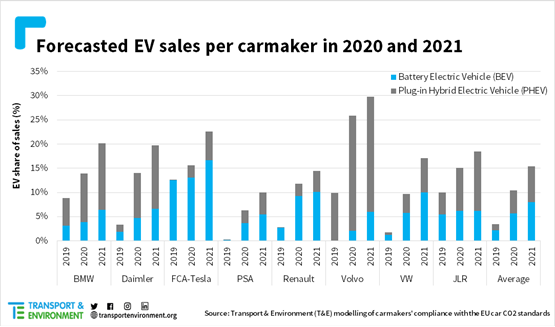
Despite the pandemic, electric vehicle (EV) sales have surged since January 1 and will reach 10% this year and 15% in 2021, says Transport & Environment (T&E).
But, with carmakers having to meet targets to reduce the average emissions of the cars they sell in Europe, or pay fines, T&E says the UK supply of EVs is likely to dry up next year in the absence of British regulations equivalent to those in Europe.
Greg Archer, UK director at T&E, said: “Electric car sales are booming thanks to emissions standards. Next year, one in every seven cars sold in Europe will be a plug-in. European manufacturers have EVs to sell, but from January they’ll have no incentive to sell them in the UK unless the Government requires them to do so.”
From 2021, UK sales of EVs will not help manufacturers achieve EU standards. T&E says that the Government has so far failed to make parliamentary time available for equivalent new UK regulations to encourage sales here. These must be introduced by the end of October to be in place by January and maintain supplies of electric cars to the UK, it says.
Furthermore, it claims that the current draft regulation contains errors that will lead to about a fifth less EVs being sold in the UK than was likely if it had remained a part of the existing EU scheme. This is despite Government claims that the rules are equivalent to those in the EU.
The Department for Transport (DfT) has dismissed the claims.
Archer continued: “The electric car is becoming mainstream, but we risk turning off the tap in Britain.
“Carmakers will prioritise EV sales in markets where laws and tax breaks encourage them most, but the UK’s proposed standards are too weak and maybe too late.
“Government needs to quickly introduce regulations equivalent to the EU’s in 2021, or demand for electric cars will outstrip available supply and drivers will be left with long waits to secure their new electric car which will be more expensive.”