Electric cars are ever more appealing in a world where reducing carbon emissions and pollution is a growing concern for many people.
Research has shown that electric cars are better for the environment. They emit less greenhouse gases and air pollutants over their life than a petrol or diesel car.
This is even after the production of the vehicle and the generation of the electricity required to fuel them is considered.
Since interest in electric cars is growing all the time, there are many questions about how green and clean they really are.
From manufacturing concerns to the way in which electricity is generated, we look at some of the facts surrounding electric cars and their environmental impact.
1. Are electric cars better for the environment?
The major benefit of electric cars is the contribution that they can make towards improving air quality in towns and cities. With no tailpipe, pure electric cars produce no carbon dioxide emissions when driving.
This reduces air pollution considerably. Put simply, electric cars give us cleaner streets making our towns and cities a better place to be for pedestrians and cyclists.
Over a year, just one electric car on the roads can save an average 1.5 million grams of CO2. That’s the equivalent of four return flights from London to Barcelona.
Whole country behind electic cars
According to the Mayor of London, road transport accounts for around half of the capital’s air pollution. It’s no wonder that the UK government and local councils want to accelerate the number of electric cars on the roads.
The UK government has set a target that the sale of petrol and diesel cars will be banned by 2040.
Electric cars can also help with noise pollution, especially in cities where speeds are generally low. As the cars are far quieter than conventional vehicles, driving electric creates a more peaceful environment for us all.
Compare an electric vs petrol car yourself
The Luxembourg Institute of Science and Technology have put a fabulous tool together to help you compare the overall environmental impact of electric cars vs internal combustion engine (ICE) cars.
The main aim is to let users understand why, how, and in which cases electro-mobility is actually performing according to its green image, by cutting per-km emissions from its fossil fuel-based counterpart.
A second objective is to show in which conditions electric vehicles may “counter-perform”: what happens when the battery size changes? or the background electricity mix? the battery lifetime? what about winter conditions affecting battery performances?
2. How does electric car production affect the environment?
Making electric cars does use a lot of energy. The emissions created during the production of an electric car tend to be higher than a conventional car.
This is due to the manufacture of lithium ion batteries which are an essential part of an electric car. More than a third of the lifetime CO2 emissions from an electric car come from the energy used to make the car itself.
As technology advances, this is changing for the better. With more efficient manufacturing techniques, the amount of emissions created during the production of batteries will improve.
Reusing and recycling batteries is also a growing market. Research into the use of second-hand batteries is looking at ways to reuse batteries in new technologies such as electricity storage.
One day we could all have batteries in our homes being used to store our own energy. Opportunities like this will reduce the lifetime environmental impact of battery manufacture.
Even after taking battery manufacture into account, electric cars are still a greener option. This is due to the reduction in emissions created over the car’s lifetime.
3. What about the electricity required to fuel an electric car?
Many people question how green electricity production required to power an electric car really is.
Research by the European Energy Agency found that, even with electricity generation, the carbon emissions of an electric car are around 17 – 30% lower than driving a petrol or diesel car.
The emissions from electricity generation are also dramatically improved when low carbon electricity is used.
That’s good news for our customers. Here at EDF we produce more low-carbon electricity than any other supplier in the UK(1).
The GoElectric tariff is also generated from 100% renewable sources, helping electric car drivers to make more informed choices about how they charge up, maximising their environmental impact whilst driving.
4. Are hybrid cars just as good for the environment?
Plug-in hybrids combine an electric motor with a traditional fuel engine and produce some emissions during a drive.
The green credentials of a hybrid depend on how much of the journey is driven on electric miles as well as the way in which the vehicle is charged.
This is why it’s important for hybrid drivers to consider how their electricity is generated. Choose a form of renewable energy, like the GoElectric tariff, and you’re making your contribution to reducing emissions.
All this shows that electric vehicles have a big role to play in reducing transport emissions and being a major factor in cleaning up the air we breathe. By Graham Hill With huge thanks to EDF Energy
Share My Blogs With Others:These icons link to social bookmarking sites where readers can share and discover new web pages.
One of the most interesting and informative articles I’ve ever published on my blog!
Learn about electric car batteries, how they work and how they’re recycled.
How do electric car batteries work?
Where internal combustion engined cars get energy from burning petrol or diesel, an electric vehicle gets its power directly from a big pack of batteries.
These are much like a scaled up version of the lithium-ion (Li-ion) battery in your mobile phone – EVs don’t use a single battery like a phone, they use instead a pack which is comprised of thousands of individual Li-ion cells working together.
When the car’s charging up, electricity is used to make chemical changes inside its batteries. When it’s on the road, these changes are reversed to produce electricity.
Electric car battery technology
EV batteries undergo cycles of ‘discharge’ that occur when driving and ‘charge’ when the car’s plugged in. Repeating this process over time affects the amount of charge the battery can hold.
This decreases the range and time needed between each journey to charge. Most manufacturers have a five to eight-year warranty on their battery.
However, the current prediction is that an electric car battery will last from 10 – 20 years before they need to be replaced.
How a battery and the car’s electric motor work together is surprisingly simple – the battery connects to one or more electric motors, which drive the wheels.
When you press the accelerator the car instantly feeds power to the motor, which gradually consumes the energy stored in the batteries.
Electric motors also work as generators, so when you take your foot off the throttle the car begins to slow down by converting its forward motion back into electricity – this happens more strongly if you hit the brakes.
This regenerative braking recovers energy that would otherwise be lost, storing it in the battery again and so improving the car’s range.
Electric car battery lithium-ion
A Lithium-ion (Li-ion) battery is a type of rechargeable battery used in electric vehicles and a number of portable electronics. They have a higher energy density than typical lead-acid or nickel-cadmium rechargeable batteries.
This means that battery manufacturers can save space, reducing the overall size of the battery pack.
Lithium is also the lightest of all metals. However, lithium-ion (Li-ion) batteries contain no lithium metal, they contain ions.
For those wondering what an ion is, an ion is a an atom or molecule with an electric charge caused by the loss or gain of one or more electrons.
Lithium-ion batteries are also safer than many alternatives and battery manufacturers have to ensure that safety measures are in place to protect consumers in the unlikely event of a battery failure.
For instance, manufacturers equip electric vehicles with charging safeguards to protect the batteries during repeated rapid charging sessions in a short period of time.
Battery capacity explained
Electric car battery life
Once an EV battery loses its capacity to power a vehicle, it can be used to power a home or building by contributing to a battery storage system.
A battery energy storage system stores energy from batteries that can be used at a later time.
If you power your home with renewable energy such as wind or solar, you can also pair it with an EV battery.
You can store it up to use throughout the night when wind and sunlight is reduced. Or even during the day alongside the solar or wind energy.
This method of generating energy can help you save on bills and reduce the amount of energy you use from the grid.
The battery on an electric car is a proven technology that will last for many years. In fact, EV manufacturers guarantee it. Nissan warrants that its electric car batteries will last eight years or 100,000 miles, for example, and Tesla offers a similar guarantee.
This might seem remarkable when the battery in your mobile phone begins to wear out after only a couple of years, but during that time it might be fully charged and discharged hundreds of times.
Each of these so-called charge cycles counts against the life of the battery: after perhaps 500 full cycles, a lithium-ion phone battery begins to lose a significant part of the capacity it had when new.
While that might be OK in a phone, it’s not good enough for a car designed to last many thousands of miles, so EV manufacturers go to great lengths to make electric car batteries last longer.
In an EV, batteries are ‘buffered’, meaning that drivers can’t use the full amount of power they store, reducing the number of cycles the battery goes through. Together with other techniques such as clever cooling systems, this means that electric car batteries should give many years of trouble-free life.
In fact, in order to preserve the life of an electric vehicle battery, manufacturers ensure that there is additional spare capacity to compensate for degradation over time. So as an electric vehicle ages and the battery cycles, the additional spare capacity is used up.
This allows the range of the vehicle to stay the same throughout the life of the battery. Once the battery capacity falls below 80%, drivers may start to notice a fall in the range and performance of the battery.
Electric car battery replacement cost
When it comes to replacing an electric vehicle battery, you need not be too concerned as many manufacturers provide a warranty of up to 8 years or 100,000 miles.
Meaning that even if you did need to replace it in an unfortunate event that something did go wrong, then it could well be covered under this warranty.
Remember to always check the type of warranty offered by your chosen electric car manufacturer.
Also, the cost of batteries fell about 80% between 2010 and 2016 according to McKinsey, from $1000 to $227/kWh. Therefore, a new 40kWh battery in 2016 would have cost just shy of £10,000.
Some predictions estimate that prices are set to fall below $100/kWh by 2030, around the same time as the government are aiming for 50% of all new vehicles sold in the UK will be electric.
Electric car battery leasing
With any new technology, there is always a fear that things won’t work as expected. So some electric car manufacturers and leasing companies have a solution, to provide customers with reassurance about battery degradation.
For instance, Renault offer a finance package, allowing customers to buy a Zoe and lease the battery, which reduces the upfront purchase price and guarantees battery performance up to 75% of the original capacity.
Electric car battery recycling
Many manufacturers are researching how EV batteries can be repurposed once they have hit retirement age.
One idea that is proving to work well is repurposing EV batteries to power homes and buildings.
However, there are no definitive answers as to what will happen to EV batteries once they’re no longer recyclable.
The time that batteries spend in an EV is often just the beginning of their useful life. Once removed from a car, most batteries will still be fit for other demanding jobs like energy storage in the electricity network, or in the home – a growing area of demand.
When batteries do reach the end of their working life, they’ll be recycled, which typically involves separating out valuable materials such as cobalt and lithium salts, stainless steel, copper, aluminium and plastic.
At the moment, only about half of the materials in an EV battery pack are recycled, but with EVs expected to undergo an explosion in popularity over the next decade or so, car manufacturers are looking to improve this.
VW recently announced a pilot plant for battery recycling which will work towards a target of recycling 97% of battery components.
In this process, batteries will be shredded, dried, then sieved to recover valuable materials that can be used to make new batteries.
Electric car batteries environmental impact
Are electric car batteries bad for the environment? Well, we’re here to tell you that the future of EV batteries looks bright.
EV batteries can be fed back into the energy cycle for factories, and homes once its life powering a car has come to an end. Repurposing EV batteries could create a closed-loop system for recycling.
Meaning that the factories that produce the batteries could eventually be powered using the repurposed batteries once their lives powering vehicles comes to an end.
Large car manufacturers have already begun to repurpose EV batteries in other areas. For example, Nissan plans to use retired EV batteries to provide back-up power to the Amsterdam ArenA – the world-famous entertainment venue and home to Ajax Football Club.
Toyota also plan to install retired batteries outside convenience stores in Japan in the near future. The batteries will be used to store power generated from solar panels.
The energy stored will then be used to support the power of drink fridges, food warmers and fresh food counters inside stores.
Renault also announced that the EV batteries from the Renault Zoe EV will be repurposed to generate power to the Powervault – a home energy battery storage system.
With more of these opportunities arising, there will clearly be life beyond an EV. Once a battery has finished powering a electric vehicle, it can be used to power our homes and businesses.
Electric car battery disposal
So what happens when electric car batteries die? Batteries of all forms can prove difficult to dispose of without harming the environment. The same goes for EV batteries.
However, EV battery life cycle management works towards solving expensive and toxic disposal of the batteries.
As well as being used to support the use of renewable energy, EV batteries can be refurbished to help power more vehicles in the future.
Volkswagen Group has plans to start a recycling project that will see batteries assessed on their quality to determine their future. The batteries with some power left will be given a second life as power packs for mobile vehicle charging.
The others that have little to give, will be ground down to fine powder to extract raw materials such as lithium, nickel, manganese and lithium. The materials can then be rebuilt into more EV batteries.
Electric car battery manufacturers
There are a large number of electric car battery manufacturers. Some are well known such as Tesla and Nissan, while others such as BYD or LG Chem, may not be as well-known around the world, but are nevertheless, significant players in the electric car battery manufacturing space.
LG Chem for instance, supply electric vehicle batteries for the likes of Volvo, Renault, Ford and Chevrolet.
Not only that, they have also signed an agreement with Telsa to supply all Telsa produced in China with batteries.
Another major electric vehicle manufacturer BYD are China’s largest electric vehicle manufacturer and are now selling more electric vehicles than they are fossil fuel powered vehicles since the turn of 2019.
Not only are these battery manufacturers focusing on electric vehicles, but they are also working on battery storage of electricity for residential, commercial and industrial applications.
Electric car battery charging
How far can one charge go?
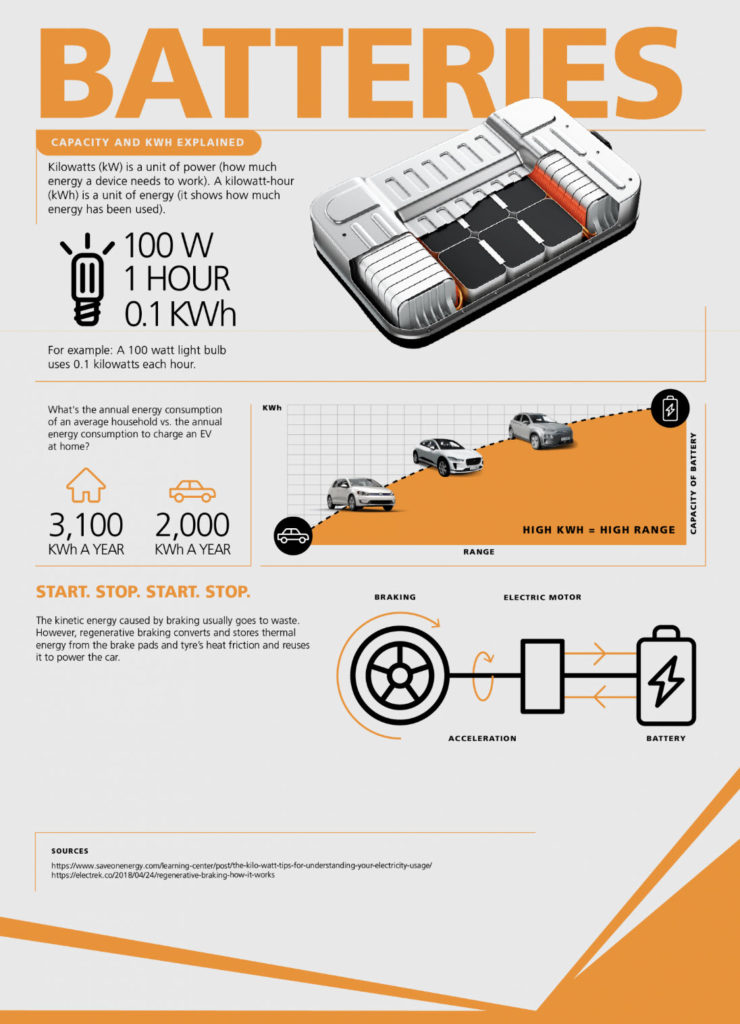
Just as conventional cars have big or small fuel tanks, lithium-ion batteries for electric cars come in different sizes. Rather than litres of fuel, their capacity is measured in kilowatt hours (kWh).
A typical 40kWh battery pack from a mainstream electric car might be enough to power it for 150 miles or more, while Tesla’s biggest 100kWh battery is good for 375 miles according to the WLTP standard – which aims to give a realistic estimation of cars’ real-world range or fuel economy.
WLTP is an abreviation of the Worldwide Harmonised Light Vehicle Test Procedure, which came in to effect in 2017 and was set up to measure fuel consumption,CO2 levels and other pollutant emissions from passenger cars.
It replaced the New European Driving Cycle (NEDC)
You might recognise the kilowatt hour from your electricity bill – it’s the industry standard charging unit. A 40kWh battery holds enough energy to power a typical home for four days!
How do you recharge an electric car battery?
You’ll get the fastest charge from a designated EV charging socket. These are rated in kW from about 3kW up to about 50kW – or 120kW on Tesla’s supercharger network. The higher the rating, the quicker they’ll restore your EV’s range.
The chargers most commonly fitted at a home or workplace are either 3kW ‘slow’ units, or 7kW ‘fast’ chargers capable of recharging an EV in 6-12 hours. The UK also has a growing network of public charging stations.
These are typically either fast chargers rated at up to 22kW, or ‘rapid’ chargers capable of delivering up to 50kW.
The fastest public charging stations can top an EV up to 80% of its range in as little as an hour – the last 20% is usually a bit slower, to prevent damage to the batteries as they get near to full charge.
Where no designated charging point is available, you can charge an electric car from a 13-amp domestic plug socket, but this can be very slow.
Because charging demands lots of power over a long period there may also be a risk of overheating or fire, so if you must do this you should have an electrician inspect the socket and wiring first.
How safe are electric car batteries?
The manufacturers of batteries for electric cars go to great lengths to make sure EV batteries are safe, fitting smart management systems to prevent overheating and other problems.
Batteries do get warm as they charge and discharge, but cars are designed to keep them cool – high performance EVs sometimes have liquid cooling systems to help.
Despite this, there have been some cases of electric cars catching fire, but very few of these incidents have been caused by battery failures.
More typically they’ve resulted from accidents or incidents that might have caused any vehicle to catch fire – such as the 2013 case of a Tesla Model S which hit a large piece of metal at high speed.
Commenting on that incident, which resulted in a limited fire, Tesla CEO Elon Musk pointed out that EV batteries contain only about a tenth of the energy of a tank full of fuel, limiting the danger they pose in an accident.
In fact, a 2017 study by the US National Highway Traffic Safety Administration found that the likelihood and severity of fires from lithium-ion batteries was comparable to, or slightly less than that from conventional vehicles.
As more electric vehicles take to the roads, we can be increasingly sure they’re as safe as the conventional cars they replace. By Graham Hill with huge thanks to EDF Energy
Share My Blogs With Others:These icons link to social bookmarking sites where readers can share and discover new web pages.
The possibilities of connected consumer vehicles are wide—and maybe a bit overwhelming. How can all these needs and wants be met at the same time?
One of the key challenges, if we are to move to driverless cars, is to enable the car to ‘think’. Whilst we may not be able to get a computer to think we can increase the speed of transfer and processing of data in order for the car to decide on a course of action without the involvement of a human brain.
So with the help of Ericcson let’s see how 5G can move the industry further.
5G Is Unbelievably Fast
Let’s start with the simple facts first: from a peak speed perspective, 5G is 100 times faster than 4G. This means that during the time it took to download just one piece of data with 4G the same could have been downloaded 100 times over a 5G network.
You can just imagine how this speed is important for a connected car when it comes to the amount of data that will need to be shared.
According to Dr. Joy Laskar, CTO of Maja Systems, future autonomous cars will generate nearly 2 petabits of data, which is equivalent of 2 million gigabits. “With an advanced Wi-Fi connection, it will take 230 days to transfer a week-worth of data from a self-driving car,” Laskar said.
With 5G, that time would go from 230 days to just over 2 days.
Lower latency
5G also means low latency, as in a matter of milliseconds.
Latency is the amount of time it takes to send information from one point to another. We encounter it everyday when we drive, and make a decision to break suddenly: latency is the amount of time between our brain sends the instruction to our foot to push down on the brake in this example.
When it comes to networks, we usually talk about the difference between the 20 milliseconds of our current 4G networks to the 1-5 milliseconds of the 5G network.
However, there’s even a larger difference when it comes to self-driving cars.
Human reaction speed is a bit above 200 milliseconds, leading to accidents every day. 5G’s 5 millisecond latency is practically real-time, which can be used to provide the user with additional safety information before it is visible, for example roadworks, fast moving emergency vehicles and visually hidden pedestrians about to cross the street.
These cooperative Advanced Driver Assistance Systems (ADAS) will help the driver to drive safely and avoid accidents.
5G’s increased reliability
Reliable communication means guaranteed delivery of time-critical information. For example, for remotely driving an autonomous vehicle in real-time in case its autonomous function fails.
There is no other alternative than cellular networks for enabling such services. 5G cellular technology is designed from day one for ultra-reliable communication with low latency to enable complex machine centric use cases, including autonomous cars in dense urban as well as high speed scenarios.
We expect adoption of fully autonomous capabilities in limited areas initially leveraging 5G signal coverage, with long-term evolution towards fully autonomous transport eco-system for maximizing safety, efficiency, and sustainability.
Exciting new case stories & innovation
Thanks to these three elements—increased speed, lower latency, and increased reliability—a whole new generation of exciting use cases can be unlocked.
In Europe, the 5GCAR project, led by Ericsson, is helping to develop an overall 5G system architecture.
As part of their work, they identified a number of new use cases that need 5G to unlock the future of transportation, from lane merge coordination to long range sensor sharing and increased protection for pedestrians.
Industry 4.0
5G won’t just make connecting cars easier: it will make manufacturing cars easier as well.
5G is about to change manufacturing as we know it through secure and almost real-time connectivity that will result in transformative productivity, speed and efficiency improvements. The car industry will be among the first to benefit.
But don’t just take our word for it: ask Mercedes-Benz. We recently teamed up with Telefónica Germany to enable 5G car production via a private 5G network for Mercedes-Benz at the company’s Sindelfingen plant in southern Germany.
Jörg Burzer, Member of the Divisional Board of Management of Mercedes-Benz Cars, Production and Supply Chain, said: “With the installation of a local 5G network, the networking of all production systems and machines in the Mercedes-Benz Cars factories will become even smarter and more efficient in the future. This opens up completely new production opportunities.”
So why should you care about 5G? Well, 5G connectivity has the potential to allow accident-free, stress-free and emission-free driving…and we think that’s a future we can all be excited about. By Graham Hill Thanks To Ericcson
Share My Blogs With Others:These icons link to social bookmarking sites where readers can share and discover new web pages.
Zap-Map has launched a service which allows EV drivers to use a single app to pay for charging across different networks.
Drivers having to use a multitude of apps and cards has long been seen as an obstacle to wider EV adoption, and the government wants it to be as easy for EV drivers to charge at public charge points as it is to pay for petrol or diesel.
Zap-Map said its Zap-Pay app will allow drivers to locate chargers, plan longer journey and pay for charging.
Engenie is the first network available on Zap-Pay, and Zap-Map says a “wave” of others will follow, including ESB EV Solutions, LiFe and Hubsta in the autumn, all using a pay-as-you-go tariff.
Zap-Pay will be rolled out across UK networks in 2021.
Ben Lane, CTO and joint managing director at Zap-Map, said: “More people than ever are buying an EV, but providing a seamless charging experience is essential to accelerate this shift, cut carbon emissions and clean our air.
“We already buy much of our shopping with the tap of a finger – Zap-Pay means that EV charging is now the same.
“No one should need dozens of accounts, apps and cards to charge their car. With one simple app, drivers can now simply plug in and the app manages the rest.”
The government last year set out its ambition that – to simplify the charging process – all newly-installed rapid and higher-powered charge points should provide debit or credit card payment by spring this year.
One year after the launch of its Road to Zero strategy, the government signalled it expects industry to develop a roaming solution across the charging network, allowing EV drivers to use any public charge point through a single payment method without needing multiple smartphone apps or membership cards.
Rachel Maclean, the UK Government Transport Minister, added: “It should be as easy for drivers to charge their vehicles at public charge points as it is to pay for petrol or diesel.
“This is why I have made services, such as the one launched today, a personal priority as we transition to zero emission vehicles.
“As the EV market continues to go from strength to strength, journey planning and paying with one app or membership card must also follow – Zap-Pay will help do just that, propelling us towards cleaner towns and cities and a zero emission future.”
At launch, Zap-Pay is live on ten Engenie charge points across four locations – Stratford, Gloucester, Chepstow and Bristol.
By the end of September, Zap-Pay will be rolled out across the Engenie network of 150-plus rapid charge points
In addition to delivering a way to pay for EV charging, Zap-Pay will provide live status updates, charging history, PDF VAT receipts and 24/7 customer support.
Last year, fuelcard provider Allstar launched its Allstar One Electric product which gives users access to a multi-brand network of charge points, including GeniePoint, Engenie, Source London, Alfa Power and ESB EV Solutions.
Earlier this year, Shell Fleet Solutions added a suite of e-mobility services to its fuel card offering, allowing customers to opt for a card that allows for payment of both fossil fuels and electric vehicle charging. By Graham Hill thanks to Fleet News
Share My Blogs With Others:These icons link to social bookmarking sites where readers can share and discover new web pages.
Petrol and diesel prices rose in August for the third consecutive month, but do not appear to be heading back to pre-pandemic levels, says RAC Fuel Watch.
The organisation says a litre of unleaded petrol rose 0.5p to 114.88p and diesel by 0.3p to 118.47p, meaning both fuels are still 13p a litre cheaper than they were at the end of January.
RAC fuel spokesman Simon Williams said: “Even though pump prices have risen for three consecutive months, August’s increase was slight sparing drivers any nasty shocks when they went to fill up.
“We had feared prices might rise more quickly as people started driving more after the lockdown but so far petrol has only gone up 9p a litre from its low of just under 106p in May which, it’s important to remember, is still 13p a litre less than it was in January.
“The short-term outlook for pump prices generally does not appear ominous for UK drivers despite a blip in the oil price at the end of August.
“The cost of a barrel of oil rose dramatically due to fears of a hurricane affecting supplies in the Gulf of Mexico, but fortunately there was no adverse impact to production as the hurricane was downgraded to a tropical depression and refineries were spared massive flooding.
“Our pump price forecast for the next fortnight shows petrol should come down by a penny while diesel ought to fall by around 5p a litre if retailers play fair and reflect the downward movement in the wholesale price properly.”
RAC Fuel Watch found the supermarkets increased their prices “very slightly” in August with petrol rising by a third of penny to 109.55p and diesel by over half a penny (0.63p) to 114.17p.
This makes a litre of unleaded at a supermarket more than 5p (5.33p) cheaper than the UK average, and diesel 4.3p cheaper per litre.
Asda started the month as the lowest cost supermarket petrol retailer but by the close Morrisons had edged marginally lower at 109.24p compared to Asda’s 109.43p.
On diesel, however, Asda was a penny a litre cheaper than its nearest rival, Morrisons, at 113.35p.
Yesterday, FairFuelUK, backed by the Road Haulage Association (RHA) and Logistics UK (FTA), has said it will ‘fight tooth and nail’ against rumoured plans to raise fuel duty.
Regional fuel price variation
Regional average unleaded pump prices
Unleaded
30/07/2020
27/08/2020
Change
UK average
114.27
114.71
0.44
London
115.38
116.04
0.66
East
114.60
115.22
0.62
Wales
113.19
113.73
0.54
Northern Ireland
111.20
111.71
0.51
South East
115.25
115.74
0.49
South West
114.10
114.57
0.47
North West
113.85
114.29
0.44
Scotland
114.13
114.53
0.40
East Midlands
114.11
114.48
0.37
North East
113.25
113.56
0.31
Yorkshire And The Humber
113.73
114.01
0.28
West Midlands
114.27
114.50
0.23
Regional average diesel pump prices
Diesel
30/07/2020
27/08/2020
Change
UK average
118.04
118.40
0.36
East
118.92
119.46
0.54
East Midlands
117.98
118.13
0.15
London
119.03
119.35
0.32
North East
116.85
117.07
0.22
North West
117.55
117.81
0.26
Northern Ireland
114.46
114.76
0.30
Scotland
117.81
118.18
0.37
South East
119.34
119.82
0.48
South West
117.97
118.37
0.40
Wales
117.05
117.72
0.67
West Midlands
118.15
118.47
0.32
Yorkshire And The Humber
117.32
117.62
0.30
By Graham Hill thanks to Fleet News
Share My Blogs With Others:These icons link to social bookmarking sites where readers can share and discover new web pages.
FairFuelUK, backed by the Road Haulage Association (RHA) and Logistics UK (FTA), has said it will ‘fight tooth and nail’ against rumoured plans to raise fuel duty.
Chancellor Rishi Sunak is considering ending a ten-year freeze on the tax in his Autumn Budget and could increase fuel duty by 5p, to pay for the coronavirus crisis, The Sun reported.
Talking directly to Rishi Sunak, MP Robert Halfon said: “Don’t let the taxpayer millions that funded half-price meals in August, be partly paid for, using an unnecessary hike in fuel duty.
“Such a needless rise in this levy will impact badly on the cost of living for families, increase inflation, hit businesses and jobs hard. It will even swell costs for our hard-pressed public services, including the NHS.”
Howard Cox, founder of FairFuelUK, said: “Do not make the world’s highest taxed drivers, the fiscal fall guys in a post pandemic recovery budget. Hiding behind a green driven agenda to hike a regressive tax will be disingenuous and hit low-income drivers hardest.”
FairFuelUK said that by putting more money in people’s pockets, the extra consumer spending to drive up GDP will help the economy recover.
Cox said: “On behalf of most drivers, business and private, do not screw the commercial and social heartbeat of our economy to mollify the environmental lobby and pay off your post pandemic debt.
“The UK needs to recover big and fast using incentives not punitive knee jerk extra taxes.”
“With more disposable income, we will all spend and spend. Businesses will flourish, and the extra tax cash from ensuing growth in the economy will flood into HM Revenue and Customs.”
Logistics UK is calling for a freeze on diesel and petrol fuel duty, in addition to a reduction in fuel duty for cleaner, lower carbon fuels to support the transition to a zero-emission industry.
Elizabeth de Jong, director of Policy at Logistics UK, said: “Logistics UK and its members are extremely concerned by rumours circulating of a significant fuel duty rise in the Autumn Budget.
“Logistics businesses have worked tirelessly during the pandemic to ensure the nation is supplied with all the goods and services it needs, all while operating at very tight margins and facing severe economic difficulties; a fuel duty rise would be a huge blow to their recovery.”
“The 5p per litre rise – as is speculated in the media – would increase operating costs significantly at a time when margins are most stretched and cash flow is a real problem for many businesses; the UK already pays one of the highest fuel duty rates in Europe.”
However, Claire Haigh, chief executive of Greener Journeys, wants road pricing introduced alongside ending the freeze in fuel duty.
Haigh said: “The Chancellor should take the opportunity of record low oil prices to increase fuel duty.
“The money should be ring-fenced to incentivise the take-up of cleaner vehicles and improve public transport.
“At the very least, the Chancellor should end the freeze and increase fuel duty in line with inflation.”
In the Budget announced in March, the Chancellor said the fuel duty freeze will continue for a further year, costing the the Treasury some £800 million in lost revenue.
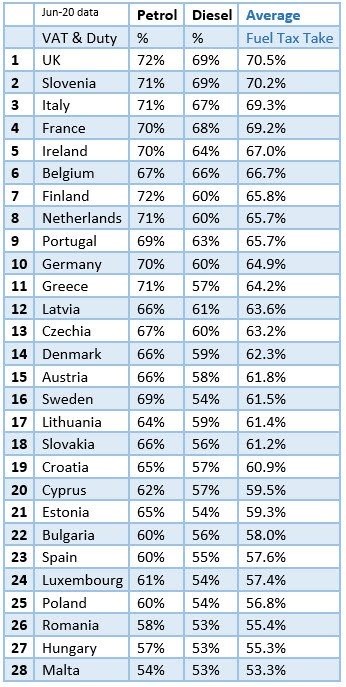
Fuel tax table – FairFuelUK
By Graham Hill thanks to Fleet News
Share My Blogs With Others:These icons link to social bookmarking sites where readers can share and discover new web pages.
The Government has launched a consultation to decide how it will stop vehicles from blocking pavements.
It outlines three options: improving the traffic regulation order process to make it easier for councils to prohibit pavement parking in their areas, giving councils powers to fine drivers who park on paths, and a London-style nationwide ban on pavement parking.
Transport Secretary Grant Shapps announced the plans in March. The proposals are designed to improve the lives of people with mobility or sight impairments, as well as parents with prams who may be forced into the road to get around parked cars.
Shapps said: “Parking on pavements means wheelchair users, visually impaired people and parents with push chairs can be forced into the road, which is not only dangerous, but discourages people from making journeys.
“A key part of our green, post-Covid recovery will be encouraging more people to choose active travel, such as walking, so it is vital that we make the nation’s pavements accessible for everyone.”
Recent research from the charity Guide Dogs shows that 32% of people with vision impairments and 48% of wheelchair users were less willing to go out on their own because of pavement parking, decreasing independence and contributing towards isolation.
In 2019 the Department for Transport concluded a review which looked at the problems caused by pavement parking, the effectiveness of legislation, and the case for reform.
It found that pavement parking was problematic for 95% of respondents who are visually impaired and 98% of wheelchair users.
The Transport Select Committee also recently conducted an inquiry into the issue, with the commitment to consult on proposals forming a key part of the Government’s response to its findings.
RAC head of roads policy Nicholas Lyes said: “Blocking pavements impacts most on those with disabilities and those pushing buggies and creates unnecessary danger for pedestrians. In short, nobody should be forced into stepping into the road to get around a vehicle that has taken up pavement space, so the Government is right to explore giving local authorities additional powers to enforce this types of selfish parking.
“However, outlawing pavement parking as a whole is more complex because not all streets in the UK are the same. For example, some drivers will put a tyre up the kerb on a narrow residential street to avoid restricting road access to other vehicles while still allowing plenty of space for pedestrian access. Therefore better guidance and a definition of what is and isn’t appropriate would be a more practical solution, rather than an outright ban.”
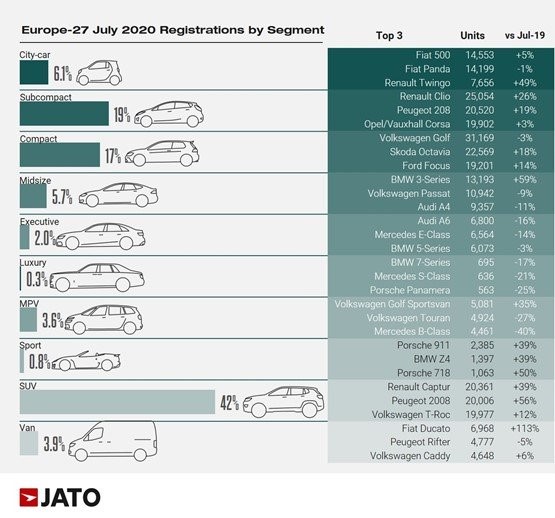
Covid-19’s impact on the economy is not denting interest in electric vehicles (EVs), with record-breaking registrations in Europe in July.
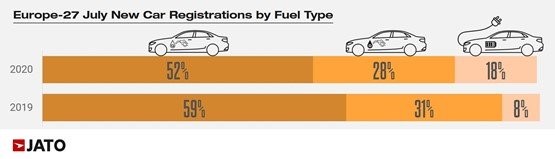
New analysis by Jato Dynamics shows that electric registrations, including hybrid and fully electric cars, were up 131% year-on-year to 230,700 – the first time it’s exceeded 200,00 units.
As a consequence, EVs accounted for 18% of total registrations in July, far greater than their market share of 7.5% in July 2019, and 5.7% in July 2018.
Felipe Munoz, global analyst at Jato Dynamics, said: “The rise in demand for EVs is strongly related to a wider offer that is finally including more affordable choices. The higher competition amongst brands is also pushing down prices.”
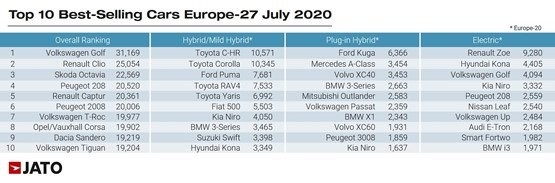
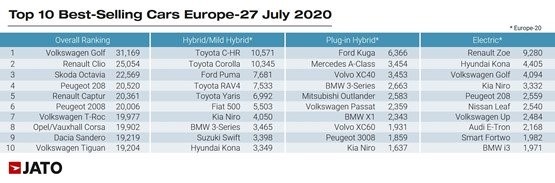
Half of the electric cars registered were powered by a hybrid engine (HEV), with demand soaring by 89%, with the mild hybrid versions of the Ford Puma and Fiat 500 contributing to this result.
Plug-in hybrid EVs (PHEVs) followed with 55,800 units, up by 365% from July 2019, helped by new models like the Ford-Kuga, Mercedes A class, BMW XC40 and BMW 3-Series.
Registrations for zero-emission battery EVs (BEVs) increased from 23,400 units in July 2019 to 53,200 a year later, and the offer increased from 28 different models available to 38.
New models like the Peugeot 209, Mini Electric, MG ZS, Porsche Taycan and Skoda Citigo helped drive demand.
TESLA DECLINE
However, Tesla posted a 76% decline to 1,050 units following shipping delays to Europe, as a consequence of production challenges in its Fremont, California plant.
Munoz said: “In contrast to the general trend of increasing demand for electric cars, Tesla is losing ground this year in Europe. Some of this can be explain by issues relating to the production continuity in California, but also by high competition from brands that play as locals in Europe.”
EUROPEAN CAR REGISTRATIONS
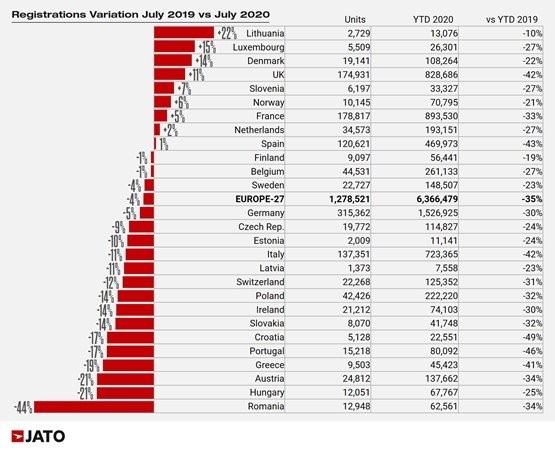
Jato’s data for 27 markets shows July saw the highest monthly volume figures so far this year – this also being the highest since September last year – with the industry registering 1,278,521 new passenger cars, down by only 4% month on month from 2019.
Munoz explained: “Both private and business consumers are responding to the better market conditions. If the current situation continues to improve, we could start to talk about a ‘V’ shaped recovery in the European car industry.
“However, there are still huge uncertainties regarding how and when the pandemic will finally come to an end, therefore caution remains.”
Volume levels since January fell by 35% to 6.37 million cars. However, demand recorded healthy figures in countries such as the UK, Denmark and France, alongside other small and midsize markets.
Much of this boost can be explained by an increased appetite for green cars, and more value offers, according to Jato.
Munoz continued: “The increasing demand predominantly favours SUVs, with a wider offering, including more electrified versions.”
SUV GROWTH
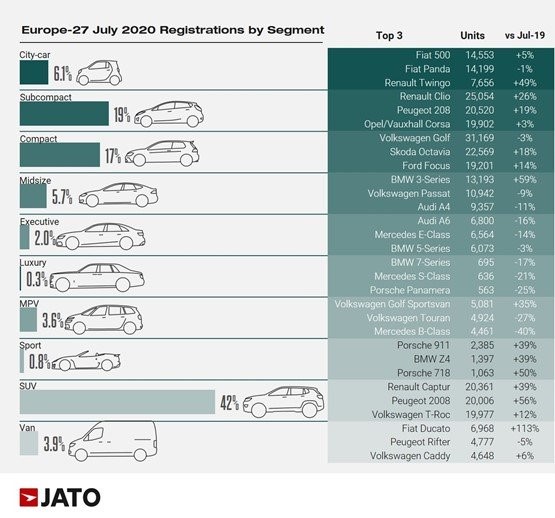
Last month, SUVs accounted for almost 42% of total registrations to 530,800 units, posting the highest monthly volume since July 2019.
“SUVs are usually more expensive than their car equivalents, so it is remarkable to see that despite the crisis, this is the only segment that has seen growth,” said Munoz. “They prove that with a competitive offer, consumers respond positively, despite the difficulties.”
Midsize SUVs were the only segment to record a decrease of 6%, a contrast to the positive results seen from small (up 9%), compact (up 4%) and large/luxury SUVs (up 14%).
At the same time, their demand has grown fast due to the electrification of many of the models available. In July, 48% of the electrified vehicles registered were SUVs.
VW GOLF REGAINS FIRST PLACE
The greater availability of the eighth generation Volkswagen Golf helped it regain first place in the rankings, that was previously lost in June.
However, it was not enough to offset the large drop posted by the seventh generation, as the average variation was negative. In contrast, the Renault Clio was able to record a 26% increase, as 89% of its volume corresponded to the latest generation.
The Skoda Octavia, Peugeot 208, Renault Captur and Peugeot 2008 also posted double-digit growth thanks to their recently launched new generations.
Other big improvers include the Hyundai Kona (up 56%), BMW 3-Series (up 59%), Mini Hatch (up 26%), Volvo XC40 (up 66%), BMW X1 (up 49%) and BMW 1-Series (up 52%).
The Renault Zoe and Kia Niro increased their registrations by 146% and 111% respectively.
Among the latest launches: Ford Puma (13,157 units at 24th position); Skoda Kamiq (8,736 units); Mazda CX-30 (5,494); Kia Xceed (5,201); Audi Q3 Sportback (4,183); Mercedes GLB (2,469); and Porsche Taycan (1,498).
VW GOLF REGAINS FIRST PLACE
The greater availability of the eighth generation Volkswagen Golf helped it regain first place in the rankings, that was previously lost in June.
However, it was not enough to offset the large drop posted by the seventh generation, as the average variation was negative. In contrast, the Renault Clio was able to record a 26% increase, as 89% of its volume corresponded to the latest generation.
The Skoda Octavia, Peugeot 208, Renault Captur and Peugeot 2008 also posted double-digit growth thanks to their recently launched new generations.
Other big improvers include the Hyundai Kona (up 56%), BMW 3-Series (up 59%), Mini Hatch (up 26%), Volvo XC40 (up 66%), BMW X1 (up 49%) and BMW 1-Series (up 52%).
The Renault Zoe and Kia Niro increased their registrations by 146% and 111% respectively.
Among the latest launches: Ford Puma (13,157 units at 24th position); Skoda Kamiq (8,736 units); Mazda CX-30 (5,494); Kia Xceed (5,201); Audi Q3 Sportback (4,183); Mercedes GLB (2,469); and Porsche Taycan (1,498). By Graham Hill thanks to Fleet News
Share My Blogs With Others:These icons link to social bookmarking sites where readers can share and discover new web pages.
The Government has launched a consultation that could lead to the introduction of cars with Level 3 autonomous driving capabilities by next year.
The Call for Evidence will look at the Automated Lane Keeping System (ALKS) – an automated system which can control the steering, brakes and acceleration of the vehicle (currently at low speeds of up to 37mph), keeping it in lane.
This technology is designed to enable drivers – for the first time ever – to delegate the task of driving to the vehicle in certain situations, such as traffic jams.
Audi developed the technology for its A8 model, as ‘Traffic Jam Pilot’, and planned to introduce it once legislation allowed, but has since confirmed that it won’t be offered on the current model.
When activated, the system keeps the vehicle within its lane, controlling its movements for extended periods of time without the driver needing to do anything. The driver must be ready and able to resume driving control when prompted by the vehicle, however.
The Government is seeking views from industry on the role of the driver and proposed rules on the use of this system to pave the way towards introducing it safely in Great Britain, within the current legal framework.
The Call for Evidence will ask whether vehicles using this technology should be legally defined as an automated vehicle, which would mean the technology provider would be responsible for the safety of the vehicle when the system is engaged, rather than the driver.
It also seeks views on Government proposals to allow the safe use of this system on British roads at speeds of up to 70mph, where technology allows.
Transport Minister Rachel Maclean said: “Automated technology could make driving safer, smoother and easier for motorists and the UK should be the first country to see these benefits, attracting manufacturers to develop and test new technologies.
“The UK’s work in this area is world leading and the results from this Call for Evidence could be a significant step forward for this exciting technology.”
Following the approval of ALKS Regulation in June 2020 by the United Nations Economic Commission for Europe (UNECE) – of which the UK is a member – the technology is likely to be available in cars entering the UK market from Spring 2021.
The Government is acting now to ensure that regulation is ready where necessary for its introduction.
Edmund King, AA president, added: “Over the last fifty years leading edge in-car technology from seat belts to airbags and ABS has helped to save thousands of lives.
“The Government is right to be consulting on the latest collision-avoidance system which has the potential to make our roads even safer in the future.”
Mike Hawes, SMMT chief executive, said: “Automated technologies for vehicles, of which automated lane keeping is the latest, will be life-changing, making our journeys safer and smoother than ever before and helping prevent some 47,000 serious accidents and save 3,900 lives over the next decade.
“This advanced technology is ready for roll out in new models from as early as 2021, so today’s announcement is a welcome step in preparing the UK for its use, so we can be among the first to grasp the benefits of this road safety revolution.”
In late 2020, the Government plans to launch a public consultation on the detail of any changes to legislation and the Highway Code that are proposed, which will include a summary of responses to this Call for Evidence. By Graham Hill thanks to Fleet News
Share My Blogs With Others:These icons link to social bookmarking sites where readers can share and discover new web pages.
Used car values for both petrol and diesel stayed strong in August, but used electric vehicles (EVs) and some hybrids continue to struggle, says Cap HPI.
For the third month in a row, values for EVs have reduced, it reports, with feedback from the market suggesting that EVs continue to look expensive compared to their internal combustion engine equivalents.
For the volume models, price pressure continues to be around the three-year-old EVs, which are coming back into the market, says Cap HPI.
Derren Martin, head of valuations UK at Cap HPI, explained: “2017 saw an increase of around 40% in EV new car registrations over the previous year, so it is no surprise that as more vehicles come back into the used market, values will be exposed to supply and demand dynamics.
“Some examples of models that have dropped in value at that age are the BMW i3, Kia Soul and Nissan Leaf.”
Some hybrids that have moved down in value at the three-year point are the Toyota Auris, Toyota Prius, Lexus LS and Mercedes-Benz S-Class. Some of this is due to a reduction in activity in the private hire industry, where demand for these vehicles has historically been strong.
Overall, pricing experts at Cap HPI say that the used car market remains strong in August, with values up by a minimal 0.2% at the three-year point, which equates to around £30 on average.
So far this year, there has only been one month where values dropped and that was during the run-up to lockdown in March.
On average, used car values when calculating the same models at the same age and mileage point as a year ago, are some 7% higher than they were in August 2019.
Martin said: “The used car retail market has remained robust throughout August, making it the third consecutive month since car showrooms reopened with remarkably strong consumer demand.#
“Looking at the retail advertised data received by Cap HPI, it is clear that across all mainstream sectors, prices have edged up slightly on average. This is unsurprising since trade prices have increased overall and consumer demand is so strong.
“If ever there was a time to increase asking prices and maintain margins, the last three months has been it. These small average increases have not adversely affected days-to-sell.”
Martin says that consumer demand is still being driven by people wanting to avoid public transport, buyers downgrading and savers looking to upgrade.
The SUV sector saw smaller models increase in price, while larger ones were under more pressure due to significant availability, meaning prices dropped slightly.
The trend was most acute at younger ages, and at six-months-old, larger SUVs have fallen by around £225 on average, whereas smaller examples have increased by around £150.
The Citroen C4 Cactus, Dacia Duster and Renault Captur have increased in value the most of these smaller models. There is generally a very different customer for these two sizes of SUV.
Martin concluded: “Since the unexpected upturn in June, particularly at older ages, Live values during July and August have stayed very stable, as we predicted.
“September will result in more part-exchanges and fleet returns hitting the market, as new car buyers opt for the 70-plate, but it is unlikely that volumes will be as high as in previous years.”
He continued: “The reduced volumes of cars would typically lead to strong prices. However, with the furlough scheme coming to a close and an economic downturn continuing, consumers are likely to become more prudent.
“The pent-up demand from inactivity during lockdown will come to an end, as will people buying to avoid public transport – that was always likely to be a short-term dynamic. Those upsizing due to grants or savings made during the last few months will also wane.
“In short, predictions are that the next few weeks will remain stable, as there is currently no weakness in the market. However, from the end of September and into October, prices are likely to come under more pressure. What is clear is that viewing valuations in real-time and keeping vigilant will become more important than ever.” By Graham Hill thanks to Fleet News.
Share My Blogs With Others:These icons link to social bookmarking sites where readers can share and discover new web pages.