Motorists caught drink-driving as the post-lockdown rush to the pubs starts, could end up being £70,000 out of pocket when all the personal financial costs of their conviction are taken into account, a road safety charity has warned.
IAM Roadsmart – formerly the Institute of Advanced Motorists – points out that those who are convicted of a drink-driving offence face fines, legal fees, higher car insurance premiums, alternative transport costs and potential loss of earnings.
Research by the organisation suggests fines associated with the conviction could be £5,000, the previous maximum fine – though a conviction now brings a limitless financial penalty. Legal fees following conviction after a not guilty plea come in at an average of £11,000, while increased car insurance premiums typically run to £13,500 over five years, the period for which drivers must tell insurers about a conviction.
During a ban, offenders can also expect to rack up £2,000 in taxi or public transportation bills while they don’t have a car, plus a loss in earnings of £38,500 over 15 months is possible based on the average UK salary, and unemployment following a conviction.
Official Government figures show there were 250 fatal drink-driving accidents in 2017 – the highest number since 2010. This was despite 2017 only seeing 326,000 roadside breath tests, compared with 737,000 in 2010.
Around a fifth of drink-driving convictions and a third of roadside breath tests take place the morning after the night the suspect has allegedly been drinking, between the hours of 7am and 1pm.
December 2018 saw a 16 per cent rise in drink-driving offences compared with the same month the previous year. Typically, around 20 per cent of drink-driving offences for any given year take place in December.
Drink-driving kills, so during the post COVID celebration period don’t be tempted to have a drink before getting behind the wheel – it’s irresponsible and incredibly dangerous.”
Neil Greig, director of policy and research at IAM Roadsmart, said: “Drink-driving wrecks lives and is totally unacceptable in any circumstance. However, some people still think they are safe to drive when they’ve had just a couple of drinks or are using home (lockdown) measures, which can quickly push them over the limit.
“The £70,000 impact of being convicted of drink-driving is very sobering. This should be more than enough – let alone the thought of causing any other suffering for yourself, your family or the other people you put at risk on the road – to stop those drivers who are tempted to have an extra drink and get behind the wheel.”
We are all desperate to get out and socialise with friends and family in pubs and bars but don’t let the celebrations lead to you having a few too many and getting behind the wheel of your car. There have already been too many deaths and even if you don’t have an accident don’t find yourself counting the cost of losing your licence. By Graham Hill thanks to Auto Express.
Share My Blogs With Others:These icons link to social bookmarking sites where readers can share and discover new web pages.
DVSA says reducing emissions will help meet climate-change targets and improve air quality; MoT tests will also be updated to check modern safety kit.
The MoT test is to be made stricter, with cars having to meet more stringent emissions targets in the future, according to the Driver and Vehicle Standards Agency (DVSA). The annual roadworthiness check will also be updated to ensure recent developments in safety technology are inspected to ensure proper operation.
Neil Barlow, head of MoT policy at the DVSA, said: “The MoT will need to change if it is to stay useful, both in terms of safety systems and emissions.”
“Manufacturers put loads of effort into designing some pretty whizzy tech that goes on modern cars with internal combustion engines”, Barlow said. “We will probably want to be better at checking that those systems will be working as designed.”
Barlow added that while “there isn’t anything immediate” in the pipeline with regard to toughening up the test, he is “keen that we get towards” tougher emission tests and inspections of safety systems.
The MoT test is unlikely to become so strict that cars would have to meet the emission limits they hit when they went through the type approval process, as engine wear and other aspects of degradation mean cars often get less clean as they age.
“Obviously that won’t be back to factory design, and has to be a solution that’s cost-effective for industry”, Barlow said. He added: “There’s no change planned that there’s a date for, but this is the direction of travel – emissions will be an important thing to check….It probably is clear as we look ahead, that if we want to keep driving down overall emission levels…we’ve got to check that cars are performing as they were designed.”
Such a toughening-up of emissions checks would partly be driven by national emission targets for the collective benefit of the country, Barlow said: “Those Government targets are for us, aren’t they? They’re for us and our health. It’s not about fulfilling draconian Government aims, it’s about improving our health, and if we can keep vehicles working better as they were designed, that must be a good thing.”
Advanced safety systems to be checked at MoT time
Turning to safety, all new cars sold in Europe from 2022 will have to have several safety systems, including intelligent speed assistance (a form of speed limiter) as well as autonomous emergency braking and lane-keeping assistance. Systems such as these, where fitted, could form part of the MoT test in the future, though which technologies would be checked have yet to be decided.
“We talk about emergency braking”, Barlow said. “From a motorists perspective, you might say ‘well I would expect that to be tested’. But what are its failure modes? What do we find with the experience of this being in service for a while? Does it actually go wrong? In what ways does it go wrong?
“The stuff we want to test is the stuff that does go wrong. There’s no point in testing stuff that proves to be incredibly reliable. I’m not saying that [AEB] is one or the other of those.. but we need to make sure it’s evidence based, what we include in the test.”
Barlow stressed that fundamental checks such as ensuring tyre-treads are of the correct depth would always be core to the MoT, saying: “The basics are really important, and we don’t want to lose those”. By Graham Hill thanks to Auto Express.
Share My Blogs With Others:These icons link to social bookmarking sites where readers can share and discover new web pages.
In the UK we are constantly talking about EV’s and how we will only be able to buy an electric vehicle from 2030 and therefore, along with the rest of the developed countries, save the planet! But what about India and Africa and even America where some people travel hundreds of miles to buy a loaf of bread? Will charge points be available in the middle of a desert or jungle?
Porsche believe that this will be a problem and are developing a solution that keeps the internal combustion engine (ICE). Here’s a report on what they are doing.
Research into replacing fossil fuels with synthetic efuels could mean there’s life in the combustion engine yet.
Batteries are the main power source that vehicle manufacturers and governments around the world consider feasible for new cars in the future, but Porsche is to build a factory producing eFuels, hinting that carbon-neutral synthetic petrol and diesel have a role to play, too.
Synthetic fuels, or eFuels, are compatible with conventional internal combustion engines, and can be produced via carbon-neutral processes that potentially offset the carbon dioxide (CO2) generated when the fuels are burnt.
Porsche is teaming up with German industrial giant Siemens, energy firms Enel and AME, and petroleum company ENAP to build a pilot factory in Magallanes, southern Chile.
The plant will initially produce just 130,000 litres of eFuel by 2022, with a target of 55 million litres a year by 2024, and 550 million litres by 2026. Those amounts are minuscule, given that figures from the Petrol Retailers’ Association show that the UK alone uses 46.5 billion litres of petrol and diesel every year.
But Porsche’s project indicates that reports of the death of internal combustion-engined cars may be exaggerated. Synthetic fuels are often talked about as an alternative for aircraft, ships, heavy goods and construction vehicles, where batteries, which lack the energy density of conventional fuel, are not currently viable. Porsche’s Chilean eFuels will be used in motorsports, at Porsche Experience Centres and in production cars.
The Haru Oni plant in Chile will take advantage of the region’s strong winds to generate clean electricity from turbines built by Siemens. Fuel will be made at the plant by using wind power to dissociate hydrogen and oxygen molecules from water, with CO2 filtered from the air being combined with the hydrogen to make synthetic fuel.
The factory is being funded with an initial 20 million Euros (£18m) from Porsche, plus eight million Euros (£7.2m) from the German government. Porsche’s chief executive, Oliver Blume, said eFuels are a “worthwhile complement” to electric cars, and “an additional element on the road to decarbonisation”.
“As a maker of efficient, high-performance engines, we have broad technical expertise,” Blume added. “We know what fuel characteristics our engines need in order to operate with minimal impact on the climate.”
Christian Bruch, CEO of Siemens Energy, called the German government’s support for the project “an important signal”.
What are efuels?
Petrol and diesel are hydrocarbons – they are composed of hydrogen and carbon atoms. But while conventional fuels are derived from oil, eFuels get their hydrogen from water and carbon from the air, with these elements then combined to mimic the structure of petrol, diesel and other oil-derived fuels.
The energy used to create synthetic fuels can be renewable, and while burning them generates carbon dioxide (CO2), capturing carbon from the atmosphere during synthesis can offset this. eFuels can also be a good way of storing energy generated by renewable sources during times of low demand.
Synthesising eFuels is expensive, though. A single litre of diesel eFuel costs £4 before taxes, according to the Royal Society scientific institute. While such fuels have been around for a century or so, producing them on a meaningful scale globally is also a challenge.
Costs could be reduced with further development and economies of scale, but critics highlight that in addition to the significant expense they bring, the cleanliness and carbon neutrality of eFuels relies on several assumptions being made about their production, as well as how and where they are burnt. By Graham Hill Thanks To Auto Express.
Share My Blogs With Others:These icons link to social bookmarking sites where readers can share and discover new web pages.
According to EV information website Zap-Map, there are 21,068 public chargers in the UK, of which 3908 are rapid chargers and 11 are ultra-rapid. If you don’t mind using one of the slower options, you should still be able to charge for free or a minimal fee.
Pod Point and Source London are among the larger companies that offer free charging (in some cases after a small initial fee) at certain locations.
It’s also worth investigating which smaller public charging companies are operating in your area. The Energise network only has a small number of charging points in southeast England, but once you’ve paid a £1 connection fee, its units are free to use.
Kent County Council also has a small number of chargers available on the same basis. There are similar options in many parts of the UK.
Another low-cost option is the ZeroNet network, which is run by the Zero Carbon World charity. Chargers are mostly in the car parks of hotels, restaurants and other hospitality industry locations, and many businesses offer free charging for customers, although parking charges might be payable while the charger is in use.
Potentially the cheapest way to charge away from home is to use the Zap-Home and Zap-Work network of chargers; the former are at EV owners’ homes and the latter on the premises of small businesses. Coverage is good all over the UK and the chargers can be used by anyone who’s registered with Zap-Map. Many are free, and those that aren’t free cost £3 to £5 per charge.
New code of practice for home charger installers
The Electric Vehicle Consumer Code for Home Chargepoints (EVCC) is a code of practice that’s been introduced for companies installing EV chargers to consumers. It has been designed to ensure that manufacturers, suppliers and installers of home chargers meet specific high standards so that consumers can have the confidence to use them for installation.
Companies signing up to the EVCC commit to no-pressure selling techniques and a high level of customer service and aftersales care. If a customer has a problem with an EVCC-registered company, they can go through a formal complaint process and use a free mediation service provided by Renewable Energy Assurance Ltd, which is a non-profit organisation with experience in operating codes of conduct for renewable energy companies.
Car insurance for electric cars
LV is the first mainstream car insurer to offer a policy specifically for owners of electric vehicles.
The policy includes a roadside recharging service in case your car runs out of juice anywhere in the UK (courtesy of a tie-up with specialist assistance provider AFF) or free recovery to the nearest charging point. Using these services won’t affect your no-claims discount.
The policy also provides accidental damage, fire and theft cover for your car’s battery pack, plus your charging cables, wallbox and adapters. By Graham Hill thanks to What Car
Share My Blogs With Others:These icons link to social bookmarking sites where readers can share and discover new web pages.
RAC patrols attended almost 1,500 call-outs in the last three months of 2020 for pothole related breakdowns, despite reduced traffic volumes as a result of the coronavirus pandemic.
Analysis of fourth quarter RAC breakdowns for National Pothole Day reveals there were 1,461 call-outs for damaged shock absorbers, broken suspension springs and distorted wheels reveals, representing nearly 1% (0.9%) of all RAC attendances.
While the pothole proportion of all RAC breakdowns is down on the previous quarter, it is identical to the same period in 2019 and slightly higher than 2018 (0.8%). The RAC says this is concerning given the lower traffic volumes brought about by coronavirus travel restrictions as in theory, less traffic should mean less damage to road surfaces.
Looking across the UK, the South East saw the largest number of vehicle problems most likely to be caused by potholes at 242 – equating to 17% of all the pothole-related call-outs dealt with by the RAC’s expert local patrols.
While this could be attributed to the region being more densely populated, this is unlikely to be the case for the South West which saw 12% of all the RAC’s pothole breakdowns (173), almost the same number as the North West (170).
The RAC’s Pothole Index, which is a long-term indicator of the health of the UK’s roads available, suggests the overall standard of road surfaces has been improving since the start of 2019. Having begun at 1.0 in 2006, the index currently stands at 1.44 which means drivers are nearly one and a half times as likely to experience damage caused by a pothole as they were 15 years ago.
RAC head of roads policy Nicholas Lyes said: “While the actual number of pothole-related call-outs our patrols have attended is down significantly compared to the same time in 2019 due to lower traffic volumes in the pandemic, they account for the same proportion (0.9%) of all RAC rescues which clearly demonstrates there are still far too many poorly maintained roads.
“We realise council budgets are under incredible pressure due to the coronavirus, but we badly need the Government to recognise the significance of local roads and take a fresh look at how to fund them.
“The Government’s approach of allocating funding to councils from various pots on an annual basis means authorities are always having to play catch-up by fixing potholes rather than focusing on preventative maintenance. We would prefer to see them make five-year funding settlements which would allow councils to make longer-term plans for their roads.
This could be funded by introducing a similar scheme to the National Roads Fund which ringfences money paid in vehicle excise duty by road users in England for the upkeep of major roads.” By Graham Hill thanks to Fleet News
Share My Blogs With Others:These icons link to social bookmarking sites where readers can share and discover new web pages.
Car use has fallen by more than a fifth in the UK during the latest lockdown – nowhere near the decline seen in March – new data from the RAC shows.
During the first week of the latest lockdown, data from RAC Black Box Insurance customers shows a 22% year-on-year reduction in car use, which puts traffic volumes are at a similar level to the middle of last May.
It was May when restrictions first started to be eased, with people encouraged to return to workplaces if they were unable to work from home.
The quietest week for traffic since the start of the coronavirus pandemic was the second week of the first coronavirus lockdown (w/c March 30), when RAC data showed a 41% reduction in car usage compared to normal.
This contrasts with the first full week of September (w/c September 7) when the RAC recorded its highest levels of car use of the year as schools in England returned after the summer holidays, with traffic back to normal levels.
Rod Dennis from the RAC said: “The feel of this latest nationwide lockdown is very different to that which was first imposed in 2020, with greater numbers of people working in Covid-secure workplaces, more shops offering click-and-collect services, and more children of keyworkers attending schools.
“In addition, with so many avoiding public transport, there will inevitably be far more people opting for the safer environment of the car. Together, these differences help account for the busier roads.”
A further sign that vehicles are being used more during this latest lockdown is the extremely high number of breakdowns attended by RAC patrols so far this year.
Incredibly, the RAC had its busiest start to a New Year on record with 8% more breakdowns handled over the first four days of January compared to the same period in previous years.
While the cold weather and the fact cars were used even less than normal over Christmas as a result of the coronavirus will both have been major factors, the data confirms that drivers are still deeming it necessary to use their vehicles for essential trips in 2021.
Dennis said: “It’s vital drivers think carefully before using their vehicles and ensure they’re only venturing out for essential trips as specified by government guidelines.
“Every unnecessary journey increases the chances of a breakdown, or worse a road traffic collision, and risks adding to the pressures being experienced by our emergency and healthcare workers.” By Graham Hill thanks to Fleet News
Share My Blogs With Others:These icons link to social bookmarking sites where readers can share and discover new web pages.
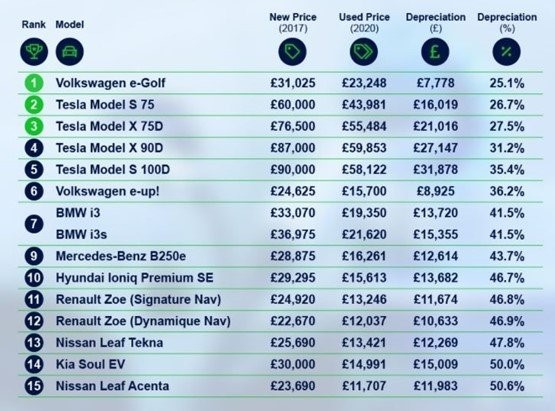
The Volkswagen e-Golf has achieved the strongest residual value in the electric car market, according to a study by CompareTheMarket.
The electric version of the Golf was ranked the top EV with the lowest depreciation of £7,778 (25.1%) after three years, with used models selling for an average price of £23,248 – three quarters of its new price three years ago.
It is followed by two Teslas, the Model S 75 (26.7% depreciation) and Model X 75D (27.5%)
The research reveals how much electric and hybrid cars deprecate in value by comparing ‘new’ prices for the most common plug-in and hybrid vehicles to their used prices to reveal the vehicles which hold their value the most.
As Teslas are among the most expensive EVs and benefit from regular software updates, it could help the models retain their value, CompareTheMarket said.
According to the research, the models that were ‘the worst’ at holding their values were the Hyundai Ioniq Premium SE, which has a depreciation of £13,682 (46.7%), Renault Zoe Signature Nav, which has a depreciation of £11,674 (46.8%) and the Renault Zoe Dynamique Nav which depreciates by £10,633 (46.9%).
Find out about the latest EVs and plug-in hybrids coming to market in 2021 in our latest digital edition of Fleet News.
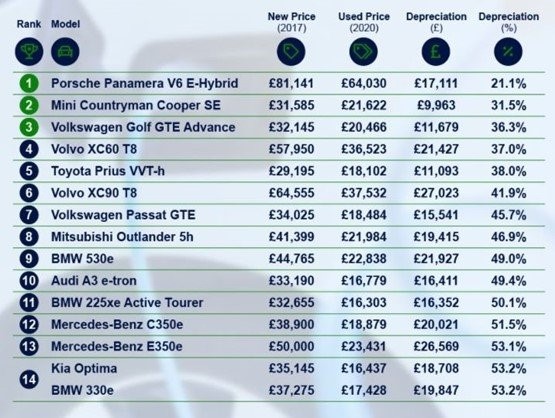
When looking at plug-in hybrids, the Porsche Panamera E-Hybrid was found to have ‘the best’ resale value over the last three years, with depreciation of 21%.
This is followed by Mini’s hybrid offering, the Countryman Cooper SE (31.5%) and another version of the VW Golf, the GTE Advance (36.3%).
The hybrids found to have the highest depreciation were the Kia Optima, which depreciates by £18,708 (53.2%), the Mercedes-Benz E350e (53.1%), Mercedes-Benz C5350e (51.5%), BMW 225xe Active Tourer (50.1%) and the Audi A3 e-tron (49.4%).
CompareTheMarket said, ‘the worst’ performing hybrids lose more of their value than electric cars, whereas ‘the best’ performing electric cars do not hold their value as well as hybrids.
Dan Hutson, head of motor insurance at CompareTheMarket, said: “EVs are becoming increasingly popular, and now that they have been in circulation for a while we are seeing them come onto the second-hand market, which is great news for people wanting to buy an EV or hybrid at a lower price.
“As the technology improves and cars become cheaper, we are sure to see greater adoption, which is the greener step forward that we need.” By Graham Hill thanks to Fleet News
Share My Blogs With Others:These icons link to social bookmarking sites where readers can share and discover new web pages.
Tesla expanded its UK dealer network to 25 sites during 2020 and plans further network growth in 2021.
It represents a U-turn on company founder Elon Musk’s 2019 declaration that Tesla would close all its showrooms in favour of an online-only sales model.
The latest strategy follows reports of Tesla’s value reaching a record £516 billion, making it worth more than Toyota, VW, Hyundai, GM and Ford combined.
Six new Tesla locations were opened across the UK in 2020, with new showrooms appearing in Newcastle, Winchester, Gatwick, Belfast, Birmingham and Chelmsford.
A new site in Glasgow is also poised to open this year.
The Californian car maker says it has boosted its aftersales operation significantly and now has 15 service locations across the country, with more than 300 service team members.
This has led to a 130% increase in available service appointments and a 60% reduction in waiting times for appointments, according to the brand.
Tesla says it can reduce the time vehicles need to be in a workshop using remote diagnosis and can perform a service four times faster than conventional garages, enabling it to operate with a smaller footprint.
The brand achieved almost 25,000 registrations during the year, outperforming established brands such as Fiat, Mazda, Porsche and Suzuki.
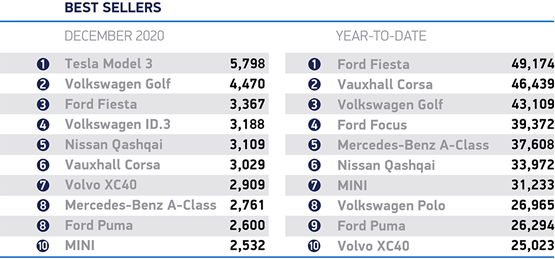
Its Model 3 topped UK monthly sales charts twice during the year – once in April and then in December.
The vast majority of sales are the Tesla Model 3 – Tesla insiders suggest the Model 3 accounts for approximately 90% of UK Tesla sales YTD. That makes the Model 3 the UK’s best-selling battery electric vehicle (BEV), and the UK’s second best-selling compact executive model behind the BMW 3 Series.
Tesla’s UK Supercharger network also grew during 2020 with the addition of 180 new chargers in 20 locations, bringing the total to more than 600 chargers in 70 locations. By Graham Hill thanks to Fleet News
Share My Blogs With Others:These icons link to social bookmarking sites where readers can share and discover new web pages.
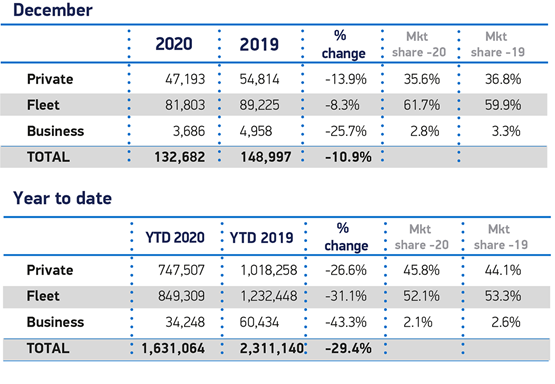
I don’t think that it would surprise anybody that new car registrations were drastically down in 2020 but the interesting statistic is the split of cars. Private registrations suffered the least with the larger fleets doing slightly better but the business registrations were down 43.3% (see chart below).
However, I would suggest that whilst these figures look dreadful many customers, both corporate and consumer extended lease contracts last year and those that had to change their cars decided to go down the used car route as there was a grave lack of new car stock available.
Here is the report and breakdown of the figures for 2020:
Fleet and business registrations fell by 32% in 2020, with 400,000 fewer company cars registered compared to 2019, but fleets were behind a massive increase in the uptake of electric vehicles (EVs).
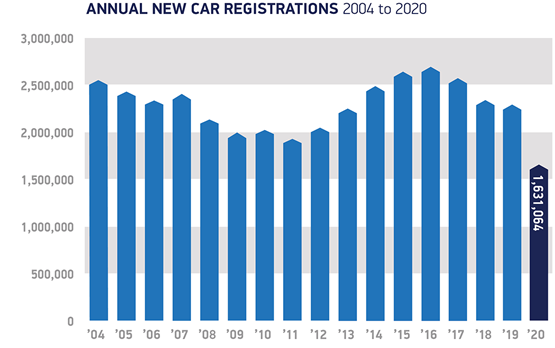
The new figures, published today by the Society of Motor Manufacturers and Traders (SMMT), show overall demand in the new car market fell to the lowest level since 1992.
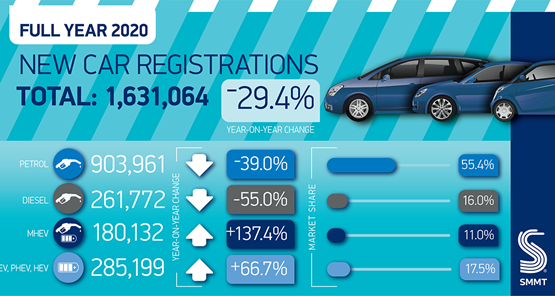
They also reveal the continuing decline of diesel, with 55% fewer diesel cars registered in 2020 compared to 2019.
The SMMT sales figures show there were 883,557 cars registered to fleet and business during 2020, compared to almost 1.3 million vehicles the previous year.
However, the latest sales data also reveals that in December, fleet and business registrations were only 9% down compared to December 2019.
It suggests a recovering company car market, with 85,489 fleet and business registrations, equating to 64% market share.
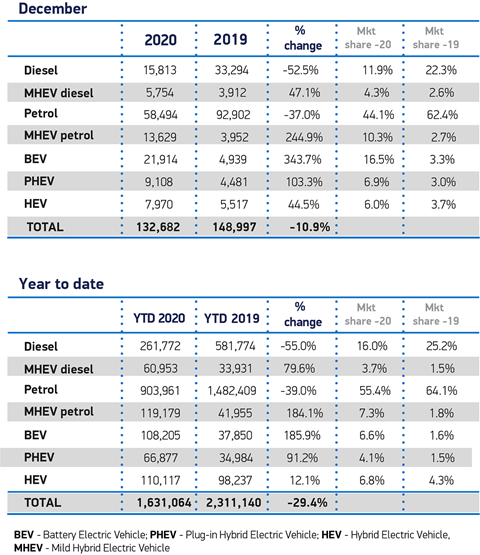
Overall, the UK new car market fell by almost a third (29%) in 2020, with annual registrations dropping to 1,631,064 units.
Against a backdrop of Covid-19, the industry suffered a total turnover loss of some £20.4 billion, with private vehicle demand falling by 27% overall, amounting to a £1.9bn loss of VAT to the Exchequer, says the SMMT.
Mike Hawes, chief executive of the SMMT, says that 2020 will be seen as a “lost year” for automotive, with the sector under “pandemic-enforced shutdown” for much of the year and uncertainty over future trading conditions taking their toll.
However, he said: “With the rollout of vaccines and clarity over our new relationship with the EU, we must make 2021 a year of recovery.
“With manufacturers bringing record numbers of electrified vehicles to market over the coming months, we will work with Government to encourage drivers to make the switch, while promoting investment in our globally-renowned manufacturing base – recharging the market, industry and economy.”
Demand fell across all segments bar specialist sports, which grew by 7%, although Britain’s most popular class of car remained the supermini, retaining a 31% market share despite a 26% decline in registrations.
Meanwhile, although falling by a combined 33%, petrol and mild hybrid (MHEV) petrol cars made up 63% of registrations, while diesel and MHEV diesels, down 48%, comprised almost a fifth of the market.
Fleets adopt more electric vehicles
Battery and plug-in hybrid electric cars accounted for more than one in 10 registrations – up from around one in 30 in 2019.
Demand for battery electric vehicles (BEVs) grew by 186% to 108,205 units, while registrations of plug-in hybrids (PHEVs) rose 91% to 66,877.
Most of these registrations (68%) were for company cars. Gerry Keaney, chief executive of the British Vehicle Rental and Leasing Association (BVRLA), says that 2020 has been a “tipping point” for EV uptake and demonstrates what can be achieved when Government works closely with fleets to develop a set of powerful grants and tax incentives and invest in a robust public charging network.
“While only a handful of EVs were on sale in 2011, there are now more than 100 models available.” Poppy Welch, head of Go Ultra Low
“The latest BVRLA data shows that the fleet sector continues to lead the charge towards zero emission motoring, with battery electric vehicles responsible for 21% of company car registrations in the three months to October 2020.”
With so much uncertainty surrounding the impact of EU Exit, coronavirus and the economic downturn, Keaney says that the Government must do everything it can to support the vehicle buyers that underpin the UK’s new car market.
“With the next Budget just weeks away, the Chancellor must continue to ring-fence the long-term grants and tax incentives that make electric vehicles affordable,” he said.
“He must also resist the urge to pile more motoring tax increases on fleets and drivers that have yet to make the transition to zero emission motoring.
“Many of these businesses and individuals are struggling financially and can’t yet find an electric vehicle that meets their needs or budget.”
More than 100 plug-in car models are now available to UK buyers, and manufacturers are scheduled to bring more than 35 to market in 2021 – more than the number of either petrol or diesel new models planned for the year.
Poppy Welch, head of Go Ultra Low, believes that in the context of the new car market, 2020 will be remembered as the breakthrough year for EVs.
“After a ninth successive year of growth in EV registrations, we’ve now seen market share rise to 10.7%,” she said.
“This has been made possible, in large part, by the Government’s ongoing support and long-term vision, combined with the automotive industry’s commitment to developing a wide range of zero-emissions vehicles that are clearly convincing the public with their performance, financial and environmental credentials.
“While only a handful of EVs were on sale in 2011, there are now more than 100 models available.”
When will the market get ‘back on its feet?
Ashley Barnett, head of consultancy at Lex Autolease, said that the 29% year-on-year drop really “hammers home” just how challenging the coronavirus pandemic has been for the motor industry.
“The market will take some time to get back on its feet,” he said. “How long that is remains to be seen.”
He added: “The growth in EVs is comforting but ultimately is from an extremely low base – only 6.6% of vehicles on the roads are EVs (including PHEVs).
“All eyes will be firmly on the spring Budget and the rumoured plans for a road pricing scheme which may go some way to recoup lost tax revenue when EVs begin to overtake conventional ICE models.
“The Chancellor has an opportunity to reassure would-be EV drivers that fiscal incentives will remain on the table and incentivise them to take the first step into alternatively-fuelled vehicles.”
Jon Lawes, managing director of Hitachi Capital Vehicle Solutions, expects economic uncertainties to continue into the first quarter of 2021, while the pandemic dampens consumer confidence.
However, he said: “The UK’s long negotiated tariff-free trade agreement with the EU should provide a welcome boost for the motor industry to lay the foundations to support a recovery in the sector.
“Similarly, the positive trend in EV uptake demonstrates that the transition to electric will gather momentum in the months ahead heightened by the wide range of new EV models coming to market in 2021 and growing consumer demand.”
By Graham Hill thanks to Fleet News & SMMT
Share My Blogs With Others:These icons link to social bookmarking sites where readers can share and discover new web pages.
A £120,000 Range Rover Autobiography was stolen from a supermarket carpark in Walthamstow, London, in just 80 seconds by thieves taking advantage of weaknesses in the keyless entry system.
Keyless car thefts are increasingly common, as criminal groups reverse-engineer the latest manufacturer security tech to steal valuable vehicles quickly and discreetly.
The vehicle was recovered by the Metropolitan Police within 12 hours, thanks to the fitment of a tracking device.
Clive Wain, head of Police liaison for Tracker, said: “It is believed that this vehicle was stolen by professional criminals who followed the owner to the supermarket from her home, waiting for an opportunity to steal the prestige model.
“At home, the valuable car was always well protected on the driveway, with a wheel clamp fitted and a van parked across the driveway entrance to prevent any chance of theft. CCTV footage of the supermarket carpark clearly shows the thieves breaking into the car and driving away in less than two minutes, in an undisputable case of organised crime and keyless car theft.”
The car’s owner, Mrs Syuleyman, initially did not believe the car would ever be recovered. She said: “I know the risk of theft is high for such a valuable car, particularly as it has had some additional modifications. That is why we always protect the car so carefully when it is parked at home. I never imagined it could be stolen so quickly and easily from a public carpark while I was shopping a few metres away.
In 2019, 92% of the cars Tracker recovered were taken without using the keys, up from 88% in 2018 and 26% higher than four years earlier.
Wain continued: “When Mrs Syuleyman’s car was recovered, it appeared that the thieves had searched it for tracking devices before leaving it parked unaccompanied to see if the police would track its whereabouts. Because the Tracker device was professionally installed, the thieves were unable to find it, leaving the police to quickly track its location. Without a Tracker installed, it is unlikely this story would have had a happy ending.” By Graham Hill thanks to Fleet News
Share My Blogs With Others:These icons link to social bookmarking sites where readers can share and discover new web pages.