Ultra-rapid charge points are proving popular with usage increasing five-fold over the past year, according to a new report from Zap-Map.
In 2020, it found that 16% of electric vehicle (EV) drivers used ultra-rapid chargers, up from 3% the year before.
Over the past 12 months, the roll-out of these charge points has been stepped up significantly, with 788 ultra-rapid chargers now installed across the country, up from 476 at the end of 2019.
The average charge time from an ultra-rapid charger is half that of a standard 50-kilowatt rapid charger, with the majority of the latest EV models such as VW ID range, Jaguar I-Pace, Tesla Model 3, Hyundai Kona and Vauxhall Corsa-e, able to take advantage of these higher charge speeds.
Zap-Map also found that the 50-kilowatt rapid chargers remain the most popular – 64% of respondents use these devices which can add 100 miles of range in around 25 mins.
Dr Ben Lane, co-founder and chief technical officer at Zap-Map, said: “This new report comes at a crucial time for the EV market.
“Competition among car manufacturers and charge point operators is becoming fierce and the industry is growing fast. The insights in this year’s wide-ranging report show that EV drivers are adapting to changes in the market.
“One of the clear conclusions is the importance of having a robust and reliable charging network. As the number of EVs continues its upward march, it’s vital that drivers are offered the simplest and smoothest experience possible.”
The Zap-Map report, which surveyed 2,200 EV drivers, also showed how drivers are now using the public network.
The survey found that while 83% of EV drivers regularly charge at home, 90% also use the public charging network, with 39% using the public network at least once a week.
This overall usage has fallen from the 2019 figure of 94%, most likely due to the impact of the coronavirus pandemic on driving patterns and car usage.
In addition, over 48% of respondents now charge at supermarkets, closely followed by motorway service stations (47%) and public car parks (32%).
In previous years, motorway service stations have been the most popular location types.
It is thought that the increase in the number of charge points available at supermarkets – now standing at 1631 chargers in 952 locations – combined with the availability of free charging at some of the major chains are driving this shift.
Other key findings from the report include: a new top 16 ranking of charging networks based on driver satisfaction. less than 1% want a return to petrol or diesel; and growing issues around accessibility for disabled users.
EV adoption rates surge
The Zap-Map report is published as pure EVs surged to take a 15% share of new lease car registrations in the third quarter of 2020
According to the BVRLA’s latest Quarterly Leasing Survey, plug-in and hybrid vehicles overtook diesel in gaining a 36% share of new lease car registrations during the same period and look set to overtake petrol very soon.
Nearly one-fifth of the BVRLA car leasing fleet now relies on some form of powertrain electrification as the fleet sector continues to drive the transition to cleaner road transport.
Diesel’s share of the total lease car market fell below 50% for the first time, while petrol held steady with a 34% share.
Average CO2 emissions for BVRLA car leasing fleet new registrations fell from 107g/km to 105g/km in Q3-2020, a new low and around 8% lower than the national average.
The car leasing market, excluding PCP and Motability vehicles, saw its fleet shrink by 6%, with the biggest reduction seen in the business fleet, down 8.7% year-on-year.
This decline was driven by an 11% fall in the business contract hire fleet compared to the same period of 2019. These fleet size declines were partially offset by an increase in the consumer leasing fleet, which was up 4% year-on-year.
The LCV lease fleet continued to increase in Q3, albeit at a slower rate of 1.1% year-on-year, following two consecutive quarters of a 2.1% growth.
“Quarter three of last year delivered the long-awaited surge in BEV registrations that we expected after the introduction of the zero-rate BiK incentive,” said BVRLA chief executive, Gerry Keaney.
“A massive 21% of new business contract hire car registrations were BEVs, once again demonstrating that the company car sector is driving the transition to zero emission motoring.”
Salary sacrifice searches increase
Using Google data, research from Tesla online valuation website ‘We Love Tesla’ identified an increase in the number of drivers searching for EV charging facilities while on the move.
Local searches for ‘Electric Chargers Near Me’ increased by 2,850% between January 2020 and January 2021.
Consumers and businesses also seem to be considering making their premises more EV-friendly, with a 350% increase in searches for EV charging installations made during the same period, and a 250% increase for homeowners searching for EV charging at home.
Chris Davies, founder of We Love Tesla, said: “Brands such as Tesla were formed with the intention to show people that they do not need to compromise to drive electric, and that electric cars can be more sustainable, economical and fun to drive.”
We Love Tesla research also showed an increase in search for salary sacrifice schemes (up 550%) in 2020.
Alongside searches for ‘electric cars 2021 UK’, and ‘upcoming electric cars’ up 1,450% and 200% respectively, the data used for this research suggests that over the next 12 months we will continue to see a rise in the number of drivers considering making the switch to EV, says We Love Tesla. By Graham Hill thanks to Fleet News
Share My Blogs With Others:These icons link to social bookmarking sites where readers can share and discover new web pages.
The Government has marked the first anniversary of Brexit by removing the EU flag from all UK driving licences and number plate designs.
Existing licences and number plates will still be valid; the new versions will be issued to everyone renewing a licence or getting one for the first time.
Transport secretary Grant Shapps said: “Changing the designs of our driving licences and number plates is a historic moment for British motorists, and a reassertion of our independence from the EU one year on from our departure.
“Looking to the future, whether it’s for work or for holidays abroad, these changes mean that those who want to drive in the EU can continue to do so with ease.”
The new designs coincide with the beginning of a number of agreements recently made between the UK and member states for British drivers.
Thanks to these agreements, UK drivers who hold photocard licences will not need an international driving permit to drive in any of the 27 EU member states, Iceland, Norway, Switzerland or Liechtenstein.
UK drivers will also not need to display a GB sticker in most EU countries if their number plate has GB or GB with a Union Flag on it. By Graham Hill thanks to Fleet News
Share My Blogs With Others:These icons link to social bookmarking sites where readers can share and discover new web pages.
A warning has been issued to fleet operators who are turning to Plug-In Hybrid (PHEV) cars without instructing their drivers as to how to get the most out of them. Some advice is the same for drivers of PHEV’s generally so I thought it would benefit all my readers by including here.
It reminded me of a very early case whereby a large company, having read of the benefits to the environment and seeing fuel consumption figures of over 140mpg they moved most of their company car fleet over to the newly launched Mitsubishi Outlander.
Their fleet manager was astonished to see average MPG figures of 27, much less than they had achieved with their diesel fleet. They had overlooked the fact that drivers needed the facilities at home or at work to plug-in the cars to an electric supply in order to achieve the high numbers of miles per gallon. Most cars were not being plugged in at all with drivers believing that the cars would self-charge anyway.
Here is what Fleet News says:
Employers need to undertake due diligence on driver charging facilities as electric vehicles (EVs) start to make their way onto fleets in larger numbers, says the Association of Fleet Operators (AFP).
Chair Paul Hollick said that this was especially important for drivers of petrol hybrid electric vehicles (PHEVs) who could potentially choose not to charge them and instead continually fuel up at the pump.
He explained: “Our members are rapidly gaining practical experience of operating EVs and one of the things that is becoming clear is that you can’t just have a short chat with a driver about the fact that they want to adopt an EV as their company car and then hand them the keys.
“Fleets need to ensure that drivers have a good understanding of their charging options, have their own charging facilities that are not just a standard socket and, in the case of PHEVs, will always charge the car even when there is option to avoid doing so.
“It’s a case of carrying out some basic due diligence so that you are gaining the maximum operational and environmental benefit from EVs and PHEVs, while minimising some of the potential pitfalls.”
In most cases drivers are paying for their own home charger although, in some cases with larger employers, a third party will provide installation on some kind of preferential terms.
However, there is a different picture for drivers of electric vans, where most employers are paying for the charger to be installed on the basis that it is a job-need requirement that they are effectively stipulating.
Sometimes, the fitting of the charger is being added to the monthly lease rate in order to provide a higher degree of affordability.
Hollick added that some fleets were stipulating that EV and PHEV drivers should sign a declaration covering basic points of vehicle operation.
“These employers are asking their drivers to ensure that they keep their vehicle adequately charged, that they have a charger available on their drive and even, where there is only on-street parking, that some form of charger is easily available.
“The conditions for PHEVs are tighter. We’ve all come across a few instances in recent years where drivers have chosen these vehicles to minimise personal taxation and then used them purely as an internal combustion engined car. This makes them extremely expensive to operate and destroys any environmental advantage. Analysis shows that a poorly used PHEV is more expensive to operate than a petrol of diesel equivalent.
“Creating a declaration that electric power will be used as often as possible for PHEVs is a potentially effective solution to this issue and something that we have seen a number of fleets now adopt. It makes the driver aware of their responsibilities and that shows them that their employer takes these matters seriously.” By Graham Hill thanks to Fleet News
Share My Blogs With Others:These icons link to social bookmarking sites where readers can share and discover new web pages.
A record number of vehicles – almost 1.3 million – failed their MOT last year, because of faults relating to exhaust emissions, new data suggests.
A Freedom of Information (FOI) request to the DVSA found more cars have failed on emissions in the past two years than any other before it.
Overall failures last year were up by more than 70% compared to 2017/18 levels – the final year before the new regulations were introduced.
Diesel vehicles have seen the greatest surge in failures due to emissions, with a rise of 240% compared to just 37% for petrol vehicles, says BookMyGarage.com, which tabled the FOI.
In May 2018, the Government introduced tougher MOT regulations to clamp down on vehicles producing excessive emissions which led to a significant rise in failures.
Jessica Potts, head of marketing at BookMyGarage.com, said: “The regulations have mostly impacted diesel cars, causing more than triple the number to fail, compared to petrol car failures which have only increased by a third.”
The large increase in diesel failures was caused by a change to rules for cars equipped with a diesel particulate filter (DPF).
Any car equipped with a DPF will fail an MOT if there is either evidence it has been tampered with or if smoke of any colour can be seen coming from the exhaust.
DPFs became standard on all diesel cars in 2009 to comply with Euro 5 emissions standards, though a few cars older than this may also be equipped with a DPF. Its purpose is to trap soot particles from exhaust emissions which are toxic to humans.
DVSA also introduced new fault categories, with ‘Major’ or ‘Dangerous’ faults resulting in a failed test.
Almost all petrol emissions failures were classed as ‘Major’ last year. By comparison, around 5% of all diesel emissions failures were classed as ‘Dangerous’, meaning the car should not be driven until the fault is rectified.
Potts said: “Since the Volkswagen ‘dieselgate’ scandal in 2015, diesel cars have earned a bad reputation for producing harmful exhaust emissions.”
According to the SMMT, the market share of diesel cars accounted for just 16% of new car sales last year. In 2015, about 50% of new cars sold were diesel.
“That’s not to say all diesels are bad,” continued Potts. “The latest diesel cars are equipped with emissions control systems such as particulate filters and selective catalytic reduction (AdBlue) to reduce or eliminate harmful emissions.
“What this data tells us though, is that an increasing number of relatively modern diesels are struggling to pass the MOT test as their emissions control systems face tougher scrutiny. It’s important these systems function correctly to protect the environment but putting them right can also cost owners thousands of pounds.”
Although diesels have seen a much larger failure rate increase in recent years, petrol cars are actually still more likely to fail, with 4.5% of the total number licenced failing annually due to emissions, compared to 3.3% for diesels.
Financial Year
Diesel
Petrol
Total
2015-2016
118,302
748,465
868,115
2016-2017
122,838
690,247
814,684
2017-2018
123,596
620,247
745,308
2018-2019*
397,991
910,620
1,311,841
2019-2020
420,537
849,740
1,273,771
By Graham Hill thanks to Fleet News
Share My Blogs With Others:These icons link to social bookmarking sites where readers can share and discover new web pages.
Following on from the last post the latest cameras are not the only one’s you should be wary of as speed cameras become more important as fewer police are seen on our roads catching speedsters.
In this report, prepared last year, there is everything you need to know about UK speed cameras, the types, how they work and what to look out for.
Speed cameras are unavoidably part of the UK motoring map, whether you think they’re a good thing or not. Those that use them would prefer they were known as safety cameras, as they’re designed to make UK roads safer, but whatever you want to call them, recent fake news reports about cameras on motorways like the M1 and M25 being set so they snap more motorists breaking the speed limit, show that they can still be misunderstood.
This guide helps you to know what to look out for where UK speed cameras are concerned. With police forces battling reduced funding, especially for road policing, speed cameras play a vital role in keeping a watchful eye on UK roads. Combined with local safety camera partnerships, they are a good visual deterrent and a reminder to check your speed when driving.
Some motorists see them as a revenue earner, though, as they can only catch speeders and are unable to spot unlicensed drivers, uninsured cars, drink and drug-drivers or general bad driving like road traffic officers are able to.
History of the speed camera
The first speed camera appeared in the UK in 1991 on the M40 motorway in West London. The cameras used rolls of film, which had to be developed and processed, and this also meant that there was a limit on how many speeders they could catch – it’s thought that the first camera used up its 400-exposure roll in 40 minutes after it was first switched on.
Over the years, new tech has been introduced, including forward-facing cameras and digital technology – so there’s no more need to change rolls of film, and means live cameras can be operated 24/7, uploading images directly to a central control room. Average speed cameras have also been introduced to monitor vehicle speed over longer distances, rather than just in one location, while traffic light and wrong-turn cameras have also been introduced.
We’ve also seen the introduction of cameras that no longer need a flash to snap speeding vehicles at night, while the latest mobile cameras operate over far longer distances than before. In this instance, if you’re speeding, the mobile camera could well have spotted you long before you’ve spotted it.
UK speed camera types explained
Here’s our guide to the different types of camera used on UK roads, and later we tell you what to expect if you think you’ve been caught speeding. The most common cameras in the UK are Gatso and Truvelo speed cameras, but there are more than a dozen different types of speed camera in use on UK roads in total. So without further ado, here’s what you should be looking for.
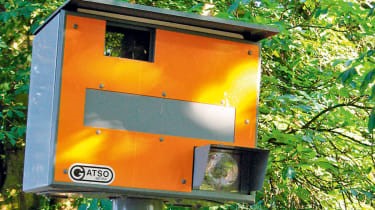
Gatso speed cameras
The Gatso was the first type of speed camera seen in the UK, and it’s still the most common type you’ll find. First introduced in 1991, the Gatso – short for Gatsometer, the name of the Dutch company that makes them – is a rear-facing camera.
That means it faces up the road and takes a picture of the rear of a speeding vehicle, so it can catch motorcycles as well as cars, vans and trucks.
A Gatso camera is easy to spot, as speed cameras must be painted yellow by law (in Scotland they have yellow and red diagonal stripes), although they can be obscured by road signs, street furniture and poorly maintained hedgerows.
Gatsos are usually mounted at the side of the road on a pole, although they can also be used in mobile units or on overhead gantries, such as you’ll find on the motorway.
Gatsos use radar to measure a vehicle’s speed, but the law says that there needs to be secondary proof of speeding. This is why all Gatso locations have dashed lines painted on the road in front of them.
These dashes are spaced evenly and are used to measure distance over time, so when a Gatso is activated it takes two pictures a fraction of a second apart, which can then be checked to see if an offence has been committed. The camera features a flash, and this goes off with each photo that’s taken.
On single carriageway roads, two sets of dashed lines are usually painted at a Gatso location. That means vehicles using either side of the road can be measured for speeding, but only in the direction that the Gatso is pointing. That means a camera site can only catch vehicles travelling away from it – if you are speeding towards one and it flashes, a ticket can’t be issued. Gatsos are also reliant on the dashed lines in the road – if the lines aren’t present, then the photos alone cannot be used to prosecute speeders.
While the first Gatso cameras used photographic film to record speeders, a new generation of digital camera arrived on 2007. These use a hard drive to store images and can be run 24/7 with a direct link to a control centre where the images are stored.
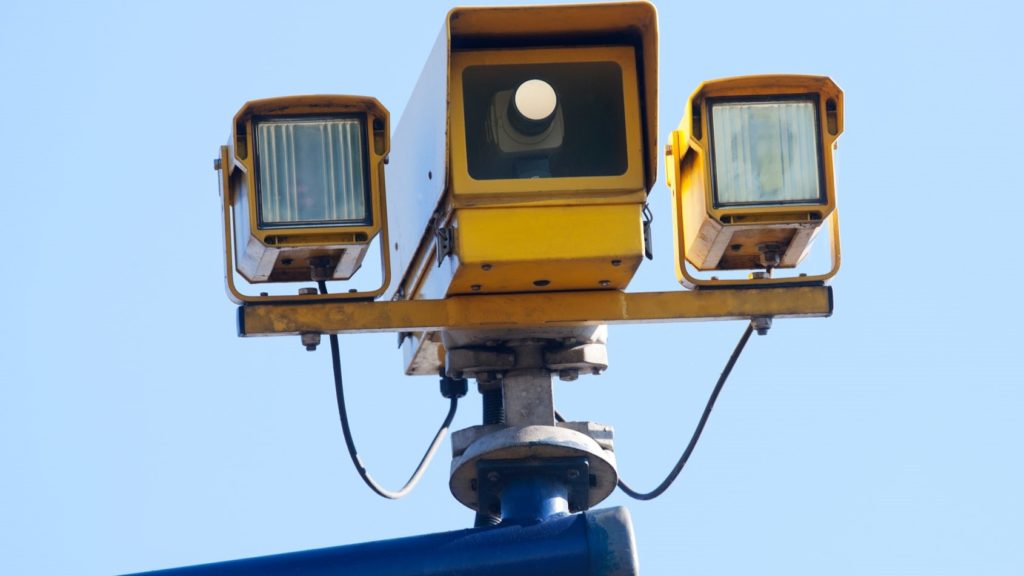
Truvelo speed cameras
The other common type of speed camera in the UK is the Truvelo, which is named after the South African company that makes it. While Truvelo cameras look similar to a Gatso because they are painted yellow and mounted on a pole, the chief difference between a Truvelo and a Gatso is that most Truvelo sites are forward facing.
As with a Gatso, a Truvelo camera uses a flash to get a clear image of a speeding vehicle’s number plate, but it also has a special filter on the flash that stops it from dazzling drivers. While this means that motorcycles (which lack front number plates) are harder to identify when speeding, the Truvelo can be used to identify the driver of a speeding vehicle.
The Truvelo only takes one picture, because the speeding offence is registered by sensors in the road which activate the camera. However, as with a Gatso, the photographic evidence needs backup, so small white squares are painted on the road where the sensors are to act as secondary evidence that a vehicle is speeding.
In recent years, the Truvelo has evolved into the Truvelo D-Cam. This is a digital version of the Truvelo that can be mounted forward or rear facing, can also be used at traffic lights, and can even be set up to watch up to 3 lanes at a time.
The D-Cam comes in a distinctive housing, while some have a flash unit separate from the camera itself – which again makes no visible light.
HADCES speed cameras
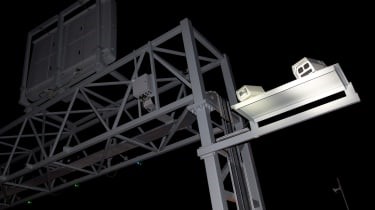
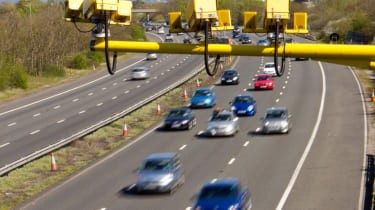
HADECS 3 stands for Highways Agency Digital Enforcement Camera System 3, which is the name given to the speed camera system that is being used on smart motorways across the country.
Hadecs units come in two small housings that are mounted on the side of motorway gantries. Thanks to their limited use of yellow to give away their location, and the fact they are about half the size of a Gatso or Truvelo camera unit, some people have called them stealth speed cameras, as they can be difficult to spot when travelling at 70mph.
Like other speed cameras, there are lines painted on the road that are used as secondary proof of speeding. And like a Gatso, Hadecs is a rear-facing radar camera, and it flashes when it picks up a vehicle travelling at more than the speed limit.
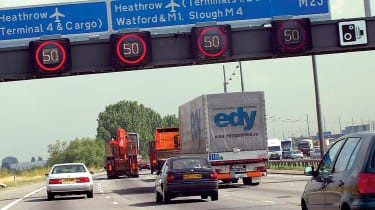
The innovation that allows Hadecs to be used on a smart motorway is its ability to adjust its detection speed according to the variable speed limit that’s posted. It does this by receiving information from sensors further along the carriageway, so when you see a lower limit posted on a smart motorway, the Hades cameras ahead can catch you for breaking it.
As well as speeding, Hadecs cameras can be set up to monitor up to five lanes, and they can detect vehicles that are using closed motorway lanes. As they are radar-based, they are able to work in all weather conditions, too.
SPECS speed cameras
The SPECS camera system works differently because it measures vehicle speed over a far greater distance than a Gatso or Truvelo camera. You’ll see two or more sets of cameras to monitor vehicle speed for an extended distance, and this can be for as little as 200 yards or up to 99 miles – as the SPECS cameras on the A9 in Scotland do. SPECS cameras are often referred to as average speed cameras and are popular for use in roadworks where a lower speed limit than usual needs to be enforced.
SPECS uses Automatic Number Plate Reading (ANPR) tech to register vehicles as they pass. The first camera logs the vehicle with a time and date stamp. Once the vehicle has passed the second camera, the time stamps on the two images are compared, and if the time taken to cover the distance means the average speed is higher than the posted limit, then a ticket is issued.
You will usually find SPECS camera systems on motorways, especially in roadworks. And while some people think that weaving between lanes can help you pass them undetected, the truth is that the SPECS system can monitor multiple lanes. It’s also no use slowing for the cameras and then speeding between them, because the system measures your average speed between the two locations, not just how fast you’re going as you pass either camera.
Mobile speed camera vans
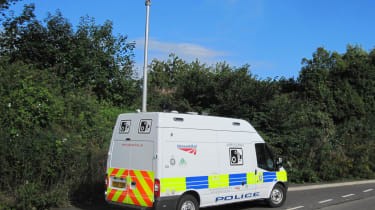
As well as these fixed speed cameras, many regions use mobile cameras to provide temporary coverage in areas where speeding is known to occur. Mobile units are usually located in vans that are marked as a safety camera vehicle with a bright livery, and they feature opening windows or panels to point the cameras through.
You will usually find them parked at the side of the road, in laybys (although not where parking restrictions apply) and also on bridges over roads.
The kind of cameras these mobile units use include mini Gatso cameras that use radar technology but there are also handheld radar or laser gun cameras. A laser gun uses a narrow laser beam that is reflected off a vehicle to measure its speed. These devices are quick and effective, being able to register a vehicle’s speed in as little as half a second and up to a distance of a mile away.
A radar gun works similarly to a laser gun. It has a wider beam and only works up to around 300 yards, while it will only come back with a reading after around 3 seconds, but it’s still an accurate way of registering a car’s speed.
Mobile camera vans can be set up in any direction to catch speeders, and can just as easily be set up to catch speeders approaching the camera site as going away from the site. As with fixed camera locations, a mobile camera site must have road signs indicating its presence, but apart from that, mobile cameras can be set up at any time.
In terms of location, mobile units are usually found in places notorious for accidents or speeding in the past, and are not normally pitched up in random places. Some local speed camera operators have been known to issue information on radio and social media to inform road users of where mobile camera units are operating on particular days.
Other speed cameras
Gatsos, Truvelos, SPECs and Hadecs 3 are the most common types of speed camera on UK roads, while other cameras that are available do a similar job. These are in addition to cameras which are used for traffic monitoring, catching vehicles that jump traffic lights (which incidentally aren’t required by law to be painted yellow) and cameras used by government agencies to check road tax and other ANPR-based activities.
Whichever way you look at it, the best way to ensure you’re not caught speeding is to remain aware of the speed limit and stick to it.
The big Speed camera questions answered
How do I know if a speed camera caught me?
If you have passed a speed camera that has flashed, the only way you will know for certain that you have been caught is when the registered keeper of the vehicle receives a Note of Intended Prosecution (NIP). This will arrive within 14 days of the offence taking place and will explain what happens next. This 14-day rule is in place so that companies, such as vehicle lease firms and car hire firms, can determine who was driving the vehicle at the time of the offence.
If you are the one that was caught speeding, then you will face a minimum fine of £100 and three points on your licence. If your driving licence is clean, then you may be offered the option of taking a speed awareness course instead of the penalty points.
As of 2017, the maximum fine for a speeding offence is up to £2,500 on the motorway. The amount you pay and the number of points you could face will depend on how much you were exceeding the speed limit by, as well as your level of income.
Do all speed cameras flash?
Most speed cameras flash when they capture an image, but you might not see the flash of a Truvelo forward-facing camera. That’s because forward-facing Truvelo cameras have a special filter over the flash to prevent dazzling oncoming drivers. If a camera is operating in good light conditions, the flash may not necessarily go off, either.
How do mobile speed cameras work?
Mobile speed camera units must be parked legally, either at the side of the road, in a layby or on a bridge, and operators must make motorists aware of their presence with the use of speed camera warning signs. That means they can operate in areas where the signs are already fixed, or they need to put up temporary signs nearby.
A speed camera van usually has openings at the rear or the side of the van for the cameras to have a clear line of sight of the road they are checking. Depending on the camera being used, the speed camera van can detect speeding vehicles up to two miles away on a clear day, especially with the latest camera technology being used.
The camera is operated either by a police officer or by a certified camera operator associated with a local speed camera partnership.
How can I avoid a speeding fine?
Of course, the easiest way of avoiding points and a fine is to check your speed at all times and keep within the speed limit. But with so much street furniture and so many distractions bombarding the average motorist, it’s not too hard to get caught out by a change in speed limit.
If you want added security, then a speed camera locator is the best piece of kit to use. We tested a batch of speed camera locators in 2018, with products from Road Angel and Snooper performing well, while apps from TomTom and Sygic were also well received.
Speed camera detectors use GPS location technology to warn you of fixed camera locations. In addition, the best units also feature laser and radar detecting technology to warn you of mobile speed camera sites, as well as those fixed locations that aren’t logged on to the device’s database. The best speed camera locators can show you your speed, as well as calculating your average speed within a SPECS average speed camera location. By Graham Hill with a big thanks to Auto Express
Share My Blogs With Others:These icons link to social bookmarking sites where readers can share and discover new web pages.
The latest TruCam ll speed cameras can read a number plate from 1.5km away but UK police forces who are currently being equipped with them are calibrating theirs to 750 metres.
Constabularies across the country have confirmed trials of the TruCam II Speed Enforcement Laser, each of which costs around £10,000. The devices work both in the daytime and in the dark thanks to a new night-mode feature.
The TruCam can automatically focus on a car approaching from half a mile away, with vehicle data uploaded to a database, after which a penalty charge notice is sent to the registered keeper. This means police don’t need to pursue and pull over speeding drivers.
Using an integrated laser, the TruCam measures the time and distance between vehicles. It contains a digital camera that can collect and store HD video evidence of a speeding offence. The device itself is actually capable of reading number plates from up to 1.5km away, but UK police are calibrating theirs to 750 metres, in line with tolerances set by the UK Government.
Various police forces – including Gloucstershire, Northumbria and Warwickshire constabularies – have begun using the TruCam II. Macclesfield South Police – part of Cheshire Police – reported on Twitter that it had deployed the device multiple times without catching anyone, but on a recent outing someone was caught in excess of 35mph in a 30mph zone.
The TruCam II was approved for use by UK police forces back in June, with the rollout now underway. The previous generation TruCam – which could only be used during daylight hours – has been used by some forces in the country for more than six years. By Graham Hill thanks to Auto Express
Share My Blogs With Others:These icons link to social bookmarking sites where readers can share and discover new web pages.
Buy a new car, and it’ll come with a warranty. Here we explain what it covers and what it doesn’t, and for how long.
If you’ve recently bought a new car then it will have come with a warranty. And with new cars becoming increasingly complex – just look at the number of vehicles that feature hybrid technology these days – it’s never been more important to be familiar with the cover your warranty provides.
Used cars bought from dealers usually have a warranty of some kind too but the original manufacturer’s warranty that comes with all cars from new is the most comprehensive.
So what is a warranty? It’s a written guarantee that your new car won’t suffer any major mechanical problems over a certain period of time, and that if it does, the cost of repairs will be met by the manufacturer or dealer.
The warranty will outline exactly what parts of the car are covered, and for how long. This either takes the form of a time limit, a mileage limit, or both. All manufacturers have their own variations for the vehicles they sell.
In any case, your car’s warranty is a legal document that means you don’t need to worry about footing the bill for any big problems that might occur in your first few years of ownership.
The majority of new car warranties will last for three years, although some carmakers cover the first two years and leave the dealer to provide the remaining twelve months.
New car warranties are usually issued automatically, meaning you don’t have to negotiate to get one. But if you intend to keep your car longer than is covered by the warranty, most manufacturers and dealers will let you buy an extended warranty.
This will cost you a bit more money, but in most cases you should still get a similar degree of cover as provided by the existing warranty.
What will your car warranty cover?
The whole car will be covered by a warranty, but there will be different warranties covering different parts of the car, such as for the car’s paintwork and a guarantee against corrosion, too.
If you’re buying an electric vehicle or plug-in hybrid, you’ll find that the battery and drive system will usually be covered by a second guarantee that runs alongside the standard warranty.
If you’re buying a used car, there are warranties available to you, too. Buy a pre-owned car from a franchise dealer, and there is likely to be a warranty available, depending on the car’s age – indeed, if the car is new enough, it’ll still be covered by the original guarantee, as the warranty coverage on a new car is transferable between owners.
Breakdown firms such as the AA and RAC also offer warranty coverage on used cars, which some non-franchise car dealers use to help give their business a higher profile and their customers extra peace of mind.
Even if you buy privately, companies such as Warrantywise can supply you with warranty cover to help you out in the event of something going wrong with a used car.
Much like car insurance, these companies will take into consideration the age and condition of the car before offering you a quote for 12 months of cover. Taking out a used car warranty can be a useful safety net, especially if you’re running an expensive car that has been bought used for a bargain amount, and gives added peace of mind if a used car doesn’t come up to scratch.
Below we run down the different types of warranty that are associated with new and used cars, from the standard new car warranty to paint and battery cover in EVs, through to extended warranties and used car cover.
What is a new car warranty?
A new car warranty is the guarantee that car manufacturers issue when they sell a new car. Each car maker will have a set warranty that applies to all of the cars that it sells in the UK. The majority of car makers offer a three-year warranty, although the main exceptions to this are Hyundai, Mitsubishi (both five years) and Kia (seven years).
Some makers have offered longer warranty periods in the past than they do now, the last being Renault, which offered a four-year warranty until recently. Vauxhall also offered a lifetime warranty for a while. This was limited to the first registered owner of the car, and also had caveats that meant the car must be serviced at a Vauxhall franchise.
However, with very little uptake on such cover and an increasing number of buyers now running cars for three years on finance, the three-year warranty has held out, and both Renault and Vauxhall stick with the standard three-year cover.
While three years is a fairly standard time period for a new car warranty, manufacturers also add a mileage limit to the warranty to ensure the vehicle is covered for what it determines to be a fair amount of time. So the warranty will last for the time period or the distance quoted, whichever comes first.
The amount of miles you can cover varies according to which manufacturer you choose. Some offer a 36,000-mile limit, while others offer unlimited mileage. As an example of the differences, Mitsubishi’s five-year cover has a 62,500-mile limit, while Hyundai, which also offers a five-year warranty, has unlimited mileage for private buyers.
Likewise, Kia’s seven-year warranty has a mileage limit of 100,000 miles, so for some high-mileage drivers, the Hyundai warranty could be more attractive.
The wording of the new car warranty will provide a general overview that gives a new car buyer an idea of what is covered, but more importantly, there will be a lot of small print that will explain what isn’t covered.
The overall objective of the new car warranty is to ensure that a car’s major mechanical components (the engine, gearbox, suspension, electrical system and safety systems) work as they should throughout the duration of the warranty. And if anything should go wrong, then the manufacturer will cover the cost of rectifying the fault.
As a result, you will find that so-called ‘wear and tear’ items and consumables, such as the tyres, brakes, belts, fluids and lubricants, wipers, bulbs and fuses won’t be covered by the warranty. It won’t cover damage to wheels from kerbing, either, or if the interior trim has squeaks or rattles. There will also be wording within the warranty that puts the onus on the car’s owner to drive it normally and treat the car properly, as misuse could invalidate the warranty.
This can include using a sports car on a race track, or an SUV for severe off-roading, or even an MPV or family car that has seen use as a taxi or for private hire.
If the manufacturer can find the car has been modified – such as the ECU being reprogrammed, a non-standard exhaust system has been fitted, or if the odometer has been tampered with – then these modifications are likely to invalidate the car’s warranty, too.
What is an extended warranty?
An extended warranty isn’t the five- or seven-year guarantees dished out by makers such as Hyundai, Mitsubishi or Kia. Instead, an extended warranty refers to the extra cover that new car buyers can pay for to give added peace of mind.
The extended warranty will be an option that some car manufacturers offer as an optional extra when you spec up a new car, while many manufacturers also offer existing owners the option to extend their car’s warranty before the standard warranty expires.
Manufacturers offer this longer warranty because there isn’t as much stress put on an EV’s battery as there would be in a conventional combustion-engined car. Again, the usual small print about tampering and modification of the battery pack applies, and just like the standard warranty for the rest of the car, the battery warranty is transferable when the car is sold on.
What is a paintwork or perforation warranty?
Paintwork warranties are designed to guarantee the quality and finish of a vehicle’s bodywork. They are usually accompanied by a perforation warranty, which guarantees the bodywork against any rust or corrosion that may occur because of faults in the vehicle building process.
The paintwork warranty usually lasts for the same length of time as the standard warranty, so normally three years, because the paintwork is the first form of defence against the elements. That means the paint is prone to damage from stone chips, scratches, bird lime and tree sap, which can have a deteriorating effect on paint.
After three years it will be hard to determine whether paint damage is a result of poor production or wear and tear, which is why the paintwork warranty is only as long as the vehicle’s overall warranty.
A perforation warranty will last for a longer period, and it guarantees against rust and corrosion that are the result of poor manufacture. A perforation warranty will be clearly worded to guarantee against corrosion that comes from a source within the bodywork, ie: not caused by external damage. Some warranties explicitly state that the bodywork has to have a hole all the way through it before the manufacturer will take action.
The duration of the perforation warranty will vary between manufacturers, and it may also vary between models, depending on where each model is built. On the whole, anti-perforation warranties last for 12 years, although some makers sometimes have models that are an exception to the general rule, when they are built at a different plant, for example.
What is an approved used car warranty?
An approved used car warranty will be a level of cover that is offered on approved used cars sold via a franchised dealer. Usually, the used cars that a manufacturer approved dealer has on sale will be less than three years old, so most will have some of their existing warranty cover still to run.
But to give used car buyers added peace of mind, a used car warranty will be offered to anybody buying a used car from the franchise.
The used car warranty will be included on an approved used car once it has been given a full inspection to make sure it meets the standards expected by the manufacturer.
Usually the used car warranty will be valid for 12 months, and there will be small print to say if there’s a mileage limit that you need to stick to so that you get the full year of cover.
In general terms, the used car warranty will offer the same amount of cover as a new car warranty, because the cars it is issued against will be nearly new, so there is a low risk of a warranty claim being made against such a car. However, it’s always worth checking the small print to see what the used car warranty covers because not all manufacturer cover will be the same.
What is a used car warranty?
If you’re buying a used car outside of the UK’s franchise dealer network or want warranty cover for an older car then you still can. However the warranty cover will be entirely dependent on where you buy your used car from.
Second-hand car dealers don’t have to offer warranty cover of any description, but those that want to raise their profile and trade on a good reputation will offer a used car warranty to keep their customers happy.
One of the favourite ways of doing this is by offering a warranty provided by the AA or RAC. The breakdown firms will carry out a multi-point inspection on a used vehicle before providing warranty cover, while the cover will last for at least six months. And as you would expect, these warranties will also be accompanied by breakdown cover for the same period.
What is private warranty cover?
If you’re buying privately, there is still warranty cover that you can take out so that your new purchase won’t leave you out of pocket. Again, the AA and RAC provide warranty cover direct to buyers, and it can be tailored to suit any car, irrespective of age, mileage or condition.
Of course, the older the car, the amount you pay is likely to rise, and what is covered is also likely to be limited to the major mechanical components.
Another option is the aftermarket warranty, provided by companies such as Warrantywise and Warranty Direct. These firms offer warranty coverage on older cars up to a certain age and mileage, and you buy the warranty in a similar way to car insurance.
That means you can pay in a lump sum or monthly repayments for your convenience. Again, these warranties are flexible, so you can pick how long the warranty lasts (it should be transferable with the car if you sell it on), and there are different levels of cover depending on the car’s age, mileage and previous history. By Graham Hill thanks to Auto Express
Share My Blogs With Others:These icons link to social bookmarking sites where readers can share and discover new web pages.
The UK’s departure from the EU means British drivers snared by speed cameras on roads in Europe will no longer be sent fines. And those Britons, resident in the EU, who return to the UK in foreign registered cars will also avoid fines.
As a member of the EU, Britain had signed up to a directive that allowed member states to share the contact details of those caught by speed cameras.
The directive was introduced because data revealed that a high percentage of speeding offences were committed by foreign drivers who were escaping the financial penalties.
Naturally Britain’s departure from the EU on January 1st meant that for the foreseeable future British holidaymakers and second-home owners driving in EU countries will not be issued fines if they are snared.
The same goes for drivers of EU-registered cars travelling on roads in the UK who are caught speeding or committing other driving offences caught on camera.
Since Britain signed up to the directive and began the data sharing in 2019, hundreds of thousands of British holidaymakers have been fined.
In France alone some 444,378 fines were sent to British drivers in 2019 which according to French driving site Caradisiac was the equivalent of between €30 to €60 million.
With such big sums of money at stake it’s no surprise some EU countries are intent on negotiating bilateral agreements with the UK to ensure contact details are shared in future.
“We will initiate bilateral negotiations with the UK, in order to reach an agreement like we have with Switzerland,” a French Interior Ministry spokesperson told Caradisiac.
But the UK is unlikely to be a in rush to enter into those talks, not least because of the ongoing pandemic that has crippled travel to and from the EU, but also because it just might not be worth it financially.
The UK avoided signing up to the cross-border directive for many years because it believed it just wasn’t profitable to process the fines abroad given the relatively small number of European-based drivers caught speeding in the UK.
But Beware: For certain EU countries like Spain and France where British holidaymakers and second-home owners often travel by car, it’s a different matter.
British drivers who are pulled over by local police in the EU for speeding or other offences will still have to pay their fines, however.
It is also the case that in the UK British police have the right to take a ‘Roadside Deposit’ if the driver doesn’t have a UK address. But with the vast majority of speeders being caught by cameras with so few police on our roads we could lose some substantial fine income.
France’s ministry of interior lamented the fact that Britain was no longer in the EU. In a statement to The Local a spokesperson said: “The purpose of the directive is to put an end to the impunity of motorists who commit offences in a Member State other than that of their residence, to improve road safety throughout the EU and to guarantee the equal treatment between drivers whether or not they are residents of the Member State where the offence was committed.
Through this exchange system, Member States can identify the owners of vehicles with which the infringement has been committed in their territory and send them notifications of infringements.”
Reminder
The 2015 European Directive, nicknamed Cross-Border Directive does not only target drivers caught on camera speeding or running red lights.
It covers six other offences:
failure to wear a seat belt
driving while intoxicated
driving under drugs
the non-wearing of a helmet by two-wheeler drivers
driving on a prohibited lane
mobile phone use while driving
By Graham Hill thanks to The Local
Share My Blogs With Others:These icons link to social bookmarking sites where readers can share and discover new web pages.
All drivers and especially fleets need to be aware of the growing impact of the Covid-19 pandemic on mental health and subsequent safety risks to drivers, says FleetCheck.
The warning follows a new poll from the Mail on Sunday, which revealed that 40% of people believed their mental health had become worse during the pandemic.
Peter Golding, managing director at FleetCheck, said: “This is just the latest in a series of polls and pieces of research showing how the last nine months have had a very negative effect on the mental health of many, many people.
“We know that mental health problems of all kinds can have an impact on driver performance on the road. With people saying that feelings of anxiety, stress and depression are particularly apparent, there is a genuine case for fleets to act.”
Golding says employers should be fulfilling their basic requirement of checking that drivers are fit to drive, and mental wellbeing should be part of the assessment.
He said: “It should be taken as a given that anyone who feels that their mental health has deteriorated to a point where they should not be driving should be taken seriously, and employers should also make it clear that such situations will be dealt with sympathetically.
“Probably the starting point for most fleets would be to seek professional human resources and medical guidance in order to ask drivers a few questions regularly in order to flag up any immediate issues that need attention.”
At the Fleet200 Executive Club virtual meeting in November, 2020, fleets discussed how Covid-19 caused a rise in drivers’ mental health issues. They also discussed how it impacted their operations and the changes they have implemented.
In an interview with Fleet News, behavioural sciences researcher at the Transport Research Laboratory (TRL), Rosie Sharp, said driver engagement could be key in improving mental health and wellbeing of drivers.
FleetCheck was examining the introduction of basic mental health tools into its Vehicle Inspection App, which incorporated questions about the driver’s health, as well as daily walkaround safety checks, says Golding.
Golding said: “We modified the app last year to cover coronavirus symptoms and now seems like a good moment to add further questions about mental health. We are taking advice and hope to be able to do this soon.” By Graham Hill thanks to Fleet News
Share My Blogs With Others:These icons link to social bookmarking sites where readers can share and discover new web pages.
Sales of internal combustion engine (ICE) petrol and diesel cars could be curtailed ahead of the Government’s planned 2030 ban, when it publishes the finer details of its strategy in the spring.
Since announcing it would end the sale of new petrol and diesel cars and vans in 2030, with a five-year grace period for some hybrids, the Government has yet to provide clarity on how it will be achieved.
Speaking at the Westminster Energy, Environment & Transport Forum policy conference for low emission vehicles in December, Katie Black, joint head of the Office for Low Emission Vehicles (OLEV) at the Department for Transport (DfT), indicated that the Government wants to avoid a situation where car makers are “selling the maximum amount of petrol and diesel cars right up to the 2030 milestone”.
She said: “We do see it as a risk, and we will be looking publicly at ways to mitigate that. What you probably want is a gradual phase out, a gradual shift across the fleet. And we’re looking at how a regulatory regime could support that.”
No further details were given as to how sales might be restricted, but a key part of Government strategy will be to promote and encourage private buyers and fleets to opt for electric vehicles (EVs) as soon as they can.
This includes an investment of £1.3 billion to strengthen the UK’s charging infrastructure and to extend the plug-in car grant.
Dylan Setterfield, head of forecast strategy at Cap HPI, said: “It is hard to see how volume restrictions in ICE cars could work from a practical perspective, given the range of customers, routes to market and complex factors impacting vehicle lead times.
“In any case, the industry is already doing this independent of government. Diesel availability has already declined as manufacturers discontinue diesel in their smaller cars and, given they will be under ever-stricter emissions targets, it is also in their interest to move customers into EVs by removing the competing fuel types.
“The weighty cost of research and development is likely to result in some hard choices now between investment in ICE or EV, with petrol and diesel the likely losers in many cases.”
Black confirmed the Government is planning to publish a delivery plan, setting out the steps that need to be taken to meet the phase out dates.
But, she admitted there were still many factors that needed to be considered, including on-street charging solutions and supporting the used car market.
Green Paper Planned
To ensure the phases are met, and to support interim carbon budgets, the DfT will publish a Green Paper in the coming months on the post-EU regulatory regime for CO2 emissions from new vehicles. This, according to Black, will cover both overall fleet efficiency and delivering the move to 100% zero emission vehicle sales for cars and vans.
There will also be a consultation to define the meaning of “significant zero emission capabilities” in order to outline what vehicles may be sold between 2030 and 2035.
These are likely to be limited to range-extender EVs, which feature a small petrol engine to charge the battery while the vehicle is driven exclusively by its electric motor, or plug-in hybrids.
Nick Molden, founder and CEO of Emissions Analytics, believes regular hybrid vehicles, which have a limited zero-emission range, actually have a lower environmental impact than plug-in hybrids.
With all new cars already exceeding the Government’s air quality targets, introduced as part of the Real Driving Emissions (RDE) test, Molden believes the issue now lies in the poorer CO2 emissions performance of most new cars against the EU’s 95g/km target.
He said electrification is the best way to reduce CO2 emissions, but it has to be deployed “effectively” to make the most of “scarce” battery resources.
“In our strong opinion, full hybrids, for a good period forward, is the sweet spot while the supply chain issues around batteries are sorted out,” Molden stated.
Following a recommendation by the National Infrastructure Commission that the sale of new diesel HGV lorries should be banned by 2040, Black confirmed a consultation will be launched this year on the phase-out of diesel HGVs.
She said: “HGVs are at a much earlier much an earlier stage than cars and vans. We can see what the technological solutions are for those, but, with HGVs, the picture is a lot less clear.
“As we look at the roll-out of charging infrastructure, we really need to make sure that we’re taking into account HGV requirements there and not thinking about cars and vans exclusively.” By Graham Hill thanks to Fleet News
Share My Blogs With Others:These icons link to social bookmarking sites where readers can share and discover new web pages.