SUV Sales Across Europe Drop For First Time In 6 Years
The growth in demand for SUVs across Europe has slowed for the first time in six years as smaller, electrified models start to claw back sales.
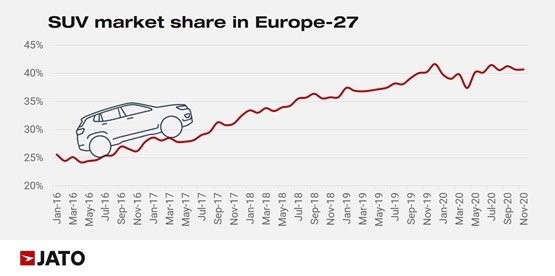
Between January 2016 and January 2020, the market share of SUVs grew significantly – from 25% to 40%.
For the majority of the year, the market share of SUVs remained stable – between 40% to 41%. However, their registrations fell by 13% in November, and 21% YTD when compared to 2019.
Felipe Munoz, global analyst at JATO Dynamics, said: “The market has benefitted hugely from a wider SUV offering provided this year. But with the impact of Covid-19 still in full force, demand is no longer growing in parallel to new product launches, nor at such a fast pace.”
Conversely, B and C cars experienced declines below the overall average, in fact, their market share increased in November due to new arrivals and a more competitive electrified offering.
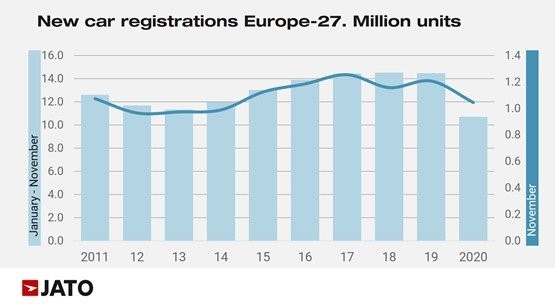
Overall, Europe registered 1,045,129 new cars – 13% less than for the same period in 2019. November 2020 has recorded the lowest volume since 2014, when just 989,500 units were registered.
Year-to-date figures continue to point to a downward trend, with YTD volume dropping by 26%. European consumers registered 10.71 million units between January and November – the lowest YTD figures so far this century.
Munoz added: “The global pandemic and its impact on mobility has been extremely painful for the automotive industry, indeed more painful than any other economic crisis that has hit Europe over the last two decades.”
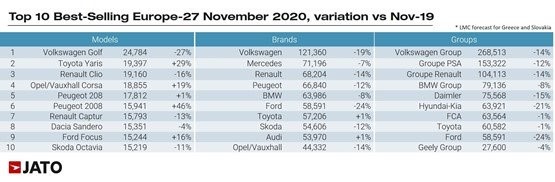
The overall ranking by models in November confirms that the Volkswagen Golf (pictured) kept its position as the most popular car in Europe. The hatchback registered 24,800 units in November – just short of 255,000 units since January.
Only two SUVs made it into the top 10 – the Peugeot 2008, followed by the Renault Captur. Further down the ranking, Ford Puma, Volvo XC40, Audi A3, Renault Zoe, Volkswagen ID3, Kia Niro, Mercedes GLA, Skoda Kamiq, Jeep Compass, Mercedes GLB, Nissan Juke, Audi Q3 Sportback, Kia Xceed, Suzuki Ignis, and BMW 2-Series, all posted healthy results.
By Graham Hill thanks to Fleet News
Share My Blogs With Others:These icons link to social bookmarking sites where readers can share and discover new web pages.
Britishvolt’s new UK battery gigaplant will start production of electric vehicle (EV) batteries from 2023 and will scale to 300,000 units a year.
Global construction specialist ISG has been appointed to lead the build of the £2.6 billion project located at Blyth, Northumberland.
Construction will start in the second half of this year (2021) and once the plant is up and running it will produce lithium-ion batteries for the automotive and renewable energy industries at the end of 2023.
Construction of further phases will continue until the end of 2027.
The Blyth gigaplant is located 20 miles north of Nissan’s Sunderland factory, which makes the Leaf EV.
Orral Nadjari, Britishvolt chief executive, said: “We’re delighted to have engaged ISG as the construction partner for our Blyth gigaplant.
“Its long expertise of delivering global projects will be crucial to meeting our exacting standards and tight timeframe.”
ISG built Jaguar Land Rover’s production facility in Slovakia and it is also currently working on two flagship schemes in London: University College’s £280 million neuroscience hub and the Oak Cancer Centre at the Royal Marsden Hospital.
Paul Cossell, ISG chief executive, said: “This landmark project to build the UK’s first gigaplant is one of the most visible signs that we are confidently stepping up to meet the challenge of new zero emissions by 2050 and closely aligned with the government’s key commitment to cease petrol and diesel car manufacturing by 2030.
“The construction phase alone will directly support thousands of jobs in the North East and create a wealth of training and upskilling opportunities for local communities.”
The gigaplant is being designed by Italian design company Pininfarina.
It will be built on a 95-hectare site, formerly the site of the Blyth Power Station.
The plant will exclusively use renewable energy, including the potential to use hydro-electric power generated in Norway and transmitted 447 miles under the North Sea via the world’s longest inter-connector from the North Sea Link project. By Graham Hill thanks to Fleet News
Share My Blogs With Others:These icons link to social bookmarking sites where readers can share and discover new web pages.
In almost half (47%) of thefts from vehicles in England and Wales, new figures from the Office for National Statistics (ONS) suggest that the vehicles were left unlocked. How stupid is that?
Analysis from insurer Aviva also shows that more than one in five drivers (23%) don’t always lock their vehicles and, in cases where a vehicle was taken, 14% were left unlocked.
Broken windows (19%) and forced doors (13%) were the next most common points of access after doors were left unlocked.
Aviva is warning drivers to take extra care when leaving their vehicles during the darker winter months.
The data shows that four out of five vehicle-related thefts in England and Wales happen during the hours of darkness.
In tandem with these figures, Aviva data reveals motor theft claims in 2019 were higher during October to December when daylight hours were shorter.
Compared to the monthly average for 2019, vehicle-related theft claims were 10% higher during these months, and 29% higher than in June 2019, when nights are shortest, it said.
Sarah Applegate, risk and governance lead at Aviva UKGI, says there are “simple steps” people can take to reduce their risk.
“Nearly half of vehicle-related thefts occur when people haven’t locked their vehicles, and an Aviva study finds almost a quarter of motorists don’t always do so,” she said.
“The same research suggests even when people have items which could protect their vehicles, they don’t always use them.”
Only around a third (34%) of drivers with garages store their vehicles in them all the time – and almost the same (33%) never put their vehicles in their garage.
Applegate continued: “Simply locking vehicles and not leaving items on show inside reduces the risk, while items like steering locks, parking posts and garages put physical barriers in the way of a possible theft.
“Taking a few extra minutes to lock up and secure a vehicle can make a big difference in the eyes of a thief.”
More than a third of businesses have had a van stolen within the last 12 months, a recent study by Logistics UK revealed.
The company’s Van Security Report, collated data from police forces across the UK and sought real-life examples and insights from van users through a Van Security survey.
Aviva has the following advice to vehicle owners to reduce the risk of vehicle-related thefts:
Always lock the door. No matter where you park, even if you need to leave your vehicle unattended for just a minute. Make sure to close the windows and sunroof if you have one.
Keep your vehicle keys or fobs in a secure place and ensure they’re out of sight and away from external doors and windows where they’re more likely to get stolen by thieves. It’s also a good idea to keep digital key fobs inside a security pouch to prevent them being scanned, thus enabling thieves to open and steal your vehicle.
Don’t leave anything in your vehicle. Anything worth stealing makes your vehicle more attractive to thieves. Keep your car as ‘clean’ as possible and try not to leave anything inside, especially valuables. If you must store something in your vehicle for a short length of time, make sure it’s out of sight.
Consider additional security. Any extra security features will further reduce the risk of theft from the vehicle or/and of the vehicle itself. Consider installing steering wheel locks, a tracking system or a car alarm if your car doesn’t have a factory-fitted model, especially if you park on the street.
Park on a driveway or in a garage if possible. This will reduce the risk of both vehicle thefts and break-ins. You may also consider installing a retractable parking post on your driveway, to block a potential ‘escape route’. If you can’t park on a drive, try to park in a busy, well-lit area.
By Graham Hill thanks to Fleet News
Share My Blogs With Others:These icons link to social bookmarking sites where readers can share and discover new web pages.
The Government is being urged to work with the fleet sector to ensure any changes to motoring taxation are carried out in a timely, effective and proportionate way.
Reports suggested that the Government was considering reviving road pricing plans to counter lost tax revenues from the increasing adoption of electric vehicles (EVs).
The fleet sector has already shown it is receptive to road pricing as a replacement to other road and fuel duties. Fleet News has been calling for the Government to launch a feasibility study since its Fleet Industry Manifesto report in 2015.
The National Infrastructure Strategy, launched to coincide with the Spending Review, emphasised the need for motoring tax revenues to ‘keep pace’ with the uptake of EVs. It did not, however, mention road pricing as a potential alternative to the current regime.
Gerry Keaney, chief executive of the British Vehicle Rental and Leasing Association (BVRLA) says any changes need to be fair to the fleet industry.
He recognises that the Government’s future motoring tax strategy must strike a “fine balance” in maintaining vital revenues and encouraging people into newer and cleaner vehicles.
But he stressed: “The Government must avoid placing a crushing tax burden on businesses and individuals that are unable to upgrade their cars, vans or trucks and are already struggling to cope with the economic implications of Covid-19 pandemic and EU exit.”
The Government has already spent £280 billion to help support the economy through the pandemic and will spend a further £55bn next year to support the recovery.
“We will very soon need a system that can levy tax on both conventionally fuelled and battery electric vehicles fairly,” Nicholas Lyes, RAC
In total, taxes on UK motoring, including vehicle excise duty (VED), fuel duties and VAT, raise around £40bn per year or 7% of total revenue to the Exchequer. Of this, benefit-in-kind (BIK) tax payments, covering the provision of company cars, raise close to £1.8bn.
Darren Handley, head of infrastructure grants at the Office for Low Emission Vehicles (OLEV), told attendees at Virtual Fleet and Mobility Live that, while the question of future motoring taxation is one for the Treasury, it should not necessarily follow that lost fossil fuel revenues will be recouped from EV drivers.
He said: “If you look at a parallel with something like health and smoking, any reduction in tax (take) from (a reducing number of) smokers isn’t regained by taxing somebody who is healthy.”
Covid-19 impact on tax revenues
In Budget 2020, the Treasury outlined expected tax receipts from fuel duty each year up to 2024/25. It expected to collect £27.5bn this tax year, a £200m decline on £27.7bn in 2019/20. But, then it was predicted to increase to £28.1bn the following year (2021/22), before reaching £30.5bn in 2022/23, £31.2bn in 2023/24 and £31.7bn in 2024/25.
VED receipts are expected to fall by £100 million to £7bn in 2021/22, before increasing by £200m each year for the next three years, reaching £7.6bn in 2024/25.
Revenues, however, have already been impacted by Covid-19, with lockdown restrictions reducing fuel duty by £2.4bn in April and May compared with the same time last year.
Nicholas Lyes, RAC head of roads policy, said: “While not paying car tax is clearly an incentive to go fully electric at the moment, we will very soon need a system that can levy tax on both conventionally fuelled and battery electric vehicles fairly.
“If this isn’t addressed, we risk finding ourselves in a situation where petrol and diesel drivers continue to pay all the tax for using the roads which is unsustainable.”
Four-in-10 drivers believe that some form of ‘pay-per mile’ system would be fairer than the current system of fuel duty, says the RAC, while half (49%) agree that the more someone drives, the more they should pay in tax.
Insurance and Mobility Solutions (IMS), which is part of Trak Global Group, has successfully piloted road pricing projects in several US states.
Dr Ben Miners, chief innovation officer for IMS, explained: “Road user charging (RUC) and electronic toll collection (ETC) are both important solutions to fairly generate revenue from road users.”
ETC focuses on specific concessions or fixed points with a roadside/infrastructure approach, whereas RUC focuses on the broader transportation network with an infrastructure-free, wireless infrastructure, process.
Miners said: “The additional flexibility of RUC enables new virtual tolls to be introduced and transform any road segment or fixed asset into a ‘tolled’ road, which eliminates lengthy construction times and shortens time-to-market.” By Graham Hill thanks to Fleet News
Share My Blogs With Others:These icons link to social bookmarking sites where readers can share and discover new web pages.
Cash-takers are returning to company car schemes in “noticeable” numbers thanks to the attractiveness of electric vehicles (EVs), reports Arval UK.
The Government introduced a new zero percentage benefit-in-kind (BIK) tax rate for pure EVs from April this year, and the leasing company says that plug-in company cars are now really gaining traction in the market.
Shaun Sadlier, head of consulting at Arval UK, explained: “Many cash takers liked their company car but didn’t like paying what they perceived as high benefit-in-kind and that was why they opted-out.
“Now, with low benefit-in-kind in place for EVs for at least five years, many more are now returning to company car schemes.”
Arval predicted that this would start to happen some time ago, but Sadlier said: “It’s now becoming noticeable In several of the major fleets with which we work.
“It’s a welcome development that will feed demand for zero-emission vehicles and lead to wider, faster adoption.”
New BIK rates are driving the choice in zero emission vehicles, but Arval believes that there are also a range of other factors in play.
“If you talk to fleet managers and their drivers, there’s a lot of enthusiasm around the vehicles themselves,” continued Sadlier. “We are beyond the early adopter phase and heading into mass-acceptance.
“All it takes is a couple of EVs on a fleet to disprove the reservations some people hold about these vehicles.
“They can see that misgivings such as range anxiety are actually of limited importance for the vast number of journeys that are made.”
Arval UK recently updated its own company car scheme to increase adoption of EVs and the move paid off with almost two thirds of its company car drivers making the switch so far.
Sadlier said: “All of our consultants and many of our sales team have switched to EVs.
“They act as ambassadors for the technology, developing personal experience to share with customers, friends and family – as more people drive EVs, consumer confidence will increase.
“Coupled with the growing number of different models that are available, plus the recent 2030 announcement, it’s not an exaggeration to say that we can all play our part in a zero-emission future and choosing an EV is a step in that direction.” By Graham Hill thanks to Fleet News
Share My Blogs With Others:These icons link to social bookmarking sites where readers can share and discover new web pages.
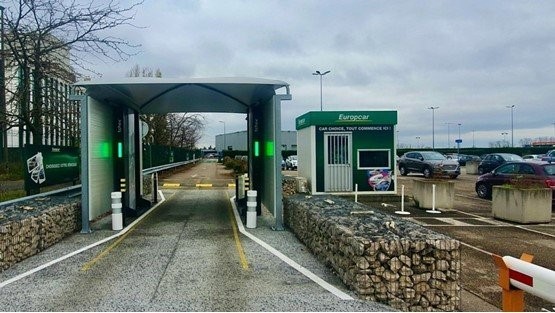
Europcar Mobility Group has partnered with a Tchek, a tech start-up that has developed an automated inspection system.
The drive-thru device uses artificial intelligence and 3D scanning to capture images of and detect damage on vehicles.
Europcar Mobility Group will begin the digitalisation and automation of check-in check-out inspections of its traditional rental model. But, ultimately, the project will also include new mobility solutions, with a view to improving overall operational efficiency, which may require more maintenance and repair than conventional vehicles.
“The integration of a digital and autonomous solution into a customer journey is a subject that can be complex and we are very happy to have removed this thorn from the side of the leaders and managers on the company.
“We are very proud to have Europcar Mobility Group as the first major partner of the industry because we share in the vision; to always save time and profitability for users and employees by combining technological know-how with irreproachable customer service,” said Léa Chevry, co-founder of Tchek.
Tchek Scan is the first autonomous scanner in the world which increases productivity by automating and mechanising the inspection of the entire vehicle with great precision, thanks to 3D reconstruction, image capture and the rapid analysis of new repairs to be carried out by artificial intelligence. By Graham Hill thanks to Fleet News
Share My Blogs With Others:These icons link to social bookmarking sites where readers can share and discover new web pages.
Michelin has announced it will incorporate Radio Frequency Identification (RFID) chips into all its car tyres by 2023.
The manufacturer said RFID technology is a cost-effective way of tracking tyres and a ‘significant contributor’ to predictive maintenance services.
It will also enhance driver safety by allowing Advanced Driver Assistance Systems (ADAS) such as ESP to adjust responses according to specific tyre characteristics, says Michelin.
Michael Ewert, vice president of Global Sales for Original Equipment at Michelin, said: “Since RFID technology ensures this exact tyre identification, it is conceivable in the future that drivers will see a tyre status display next to their fuel gauge.
“RFID in tyres makes many new business models possible and can also further increase safety when driving. We are convinced it represents a significant step forward in the tyre industry.”
The technology could also be used to improve recycling rates, allow proof of recycling and help improve the efficiency of energy recovery programmes.
Michelin says it is working with car manufacturers to develop algorithms that could pave the way for several new advances as cars become more connected.
Dealers and workshops will also benefit as exact tyre identification and data will be easily accessible, reducing fitting errors and helping with stock control, it says.
Up to 15 million chips a year will be encased in rubber at Michelin’s Homburg plant in Germany before they are installed in new tyres on site or shipped to other Michelin factories in Europe, China, Thailand and Brazil.
Michelin recently warned fleet managers to ensure they are selecting the right replacement tyres for their cars and vans, to avoid unnecessary costs. By Graham Hill thanks to Fleet News
Share My Blogs With Others:These icons link to social bookmarking sites where readers can share and discover new web pages.
New vehicle safety systems, such as emergency braking technology, are being switched off by drivers, new research suggests.
The range of Advanced Driver Assistance Systems (ADAS) have become increasingly common in new cars and vans.
Autonomous emergency braking (AEB), for example, has become standard in many new fleet cars, but the research from Autoglass shows there is still a lack of knowledge and awareness.
It found that almost a quarter (24%) of drivers with ADAS enabled vehicles said they were not provided with any information about the importance of these features and how they work when they had the vehicle handed over to them.
The survey of almost 1,400 drivers also found that 41% intentionally switch off safety systems such as AEB or lane departure warning systems, while driving.
Neil Atherton, sales and marketing director at Autoglass, said that ADAS can help keep drivers and passengers safe, but only if the technology is “switched on and operating correctly”.
“ADAS is becoming more and more common in UK fleets and so more should be done to educate drivers, to encourage positive behaviour and ensure the systems are being used correctly,” he said
“Fleet managers have a responsibility to not only help drivers understand the benefits of these systems but also to review their supply chain to ensure the vehicles are being maintained to the correct standards.” This applies to drivers themselves, they should also acquaint themselves with all the safety systems.
The cameras and sensors that ADAS relies on need to be recalibrated to manufacturer standards if they have been impacted by a windscreen replacement, and in some cases body damage, to ensure the features are working correctly.
However, more than half (55%) of respondents were unaware that they need to be recalibrated when the windscreen is replaced and 52% of drivers were unaware that the cameras may need to be recalibrated if they have been impacted by body repair work.
When asked, two thirds (67%) of drivers agreed that more education is needed around the importance of ensuring this technology is properly maintained.
“It is paramount that fleet managers have a trusted partner who can carry out the recalibrations to industry standards,” said Atherton.
The increasing number of ADAS enabled vehicles in UK fleets has inevitably led to an increase in demand for recalibration.
In response to this, Autoglass has opened 12 new centres this year, taking the total number of centres in the UK to 90, to allow recalibration to be done in-house.
The new centres have been opened across the UK including Reading, Derby, Carlisle and Banbury.
The locations have been chosen to provide fleets with a more convenient service, and all centres offer windscreen repair and replacements, ADAS recalibration and replacement wiper blades, says Autoglass.
Atherton concluded: “Looking ahead to 2021, we are continuing our plans of opening more centres to ensure we are doing all we can to keep fleet drivers safe on the roads.” By Graham Hill thanks to Fleet News
Share My Blogs With Others:These icons link to social bookmarking sites where readers can share and discover new web pages.
Drivers are being urged to ensure they are selecting the right replacement tyres for their cars, to avoid unnecessary costs.
Michelin warns that inappropriate or incorrect fitments could negatively impact fuel economy and tyre life, as well as affecting vehicle handling and performance characteristics.
In some cases, incorrect tyre fitment can risk invalidating the vehicle manufacturer’s warranty.
Michelin’s fleet team points to a rise in the instances of vehicles driving on inappropriate tyres, such as cars running on van tyres (or vice versa), the mixing of standard and run-flat technology products, or incorrect tyres which don’t have the required speed or load rating for the vehicle.
Some manufacturers of 4x4s and high-performance vehicles also stipulate specific marked, homologated tyres for their vehicles.
Brian Porteous, Michelin’s technical manager – Car, Van, 4×4 and Government Contracts, said: “It is crucial that any replacement tyres you select are compatible with each other, compatible with the vehicle and deliver the appropriate handling and performance characteristics.
“Vehicle manufacturers work incredibly hard to fine-tune their cars and vans to handle a certain way, and all of that can be upset if you fit a tyre which, although the correct size, might be intended for a different vehicle altogether. Driving on inappropriate tyres can also lead to reductions in fuel efficiency, passenger comfort and tyre life, plus a noisier ride.”
To help fleets and consumers maximise safety and avoid incorrect tyre selection, Michelin has published a six-point guide which is applicable regardless of tyre brand preference.
Tyres must meet the vehicle manufacturer’s requirements of load and speed, plus any local regulatory requirements such as: vehicle speed, E marking, winter marking, directional fitment etc.
If a vehicle manufacturer requires specific marked, homologated tyres, then these must be fitted. It is sometimes possible to use other tyres, but not always – consult your vehicle handbook
It is essential for vehicle stability that the best grip is maintained at the rear. If all tyres are not being replaced together, the new tyres must be fitted to the rear
The tyres on each end of an axle must be of the same type. Differences in tyre performance, particularly towards the end of a tyre’s life, make this critical for vehicle stability and predictability
Winter tyres must always be fitted in full vehicle sets. Do not mix summer and winter tyres across a vehicle
Run-flat technology tyres must always be fitted in full vehicle sets and to the appropriate wheel type. The vehicle manufacturer’s guidance must be followed as there are often differences in vehicle characteristics to work effectively with the run-flat tyre capability
Peter Wood, Michelin key account manager, added: “As technology has evolved, so has tyre choice. Customers can now select between summer, all-season, winter, extra load, run-flat technology and even acoustic tuned tyres, to name just a few of the options.
In one size alone, there can be several different load and speed ratings to suit various vehicle types, plus options for different seasons and driving styles.” By Graham Hill thanks to Fleet News
Share My Blogs With Others:These icons link to social bookmarking sites where readers can share and discover new web pages.
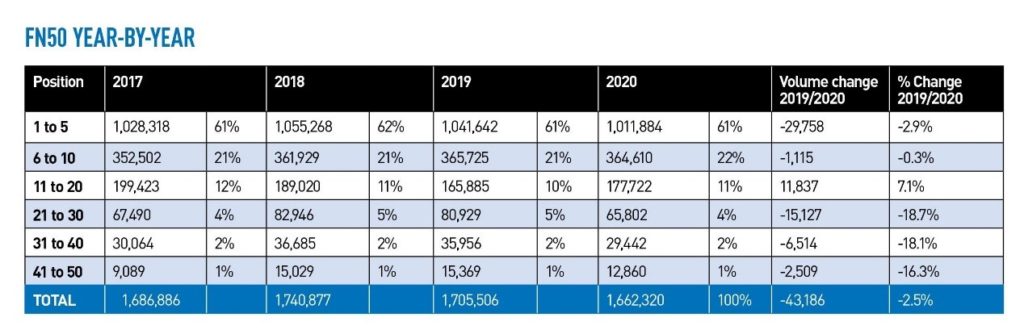
For the second consecutive year, the FN50 top 10 has, aside from some minor positional shuffling, remained the same: the same companies largely in the same places.
The two exceptions are Arval and LeasePlan switching places and an identical swap by Free2Move and Zenith.
Also occurring for the second consecutive year is a decline in total car and van volumes funded by the UK’s 50 biggest leasing companies. The 2.5% reversal, or 43,186 vehicles, is slightly higher than the previous year’s 2%/35,371, resulting in an FN50 funded fleet of 1,662,320 vehicles.
However, where last year the drop in vehicles was largely prompted by the exit of Mercedes-Benz Financial Services (now retail only) and Sandicliffe Motor Contracts (no longer funding), the year it is due to an industry-wide reduction in company cars.
This is a result of people opting for cash (the number of employees paying benefit-in-kind (BIK) tax on a car continues to fall – 90,000 have left a car scheme over the past five years) and, more recently, by the impact of Covid-19 on jobs, although the full shock of this impending economic crisis is still to be felt.
And, while opt-outs are often converted into personal leases, this hasn’t plugged the gap.
Consequently, the number of company cars in the FN50 has fallen year-on-year by 3.3%, or 41,080 units, while vans saw a negligible 0.5% dip of 2,106 vehicles.
It continues a three-year trend of vans taking a gradually increasing share of the total number of vehicles funded by the FN50: in 2017 they accounted for 24%; this year it’s 27%.
The FN50 data presents a slightly less sombre picture than the recent industry-wide figures released by the British Vehicle Rental and Leasing Association which showed a lease fleet decline of 3.6% year-on-year, at a little more than 2.53 million vehicles.
However, its survey revealed growth in the van fleet by 2.1%, which partially offset a heavier deficit in cars of 5.2%.
Swing towards PCH
Healthier performance by personal leasing Business contract hire bore the brunt of the losses, down 9.7%, while personal contract hire (PCH) enjoyed a healthier performance, up 5.7%. This is echoed by the FN50 members, where the larger organisations have been extending their penetration into the personal leasing sector in recent years.
The past couple of years have seen a definite swing towards PCH among the UK’s biggest leasing companies. In 2018, fleet leasing accounted for 87% of their car business; this year that has fallen to 80%. Almost a quarter of a million cars (244,194) are now PCH.
Often, manufacturer-owned leasing providers have a greater proportion of retail business due to the agreements sold via their franchised dealers, such as FCA’s Leasys at 69% and Renault’s RCI at 67%, while ALD, which powers white label finance for the likes of Kia and Ford, is also weighted towards private leasing. Santander Consumer Finance (the clue being in the name) is 82.5% private and Affinity Leasing, which specialises in corporate affinity schemes for employees, is 96% private.
With the likes of Zenith (ZenAuto) and Arval (Arval for Employees) stepping up their retail aspirations, and growth in salary sacrifice schemes (although not all leasing companies view these as private leasing because of the central agreement with the employer), plus bank-owned organisations such as Lex Autolease improving internal synergies, personal lines could tighten their grip on the FN50 numbers in the coming years.
“The market has been diversifying for many years now and personal leasing in its various forms has penetrated both the retail market and corporate sectors,” says Craig McNaughton, corporate director at the UK’s biggest fleet lender Lex Autolease.
However, a compelling counter-argument centres on the growing attractiveness of electric and plug-in hybrid cars due to the very low BIK tax rates over the next four years.
Some leasing companies are already reporting electric cars accounting for 30-40% of their order books.
McNaughton again: “The advent of 0% BIK for EVs and low BIK for ULEVs has seen movement back into company cars and salary sacrifice.”
He believes that traditional fleet funding methods will remain dominant, despite suggestions among some industry commentators that a growing need for flexibility will persuade companies to negotiate shorter terms and consider alternative funding arrangements.
“We have been part of subscription trials with partners and they do have potential in very specific circumstances, but the economic model for such services remains a challenge, as can be seen by the poor financial results that continue to be delivered by traditional vehicle rental companies,” he says.
“As such, changes to shorter leases and more flexible products are likely to remain small scale due to their relative expense with the market continuing to mainly fulfil demand for providing long-term leasing/funding solutions.”
Nevertheless, flexibility is a recurring theme during 2020 due to the uncertainties caused by Covid-19 and a surge in people working from home, reducing their dependence on the car.
Alphabet doesn’t see subscription services as a replacement for traditional funding, but it does recognise the need for increasing flexibility, according to chief commercial office Simon Carr.
“We expect to see a rise in demand for shorter term, adaptable leasing arrangements to bridge the gap between rental and longer-term leases as drivers’ roles and requirements change,” Carr says.
“Funding choices will become even more data-led and wholelife costs will play an even bigger part in fleet managers’ decisions as the total cost of mobility will be key to running a successful fleet in a time when travel has naturally reduced.”
Flexibility doesn’t just mean shorter terms, however. Salary sacrifice expert Tusker has responded to customers’ needs to “provide shorter and longer agreement options for employees to increase inclusion for lower earners and those on shorter employment contracts”, says CEO Paul Gilsham.
EVs stimulating growth
Meanwhile, Claire Evans, fleet consultancy director at Zenith, believes EVs are stimulating growth in all sectors of the market, from company cars to salary sacrifice to personal contracts.
“We are already seeing a trend into leased vehicles and away from ownership with the growth in electric vehicles and movement to subscription-based services based on monthly affordability,” Evans says.
“It has resulted in increases in salary sacrifice and personal contract hire cars, where EVs account for one-in-two and one-in-four orders placed this year, respectively. We expect to see this trend continue.”
As part of the FN50 survey, leasing companies provide data on the vehicles they manage on behalf of a fleet customer but don’t fund.
For cars, the numbers have risen, showing that the need by UK business for fleet management support is growing, as outsourcing of a function sometimes seen as non-core continues.
This year, the number of cars under fleet management has risen by 27,046 to 259,518; meanwhile, the number of vans has fallen slightly, from 62,808 to 62,129.
As a business essential tool, vans are much more likely to be an in-house responsibility, particularly if the company also runs trucks with their elevated legal and compliance requirements.
The rise in fleet management has helped many leasing companies to offset the reversals in fleet funding.
With three new entrants in 2020, 26 of the 47 returning FN50 companies saw their funded fleet fall compared with 2019, up from 19 companies last year.
By far, the biggest impact was felt by those left outside the top 20 (see table), where double-digit falls were commonplace.
Half of the top 10 are funding more vehicles than a year ago, with notable growth in cars and vans by Arval, lifting it by 6% to leapfrog LeasePlan into third place, and seventh-placed Hitachi Capital Vehicle Solutions, up 7% thanks to wins in both cars and vans.
Free2Move bumped Zenith from eighth after a 5% boost to its funded business, almost entirely cars with a 7,000-unit rise, while Zenith experienced a marginal 1% drop in funded business – although its van division was up year-on-year.
Zenith has also extended its penetration into the truck business with the acquisition in September of Cartwright Fleet Services, Cartwright Rentals and Cartwright Finance Sales from the administrators.
The move created one of the UK’s largest HGV and specialist fleets with more than 50,000 vehicles and one of the UK’s largest trailer rental fleets.
It also underlines how some of the UK’s top lenders are now multi-asset funders with a breadth of interests, from salary sacrifice, job need and perk cars to vans, trucks and trailers.
And some are starting to gow even further, with e-scooters/ e-bikes, car share and other forms of mobility services. By Graham Hill thanks to Fleet News
Share My Blogs With Others:These icons link to social bookmarking sites where readers can share and discover new web pages.