BMW Price Increase Irrespective Of Brexit Deal – Interesting Revelation

Wednesday, 16. December 2020

Fleet decision-makers and the leasing industry is bracing itself for a price hike on new company car and van orders in the event of a ‘no deal’ Brexit.

However, in a note from BMW, seen by Fleet News, the German manufacturer has announced a customs duty related increase of more than £3,000 on the recommended retail pricing (RRP) of the BMW i3, irrespective of whether there is a free trade deal or not.

BMW had announced at the beginning of October that BMW i3 models, along with the majority of other BMW models, would be subject to an “economic increase” in the recommended retail price rise from January 1, 2021.

Due to changes in the ‘Product Specific Rules of Origin’ legislation, it says that the maximum permitted content of non-EU and non-UK materials means these models will be subject to additional tariffs after the end of the Brexit transition period.

This will be the case, it adds, “whether or not there is a free trade agreement with the EU”, which means a further increase in the RRP of BMW i3 models is needed.

The current RRP for a BMW i3 (ZI3I), valid until December 31, is £35,120 – the previously announced RRP, to be effective from January 1, was £35,670. However, BMW says that the new RRP from January will now be £38,785 – an increase of more than £3,600.

Similarly, the current RRP for a BMW i3 (ZI3J), valid until December 31, is £37,650 – the previously announced RRP, to be effective from January 1, was £38,200. However, BMW says that the new RRP from January will now be £41,315 – again an increase of more than £3,600.

It says that for Direct Sales Agency Agreement vehicles, orders registered on or before December 31 will be charged the pricing valid on the date of order.

Meanwhile orders registered on or after January 1 will be charged as follows:

Vehicles which arrive in the UK on or before December 31 and which are marked sold on or before December 31 will be charged the pricing valid on the date of order as the vehicle will not incur additional import charges. Vehicles must be registered by April 30, 2021, to benefit from this pricing.

Vehicles which arrive in the UK on or after January 1, regardless of the date of order, or which are marked sold on or after January 1, will be charged at the new price, incorporating the customs duty increase and are not price protected.

BMW’s price hike comes after Renault issued its own price warning ahead of a free trade agreement not being reached.

In a letter from Renault’s fleet director, Mark Dickens, to customers, he says that the manufacturer has been in discussions with our factories to secure “increased production of vehicles and parts” to mitigate any risk of disruption to supply at the UK-EU border.

In addition, he said that Renault has increased capacity and staffing to ensure the “timely delivery of vehicles, parts and accessories to our customers”.

Any customer order created up to and including October 31, 2020, will be price protected regardless of the importation date, he says.

Any order placed from November 1 onwards, and that is matched to a vehicle imported from January 1, however, could be subject to revised pricing based on the imposition of vehicle tariffs.

In the event that tariffs apply on import, Renault says that those will be as per World Trade Organisation (WTO) terms, and will be added to the order price. Tariffs on WTO terms equate to 10% of the total new vehicle price including options.

Furthermore, it says any vehicle imported from January 1, ordered from November 1, could be subject to revised pricing based on the imposition of vehicle tariffs.

Finally, it says that any customer order created from January 1 would be subject to any new pricing irrespective of vehicle importation date.

Dickens wrote: “We will continue to closely monitor events and will keep you informed of any developments.”

Fleet News reported last month, how manufacturers had written to leasing companies warning them that they cannot guarantee company car prices beyond the end of the year, even for some models being ordered now.

In letters sent to vehicle lease provides by major carmakers, including BMW, Jaguar Land Rover and Mercedes-Benz, they say that the threat of a ‘no deal’ Brexit was to blame for the potential price hike.

Talks between the UK and EU are due to resume in Brussels at this 11th hour. A free trade deal is looking less likely but still in the balance.

Any deal between the UK and EU would need to be ratified by parliaments on both sides, so time is running out for an agreement to be reached and to get the sign off before December 31.

Residual Value Concerns

A senior manager working at an FN50 vehicle leasing company, said the lack of clarity around pricing was a big issue for the industry.

He said: “Our view is that we should be advising clients to hold back on orders unless they choose from the manufacturers that have said they will honour prices.”

He envisages a number of cancellations from customers where any price protection doesn’t apply.

Furthermore, in terms of future residual values, he said they were in a state of “limbo”.

“There is an argument that they should increase proportionately to the increase in new vehicle prices,” he said, “but that would only be if we expected that the used market increases in value proportionately in three years’ time.

“There is an argument for that, but the future used values would then be increasing in value because of a one-off tariff that is being imposed rather than anything that relates to enhanced value.

“Such increases may be correct when looking at the actual price values of new vehicles, but it is also a value based on the future value prediction of a tax, which doesn’t feel quite right either.”

He continued: “If the tariff was imposed for just an – undetermined – period of time, and then taken away, what would happen to used car prices? Will they also increase now for a while and the turn back or will they stay at the higher value? Will future residual values also rise and then fall again in that scenario?

“In essence, the uncertainty will show through in the new car and used car market we believe and cause a de-stabilising effect. This is never good news for anyone in the automotive sector.”

‘Costly’ Brexit Preparations

The Society of Motor Manufacturers and Traders (SMMT) has revealed the cost to the sector of preparing for Brexit has surpassed £735 million, with more than £235 million spent in 2020 alone.

Most companies (67%) across the industry say they are doing everything in their control to prepare for new processes that will come into play on January 1, with 70% securing GB Economic Operators Registration and Identification (EORI) numbers, 60% spending significantly on stockpiling and 52% employing customs agents, as companies also try to prepare for any disruption or delay to supply chains.

However, significant gaps in the industry’s ability to plan still exist, with a lack of clarity on the nature of the UK-EU’s future relationship hampering the efforts of almost nine in 10 (86%) firms to prepare.

Critical questions remain unanswered. With the industry’s competitiveness built on Just-in-Time deliveries, companies cannot afford any supply chain delays so clarity on the operation of key new customs systems such as the Goods Vehicle Movement Service (GVMS) and the Permission to Progress (P2P) process, is vital, says SMMT.

Moreover, even if the UK and EU do conclude a Free Trade Agreement (FTA) from the end of 2020, there is uncertainty as to how companies will prove origin or products; if firms cannot do this then they will not be able to benefit from preferential trading terms.

Mike Hawes, SMMT chief executive, said, “As the UK-EU FTA negotiations enter the endgame, now is the time for both sides to deliver on promises to safeguard the automotive industry.

“Securing a deal is absolutely critical but it cannot be any deal. To work for UK automotive it must deliver for UK products and that means securing the right terms and conditions that allow our exports – now and in the future – to be zero tariff and zero quota trade.

A deal that failed to achieve this would be the equivalent to no deal at all, devastating jobs and slamming the brakes on the UK’s ambitions to be a world leading manufacturer and market for electrified mobility and battery technologies.”  By Graham Hill thanks to Fleet News

Share My Blogs With Others: These icons link to social bookmarking sites where readers can share and discover new web pages.
  • MisterWong
  • Y!GG
  • Webnews
  • Digg
  • del.icio.us
  • StumbleUpon
  • Reddit
  • Alltagz
  • Ask
  • Bloglines
  • Facebook
  • YahooMyWeb
  • Google Bookmarks
  • LinkedIn
  • MySpace
  • TwitThis
  • Squidoo
  • MyShare
  • YahooBuzz
  • De.lirio.us
  • Wikio UK
  • Print
  • Socializer
  • blogmarks

Electric Vehicle Charge Points Continue To Increase But Are They Necessary?

Friday, 4. December 2020

For the last two years I’ve questioned the need for an electric vehicle charge infrastructure. We now have a deadline following which no petrol or diesel cars can be sold so we need to be satisfied that we can charge our EV’s.

Manufacturers are already developing cars with ranges up to 800 miles whilst BP have superfast chargers that can charge 80% in around 30 minutes. With average annual mileage dropping and set to remain low post COVID there is no need to have a massive charging infrastructure.

These are my views but they don’t seem to be shared by too many others. Let’s see what others say.

The number of public electric vehicle charging devices has increased 18% in the UK over the past year to 19,487.

The figure is included in the latest Electric Vehicle Charging Device Statistics report produced by the Department for Transport, which says that, of these, 3,530 were rapid devices.

This is an increase of nearly 10 times since 2015.

Rod Dennis, RAC data insight spokesman, said: “The rise in the number of charge points across the UK is very encouraging and sends all the right signals to drivers who might be thinking about opting for an electric model next time they change their car.

“Add in the fact that many people with electric cars can charge from home and overall it’s a positive picture.

“But there’s still a way to go and the focus now needs to be on installing as many fast chargers as possible, given that less than a fifth of public chargers are rapid.

“While the speed of fully charging an electric car can’t compete with the five minutes or so it takes to fill up a petrol or diesel model, a greater number of faster chargepoints could help tempt more people to ‘go electric’ sooner.”

The DfT report says there is an uneven geographical distribution of charging devices within the UK.

London has the highest level of charging device provision per 100,000 of population with 63, while Northern Ireland is lowest with 17. The UK average is 29 per 100,000 people.

Some UK local authorities have bid for Government funding for charging devices, and others have not.

The report says most of the provision of charge points has been market led, with individual charging networks and other businesses such as hotels choosing where to install devices.

Charlie Jardine, founder and CEO, EO Charging, the electric vehicle charge point and charging software developer, added: “It’s great to see an 18% increase in public chargers this year with a 7% increase in available chargers in the last quarter alone.

“We look forward to seeing this number grow as electric vehicles are set to be an essential part of how we ‘build back better’ from the Covid-19 pandemic.

“Whilst increasing the availability of public charge points is an important step in overcoming the barriers to EV adoption, 59% of vehicles on roads are company vehicles so businesses must carefully consider installing their own EV charging infrastructure.

“We’ve seen much evidence of businesses leading the way on this in recent months, with significant demand from our customers transforming their fleets across the UK and Europe from diesel and petrol to electric.”

At the end of last month, Richard Jones, managing director of Lex Autolease – the UK’s largest leasing company – labelled the country’s charging infrastructure “not-fit-for-purpose”.

He told Fleet News parts of the country are poorly served, limiting the wider adoption of EVs.  By Graham Hill thanks to Fleet News

Share My Blogs With Others: These icons link to social bookmarking sites where readers can share and discover new web pages.
  • MisterWong
  • Y!GG
  • Webnews
  • Digg
  • del.icio.us
  • StumbleUpon
  • Reddit
  • Alltagz
  • Ask
  • Bloglines
  • Facebook
  • YahooMyWeb
  • Google Bookmarks
  • LinkedIn
  • MySpace
  • TwitThis
  • Squidoo
  • MyShare
  • YahooBuzz
  • De.lirio.us
  • Wikio UK
  • Print
  • Socializer
  • blogmarks

Fears Over EV Battery Fires Increase As A Result Of Ford Kuga PHEV Recall

Friday, 4. December 2020

Ford will begin recalling Kuga PHEV models to replace their battery packs, following an announcement in August that a potential fault could lead to fires.

Sales of the plug-in hybrid (PHEV) SUV were halted in the Summer when it was discovered that the car’s battery pack could overheat and cause a fire.

The manufacturer says it has now identified the cause of the issue and will replace the battery packs in all affected vehicles.

A statement issued by the brand said: “The root cause has been identified as a battery cell contamination issue in our supplier’s production process and we have determined that the best course of action for the safety of our existing customers is to replace the drive battery pack.”

The same issue was discovered with batteries used in some BMW plug-in hybrid vehicles.

The recall will require the car to be in a workshop for at least one day. Ford will offer a collection and delivery service, as well as courtesy vehicle where required.

Ford says it will carry out the necessary repair to all affected vehicles between late December 2020 and March 2021.

Ford will provide extended warranties or £500 fuel vouchers as compensation to affected owners.

Drivers are advised not to charge their vehicle and not to use the EV Mode, Sport or Snow settings until the vehicle has been repaired.  By Graham Hill thanks to Fleet News

Share My Blogs With Others: These icons link to social bookmarking sites where readers can share and discover new web pages.
  • MisterWong
  • Y!GG
  • Webnews
  • Digg
  • del.icio.us
  • StumbleUpon
  • Reddit
  • Alltagz
  • Ask
  • Bloglines
  • Facebook
  • YahooMyWeb
  • Google Bookmarks
  • LinkedIn
  • MySpace
  • TwitThis
  • Squidoo
  • MyShare
  • YahooBuzz
  • De.lirio.us
  • Wikio UK
  • Print
  • Socializer
  • blogmarks

Serious Concerns Raised Over Data Protection As We Move Towards Connected Vehicles

Friday, 4. December 2020

Fleet operators are at the nexus of the digital and physical realms.

Whilst more business is done online than ever before, just in time logistics help keep modern supply chains lean and profitable, and form a critical part of many business operations transporting materials from A to B.

Internet of Things (IoT) technologies are improving vehicle and driver safety, finding more efficient routes, and delivering great customer experiences.

These connections, which will soon benefit from 5G networks, power the modern economy but can also be exploited for unintended purposes.

Essentially, as more devices and systems connect to the internet, the greater the amount of targets threat actors (hackers) have to exploit.

Indeed, the attack surface of a modern vehicle has never been larger: infotainment systems; OBD II dongles needed for telematics and insurance; GPS navigation systems; digital key fobs; fleet management systems; dashcams etc. plus connected apps offering tracking and remote unlock services – these are all connected devices or systems that have the potential to be exploited by threat actors.

Heavy vehicles have connected more widely through satellite and cellular communications for quite some time.

Consequently, heavy vehicles currently have more avenues for remote access than light vehicles.

Coupled with a high level of electronic homogeneity within commercial trucking fleets, an adversary could easily develop viable exploits that could attack large numbers of vehicles simultaneously.

The benefits that connecting fleets brings must be balanced against cyber, safety and continuity risk to ensure a resilient business.

2019 blackhat threats on auto overtook whitehack threats for the first time (Source: Upstream).

Currently, ransomware is the preferred tactic used by threat actors with Check Point Research reporting a 50% increase in the daily average of ransomware attacks during 2020.

It’s taking its toll on businesses globally; this year the Australian logistics giant Toll Group suffered two ransomware attacks within three months and they have yet to disclose the full cost impact to the business.

Ransoms and unplanned costs can be hefty; IBM Security X-Force has reported seeing ransom demands of more than $40 million this year.

Although, that is a snip compared to the $400 million expenses Fedex faced in the first 12 months following the NotPetya malware incident in 2017.

Cyber-threats to connected fleets are not just limited to actions within a company’s own networks either, as the cyber threat may affect a manufacturer directly, and subsequently it’s customers.

With more research being conducted and the number of cyber attacks increasing, there may be additional disruption to connected fleets due to maintenance cycles and vehicle recalls.

In 2019 security researchers found Teletrac Navman, Global Telemetrics and LoJack smart tracker app APIs had authorization vulnerabilities, allowing a hacker or thief to take over the account, track individual vehicles in real time, suppress theft alerts, and extract personal data.

If a vehicle was alerted as stolen, the thief could also delete the alert and prevent any further action being taken.

One tracking device could be remotely triggered to immobilize the vehicle, stopping it from being driven (Upstream 2020). 

Threats come in other forms; using a vehicle as a weapon is a popular tactic for terrorists and extremists.

Lone actors and small cell operations don’t require large financial support when they can hire, or hijack, a vehicle and use it in an attack.

In recent years, individuals have driven vehicles as weapons into crowds of pedestrians in fatal attacks in major cities including New York, Edmonton, Toronto, London, Berlin and Nice, France.

The Global Terrorism Database recorded 12 incidents where vehicles were used as the weapon in a terrorist attack between 2015-2018 in the US alone.

There is a risk that threat actors with extreme political beliefs could utilise technology like connected vehicles to conduct an attack.

So what is being done?

Manufacturers are responding to threats by hosting bug bounty programs whereby white hat hackers try to identify any potential weaknesses.

These programs indicate a growing awareness of the vulnerabilities and potential damage, should they be exploited.

The Hackerone bug bounty platform hosts public vulnerability disclosure programs for both Ford and General Motors and shows the large number of vulnerabilities that existed before the programs launched.

Security by design principles are slowly becoming the standard for all IoT devices, yet with the myriad of devices that will be connected to the internet, let’s not forget the responsibility organisations and individuals have to ensure their devices, systems and networks are properly patched, updated and backed up safely and regularly.

Other measures can include encrypting data and systems, using multi-factor authentication (MFA) and even Intrusion Prevention Systems to prevent entry to vehicles and onboard systems being hacked.

With this type of security in place, it can also help to minimise operational risk and the business impact by including cyber insurance as part of an overall risk protection strategy.

Traditionally, cyber insurance has been an ‘add-on’ to existing commerical policies or only provided third party cover in the event of a breach, potentially leaving businesses woefully underinsured and without specialist expertise to remediate the short, medium and long-term impacts of a cyber attack.

It’s worth utilising tailored cyber insurance services as part of a comprehensive defense strategy against threat actors.

Connectivity, automation and electrification will continue to be the most dominant automotive technology trends in the next decade; Frost & Sullivan forecasts that by 2025, 55% of all trucks in North America will be part of connected fleets.

As technology advances, the potential for vulnerabilities to be exploited also grows, so fleet owners and operators need to consider the implications; how can they control cybersecurity risks while still embracing innovation?  By Graham Hill thanks to Fleet News

Share My Blogs With Others: These icons link to social bookmarking sites where readers can share and discover new web pages.
  • MisterWong
  • Y!GG
  • Webnews
  • Digg
  • del.icio.us
  • StumbleUpon
  • Reddit
  • Alltagz
  • Ask
  • Bloglines
  • Facebook
  • YahooMyWeb
  • Google Bookmarks
  • LinkedIn
  • MySpace
  • TwitThis
  • Squidoo
  • MyShare
  • YahooBuzz
  • De.lirio.us
  • Wikio UK
  • Print
  • Socializer
  • blogmarks

TRL Call For Urgent Action To Address Driver Wellbeing To Avoid Driver Errors Amongst Company Car Drivers

Friday, 4. December 2020

Driver wellbeing is ‘in the spotlight’ due to the ongoing Coronavirus pandemic and needs addressing, says Rosie Sharp, behavioural sciences researcher at TRL.

Organisations that fail to resolve issues with driver wellbeing can result in more collisions, traffic violations and poor fuel economy, as drivers with poor mental health make more driver errors and drive more erratically, says Sharp.

She said: “Mental health and wellbeing isn’t usually something that you would initially associate with driver performance and the success of a fleet business, but I think it has more impact than most people realise.

“The other issues that organisations can face if they if they don’t address any wellbeing issues are things like staff being off sick, high staff turnover, poor customer service and even damage a corporate reputation.”

Sharp will be speaking at this year’s Virtual Fleet & Mobility Live conference on the second day of the event at 12pm.

In her session, ‘Mental health and wellbeing: looking after your drivers’, Sharp will be providing delegates with best practice advice on how to create an environment that promotes mental health and wellbeing and infrastructure to deal with wellbeing issues.

She said: “Change in attitudes and stigma towards mental health, particularly in male dominated industries which we know that fleets usually are, is not something that’s going to be done overnight.

“What can be done, is create an open and kind of reassuring organisation for employees to come forward and to be able to feel comfortable in talking about their mental health.

“Putting things in place like confidential employee helplines, trained managers or mental health first aiders and having post incident reviews, considering any mental health conditions that could have contributed to collisions.

“Driver wellbeing in always important, but I think particularly this year, in terms of Covid-19 it’s really in the spotlight now and something that needs addressing.”

Matt Hammond, head of fleet at Altrad Services, also said that focus on driver mental health and wellbeing can be key to safety and risk management within a fleet.  By Graham Hill thanks to Fleet News

Share My Blogs With Others: These icons link to social bookmarking sites where readers can share and discover new web pages.
  • MisterWong
  • Y!GG
  • Webnews
  • Digg
  • del.icio.us
  • StumbleUpon
  • Reddit
  • Alltagz
  • Ask
  • Bloglines
  • Facebook
  • YahooMyWeb
  • Google Bookmarks
  • LinkedIn
  • MySpace
  • TwitThis
  • Squidoo
  • MyShare
  • YahooBuzz
  • De.lirio.us
  • Wikio UK
  • Print
  • Socializer
  • blogmarks

Survey Finds That Older Better Off Drivers Are More Likely To Speed

Friday, 4. December 2020

A third of drivers admitted to breaking the speed limit, with older, higher-earners among the worst offenders, a new survey has revealed.

It also highlighted a need for a greater number of visible speed limit signs, as motorists admit they have unwittingly broken the speed limit because they did not know the limit for the roads they were driving on. 

The findings were revealed by Venson Automotive Solutions, which ran the survey ahead of Brake Road Safety Week 2020, which is centred around speeding.

Simon Staton, director of client management at Venson Automotive Solutions, said: “Our survey findings suggest that more needs to be done to make people aware – both in terms of in-car tech to alert drivers to their speed and dominant signage on UK’s roads – of varying  speed limits, particularly in the wake of new reduced limits across many towns and cities.

“Driving a vehicle at excess speed is one of the most common motoring offences. However, with the HSE estimating that more than a quarter of all road traffic incidents may involve somebody who is driving as part of their work at the time, more must be done to curb speeding.

“Fleet managers and businesses need to ensure they have a Duty of Care policy in place that includes driver licence checking, driver risk assessments and driver training.

It is important to also monitor speeding fines and accident data to understand the drivers that pose a risk to the business, themselves and other road users, and work with them to improve their  behaviour behind the wheel.

Businesses can also encourage user-choosers to consider in-car technology to help them drive responsibly such as intelligent speed assistance systems. Educating drivers and ensuring best practices are in place will in turn save lives.”  By Graham Hill thanks to Fleet News

Share My Blogs With Others: These icons link to social bookmarking sites where readers can share and discover new web pages.
  • MisterWong
  • Y!GG
  • Webnews
  • Digg
  • del.icio.us
  • StumbleUpon
  • Reddit
  • Alltagz
  • Ask
  • Bloglines
  • Facebook
  • YahooMyWeb
  • Google Bookmarks
  • LinkedIn
  • MySpace
  • TwitThis
  • Squidoo
  • MyShare
  • YahooBuzz
  • De.lirio.us
  • Wikio UK
  • Print
  • Socializer
  • blogmarks

New Used Car Seller Cinch Due To Expand Thanks To £50 Million Boost

Friday, 27. November 2020

British Car Auction’s online car retailing platform cinch has secured a £50m finance facility from HSBC and Natwest to boost its inventory.

Cinch launched in July 2019 as a rival to Auto Trader, offering car retailers an online marketing platform on which to promote their stock for sale. Last month (October 2020), it announced that it would begin selling cars, putting it in direct competition with its clients; such as online retailer Cazoo.

It allows consumes to find, buy, finance and part exchange their car online, with a 14-day money back guarantee.

As a marketplace, dealers, car manufacturers and leasing companies can also offer their vehicles directly to consumers through the cinch platform.

Geoffrey Head, cinch’s finance director, said: “This finance facility from HSBC UK and NatWest comes at a pivotal time for our business and will allow us to further develop our end-to-end digital offering for consumers.

The pandemic has drastically changed consumer behaviours and the ability to sell vehicles online will continue to be critical across the automotive sector. We are committed to developing this offering for both our consumers and partners across the industry.”

The new funding package, which includes £35m of funding from HSBC UK and £15m from NatWest, will be used to bolster cinch’s own inventory programme with around 5,000 new vehicles. Cinch says, along with its dealer partner stock, it will be among the UK’s largest direct-to-consumer platforms.

Gerard Haughey, head of global trade and receivables finance, Large Corporate, at HSBC UK, said: “Cinch’s fully digital offering is playing a central role in transforming the used car market for the digital age.

We are delighted to be able to support the business with a fairly unique inventory only asset-based lending facility as the team at cinch build this innovative service for the benefit of consumers and all players in the industry.”

Martin Noakes, head of asset based lending at NatWest, added: “This innovative financing package will help cinch achieve its ambition of providing cars to consumers in a convenient way through its online platform.

Our support will enable cinch to futureproof its business and keep pace with changing consumer behaviour in their industry.”  By Graham Hill thanks to Fleet News

Share My Blogs With Others: These icons link to social bookmarking sites where readers can share and discover new web pages.
  • MisterWong
  • Y!GG
  • Webnews
  • Digg
  • del.icio.us
  • StumbleUpon
  • Reddit
  • Alltagz
  • Ask
  • Bloglines
  • Facebook
  • YahooMyWeb
  • Google Bookmarks
  • LinkedIn
  • MySpace
  • TwitThis
  • Squidoo
  • MyShare
  • YahooBuzz
  • De.lirio.us
  • Wikio UK
  • Print
  • Socializer
  • blogmarks

Planned Increase To Congestion Zone In London Put Back.

Friday, 27. November 2020

The Government has agreed a six-month £1.8 billion funding deal with Transport for London (TfL), but a suggestion the congestion charge zone could be expanded has been taken of the table.

TfL had asked for a £5.7bn package to prop up services for the next 18 months, after passenger numbers and revenues have fallen after the March lockdown.

However, after an interim funding measure was agreed a couple of weeks ago, the possibility of TfL having to expand London’s congestion charge zone to the north and south circular appeared to be conditional to this latest financial deal.

An initial bailout from the Government in the wake of the coronavirus crisis has already seen prices increased and its hours of operation extended.

It now applies from 7am to 10pm, seven days a week, while drivers must pay £15, rather than £11.50, to enter the zone.

At the time, TfL described that as a ‘temporary’ price increase as a result of a funding agreement between the Government and the transport authority.

It secured a £1.6bn bailout from the Government after warning it could have to cut services.

The proposed extension to the £15 congestion charge zone, which was mooted as part of this latest deal, would have gone live in October next year, when the expanded ULEZ is also introduced due to be introduced covering the same area.

The Mayor of London, Sadiq Khan, labelled the plans “ill-advised and draconian”, and warned it would “punish Londoners for doing the right thing to tackle Covid-19”.

Talking after this latest round of funding was agreed, he said: “These proposals from the Government (if given the go-ahead) would have hammered Londoners by massively expanding the congestion charge zone, scrapping free travel for older and younger Londoners and increasing TfL fares.”

The deal makes around £1.8bn of Government grant and borrowing available on current projections to TfL in the second half of this financial year.

TfL will itself make up through cost savings the £160 million gap the deal leaves from the nearly £2bn the organisation projects it will need to run the tube, bus and other TfL services for the remainder of this financial year.

As part of the deal, London will also have to raise extra money in future years. Decisions about how this additional funding will be raised are yet to be made by Khan, but some of the options that he and the Government have agreed to be looked at include a modest increase in council tax, pending the appropriate consultation, as well as keeping in place the temporary changes to the central London Congestion Charge that were introduced in June 2020, subject to consultation.

Khan said: “This is not a perfect deal, but we fought hard to get to the best possible place. The only reason TfL needs Government support is because almost all our fares income has dried up since March as Londoners have done the right thing.”

Two Government special representatives will continue to sit on TfL’s board.

A new Government-chaired Government oversight group will monitor the implementation of the agreement and the sustainability plan.

Transport secretary Grant Shapps said: “This deal is proof of our commitment to supporting London and the transport network on which it depends. Just as we’ve done for the national rail operators, we’ll make up the fare income which TfL is losing due to Covid-19. Londoners making essential trips will continue to be able to use tubes, buses, and other TfL services, thanks to this Government funding.

“At the same time, the agreement is fair to taxpayers across the country. The Mayor has pledged that national taxpayers will not pay for benefits for Londoners that they do not get themselves elsewhere in the country.

“Over the coming months, as we look to move beyond the pandemic, I look forward to working with London’s representatives to achieve a long-term settlement, with London given more control over key taxes so it can pay more costs of the transport network itself. This agreement marks the first step towards that, potentially allowing a longer-term, sustainable settlement for TfL when the course of the pandemic becomes clearer.”

Logistics UK, formerly the Freight Transport Association (FTA), welcomed the decision not to go-ahead with the expansion of the congestion charge zone.

David Wells, chief executive of Logistics UK, said: “The Government’s decision to… refrain from expanding the London Congestion Charge is a huge relief to logistics businesses, many of whom continue to struggle financially and operationally as a result of the Covid-19 crisis.

“Now, Logistics UK is urging Government to reconsider whether logistics activity should still be included in the temporary conditions added in June 2020, which saw a significant increase in the fee and longer operating hours.

With little alternative to using lorries and vans to keep London stocked with all the goods the population needs, it simply amounts to an additional tax on those charged with supporting the capital during the pandemic, and beyond.”

Peter Hogg, London city executive and UK cities director at Arcadis, also welcomed the deal between Government and TfL.

However, he said what the settlement illustrated was the need for a “new, long term funding model for TfL”.

“More than ever, London and national government as well as business and citizens have to protect London’s status as a global economic powerhouse. That is impossible to achieve without a correspondingly world class transport network.

“Both Government and the GLA will know that a twice yearly Punch and Judy show to agree a short term funding settlement is not a sustainable way to achieve a world class network.

“It is important that central Government and the GLA use the next months to develop a robust long term funding model for TfL that allows for capital investment, effective operation and – above all – a genuinely world class network that bolsters London’s global competitive advantage.”  By Graham Hill thanks to Fleet News

Share My Blogs With Others: These icons link to social bookmarking sites where readers can share and discover new web pages.
  • MisterWong
  • Y!GG
  • Webnews
  • Digg
  • del.icio.us
  • StumbleUpon
  • Reddit
  • Alltagz
  • Ask
  • Bloglines
  • Facebook
  • YahooMyWeb
  • Google Bookmarks
  • LinkedIn
  • MySpace
  • TwitThis
  • Squidoo
  • MyShare
  • YahooBuzz
  • De.lirio.us
  • Wikio UK
  • Print
  • Socializer
  • blogmarks

More Manufacturers Face Fines Over Falsified Emission Figures

Friday, 27. November 2020

Fiat Chrysler Automobiles (FCA) is the latest manufacturer to face an emissions-based legal battle in the UK, as law firm PGMBM claims the manufacturer misled customers through the use of emissions ‘defeat’ devices.

PGMBM, which has also launched legal action against Mercedes-Benz and the Renault Nissan Alliance, says up to half a million of vehicles with FCA Group engines, manufactured since 2008, could be affected in England and Wales, .

Owners could be due £10,000 in compensation, if the claim is successful.

PGMBM managing partner Tom Goodhead said: “Fiat Chrysler Automobiles have misled drivers about the true diesel emissions that many of their vehicles produce. This is yet another instance of a huge automotive firm conning consumers – with a significant impact on the environment and our collective wellbeing.

“FCA must be held to account for these practices, and this case will give consumers the opportunity to pursue some justice and be compensated for being misled by a company that they may have trusted.

“Legally, consumers could be entitled to anything up to the full cost of the affected vehicles. But based on similar legal actions around the world, we believe that £10,000 per claimant should be expected.”

The car maker’s offices, including those of truck maker CNH, in Germany, Switzerland and Italy were raided in July, following claims that some of the company’s engines produced illegal levels of emissions.

According the PGMBM, potentially illegal software was used in the engine management systems used in Alfa Romeo, Jeep, Fiat and Suzuki cars, plus Iveco and Fiat commercial vehicles.

Affected engines, highlighted in the investigation, include Euro 5 and 6 variants of the 1.3-litre, 1.6-litre and 2.0-litre Multijet diesel engine.

A full list of potentially affected models can be viewed below.

In 2019, FCA agreed to a settlement worth $800 million to resolve claims from the US Justice Department and the state of California relating to the use of illegal software that produced false results on diesel-emissions tests.

The new claim alleges that FCA committed fraud by manufacturing vehicles whose true diesel emissions far exceeded the limits imposed by EU and UK laws.

An FCA spokesperson said: “FCA believes this claim to be totally without merit and we will vigorously defend ourselves against it.”

Potentially affected vehicles with FCA’s diesel engine:

Make / Model1.3 litre1.6 litre2.0 litre3.0 litre3.0 litre (V6)
Fiat500 500C 500L 500X Doblo Fiorino Panda Punto Punto Evo Grande Punto Qubo Tipo500L 500X Bravo Doblo Grande Punto Punto Evo Scudo Talento Tipo500X Bravo Doblo Ducato Scudo TalentoDucato
Alfa RomeoMiToGuilietta MiTo159 Brera Guilietta Spider
JeepCompass RenegadeCherokee Compass RenegadeGrand-Cherokee Commander
SuzukiSX4 Vitara S-Cross
IvecoAll models

By Graham Hill thanks to Fleet News

Share My Blogs With Others: These icons link to social bookmarking sites where readers can share and discover new web pages.
  • MisterWong
  • Y!GG
  • Webnews
  • Digg
  • del.icio.us
  • StumbleUpon
  • Reddit
  • Alltagz
  • Ask
  • Bloglines
  • Facebook
  • YahooMyWeb
  • Google Bookmarks
  • LinkedIn
  • MySpace
  • TwitThis
  • Squidoo
  • MyShare
  • YahooBuzz
  • De.lirio.us
  • Wikio UK
  • Print
  • Socializer
  • blogmarks

Electric Vehicle Batteries Degrade Over Time, Here’s Some Advice On Keeping Them In Tip Top Condition

Friday, 27. November 2020

The following article was created for large fleet users but the same advice equally applies to consumers and small companies who drive electric vehicles

How long does an electric car battery last? Use the free Geotab EV Battery Degradation Tool to compare the average battery degradation over time for different vehicle makes and model years.

Geotab developed the tool based on an analysis of 6,300 fleet and consumer electric vehicles. Read on to learn about EV battery health and get key takeaways on real-world battery performance.

See also: To what degree does temperature impact EV range?

The importance of EV batteries

If you’re thinking about buying an electric vehicle (EV), there are some important factors to consider. These three questions are probably at the top of your list:

  • How much will the EV cost?
  • What is its range?
  • How long will the battery last?

From a life-cycle perspective, battery performance and health really are the key to it all. As the battery is an EV’s most expensive component, the degree of degradation will affect the vehicle’s residual value (which helps answer the cost question from above), and will also have a direct impact on maximum usable range over time.

See also: Podcast: EV myths and management with Charlotte Argue

How long will an EV battery last?

You might have noticed that it is tough to get a straight answer to questions about an EV’s battery lifespan. What you may find instead are assurances that batteries are covered by warranty should something go wrong. Typically, battery coverage is 8 years or 100,000 miles, but this will vary by manufacturer and country.

Warranties are reassuring, and so too is the fact that battery costs are decreasing significantly year over year. Since 2010, the price of an average Lithium-ion battery pack has dropped by over 80%.

An automaker’s guarantee of their battery technology and the promise of decreasing costs should inspire some confidence. However, most of us would find more comfort knowing how quickly our batteries are expected to degrade, and how to minimize this loss.

See also: Preparing for EVs: Charge the North EV study findings for fleet operators

What is EV battery degradation?

Battery degradation is a natural process that permanently reduces the amount of energy a battery can store, or the amount of power it can deliver. The batteries in EVs can generally deliver more power than the powertrain components can handle. As a result, power degradation is rarely observable in EVs and only the loss of the battery’s ability to store energy matters.

A battery’s condition is called its state of health (SOH). Batteries start their life with 100% SOH and over time they deteriorate. For example, a 60 kWh battery that has 90% SOH would effectively act like a 54 kWh battery.

Keep in mind, this is not the same as vehicle range (distance the vehicle can travel on those kWhs), which will fluctuate on a daily or trip-by-trip basis, depending on a number of factors including charge level, topography, temperature, auxiliary use, driving habits and passenger or cargo load.

Common factors impacting Lithium-ion battery health:

  1. Time
  2. High temperatures
  3. Operating at high and low state of charge
  4. High electric current
  5. Usage (energy cycles)

While there has been plenty of research done on battery health, there has been very little data following the real-world performance of EVs over time, let alone comparisons across different makes and models. Until now.

See also: J1939: Why having electric trucks and buses speak the same language is good for fleets

Introducing the EV Battery Degradation Tool

Geotab created the EV Battery Degradation Tool to assess how batteries have been holding up and to consider the relative importance of the above factors on EV battery life under real-world conditions.

We analyzed the battery health of 6,300 fleet and consumer EVs, representing 1.8 million days of data. From the telematics data processed, we have gained insight into how real-world conditions influence the battery health of electric vehicles, providing aggregated average degradation data for 21 distinct vehicle models, representing 64 makes, models and years.

Notes about the tool:

  • The degradation curves displayed below are the average trend line from the data analyzed.
  • These graphs can offer insight into average battery health over time, but should not be interpreted as a precise prediction for any specific vehicle.
  • A subset of vehicle makes, models and years are not available in the visualization tool – we have excluded vehicles with insufficient data, so don’t be alarmed if your car of choice is missing.

Get started with the tool

For more information and to use the tool, see the Electric Vehicle Battery Degradation Tool page. To test it out, use the embedded version below:

Key takeaways

High levels of sustained battery health observed

First and foremost, based on data from over 6,000 electric vehicles, spanning all the major makes and models, batteries are exhibiting high levels of sustained health. If the observed degradation rates are maintained, the vast majority of batteries will outlast the usable life of the vehicle.

Like us, health declines with age

As you might expect, the older a vehicle is, the more likely its battery has deteriorated. However, when looking at average decline across all vehicles, the loss is arguably minor, at 2.3% per year.

This means that if you purchase an EV today with a 150 mile range, losing about 17 miles of accessible range after five years is unlikely to impact your day-to-day needs.

Is EV battery degradation linear?

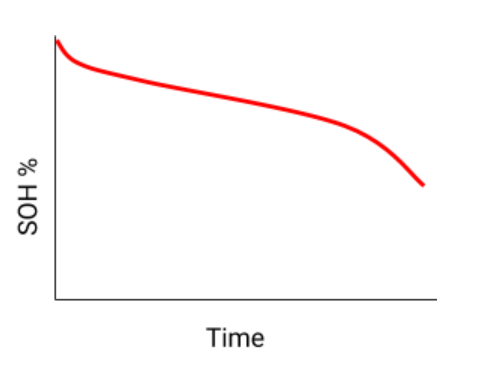
While this tool shows more or less linear degradation, as a general rule, EV batteries are expected to decline non-linearly: an initial drop, which then continues to decline but at a far more moderate pace. Towards the end of its life a battery will see a final significant drop, as seen below.

Figure 1: A normal degradation curve is expected to look something like this.

Fortunately for the drivers, too few batteries we’ve observed have reached the end-of-life drop for us to predict at what point this is likely to occur. We will continue to monitor to see when the non-linear degradation (also known as the “heel”) begins.

There is a measurable difference between makes, models and years

From our data, it appears that vehicle batteries respond differently to the test of time, depending on their make and model-year. Why do some vehicle models seem to, on average, degrade faster than others? Two potential contributors are battery chemistry and thermal management of the battery pack.

While EVs use Lithium-ion batteries, there are many different variations of Lithium-ion chemistries (the most prominent difference being the materials used for the electrodes). A battery’s chemical make-up will influence how it responds to stress. In addition to cell chemistry, temperature control techniques differ across vehicle models. A major distinction is if the battery pack is cooled and/or heated by air or by liquid.

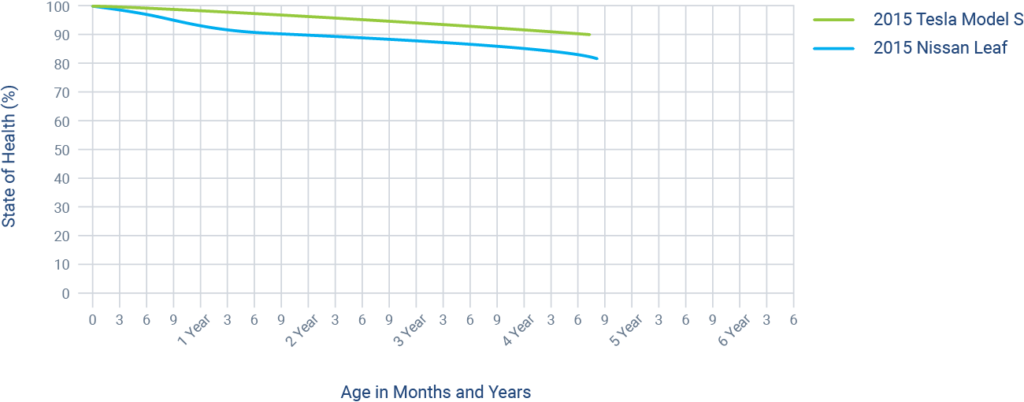
Let’s compare a vehicle with a liquid cooling system to one with a passive air cooling system: the 2015 Tesla Model S and the 2015 Nissan Leaf, respectively. The Leaf has an average degradation rate of 4.2%, while the Model S is 2.3%. Good thermal management means better protection against degradation.

Figure 2: Battery degradation comparison of the 2015 Tesla Model S (liquid cooling) vs. the 2015 Nissan Leaf (passive air cooling).

State of charge (SOC) and the buffer effect

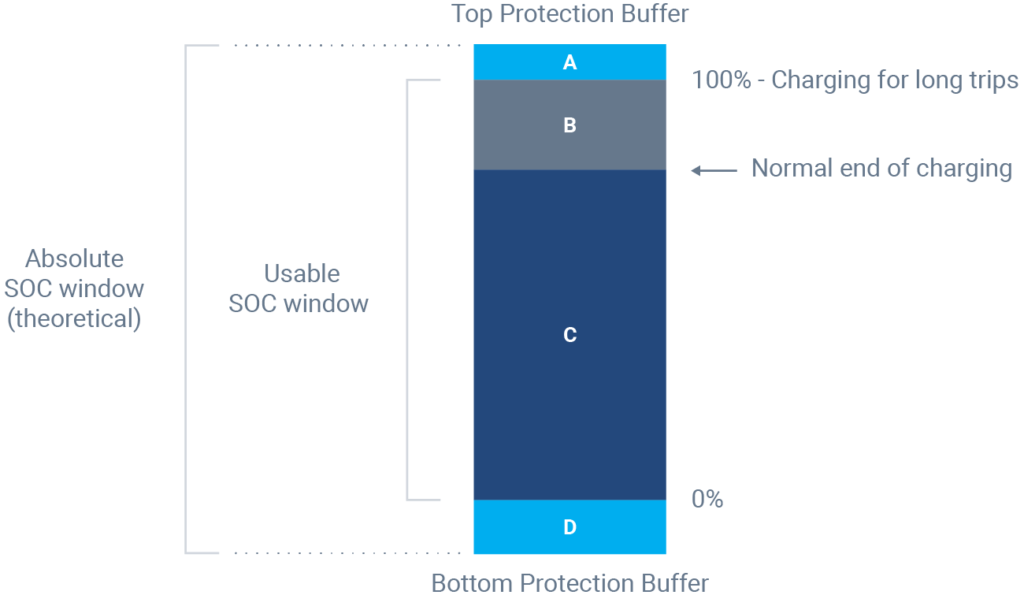
Another anticipated reason for the differences in battery health between manufacturers is how SOC is controlled. Operating a battery at near full or empty has implications on battery health. To limit this effect, many manufacturers add a buffer, effectively preventing access to the extreme ends of the SOC window (shown in the image below).

In addition to the protection buffers at the top end and bottom end of the battery range, many vehicles provide the EV owner the option to stop normal daily charging at a level below 100%.

https://storage.googleapis.com/geotab_wfm_production_cms_storage/CMS-Images-production/Blog/NA/December_2019/battery_degradation/ev-battery-protection-buffers.png

Figure 3: Battery protection buffers control the usable state of charge window for an EV.

Did you know?

Removing the extremes is not only done for battery health but also for safe vehicle operation. At the extreme ends the battery wouldn’t be able to accept or deliver full power and the driving experience would be impacted. In essence, a battery at 100% isn’t completely charged from a pure battery chemistry standpoint.

Similarly, 0% isn’t completely empty. Since the vehicle owner is unable to access these parts of the battery range for safety and battery life reasons, it is likely that many are unaware of it.

Thanks to over-the-air software upgrades, it’s possible that the size of the buffer can change over time, as discovered by some Tesla owners in 2019 when they noticed a decrease in their top range. Tesla confirmed the upgrade was “to protect the battery and improve longevity.”

In addition, some automakers have adjustable charge ceilings, where the user can pre-set at what point the battery stops charging (e.g., they can tell the vehicle to stop charging at 75% instead of 100%).

This owner-discretionary region (B in the graphic above) works in combination with the non-discretionary buffer (A) to limit battery operation in areas of higher degradation. In later updates to the degradation tool we intend to include the impact of owner’s operation within this discretionary (B) region and the resulting impact on degradation rates.

Let’s consider an example:

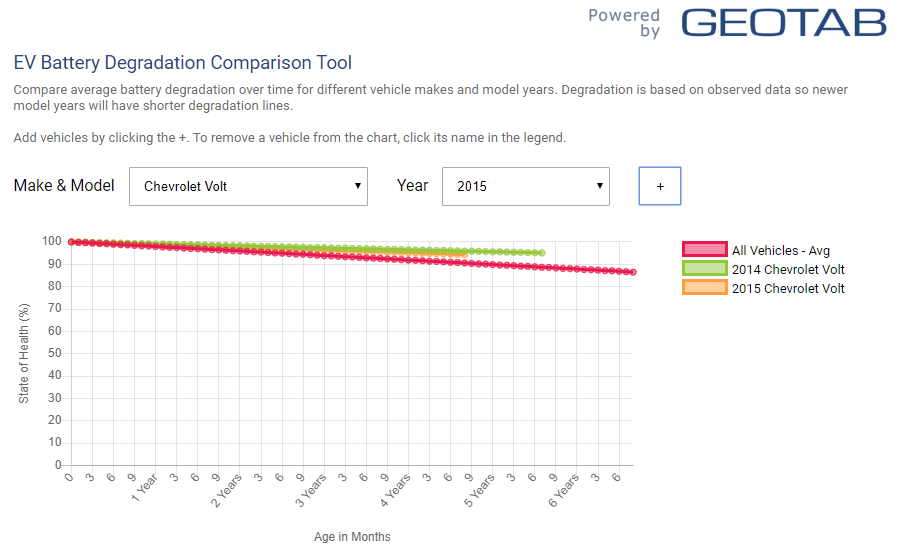
The Chevrolet Volt, especially the early model years, has comparatively large top and bottom protection buffers (regions A and D) that dynamically change as the battery ages. While the larger buffers mean less energy for driving, it should result in a longer lasting battery pack.

Given the larger SOC buffers, liquid thermal management, and dynamic (decreasing) buffer size, slower than average degradation rates should be expected on the Volt.

https://storage.googleapis.com/geotab_wfm_production_cms_storage/CMS-Images-production/Blog/NA/December_2019/battery_degradation/ev-battery-degradation-volt-vs-all-vehicles.png

Figure 4: Battery degradation over time for a Chevrolet Volt vs. all vehicles.

What additional factors appear to influence battery health?

Based on the telematics data available, we were able to evaluate battery degradation by different factors the vehicles were exposed to and see if there was any correlation with health decline. These factors included:

  • Use
  • Extreme climates
  • Charging type

Over time, we hope to develop these insights into a degradation tool that can better predict EV state of health.

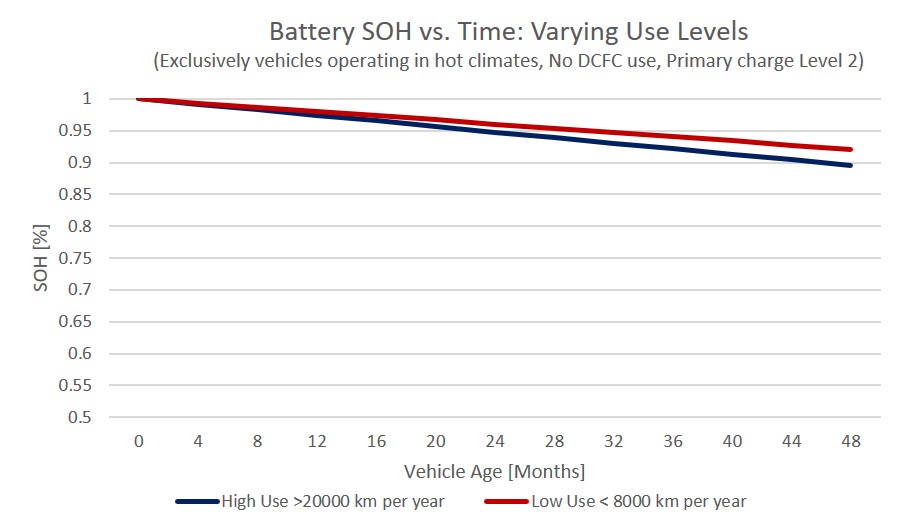
High vehicle use does not equal higher battery degradation

One exciting piece of information we were able to glean from the data was that vehicles with high use did not show significantly higher battery degradation. This should come as welcome news, since you don’t get the benefit of an EV if it’s just sitting in the fleet yard.


The takeaway? Don’t be afraid to put your EVs in high-use duty cycles. As long as they are within their daily driving range, their battery life won’t be negatively impacted.

One caveat: if high use requires routine DC fast charging, be sure to read the section on the impact of charging type.

Amount of use doesn’t appear to have much impact on degradation rates.

Figure 5: Amount of use doesn’t appear to have much impact on degradation rates.

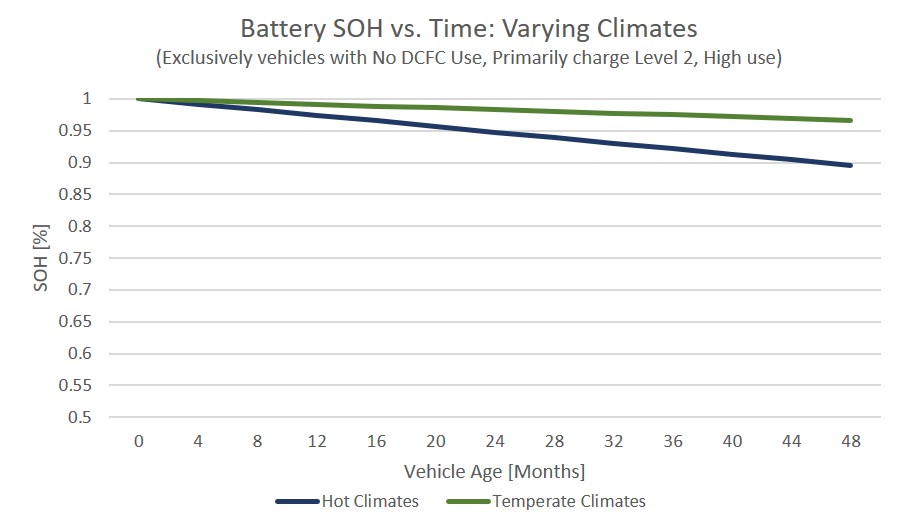
Vehicles driven in hot temperatures show faster decline in battery SOH

A battery exposed to very hot temperatures will be prone to more damage, but by how much? Will an EV in Arizona have a different battery life than the same car driven in Norway? To find out, we grouped the vehicles based on the following climate conditions:

  • Temperate: Fewer than 5 days per year over 80 F (27 C) or under 23 F (-5 C).
  • Hot: More than 5 days per year over 80 F (27 C).

As illustrated below, vehicles driven in hot climates showed a notably faster rate of decline than those driven in moderate climates. This is not great news if you and your fleet toil under the hot sun.

Heat and cold weather also impacts your day-to-day range. To understand how, take a look at our Temperature Tool for EV Range.

Batteries exposed to hot days degrade faster than those in temperate climates.

Figure 6: Batteries exposed to hot days degrade faster than those in temperate climates.

Taking a look at charge type

We were able to look at the predominant charging level used for the EVs in our system. North American EV charging stations are categorized in three common types:

  1. Level 1: 120 volt – a regular home outlet in North America.
  2. Level 2: 240 volt – typical for home or fleet charging.
  3. Direct current fast charger: DCFC – for faster top ups.

For an overview of charging and related costs, read our simple guide to EV charging.

Charging in most of Europe is referred to as AC charging (which is generally equivalent to Level 2 in North America) and DC charging (DCFC, as described above).

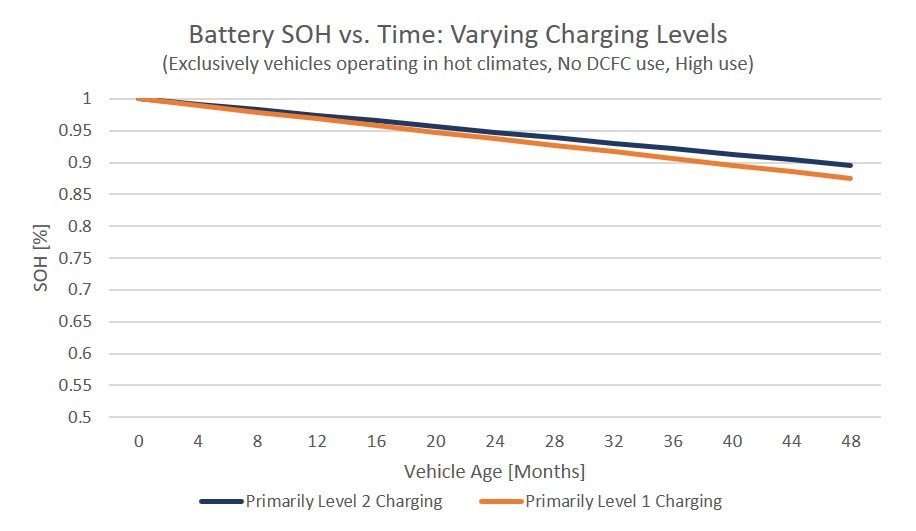
While Level 2 is often cited as the optimal way to charge an EV, the difference in battery health between cars that routinely charged on Level 2 as compared to those who used Level 1 appeared to be observable but was not beyond the level of statistical significance.

Battery degradation for vehicles that primarily charge on Level 1 compared with Level 2.

Figure 7: Battery degradation for vehicles that primarily charge on Level 1 compared with Level 2.

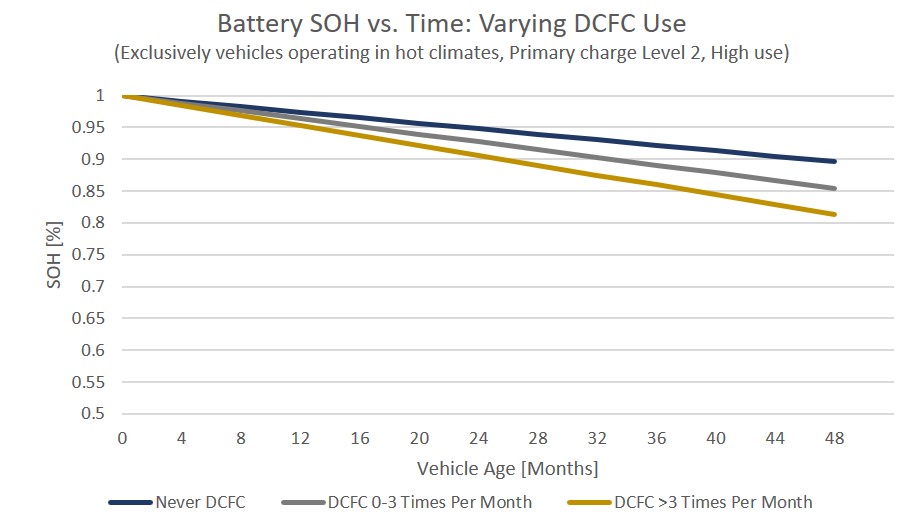
The use of DCFCs, however, does appear to impact the speed that batteries degrade. Rapidly charging a battery means high currents resulting in high temperatures, both known to strain batteries. In fact, many automakers do suggest limiting the use of DCFC in order to prolong their vehicles’ battery life.

Here we look at all battery electric vehicles in the same climate group (we chose to look at the most susceptible group – those operating in extreme climate conditions), and categorized them based on how frequently they used a DCFC: Never, occasionally (1–3 times per month) and frequently (more than 3 times per month).

 Battery degradation appears to be strongly correlated with DCFC use for vehicles in seasonal or hot climates.

Figure 8: Battery degradation appears to be strongly correlated with DCFC use for vehicles in seasonal or hot climates.

The difference between those vehicles that never used DCFC and those that used it even occasionally in seasonal or hot climates was notable. While there may be other factors at play (we want to stress that this wasn’t a controlled experiment), charging via lower power Level 2 charging should be prioritized.

Tips to prolong your EV battery’s life

While battery degradation varies by model and external conditions – such as climate and charging type – the majority of vehicles on the road today have not experienced significant decline. In fact, overall degradation has been very modest, with an average capacity loss of just 2.3% per year. Under ideal climate and charging conditions, the loss is 1.6%.

While some things are out of an operator’s control, there are ways you can extend the life of your EV’s battery.

Some tips for operating your EVs:

  • Avoid keeping your car sitting with a full or empty charge. Ideally, keep your SOC between 20–80% particularly when leaving it for longer periods, and only charge it fully for long distance trips.
  • Minimize fast charging (DCFC). Some high-use duty cycles will need a faster charge, but if your vehicle sits overnight, level 2 should be sufficient for the majority of your charging needs.
  • Climate is out of an operator’s control, but do what you can to avoid extreme hot temperatures, such as choosing shade when parked on hot days.
  • High-use is not a concern, so fleets shouldn’t hesitate to put them to work. An EV isn’t useful sitting idle in the fleet yard, and putting on more miles per vehicle is overall a better fleet management practice.

Final thought

Don’t sweat the small stuff. As vehicles come out with larger battery packs, losing some capacity may not impact your day-to-day driving needs, and shouldn’t overshadow the many benefits EVs have to offer.  By Graham Hill thanks to Geotab

Share My Blogs With Others: These icons link to social bookmarking sites where readers can share and discover new web pages.
  • MisterWong
  • Y!GG
  • Webnews
  • Digg
  • del.icio.us
  • StumbleUpon
  • Reddit
  • Alltagz
  • Ask
  • Bloglines
  • Facebook
  • YahooMyWeb
  • Google Bookmarks
  • LinkedIn
  • MySpace
  • TwitThis
  • Squidoo
  • MyShare
  • YahooBuzz
  • De.lirio.us
  • Wikio UK
  • Print
  • Socializer
  • blogmarks