Crash Repair Market Has Suffered A Major Drop In Business

Friday, 8. January 2021

The total market value for UK primary vehicle body repairs has fallen by 26.6% to £3.57 billion in 2020, as a direct result of the Covid-19 pandemic, new research suggests.

Furthermore, the report on the UK vehicle body repair and motor insurance market, published today (Monday, November 30) by independent market research company Trend Tracker, says accident repair volumes will not return to pre-Covid levels until 2022.

The Emerging from Covid-19 – The UK Vehicle Body Repair and Motor Insurance Market 2020-2023 Market Study reports that accident repair volumes declined by 30% in 2020.

However, it says that as repair costs have continued on an upward trajectory, predominantly due to the increased complexity of Advanced Driver-Assistance Systems (ADAS) and an increasing number of vehicles with hybrid or electric powertrains, the financial loss to the sector is calculated at 26.6%.

Mark Bull, director of Trend Tracker, said: “Anecdotally, the volume demand for insurer-funded accident damage repairs fell by approximately 80% overnight as the initial nationwide lockdown came into effect in March, however they had steadily recovered to approximately 75% of pre-Covid levels as Government restrictions eased, until November that is.

“The Trend Tracker research has monitored repair volume and values throughout the year to calculate quantitative figures that show a projected annual loss of £1.3bn in 2020 to the UK vehicle repair industry.”

Of the £1.3bn market contraction, which can readily be viewed as a direct saving to motor insurers’ claims expenditure, £5.6 million is attributed to a loss of parts sales, £4.1m as lost labour sales and £2.6m as lost paint sales, with the remainder being additional and consumable items.

“We would expect traffic volumes to return to greater levels during 2021,” Mark Bull, Trend Tracker

Meanwhile, offsetting some of the financial loss to the vehicle body repair market, the cost of repairs continues to rise year-on-year.

Since 2018 to the first half of 2020, overall repair costs generated via the Solera Audatex system have increased by 10.2%, from an average of £1,860 to £2,050 per repair.

Taking a longer-term view, since 2013 overall repair costs generated via the Solera Audatex system have increased by 48.5% and they show no sign of slowing, due primarily to ever-increasing vehicle complexity.

Bull explained: “While we know that 2020 has been devastating for many businesses across all sectors, the vehicle body repair sector was very much on the road to recovery until lockdown 2.0 came into effect.

“However, with the excellent news that a vaccine will be available shortly, we would expect traffic volumes to return to greater levels during 2021, which should correlate to a V-shape recovery in terms of the number of accident damage claims.

This is encouraging for bodyshops, although we predict that pre-Covid work volume will not return until 2022.”  By Graham Hill thanks to Fleet News

Over 50,000 Video Clips Of Driving Offences Sent By Drivers To Police

Friday, 8. January 2021

Road users have sent more than 50,000 dashcam recordings of potential traffic offices to police forces since 2017, with one-third resulting in action.

Police forces across the UK receive more than 35 pieces of footage every day, according to a freedom of information request sent to every UK constabulary by What Car?

Just over 10% of the incidents captured on film were severe enough to warrant a court prosecution and 9.6% resulted in a Fixed Penalty Notice (FPN).

A further 10.5% resulted in the driver being asked to attend a driver awareness course, and 3.0% of drivers were given a warning.

The use of dashcams by drivers and other road users has increased by around 850% since 2017, when insurance companies started accepting footage as evidence for claims and the courts first used footage to convict an offender.

The What Car? research found Dyfed-Powys Police in South Wales is the most active in using dash cam footage.

It has taken action over 81.3% of the videos it’s received, with 40.2% of offenders receiving a warning, 18.6% of them were prosecuted in court and 18.4% were asked to attend a driver awareness course, while just 4.0% were handed an FPN.

London’s Metropolitan Police received the largest volume of submissions – nearly 25,000 videos over four years – and acted in 45.4% of cases, issuing court proceedings to 18.9% of offenders, driver awareness courses to 13.9%, FPNs to 9.6% and warnings to 2.9%.

The report comes one month after Fleet News reported that 3,805 videos were uploaded to the National Dash Cam Safety Portal in just 90 days.

The National Dash Cam Safety Portal, which allows motorists to quickly and securely upload footage of dangerous driving to the relevant police authority, is now being used by 33 forces.

Fleet operators and their drivers are being urged to share dashcam footage with police to help prosecute dangerous drivers and improve road safety.

Police forces that have taken the highest share of actions per footage received –

Police ForceNumber of dash cam videos received 2017 – 2020Number of videos resulting in action by Police ForcePercentage of videos resulting in action by the Police Force
Dyfed-Powys Police37530581.3%
Norfolk & Suffolk Constabulary187796651.5%
Northamptonshire Police61230049.0%
Metropolitan Police Service24,79911,24745.4%
Gwent Police  72830642.0%
Warwickshire Police187572238.5%
Gloucestershire Constabulary47018038.3%
Humberside Police  2729434.6%
Devon and Cornwall Constabulary118237932.1%
North Wales Police185751627.8%

By Graham Hill thanks to Fleet News

Argument Flares Over The True Carbon Emissions Of Electric Vehicles Compared To Petrol And Diesel

Friday, 8. January 2021

The Government should focus on decarbonising the fuel, not the vehicle, a new report into the future of Britain’s automotive industry has said.

The ban of the sale of new petrol and diesel cars from 2030 “wasn’t helpful”, said the Decarbonising Road Transport: There is no Silver Bullet report, commissioned by companies including Honda, Aston Martin, Bosch and McLaren.

It encouraged manufacturers to follow the lead of Polestar and Volkswagen in being more transparent about the emissions generated during the production of each model, after research found the manufacture of EVs generates 63% more CO2 than its petrol or diesel equivalent.

The report said a Polestar 2 would need to run for around 49,000 miles before its carbon footprint became smaller than that of a diesel Volvo XC40.

However, this figure – and much of the interpretation in included in the press release – has been disputed, with analyst Michael Liebrich saying this figure is actually nearer 16,000 miles.

Dr Uwe Gackstattar, president of Bosch Powertrain Solutions, called on the Government to leave engineers to come up with the solutions.

Andy Palmer, former CEO of Aston Martin, said it was vital to understand there were many routes to net zero.

He added: “You can demand zero CO2 from the tailpipe, but a lot of CO2 is then produced in manufacturing.

“And while synthetic fuels are not CO2-free at the tailpipe, they can be at production and expulsion. There are lots of solutions and it’s important we make that distinction.”

The report said making all new vehicles zero emissions at the tailpipe works only if the energy grid is zero emission and addresses only those new vehicles sold each year, which is around two million.

Introducing renewable fuels impacts on all vehicles in the legacy car parc – around 40 million – 10% of which are more than 20 years old.

Report recommendations

The report made six recommendations:

  • The focus should be on the decarbonisation of the fuel, not the vehicle in order to meet the country’s climate change ambitions.
  • The decarbonisation of the legacy fleet is as much of a problem as new vehicles. We need to address both.
  • We need to recognise the differing technology needs of different vehicle types.
  • Encourage greater transparency from automotive OEMs on the whole vehicle CO2 footprint of their products
  • Ensure a clear link between renewable energy generation and transport decarbonisation
  • Taking a technology neutral approach to decarbonisation. Allows industry to continue to innovate, offering customers a range of solutions to meet their needs.

The report points out battery electric vehicles face a number of challenges, but “play an integral role in the decarbonisation of road transport”. It added: “They are becoming increasingly viable for a growing number of people.”

Andy Eastlake, managing director of the Low Carbon Vehicle Partnership, which provided some specific information to report author Clarendon Communications, said: “We need to do more than just electrify the fleet.

“We are still selling diesel and petrol cars, the engines of which could play out until 2050, so we have to look at decarbonising fuel.”

In a later statement, LowCVP said the recent media interpretation of the report does not in any way reflect the organisation’s position.

“Lifecycle analysis (sourced from Polestar in the report) has not been properly contextualised in several media reports,” it said.

“These highlight a single snapshot to suggest only modest emissions benefits arising from EV adoption.

“As stated in the report, energy grids in UK and elsewhere are rapidly decarbonising and EV battery and associated production processes are also improving so the lifecycle impacts of electric vehicles are on a sharply improving trajectory.

“LowCVP has been a lead proponent of efforts to incorporate the full life-cycle analysis of road transport CO2 emissions and other sustainability factors into policy decisions and will continue to do so.

“However, this is a complex area and analysis of life-cycle impacts should be seen as a key part of the process towards achieving zero emissions transport and not – as in this case – as a misleading tool to undermine progress.”

‘Driving an EV is better for climate’

Fiona Howarth, CEO of Octopus Electric Vehicles, added: “Studies have consistently shown that EVs emit significantly less lifetime emissions than internal combustion engine cars.

“In 95% of the world, driving an EV is better for the climate than a petrol car and in countries like Sweden and France, where most electricity is low carbon, emissions are around 70% lower – a massive environmental benefit.

“Unlike their fossil fuel counterparts, EVs also get cleaner as we decarbonise our energy grids.”

“If we’re serious about tackling the climate emergency, there is no question that we should all aim to walk, cycle and take public transport where possible, but if you’re going to drive make it electric.”  By Graham Hill thanks to Fleet News

Latest Information On Electric Vehicle Fires Is An Attempt To Quell Fears.

Friday, 8. January 2021

Production process problems have been blamed for recalls by Ford and BMW affecting more than 46,000 cars, including almost 5,000 in the UK.

Ford recalled more than 20,000 Kuga plug-in hybrids in August after it found, in some instances, faulty batteries had overheated when charging, causing a fire. Owners, including around 1,800 in the UK, were advised not to charge their cars and to operate them in ‘EV Auto’ mode only.

Ford also sent affected customers a £500 fuel card for use at BP fuel stations, acknowledging that the fuel economy of the PHEV “may not be what customers may have expected when they took delivery”.

The manufacturer has now announced a fix for the problem, which will involve the entire drive battery pack being replaced.

The work will be carried out towards the end of December for customers who already have their vehicles, with the recall expected to take until late March to complete.

“We will be communicating with customers directly later in November to arrange a time to implement the replacement,” it said.

Following Ford’s recall, BMW revealed it has identified almost 3,000 plug-in hybrid models in the UK that could be at risk of a battery fire.

It has now issued a recall and suspended delivery of affected new models as a preventative measure. A total of 26,700 vehicles are said to be involved worldwide, of which around 2,930 are either with UK customers or awaiting delivery.

The recall affects plug-in hybrid versions of the 3, 5 and 7 Series, the X1, X2, X3 and X5 SUVs, the 2 Series Active Tourer and the Mini Country-man PHEV, built between January 20 and September 18, 2020. It also affects i8s built this year.

“I see this is as just another recall and it doesn’t cause me any concern about the technology,” Debbie Floyde, Bauer Media

In a statement, the German carmaker said particles may have entered the battery during the production process, which could lead to a short circuit within the battery cells when it is fully charged. This may lead to a fire.

BMW says it is currently working on a solution to the fault. Until a remedy is available, drivers have been instructed to not charge their vehicle, not to drive in manual or sport mode, and to not use the shift paddles.

Ford also acknowledged that the issue had arisen in the production of the car’s battery, which is sourced from an external supplier.

“The root cause has been identified as a battery cell contamination issue in our supplier’s production process,” it said.

The two recalls come a year after Kia recalled more than 5,000 Niro hybrid and plug-in hybrid models due to an electrical relay that could overheat.

Vehicle fire data

Data obtained through a Freedom of Information (FOI) request revealed that in 2019 the London Fire Brigade dealt with 54 electric vehicle fires compared with 1,898 petrol and diesel fires.

Vehicle registration numbers from the Department for Transport (DfT) show there are 50,000-plus plug-in cars licensed in the capital out of a total 4.63 million licensed cars.

Looking at the London Fire Brigade data, that would suggest an incident rate of 0.04% for petrol and diesel car fires, while the rate for plug-in vehicle is more than double at 0.1%. So far this year, there have been 1,021 petrol and diesel fires and 27 EV fires in the capital.

Leasing companies are reporting a surge of interest in plug-in vehicles thanks, in part, to new, EV-friendly company car tax rates introduced in April.

Plug-in vehicles, both PHEV and pure electric new registrations, accounted for 12% of all new registrations in October, while Tusker reported that more than 45% of all its new orders over the past 30 days have been for pure EVs.

Group fleet manager at Bauer Media, Debbie Floyde, has first-hand experience of the issue after a BMW 330e on her fleet suffered an electrical fire.

The car was left on charge on overnight at the employee’s home, but the following morning he discovered the car had not charged and there was a fault on the dash saying that the car was using power while stationary.

On closer inspection he found that both his outside plug socket and the charging unit plug had melted.

However, the experience has not put Floyde off electric cars.

“I see this is as just another recall and it doesn’t cause me any concern about the technology,” she said.

“We have lots of drivers interested in having an electric car and we’re happy for them to make that choice.”  By Graham Hill thanks to Fleet News

BMW iX Continues To Extend EV Range Whilst Dropping Charge Times

Friday, 8. January 2021

BMW has unveiled its iX: its first purpose-built fully electric SUV, offering more than 500PS and a range of up to 373 miles.

A similar size to the X5, it will rival the Audi e-tron and Mercedes-Benz EQC when it goes into production in the second half of 2021.

The iX features two electric motors – a 121PS one to drive the front wheels and a 400PS on to power the rear wheels.

It will be offered with different battery options with the range-topping model featuring a battery of more than 100kWh.

The iX can be charged at up to 200kW, allowing the battery to be charged from 10% to 80% in under 40 minutes.

The standard charger works at 11kW which means the battery can be charged from 10% to 80% in 11 hours.

BMW says the iX will offer a new level of connectivity through the presence of 5G and cloud technology, with some functions which need a lot of computing power carried out in the cloud, where they can be processed faster than in the car.

Frank Weber, member of the board of management of BMW AG, Development, said: “We are setting new industry standards with the technology in the BMW iX.

“The iX has more computing power for data processing and more powerful sensor technology than the newest vehicles in our current line-up, is 5G-capable, will be given new and improved automated driving and parking functions and uses the high-performing fifth generation of our electric drive system.” By Graham Hill thanks to Fleet News

General Increase In Car Size Creates Parking Problems

Friday, 8. January 2021

Cars have grown by as much as 55% since the 1970s, leaving drivers little room to squeeze out of them in parking bays that have remained the same size, new research suggests.

Parking guidelines haven’t changed in 50 years, says CarGurus.co.uk, which conducted the research.

The recommended 2.4m x 4.8m leaves drivers little room to get out their parked car, it says, which is contributing to the thousands of incidents that occur in car parks every year, costing drivers and fleets dear.

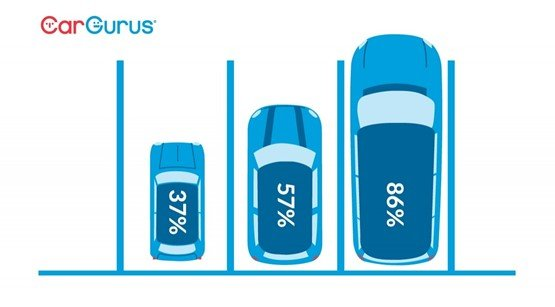
In the most extreme example, CarGurus research found that today’s Land Rover Range Rover takes up to 86% of the standard parking space, leaving just 21cm of room for drivers to get out. In contrast, the 1970s model took up just 69% – the same footprint as today’s Ford Focus.

Research by the automotive shopping site, compared the most popular cars currently on UK roads, which had an equivalent available in the 1970s, showing how their footprint on the typical parking bay has grown.

As cars have grown, many of the most popular vehicles are leaving little space for drivers to get out. For example, the 10th generation Honda Civic, one of the biggest growers from its first generation, now takes up 71% of the parking space, ballooning from 49% in the first generation and leaving just 30cm of space for drivers to get out.

Chris Knapman, editor at CarGurus.co.uk, said: “It’s understandable why cars have grown so much over the years, and the dramatically improved safety standards of modern cars versus those of years gone by is an obvious benefit. However, as many motorists will no doubt confirm, it’s disappointing that parking space guidelines haven’t been updated accordingly.”

The Mini Hatch was the biggest grower on the list; 55% larger and taking up 20% more of the typical parking space than the original that was produced between 1959 and 2000. This means it offers 16cm less room for drivers to get out.

“Many of the latest cars are at least available with technology to help with parking,” Chris Knapman, CarGurus.co.uk

The Audi A4, BMW 3 Series, BMW 5 Series, Ford Focus, Ford Mondeo, Mercedes E-class, Peugeot 308, Vauxhall Insignia and VW Passat have also all grown significantly to leave drivers with less than 30cm space to exit the vehicle.

Despite many cars already proving to be a tight fit in standard parking spaces, the growth spurt appears to be unrelenting with CarGurus’ research finding cars are continuing to grow by an average of nearly 3% from generation to generation6, meaning squeezing out of parking spaces will continue to become more and more challenging for drivers.

Knapman said: “Many of the latest cars are at least available with technology to help with parking, including parking sensors, reversing cameras, 360-degree view cameras and automatic parallel and bay parking functions.

“Some even equip cars with features to help prevent car park damage, such as door edge protectors and Citroën’s Airbump Technology.

“However, it is of course worth noting that no matter how easy the technology makes it to park, if the space is too small for your car none of it will help you to physically squeeze out of the driver’s seat.”

CarGurus.co.uk compared the dimensions of the 23 most popular cars on the road today which had an equivalent available in the 1970s.

CarGurus’ Car Dimensions Comparison: 1970s vs. 2020

Ranking1970s Make & ModelSpace to open door (cm)Area of parking space used upToday’s Make & ModelSpace to open door (cm)Area of parking space used up% increase in area
1Morris/Austin/ Rover Mini (1959-2000)5037%MINI Hatch 3dr (2014-)3457%55%
2Fiat 500 (1957-1975)5434%Fiat 500 (2007-)3950%47%
3Honda Civic 1st Gen (1972-1979)4549%Honda Civic 10th Gen (2016-)3071%44%
4Peugeot 104 (1972-1988)4443%Peugeot 208 2nd Gen (2019-)3361%42%
5Renault 5 (1972-1985)4447%Renault Clio V (2019-)3063%36%
6Mazda 323 3rd Gen (1977-1980)4053%Mazda 3 4th Gen (2019-)3070%31%
7Audi 80 (1972-1978)4058%Audi A4 B9 (2016-)2876%30%
8VW Passat B1 (1973-1981)4058%VW Passat B8 (2015-)2876%30%
9Vauxhall Nova A (1982-1993)4348%Vauxhall Corsa F (2019-)3262%29%
10VW Golf MK1 (1974-1983)4052%VW Golf MK8 (2020-)3167%28%
11Ford Escort MKII (1974-1980)4254%Ford Focus MKIV (2018-)2969%28%
12VW Polo MK1 (1975-1981)4249%VW Polo MK6 (2018-)3262%26%
13Ford Fiesta MK1 (1976-1983)4248%Ford Fiesta MK8 (2017-)3361%25%
14Range Rover Classic (1969-1996)3169%Range Rover L405 (2012-)2186%25%
15Toyota Corolla 3rd Gen (1974-1981)4254%Toyota Corolla 12th Gen (2019-)3168%25%
16Ford Cortina MKIV (1976-1979)3564%Ford Mondeo MKIV (2014-)2778%22%
17Vauxhall Cavalier MK1 (1975-1981)3764%Vauxhall Insignia B (2017-)2779%24%
18BMW 3 Series E21 (1975-1983)4061%BMW 3 Series G20 (2019-)2975%23%
19Vauxhall Astra MK1 (1979-1984)3857%Vauxhall Astra MK7 (2015-)3069%21%
20Peugeot 304 (1969-1980)4256%Peugeot 308 2nd Gen (2013-)2967%19%
21BMW 5 Series E12 (1972-1981)3668%BMW 5 Series G30 (2017-)2780%17%
22Mercedes 190 (1982-1988)3664%Mercedes C-class 4th Gen (2014-)3074%14%
23Mercedes W123 (1976-1986)3173%Mercedes E-class 5th Gen (2017-)2779%8%

By Graham Hill thanks to Fleet News

UK Car Manufacturers Call For The Immediate Ratification Of The Brexit Agreement.

Thursday, 31. December 2020

The UK’s automotive trade body, the Society of Motor Manufacturers and Traders (SMMT), is calling on the UK Parliament to ratify the Brexit trade agreement.

MPs are debating the draft deal with the EU today (Wednesday, December 30) after Parliament was recalled to put the deal into law, a day before the UK severs ties with the European Union.

The SMMT wants the immediate ratification of the draft UK-EU Trade and Cooperation agreement (TCA), to ensure all automotive companies benefit from continued tariff-free trade from January 1.

It says that the draft TCA delivers across several areas for UK automotive, keeping the sector connected to a market that accounts for eight out of 10 of its vehicle exports.

Furthermore, the SMMT says that the TCA delivers on the core ask to avoid tariffs for most finished vehicles, parts and components.

Mike Hawes, the SMMT’s chief executive, explained that for automotive, Brexit has always been about “damage limitation”.

“The draft Trade Cooperation Agreement, while no substitute for the completely free and frictionless trade with Europe we formerly enjoyed, will address immediate concerns,” he said.#

“The TCA provides the opportunity for tariff and quota-free trade, foundations on which the industry can build.

“Even with immediate ratification, however, there will be just hours to adjust to new trading rules, so a phase-in period is critical to help businesses adapt.

“All efforts should now be made to ensure its seamless implementation, with tariff-free trade fully accessible and effective for all from day one.”

The SMMT says that the inclusion of specific provisions on transitional phase-ins for both electric vehicles (EVs) and batteries is also welcome.

However, it argues that the deal does not deliver some key asks, including formalising co-operation on the development of regulations and standards after the end of transition.

Nor does it prevent increased administration and potential for friction at the border, as we leave the single market and customs union, it said.

Hawes continued: “Further ahead, we must pursue the wider trade opportunities that Brexit is supposed to deliver while accelerating the UK’s transition to electrified vehicle manufacturing. 

“With the deal in place, Government must double down on its commitment to a green industrial revolution, create an investment climate that delivers battery gigafactory capacity in the UK, supports supply chain transition and maintains free-flowing trade – all essential to the UK Automotive sector’s future success.”

The eleventh-hour post-Brexit trade deal struck between the UK and the EU has been welcomed by the fleet and leasing industry.

It had faced a significant rise in costs, with tariffs imposed on cars and vans, if no deal had been agreed when the UK exits EU trading rules tomorrow (Thursday, December 31). By Graham Hill thanks to Fleet News

Increase In Number Of Contract Hire Cars Incurring End Of Lease Charges

Thursday, 31. December 2020

Drivers urged to carry out regular maintenance checks to avoid costly fair wear and tear outlay, reports Fleet News.

The average fair and wear charge incurred by company cars has risen 12% in the past five years, according to this year’s FN50 (The top 50 contract hire companies).

Bear in mind these are charges on companies with fleets of cars. If you are an individual, sole trader or small business owner the contract hire companies treat you differently as the loss of you as a customer is less important than the loss of a multi-vehicle fleet so end of lease charges tend to be considerably more than those imposed on a fleet customer with the same level of damage on the vehicle.

So please keep this in mind when reading this article. Of course using a good broker who can assist with these end of contract charges can help to level the playing field and minimise the charges.

A company car would, on average, have faced a fair wear and tear bill at defleet of £289 in 2016. This year’s FN50 shows that has risen by £35 to £324, on average, not including salary sacrifice cars.

Looking at the 10 biggest leasing companies in isolation, the average fair wear and tear bill was £407.

That is £83 higher than the FN50 average and worrying, when the vast majority of cars are operated by these firms.

Compared with FN50 2019, however, the overall average charge has fallen for the first time in more than a decade; by £2 from an average of £326.

Tusker says it has found that the condition of returned vehicles has improved marginally over the past year. “We are seeing a reduction in the value of the recharge (circa 2%) and a reduction in the number of recharges applied (3%) since 2018,” says Tusker CEO Paul Gilshan.

“A variety of reasons could explain this, including lower mileage contracts.”

However, Tusker’s experience of a reduction in the number of cars incurring charges year-on-year was not replicated by the FN50 average.

The percentage of cars that incurred fair wear and tear costs rose by one percentage point to 44% from 43% the previous year.

Five years ago, just more than a third (36%) of cars were attracting fair wear and tear charges, before getting as high as one-in-two cars (50%) in 2018 and falling to 43% last year.

Bridle Group reported the lowest percentage of cars attracting charges, with just one-in-50 (2%) of its vehicle returns.

Alan Carreras, sales director at the top 50 leasing firm, explains: “There are a number of factors at play.”

Bridle Group’s customer base consists, predominantly, of public sector users, typically schools, colleges and community trusts for which it provides minibuses.

“They cover a reasonably low annual mileage – on average 7,000 miles per year – and, while this in itself doesn’t exclude them from attracting damage, the likelihood is lower than the ‘typical’ annual mileage, for obvious reasons,” he says.

“We also take a pragmatic approach to de-hire; we understand the difficulties some organisations face when attempting to balance their books.”

Carreras explains that a damage recharge, which might be acceptable under the current British Vehicle Rental and Leasing Association (BVRLA) fair wear and tear guidelines, is not something they would automatically apply.

“We wouldn’t look to put our clients in an unnecessarily difficult position at the end of contract especially where any potential issues might not negatively affect the actual resale value once the vehicle has been remarketed.”

FAIR WEAR AND TEAR GUIDE

Most rental and leasing companies adhere to the Fair Wear and Tear guide published by the BVRLA.

The aim of the guide is to provide an industry-wide, accepted standard that defines fair wear and tear when vehicles are returned at the end of a lease or finance agreement.

The guide also gives advice to drivers and fleets about what they need to do to avoid end of lease charges, where they can get advice on routine maintenance, servicing and appraising the vehicle at the end of the lease and what they can expect the day the vehicle is returned, as well as how to complain if things go wrong.

Some leasing companies offer a fixed-cost menu of charges set out at the start of the contract.

Others do not repair vehicles before sending them out to auction, so do not charge for the cost to repair the damage. Instead, they charge for the loss of value against the residual value due to the damage.

Nick Hardy, sales and marketing director at Ogilvie Fleet, the Fleet News Leasing Company of the Year (up to 20,000 vehicles), says its fixed-cost menu pricing approach creates a transparent process for customers.

“Transparency is at the heart of our relationships with clients and I genuinely believe that it’s the reason why we’ve continued to grow the business every year, including this – very challenging – year,” Hardy explains.

“Our truly ‘fair’ fair wear and tear policy is possibly the most transparent way we work with our clients. We explain what the extra costs might be at the outset of a contract. Nothing is hidden.

“Any charges we make are done on the basis of reduction on vehicle values, this only showing the true cost of any necessary recharges and we always verify the costs with photographic back up.

“If we don’t or can’t do that, there are no charges made. Our clients always know where they stand and we rarely have any issues.

“We know that our stance is quite unique, but unlike many others, we don’t see this area as a profit centre and so can be completely transparent about it all.”

Leasing companies, typically, also employ a damage waiver and, while the percentage of cars incurring damage charges has increased, so has the average damage waiver.

It now stands at £144, up from £112 in 2019. It was as high as £170 in 2016.


Simon Staton, client management director at Venson Automotive Solutions, says: “Comparisons year-on-year, however, can be misleading.”

The annual figures, he argues, will be influenced by those vehicles coming back off contract, how long they have been on that contract and the industries in which the vehicles operate.

Staton adds: “For company cars, the organisation may have the approach that for non-critical damage, scratches, scuffs, repairs are left and they are happy for the recharge.

For other organisations, vehicle condition is critical to company image and they will get the repairs done as and when they occur.

“Equally, a car being used as a pool vehicle may be treated better because the tracking of who’s driving it and when, compared with a company car being used for job requirements and travelling several thousand miles a year.” 

Implementing a few simple changes could significantly reduce wear and tear costs to the business, according to Staton.

“For example, regular maintenance checks by employees or the business can help identify issues early and avoid things getting worse and causing further damage,” he says.

“It is important for fleet operators to ensure they fully understand the contract they have with their fleet provider, so that they can avoid unnecessary costs at the end of the vehicle’s contract term.”

Venson also suggests implementing a fleet policy that recharges fees back to drivers if damage is not reported or routine inspections are not carried out.

Furthermore, it says fleets should regularly communicate and educate drivers on what needs reporting to the fleet team and consider using driver training, and an ongoing education programme, to ensure employees are driving safely which, in turn, will reduce accident damage.

Salary sacrifice charges rise but average waiver falls. The average fair wear and tear charge for salary sacrifice cars was £331, a £60 increase on the £271 reported last year.

It means that the average charge incurred by salary sacrifice vehicles is now on a par with the FN50’s leasing average, after being some 20% lower in 2019, the first year the figures were collated separately.

However, this rise is not necessarily down to cars having more damage: the more likely explanation for the higher charge is a reduction in the average damage waiver from £133 in 2019 to £79 this year – a fall of £54.

Salary sacrifice is the third largest market segment for funding type after contract hire, operating and finance, in this year’s FN50, representing 3.7% of the risk fleet overall.

The data also shows more cars attracted charges this year, with 34% facing a fair wear and tear bill, up from 31% in 2019. However, this is still significantly lower than the 44% reported for non-salary sacrifice cars.  By Graham Hill thanks to Fleet News
The Initial Thoughts On The Brexit Proposal By The Vehicle And Fleet Industry

Thursday, 31. December 2020

An eleventh-hour post-Brexit trade deal struck between the UK and the EU has been welcomed by the fleet and leasing industry.

It had faced a significant rise in costs, with tariffs imposed on cars and vans, if no deal had been agreed when the UK exits EU trading rules on Thursday (December 31).

However, while business will now have to adapt to the new trading rules and work through the detail of the deal, the expected hike in vehicle prices of several thousand pounds has been avoided. 

Gerry Keaney, chief executive of the British Vehicle Rental and Leasing Association (BVRLA), said that the Brexit trade deal comes as a “big relief” for the industry and provides a “welcome boost” for the UK automotive sector, which can now plan with more “confidence and certainty”.

“Avoiding tariffs on vehicles and parts is essential,” he added, “but with the end of the transition period only days away, there is a lot to be done to prepare for January and beyond as details around the new trading terms become clear.”

Mike Hawes, chief executive of UK automotive business group, the Society of Motor Manufacturers and Traders (SMMT), also welcomed the agreement.

However he said: “We await the details to ensure this deal works for all automotive goods and technologies, including specifics on rules of origin and future regulatory co-operation.

“A phase-in period is critical to help businesses on both sides adapt and efforts should now be sustained to ensure seamless implementation, with tariff-free trade fully accessible and effective for all from day one.”

Hawes said that the SMMT will continue to work closely with Government to ensure all companies are “as prepared as possible in the limited time left.”

Fleet News reported in November, how BMW has announced a customs duty related increase of more than £3,000 on the recommended retail pricing (RRP) of the BMW i3, irrespective of whether there is a free trade deal or not.

BMW had announced at the beginning of October that BMW i3 models, along with the majority of other BMW models, would be subject to an “economic increase” in the recommended retail price rise from January 1, 2021.

Due to changes in the ‘Product Specific Rules of Origin’ legislation, it says that the maximum permitted content of non-EU and non-UK materials means these models will be subject to additional tariffs after the end of the Brexit transition period.

This will be the case, it said, “whether or not there is a free trade agreement with the EU”, which means a further increase in the RRP of BMW i3 models is needed.

Stephen Haddrill, director general of the Fleet and Leasing Association (FLA), said: “As always in trade talks, the devil is in the detail but we appear to have a deal that will enable UK goods to be sold without tariffs or quotas in the EU market – that bodes well for business confidence, leading to renewed investment and lending as we enter 2021 and begin the long economic recovery from the Covid impact.”

Businesses urged to prepare

Logistics UK (formerly the Freight Transport Association), while welcoming the deal, warned that there was still a lot of work to be done to protect the nation’s supply chains, and the economy as a whole.

Elizabeth de Jong, policy director at Logistics UK, said: “A deal is great news for the UK economy, since it removes the risk of tariffs being placed on almost every item imported from the EU, which would have raised prices and slowed the rate of economic growth.

“We are still absorbing all the details, but it looks as though HGVs will continue to have access to the EU market, and aircraft will still be permitted to fly to and from the EU, which safeguards the UK’s highly interconnected supply chains and protects the jobs of those charged with keeping the country stocked with the goods it needs.”

Meanwhile, Logistics UK is urging traders to continue to get ready for new trading conditions as they were before. “The new trading relationship will still require many of the same preparations, not least the introduction of customs declarations and additional checks on food and livestock,” added De Jong.  “Logistics UK is advising traders not leave paperwork to the last minute, or ignore it, as this will cause delays to journeys.” By Graham Hill thanks to Fleet News

Tailgating Collisions Down By A Half Over Last 5 Years

Wednesday, 16. December 2020

The number of reported road accidents where ‘following too close to another vehicle’ was a contributory factor has almost halved in the last five years, according to analysis by TrackDays.co.uk.

Analysis of figures from the Department for Transport, by the driver training provider, highlighted that the number of reported accidents where following too close was a contributory factor have dropped by 48% year-on-year, from 7,023 in 2015 to just 3,582 in 2019, the latest year for which full figures are available.

It is one of the largest percentage drops of all the contributory causes of accidents caused by a lack of judgement.

Tailgating remains a factor in around one in eight casualties on England’s motorways and major A roads.

Dan Jones, operations manager at TrackDays.co.uk, said: “It’s very welcome to see such a dramatic drop in the number of reported accidents when following too close was a contributory factor.

“It could be due to a number of factors, perhaps most importantly though advanced safety features on modern cars, such as adaptive cruise control which help keep a safe distance from the car in front. But it would also be nice to think that drivers are now calmer and more considerate to their fellow road users.”

Earlier this year, new cameras aimed at catching drivers tailgating identified some 10,000 vehicles committing the offence in the first two weeks of trials.

A survey for Highways England found that while more than a quarter of drivers admitted to tailgating, nearly nine in 10 people say they have either been tailgated or seen it.

Meanwhile, more welcome news highlighted how the number of reported accidents when travelling too fast for the conditions was a contributory factor was also on a long-term decline, showing a significant decrease from 7,361 in 2015 to 4,666 in 2019, a decrease of 36%.

Additionally, there are also fewer reported accidents when disobeying automatic traffic signals, and disobeying ‘Give Way’ or ‘Stop’ signs and markings was a contributory factor.

Jones added: “Brits do appear to be becoming safer motorists in certain areas of driving, which has to be good news for all road users.”  By Graham Hill thanks to Fleet News