With Car Showrooms Still Struggling To Open Is Virtual Reality The Way Forward?

Thursday, 25. February 2021

It is always risky predicting The Next Big Thing, but Abarth might just have it. It’s not the 595 Scorpioneoro you see here which, while unquestionably a stylish special edition, is based on a car that’s been on sale for well over a decade. No, the really exciting thing is how potential owners can try the car out.

Because Abarth has just started a trial that will see prospective 595 buyers sent a wooden crate, inside which rest Bose headphones and a virtual reality (VR) headset. Pre-loaded on this headset is a three-minute film, which takes viewers on a ‘virtual test drive’ through stunning Welsh vistas in a 595 Scorpioneoro.

I’ve tried VR in the past, and let’s just say that when used for corporate videos, the experience is underwhelming. But what Abarth has done with its virtual test drive – the world’s first, no less – is nothing short of spectacular.

Beginning on Black Rock Sands beach in North Wales, we’re introduced to both the car and our co-driver, Stef Vilaverde, a died-in-the-wool Abarth fan and YouTuber. The beginning is short, but gives time to appreciate the surroundings. In front of you stands the car, but tilt your head up (in the real world) and you can see the sky and clouds.

Turn around and you’re faced with headland cliffs, the camera angle and audio moving with your eyes and ears; it really looks and sounds like you’re stood on the Welsh coast. No time to dwell on the scenery, though, as the roar of the 595’s exhaust draws you back to the car in time to see it blast across the sands.

We’re in the passenger seat for most of the rest of the test drive, and as far as your eyes and ears are concerned, you’re in the car. Turn your head to the left and watch the crystal-clear lake waters of Llyn Ogwen pass by; face ahead and Snowdon looms into view ahead of the 595’s bonnet; look inside the cabin and you can make out details like the Scorpioneoro’s limited-edition plaque.

It’s an immersive experience, and when Stef activates the sports exhaust and gives the 595’s 163bhp 1.4-litre engine a blast, the audio is as engaging as the visuals. Another camera angle sees looking from outside the car at road level; facing forwards reveals rushing tarmac, turning behind shows the bonnet of the 595 bobbing away, inches from your eyes.

There are a couple of limitations. Even though the gear has to be returned to Abarth, the cost of VR headsets means it’s doubtful every manufacturer could offer every customer a VR drive (Abarth’s trial is operating only from Vospers dealership in Exeter – for now).

And while the wooden crate the gear arrived in is a cool nod to past Abarths (which had performance upgrades in a similar box) the crate itself is too large and heavy to be handled easily by all.

But with real-world test drives likely to be problematic for some time, VR could be an important tool for car makers, dealerships and, of course, buyers – not least because as well as leaving me yearning to drive a 595 Scorpioneoro, the virtual world brought excitement and variety after months being cooped up.

How does virtual reality work?

VR films are created using a camera with multiple lenses that film 360-degree footage with no blind spots; a 360-degree microphone with several channels is also used. Software stitches the recordings into a seamless ‘bubble’ of footage; camera mounts that might be in shot are also removed.

A VR headset displays the all-encompassing footage on two small screens directly in front of your eyes, motion sensors determining where you are looking; tilt your head up, for example, and the footage follows, mimicking what your eyes would see if they were the camera.  By Graham Hill thanks to Auto Express
Do We Still Need Police Patrolling Our Roads?

Thursday, 25. February 2021

Once upon a time we needed police on our roads to catch speeding motorists and those driving dangerously. But then came speed cameras to constantly survey speeding hotspots and now we have the public, happy to fit dash cams or download an app on their mobile phone, turning it into a dash cam, in order to use footage to report motorists breaking the law.

Initially dash cams were used to record accidents and certainly to refute claims from those carrying out ‘cash for crash’ crimes. But now everyone is becoming a policeman making it less necessary to have police patrolling the roads. What next? Will the Government look again at mobile apps that the public could use, as they do in Canada, to photograph those who are illegally parking in exchange for a piece of the fine?

Here is what the RAC has to say about the police inside your car.

Police are receiving an average of 89 dash cam clips of alleged motoring offences every day, with motorists being urged to ‘always drive as if you are being watched by the police’.

In 2019, 32,370 pieces of dash cam footage were sent to the 24 UK police forces that responded to a Freedom of Information request by the RAC – more than twice as many as the 15,159 received the previous year. Furthermore, 8,148 (25 per cent) of the clips received in 2019 resulted in a prosecution.

The Metropolitan Police received 8,082 dash cam clips in 2019 – more than any other force. Surrey was second with 3,542 and West Midlands third on 3,242. Fourth was Gwent Police, which received 3,037, while Greater Manchester Police were sent 2,940.

The footage received by police forces covered a variety of motoring offences, including dangerous driving, careless driving or driving without due care and attention, driving too close to cyclists, contravening red traffic lights, contravening double white lines, contravening ‘no entry’ signs, illegal use of a handheld mobile phone and evidence of vehicles apparently without MOTs.

Dash cam manufacturer Nextbase runs a footage portal where drivers can upload clips to 33 police forces. It’s said to have saved 170,000 hours of police time over two years.

RAC road safety spokesman Simon Williams said dash cams are a “game-changer”, with drivers able to easily submit clips to the police without a road traffic officer needing to have witnessed the incident.

He added: “As so many drivers and cyclists are now using dash cams and helmet cameras, every road user needs to be very conscious that any of their actions that aren’t in accordance with the law could end up with the police. Some will inevitably find this out the hard way while others will hopefully become increasingly mindful of it.”  By Graham Hill thanks to Auto Express
Vauxhall Added To List Of Diesel Manufacturers Found To Use ‘Defeat Devices’

Thursday, 18. February 2021

It should come as no surprise to anyone in the industry that another car manufacturer has been accused of using emissions defeat devices to fool the emissions tests. I was one of the first to say that when VW were found to be using such devices that the problem goes industrywide. It was common knowledge that this was going on, it was just a matter of time before they were found out.

It all started years ago when manufacturers would tape up car doors and remove trim and even door mirrors to reduce drag when checking fuel consumption. They did similar things when emission rules were introduced but when inspectors finally started to check the tests they had to come up with something more creative.

On to the report:

Vauxhall is the latest manufacturer to face claims that some of its diesel engines were fitted with emissions ‘cheating’ devices or software.

It follows similar accusations against Mercedes-Benz, Fiat-Chrysler and the Renault-Nissan alliance, in the wake of the Volkswagen ‘dieselgate’ scandal.

Law firm Milberg London says it is launching a case against Vauxhall for drivers who bought or leased certain models manufactured between 2009 and 2019.

A statement issued by the car maker said: “Vauxhall Motors is not aware of any such claim and rejects any accusation of using illegal defeat devices. Our vehicles meet the applicable regulations.”

More than a million people could receive compensation if the claim is successful.

Edward Cardington, partner at Milberg London LLP and lead lawyer for the Vauxhall Pay Up Campaign, said: “The Vauxhall Pay Up campaign has set out to prove that Vauxhall cheated both the emissions tests and hardworking British drivers.

“Motorists were promised a combination of low environmental impact and high driving performance that appears to have been impossible in real driving conditions. Put simply, clean diesel looks like a myth and Vauxhall’s cars did not provide the performance drivers paid for.”

The Vauxhall Pay Up campaign will claim under the Consumer Protection from Unfair Trading regulations. These laws state that customers who were sold products with misleading information could receive anything between 25% and 75% of the cost of the product they purchased in compensation.

Potentially affected models highlighted by Milberg London include diesel versions of the following Vauxhall models: Astra, Cascada, Corsa, Insignia, Mokka, Movano and Zafira. By Graham Hill thanks to Fleet News

Potholes Still Causing Major Problems Despite Drop In Car Use

Thursday, 18. February 2021

RAC patrols attended almost 1,500 call-outs in the last three months of 2020 for pothole related breakdowns, despite reduced traffic volumes as a result of the coronavirus pandemic.

Analysis of fourth quarter RAC breakdowns for National Pothole Day reveals there were 1,461 call-outs for damaged shock absorbers, broken suspension springs and distorted wheels reveals, representing nearly 1% (0.9%) of all RAC attendances.

While the pothole proportion of all RAC breakdowns is down on the previous quarter, it is identical to the same period in 2019 and slightly higher than 2018 (0.8%). The RAC says this is concerning given the lower traffic volumes brought about by coronavirus travel restrictions as in theory, less traffic should mean less damage to road surfaces.

Looking across the UK, the South East saw the largest number of vehicle problems most likely to be caused by potholes at 242 – equating to 17% of all the pothole-related call-outs dealt with by the RAC’s expert local patrols.

While this could be attributed to the region being more densely populated, this is unlikely to be the case for the South West which saw 12% of all the RAC’s pothole breakdowns (173), almost the same number as the North West (170).

The RAC’s Pothole Index, which is a long-term indicator of the health of the UK’s roads available, suggests the overall standard of road surfaces has been improving since the start of 2019. Having begun at 1.0 in 2006, the index currently stands at 1.44 which means drivers are nearly one and a half times as likely to experience damage caused by a pothole as they were 15 years ago.

RAC head of roads policy Nicholas Lyes said: “While the actual number of pothole-related call-outs our patrols have attended is down significantly compared to the same time in 2019 due to lower traffic volumes in the pandemic, they account for the same proportion (0.9%) of all RAC rescues which clearly demonstrates there are still far too many poorly maintained roads.

“We realise council budgets are under incredible pressure due to the coronavirus, but we badly need the Government to recognise the significance of local roads and take a fresh look at how to fund them.

“The Government’s approach of allocating funding to councils from various pots on an annual basis means authorities are always having to play catch-up by fixing potholes rather than focusing on preventative maintenance. We would prefer to see them make five-year funding settlements which would allow councils to make longer-term plans for their roads.

This could be funded by introducing a similar scheme to the National Roads Fund which ringfences money paid in vehicle excise duty by road users in England for the upkeep of major roads.”  By Graham Hill thanks to Fleet News

Car Use Falls During Current Lockdown But Still Higher Than Last March

Thursday, 18. February 2021

Car use has fallen by more than a fifth in the UK during the latest lockdown – nowhere near the decline seen in March – new data from the RAC shows.

During the first week of the latest lockdown, data from RAC Black Box Insurance customers shows a 22% year-on-year reduction in car use, which puts traffic volumes are at a similar level to the middle of last May.

It was May when restrictions first started to be eased, with people encouraged to return to workplaces if they were unable to work from home.

The quietest week for traffic since the start of the coronavirus pandemic was the second week of the first coronavirus lockdown (w/c March 30), when RAC data showed a 41% reduction in car usage compared to normal.

This contrasts with the first full week of September (w/c September 7) when the RAC recorded its highest levels of car use of the year as schools in England returned after the summer holidays, with traffic back to normal levels.

Rod Dennis from the RAC said: “The feel of this latest nationwide lockdown is very different to that which was first imposed in 2020, with greater numbers of people working in Covid-secure workplaces, more shops offering click-and-collect services, and more children of keyworkers attending schools.

“In addition, with so many avoiding public transport, there will inevitably be far more people opting for the safer environment of the car. Together, these differences help account for the busier roads.”

A further sign that vehicles are being used more during this latest lockdown is the extremely high number of breakdowns attended by RAC patrols so far this year.

Incredibly, the RAC had its busiest start to a New Year on record with 8% more breakdowns handled over the first four days of January compared to the same period in previous years.

While the cold weather and the fact cars were used even less than normal over Christmas as a result of the coronavirus will both have been major factors, the data confirms that drivers are still deeming it necessary to use their vehicles for essential trips in 2021.

Dennis said: “It’s vital drivers think carefully before using their vehicles and ensure they’re only venturing out for essential trips as specified by government guidelines.

“Every unnecessary journey increases the chances of a breakdown, or worse a road traffic collision, and risks adding to the pressures being experienced by our emergency and healthcare workers.” By Graham Hill thanks to Fleet News

New Technology To Remove Range Anxiety Of Electric Vehicles

Thursday, 18. February 2021

Here Technologies has unveiled a new electric vehicle (EV) routing feature aimed at delivering drivers the most optimal route, including charging time.

The new EV Routing feature takes into account topography, road geometry, real-time traffic information and traffic patterns, while planning trips.

Here Technologies says It can be synced to the consumption model of the vehicle and can be adjusted to different driving styles, loads or weather conditions.

Jussi Koski, VP product management at Here Technologies, said: “EV Routing does more than show you the way to a charging station.

“It provides the most optimal route, including charging times, while taking into account static and dynamic data such as charging speed or real-time traffic conditions.

“Not only is EV Routing based on a wide range of parameters, it can also be customised. With EV Routing, Here goes beyond removing range anxiety and makes EV driving a truly personalised experience.”

EV Routing leverages Here EV Charge Points, a database that includes vehicle brand, real-time availability of charging stations, subscription and pricing information. By Graham Hill thanks to Fleet News

Electric Vehicles Achieve Strong Resale Values As VW Leads The Way

Thursday, 18. February 2021

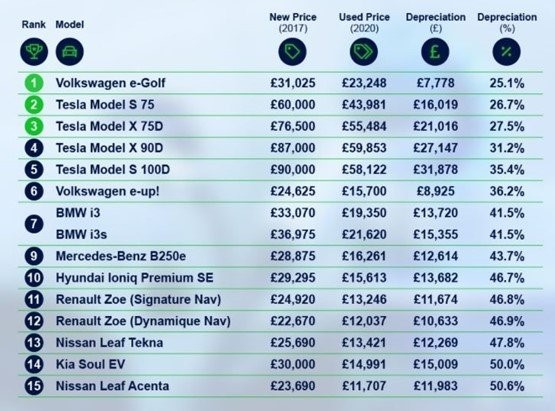
The Volkswagen e-Golf has achieved the strongest residual value in the electric car market, according to a study by CompareTheMarket.

The electric version of the Golf was ranked the top EV with the lowest depreciation of £7,778 (25.1%) after three years, with used models selling for an average price of £23,248 – three quarters of its new price three years ago.

It is followed by two Teslas, the Model S 75 (26.7% depreciation) and Model X 75D (27.5%)

https://cdn.fleetnews.co.uk/web/1/root/compare-the-market-ev-residuals_w555_h555.jpg

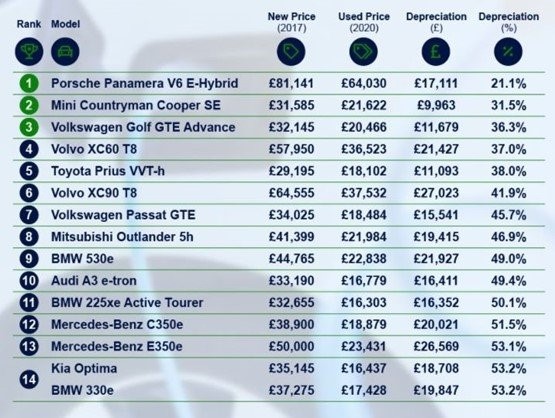
The research reveals how much electric and hybrid cars deprecate in value by comparing ‘new’ prices for the most common plug-in and hybrid vehicles to their used prices to reveal the vehicles which hold their value the most.

As Teslas are among the most expensive EVs and benefit from regular software updates, it could help the models retain their value, CompareTheMarket said.

According to the research, the models that were ‘the worst’ at holding their values were the Hyundai Ioniq Premium SE, which has a depreciation of £13,682 (46.7%), Renault Zoe Signature Nav, which has a depreciation of £11,674 (46.8%) and the Renault Zoe Dynamique Nav which depreciates by £10,633 (46.9%).

Find out about the latest EVs and plug-in hybrids coming to market in 2021 in our latest digital edition of Fleet News.

When looking at plug-in hybrids, the Porsche Panamera E-Hybrid was found to have ‘the best’ resale value over the last three years, with depreciation of 21%.

This is followed by Mini’s hybrid offering, the Countryman Cooper SE (31.5%) and another version of the VW Golf, the GTE Advance (36.3%).

The hybrids found to have the highest depreciation were the Kia Optima, which depreciates by £18,708 (53.2%), the Mercedes-Benz E350e (53.1%), Mercedes-Benz C5350e (51.5%), BMW 225xe Active Tourer (50.1%) and the Audi A3 e-tron (49.4%).

CompareTheMarket said, ‘the worst’ performing hybrids lose more of their value than electric cars, whereas ‘the best’ performing electric cars do not hold their value as well as hybrids.

Dan Hutson, head of motor insurance at CompareTheMarket, said: “EVs are becoming increasingly popular, and now that they have been in circulation for a while we are seeing them come onto the second-hand market, which is great news for people wanting to buy an EV or hybrid at a lower price.

“As the technology improves and cars become cheaper, we are sure to see greater adoption, which is the greener step forward that we need.” By Graham Hill thanks to Fleet News

Post-Brexit Warning About Disrupted Car And Van Supply

Thursday, 18. February 2021

Tariffs on new cars and vans may have been avoided, but a lack of detail in the Brexit deal could still lead to disruption in the market, the remarketing industry has warned.

The Vehicle Remarketing Association (VRA) says that several key points surrounding the future of manufacturing and cross-border movement of vehicles remain vague or undefined.

Sam Watkins, chair at the VRA, said: “Let’s be clear on this – any deal is good news because it avoids the kind of tariffs that would’ve been attached to no deal. It is something that should be a huge cause for relief.

“However, the deal that we now have raises as many questions as it answers. It is generally being described as ‘thin’ and that is accurate in that there are several areas where there is very little detail for the motor industry or remarketing.

“We are probably entering into a process now where those points are going to be worked through, but it seems that some will be easier to resolve than others.”

As a result, Watkins expects disruption to car and van supply. “It’s quite difficult to separate the negative effects of the pandemic and Brexit but getting hold of a number of popular new models is almost certainly going to be tricky in 2021,” she said.

“For a motor industry that has finished last year around 30% down in new car sales compared to 2019, this is not good news, and there will be knock-on effects for the used sector that will persist into the medium term.”

Watkins believes that the reduced numbers of vehicles entering the market will mean that getting hold of the used stock will remain difficult. “The situation may even worsen compared to the last few months,” she said.

“However, if 2020 has underlined anything, it is that the used car sector is incredibly flexible and innovative, and that people will continue to want to buy despite substantial practical barriers in their way.”

She continued: “The threat of motor manufacturing in the UK potentially unravelling overnight has been removed, and this should mean that there is no immediate question mark over UK factories and supply chains.

“However, looking ahead, substantial costs have been added in terms of the new customs arrangements, and the regulatory background against which car makers operate is unclear in several important areas.

“Presumably, these will be clarified in the coming months and years but it does perpetuate an effect that has been present ever since the Brexit referendum – that it is difficult to make plans and for investment decisions to be finalised without all of the facts available. There remains a lot of uncertainty.”

Notably, there were special difficulties surrounding the rules of origin arrangements, claims Watkins, that could have implications for EV manufacturing in the UK.  By Graham Hill thanks to Fleet News

Electric Car Manufacturers Turn Up The Wick – Starting With Tesla

Thursday, 18. February 2021

Tesla expanded its UK dealer network to 25 sites during 2020 and plans further network growth in 2021.

It represents a U-turn on company founder Elon Musk’s 2019 declaration that Tesla would close all its showrooms in favour of an online-only sales model.

The latest strategy follows reports of Tesla’s value reaching a record £516 billion, making it worth more than Toyota, VW, Hyundai, GM and Ford combined.

Six new Tesla locations were opened across the UK in 2020, with new showrooms appearing in Newcastle, Winchester, Gatwick, Belfast, Birmingham and Chelmsford.

A new site in Glasgow is also poised to open this year.

The Californian car maker says it has boosted its aftersales operation significantly and now has 15 service locations across the country, with more than 300 service team members.

This has led to a 130% increase in available service appointments and a 60% reduction in waiting times for appointments, according to the brand.

Tesla says it can reduce the time vehicles need to be in a workshop using remote diagnosis and can perform a service four times faster than conventional garages, enabling it to operate with a smaller footprint.

The brand achieved almost 25,000 registrations during the year, outperforming established brands such as Fiat, Mazda, Porsche and Suzuki.

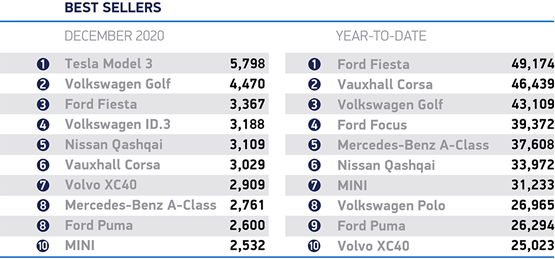
Its Model 3 topped UK monthly sales charts twice during the year – once in April and then in December.

The vast majority of sales are the Tesla Model 3 – Tesla insiders suggest the Model 3 accounts for approximately 90% of UK Tesla sales YTD. That makes the Model 3 the UK’s best-selling battery electric vehicle (BEV), and the UK’s second best-selling compact executive model behind the BMW 3 Series.

Tesla’s UK Supercharger network also grew during 2020 with the addition of 180 new chargers in 20 locations, bringing the total to more than 600 chargers in 70 locations. By Graham Hill thanks to Fleet News

Massive Drop In New Car Registrations In 2020

Monday, 8. February 2021

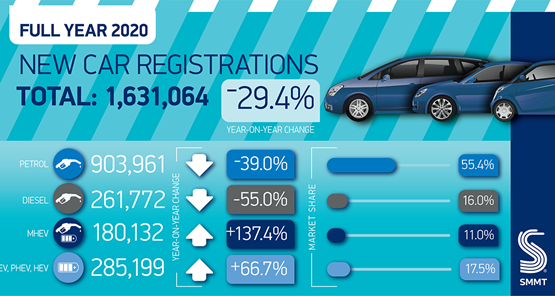
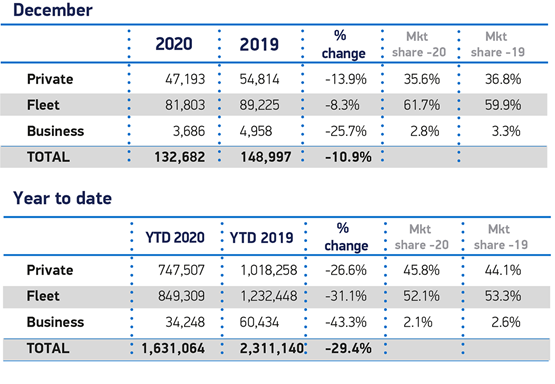
I don’t think that it would surprise anybody that new car registrations were drastically down in 2020 but the interesting statistic is the split of cars. Private registrations suffered the least with the larger fleets doing slightly better but the business registrations were down 43.3% (see chart below).

However, I would suggest that whilst these figures look dreadful many customers, both corporate and consumer extended lease contracts last year and those that had to change their cars decided to go down the used car route as there was a grave lack of new car stock available.

Here is the report and breakdown of the figures for 2020:

Fleet and business registrations fell by 32% in 2020, with 400,000 fewer company cars registered compared to 2019, but fleets were behind a massive increase in the uptake of electric vehicles (EVs).

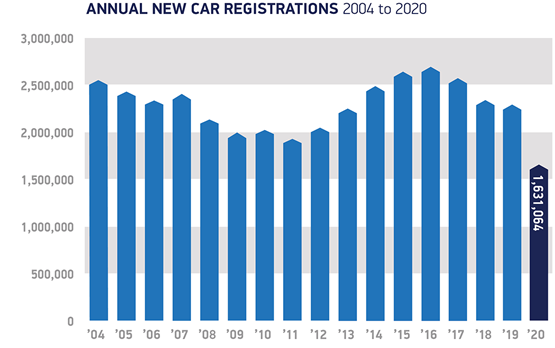
The new figures, published today by the Society of Motor Manufacturers and Traders (SMMT), show overall demand in the new car market fell to the lowest level since 1992.

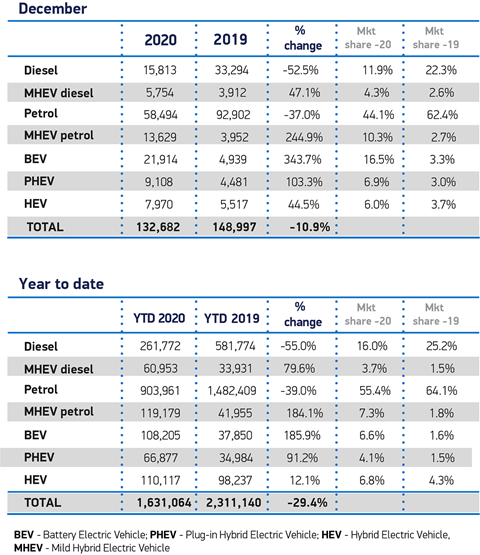
They also reveal the continuing decline of diesel, with 55% fewer diesel cars registered in 2020 compared to 2019.

The SMMT sales figures show there were 883,557 cars registered to fleet and business during 2020, compared to almost 1.3 million vehicles the previous year.

However, the latest sales data also reveals that in December, fleet and business registrations were only 9% down compared to December 2019.

It suggests a recovering company car market, with 85,489 fleet and business registrations, equating to 64% market share.

https://cdn.fleetnews.co.uk/web/1/root/smmt-registrations-2020_w555_h555.png

Overall, the UK new car market fell by almost a third (29%) in 2020, with annual registrations dropping to 1,631,064 units.

Against a backdrop of Covid-19, the industry suffered a total turnover loss of some £20.4 billion, with private vehicle demand falling by 27% overall, amounting to a £1.9bn loss of VAT to the Exchequer, says the SMMT.

Mike Hawes, chief executive of the SMMT, says that 2020 will be seen as a “lost year” for automotive, with the sector under “pandemic-enforced shutdown” for much of the year and uncertainty over future trading conditions taking their toll.

However, he said: “With the rollout of vaccines and clarity over our new relationship with the EU, we must make 2021 a year of recovery.

“With manufacturers bringing record numbers of electrified vehicles to market over the coming months, we will work with Government to encourage drivers to make the switch, while promoting investment in our globally-renowned manufacturing base – recharging the market, industry and economy.”

https://cdn.fleetnews.co.uk/web/1/root/smmt-december-and-year-to-date_w555_h555.png

Demand fell across all segments bar specialist sports, which grew by 7%, although Britain’s most popular class of car remained the supermini, retaining a 31% market share despite a 26% decline in registrations.

Meanwhile, although falling by a combined 33%, petrol and mild hybrid (MHEV) petrol cars made up 63% of registrations, while diesel and MHEV diesels, down 48%, comprised almost a fifth of the market.

Fleets adopt more electric vehicles

Battery and plug-in hybrid electric cars accounted for more than one in 10 registrations – up from around one in 30 in 2019.

Demand for battery electric vehicles (BEVs) grew by 186% to 108,205 units, while registrations of plug-in hybrids (PHEVs) rose 91% to 66,877.

Most of these registrations (68%) were for company cars. Gerry Keaney, chief executive of the British Vehicle Rental and Leasing Association (BVRLA), says that 2020 has been a “tipping point” for EV uptake and demonstrates what can be achieved when Government works closely with fleets to develop a set of powerful grants and tax incentives and invest in a robust public charging network.

“While only a handful of EVs were on sale in 2011, there are now more than 100 models available.” Poppy Welch, head of Go Ultra Low

“The latest BVRLA data shows that the fleet sector continues to lead the charge towards zero emission motoring, with battery electric vehicles responsible for 21% of company car registrations in the three months to October 2020.”

With so much uncertainty surrounding the impact of EU Exit, coronavirus and the economic downturn, Keaney says that the Government must do everything it can to support the vehicle buyers that underpin the UK’s new car market.

“With the next Budget just weeks away, the Chancellor must continue to ring-fence the long-term grants and tax incentives that make electric vehicles affordable,” he said.

“He must also resist the urge to pile more motoring tax increases on fleets and drivers that have yet to make the transition to zero emission motoring.

“Many of these businesses and individuals are struggling financially and can’t yet find an electric vehicle that meets their needs or budget.” 

More than 100 plug-in car models are now available to UK buyers, and manufacturers are scheduled to bring more than 35 to market in 2021 – more than the number of either petrol or diesel new models planned for the year.

Poppy Welch, head of Go Ultra Low, believes that in the context of the new car market, 2020 will be remembered as the breakthrough year for EVs.

“After a ninth successive year of growth in EV registrations, we’ve now seen market share rise to 10.7%,” she said.

“This has been made possible, in large part, by the Government’s ongoing support and long-term vision, combined with the automotive industry’s commitment to developing a wide range of zero-emissions vehicles that are clearly convincing the public with their performance, financial and environmental credentials.

“While only a handful of EVs were on sale in 2011, there are now more than 100 models available.”

When will the market get ‘back on its feet?

Ashley Barnett, head of consultancy at Lex Autolease, said that the 29% year-on-year drop really “hammers home” just how challenging the coronavirus pandemic has been for the motor industry.

“The market will take some time to get back on its feet,” he said. “How long that is remains to be seen.”

He added: “The growth in EVs is comforting but ultimately is from an extremely low base – only 6.6% of vehicles on the roads are EVs (including PHEVs).

“All eyes will be firmly on the spring Budget and the rumoured plans for a road pricing scheme which may go some way to recoup lost tax revenue when EVs begin to overtake conventional ICE models.

“The Chancellor has an opportunity to reassure would-be EV drivers that fiscal incentives will remain on the table and incentivise them to take the first step into alternatively-fuelled vehicles.”

Jon Lawes, managing director of Hitachi Capital Vehicle Solutions, expects economic uncertainties to continue into the first quarter of 2021, while the pandemic dampens consumer confidence.

However, he said: “The UK’s long negotiated tariff-free trade agreement with the EU should provide a welcome boost for the motor industry to lay the foundations to support a recovery in the sector.

“Similarly, the positive trend in EV uptake demonstrates that the transition to electric will gather momentum in the months ahead heightened by the wide range of new EV models coming to market in 2021 and growing consumer demand.”

https://cdn.fleetnews.co.uk/web/1/root/smmt-december-registrations_w555_h555.png
https://cdn.fleetnews.co.uk/web/1/root/smmt-year-on-year-registrations_w555_h555.png
https://cdn.fleetnews.co.uk/web/1/root/smmt-december-best-sellers_w555_h555.png

By Graham Hill thanks to Fleet News & SMMT