Penalty Points For Not Wearing Seat Belts

Friday, 18. June 2021

The Government is being urged to honour a commitment made in its road safety action plan to increase the penalty for not wearing a seatbelt.

In the plan, launched in July 2019, the Government said people caught not wearing a seatbelt would face penalty points on their licence as well as a fine.

The offence has long been endorsable in Northern Ireland, where drivers who fail to ensure a child in a front or rear seat is not wearing a seatbelt also face points on their licence. However, these tougher sanctions do not apply in England, Scotland or Wales.

GEM chief executive Neil Worth explained that official figures show that, despite compliance rates of 98.6% among car drivers, more than one in four (27%) of those killed in cars were not wearing a seat belt – amounting to more than 200 deaths.

“Seatbelts reduce the risk of death by 45% for drivers and front seat occupants. They also reduce the risk of serious injury by 50%,” he said.

“Research shows time and again that seatbelt laws increase seatbelt use, and therefore reduce deaths and serious injuries.

“We have seen mobile phone penalties for drivers rise in recent years, and if seatbelt offences were dealt with in a similar way, we believe would see a significant and immediate reduction in the number of drivers and vehicle occupants killed and seriously injured on our roads.”  By Graham Hill thanks to Fleet News

Shopping Centre To Install 236 EV Charge Points

Friday, 18. June 2021

A 236-bay electric vehicle (EV) charging hub will be installed at Brent Cross Shopping Centre, making it the largest facility of its kind in the UK.

The hub will be installed and operated by Franklin Energy. It is expected to be completed in 2026.

Initially, 50 22kW charging points will be installed in the shopping centre’s multi-storey car park along with two 350kW ultra-rapid units in the Western overflow car park. These will be completed by the end of 2021.

Brent Cross shopping centre is co-owned by Hammerson and Aberdeen Standard Investments. The new charging hub will be Hammerson’s ninth destination to offer charging points.

Louise Ellison, group head of dustainability at Hammerson, said: “The installation of the UK’s largest EV charging facility will not only attract more visitors to our centres at a time when we are expecting to see a significant increase in electric vehicles on the roads, but also shows our continued commitment to tackling climate change, as we continue our journey towards becoming net positive by 2030.

“Combined with our renewable electricity contracts, this service has the potential to significantly reduce the carbon footprint of visitors to Brent Cross by supporting the transition to electric vehicles. ”

In addition to benefiting existing customers visiting the shopping centre, the facility will also provide charging points for cars passing by on the nearby M1, A41 and A406 via the North Circular.

The EVBox charging units will be part of Franklin Energy’s LiFe Network which is expected to have 5,000 public chargers by 2025.

Niall Macdonald, deputy fund manager for the Aberdeen Standard UK Shopping Centre Trust, added: “The scale of this installation of electric vehicle charging points at Brent Cross is our most ambitious to date and we believe it will provide a fantastic service to our customers allowing them to make the change to EV confident in the knowledge that this facility is available to them.” By Graham Hill thanks to Fleet News

Toyota Invest £1 million To Combat Catalytic Converter Theft

Friday, 18. June 2021

Toyota is working with police and Smartwater to covertly mark the catalytic converters on more than 100,000 cars in an attempt to deter thieves.

The initiative is costing the car maker more than £1m and will be provided to existing Toyota owners for free.

Rob Giles, Toyota (GB) director of Customer Services, said: “Catalytic converter theft is a very serious problem in the UK and the effects on victims of this crime are emotional as well as financial.

“We’re pleased to be starting this initiative, working closely with the police, not only to help them with their efforts to combat this crime but also to send a clear message to criminals that if they choose to target a Toyota or Lexus car there is now a far higher chance of getting caught.”

Toyota hopes that the marking programme will dissuade rogue scrap metal dealers who are happy to pay cash for stolen converters, now that the risk of being caught is greater than before.

Thieves are targeting the catalytic converters in older hybrid models, like the Toyota Prius, because the catalyst in a hybrid has a lower work load than in a non-electrified vehicle, meaning it is in better condition.

In more modern Toyota and Lexus cars the catalysts are of a different design and are not typically targets for theft as a result.

According to Ageas Insurance, three-in-10 of all theft claims reported are now related to catalytic converters. Before the Coronavirus lockdown, catalytic converter theft only accounted for around one-in-five.

Catalytic converters contain a honeycomb coated with precious metals such as platinum, palladium and rhodium which help to filter harmful gases from the vehicles’ exhaust systems.

The RAC says that when the global value of these metals increase it usually leads to a spike in thefts. Prices of rhodium hit a record highs earlier this year, up more than 200% since March 2020.

Toyota is offering the Smartwater marking free to all Toyota and Lexus owners, who simply need to call their local Toyota or Lexus retailer to arrange a visit.

It has also issued 20,000 Smartwater kits to police to support their local anti-catalyst theft initiatives. The company is also working with the AA, Toyota’s road-side partner, so its patrols can point customers to where they can get a free kit.  By Graham Hill thanks to Fleet News

Global Microchip Shortage Stops VW And Daimler/Mercedes Production

Friday, 18. June 2021

The semiconductor shortage has forced Daimler and Volkswagen to cut the working hours at some of their plants.

Every car- and van-maker is being impacted by the computer chip crisis, with some delivery times for cars lengthening from three to six months, and many new vans not expected to be delivered until 2022.

Daimler is reducing working hours this week at its Bremen and Rastatt plants, a spokeswoman told Reuters, adding that the situation was “volatile”, and it was not possible to make a forecast on the impact.

Volkswagen will cut working hours at its Wolfsburg factory next week, a spokesman said.

Volkswagen chief executive, Herbert Diess, said last month that it was in “crisis mode” over the shortage, adding that the impact would intensify and hit profits in the second quarter, which ends in two weeks.

Ford was among the first auto motive companies to highlight the potential impact of chip availability on first quarter production, earlier this year.

“The global semiconductor shortage is affecting automakers around the world as well as other industries, including consumer electronics companies,” a Ford spokesman explained.

“Ford is concentrating on how to best use our allocation of semiconductors to deliver high-demand vehicles to customers.”

The manufacturer has reported it could lose half of all planned production in quarter two of 2021.

The factory in Turkey that builds the Ford Transit for the European market was closed until June 13.

The Focus production line in Germany will be on limited production for much of next month, while closures of varying length will impact Galaxy, Kuga, Mondeo, S-Max and Transit Connect production until July 31.

Closures will also impact the Fiesta and Puma production lines in Germany and Romania respectively, although to a much smaller degree.

The Ford spokesman said it was looking at a number of factors to manage the chip shortage, including overall consumer demand by nameplate, the individual vehicle’s contribution to its fuel economy commitments and its ability to make up for the short-term production loss later this year.

Stellantis – parent company of the merged PSA and FCA Groups – saw eight of its 44 global plants idled at some point in Q1, with production losses due to chip shortages down around 190,000 units or 11% of planned output.  By Graham Hill thanks to Fleet News

As Demand Increases, Price Parity Between Electric Vehicles And Petrol & Diesel Expected Within 5 Years.

Friday, 18. June 2021

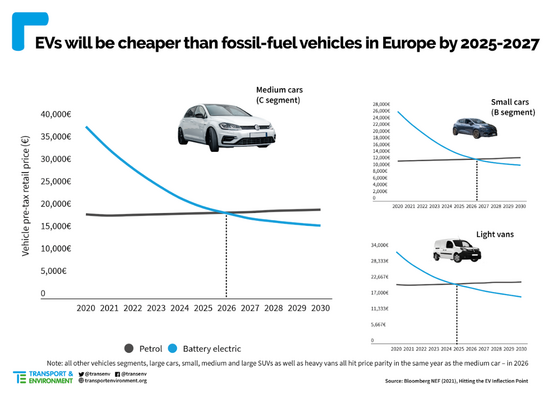
Electric cars and vans should be cheaper to make than petrol or diesel vehicles by 2027, with some segments achieving price parity from 2026, new research suggests.

The Bloomberg New Energy Finance (BNEF) study, commissioned by Transport & Environment (T&E), found that C and D segment vehicles and SUVs will be as cheap to produce as petrol vehicles from 2026, while small cars (B segment) will follow in 2027. 

Falling battery costs, new vehicle architectures, and dedicated production lines for electric vehicles (EVs) will make them cheaper to buy, on average, even before subsidies, says BNEF.

However, it explained that the early build-up of EV production and sales will be crucial to drive down costs and generate consumer buy-in for further adoption in the future.

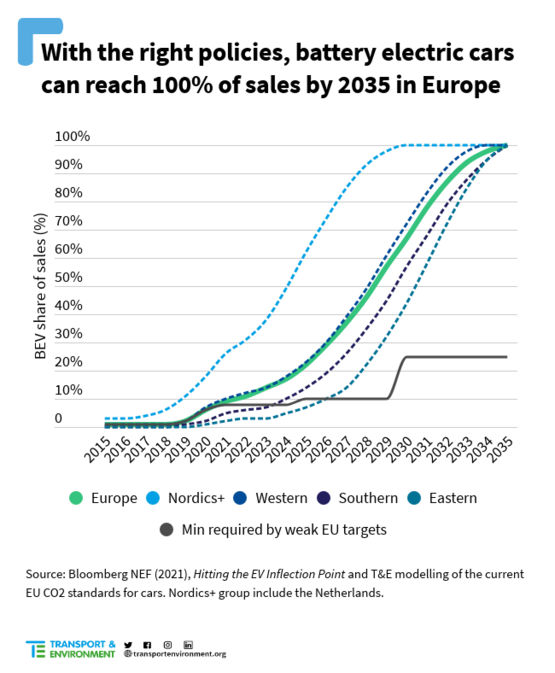
The research found that battery electric vehicles (BEVs) could reach 100% of new sales across the EU by 2035, if lawmakers introduce measures like tighter vehicle CO2 targets and strong support for charging infrastructure.

T&E called on the EU to tighten emissions targets in the 2020s and set 2035 as the end date for selling new polluting vehicles.

The UK Government announced last year that new petrol and diesel cars and vans will not be allowed to be sold in the UK from 2030.

It has, however, said that it will allow the sale of hybrid cars and vans that can drive a significant distance with no carbon coming out of the tailpipe until 2035.

Julia Poliscanova, senior director for vehicles and emobility at T&E, said: “EVs will be a reality for all new buyers within six years.

“They will be cheaper than combustion engines for everyone, from the man with a van in Berlin to the family living in the Romanian countryside.”

ELECTRIC VANS REACH PRICE PARITY

The research suggests that light electric vans will be cheaper than diesel vans from 2025, and heavy electric vans from 2026.

However, as it stands today, electric vans only account for 2% of sales. T&E says EU lawmakers will need to set van-makers challenging CO2 targets, alongside dedicated e-van sales quotas, to increase investment and the number of electric models on the market.

Poliscanova continued: “With the right policies, battery electric cars and vans can reach 100% of sales by 2035 in western, southern and even eastern Europe.

“The EU can set an end date in 2035 in the certainty that the market is ready. New polluting vehicles shouldn’t be sold for any longer than necessary.”

T&E says the EU Commission should set an end date for fossil-fuel car sales in June, when it will propose tightening the bloc’s car CO2 targets.

Last month, 27 major European companies called on EU lawmakers to set 2035 as the end date for selling new combustion engine cars and vans. A recent poll showed 63% of urban residents in Europe support a ban after 2030.

At least seven carmakers and 10 European countries have announced plans to phase out conventional cars. But, in the absence of an EU commitment, these deadlines remain either voluntary or uncertain as to their enforceability, says T&E.

UK FLEET ELECTRIFICATION CONCERNS

Separate research suggests that the UK’s drive to switch to electric cars, trucks and vans from 2030 risks failing, because of serious cost concerns from the country’s SME business leaders.

The YouGov survey, commissioned by Mer – part of Norwegian clean energy giant Statkraft, asked 861 businesses in the UK whether EV charging was on their radar, what they perceived as barriers to installing charging facilities, and who they thought was responsible for encouraging adoption.

When asked what would encourage SME business owners to install charging points at their workplace, they said tax incentives (37%), followed by ‘cheap installation’ (35%), and the relative cost of EVs (32%).

Nine percent of SMEs, however, stated they already had EV charging points on their premises – a figure that leapt to 17% for medium sized SMEs (those with 50 – 250 employees).

A further 21% (or 30% in medium sized SMEs) were planning to install EV chargers before 2030 – when the Government’s ban on new diesel and petrol vehicle sales comes into force.

Mer UK managing director, Anthony Hinde, said: “There are really strong indicators here that SMEs do see the value in installing EV chargers – both for their customers and as ways to attract and retain staff.

“It’s also clear they are going to need – and are asking for – support from Government and local authorities to help with the costs involved in putting in chargers.

“But just like in Norway, this is a huge opportunity for politicians to react and take action – cut VAT on new EV cars, up the subsidies, and apply further tax incentives for those working with UK infrastructure – so we can meet the 2030 target and ensure we power more vehicles with less polluting technology.”

Mer recently launched into the UK to support and lead the UK’s transition to EVs.  By Graham Hill thanks to Fleet News

Government Measures To Prevent Terror Attacks Using Vehicles.

Friday, 18. June 2021

New guidance has been published for fleets by the Government to minimise the risk of commercial vehicles being used in a terror attack.

The new standard has been published by the British Standards Institution (BSI) and sponsored by the Department for Transport (DfT).

It sets out a raft of security measures to prevent criminals and terrorists from accessing commercial vehicles, including vans, lorries, buses, coaches and cranes.

Transport Minister Robert Courts says the “vital new guidance” will help in the fight against terrorism and organised crime.

“I wholeheartedly support this move and the British Standards Institution in their important work,” he continued.

“Terror attacks and organised crime involving commercial vehicles have had tragic and devastating effects in recent years, with every life lost leaving an unimaginable void in the lives of so many.

“This Government will continue to work tirelessly to ensure the British public are kept safe.”

To meet the new standard, operators will have to improve their knowledge of potential risks and determine which of those risks apply to their business.

Furthermore, they must develop a security management plan, assess risk exposure and put in place management and accountability for security.

Other requirements will include checks of drivers’ references and previous employment history and also regular visual checks of vehicles for signs of tampering.

The Government says it is working with the fleet industry to develop accreditation and certification schemes for operators, with further details to be announced in due course.

Nick Fleming, head of mobility and transport standards at BSI, said that the new standard, developed with commercial vehicle operators, encourages good practice that could reduce the threat of vehicles in terror attacks.

“The standard highlights the growing importance of physical vehicle security measures to help prevent such criminal acts taking place,” he added.

Terror attacks on the public involving vehicles have had tragic consequences in recent years, including in the Westminster and London Bridge attacks of 2017.

In the wake of those attacks, three quarters (76%) of commercial fleet drivers said they would like training to deal with the threat of their vehicle being hijacked or stolen and used in a terrorist attack.

Ministers say that the new measures could also assist the fight against serious and organised crime, including helping to minimise the risk of drug and people smuggling.

In 2019, people smuggling resulted in the deaths of 39 Vietnamese nationals, whose bodies were found in a lorry container in Essex.

The new standard is targeted at operators of light and heavy goods vehicles, as well as those of public service vehicles and mobile plant, such as cranes and tip trucks.  By Graham Hill thanks to Fleet News

Surprising Speed Camera Survey Results

Friday, 18. June 2021

A majority of drivers (54%) want the 70mph-limit on motorways enforced by average speed cameras, new research from the RAC suggests.

That’s despite more than half of drivers (56%) admitting to breaking the speed limit on motorways, with a third (34%) of those confessing to having travelled at speeds in excess of 80mph.

Two-thirds (66%) said that their highest speed on a motorway was between 71-80mph, more than a quarter (27%) claim to have driven at 81-90mph.

Almost one in 20 (4%) believed their top speed was 91-100mph, while 3% admitted to driving on a motorway in excess of 100mph.

RAC road safety spokesman Simon Williams says that, despite more than half of drivers admitting to regularly exceeding the 70-mph speed limit, road safety statistics show that motorways are the UK’s safest roads.

However, he added: “With so many motorists admitting to driving much faster than they should on the motorway, it was interesting to see such strong support for average speed cameras to be used more widely to enforce the 70-mph limit as opposed to just in roadworks, as is currently the case.

“We believe drivers see these cameras as being very effective at reducing speeds over longer distances and controlling traffic flow as well as being fairer than fixed position ones as they aren’t instantly punished for a momentary transgression.”

When drivers were asked by the RAC why they broke the speed limit on a motorway, most (39%) said they were following the example set by other motorists, although almost a third (31%) believed they thought it was safe to travel faster than 70mph.

Other common reasons for speeding on a motorway were: nothing else being on the road (28%); the speed limit being inappropriate (27%) and feeling pressure from other drivers behind (26%).

On high speed roads where the speed limit is 60mph and 70mph, more than half (58%) of the 3,000-plus motorists surveyed for the RAC Report on Motoring said they favoured ‘average speed cameras’ which measure speeds between cameras rather than at a single, fixed location like traditional speed cameras.

Nearly a fifth (18%) felt fixed position cameras are most effective while 12% said it was mobile speed traps, with a similar proportion not offering an opinion.

While average speed cameras are used on a number of A-roads, on motorways they are currently only used in sections of roadworks.

More than half of drivers (54%), however, said they would like to see them used in general motorway conditions enforcing the 70mph-limit. Only a quarter (26%) disagreed with this idea, with 18% unsure.

Average speed cameras were also preferred by the majority of drivers for use on 40-50mph limit roads with 46% saying this, compared to 29% for fixed position cameras.

On 20-30mph limit roads however, fixed position cameras came out top with 43% of drivers saying they were best and a quarter (25%) opting for average speed cameras, only just ahead of police officers operating mobile speed traps (21%).

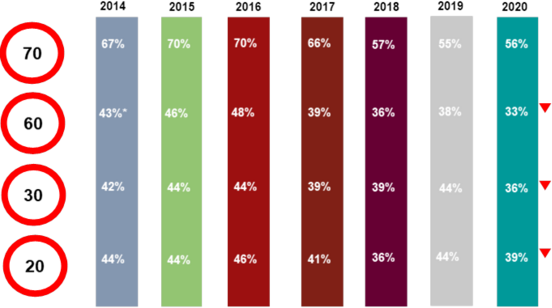
While compliance on roads with lower speed limits is far better than the 54% who admit to exceeding the 70mph-limit, four-in-10 (39%) admit to frequently disobeying 20mph limits. This rises to a third (33%) on 60mph country roads – statistically some of our least safe roads – and to 36% on 30mph urban roads.

More than one in 10 (11%) claim to have driven above 40mph in a 30mph zone, while 10% have exceeded 30mph in a 20mph zone.

In the case of the latter, 45% of those who speed at least occasionally say this is because they believe the limit is ‘inappropriate’ for the area or stretch of road in question.

In separate research, published last year, IAM RoadSmart reported that four out of five drivers (82%) were in favour of using speed cameras to automatically fine drivers travelling more than 10mph over the limit near schools.

Williams said: “Our research shows speed limit compliance on all types of road has improved on previous years, but as our study was carried out during the pandemic we suspect this has partly been brought about by the reduction in the number of journeys carried out for the purposes of commuting – or for other business purposes – where drivers feel greater time pressure and may be more tempted to break the law by speeding.”

Proportion of drivers who frequently or occasionally speed

By Graham Hill thanks to Fleet News

VW Announce Latest Free EV Charging Plans In Tesco Carparks

Friday, 18. June 2021

Leading the charge

Volkswagen and Tesco are delivering the UK’s largest retail EV charging network, with free top ups available to all electric vehicles, powered by Pod Point.

What are we doing?

Volkswagen and Tesco want to make it easier for you to charge your electric car while you’re out, no matter what brand of Electric Vehicle you drive. That’s why by the end of July 2021 there will be free 7kW EV charging bays at 400 Tesco stores.

At selected stores there are free 22kW chargers and (chargeable) 50kW rapid chargers.  All of the chargers are installed by Pod Point, the UK’s largest independent public charging network operator, and all use renewable/green energy.

Where will I be able to charge?

Finding a charge point is easy. You’ll quickly spot them in both Tesco Extra and Superstore car parks. And with 400 stores with charging bays (by the end of July 2021), you shouldn’t need to travel too far to find a Tesco where you can top up your battery.

Want to stay up to date with all the latest charge points?

View the latest Tesco stores with EV charging here.

How do I use the chargepoints?

To use the charge points you’ll need to download the Pod Point app or use their web app.

How much will it cost?

To make charging more accessible, the 7kW chargers are free of charge.  Where available, 22kW chargers are also  available free of charge. But even if you decide to use the rapid 50kW charger (where available) you’ll only pay a small fee in line with the going market rate.

Some stores may have a parking charge and as you’d expect, you need to be a Tesco customer to use them.  By Graham Hill thanks to Volkswagen.co.uk

COVID Has Increased Demand For Business And Private Cars As Demand For Public Transport Declines

Thursday, 10. June 2021

The company car market is predicted to grow significantly after new research reported a three-fold increase in drivers wanting to source their next vehicle through their employer.

The findings, from the OC&C Speedo meter ‘Battery Late Than Never’ report, also suggest that Covid-19 has helped cement the importance of a car, despite people driving less.

More than two-in-five drivers (42%) said the pandemic has increased their belief that a car is essential. It is not just drivers who see the car as essential either – the number of non-drivers who expect to own in the future has risen by 21% in the UK.

The global report was published last week and is a follow-up to a 2019 study. It tracks how trends in consumer attitudes and behaviours toward vehicles and their mobility needs have changed.

Looking at UK-specific data, it shows that just 2% of consumers expected to source their next car through their employer in 2019, but, three years later, that has risen three-fold to 6% – a 200% uplift.

COMPANY CAR MARKET

It is a positive outlook for a sector which has been in decline for the past few years. The most recent figures, published by HMRC in September 2020, showed that the number of people paying company car tax had again fallen substantially, with HMRC reporting 30,000 fewer people receiving the benefit.

The benefit-in-kind (BIK) statistics, published by HMRC, showed there were 870,000 company car drivers in 2018-19 – a massive 30,000 year-on-year decline.

The figures suggested that the number of employees receiving the benefit had fallen by some 90,000 in the past five years, from 960,000 in 2015/16.

The introduction of a new zero percentage tax rate for a pure electric company car in April 2020, along with lower rates for hybrids, however, has led many to predict a brighter future for the benefit.

The latest new car registration figures from the Society of Motor Manufacturers and Traders (SMMT) highlight the relative strength of the sector.

Almost 80,000 new company cars were registered to fleet and business in April as the market continued to show signs of recovery.

Year-to-date, 318,991 new cars have been registered to fleet and business compared to the 259,017 units registered during the same period last year, a 23% uplift.

Fleet and business registrations now account for 56% of the market, with 567,108 cars registered overall.

There were 141,583 new car registrations in April, with 79,648 new company cars registered to fleet and business.

In April 2020, at the start of the first lockdown, just 3,450 new company cars were registered.

APPETITE FOR EVs

OC&C says the proportion of drivers considering an electric vehicle (EV) is “unprecedented” and is likely to translate into a fast acceleration in EV adoption.

Globally, more than 50% of drivers considered a hybrid when they last changed their car, and more than 40% report they will consider a pure EV next time.

The UK leads the West in EVs in the survey, with 57% of UK drivers considering fully electric for their next vehicle versus 45% in Germany and the US.

In the UK, new BIK tax rates will be persuading some to make the switch to a plug-in car, but the OC&C study shows range and tech improvements (38%), concerns about the environment (39%), Government regulation changes (36%) and better availability of charge points (35%) are the main drivers for consumers.

The OC&C data reflects the experience of leasing companies, which have reported a growing number of company car drivers choosing an EV.

Tusker, for example, has a risk fleet of approximately 20,000 cars and, while just one-in-33 (3%) were pure electric in 2019, it has since increased to one-in-five (20%).

Half of the leasing company’s orders in 2020 were for pure electric cars. Hybrid vehicles, both plug-in and mild, accounted for 20% of its new vehicle orders, with petrol and diesel responsible for less than a third (30%).

In fact, zero-emissions-capable cars, including electric, hybrid and fuel cell models, now account for one-in-three of the available models in the UK, according to the SMMT.

BARRIERS TO ADOPTION

Barriers to adoption have shifted, with the OC&C report suggesting the percentage of people citing access to public charging infrastructure as an issue has fallen dramatically.

In 2019, it said that 64% of respondents in the UK saw it as a barrier to adoption; the latest study reports that it has fallen by 14 percentage points to half (50%).

An EV’s range, while still the number one concern, is also seen as less of a barrier, falling seven percentage points, from 62% to 55% over the same period.

Meanwhile, more drivers see vehicle cost as a barrier, with more than half of respondents (51%) highlighting it as issue, compared with 49% in 2019.

The cost of electricity saw the greatest swing, with more than a quarter of respondents (29%) citing it as a barrier compared with 19% in 2019 – a 10 percentage point uplift.

The Association of Fleet Professionals (AFP) says the lack of an effective national strategy for creating kerbside charging infrastructure is emerging as the biggest barrier to adoption of EVs by businesses.

OC&C’s study, however, suggests access to a charge point close to home or at the driver’s property is becoming less of an issue for UK consumers, with 39% citing it as issue in the most recent survey, compared with 44% in 2019.

The current Government approach to install kerbside charging means 75% of the cost is met by a national fund and 25% is paid by local authorities.

AFP chair Paul Hollick believes the strategy is not working. He said: “We have national fleets who are AFP members and want to go 100% EV as soon as possible. The stumbling block they face is that nationally, around four-out-of-10 people live in apartments or terraced houses and don’t have access to on-street parking.

“That means they are reliant on local authorities to install street charging facilities but, as you’d expect, the impetus and ability to do so varies massively from area to area.”

A kerbside charger costs around £2,500 to install, meaning local government needs to find £600 per unit. In the wake of the pandemic, Hollick says many simply don’t have the money, even if there is the will.

CAR CLUB POTENTIAL

Exclusive access to a car still remains vital to 82% of drivers, according to the OC&C report, with most expressing concerns around accessibility, storage and privacy as key to their reluctance to consider co-ownership or access models.

However, the importance of exclusivity is starting to wane for a forward-thinking minority, with 13% of UK drivers happy to consider mobility solutions as an alternative to having their own car, be it carsharing solutions, taxis or even short-term rental – a four percentage point increase on 2019.

OC&C says this reflects lower car usage in 2020 as a result of the pandemic, environmental and cost concerns, while the development of models such as Zip Car and Drover are also driving changes in attitude.

Consumers also continue to see a car as essential to travel, according to the report. The percentage of drivers who see a car as essential has remained stable between 80-90% since 2019.

This is true even among the young; Gen Y and Gen Z drivers still care about having cars and driving, it suggests. In fact, they have become more dependent on cars than they were. The percentage of 18-29-year-olds disagreeing that a car is essential has fallen from 11% to 5%. By Graham Hill thanks to Fleet News
Drivers With Home Chargers Could Face Substantial Electric Bills.

Thursday, 10. June 2021

Electric vehicle (EV) drivers could face an increase in household energy bills of more than £1,000 a year if they don’t use a suitable electricity tariff for vehicle charging.

Energy prices in the UK increased on April 01, 2021, so many households – including those with drivers who charge company vehicles at home – will now have larger electricity utility bills to pay, according to vehicle home charger and energy comparison site Rightcharge.co.uk.

But fleet drivers can avoid price hikes by seeking a more generously priced EV-friendly energy tariff to cover charging electric vehicles.

For example, a fleet driver covering 20,000 miles annually will expect to pay £2,599 a year on a Standard Variable Tariff from one of the big six energy suppliers from April 2021. This includes £1,454 for charging their car.

But users who switch to a lower-cost alternative EV energy tariff could pay only £1,349 a year – with just £459 of that amount on vehicle charging. That’s a huge saving of £995 on charging a vehicle at home, with another £255 saved on household energy bills. So that’s a total saving of £1,250 a year.

Charlie Cook, founder of Rightcharge.co.uk, said: “Compared to a standard tariff, having an EV-friendly energy tariff is incredibly cheap – to the point where a homeowner can charge their car at home and reduce their total energy bills at the same time.

A fleet driver who does 20,000 miles a year can save up to £1,250 a year, so drivers really can’t afford to miss out on the savings available if they change to the right deal.

“If all the current 1.04 million business contract hire drivers switched to electric cars and an EV-friendly energy tariff on the same mileage parameters, the potential saving is more than £1 billion on vehicle charging alone, plus a further £265 million on home energy costs.”

Rightcharge.co.uk compares EV-friendly energy tariffs for users by including their car charging needs as well as their home requirements, so customers can reduce the cost of running an EV.

Cook added: “We believe many EV drivers just don’t realise that while costs have gone up they can still save. Our price comparison website offers them the choices to make the best decisions.”  By Graham Hill thanks to Fleet News