New Research Exposes Tired Driving Trend

Friday, 16. July 2021

The following warning applies to all drivers although the report was aimed at company car or fleet drivers.

Company car and van drivers are being urged not to drive for longer than two hours without taking a break, after new research revealed a worrying trend in tired driving.

The survey, from road safety organisation IAM RoadSmart, found that one-in-10 drivers had momentarily closed their eyes because they were so tired.

The same number (10%) of drivers also admitted that they had hit the rumble strip, while two-in-five (40%) had turned down the heating or rolled down the windows in order to stop them from being tired.

Neil Greig, IAM RoadSmart director of policy and research, said: “Fatigue behind the wheel is a very serious problem, perhaps more concerning than previously thought of.

“The potential carnage that could result from even one accident doesn’t bear thinking about.”

More than half of drivers said they were very concerned about fatigue when driving long distances, while encouragingly around a quarter of drivers had pulled over for a rest or a coffee as the road safety experts advise.

“Driving a long distance needs pre-planning to ensure there are plenty of available rest places and to make sure there’s enough time to complete the journey if delays are encountered,” explained Greig.

“Never drive for longer than two hours without a break and take particular care if driving when you would normally be asleep. This is even more important as the country reopens after the pandemic and not all facilities may be available yet.

“Drivers can then concentrate on staying alert behind the wheel rather than staving off tiredness by trying to reach their end destination without adequate rest breaks.”  By Graham Hill thanks to Fleet News
Germany Reacts To The Global Microchip Shortage In Its Usual Efficient Manner

Friday, 16. July 2021

Bosch has opened a €1 billion (£860m) semiconductor fabrication facility in Dresden, Germany – the largest single investment the company has ever made.

Production in Dresden will start as early as July – six months earlier than planned, with the first semiconductors made in the new plant to be installed in Bosch power tools.

For automotive customers, chip production will start in September, three months earlier than planned.

With the automotive sector facing a global semiconductor shortage and fleets facing increased SMR costs and lead times due to the microchip crisis, Bosch says that the new factory will be an important part of the semiconductor manufacturing network.

Harald Kroeger, Bosch board member with responsibility for the Mobility Solutions, says automotive microchips are the “ultimate discipline” in semiconductor technology.

“This is because in cars these small building blocks have to be especially robust,” he explained. “Nowhere else are they subjected to such strong vibrations and extreme temperatures.”

He says that demand for automotive semiconductors is rising. As recently as 1998, the value of semiconductors in a car was 170 euros (£145), by 2023 it will have exceeded 600 euros (£514).

However, chairman of the board of management of Robert Bosch GmbH, Volkmar Denner, stressed that the new semiconductor factory would not solve the chip shortage, but would help “contribute” to the increasing demand.

“We can provide some help, but we certainly cannot resolve that overall shortage,” he said.

Every car- and van-maker is being impacted by the computer chip crisis, with some delivery times for cars lengthening from three to six months, and many new vans not expected to be delivered until 2022.

Vehicle production lines have been temporarily halted, focus has been shifted to high demand vehicles and some options are not being offered.

Furthermore, with the auto industry facing tough new emissions targets, lower emitting models have been prioritised in some cases.

Bosch says the semiconductor shortage could last well into next year.  By Graham Hill thanks to Fleet News

Autonomous Driving Trials Start In Birmingham

Friday, 16. July 2021

Birmingham is hosting the Project Endeavour autonomous driving trial, as it enters its next phase on public roads.

The trials offer the Project Endeavour partners the opportunity to refine local deployment approaches as well as understand and model the complex and busy road network in Birmingham.

Project Endeavour – a Government-backed mobility research project – is the UK’s first multi-city demonstration of autonomous vehicle services and capability. The Birmingham trials follow a successful deployment in Oxford and the project will culminate with a final demonstration at a showcase event in Greenwich in August 2021.

The Project Endeavour trial will feature four Ford Mondeo vehicles fitted with LiDAR, radar and stereo cameras and integrated with Oxbotica’s autonomy software platform. The fleet, capable of Level 4 autonomous driving, will operate in a five-mile area around Lea Hall station, between Birmingham International Airport and the city centre.

During the trials, a professionally-trained safety driver will be in the vehicle, capable of resuming control if necessary.


Trials will run throughout the day for several weeks, allowing Oxbotica’s autonomous vehicles to experience a range of traffic scenarios and weather conditions.

Dr Graeme Smith, senior vice president at Oxbotica and director of Project Endeavour, said: “Project Endeavour is a one-of-a-kind research project that is allowing us to learn about the challenges of deploying autonomous vehicles in multiple cities across the UK – a key part of being able to deploy services safely and at scale.

“This stage of the mobility project is a new step for us, as Birmingham hosts our fleet of autonomous vehicles for the first time in real-life environments, and there has been a huge amount of enthusiasm from the local authority in the UK’s second largest city ahead of the deployment.

So far, Project Endeavour has been a real collaborative effort, bringing everyone into the discussion: from local authorities, to road safety groups, transport providers, and, most importantly, the general public.”

As part of the deployment, Birmingham City Council says it is keen to understand the impact that autonomous vehicle services could have on areas with limited connectivity, and how improving access to employment hubs could boost job opportunities and reduce private vehicle use.  By Graham Hill thanks to Fleet News

BP Opening Rapid Charging Hubs Starting With London

Friday, 16. July 2021

The first BP Pulse rapid charging hub for fleet vehicles has been switched on in Park Lane, London, with Uber among its first customers.

The new multi-charger hub can provide rapid charging for 10 vehicles simultaneously and BP Pulse plans to more than double its capacity in the coming months.

The company says it intends to open hundreds of similar hubs across London and other UK and European cities by 2030, supporting the transition of fleets to electric vehicles.

Richard Bartlett, BP’s senior vice president, future mobility and solutions, said: “London anticipates that by 2025 taxis and private hire vehicles will account for 80% of all public charging demand in the city.

“Fast, reliable charging infrastructure in convenient locations is essential to give business and fleet customers the confidence to make the switch to electric. That’s why we’re opening our new hubs at the heart of major cities across the UK and Europe, aiming to keep fleets charged and ready for business – whilst producing zero emissions.”

BP’s ambition is to become a net zero company by 2050 or sooner and, with electrification at at the heart of its ‘convenience and mobility strategy’, it aims to grow its network of public EV charging points to more than 70,000 worldwide by 2030.

Uber’s vision is to electrify all cars on its app in London by 2025. As part of its strategic relationship with BP, Uber is BP’s first fleet customer to get access to the new hubs, with dedicated charge points for Uber partner-drivers.

BP’s EV customers already have access to around 8,700 rapid and ultra-fast charging points, including a fast-growing network at BP retail sites in the UK. These new hubs will expand BP’s offering to fleet customers by providing rapid charging in major cities.

Jamie Heywood, Uber regional general manager, northern and eastern Europe, said: “At Uber, we have been doing everything we can to encourage drivers to switch to electric vehicles, including launching Uber Green to make zero-emissions transport a reality.

“We know that one of the greatest barriers to electrification is the lack of rapid charging points in the right places that are convenient for drivers – BP Pulse’s fantastic new hub is a great step forward in making sure their needs will be met.”

The new rapid charging hubs will deliver charging in locations where fleet and operational vehicles need it most – and importantly at scale, with a target of at least 10 chargers per site, says BP Pulse.

Wherever possible, additional facilities will be provided at each location, including toilets, WiFi and refreshments.

The Park Lane hub has 10 rapid 50kW chargers, with a further 12 chargers being added in the coming months. A second site is already under construction in the Westminster area.

In an interview with Fleet News, CEO Matteo de Renzi reveals how BP Pulse aims to have UK’s biggest network of ultra-fast chargers. By Graham Hill thanks to Fleet News

New Emissions Collusion Between Manufacturers Revealed.

Friday, 16. July 2021

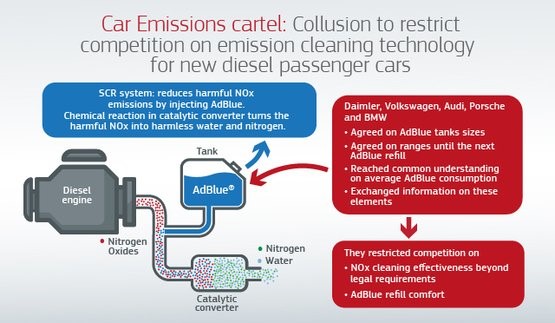
The European Commission has fined BMW and Volkswagen Group €875,189,000 (£751m) for colluding with Daimler on the development of NoX treatment technology.

Daimler was not fined, as it revealed the existence of the cartel to the Commission.

According to the European Commission’s report, Audi, BMW, Daimler, Porsche and VW held regular technical meetings to discuss the development of AdBlue systems, also known as selective catalytic reduction (SCR)-technology.

During these meetings, and for more than five years, the car manufacturers colluded to avoid competition on cleaning better than what is required by law despite the relevant technology being available.

Daimler, BMW and Volkswagen group reached an agreement on AdBlue tank sizes and ranges and a common understanding on the average estimated AdBlue-consumption. They also exchanged commercially sensitive information on these elements.

Executive vice-president of the Commission, Margrethe Vestager, said: “The five car manufacturers possessed the technology to reduce harmful emissions beyond what was legally required under EU emission standards. But they avoided to compete on using this technology’s full potential to clean better than what is required by law.

“So today’s decision is about how legitimate technical cooperation went wrong. And we do not tolerate it when companies collude. It is illegal under EU Antitrust rules. Competition and innovation on managing car pollution are essential for Europe to meet our ambitious Green Deal objectives. And this decision shows that we will not hesitate to take action against all forms of cartel conduct putting in jeopardy this goal.”

Green group Transport & Environment (T&E) believes that in the wake of Dieselgate, this latest scandal shows car manufacturers “cannot be trusted” to put people’s health and the climate before profit.

Julia Poliscanova, senior director for vehicles and emobility at the organisation, said: “Carmakers cannot be trusted to clean up cars. First they cheated on emissions tests, then they colluded to delay cleaner vehicles even though they had the technology. Only an EU target to switch to 100% emissions-free cars by 2035 will be enough to decarbonise by mid-century and avoid climate catastrophe.” By Graham Hill thanks to Fleet News

Coventry To Pilot Wireless Under-Road Electric Vehicle Charging

Friday, 9. July 2021

Coventry City Council is leading a new project to investigate the implementation of dynamic wireless charging solutions for electric vehicles, including HGVs.

The system would allow compatible vehicles to charge up as they drive along a specific section of road.

The study, which is funded through the Ofgem Network Innovation Allowance (NIA) mechanism, will consist of research and data modelling to assess feasibility for implementing the system in the UK and the potential for the first real-world demonstrator.

Environmental consultancy Ricardo will be supporting the project, working alongside electricity distribution network operator, Western Power Distribution (WPD).

Denis Naberezhnykh, technical director at Ricardo, said: “This technology allows electric vehicles to charge their batteries or be powered directly, while being driven, and would allow vehicles with demanding duty cycles to switch from petrol or diesel to being electric.

This could be a game-changer as the automotive industry looks for ways to reduce its dependency on fossil fuels and indicates just how important this project is.”

Ricardo will undertake the project management and technical review of the project activities and outputs on behalf of WPD, utilising its experience in the field and providing an additional level of technical expertise and quality assurance.

Other partners involved in the 11-month study includine: Cenex; Coventry University; Hubject; Midlands Connect; National Express; Transport for West Midlands; and Electreon.

Steven Pinkerton-Clark, WPD’s innovation & low carbon network engineer, added: “This project will assess the technology’s potential to support decarbonisation of transport and meeting UK Net Zero targets.

“The study will look at developing an understanding of how this technology can be connected to the electricity network and aims to minimise network reinforcement costs, while enabling the connection of low carbon technologies to benefit our customers.”

The results will assess the electrical impact and requirements of the technology on the distribution network, look at the feasibility of dynamic wireless charging and help forecast the uptake in Coventry and throughout the UK.

The study will also look at specific opportunities for a future demonstrator to be implemented in Coventry to demonstrate the real-world operation of the technology and how to address potential challenges.  By Graham Hill thanks to Fleet News

How To Reduce Electric Vehicle Battery Wear

Friday, 9. July 2021

New research has highlighted how temperature and state of charge (SoC) impacts the degradation of lithium-ion (li-ion) batteries used in electric vehicles (EVs).

The research by Altelium, an EV battery warranty provider, investigated calendar degradation of li-ion batteries – which is caused by chemical deterioration of batteries when they are not in use, especially when parked.

The data found the ideal conditions for improving overall battery life is charging the battery once it hits the 10% level and recharge to 80%, instead of allowing the battery to drain to empty or zero and recharging to 100%.

The research also highlighted that high-level SoC between 70-80% as the ‘worst’ position in which a car should be left parked at, as it could cause greater calendar ageing.

EV batteries stored at 70-80% could lose up to four to eight per cent of capacity to hold charge at the end of one year, when compared to the ‘best condition’ observed – when the battery is completely discharged, the research found.

Dr. Alana Zülke, lead research author and member of the battery research team at Altelium, said: “What happens if you are a very conservative driver, who prefers to daily top up your car battery, so it stands at an 80% overnight, always ensuring that you always have maximum energy reserve ready to use?

“Although four to eight per cent may not sound that much, you have to remember that current li-ion batteries on the market used in EVs are deemed to need replacing when their ability to hold charge drops by as little as twenty or thirty per cent. In this scenario, 8% becomes a pivotal margin.

“When batteries reduce their capacity by 20 or 30%, they can be repurposed to second-life applications such as battery energy storage system (BESS).

“The previous history of these batteries, including calendar ageing, will impact their second-life performance.”

The research also found that reducing the temperature experienced by the battery from 40 to 25 degrees celsius can almost double the overall lifetime of the battery.

Alteium said the research provides EV drivers the information to help them make ‘more informed’ choices on what vehicle add-ons to opt for, such as ensuring the use of a thermal management system, and which strategies could impact the value of their car battery.

Zülke said: “Calendar ageing dominates electric vehicle battery degradation when parked– in the UK, a car will spend on average more than 95% of its time parked. To improve the lifecycle of batteries, it is vital to define the optimal conditions to reduce such degradation.

“Our research is another important step in quantifying the impact of working and environmental conditions on battery state-of-health. By doing so, we can predict battery life cycles and develop strategies to prolong their usefulness more accurately.

“Ultimately this data will not only inform EV battery and Battery Management Systems (BMS) design, but also has further applications for the industry.

“Information about battery degradation will inform risk calculations for EV battery-related insurance and warranty products and further still, help to consider the value of second-hand cars and second-life batteries.”

Alteium said the team conducted a series of experiments using commercial high-energy 21700 lithium-ion battery cells (NCA|Gr-Si) under eight state of charge levels (0%, 20%, 40%,60%, 70%, 80%, 90% and 100% state of charge) and three temperature values (25°C, 40°C and 50°C) to measure the effects of degradation. By Graham Hill thanks to Fleet News

What You Need To Know About The New E10 Grade Petrol – MUST READ

Friday, 9. July 2021

The Government is launching a national advertising campaign this month ahead of the rollout of E10 petrol.

Aimed at raising awareness of the greener fuel, the campaign will be seen on fuel pump labels and in targeted digital, radio and social media advertising.

As well as promoting the benefits of E10 – which is petrol blended with up to 10% renewable ethanol – the campaign will encourage motorists to check their vehicle is compatible with the fuel.

E10 petrol will be available in UK petrol stations in Great Britain from September. Transport minister, Rachel Maclean, said the rollout of E10 is the latest in a “string of measures” the Government is taking to cut road emissions.

“This campaign will not only make drivers aware of the changes we’re making, but will also show millions of motorists how E10 introduction plays a part in helping reduce carbon emissions and build back greener with every tank of petrol,” she added.

The introduction of E10 will see renewable ethanol in petrol double from the current petrol blend E5, which contains no more than 5% ethanol.

A small number of older vehicles, including classic cars and some from the early 2000s, will continue to need E5 fuel, which is why supplies of E5 petrol will be maintained in the super petrol grade.

The Government is advising motorists to use the new E10 compatibility checker to see if their vehicle is compatible.  By Graham Hill thanks to Fleet News

Motorway Cameras Used To Identify Those Spreading Litter

Friday, 9. July 2021

Highways England has released video footage of the moment it caught vehicle occupants dumping rubbish at the side of the M6.

The ‘litter louts’ were spotted on CCTV by a keen-eyed control room operator.

Police were dispatched to the Staffordshire location and the offenders were intercepted further along the motorway. They were escorted back to the emergency area where they’d dumped the rubbish and forced to clean it up.

Highways England’s senior network planner, Frank Bird, said: “This was a blatant and reckless abuse of one of our designated emergency areas which are there to help people in the event of just that, an emergency. 

“We watched the whole incident unfold on our CCTV system in our control room and then quickly passed it to the police who were able to stop the vehicle and escort them safely back to the emergency area to tidy up their mess. 

“We continue to work closely with our police colleagues who enforce issues like this and we’d remind people to take their litter home and dispose of it safely.”

Along with a stern word in the ear of the culprits, their details will also be forwarded to Environmental Health officers for their information so should any future incidents occur there will be a recorded history. 

The incident – which took place on March 28 – is being used as a timely reminder about the dangers of littering which puts Highways England’s workforce at risk when they have to go out and collect it.

Highways England is calling on drivers to ‘be part of the pick’ and join them in doing their bit to reduce litter levels on the nation’s motorways as part of the Great British Spring Clean (May 28-June 13).

During last year’s campaign, Highways England collected 12,000 bags of litter from the network. By Graham Hill thanks to Fleet News

Are Fleet Drivers Sufficiently Trained To Protect Other Drivers?

Friday, 9. July 2021

Fleet operators are most worried about the use of mobile phones, speeding, eating or drinking behind the wheel and tired driving, according to a Webfleet Solutions survey.

Almost three-quarters (73%) of UK fleet decision-makers say poor driving behaviour is negatively impacting their business.

The findings, from a survey of 1,050 European fleet decision makers and published in the European Road Safety Report 2021, suggest that the use of mobile phones and other devices (71%), followed by speeding (69%), eating or drinking behind the wheel (68%), and driving while fatigued (67%) are their biggest areas of concern.

More than two-thirds (68%) of UK commercial fleets have vehicles involved in road collisions every year, and 61% say that, on average, they have at least one insurance claim a month made against their company by other road users.

“Significant investment is being made in developing more powerful hardware and software to make vehicles safer,” said Beverley Wise, sales director UK and Ireland for Webfleet Solutions.

“Telematics, for example, can improve the safety of commercial fleets by offering powerful insights into driver behaviour. Fleet managers and decision makers can access a range of valuable data points from each driver trip, with an overview of incidents like speeding, harsh steering, or sudden braking.

“This data can be paired with vehicle camera footage, offering fleet managers context of why these events occur. 

“Driver-facing cameras, using Artificial Intelligence (AI), also assist in better driving by detecting various types of unsafe behaviours and alerting the driver to correct their course before an accident occurs.”

Wise says that the integrated solution gives fleet managers “full transparency and clarity”, allowing them to protect their drivers from non-fault claims and coach them to drive more safely.

According to the European Road Safety Report survey, UK fleet decision makers were most likely to have adopted reversing and side camera technology to help improve road safety (40%) and half (51%) of businesses said they were offered a lower premium if they adopted a telematics system.

Driven largely by the positive impact connected cameras can have on insurance claims, the stringent new vision regulations coming into force in parts of the UK will also play a role in connected camera uptake.


“This latest research underlines the need to improve road safety of UK fleets, and the best way to achieve that is through better driving habits and improved visibility,” added Wise.

“Legislative change will certainly encourage uptake of technology in the coming years but fleet decision makers should aim to be one step ahead and use technology and telematics to their competitive advantage.”  By Graham Hill thanks to Fleet News