Massive Used Car Price Hike In 3 Months

Wednesday, 4. August 2021

Used car trade values are continuing an “unparalleled shift upwards”, according to Cap HPI.

The data provider’s daily Live trade values show that, on average, trade prices for used cars have increased by £1,700 or 13.5% in the last three months.

Younger cars, up to one-year old, have seen rises of £2,500 in the same period.

In June alone, the average used car price was up 4.8%.

“Consumer demand has remained very strong in June, despite half-term, great weather, and Euro 2020 to distract people.

“With stock-turn high, this has led to retailers requiring a constant supply of cars to replenish their forecourts,” said Derren Martin, head of valuations at Cap HPI.

“Well-documented new car supply issues resulting from several component shortages, have led to fewer fleet returns and part exchanges. This has caused demand to outweigh supply for the third month running,” he added.

Every sector and fuel-type has seen values increase in May. Examples of some volume models from across various sectors that have increased in value at the 3-year, 60,000-mile point are Ford Fiesta (+6% or £500), BMW 1-Series Diesel (+7% or £850), Hyundai Tucson (+10% or £1,150) and Vauxhall Zafira (+9% or £750).

Martin concluded that even if demand dips from its current levels, supply is still going to be lower than normal for some time yet.

He said: “With new cars being in such short supply and likely to continue to be so for at least the next quarter, there is no bow wave of fleet returns coming through. One million less cars have been registered than would reasonably have been forecast over the last 18 months. These cars are lost to the used car market. It will be a while before supply outweighs demand again.” By Graham Hill thanks to Fleet News

New EU Tyre Labelling To Be Introduced Into The UK By The End Of 2021

Wednesday, 4. August 2021

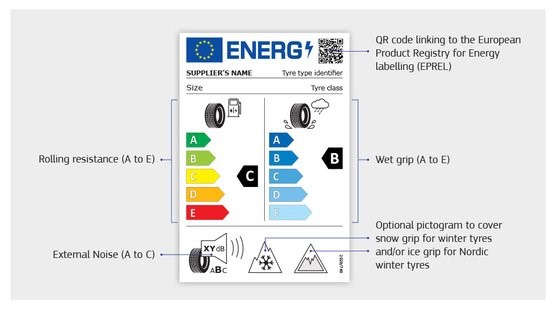
New tyre label regulations from the EU are expected to be introduced in the UK before the end of the year.

The new rules, which are designed to improve awareness of tyre characteristics, were introduced in Ireland and Northern Ireland on May 1.

The new EU tyre label must be applied to heavy-duty commercial vehicle tyres including trucks and buses (Class C3) with all tyre suppliers – including commercial vehicle suppliers – now required to inform buyers of the label values during the sales process.

It now rates wet braking distances and fuel efficiency from A to E, with A being the best performing, and ranks external noise of the tyre from A to C, with A the quietest.

It also includes winter performance data, via the Three Peak Mountain Snowflake (3PMS) symbol, which determines whether a tyre meets tough snow performance requirements, as stipulated when driving across many European countries during colder seasons.

For C1 and C2 tyres, for cars and vans respectively, those previously in class E for fuel efficiency and wet grip will now be assigned to Class D which was previously empty, while those formerly in classes F and G will be assigned to class E. This makes the label clearer and easier to interpret.

Another addition to the EU tyre label is the stipulation that it must include a unique QR code, both on the on actual label and in the tyre manufacturers’ information that links the tyre to the European Product Database for Energy Labelling (EPREL) database, where additional tyre label information can be obtained.

As it stands, the regulation underpinning the new EU tyre labels only applies to new tyres, with revised legislation relating to retread tyres expected in 2023.

Importantly for commercial vehicle operators, mileage performance is not yet incorporated into the label, on the basis that suitable test methods are not currently available.

The label values are also based on the tyre’s performance when new and do not take into account the performance characteristics of the tyre across its lifetime.

Tony Stapleton, head of group fleet sales at Continental Tyres, said: “The new EU tyre label is designed to help people choose safer, more fuel-efficient tyres, factors which are vitally important whether you drive a car, a van or are responsible for choosing tyres for a commercial vehicle fleet.

 “However commercial vehicle customers should view the labelling as just one part of their discussions with tyre suppliers, to ensure performance factors not included in the labelling, such as the opposing requirements of mileage and durability, are factored into their choice.

Most fleets need to make sure their tyres offer a balance between these contrasting drivers, and this will greatly differ fleet to fleet depending on the type of operation and vehicles.

“For example, for construction and waste disposal fleets, tyre durability is critical, with fuel efficiency taking a secondary role, whereas in general haulage such as retail distribution, the fuel efficiency capabilities of a tyre will likely play a far greater role.”  By Graham Hill thanks to Fleet News

Drivers Confused Over Clean Air Zone Charge And Congestion Zone Charge In London

Thursday, 29. July 2021

I’ve included this piece aimed at companies but it also includes some useful information regarding the fact that an electric or low-emission vehicle may avoid charges in Clean Air Zones but still be charged for entering a Congestion Zone.

To understand why we need congestion charges and clean air zones, we have to consider the following statistics. There are currently around 37.5 million vehicles registered for use on the roads in the UK. Of these, only 0.5% are classified as ultra-low emissions. This is contributing to a crisis in our air pollution levels.

In 2019, the average CO2 emissions of cars sold in the UK increased for the third year in a row. And to understand why this is important, consider that around 28,000 and 36,000 deaths a year are the result of prolonged exposure to air pollution.

Congestion charges and Clean Air Zones are two initiatives which aim to reduce air pollution and car use in the most built-up areas. But despite having similar aims, these are not the same thing. Both are additional charges for using a vehicle, but they have quite different end goals.

Congestion charging aims to help reduce the number of cars that enter an area, while Clean Air Zones aim to improve air quality by discouraging high emission vehicles from entering the zone.

While a clean air zone might have an impact on congestion, this will only be a short-term impact as more vehicles are upgraded or retrofitted with emissions control technology.

Where are the Congestion Charges used?

Congestion Zones are found across London. They are marked with a white ‘c’ in a red circle on the roads and with road signs. To check if an area is in a congestion zone, you can use this postcode checker. Vehicles entering a congestion zone between 07:00-18:00, Monday to Friday will be charged £11.50.

To further deter drivers, the London congestion zone is also an Ultra-Low Emissions Zone. This means that if your vehicle does not meet the required emissions guidelines, you will also have to pay the ULEZ charge of £12.50 for vehicles up to 3.5t.

While the Congestion zone only covers peak travel times, the ULEZ charge is applicable 24 hours a day, 7 days a week. So a drive to the centre of London at peak times on a Wednesday could set you back £14.

Where are the Clean Air Zones?

The Clean Air Zones scheme is set to roll out in early 2021. The first cities to trial the zoning will be Birmingham, Leeds and Bath. Vehicles which enter this zone will be picked up by automatic number plate recognition cameras and charged a flat fee which will be set by the local council. In Birmingham, this will be £8 per day, and in Leeds, non-compliant vehicles will pay £12.50 per day.

How can I future proof my business against these charges?

Even if you don’t currently operate in an area which uses congestion charging or Clean Air Zoning, these schemes are rapidly gaining momentum. This map shows where schemes are expected to roll out in the future.

To truly future-proof your business, making the switch to low emission electric vehicles is essential. This will not only cut your operating costs if you work in an area where a low emissions scheme is planned, but you will also experience long term savings in reduced running costs. Electric vehicles are reliable, cost-effective and great for the environment.

In addition to the above What Car/ have also advised the following update.

In December 2018 Transport for London advised that Alternatively Fuelled Vehicles (Hybrid, Plug-In Hybrid and EV’s) that were currently exempt from congestion charges would eventually be phased out.

From April 2019 hybrids and PHEV with higher emissions were no longer exempt and had to pay the congestion charge.

At the moment PHEV’s with an electric range of 20 miles or more on electric power and emissions of less than 75g/km of CO2 are still exempt but will lose the exemption from the 25th October 2021.

EV’s will have to start paying the Congestion Charge from 2025. If you are driving into London and you are currently exempt you must first register your car with TfL via their website or you may receive a fine even though your car is exempt. This costs £10 per vehicle to register and can take up to 10 days to get registered.

Also please not that due to the pandemic the charge increased from 22nd June 2020, from £11.50 to £15 per day from 7.00am to 10.00pm.

Hope that helps. By Graham Hill thanks to What Car? and Compact Electric Vehicles

FCA Steps In To Stop Insurers From Penalising Loyalty.

Thursday, 29. July 2021

Is this the end of insurance rip-off? £1billion saving predicted as firms are stopped from charging existing loyal customers more than new ones.

The Financial Conduct Authority announced that insurers would not be allowed to charge loyal clients more than new ones.

The FCA found insurers were making it harder for customers to stop automatic renewals by keeping them on hold on the telephone for a long time.

These practices were costing around six million households an average of £200 each a year.

INSURANCE customers will no longer be punished for their loyalty under plans that could save households £1billion a year.

In a victory for Money Mail, the Financial Conduct Authority yesterday announced that insurers would not be allowed to charge existing clients more than new ones.

The regulator said its reforms would ‘put an end to the very high prices paid by some long-standing customers’.

Under ‘price walking’, a new car insurance customer typically pays £285 a year, while one who is loyal for five years pays £370. The equivalent figures for home cover are £130 and £238.

One Money Mail reader saw their household premium rise from £313 in 2019 to £1,119 in 2020, despite not having made a claim since 2012.

Ten million policies across home and motor insurance are held by customers who have been with their provider for five years or more. A third of those overpaying for cover are vulnerable, elderly or low paid, the FCA found.

It said insurers were making it harder for customers to stop automatic renewals by keeping them on hold on the telephone for a long time.

Those switching regularly will be flagged by insurers and potentially denied the best deals.

The watchdog said these ‘complex and opaque pricing practices’ were costing around six million households an average of £200 each a year.

Under its proposals, firms will be free to set prices for new customers, but they would be prevented from raising premiums over time, other than in line with changes in a customer’s risk. The FCA said it could save customers between £3.7billion and £11billion over ten years.

Sarah Coles, personal finance analyst at Hargreaves Lansdown, warned that some customers would lose out.

She added: ‘Insurers offer far better deals for new customers. Some will actually make a loss on the first year, and aim to claw it back with price rises on renewal. Switchers can take advantage of these introductory deals, and then move before the price hikes. The new rules would put a stop to this overnight.’

Gareth Shaw of consumer champions Which? said the FCA should ‘closely monitor insurance firms to ensure they do right by their loyal customers’.

Huw Evans of the Association of British Insurers, an industry body, said: ‘We will consider carefully this package of proposals, so that we can engage with the FCA on the most effective measures possible. There are winners and losers in the way the market works currently with those who switch provider every year often ending up with lower prices.’

 WHEN John Finlay saw his car premium rise by 85 per cent in four years, he decided enough was enough.

Instead of coughing up for a £626 policy with existing provider AA, he bought one for £437 with AXA. But he is now back with the AA after AXA hiked his premium – and the AA offered him a quote for £384.

Mr Finlay, a 79-year-old from Mayfield in East Sussex, also saw his AA home cover rise from £155 to £201. It was cut to £156 when he objected.

He said: ‘It’s disrespectful to existing customers. They get loyalty from us but there is no reciprocation.’

AXA said its rise reflected ‘claims cost inflation’. The AA said its quotes were competitive and reflected the new business discounts typically available.  By Graham Hill thanks to What Car?

MP’s Challenge The Government Over 2030 Petrol/Diesel Ban

Thursday, 29. July 2021

Public Accounts Committee accuses Government of having no “clear, published plan” on how the UK will switch to an electric car future…

The viability of the Government’s plan to ban the sale of new petrol and diesel cars by 2030 has been called into question by a group of MPs, who say the transition represents a “huge challenge” for the country, and that the departments responsible for it have “lacked a clear, published plan” to set out how it will happen.

The criticism comes from the Public Accounts Committee (PAC), which evaluates the effectiveness and value of Government proposals and services. The PAC is made up of 15 MPs, eight of whom are Conservatives, although the chair is Labour’s Meg Hillier.

The PAC report says that although the Government has set “ambitious targets” for the transition, there are still big hurdles to overcome, including increasing the uptake of electric cars among buyers, lowering their cost, and upgrading the UK’s charging network.

Under current plans, the sale of new petrol and diesel cars will be banned from 2030, albeit with some hybrid cars given a stay of execution until 2035. So far in 2021, electric cars have accounted for 7.2% of sales – up from 4% across the same period in 2020.

Below, we look at each of the issues raised in the report, and what’s being done to address them.

Lowering the cost of electric cars

The cost of buying an electric car is one of the biggest issues, with the committee saying it is “not persuaded that the upfront costs are low enough for many”, and pointing out that there are currently only 13 electric car models costing less than £30,000. Any fully electric car which costs less than £35,000 qualifies for the Government’s plug-in car grant, currently worth £2500.

The plug-in car grant is expected to last until at least 2023, when funding allocated for the scheme in 2020 is due to run out. To date, the grant scheme has provided more than £1 billion to electric vehicle drivers.

The cheapest electric car you can buy currently is the Seat Mii, which costs from £22,800 before the grant is factored in.

A recent What Car? survey of more than 10,000 in-market buyers showed that one-in-five were considering an electric car as their next purchase – a significant rise compared with the 8% who answered the same way in 2019.

In our survey, 31% of respondents said the biggest concern they had over going electric was range, followed by charging (18%).

Lowering the cost of charging

The PAC report says that price differences between charging using a public charging network and charging at home “need to be addressed”, as well as the cost of replacing electric car batteries. Indeed, a National Audit Office report suggests that charging at home can cost up to 78% less than relying on the public charging network.

A recent What Car? investigation found that public charging prices vary wildly, with it costing as little as £7.49 and as much as £17.46 to charge a Renault Zoe electric hatchback to 80% of capacity, depending on location, associated fees and the type of charger used.

Similarly, while the Department for Transport estimates that, on average, it costs around 1p per mile to run an electric car (compared with around 10p per mile to run a petrol or diesel) our real-world tests show that this is only the case when you’re charging at home.

In reality, we found that an electric car can cost up to 9p per mile when all of the fees associated with public charging are taken into account, while 13p per mile is realistic for a petrol car, and 11p per mile for a diesel car.

In its evidence to the PAC, the Department for Transport said that it expects “more competition in the market and innovation which may benefit customers in terms of the price paid for electricity”.

The department also suggested that some electric cars might act as energy storage devices for smart homes, and feed energy back into the grid at peak times, thus reducing energy costs.

Increasing the availability of charging points

The PAC report says that although there has been progress made to increase the number of charging points available in the UK, “take-up has been greatest where there are high levels of traffic, charge-points and affluence.”

The report notes that rural areas are in danger of getting “left behind during this transition” if they too don’t see an expansion of their local charging networks. It should also be noted that the take-up among local authorities to support the growth of on-street residential charge points has been poor, with the National Audit Office estimating that almost a third of the £8.5 million set aside has not been used.

The report says: “We are not convinced that Government has sufficiently thought through how the charging infrastructure will expand at the pace required to meet the ambitious timetable to phase out petrol and diesel vehicles.”

It says that the Department for Transport has made a number of assumptions around the type of journeys most drivers are making, noting that, according to those assumptions, 99% of journeys are less than 100 miles, the vast majority of electric car charging is done at home and overnight, and that people will use public charging stations to top up during longer trips.

Despite those assumptions, the report says there is no estimate for how many charging points the country will need to keep up with the increase in electric cars. Data from the English Housing Survey also notes that 33% of households in England do not have access to off-street parking, so could not charge at home easily.

The PAC report notes that, while the Government has pledged to offer six rapid charging points at every UK motorway service station by 2023, it has “not focused much attention on charging for people that do not have off-street parking”.

According to Zapmap, which lists every public charging station in the country, there are currently 23,873 charging points at 15,254 locations across the UK. The biggest provider of publicly available charging points is Source London, which has a market share of 25.8%, followed by Ubitricity and Pod Point, with shares of 14.7% and 12.1% respectively.

Maintenance and energy costs

Other issues raised in the PAC report include the need to re-train dealership and independent garage technicians to work on and repair electric cars, especially as these vehicles age, and a safeguarding of the National Grid to cope with an increased demand for energy.

The Department for Business, Energy and Industrial Strategy estimates that the increased demand for electric cars will equate to a 2% increase in energy bills for households by 2030, although this is money that you would otherwise spend on filling up with petrol or diesel.

What has the reaction been?

The Society of Motor Manufacturers and Traders, which represents the views of the motor industry to Government, said: “The automotive industry shares the Government’s ambition for an electric revolution, a transformation that has already begun.

However, as the Public Accounts Committee has made clear, we need a comprehensive and holistic plan to get us there in time.

“That plan must convince consumers to make the switch, it must provide the incentives that make electric cars affordable for all, and it must ensure recharging is as easy as refuelling – which means a massive and rapid rollout of infrastructure nationwide.”

When asked for comment, a Department for Transport spokesperson told What Car?: “We’ve got a highly ambitious and world-leading approach to increasing the uptake of zero emission cars, and the progress we’re making in this area will help us to meet our targets.

“Already, we’re investing £2.8 billion in helping industry and drivers make the switch – and will continue our work to install thousands of charge points and boost the development of new technologies to meet our goals.”

The reaction to the ban from buyers has been negative, with a What Car? survey conducted in November of last year – soon after the proposal was announced – revealing that 59% of buyers disagreed with the principle behind the ban, while 29% said they did not understand which cars would still be allowed to be on sale after 2030.  By Graham Hill thanks to What Car?
Hyundai Ioniq 5 Electric Vehicle Gets A Rare 5 Star Rating By Auto Express

Thursday, 29. July 2021

The Ioniq 5 family hatchback represents a real shift forward in Hyundai’s ability to chase down premium electric rivals, helping to persuade EV buyers who are motivated by stylish design, great on-board tech and practical range and charging speeds, to invest in the Korean brand.

With stunning looks and a sense of cool that sets it apart from the pack, the manufacturer has added to the Ioniq 5’s strong kerb appeal with competitive pricing, generous standard kit and advanced active safety systems. We named it our Car of the Year for 2021, so if you’re thinking of a new purchase and you have the means, then the Hyundai Ioniq 5 is one of the best cars you can buy.

We have the car on special offer this week.

About the Hyundai Ioniq 5

Over recent years, Hyundai, along with its subsidiary brand Kia, has been at the forefront of producing well-built, practical electrified family cars. Mild- or plug-in hybrid tech is offered on models such as the Ioniq and Kona, as well as the bigger Santa Fe SUV, while the former two cars are also available with the benefits of zero-emission, all-electric drive.

But, pioneering and innovative auto makers must continue to push things forward, or risk falling into EV obscurity, and that is exactly what Hyundai has done with its latest Ioniq 5 hatchback/crossover. In a move away from the architecture used so far across its electric, hybrid and combustion-engined models, the Ioniq 5 is Hyundai’s first car to use its new Electric Global Modular Platform (E-GMP) and, as a foundation for the company’s next-level EV tech, it’s mightily impressive.

Two battery choices are available across the range, along with three individual power outputs: a 58kWh battery and a single 168bhp motor driving the rear wheels provides the entry point to Ioniq 5 ownership, while the next step up includes a 73kWh version paired with a 214bhp rear-mounted motor.

The top-spec option comprises the same 73kWh battery, but uses a second motor at the front giving a total of 301bhp and a meaty 605Nm of torque.

Buyers thinking of investing in a capable family EV now have top quality options to consider. The Volkswagen ID.3 hatchback might suit smaller households, although the ID.4 is a more direct rival to the 4.6-metre long Ioniq 5 and offers more space and day-to-day practicality than its compact sibling. Meanwhile, Ford has come up with its own brilliant all-electric model, the Mustang Mach-e, which provides the typical blue oval USP of a great driving experience, as well as being easy to live with.

Hyundai provides three trim levels for the Ioniq 5: SE Connect, Premium and Ultimate. Entry-level kit is good with 19-inch alloy wheels, LED headlights, rear parking sensors, climate control and smart cruise control all included, while inside the cabin there’s a wireless smartphone charging pad and two 12.3-inch displays – one covering the infotainment and the other a digital instrument cluster providing key info for the driver.

The Ioniq 5 range starts from just under £37,000 and rises to around £48,000. An Ultimate-spec car, particularly when paired with the most powerful 301bhp dual-motor setup, brings the Ioniq 5 firmly into Tesla territory, and will also provide food for thought for those considering an Audi Q4 e-tron in a top Edition 1 or more expensive Vorsprung trim. See our special offer above. By Graham Hill thanks to Auto Express.

GB Stickers Are No Longer Valid In The EU

Thursday, 29. July 2021

From September, drivers travelling abroad will have to display UK stickers instead of GB ones.

Anyone taking their car abroad from 28 September will have to display a UK sticker rather than a GB one. The change is rumoured to be a sign of solidarity with Northern Ireland from Westminster in the face of post-Brexit trade tensions.

The GB sticker has been in use for 111 years, but while it is technically valid for Northern Irish cars taken abroad, that country is not part of the geographical island of Great Britain, a detail that has irked some Northern Irish residents over the years.

But in the face of issues such as the ‘sausage wars’, the UK Government has written to the United Nations to effect the change, stating: “The United Kingdom is changing the distinguishing sign that it had previously selected for display in international traffic on vehicles registered in the United Kingdom, from “GB” to “UK”…this change will take effect on 28 September 2021.”

The switch from GB to UK stickers comes just months after ministers unveiled a new GB number plate with a Union Flag. This replaced the previous ‘Euro’ plate, which showed the stars of the European Union with the letters GB.

But the switch to UK signifiers, while being inclusive of Northern Ireland, means drivers with the new GB plates will have to either change their plates, or affix an additional UK sticker to their cars from September.

Unlike the soon-to-be-invalid GB plates, which were heralded by Transport Secretary Grant Shapps in January, the switch to UK signifiers was not formally announced by the Government.

Instead it was spotted as a footnote in UN regulations by the AA, which says it has 50,000 items of stock it will now need to change.  By Graham Hill thanks to Auto Express

Volvo Working On Next Generation Electric Cars with 600+ Mile Range

Thursday, 29. July 2021

Volvo is developing new battery technology that will enable it to offer cars with a real-world range of 621 miles and cut re-charge times in half.

The car maker is working with Swedish battery company Northvolt to  produce the units, which are expected to be ready by 2025.

“We want to constantly increase the customer benefits of driving a pure electric Volvo car,” said Henrik Green, chief technology officer at Volvo Cars. “By simplifying the design and integration of our battery cells, we can reduce weight and maximise space, allowing for considerable improvements in battery capacity, range and charging times.”

The next-generation Volvo XC90 will be the first car to feature the new battery technology, it is expected to be revealed next year.

As Volvo introduces its third generation of electric cars, it plans to integrate the battery pack into the floor of the car, using the cell structure for overall vehicle stiffness and improving efficiency.

Battery cells from Volvo Cars’ planned collaboration with Northvolt aim to be produced using 100 per cent renewable energy, while it is working with other battery suppliers to do the same by 2025.

Customer data to lead safety improvements

Volvo is looking towards processing data from customer cars in real time, if customers choose to share data, to help it make its cars safer.

By allowing customers to choose and be a part of improving safety levels and traffic safety in this way, Volvo says it can make “continuous and much faster” improvements to its cars.

Customer data would enable Volvo engineers to validate and verify autonomous driving features more quickly and then roll out updates over-the-air.  By Graham Hill thanks to Fleet News

Manufacturers Start To Reveal Plans For All Electric Cars At Reduced List Prices Starting With Renault

Thursday, 29. July 2021

Renault Group will launch 10 new battery electric vehicles (BEVs) by 2025, seven of them for the Renault brand, with a new platform promising cheaper plug-in cars.

It recently announced it was reviving the iconic Renault 5 in electric guise and says it will do the same for the Renault 4, currently named ‘4ever’.

It says it will also strengthen its presence in the all-electric C-segment, firstly with the All-New MéganE in 2022, while the Alpine ‘dream garage’ unveiled in January will become a reality, starting in 2024.

The Group aims at providing the greenest mix in the European market in 2025, with more than 65% of vehicles in the sales mix electric and electrified, and up to 90% BEVs in the Renault brand mix by 2030.

Luca de Meo, CEO of Renault Group, said: “Ten new electric models will be conceived and up to one million electric vehicles will be manufactured by 2030, from cost-efficient urban vehicles to sportier, higher-end ones.

“As well as efficiency, we bet on iconic designs such as the beloved R5 to bring the Renault touch to electrification, making electric cars popular.”

With CMF-EV and CMF-BEV platforms, the Group says it can capitalise on its 10 years’ of EV experience making dedicated EV platforms along with its highly efficient CMF-B platform.

For the C- and D-segment, the CMF-EV platform will represent 700,000 units at Alliance level by 2025. CMF-EV offers a range up to 360 miles (580km, WLTP).

This performance, it says, comes from the Group and Nissan’s engineers working on reduced friction, weight reduction and a state-of-the-art thermal management system.

In addition to performance, CMF-EV, which the All-New MéganE will be based on, offers greater driving pleasure thanks to its low centre of gravity and optimal weight distribution, a very low steering ratio allowing quick vehicle responses and a multi-link rear suspension setup, says Renault.

CHEAPER ELECTRIC VEHICLES

For the B-segment, CMF-BEV will allow the Renault Group to make more affordable BEVs. At vehicle scale, this brand-new platform will reduce the cost by 33% compared to the current generation Zoe.

This has been achieved with the interchangeability of the battery module, a right-sized powertrain of 100kW at lower cost, and all non-EV components caried-over from the CMF-B platform, it says.

CMF-BEV will offer up to 249 miles (400km, WLTP) and the platform will also feature the Group’s ‘plug and charge’ system that automatically identifies the car, driver and payment based on the NF-C 15118 regulation and secure communication protocol.

The Group has also signed a partnership with the French start-up Whylot for an automotive axial flux e-motor. This technology will first be applied on hybrid powertrains aiming to reduce costs by five per cent while saving up to 2.5g of CO2 (WLTP) for B- and C-segment passenger cars. Renault Group claims it will be the first OEM to produce axial flux e-motors on a large scale from 2025.

On top of these new technologies, the Group is also working on a more compact, all-in-one e-powertrain.

This e-powertrain integrates the e-motor, the reducer and the power electronics (One Box Project) in a single package: enabling 45% less volume in total (equivalent to the volume of the current-generation Clio fuel tank), 30% reduction in cost of the overall powertrain (this value saving being the equivalent of the e-motor cost), and 45% reduction of wasted energy on WLTP allowing an extra EV range of up to 12 miles (20km).  By Graham Hill thanks to Fleet News

Streets Are Clogged With Cars That Can’t Park In Garages Because They Are Too Small

Friday, 23. July 2021

Modern cars are too BIG to fit in garages… causing parking chaos as more motorists leave their vehicle on the street, new report shows. Residential streets are becoming clogged with parked cars because larger modern vehicles no longer fit in garages, a report says

Top five selling cars in the UK in the 1960s were 4ft 11in wide and 12ft 9in long

But last year the five most popular cars were 5ft 11in wide and 14ft 1 in long.

Residential streets are becoming clogged with parked cars because larger modern vehicles no longer fit in garages, a report says.

The top five selling cars in the UK in the 1960s – including models such as the slimline Ford Anglia – were 4ft 11in wide and 12ft 9in long on average, it found. But last year the five most popular cars were 5ft 11in wide and 14ft 1in long on average.

Meanwhile, private garages have largely remained the same width – 6ft 11in on average. This gives only 6in of clearance on each side when modern cars are driven in.

As a result, many more motorists are instead parking on the street, according to the RAC Foundation study.

Around two-thirds of homeowners with a garage do not use it for the purpose it was intended.

It means the amount of space occupied by modern cars on residential roads is now a third more than in the 1960s, the report found.

This is leading to increasingly clogged roads as drivers have less space to pass each other alongside parked cars, while pedestrians such as mothers with pushchairs often find footpaths are blocked.

Steve Gooding, director of the RAC Foundation, said the problem is exacerbated by the fact that there are now around 31.7million cars on Britain’s streets, compared with 7.7million in 1965.

The foundation wants the planning system to catch up with the growth in car size by allowing bigger garages to be built, which would help cut on-street parking.

Mr Gooding said: ‘Not only are cars getting bigger – there are more of them. This is putting huge pressure on roadside space. Crucially, domestic garages are also often unfit for their intended purpose.’

The five best-selling cars in 1965 were the Austin Morris 1100/1300, Ford Cortina, Mini, Ford Anglia and Vauxhall Victor. Last year they were the Ford Fiesta, Vauxhall Corsa, Volkswagen Golf, Ford Focus and Mercedes A Class. By Graham Hill thanks to the Daily Mail