Orders for diesel and petrol cars at Zenith in June were surpassed by those for battery electric vehicles (BEVs) for the first time.
The top 10 FN50 leasing and fleet management company says that pure electric vehicles (EVs) accounted for more than half (54%) of orders in June, compared to almost a third (32%) in the same month last year.
Over the past 12 months, Zenith reports that 41% of orders were for BEVs.
Demand for electric vans also increased in June to account for 69% of van orders compared to 1% in June 2020. Over the past 12 months, demand for fully electric vans has built to account for almost one in three van orders.
Ian Hughes, CEO, car and van division at Zenith, says orders had increased as the wider economy reopens. “In June, year-on-year total car orders almost doubled and, we have seen an almost nine-fold increase in total van orders as customers invest in fleet and fast-track their journey to net zero through the adoption of new technologies,” he added.
“Company car and salary sacrifice car scheme drivers continue to be attracted to the significant benefit-in-kind tax savings that can be made when choosing an EV, the ever-growing choice in vehicles and confidence in the charging infrastructure.”
Zenith says that salary sacrifice is helping company car drivers to transition to BEVs. In one scheme, 85% of orders have been for BEVs, with the remaining 15% for plug-in hybrid electric vehicles.
SAL SAC HELPS NEGATE GREY FLEET
Fleet Evolution reports that, with more employees buying used cars to avoid public transport on the commute, salary sacrifice could help alleviate a potential growing grey fleet issue.
Andrew Leech, managing director at Fleet Evolution which was one of the early introducers of EV salary sacrifice schemes, says that salary sacrifice car scheme offers employees a number of benefits.
Typically, all maintenance, road tax, business insurance and breakdown cover costs are included within the monthly cost, which is deducted from the employee’s gross salary. This creates savings in income tax and National Insurance Contributions which can be significant.
While benefit-in-kind (BIK) tax is payable on the car provided, if employees select EVs with zero emissions they benefit from a tax rate of just 1% in the current tax year.
Employers, as a result, see monthly savings in NIC and VAT, as well providing employees with clean, fully maintained vehicles which helps manage their grey fleet risk.
Leech continued: “We are currently seeing that 97% of our forward orders through our salary sacrifice car schemes are battery electric or plug-in electric hybrids.
“Customers are realising the benefits of offering employees, who would not normally qualify under the company car scheme, access to low cost, low emission EVs.
“Our figures show that an electric car which travels 10,000 miles a year has transport costs of under £20 per month. And to show how cost effective EVs can be, a customer at automotive components manufacturer, Unipres, was able to travel 31,000 miles at just £320 per annum in electricity charges, which is a huge saving over conventional motoring costs.”
He added: “For employees who may be feeling under financial pressure, and who also may not want to risk public transport when they return to work, a salary sacrifice electric car scheme could be the prefect answer.” By Graham Hill thanks to Fleet News
Used car values continue to outstrip expectations by a significant margin, with the market expected to remain bouyant over the coming months.
Figures from Cap HPI, published earlier this month, showed that, on average, trade prices for used cars have increased by £1,700 or 13.5% in the past three months.
Now, new data from BCA shows that average used car values at the auction house rose above £9,000 for the first time on record in June.
It reports average used car values rose by £835 month-on-month, equivalent to a 10% increase and averaging around 3% ahead of guide values.
The acceleration of price rises had showed some signs of easing towards the end of June, but the July market has continued the trend of steady improvements seen over the past few months.
Stuart Pearson, chief operating officer, said: “There is no doubt that the used car sector has seen some exceptional price movements this year, in the main fuelled by extraordinary levels of demand for the right vehicles.”
He continued: “Whilst there will always be some nervousness in a market that continues to rise, based on BCA’s current intelligence, it would seem highly unlikely that any significant changes will occur over the next few months.”
Premium used cars most in demand
Aston Barclay has revealed its latest Used Car Desirability Index for July, which highlights premium SUVs and used sports cars are the most in-demand stock across both its physical and online auction channels.
Its data takes into consideration three key metrics: web views prior to sale, number of physical and online bids per sale, and the sale price achieved as a percentage of CAP average.
The BMW 7-series and BMW M4 tied for first place with the Mercedes S-Class and Range Rover Velar close behind.
This is the first month where no full electric cars have made the top 25, previously Tesla had made the June list, while the Lexus NX was the only hybrid on the list.
In July, 19 out of the top 25 places were taken up by BMW, Mercedes-Benz, Volvo, Jaguar, Range Rover and Lexus. Higher end SUVs and sports cars are most sought after, as the new car supply challenges caused by the semiconductor shortage have increased used car demand.
The Fiat 500C, the Suzuki Jimny and the Skoda Yeti reflects the high demand at the lower price end of the market for cars that are in short supply.
Martin Potter, Aston Barclay’s managing director – customer, said: “Our latest index highlights the current demand for premium vehicles.
“At this end of the market consumers do not want to wait long periods for a new car to arrive so they have switched their attention to the used market to source their next car. This has meant many dealers are competing for the same make and model of car which continues to push up prices.” By Graham Hill thanks to Fleet News
A “handful” of BP petrol stations have been closed temporarily due to driver shortages impacting the delivery of fuel.
However, the oil firm told the BBC that the “vast majority” of shortages were being “resolved within a day”.
The issue had been further exacerbated by a distribution centre having to close last week after some staff had been told to isolate.
“We are working hard with our haulier supplier to deliver fuel into sites and minimise any disruption to our customers,” said BP. “We apologise for any inconvenience caused.
“Our supply chain has been impacted by the industry-wide driver shortages across the UK and was exacerbated by the temporary closure of our Hemel Hempstead fuel distribution terminal last week because of necessary Covid-19 isolations amongst staff. The terminal is now operating as normal once again.”
Ministers have unveiled a package of measures to tackle the HGV driver shortage and ease pressure on the sector.
They include launching a consultation on allowing drivers to take one test to drive both an articulated and rigid lorry. This, says the Government, would streamline the process for new drivers to gain their HGV licence and would increase lorry test appointment availability.
The pandemic has resulted in the loss of about 12 months of driver training and testing, while online retail averaged 28.1% of retail sales in 2020, according to Logistics UK, up from 19.2% in 2019.
In an effort to help alleviate the pressure, ministers have pledged to work with industry leaders to attract new drivers, simplify training and encourage people to stay in the industry in an open letter to the road haulage sector. By Graham Hill thanks to Fleet News
Tesla will enable cars from other manufacturers to use its Supercharger network later this year, according to Elon Musk.
The company’s CEO made the announcement on Twitter, but no further details of the arrangement have been outlined.
His tweet said: “we’re making our Supercharger network open to other EVs later this year.”
Currently the Tesla Supercharger Network is available exclusively to Tesla drivers, meaning units in the UK do not have to meet the Government’s requirements for ad-hoc access to public charging.
The Supercharger points provide up to 250kW of charging power, but would require users of non-Tesla vehicles to use a socket adapter for compatibility. There are currently 600 charge points in the network.
Telsa’s Supercharger network was found to be the nation’s favourite in a recent poll by What Car?
Users rated it very highly for reliability, charging speed, ease of payment and value for money, giving it an overall score of 89.8%.
Drivers of other electric vehicles told What Car? that the Instavolt network was their preferred public charger. It achieved an overall score of 81.2% and was the top scoring network for reliability with 92.6%.
Gridserve’s Electric Highway gained the highest score of 74.9% for location, the motorway network was rated worst for reliability, scoring just 23.7%. This network was previously operated by Ecotricity and has only recently been taken over by Gridserve, which has promised to revamp every location by the end of this year.
Steve Huntingford, editor, What Car?, said: “Our investigation highlights the significant differences between electric car public charging networks. Those that offer the fastest charging speeds are not necessarily the best to use, and some of the most affordable can also be the most inaccessible. As more people switch to EVs the demand for public chargers will increase, and EV owners really do need to shop around to find the best charging solutions.”
When it comes to charging speed, Tesla took the lead and scored 95.5%, followed closely by Ionity with 95.3% – both providers offer charging speeds of above 200kW.
Tesla’s flat charging fee of 28p per kWh helped it gain the best score for value for money, too, whereas Ionity’s 69p per kWh charge earned it a rating of just 19.5%, the worst in What Car?’s data.
The easiest networks to use were those that allowed drivers to tap and pay and didn’t require them to register, while those with glitchy apps, lengthy sign-up processes or a requirement to use a physical charging card to activate a charge point were rated down in this area. Worst of all was Charge Place Scotland, which has a complex registration process and took 10 days to send out a charging card, without which you can’t access the network.
However, it was Charge Your Car that came last overall because its charge points were deemed unreliable and in What Car?’s experience were frequently blocked by other vehicles because they were at the roadside with no dedicated electric car bays. It scored just 26.6% for reliability and 34.4% for location, and managed only 43.5% overall.
Electric cars in traffic jams – will your battery cope? Which? tested how air-con, lights and heated seats affect an electric car’s battery
Your electric car’s battery is already at 60%. It’s getting late and there’s still another hour of driving to do yet – but then, disaster. A standstill traffic jam. You’re not going anywhere soon and naturally your eyes drift to how much battery power you have left. Will your electric car make it?
Electric cars are still relatively new and there is a lot of misinformation out there about battery range, including dystopian style warnings of dormant electric cars strewn across our roads because the air-con (or lights, or similar) drained the battery in a traffic jam.
But is this for real or can electric cars cope in dormant traffic? We put it to the test and simulated a traffic jam in an electric SUV, the VW ID.4. Scroll down to see our video and find out what happened. Our independent lab and road tests reveal the best electric cars for 2021 Electric cars and traffic jams – here’s what we did.
Coming to a halt in a traffic jam in an electric car can be nerve wracking, and you’ll likely question whether you can still listen to the radio or keep the air-con going. We simulated a traffic jam in a VW ID.4 electric SUV and had:
Music streaming through Android Auto Both front heated seats turned up to max
Air-con going Dipped headlights on (not on automatic, but manually on)
Tablet plugged into a USB socket playing a film.
And here’s what happened:
We lost just 2% of battery from a 77kWh battery That’s the equivalent of only 8 miles of range. We then took the car for a short drive to make sure the car hadn’t given us an overly optimistic remaining range based on the car’s lack of movement.
In this case, it hadn’t. In short, a very small amount of the electric car’s battery was used to keep the car comfortable. However, this was on a summer’s day.
Cold weather will have more of an affect on the car’s power usage as batteries don’t like the cold. We’ll return to this subject in winter, when the temperature starts dropping, to look at what happens.
The VW ID.4’s battery may have lived up to our traffic jam challenge, but what’s it like to drive and does its range meet VW’s claims? Find out in our expert, independent Volkswagen ID.4 review.
What happens if my electric car runs out of charge? There will be cases of people in electric vehicles (EVs) running out of charge. Perhaps someone had set off without much charge in their battery, or had problems using a public charger and were trying to get to the next charger and fell short – see our news story on fiv
e problems with public car charging and how to fix them.
An electric car running out of juice is potentially problematic. A little known fact about EVs is that they can’t be towed. So if you were to somehow run out of battery, you can’t hook up a tow rope and be dragged the final leg to a charger.
Instead you need a breakdown service to retrieve your car for you, or possibly even charge it on the spot. See 8 things electric car owners should know. Electric vehicle warning and tortoise/turtle mode
Your EV should give ample warning as the battery starts to empty, making you aware of your need to find a charger. If the worst happens, an EV’s so-called ‘turtle mode’ (also called tortoise mode) will kick in before the car cuts out to allow you to pull over, out of traffic’s way.
In the ID.4 we drove for this video, according to the manual, a yellow tortoise symbol will show on the dashboard to indicate the car has gone in to a restricted power mode, and then will turn red to indicate that deactivation of the drive is imminent due to a very low battery.
When it’s red, you will only be able to move the car at speeds of up to 4mph, and start the car twice if already deactivated. So while a traffic jam may not have the draining effect that some say it does, it is still important to keep an eye on your car’s remaining state of charge (SOC) and plan to reach a charger with a healthy buffer of charge, just in case. Not yet ready for an electric car? See our expert pick of the best hybrid cars.
By Graham Hill thanks to Which? and good friend Greg Gregory.
Stellantis, owners of Vauxhall has outlined a £25 billion electrification strategy, which includes switching Vauxhall to an EV-only brand by 2028.
The automotive group, which owns 14 car brands, has set a target for electric vehicles (EVs) and plug-in hybrids (PHEVs) to account for 70% of its European sales by 2030.
It plans to secure five battery factories across Europe and North America and says it will reduce the cost of batteries by 60% by 2030.
The Company is also targeting for the total cost of ownership of EVs to be equivalent to internal combustion engine vehicles by 2026.
Four platforms form the backbone of the electrified vehicles from all Stellantis brands. The platforms are said to provide a high level of flexibility, both in length and width, and component sharing.
Alongside the Small, Medium and Large car platforms will be one dedicated for commercial vehicles, such as vans an pick-ups.
The platforms can be paired with a family of three electric motors, offering varied configurations including front- rear- and all-wheel-drive, plus plug-in hybrid.
Battery packs will range from 37kWh up to 200kWh and offer between 300-500 miles of driving range, with the charging ability to add 20 miles per minute.
“Our electrification journey is quite possibly the most important brick to lay as we start to reveal the future of Stellantis just six months after its birth, and now the entire company is in full execution mode to exceed every customer’s expectations and accelerate our role in redefining the way the world moves,” said Carlos Tavares.
“We have the scale, the skills, the spirit and the sustainability to achieve double-digit Adjusted Operating Income margins, lead the industry with benchmark efficiencies and deliver electrified vehicles that ignite passion.” By Graham Hill thanks to Fleet News
Petrol prices have soared in the last eight months to reach an eight-year high of 132.19p per litre, according to data from RAC Fuel Watch.
Since November 2020, it shows the price of a litre of unleaded has risen by 18p – boosting the price of filling the average car by £10.
Diesel has also reached a two-year high, costing 134.32p per litre on average.
In June alone, a litre of unleaded rose by 2.7p, while diesel went up 2.5p.The rises were driven by a 10% increase in the cost of oil, which now stands at $76.12 per barrel.
RAC fuel spokesman Simon Williams, said: “June proved to be a shocking month for drivers with not just the eighth straight monthly rise at the pumps, but a return to 132p a litre petrol –something we haven’t seen since October 2013.
“And if an 18p a litre hike in cost over eight months isn’t bad enough it’s hard to see the increases coming to an end as the price of oil seems to be going up and up, with $6 being added to a barrel in June alone.
“Compared a year ago oil is now $35 more expensive. What’s even more worrying is that some analysts are predicting an oil deficit by the end of the year, which could mean further relentless price rises in the coming months.”
The average price of unleaded at the country’s four big supermarkets now stands at 128.17p after going up 3.3p in a month. Diesel is 130.25p after a rise of 2.91p. This makes a tank of supermarket fuel on average £2.20 cheaper than at other forecourts.
Police driving an unmarked HGV cab have caught motorists on the motorway breaking the law, with 85 offences detected during a week-long operation.
West Mercia Police teamed up with Highways England for Operation Tramline, a joint national operation aimed at changing driver behaviour.
It involves roads policing officers driving an unmarked HGV cab which offers an elevated position allowing police officers to film risky behaviour, such as mobile phone use and seatbelt use, within passing vehicles.
The plain white HGV tractor unit loaned to West Mercia Police by Highways England has been used across the country enabling officers to crack down on motorists who break the law, first taking to the road in 2018.
Superintendent Gareth Morgan of West Mercia Police said: “During this operation officers have witnessed a number of drivers not wearing seatbelts and using their phones behind the wheel.
“There have been various education campaigns highlighting these particular issues so there really is no excuse for people not to know what the law states or the penalties they can receive when they are caught.”
He continued: “This Operation is a great demonstration of joint partnership working with Highways England where the ultimate aim is to improve road safety for all and reduce the amount of people that are killed or seriously injured on our roads.”
Highways England assistant regional safety coordinator, Marie Biddulph, added: “We know that the majority of drivers who use our roads every day are sensible and safe behind the wheel but it is disappointing so see how many people are still putting themselves and others at risk by simply ignoring the law.
“Operation Tramline could not operate without our police partners and we are very grateful to West Mercia Police for helping us to tackle such dangerous driving on our roads.
“We hope that through our continuing partnership and use of the supercabs we can encourage all motorists to think about their driving behaviour.”
During the week-long operation in West Mercia, 85 offences were detected on the motorway, such as non-seatbelt use, mobile phone use and driving without due care. By Graham Hill thanks to Fleet News
Public charge points are currently outnumbered three-to-one by home units, with 80% of all charging sessions taking place at residential addresses.
But it is the public charging network which will, arguably, have a more important role in the transition to electric vehicles (EVs).
This is, primarily, for two reasons. Around 40% of households do not have off-street parking, while the availability and reliability of public charge points is also critical to build consumer confidence.
This was highlighted in the latest Department for Transport (DfT) Transport and Technology Public Attitudes Tracker report, which cited worries around charging infrastructure as the biggest disadvantage to EVs.
“People might only have to charge their EVs once or twice a week, but they still want it to be convenient and it is still a big barrier for people in terms of thinking ‘how am I going to charge?’, ‘what am I going to do?,” says Natasha Robinson, head of Office for Zero Emission Vehicles (OZEV).
“We’ve looked to help move that market through our infrastructure schemes, but this is definitely an area we’re looking for a more accelerated timetable.”
In recognition of the need to increase the public charging network, the Government announced £1.3 billion of funding to grow it in its November spending review:
£950 million to support the rollout of rapid EV charging hubs at every service station on England’s motorways and major A-roads.
£275m to extend support for charge point installation at homes, workplaces and on-street locations, while reforming these schemes so they target difficult parts of the market such as leaseholders and small and medium-sized enterprises (SMEs).
£90m to fund local EV charging infrastructure to support the roll-out of larger on-street charging schemes and rapid hubs in England.
The DfT’s latest Electric Vehicle Charging Device Statistic report found the number of public charge points had increased 18% in the past year to 19,487, with 3,530 of those being rapid devices.
The report says there is an uneven geographical distribution of charging devices within the UK, with fewer charge points in rural or remote areas.
London has the highest level of charging device provision per 100,000 of population with 63, while Northern Ireland is lowest with 17. The UK average is 29 per 100,000 people.
The locations of public charge points are split into three segments: destination, transit and on-street.
Here we look at what these segments are and some of the developments within them.
Destination
‘Destination’ charge points are found at locations where people go to for a reason other than to charge their EV, such as supermarkets, shopping centres, cinemas or restaurants.
The charge points are often installed by businesses to provide an additional benefit or incentive to customers, says John Murray, head of EVs at energy research and consultancy company Delta-EE, and the length of stay is typically 30-to-60 minutes.
“We expect this segment to continue to be led by standard-speed (22kW or less) chargers, with some rapids (22-100kW), and only a small number of high-power chargers (100kW or more),” Murray adds.
This certainly seems to be the current trend, with numerous retailers and restaurants announcing partnerships to install charge points at their sites for customer use.
One of the earliest major announcements came from a partnership of Tesco, Volkswagen and PodPoint and this will see more than 2,400 EV charging bays introduced across 600 Tesco stores by the end of this year.
The bulk of these will be 7kW chargers, while some sites will also offer 22kW and 50kW units.
Other supermarkets are following suit. In the summer, Aldi announced it was partnering with NewMotion to provide charge points at all new store locations, adding 140 chargers to the UK public charging network over the next three years.
These will support charging speeds of up to 22kW, with Fritz Walleczek, managing director of corporate responsibility at Aldi UK, saying this will ensure the retailer’s EV charging infrastructure is future-proofed to accommodate newer EV models that will have bigger battery sizes and support greater charging speeds.
Restaurant chains are another obvious location for charge points, allowing customers to top-up EVs while they eat (in a post-coronavirus world).
Marstons Inns and Taverns has, so far, had 400 50kW chargers installed at 200 of its sites by Engenie, and says these can provide customers with up to 75-100 miles of charge in 30 minutes (assuming the EV is capable of pulling that charge capacity).
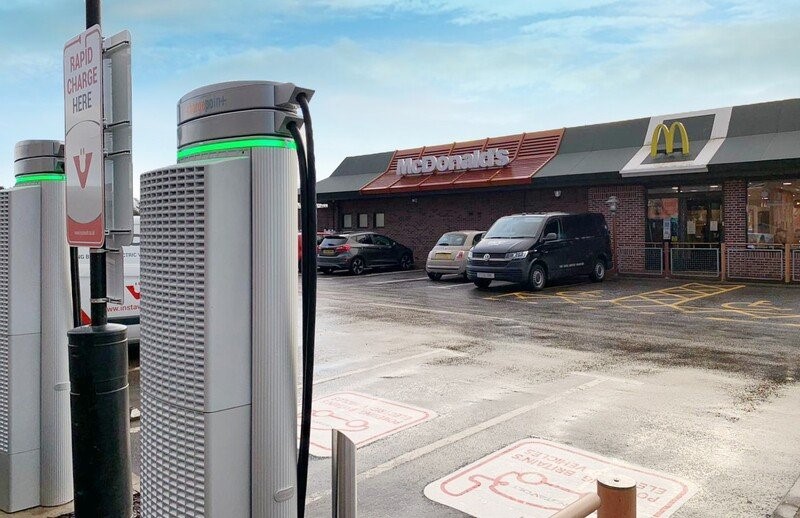
Further examples of how restaurants are embracing the technology came last summer when McDonald’s and KFC both announced partnerships with InstaVolt.
McDonald’s will introduce 125kW charging points at both new and existing Drive Thru restaurants within the McDonald’s estate where they can be accommodated.
Its first charge point went live at its restaurant in Port Talbot, Wales, last month (December) as the first step in the business’s ambition to have more EV charging points than any other company in the UK and Ireland.
“With more than 1,300 restaurants, our ambition would mean you would never be far from a charging point,” says Paul Pomroy, CEO of McDonald’s UK and Ireland.
“Drivers will be able to pop in for a coffee or a meal and get an 80% charge in 20 minutes. We are known for speed and convenience, and this partnership with InstaVolt will provide just that for EV drivers.”
InstaVolt’s deal with KFC will see rapid chargers installed at up to 450 KFC drive-through restaurants. It already has chargers at KFCs in Sheffield, Nottingham, Rotherham and Crewe.
Transit
The ‘transit’ segment refers to charge points at locations where the primary reason for the visit is to charge an EV, similar to the current petrol and diesel forecourt model.
At the moment, these account for less than 1% of the UK’s charge points and this proportion is likely to be similar in 2030, says Murray.
However, the proportion of the actual electricity they will charge EVs with will be around 20% of the UK’s total in 2030 due to their higher power than other charge points and increased utilisation.
“We expect a greater reliance on transit charging, similar to the forecourt model we see today for refuelling ICE (internal combustion engine) vehicles,” says Murray.
The Government has been looking at this sector in “quite a lot of detail over the past 12-to-18 months”, says OZEV’s Robinson.
“By 2035, we expect to see around 6,000 high-powered charge points across the motorway and A-road network,” she adds. “We’re working hard with others, such as Highways England, Ofgem, the DNOs (distribution network operators) and National Grid, to make sure we’re getting our motorway network ready for mass uptake.
“We want to ensure there is a good experience for the drivers and also, critically, for fleets, which have slightly different needs and requirements of the charging infrastructure network.”
As well as drivers who do long journeys, transit charging will appeal to those who either do not have access to a home charger or on-street charging, or just want the convenience of a fast top-up.
An example of a transit charging facility is BP’s Hammersmith Flyover site, which features four 150kW chargers and one 50kW unit.
“We believe Hammersmith Flyover is the most-visited public charging destination in the UK, recently charging an average of 115 vehicles each day with more than 2,000kWh of energy,” says Matteo de Renzi, CEO of BP Pulse.
“Ultra-fast is the new frontier of public charging, with even the latest generation of small electric cars offering 100kW charging speeds, and it is as important to private motorists without off-street parking as it is to drivers with higher mileage needs.”
Like BP, Shell is one of the fuel suppliers also installing charge points on existing forecourts.
It plans to have a combination of 200 50kW and 150kW chargers on forecourts located on major routes across the UK, in addition to a network of chargers available on local roads.
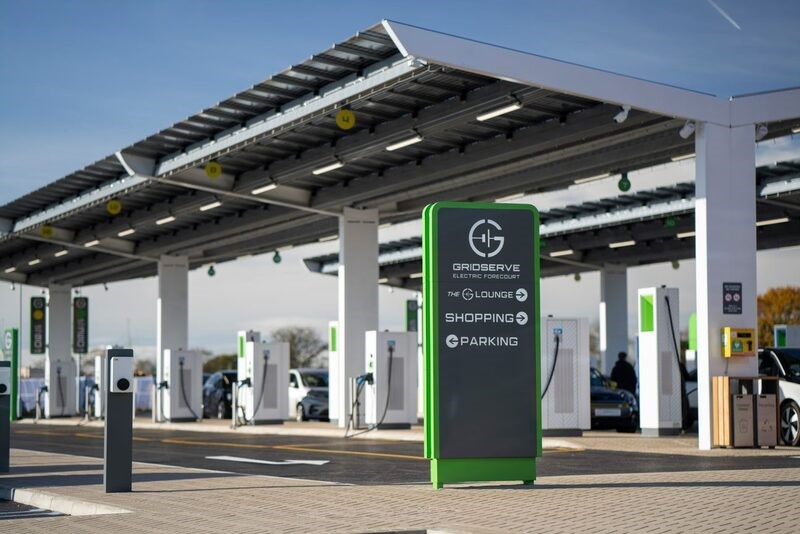
A new entrant in this sector is Gridserve, which plans to build 100 Electric Forecourts in the UK in the next five years as part of a £1bn programme.
It opened its first one in Braintree last month and this enables 36 vehicles to be charged at the same time at speeds up to 350kW.
Electricity is generated from both solar power canopies above the chargers and a network of hybrid solar farms, also operated by Gridserve.
The Electric Forecourt blurs the line between transit and destination segments, as it includes a retail space hosting partners including WH Smith Travel, Costa Coffee, Booths and the Post Office. It also has a waiting lounge, washrooms, dedicated children’s area and business meeting rooms.
On-street
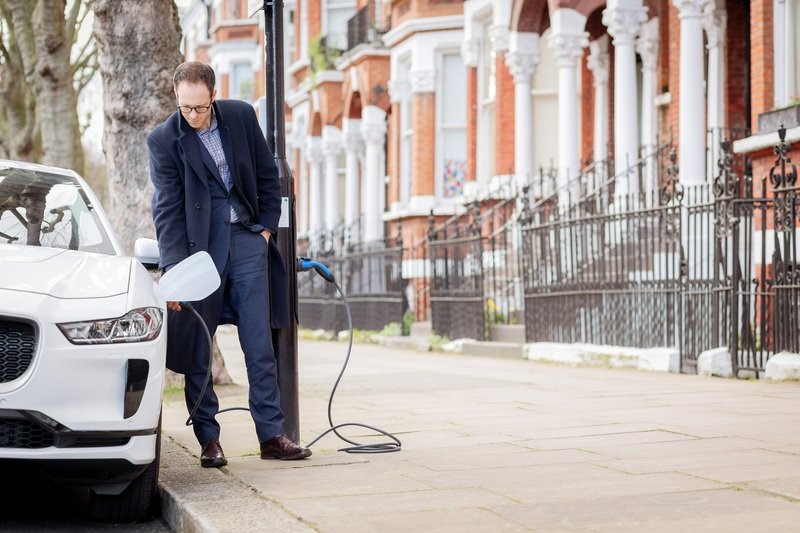
As the term suggests, ‘on-street’ charge points are found on roads or near homes, typically for the estimated 40% to 50% of UK households that do not have access to off-street car parking.
“We’ve got to support this area with our on-street residential scheme,” says Robinson. “This provides funding for local authorities to put in 7kW to 22kW charge points in locations that people can access so it unlocks the option of having an EV.”
The deployment of on-street charge points faces a number of difficulties, including costs for providers to install as well as practical constraints in space and capacity to meet likely demand.
“There are already concerns about the impact of existing chargers to the streetscape: they’re large, can be loud and often unsightly,” says Chris Pateman-Jones, CEO of Connected Kerb.
“Instead of constructing another mammoth-sized thing to plonk on the footpath and inconvenience all parents with prams out for an evening stroll, how about utilising posts and bollards that have been inconveniencing people for years which they have already learned to live with?”
Connected Kerb develops charge points which can be attached to signposts or other existing street furniture.
Some companies are developing solutions which will allow lampposts to be used to charge EVs.
Chargy, for example, became the first company to install lamppost charge points in London in 2018 in a deal with Southwark Council, while last year Siemens and Ubitricity began installing them in Richmond-upon-Thames.
“The standard lamppost is connected to a 25-amp supply,” says Richard Stobart, CEO of Chargy. “If it has gone across to LED lighting, that leaves 24 amps for charging cars.
“You will be able to get around 20 miles of driving for every hour of lamppost charging.”
In March last year, Westminster City Council teamed up with Siemens and Ubitricity to unveil the UK’s first converted lamppost charging street: Sutherland Avenue, Maida Vale, W9, which the local authority has dubbed ‘Electric Avenue, W9’.
Residents can charge their EVs at 24 lampposts at various locations along the street.
“While we cannot solve the challenge of air quality overnight, Electric Avenue W9 is an important showcase of what’s possible using existing city infrastructure,” says Cedrik Neike, CEO of Siemens Smart Infrastructure. “It illustrates how residential streets will look in the near future and accelerates the shift to zero emission vehicles.”
Another potential on-street charging solution is the app-operated pop-up charger, which sits flush to the pavement when not in use, extending only when it is needed.
Oxford became the first city in the world to trial this technology after its city council and charge point developer Urban Electric were awarded £474,000 funding through Innovate UK.
The trial ran from September 2019 to the end of February 2020 and was a success, says the council.
“Resident satisfaction and utilisation was very high and all project partners learned a great deal about the possibilities of the technology,” it adds.
The technology is being deployed in Dundee as part of a £3.8m trial, jointly funded by OLEZ (Office for Low Emission Vehicles) and Innovate UK.
“I think is a really exciting development and I think it will increase the resident charging across many cities in the UK,” says Fraser Crichton, fleet manager for Dundee City Council. By Graham Hill thanks to Fleet News
New car sales in the UK were down by more than 16% in June and down by almost 27% in the first half of the year, when compared with averages from the previous decade.
Fleet and business registrations were a combined 97,413 units for the month, more than a third up (34%) on the same month last year, when the UK began to emerge from the first pandemic lockdown and showrooms in England opened up at the beginning of the month.
Year-to-date fleet and business registrations now stand at 499,275 units, a 47% uplift on the first six months of 2020 (338,918 units), according to the latest figures from the Society of Motor Manufacturers and Traders (SMMT).
Combined, battery electric (BEVs) and plug-in hybrid vehicles (PHEVs) accounted for 17% of new vehicles sold (31,981 units), including retail sales. BEVs accounted for more than one in 10 registrations (10.7%).
PHEV uptake, however, continued to grow faster than BEV uptake for the third month running.
Meryem Brassington, electrification propositions lead at Lex Autolease, said: “Momentum is beginning to build along the road to recovery from the pandemic, but today’s half-year figures still represent a drop on pre-Covid levels, indicating that the car industry isn’t out of the woods just yet.
“We’ll no doubt see the impact of vehicle supply issues and semi-conductor shortages unfold in the coming months, but if we’re serious about leading the EV charge then sustained investment from policymakers to accelerate the UK’s electrification plans has to stay at the top of the agenda.”
All vehicle sizes – bar executive and multi-purpose – saw growth in June, with the strongest growth seen in the mini segment, which had been relatively weak for several months. Superminis were the most popular car class, accounting for 34% of registrations, followed by lower medium (27%) and dual purpose (24%).
Mike Hawes, SMMT chief executive, said: “With the final phases of the UK’s vaccine rollout well underway and confidence increasing, the automotive sector is now battling against a ‘long Covid’ of vehicle supply challenges.
“The semiconductor shortages arising from Covid-constrained output globally are affecting vehicle production, disrupting supply on certain models and restricting the automotive recovery. However, rebuilding for the next decade is now well underway with investment in local battery production beginning and a raft of new electrified models in showrooms.
“With the end of domestic restrictions later this month looking more likely, business and consumer optimism should improve further, fuelling increased spending, especially as the industry looks towards September and advanced orders for the next plate change.”
Every car- and van-maker is being impacted by the computer chip crisis, with some delivery times for cars lengthening from three to six months, and many new vans not expected to be delivered until 2022.
EVs becoming ‘increasingly mainstream’
Jon Lawes, managing director of Hitachi Capital Vehicle Solutions, says that the latest figures from the SMMT “unequivocally” demonstrate that BEVs are now an “increasingly mainstream” option for motorists.
“We’ve seen this sustained uptake in EVs first-hand, with HCVS seeing a 368% increase in EVs across our fleet in the last financial year – a remarkable figure during the lowest year of new car registrations since 1992,” he said.
“EVs will increasingly become front of mind as consumers and businesses look to replace their vehicles in the coming years and ensuring there are viable options in place for all lifestyles and budgets is vital to future-proof the industry as the 2030 ICE ban approaches.”
Richard Peberdy, UK head of automotive at KPMG UK, highlighted how the supply and demand imbalance has created the unusual situation of used cars rising in value, rather than depreciating.
However, he said: “Recovering fleet sales will eventually replenish the used car market and clip inflation, following 18 months of stifled investment.”
Meanwhile, Jamie Hamilton, automotive director and head of electric vehicles at Deloitte, echoed the SMMT’s concerns over the semiconductor shortage and its impact on UK new car sales.
“The ongoing global semi-conductor shortage has had a direct impact on consumers with manufacturers unable to fulfil orders in a timely manner, especially on the less popular models they have had to deprioritise,” he said.
“The ripple effect of this shortage has seen unusual activity in the used car market. Demand is high, but the limited availability of new cars means that there are even fewer used cars coming onto the market. As a result, prices have shot up. In an attempt to secure stock, some dealers have looked beyond the auction houses, turning their attentions to private sellers.
“Unfortunately, there is little respite for the industry, with the semi-conductor shortage expected to continue causing issues throughout the rest of the year and maybe even into 2022.” By Graham Hill thanks to Fleet News