Sadly another expert commentator missing the point. Prices are too high – only if you buy the cars. Lease them! Poor charging infrastructure. Really? As VW rolls out chargers into 400 Tesco car parks and many others following suit with fast chargers now down to 30 minutes for a full charge why the concern over infrastructure? On to the report.
Transport minister Rachel Maclean has paid tribute to the fleet sector as the driving force behind the UK’s move to decarbonisation.
“You are at the forefront of the change… you have a lot of influence,” she told an audience of fleets, leasing, manufacturers and suppliers at the British Vehicle Rental and Leasing Association’s autumn parliamentary reception.
However, she acknowledged that EV uptake was “not moving fast enough”, with around one-in-seven new car sales a plug-in vehicle so far this year.
With the ban on sales of new petrol/diesel cars and vans set for 2030, “we need to get to nine million in under nine years – that’s the target”, Maclean said.
Government was creating the conditions with plug-in grants and tax incentives, but “success rests on having an adequate infrastructure”, she added.
Over the next four years, it will invest £1.3 billion, with the current roll-out reaching 500 charge points a month, of which 100 are rapid chargers.
“It’s a race against time,” Maclean said. “We are in a defining decade to prevent irreversible damage.”
Launching the BVRLA’s Road to Zero 2021 roadmap, chief executive Gerry Keaney described the 2030 ban on sales of new petrol/diesel vans as “ambitious” but said the phase out plan for HGVs (2035 for trucks up to 26 tonnes, and 2040 for heavier trucks) was “beyond ambitious”.
The association’s score card methodology on progress was “red, red, red”, he added.
“We have a commitment to a date, and it stops there. We have no vehicles or clarity on the technology roadmap, or charging, or hydrogen refuelling.”
While van adoption was in a better position, there remained challenges over supply and concerns about bulk workplace charging infrastructure.
He described it as “ridiculous” that some companies were being told to pay for a local substation in order to transition their fleet to electric.
“The Government needs to do more in incentives and grants, especially in the SME sector,” Keaney said.
He also urged the Government to consider support for the used market, claiming that the lowest 40% of earners buy used and were at risk of “being excluded” because they can’t afford to make the change.
His view was supported by Arval UK managing director Lakshmi Moorthy, who said it was “super critical to stability and secure” the market for used electric vehicles. “We are at risk of leaving behind a huge swathe of the population and SME businesses.”
She also called on ministers to provide “clarity and foresight” for tax incentives beyond the current 2025 for BIK rates. “We need to extend that view,” she said.
Meanwhile, demand for electric vans is “fragile”, with many companies “not comfortable” making the change.
Arval is looking at ways to “nudge” them but needs support from the Government.
“Prolong the plug-in grant or look at the super-deduction for vans that doesn’t exist for leasing companies,” Moorthy said. By Graham Hill thanks to Fleet News.
New electric vehicle (EV) charge points, installed at home and in the workplace from May, will be pre-programmed to switch off during peak hours to ease pressure on the National Grid.
A ‘randomised delay’ of up to 30 minutes, when there is high demand from motorists, will also be introduced as more company car drivers make the switch to EVs away from diesel and petrol.
New chargers will not operate from 8am to 11am and 4pm to 10pm, but owners and fleets will be able to override the preset times to take account of night workers and people who have different schedules.
Public chargers and rapid chargers, on motorways and A-roads, will be exempt, reports The Times.
Tanya Sinclair, policy director for UK and Ireland at ChargePoint, said: “Concerns surrounding the UK’s grid to support the charging of electric vehicles is mounting.
“The challenge for the Government, and perhaps the wider electricity system, is ensuring the ‘smartness’ in every charger is actively used by consumers, and managing the load represented by the legacy charging infrastructure already in the field which is not smart.”
The National Grid has estimated that 80% of EV drivers will use smart charging by 2050 and this will help balance almost half of the UK’s energy demands brought on by the move to zero emissions driving.
It says that around 45% of homes will actively help to balance the grid, offering up to 38GW of flexible electricity to help manage peaks and fill troughs in demand.
Smart changing means EV owners can plug in their vehicles and a management system will top up the vehicle at times that will be most beneficial to manage energy demand.
It also allows drivers and fleet operators to manage their charging stations remotely, implement new features automatically and gather data about how chargers are being used and by whom.
Government consultation on smart charging
The move to a default off-peak charging setting was first mooted in a Government consultation on Electric Vehicle Smart Charging, in 2019.
In its response to the consultation, published recently, it said that many respondents raised concerns about defining a specific off-peak time period in legislation, suggesting it could result in a secondary peak in demand.
Based on the feedback, it said it would adopt a more “nuanced approach” by mandating that smart charge points must prompt users to input a charging schedule and they must be preset to offer users a charging schedule that by default prevents EVs from charging at peak times.
During first use, the user must be given the opportunity to edit or remove this setting, it said. The user must also be able to remove or edit this default setting at a later date.
Peak times will be defined in legislation as 8am to 11am and 4pm to 10pm on weekdays. This time window, the Government says, is consistent both with its internal projections of expected EV demand, and with various external studies of EV charging patterns.
It explains that mandating the setting of a default charging mode will help mitigate the risk that some users do not engage with smart charging offers, and instead charge during peak times.
Importantly, it adds, mandating that users must be informed of and prompted to edit the pre-set charging schedule during first use of the chargepoint will help mitigate the risk that any default setting causes confusion and negatively impacts the user experience.
The consumer override and edit functions will ensure that users can turn off or edit their charging schedule, for example where they wish to sign-up to a DSR service such as a smart tariff.
Defining a peak time period in legislation instead of an off-peak period could encourage greater variation in approach amongst charge point sellers, thereby helping to mitigate the risk of a default mode requirement causing secondary peaks in demand, it argues.
However, it says it will monitor the effectiveness of this approach “closely” as part of our post-legislation evaluation.
The upcoming 2021 Smart Systems and Flexibility Plan will outline the steps that Government is taking to help drive the uptake of smart charging offers, including work to help ensure that consumers have confidence in the smart charging market.
Ben Fletcher, associate director of EV at Moixa, said: “Concerns surrounding the grid being able to support charging of electric vehicles aren’t new and the Government’s proposed plans around smart charger capabilities are a good way of answering this.
“The challenge is ensuring consumers are given the right tools to put them in control, and allow them to intelligently charge in an easy, flexible way that is convenient for them.
“Intelligent EV charging not only allows individuals greater control over the power in their vehicle but also enables greater access to cheaper, greener energy. In turn, this ensures that drivers can decide when they want their vehicle to be ready by and the system then optimises when the vehicle charges.”
Moixa, through its Smart Battery hardware and Gridshare software, facilitates smart energy storage and sharing. “We facilitate and interpret interactions between energy storage devices and the grid, enabling data driven optimisation,” explained Fletcher.
“This means we can alleviate the demand on the grid and pave the way for smart EV charging, as well as help companies manage energy storage using advanced analytical data.
“Intelligent home charging is critical to help EV owners save money on their energy bill by tapping into cheaper energy rates while also enabling more renewable energy on the grid by integrating with increasingly agile tariffs.”
News of the charge point ‘switch off’ comes after MPs on the transport committee warned that unless charging habits change the charging needs from millions of new EVs will cause blackouts to parts of the country.
In a report – Zero emission vehicles – published by the transport committee in July, the MPs set out a series of recommendations to Government to boost the production and purchase of EVs.
Last week, the Government announced it would legislate to ensure electric car chargers are built into all new homes and offices. By Graham Hill Thanks To Fleet News And The Times
Skoda has launched a new connected car service that provides drivers with detailed information about current road conditions.
The Local Hazard Information Service uses swarm data intelligence, by collecting data from all ‘connected’ vehicles on the road. More than three million vehicles set to provide data by the end of 2022
The system will be available for the Enyaq iV, Fabia, Kamiq, Kodiaq, Octavia, Scala and Superb in the UK as part of ŠKODA Connect services
By collecting and evaluating anonymous vehicle data, the system is able to warn of approaching hazards such as slippery or damaged road surfaces via the infotainment system, actively increasing safety in the process.
Sebastian Lasek, head of product line connectivity at Skoda, said: “The system uses the car’s sensors to detect challenging road conditions in advance. To this end, the ‘Local Hazard Information Service’ increases active safety for drivers and passengers. We are continuously developing our connectivity services to offer our customers extra safety features and even more convenience.”
Accelerometers and ABS sensors – that measure the acceleration and braking of the car – allow the required data to be captured continuously during each journey. Meanwhile, virtual sensors estimate the friction between the tyres and the road surface based on wheel slip.
The combined data is anonymised and transmitted to the cloud, where aggregated information from all connected vehicles is paired with metadata, such as weather information or previous measurements.
Using the data collected, the road network can be displayed as a precise three-dimensional model, which is used to send alerts to vehicles when they find themselves approaching or within an area with bad road surfaces.
If a connected vehicle encounters icy conditions, for example, the driver will be alerted via the vehicle’s infotainment system based on information acquired by the car itself.
This information is then anonymously transmitted via the Car-to-Cloud application, alerting nearby drivers – the more connected cars that encounter the affected road, the more ‘swarm’ data is produced and the more accurate the maps, information and driver alerts will become.
This swarm intelligence enables precise analysis, helping to build the self-learning system. Over the course of 2021, more than 1.7 million Volkswagen Group vehicles in Europe will supply data, a figure set to rise to more than three million by the end of 2022. By Graham Hill thanks to Fleet News
The Association of Fleet Professionals (AFP) is urging fleets to think carefully before ordering company cars where safety devices have been removed due to the semiconductor shortage.
The same applies to consumers about to order a new car. The global shortage of chips has caused delays to new car orders and seen some specifications removed such as lane departure warning and rear parking sensors.
The AFP says that there are a number of issues to be considered by fleets – from ethics to risk management responsibilities to future residual values.
AFP chairman, Paul Hollick, said: “We appreciate that the semiconductor shortage is leaving manufacturers with some tough production decisions to make and some have decided to delete what might be described as non-core safety equipment such as lane departure warning and rear parking sensors.
“Our view is that everyone should think carefully before buying these vehicles. From a risk management point of view, there is a moral and potentially also a legal issue in terms of operating some vehicles that are known to be potentially less safe than would normally be the case.
“Similarly, although safety equipment has not historically had a significant effect on vehicle residual values, the trade will know that these are ‘decontented’ cars and are likely to price them according in three or four years at disposal time. The impact on overall operating costs is difficult to assess.”
Hollick added that ongoing vehicle shortages caused by the semiconductor shortage were prompting a range of issues for fleets.
“There are predictable problems such as ensuring that cars and vans that are being operated for longer are maintained to a level that ensures they remain fit for purpose,” he continued.
“This is relatively simple but can be expensive and does require a lot of attention to detail.
“However, probably the most frustrating issues are the delays that are being caused to fleet electrification programmes.
“There are relatively large numbers of drivers with an EV on order who are facing the prospect of driving their existing diesel for another 6-12 months.
“Not only is there annoyance at the enthusiasm for EV adoption that exists being hindered but the practical fact that much higher benefit-in-kind taxation bills are being paid for much longer than expected.
“Additionally, many of these new EVs will now have life cycles that end beyond the current benefit-in-kind taxation tables, which adds a further layer of uncertainty.” By Graham Hill thanks to Fleet News
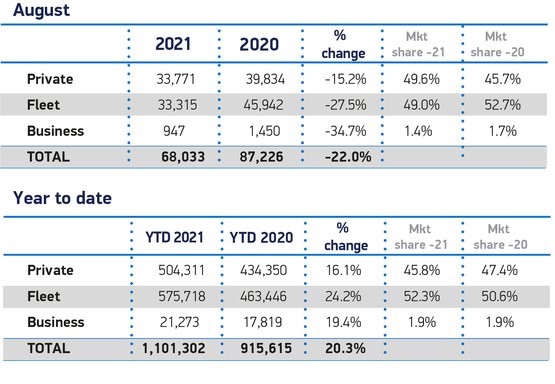
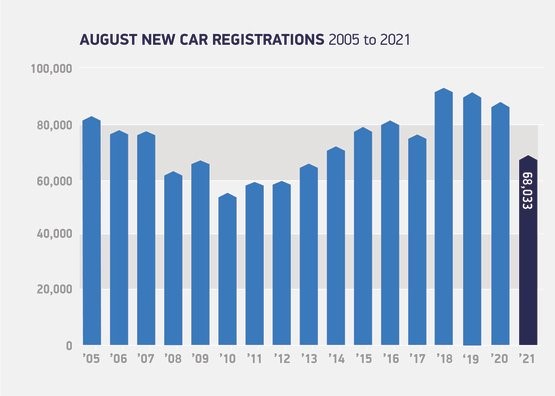
New car registrations fell by 22% in August, the lowest performance for the month since 2013.
Figures from the Society of Motor Manufacturers and Traders revealed that 68,033 cars were registered in August 2021, as the automotive sector continues to be constrained by the global semi-conductor shortage and issues caused by the Coronavirus pandemic.
While August is traditionally one of the quietest months of the year for new car registrations, ahead of the important plate-change in September, last month’s registrations were down 7.6% on a 10-year average.
Registrations by business and fleet buyers fell by double digits in the month with fleet purchases down 27.5%, a loss of 12,627 units. Private activity held up better, registrations dropping 15.2% to 33,771 units, meaning that just shy of half (49.6%) of all sales in August were driven by private consumers.
Mike Hawes, SMMT Chief Executive, said: “The global shortage of semiconductors has affected UK, and indeed global, car production volumes so new car registrations will inevitably be undermined. Government can help by continuing the supportive Covid measures in place currently, especially the furlough scheme which has proven invaluable to so many businesses.”
Jamie Hamilton, automotive director and head of electric vehicles at Deloitte, added: “As the semi-conductor shortage continues, even as far as Q2 2022, new car sales will be impacted. All eyes will be on September, with plate change months traditionally leading to some of the biggest months for new car sales. Whilst there will be consumer interest in the new 71-plate, some in the industry are tempering their expectations. Dealer pre-registrations are significant contributors to September’s figure but the motive to pre-reg may be lower-than-normal, as some manufacturers have softened dealer targets and are currently only building to order, anyway.”
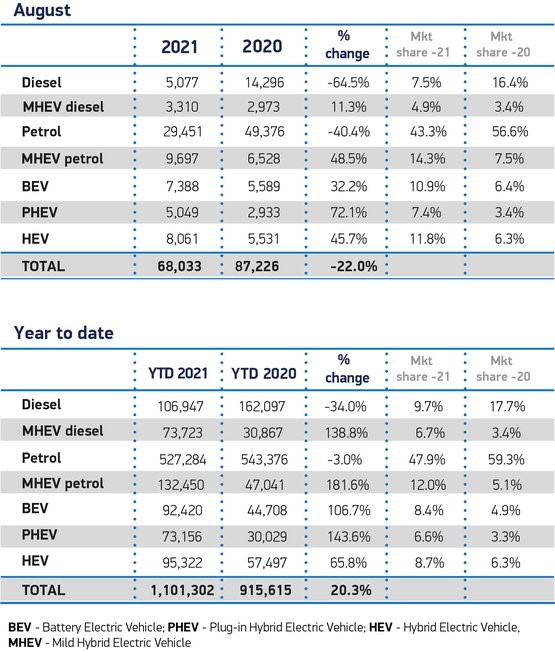
Demand for the latest battery electric (BEV), hybrid (HEV) and plug-in hybrid (PHEV) vehicles, however, surged, up 32.2%, 45.7% and 72.1% respectively. In fact, demand for PHEVs has outpaced BEVs in five of the last six months since changes to the Plug-in Car Grant, affecting BEVs, were introduced in March. There are now some 130 plug-in models on the market.
Meryem Brassington, electrification propositions lead at Lex Autolease said: “The growth in electric and hybrid vehicles is encouraging as ever. The journey to move towards net zero is set to be strengthened even more with the closing of a Government consultation later this month to set the bar on how environmentally friendly a hybrid vehicle has to be to remain on sale post-2030. These positive changes will be crucial to ensuring that even more of the vehicles on the UK’s roads post 2030 are genuinely sustainable and contributing towards the UK’s net zero ambitions.”
The mini segment was the only car bodystyle to see growth, up 30.7%, but with just 902 registrations it is a segment prone to greater fluctuations.
So far this year, UK new car registrations remain up 20.3%, to 1,101,302 registrations, an increase of 185,687 units with BEVs and PHEVs at 8.4% and 6.6% market share respectively. However, this performance is measured against the Covid-hit 2020 market, when showrooms were closed for much of the year.
Total registrations in 2021 are 25.3% below the 10-year average for the period January – August, according to the SMMT.
Lucy Simpson, head of EV enablement at Centrica Business Solutions, added: “Despite the downturn in overall registrations, it’s encouraging to see EV adoption continue to go from strength the strength, with battery and plug-in hybrid vehicles accounting for 30% of the new car market.
“With the 2030 phase-out date for the sale of new petrol and diesel vehicles now firmly set in stone, encouraging EV uptake needs to remain our top priority. The government’s recent Transport Decarbonisation Plan and other commitments have put down a strong marker for the UK’s electrification journey, however we must ensure that EVs remain accessible for all. This includes speeding up the roll-out of on-street charging to avoid large swathes of the population being left behind on the road towards an electric future.”
The Government has announced changes to the HGV driver test in order to free up capacity for 50,000 additional tests per year.
A new streamlined test means drivers will only need to take one test to drive both a rigid and articulated lorry, rather than having to take two separate tests (spaced three weeks apart). This, according to the Government, will make around 20,000 more HGV driving tests available every year and mean drivers can gain their licence and enter the industry more quickly.
Tests will also be made shorter by removing the ‘reversing exercise’ element – and for vehicles with trailers, the ‘uncoupling and recoupling’ exercise – and having it tested separately by a third party. This part of the test is carried out off the road on a manoeuvring area and takes a significant amount of time. Testing such manoeuvres separately will free up examiner time, meaning they can carry out another full test every day.
Car drivers will no longer need to take another test to tow a trailer or caravan, allowing roughly 30,000 more HGV driving tests to be conducted every year.
Car and trailer driving tests will no longer be available after September 20, 2021. The DVLA will update driving licence records automatically. The category B+E will be added to photocard driving licences when they are renewed.
This new legislation is changing previous EU regulations which the UK is no longer obliged to use.
Transport Secretary Grant Shapps said: “From Inverness to St Ives, HGV drivers are helping to keep the country running, and have been throughout the pandemic. The shortage of drivers is a global problem, but we’ve been taking action here in the UK to help industry leaders attract drivers and build a more resilient sector.
“We’ve already delivered 50% more tests than were available before the pandemic, but today’s additional measures will deliver up to 50,000 more a year, helping more and more people to kickstart their career as a well-paid HGV driver.”
The changes follow a public consultation over the summer, which saw thousands of respondents, including industry leaders, support the move as a positive step to help the sector tackle the lorry driver shortage currently affecting countries around the world.
The Government says the standard of driving required to drive an HGV will not be affected and any driver who does not demonstrate utmost competence will not be granted a licence.
Ahead of the announcement, RED Driver Risk Management said it believes the move to make it easier for drivers to be allowed to drive specialised vehicles not only smacks of desperation, but undermines the relentless work the driver training industry has put in to make the UK’s roads safer over the years.
Ian McIntosh, CEO of RED Driver Training, explained: “No doubt stung by negative media coverage of empty supermarket shelves, and with driver shortages impacting upon freight distribution in the UK, the Government is seemingly panicked into being seen to do something, rather than actually thinking through the issues these proposals raise.
“For example, removing the need for an additional test for B+E entitlement for drivers to be able to drive car and van trailer combinations is a dangerous step backwards. It will expose more businesses, their employees and other road users to increased risk.”
Figures from the DVSA (Driver and Vehicle Standards Agency) show that the national pass rate for B+E driving tests was 69.6% in 2019/20 and only 58% for 2020/21. In other words, between 30-42% of people taking this test are unable to demonstrate the minimum standard of driving and competence to tow loaded trailers on the road on at least their first attempt.
Matt Hammond, head of fleet at M Group Services, said: “Whilst the overhaul will increase the capacity for HGV tests it doesn’t answer the underlying issue surrounding how HGV drivers are perceived and treated. The issue might be associated with Brexit and Covid but in reality, the issue of drivers leaving the profession has been one that supersedes both of these events.
“Why would anyone want a career that takes them away from home for up to 5 nights each week, expected to park in lay-bys or at best, poor service stations with limited facilities and having to pay top dollar for the privilege. We as an industry need to rethink how we treat our drivers and the expectations we put in them.
“Only then will new drivers want to come into the profession.” By Graham Hill thanks to Fleet News
A guide to everything you need to know about speeding, from fines to the cameras the police use.
There was a time when fixed and average speed cameras didn’t exist, and the most likely way of accruing endorsements (now better known as penalty points) on your licence was to miss seeing the local policeman pointing a ‘speed gun’ at your car as you edged above the posted limit. Those days have long since passed, and the rise in digital technology now means that drivers are faced with a plethora of different roadside devices.
How can I be caught speeding?
There are a variety of different speed-detecting technologies on British roads today. Here are the most common.
Truvelo
All speed cameras have to be coloured bright yellow by law and the Truvelo is no exception. Most commonly mounted on a pole at the side of a single or dual carriageway, the Truvelo uses a front-facing camera to record your speed, backed up by a matrix of small squares painted on the road. (Secondary evidence of speed is required with all fixed-position cameras.)
While images of motorcycle numberplates can be tricky to capture, due to their lack of front registrations, the Truvelo can identify drivers of other vehicles, adding a further layer of evidence if a prosecution is disputed. More recently, a Truvelo D-Cam has been launched for motorway applications, with front- and rear-facing capabilities.
Gatso
The name that most of us are familiar with, the Gatso first graced our road scene in 1991 and is a rear-facing camera, meaning that it records your vehicle after it’s passed the camera unit, with two images taken in quick succession. Like the Travelo, the images are supported by secondary evidence of speed provided by painted ‘dashes’ on the road surface. These dashes may be found on both sides of the road next to the camera, but the Gatso will only record your speed in the direction in which it is facing.
SPECS
SPECS (average speed check cameras and speed enforcement) units measure your speed over a set distance, via two banks of cameras. Most commonly found through roadworks, or where there is a lower than normal speed limit, they use automatic numberplate recognition (ANPR) to identify vehicles. As you pass the first set of cameras, your vehicle’s details are recorded, and if your average speed before reaching the second cameras is above a set threshold, a notice of intended prosecution (NIP) will be automatically generated. (See below.)
HADECS 3
The catchily named Highways Agency Digital Enforcement Camera System 3, or HADECS 3 for short, is most commonly found on smart motorways, mounted on the overhead gantries that carry variable speed limit alerts. The camera’s limited use of yellow cladding and the fact that it is a fraction of a Gatso/Travelo’s size mean that it can be easily missed, especially if you’re travelling at 70mph. HADECS 3 is rear facing, and once again it uses painted dashes on the road as secondary evidence of a vehicle’s speed. It also adapts to posted, mandatory speed limits that can vary depending on road conditions.
Mobile speed camera units
It’s not uncommon for the police to monitor vehicle speeds at known accident hotspots using mobile units – quite literally, vehicles with miniature Gatso cameras pointing through their rear windows. These are often found parked in laybys or above dual-carriageway or motorway bridges and have a range of up to one mile. The police also have access to handheld radar- and laser-controlled devices that can be used at a variety of locations.
How will I know if I’ve been caught speeding?
If you’ve been caught speeding with a hand-held device, or one installed in a moving police car, you could be asked to stop there and then. In this case, the police have two options: they can either give you a verbal warning and send you on your way, or they can issue you with a fixed penalty notice (FPN). But if you’ve been caught speeding by a remote device, the registered keeper of the vehicle will receive a notice of intended prosecution (NIP) and section 172 notice by post within 14 days of the offence. The section 172 notice then has to be returned within 28 days, providing details of the driver who committed the offence. A fixed penalty notice (FPN) will then be issued to the driver, or if the offence is deemed serious enough, a court summons.
What kind of penalty can I expect?
If you receive an FPN, you can either plead guilty or not guilty to the offence, with each decision triggering its own process. A guilty plea will generally carry a fixed £100 fine and three points added to your licence. Depending upon where you were caught speeding, there will be different ways to pay the fine, which can be found here.
However, you may be offered the option of paying instead for a speed awareness course (typically costing a similar amount to the fine itself), which will avoid the addition of points to your licence. Certain caveats exist, though. The police will decide if it’s appropriate to your offence (so it tends to be offered for more minor transgressions).
And it will only be offered if you’ve not been on such a course in the past three years. It’s also worth noting that not all police authorities run speed awareness courses, so this option is by no means a given.
The situation becomes more complex if you plead not guilty, though. Of course, if you’re convinced of your innocence, then it’s the right and proper course of action and it will probably involve a trip to court. But if you lose your case, you could be fined more and receive more penalty points.
Excess speed bands and your weekly income make up the fine
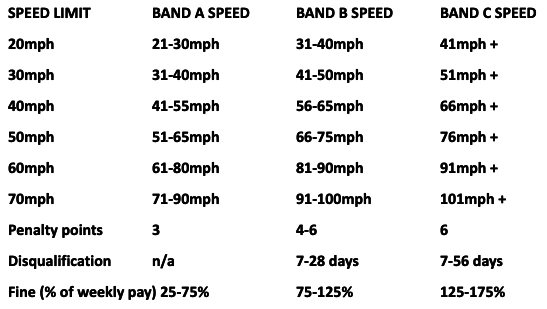
In 2017, the speeding penalty system was overhauled, with larger fines for drivers charged with excessive speed. If you are prosecuted in court, the amount you are fined and number of points you receive (or the disqualification period) will firstly be determined by the speed you were travelling over the posted limit, as shown here.
But as you can see from the last line, the actual fine is ‘personalised’ depending on your average gross weekly income.
For example, based on a driver earning the UK average income (2020-21) of £29,600:
Speeding at 81-90mph in a 60mph zone = £428-£713 fine plus 4-6 penalty points
Speeding at 66mph+ in a 40mph zone = £713-£998 fine plus 6 penalty points
There are a further three bands (D, E and F) that deal with more extreme transgressions, which may include excessive speed where the driver is: on bail; has existing convictions; in charge of a large vehicle; heavy load; towing; carrying passengers; driving through a heavily pedestrianised area.
It’s also worth noting that if you’ve only held a full driving licence for less than two years, it will be revoked if you reach six or more penalty points.
On the upside, mitigating factors, such as it being a first offence, or being of ‘good character’, may help reduce the fine and penalty. The court may even take into account speeding for a genuine emergency.
Either way, under any circumstances, there is a £1000 fine cap for all speeding offences, apart from those committed on motorways, where it increases to £2500.
How many points do I need before I lose my licence?
Even less serious speeding offences can cause you to lose your licence. If you accrue 12 or more penalty points in a three year period – potentially four minimum-fine/points offences – you could end up with a six-month ban. And this could have further repercussions. If you’re disqualified for 56 days or more (see also the more serious single-offence bans, above) you’ll need to apply for a new licence, and this may even entail retaking your driving test.
How will speeding penalties affect my car insurance?
Insurers will generally regard drivers who’ve accrued penalty points for any offence – including speeding – as a higher risk and will likely impose a higher premium as a result. While penalty points for speeding are generally only valid for three years as far as totting up endorsements and a potential ban goes, they remain visible on your licence for four years. Most insurance companies will ask you to declare any motoring offences in the past five years, and if you withhold information, it could affect a future claim, so it’s important to be honest when searching for new quotes.
Top 10 speeding trivia
Would you be surprised if we told you that the world’s first speeding fine was issued in the UK? Well, it was. Driving his new Benz, Walter Arnold was nabbed at four times the national speed limit in Paddock Wood, Kent.
That the limit was just 2mph and the year, 1896, explains a lot. To make matters worse for Arnold, he was reprimanded for not having a red flag waver walking in front of him, too.
And from one extreme to another… The UK’s fastest speeder was caught in 2015 travelling at 192mph in a Nissan GTR. A 28-month custodial sentence followed and Northamptonshire police banned him from driving for 10 years.
But you don’t need anything exotic to get your collar felt. In 2003, an off-duty policeman was caught driving his unmarked Vauxhall Vectra at 159mph on the M54.
It wouldn’t have been as much as the hapless Swiss driver had to shell out, though, after he hit 85mph in a 50mph zone driving his Ferrari Testarossa. Swiss authorities base fines on your financial worth, and with £14.1 million in the bank, this driver ended up with a £180,000 ticket.
But that was nothing compared with another Swiss millionaire who managed 180mph on local roads in his Mercedes-AMG SLS and set a new speeding fine world record at $1,001,400 (£727,166).
Both the above would have got away with it if they’d come to the Isle of Man, where no speed limits apply (although dangerous/careless driving is still an offence, as is breaching local speed limits through built-up areas). Other speed-limit-free havens are Germany’s autobahns (for now) and Australia’s Northern Territories.
But not Dubai. Driving a rented Lamborghini Huracán, a British tourist managed to trigger 33 speed cameras while joyriding through its downtown area, generating $48,000 (£34,847) in speeding fines, before fleeing the country and leaving the rental company to sort out the mess.
If you live near Bristol, though, it takes only one speed camera to extract mega-sums in fines. A camera positioned on the city’s M32 motorway captures on average 50 speeding drivers each day, and over a three-year period relieved them of £5.7m.
Showing slightly more lenience, Poland has the highest speed limits in Europe, at 140km/h (87mph), and in the US, Texas’s Highway 130 allows 85mph before fines are imposed. But the world’s highest speed limit is 160km/h, or, tantalisingly, 99.4mph, in the UAE.
But like it or not, speed cameras in the UK are now part of our motoring life, and with 7000 of them positioned around the country, only Russia, Italy and Brazil have more on their roads. By Graham Hill thanks to Autocar
As a member of MENSA myself I was sad to hear of the death of one of our most colourful and clever people. He was the genius that invented the pocket calculator and later the mini-computer that he later sold to Alan Sugar.
He married a pole dancer that he met in Stringfellows and despite all of the rumours that she was only with Sir Clive for his money (she was 36 years his junior) led a fairly frugal lifestyle outside the glare of the public and appeared to love each other – good on them!
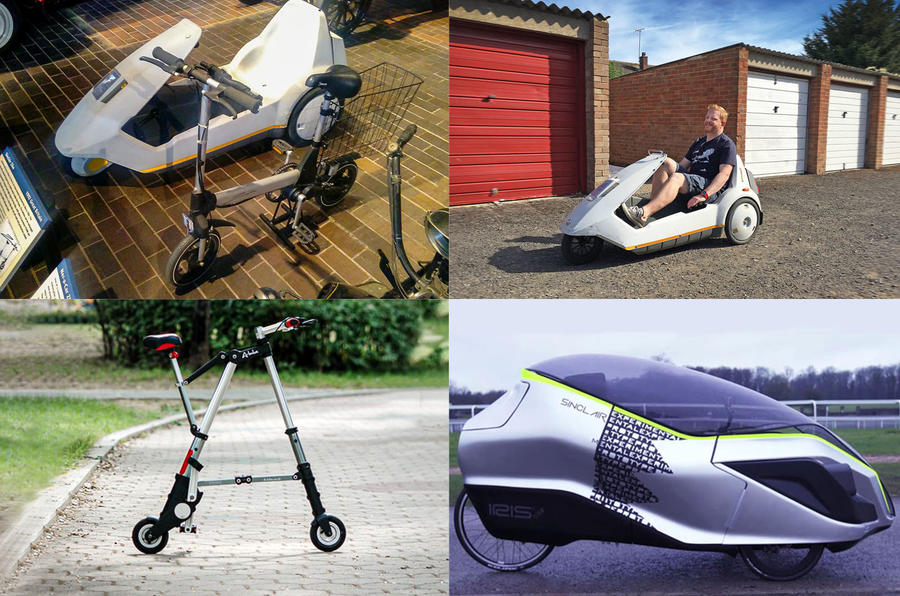
Moving on to his e vehicle inventions. Four times Sir Clive Sinclair tried to revolutionise e-transport. From an electric car to electric bikes and an electric trike: Sir Clive Sinclair’s death has shed a wider light on his creative – and sometimes doomed – genius.
The sad passing of Sir Clive Sinclair has generated thousands of headlines, most focused on his work to revolutionise either the pocket calculator or home computing.
But his death has also shed a wider light on his creative – and sometimes doomed – genius, including a decades-too-soon determination to electrify personal transport.
Here, as a stark reminder that for every Elon Musk there are thousands of right ideas at the wrong time (as well as a lot of wrong ideas, lest we be accused of being too kind), are four Sinclair inventions that sought to change how we travel.
Sinclair C5
Technically an electrically assisted pedal cycle, the C5 – with, you guessed it, the C signifying its founder’s first name, Clive – arrived in 1985 in a blaze of publicity driven both by its inventor’s high profile and mega success in the computing world and the fact that it was, well, downright odd.
For many, this was the first glimpse of how Sir Clive’s brilliance could tip onto the wrong side of genius. While the concept was enthralling, the reality was rather more puzzling, something summed up well by Steve Cropley, who was there for the launch.
The C5 was slower and less practical than a bike, with a range rated at 20 miles from its 12V lead-acid battery, and a top speed of 15mph, boosted by the 250W electric motor, but with many of the same limitations, such as a lack of protection from the weather. It added a few extra issues into the mix, too, chiefly just how visible its occupant was in city traffic, with a flagpole-like structure a hastily arranged optional extra soon after launch.
At £399, it was competitively priced with top-end bicycles, but even so, sales bombed: 14,000 C5s were made, and 5000 sold before the firm went into receivership. Ironically, the remaining stock was snapped up and went on to attain collectable status, with pristine prices reputed to have hit £6000 – and one plucky soul converted a C5 to hit a top speed in excess of 150mph. How Sir Clive, his fortune severely dented, must have rolled his eyes.
In Sir Clive’s head at least, the C5 – itself derived from a prototype called C1, of which many running examples were produced in the late 1970s and early 1980s – was intended to be the first of a series of electric vehicles.
The C10 and C15 are widely believed to have been committed to the drawing board, their prospects of a wider audience dying along with the sales fortunes of the C5.
Sinclair Zike
The Sinclair Zike was revealed in 1992 and, once again, indicated that Sir Clive’s genius was often ahead of the public mood, as it combined Brompton-like convenience with the practicality of the soon-to-boom e-bike.
Weighing 11kg, and using a small electric motor to drive the rear wheel, the Zike (picture by Pasicles below) had its nickel-cadmium batteries – notable at the time for being half the weight of the equivalent lead-acid batteries – built into the frame. It cost £499 – about the same as a high-end traditional bike at the time.
Riders had three power levels to choose from, but just one gear, with assistance available for between 30 and 180 minutes, depending on how much electric shove you wanted. Top speed was limited below 15mph, in line with the law. The recharge time was one hour and the batteries rated as good for 2000 recharge cycles.
Testers noted the wheel size meant potholes were a potentially lethal hazard and almost every review of the bike praised its compactness but criticised its stability. Just 2000 were sold in total in the six months it was on sale – against a production target of 10,000 a month.
Sir Clive blamed a dispute with the firm contracted to produce it for its failure and, enthusiasm undimmed, created the Sinclair ZETO, standing for Zero Emission Transport Accessory, a detachable powerpack that could be fitted to the wheel of any bike to provide electrical assistance.
Another fine idea that was doomed to fail – but, who knows, could yet be successfully reinterpreted in our changing world.
Sinclair A-bike
Fast forward to 2006 and Sir Clive reaffirmed that his creative juices were still flowing fast with the launch of the A-bike, imagined by him and designed by a Hong Kong-based agency, and so called for looking like the letter it was named after when unfolded.
It was remarkable not just for how it looked, but also – more pertinently – for the fact that it could fold into a bag, measuring just 67x30x16cm when folded and weighing 5.7kg. Wheel size was initially – and that’s a crucial word, given it implies there were successors – 15cm in diameter, but later expanded to 20cm to boost stability.
In the company of the other inventions listed here, the A-bike deserves to be considered a success. Not only was an updated model launched two years after the first, but it also had the dubious honour of having its design ripped off by numerous Chinese manufacturers, who filled the home market with their knock-offs.
Top Gear fans may also recall James May and Richard Hammond taking to an official version of the bike to get from a ferry to a cable car as they raced Jeremy Clarkson in a bid to prove a train ride could be faster than travelling by car.
Finally, to justify its presence in a Move Electric article, the A-bike spawned an electric variant in 2015. The A-bike Electric was funded via a Kickstarter campaign and more than £110,000 was raised to put it into production – and you can still buy one today, albeit modified and improved from the original design.
The A-bike Electric’s electrical assistance is rated at 15 miles, the top speed 12.5mph and it measures 70x40x21cm and weighs 12kg. Prices start from £399.99.
Iris eTrike
As people mull the legacy of Sir Clive in the wake of his death, perhaps it’s worth pausing to consider that his pioneering if sometimes misguided spirit lives on, not least in a new generation of Sinclairs, led by his nephew, Grant Sinclair.
Back in 2017, Grant, who worked in the family business on his way up, no doubt learning a thing or two from his famously always-inventing uncle, unveiled the Iris eTrike, which is hard to describe as anything other than a modern reinterpretation of the C5.
Taking the concept of the increasingly popular – if still considered as sitting to the far left of left-field – electric hybrid tricycles that are sometimes seen out and about, Grant sought to improve the experience, providing a higher, more upright seating position, a hinged canopy to keep the elements out and the use of aviation-quality materials to reduce weight. Praise be, he also engineered it so it could tackle a pothole without mishap. And with a luggage compartment…
With power assistance for a top speed of up to 30mph and up to 55 miles of electric range assistance from a lithium ion battery, the Iris eTrike was a concept that apparently had it all, for a mooted starting price of £2999.
Delivery was slated to begin at the end of 2017, but despite a blaze of publicity kick-starting interest, sales appear to have been hard to come by. More recently, astronaut Tim Peake tried one out on the BBC’s One Show, but potential buyers must still be patient: Grant’s website offers the Iris eTrike for pre-sale only, now at £4999. By Graham Hill thanks to Autocar.
All new fully electric Volvo models will be completely leather-free from 2025, with many interior options set to be replaced by more sustainable materials.
The change comes as the manufacturer looks to reduce animal harm and its contribution to global emissions and will begin with the C40 Recharge.
Volvo will aim for 25% of all materials on new cars to be recycled and bio-based, in addition to the goal of ensuring all immediate suppliers use 100% renewable energy by 2025.
“Being a progressive car maker means we need to address all areas of sustainability, not just CO2 emissions,” said Stuart Templar, Volvo’s director of global sustainability.
“Responsible sourcing is an important part of that work, including respect for animal welfare. Going leather-free inside our pure-electric cars is a good next step towards addressing this issue.”
Volvo will offer bio-based and recycled alternatives for leather interior options, including its Nordico material, made from plastic bottles, ‘bio-attributed material’ and corks reused from the wine industry.
Wool-blend options will still be available and sourced responsibly, with full traceability in line with animal-welfare standards.
Volvo will also aim to reduce the use of residual products from livestock production used in the production of plastics, rubber, lubricants and adhesives, either as part of the material or as a process chemical in the material’s production or treatment.
“Finding products and materials that support animal welfare will be challenging, but that’s no reason to avoid this important issue,” said Templar.
“This is a journey worth taking. Having a truly progressive and sustainable mindset means we need to ask ourselves difficult questions and actively try to find answers.
“By aiming to actively replace these materials as much as possible, Volvo Cars takes a strong and ethical position to do what it can to help stop animal harm, by contributing to a reduced demand for these materials containing animal products.” By Graham Hill thanks to Autocar
TTC is warning drivers and fleet managers to focus on the legislation change surrounding licence extension periods affecting all drivers.
TTC said the changes, that came into effect on September 1, is catching some drivers out with fines of up to £1,000.
In response to the Covid-19 pandemic, the Driver and Vehicle Licensing Agency (DVLA) announced a grace period that saw all driving licences due to expire between February 1 and December 31, 2020, extended by a further period of 11 months.
As a result, any driving licences that were originally due to expire in October 2020 were valid until September 2021.
The Government also granted a seven-month extension to drivers whose photocard driving licence expired between the start of February and the end of August.
TTC is urging drivers to check their driving licence expiration date and re-apply to the DVLA immediately, while advising fleets to pay extra attention to driver licence compliance in the coming weeks.
Jim Kirkwood, chief executive of TTC Group, said: “The past 18 months have seen a host of regulatory shifts for drivers, as the Government has responded to the pandemic.
“As we return to a more normal regulatory environment, it is important drivers aren’t caught out by the end of this extension period.
“The range of solutions offered by Licence Bureau allows fleet managers to perform online driving licence verification checks both easily and quickly, and they will be immediately notified of any drivers whose licences have expired.
”
All drivers should make sure that they have a valid driving licence or risk a £1,000 fine. By Graham Hill thanks to Fleet News