Electric Vehicles Present A Challenge To Auction Houses And Dealerships

Friday, 21. February 2020

The Vehicle Remarketing Association (VRA) is concerned that some of its members could face a “charging crisis”.


The industry body, which represents businesses that handle, sell, inspect, transport or manage more than 1.5 million used cars and vans every year, says the demands for power on some sites will be considerable.


VRA chairman Sam Watkins explained: “We have some members who process tens of thousands of vehicles every month.


“Currently, it is just a question of ensuring that there is sufficient fuel in the tank of each but looking ahead, a large proportion will be EVs, especially following the Government’s 2035 commitment.


“Those remarketing companies will need to make sure that EVs are charged to a useable degree simply to move them around, and comply to best practise for storage scenarios.


“Once an EV has a flat battery, the movement of it becomes a challenge as they must be handled in line with correct safety protocols which differ from internal combustion engines.


“Really, the only way at present to ensure that they will all have sufficient power is to install a lot of chargers – perhaps hundreds on some large sites that are used for storage by manufacturers and leasing companies.”


Watkins believes that this could potentially place huge demands on local electricity supplies.


“We already know of major remarketing operations whose plans for new sites have been dictated, at least in part, by the availability of power infrastructure that is capable of the necessary charging capacity,” she said.


The issue did not affect just large remarketing companies but also individual dealerships, many of whom were already operating from cramped sites.


Watkins continued: “If you are selling and servicing large numbers of EVs, then charging again becomes a concern and it is not inconceivable that even a medium-sized dealership might need a dozen chargers on-site until new charging solutions are evolved.


“We are looking at a situation where the remarketing of EVs might require careful consideration by many different kinds of business in our sector purely to ensure that sufficient charging is available.


“In saying this, we are aware that the charging picture changes all the time and that new solutions are being introduced to the market. As things stand, however, there is certainly potential for what you might call a charging crisis.”


The charger issue was raised at the VRA’s January meeting, which took place at Bruntingthorpe in Leicestershire and was attended by more than 40 members.

Watkins said: “This was just one of the emerging issues discussed at the meeting and illustrates how the VRA is an essential resource for remarketing businesses who want to find out how other businesses are tackling new problems and new opportunities.”  By Graham Hill thanks to Fleet News
WLTP Emissions Figures Still Not Totally Available Causing Confusion

Friday, 21. February 2020

The latest emission figures are measured by attaching equipment to cars and physically driving cars on public roads to simulate real-world driving conditions. This is fine for standard cars but the manufacturers should also assess the emissions when fitted with options and extras.


For example if a car has bigger wheels fitted the emissions can increase. But without that information drivers could be exposed to higher Benefit In Kind tax and Road Tax could increase.


Businesses should therefore consider reviewing their fleet policies due to a lack of WLTP CO2 data for some cars, says the British Vehicle Rental and Leasing Association.


The WLTP CO2 value, derived from the new emissions test, will be used for tax purposes from April, but a shortage of reliable data threatens to disrupt the move to a new VED and company car tax regime, it says.


VED and company car tax for newly registered vehicles will use CO2 figures based on the more accurate WLTP standard from April 1 and 6 respectively.


However, many vehicle manufacturers are struggling to provide WLTP data for their cars, with the result that BVRLA members currently only have accurate CO2, electric mileage range or RDE2 compliance (latest NOx emissions standard) information for around 80% of base (pre-option) models.


With average lead times for cars at around 9-12 weeks from ordering, this data gap is hindering the leasing sector’s ability to provide accurate quotes on many different vehicles and their various configurations and options.


“The introduction of WLTP-based motoring taxes is adding yet another layer of complexity and confusion to a fleet sector that is already having to cope with a deluge of new automotive technology and local authority air quality measures,” said BVRLA chief executive, Gerry Keaney.


“The BVRLA and its members are working with OEMs and third-party data providers to bridge this gap, but in the meantime, we would recommend customers consult with their lease providers to assess the impact on their fleet policies and procurement.”


WLTP CO2 data is available for the entire BMW range at www.bmw.co.uk. Rob East, general manager of Corporate Sales at BMW UK, said: “With the BIK tax liability a key consideration for many company car drivers when choosing a new vehicle, it’s imperative that we provide our customers with this information.


“This transparency allows them quickly to make an informed decision as to whether their favoured BMW works for them from a tax point of view. Without WLTP details, they simply have no way of knowing.”


He added: “Ensuring the easy availability of these details underlines our drive to make it as straightforward as possible for business customers to purchase a new BMW.


“It also reflects the increased level of interest that there is in our key corporate models such as the new 1 Series and new 3 Series.”


The BVRLA has contacted the SMMT, which represents vehicle manufacturers, to offer its support in addressing the WLTP data shortage. It is also working with HMRC on its forthcoming WLTP communications plan. By Graham Hill thanks to Fleet News

Government Electric Car Grant To Be Withdrawn At The End Of March

Friday, 21. February 2020

The future of the plug-in car and van grant is expected to be revealed by the new Chancellor in the Budget in March.


The electric car and van subsidy was cut in 2018 by £1,000 and fleets were told it would no longer apply to hybrid cars with a range of less than 70 zero emission miles.


The Government said the reduction in funding – from £4,500 to £3,500 – for the cleanest cars, and withdrawing the grant completely for the likes of the Mitsubishi Outlander PHEV and the Toyota Prius Plug-in, was a sign of its success.


Talking to delegates at the ICFM’s annual conference last summer, deputy head of the Office for Low Emission Vehicles (OLEV), Phil Killingley, acknowledged that incentives will be of continued importance beyond 2020, but stressed the detail was still being “talked through”.


Meanwhile, the Treasury told the Telegraph that “consumers incentives will continue to play a role beyond 2020”.


A Whitehall source said: “We have always said we would phase out the subsidies gradually, but there are other ways we can help people to go electric.”


BVRLA chief executive, Gerry Keaney, says that the Budget on March 11 will be an opportunity to set the tone for a new decade in which the transition to decarbonised road transport will be won or lost.


“Fleets are being asked to invest billions of pounds in new electric vehicle technology and infrastructure, which comes at a hefty price premium to its petrol and diesel alternatives,” he said.


“To achieve these goals the Government must provide a clear support package through to at least 2025. It must preserve the Plug in Car and Van Grants, maintain a strong set of tax incentives and tackle the huge and often arbitrary costs associated with fleet charging infrastructure.”  By Graham Hill thanks to Fleet News
Public Transport Deficiencies Fuels Greater Use Of Cars

Friday, 21. February 2020

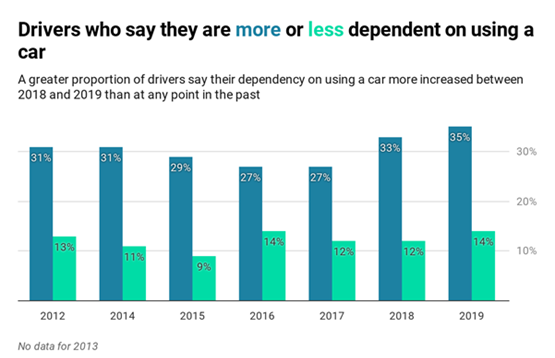
One in three drivers (35%) say they are more dependent on using their car than 12 months ago, with public transport seen as an expensive and unreliable alternative.


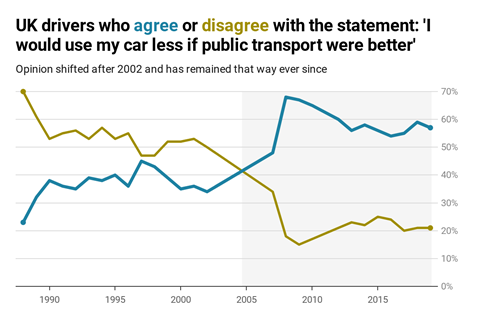
The data, released as part of the latest RAC Report on Motoring, shows that most drivers would use their cars less if public transport was better.


At a time when the Government and local councils are keen for drivers to use their cars less frequently to improve air quality and cut congestion, the RAC believes the findings are a stark reminder that many people, especially those who live outside the biggest cities, remain dependent on their cars for many types of journeys.


Just 14% of drivers say they have become less dependent than a year ago, though this has also increased from 12% in 2018 indicating a small rise in those saying they are less dependent on their vehicles.


The top reasons drivers give for using their cars more are a greater need to transport family members (28%), family and friends moving further away (24%) and, perhaps most strikingly, a reduction in the provision or quality of public transport (25%) – with drivers in the North East (42%) significantly more likely to call this out as a reason for them increasingly turning to the car.


Drivers are particularly frustrated by the lack of feasible alternatives to the car for the journeys they need to make, according to the data.


More than half (57%) say they would be willing to use their cars less if the quality of public transport was better, and agreement with this statement has been high for an incredible 11 consecutive years.


Around half of drivers (53%) say they are frustrated by the lack of feasible alternative modes of transport for long journeys, with a similar proportion (52%) saying the same about short journeys. These figures both rise to 55% for drivers aged between 25 and 44.


Frustrations with public transport


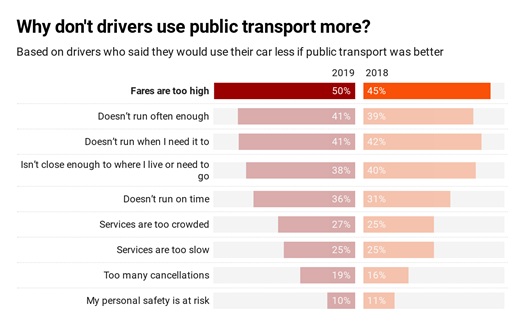
Among drivers who would be willing to use public transport more, half (50%) say the reason they don’t use public transport more is that fares are too high – up by five percentage points on last year – while 41% say services are not frequent enough.


Meanwhile, a growing number of people (36% – up from 31% in 2018) say that a lack of punctuality is a significant barrier to them using public transport as an alternative to driving, and 38% say services don’t run where they need them to.


Of those who would be willing to consider using public transport if services were better, almost a third (31%) say they would make more use of it if there was greater availability of services – a figure that rises to 40% for rural motorists, reflecting to some extent the significant cuts that were made to rail services following the Beeching Report and, more recently, to rural bus services as highlighted last year by the Parliamentary Transport Committee.


The RAC’s findings also show that motorists who live in London are more likely to use alternatives to their cars compared to drivers elsewhere in the UK.


In the capital, on average 38% of each driver’s weekly journeys are made either by public transport, walking or cycling, compared with a national average of just 24%.


For those who live in villages or other rural areas, cars typically account for an enormous 85% of all journeys, with just 15% currently represented by public transport, cycling or walking.


RAC data insight spokesman Rod Dennis said: “These findings present the stark reality for so many people in the UK – that for good or bad, in 2020 the car remains an essential means of getting about whether that is for commuting, dropping off and collecting children or going to visit family and friends.


“While the car might be the obvious choice for many people’s journeys, especially for those who have already invested a lot of money in buying or leasing one, it is also clear just how frustrated many drivers are with the lack of decent alternatives for some of their trips.


“For more than a decade now, drivers have been saying that they are willing to use their cars less if public transport was better – and this year’s figures indicate it’s the high cost and low frequency of services that are the biggest problems cited by drivers. At the same time,


“The ongoing challenge for national and local government, and combined authorities, is therefore to deliver credible alternatives to the car for specific journeys that are regularly completed by a lot of people.


“Connecting large residential areas with popular locations for work would surely be a good starting point – giving drivers the opportunity to swap sitting in daily traffic jams for a fast, frequent alternative.


“Greater investment in walking and cycling infrastructure could also go a long way to encouraging drivers to use of their cars less, especially for short journeys that make up around a quarter of all drivers’ trips.


“But it remains the case that short of cheap, reliable and integrated public transport systems operating all over the UK, it is very difficult to see things changing radically in the years ahead.


“The car remains an integral part of so many people’s lives, whether that is for carrying heavy shopping, transporting family members or going to visit friends in all the corners of the UK.”


In charts and tables: car dependency in the UK

Source: RAC Report on Motoring 2019


  More dependent Less dependent No change
All drivers
Drivers aged 17-24
Drivers aged 25-44
Drivers aged 45-64
Drivers aged 75+
Drivers in towns and cities
Drivers in rural areas

The problems with public transport: insights into bus and rail use

At the end of last year, the Campaign for Better Transport’s Future of Rail report indicated that the cost of rail fares has increased by 47% over the last 10 years, with motoring costs having gone up by 32% over the same period.

The same organisation’s Future of the Bus report also found that national and local funding for buses is now almost £400m a year lower than it was a decade ago.

The last National Travel Survey also showed that bus use is falling across much of England.

Last May meanwhile, the Parliamentary Transport Committee published a report which called for the introduction of a national bus strategy to address the paucity of services available outside of London, where bus provision is regulated by Transport for London.

The committee said that more than 3,000 bus routes had been reduced, withdrawn or altered since 2010-11.

By Graham Hill Thanks To Fleet News

Just To Prove That The Law Can Be Daft

Friday, 21. February 2020

I know that you like to read legal stories that make no sense whatsoever – so here is one that makes no sense whatsoever. It shows that you can be held responsible for the health and safety of anyone who breaks into your property! Totally ridiculous.


The article revolves around the following incident. Click on the link before reading further


https://garagewire.co.uk/news/thief-crushed-to-death-while-stealing-catalytic-converter/


The question was asked – what liability could there be on the garage where someone breaks in and ends up getting injured or getting killed when they are there unlawfully?


Some people think that if you have broken into someone else’s property with ill intent then you deserve anything and everything you get.  This is not so in the eyes of the law – as Norfolk farmer Tony Martin found when he shot burglars encroaching into his home in 1999 killing one of them – as he was sent to prison initially for murder but downgraded to manslaughter due to diminished responsibility.


It is the Occupiers’ Liability Act 1984 which imposes a duty of care on landowners (occupiers) to take reasonable care for the safety of trespassers in respect of any risk of their suffering by reason of any danger due to the state of the premises – or to things done or omitted to be done on them.


The threshold test is set out in Section 1 (3) of the Act which provides that a duty is owed to trespassers in respect of any such risk if


(a)        The occupier is aware of the danger or has reasonable grounds to believe that it exists;


(b)        The occupier knows or has reasonable grounds to believe that the trespasser is in the vicinity of the danger or that he may come into the vicinity of the danger; and


(c)        The risk is one against which, in all the circumstances of the case, the occupier may reasonably be expected to offer the trespasser some protection.


As you can imagine, cases turn on their specific facts such as several years ago when the High Court in Buckett v Staffordshire County Council dismissed a claim brought against them by a Claimant after he fell through a skylight whilst trespassing on the roof a school when he was aged 16.  The court decided that even though his presence on the roof near the skylight ought reasonably to have been foreseen, the council did not owe a duty of care under the Occupiers’ Liability Act 1984 as the skylight’s structure, makeup and location on the roof did not constitute a danger.


Even though children trespassing on the roof and proximity to the skylight was foreseeable, the claimant’s injuries were caused by his own action of jumping onto the skylight.  And because the skylight was not faulty or inherently dangerous, the council was not liable.


This followed a principle set by the House of Lords in Tomlinson v Congleton Borough Council in 2004 where a 12 year old was injured falling on a fire escape when trespassing.  As the fire escape was not defective, in need of repair or otherwise dangerous, the council had no liability. You see what I mean – totally dopey! By Graham Hill

Is It Safe To Pay A Deposit When Ordering A Car?

Friday, 21. February 2020

As many of my readers know I have written about this in the past because it can be very confusing. My work with the BBC and various motoring journals has highlighted some of the crooked methods to extract large ‘deposits’ from customers then mis-state the law in order to prevent paying money back when the customer decides not to go ahead with a purchase.


A law firm has given advice to dealers as follows:


It has long been thought that if a consumer decides to pull out of a car purchase having paid a deposit, that the car dealer is automatically entitled to retain that deposit.  However, there are several important considerations that need to be met before that is allowable, the first of which is especially relevant.


  1. The Consumer Rights Act 2015 says that a contract term may be considered unfair (and thus unenforceable) if it is “A term which has the object or effect of permitting the trader to retain sums paid by the consumer where the consumer decides not to conclude or perform the contract, without providing for the consumer to receive compensation of an equivalent amount from the trader where the trader is the party cancelling the contract. We are advising that your terms/conditions, order form and any document that makes reference to a non-refundable deposit, be reworded as below, followed (where possible) by the consumer’s signature:


“By paying a deposit you are entering into a legally binding contract.  If you change your mind and do not pay the balance due, you will be in breach of contract and we will be entitled to retain the deposit in full and not return it to you.  However, if we are in breach of contract and do not agree to sell you the car upon payment of the balance, we will return your deposit in full and you may be entitled to additional compensation from us up to the full value of the deposit amount”.


  1. The amount of deposit is the most you can retain. You cannot retain a deposit and then on top of that seek losses such as prep time or having to re-advertise or re-selling at a lower value.  The whole purpose of a deposit is that it gives certainty as to what can be lost in the event of contractual beach – regardless of whether your actual loss is greater or less than the amount of the deposit.  HOWEVER………


  1. The deposit figure must be proportionate to the value of the vehicle – you cannot simply seek to punish the buyer by making him pay a hugely disproportionate deposit and retaining it if he or she does not pay the balance. The Court of Appeal ruled in 2016 (and gave a new test of what is allowable) and removed the test of “reasonable pre-estimate of loss” and “penalty clauses” and replaced it with this, somewhat wordy conclusion:


“The true test is whether the impugned provision is a secondary obligation which imposes a detriment on the contract-breaker out of all proportion to any legitimate interest of the innocent party in the enforcement of the primary obligation. The innocent party can have no proper interest in simply punishing the defaulter. His interest is in performance or in some appropriate alternative to performance.[Emphasis added].”


  1. Whilst the courts – and only the courts can decide – we think that a deposit that is greater than 10-15% of the value of the car might be seen as difficult to justify except in very rare circumstances. Maybe where something is being built to such an unusual, bespoke and personal specification that the sale to anyone else other than the actual buyer would be compromised substantially or could only be re-sold at a price significantly less than agreed with the intended buyer (who then did not pay the balance after the deposit was made).


  1. Where a deposit is taken in contemplation that the car will be financed by, say a hire-purchase agreement, the deposit must be refunded if the consumer withdraws from the deal BEFORE all three parties sign the finance agreement – as set out by Section 57 of the Consumer Credit Act 1974 (Withdrawal from a Prospective Agreement). This does NOT form an obligation to fund the purchase of the car by some other means.


  1. Where the consumer cancels the credit agreement within 14 days of all parties signing the credit agreement, then there IS an obligation to buy the car by some alternative means BUT we will argue that this obligation is between the consumer and the finance company (not the dealer) as the finance company have bought the car from the dealer, has good title in it and the dealer is not in breach of contract. Again, though, some finance companies may, in their terms and conditions have a clause that states that the dealer has to indemnify them in the event that this happens!


So, anyone who tells you that the law of refunds of deposits is straight-forward, invite them to read the above!


My advice has always been to pay as little deposit as possible if you need to pay a deposit to secure a car. If possible pay with a credit card as this gives you greater rights. Even the suggestion of 10 – 15% is not reasonable in my opinion.


You can also get your deposit back if it was paid towards the finance of the car as shown above. So if you are paying a deposit and intend the money to be used to pay towards the HP or PCP agreement you should make sure that you make that clear to the dealer and have it written on the receipt. But beware that when the contract has been executed (all parties have signed it) you cannot cancel the contract without the risk of being in breach. Don’t sign the contract till the last minute.


If you have a large deposit to pay towards the finance keep it till the last minute. We only provide contract hire and personal contract hire and we take no money whatsoever until you have received your car. The safest way. The initial rental is taken by direct debit after the car has been delivered and signed for.  By Graham Hill


The Dangers If Your Number Plate Is Cloned

Friday, 21. February 2020

This crime is on the increase as joyriders and thieves get smart and stick on cloned number plates to avoid detection. With more number plate recognition cameras aimed at drivers the crooks were getting caught far too quickly for their liking so they have reverted to making up number plates that they’ve seen on cars in adverts or on the road and sticking them over the original plates.


But what if your number is cloned and you receive a speeding ticket, parking ticket or other penalty? According to a firm of solicitors far too many people ignore the tickets on the basis that they are charged for parking in a car park in an area miles away that they’ve never visited or caught speeding at a time when they were tucked up in bed. But you mustn’t ignore the ticket.


As one lawyer points out: Cloned vehicles can cause havoc, especially when drivers  fail to respond to the notices, sometimes in the belief that if it is not their car, no ruling can be made against them. However, once the process is up and running, drivers need to make sure they respond to any notice and quickly.


In the case of cloned vehicles, you will need a police reference number and photographs of your vehicle to evidence that the vehicle carrying your plates is not the real vehicle.


Even if you respond quickly, chances are that the authority will reject your case which means you will need to go to appeal. Miss the deadlines and you are very likely to lose any chance to appeal and you will find yourself with fines, charges and penalties plus costs to pay and this can ultimately end in a bailiff visit with even more costs to pay.


In short, these cases are a pain and it can be difficult to get the fine discharged on first attempt but if you stick to the deadlines, you will get a chance of an appeal and it is at this appeal stage, that these cases are usually won. So if you receive a parking or icket that you know doesn’t apply to to, don’t just ignore them, act immediately and inform the police that you suspect that your number has been cloned. By Graham Hill

4 Year Lease Agreements And Your Warranty

Friday, 21. February 2020

There has been an increase of late in extensions and customers taking out 4 year PCP, PCH and contract hire agreements. This is done mainly to save money on the monthly rental but after allowing for the various costs that come into play after 3 years you may find that it’s a false saving.


When I looked to extend the lease on my Mercedes E Class I checked with my local dealer and was quoted nearly £900 for a 1 year extension to the Mercedes warranty. Had I leased my car over 4 years the lease cost would have been just £18 + VAT less per month when compared to the 3 year rate.


Then there are other subscriptions such as the Sat Nav which generally come with free updates for 3 years but you have to pay the subscription thereafter. Roadside assistance is also generally included for a minimum of 3 years with all new cars so there’s another extra to pay for. It all adds up.


On top of that, there is service and maintenance and possibly another pair of tyres. Obviously, as the car gets older it requires more wear and tear parts to ne replaced, brake discs, suspension dampers, filters etc.


So this raises the question as to whether it’s worth taking a car over 4 years given the fact that you will need to take out an extended warranty that could represent around half of the down payment on the next car, which of course comes with a new car warranty.


There are of course cars that come with 5 and even 7 year warranties but on closer inspection, you will find that a large number of components drop off cover after 3 years as a result of normal wear and tear. So things are not always as they seem. You could, of course, Google the market for a lower-priced warranty than the manufacturer’s own. However, whilst they love to take your money there are some that hate paying it back out.


Beware of betterment! As cars get older the warranty companies will try it on. Let’s say in the 4th year you have a problem with the gearbox. The manufacturer or the warranty company agrees to replace it under the warranty but as the car is, say three and a half years old they have a betterment clause in their warranty that says, if the replacement part puts the car in a better condition than it was before the part went faulty that you should contribute to the replacement.


So the replacement gearbox could cost you 2 or even £3,000 towards the cost of the replacement gearbox. It’s a scandal. So if you are going to take out a 4-year contract or extend a 3 year contract, check the true cost of that last year and if you extend the warranty check the betterment clause. Also check out Warranty Direct. They may be a little more expensive than some other 3rd party warranties but the have some of the best terms and conditions and no betterment charges. By Graham Hill

Ban On The Sale Of Petrol & Diesel Vehicles Brought Forward To 2035

Thursday, 6. February 2020

The ban on the sale of new petrol and diesel cars and vans will be brought forward to 2035 and will now include hybrids.


The Government had previously announced they would end the sale of new fossil fuel vehicles from 2040 but would still allow the sale of hybrid vehicles that had a zero-emission capability.


However, speaking at the Conservative party conference last October, transport secretary Grant Shapps hinted at bringing the date forward.


Launching the next UN climate conference COP26 today (Tuesday February 4), the Prime Minister Boris Johnson will confirm the much tougher, stricter timetable.


Shapps said: “This Government’s £1.5 billion strategy to make owning an electric vehicle as easy as possible is working – last year alone, a fully electric car was sold every 15 minutes.


“We want to go further than ever before. That’s why we are bringing forward our already ambitious target to end the sale of new petrol and diesel cars to tackle climate change and reduce emissions.”


The Government says it will continue to work with all sectors of industry to accelerate the rollout of zero emission vehicles.


But, the Society of Motor Manufacturers and Traders (SMMT), which represents car and van makers in the UK, says the Government has set the new target without a plan showing how it intends to get there.


Mike Hawes, SMMT chief executive, said: “Manufacturers are fully invested in a zero emissions future, with some 60 plug-in models now on the market and 34 more coming in 2020. However, with current demand for this still expensive technology still just a fraction of sales, it’s clear that accelerating an already very challenging ambition will take more than industry investment.


“This is about market transformation, yet we still don’t have clarity on the future of the plug-in car grant – the most significant driver of EV uptake – which ends in just 60 days’ time, while the UK’s charging network is still woefully inadequate.


“If the UK is to lead the global zero emissions agenda, we need a competitive marketplace and a competitive business environment to encourage manufacturers to sell and build here.


“A date without a plan will merely destroy value today. So we therefore need to hear how government plans to fulfil its ambitions in a sustainable way, one that safeguards industry and jobs, allows people from all income groups and regions to adapt and benefit, and, crucially, does not undermine sales of today’s low emission technologies, including popular hybrids, all of which are essential to deliver air quality and climate change goals now.”


Helen Clarkson, CEO of the international non-profit The Climate Group, welcomed the “more ambitious” target from the Government.


However, she said: “We believe that this could still be sooner – and that to be a global leader, especially post-Brexit, a 2030 phase-out commitment is required; without this, we risk being out of step with our international peers.


“Our business campaign for the 100% adoption of electric vehicles by 2030, EV100, has 62 corporate members, many of which are British, including AstraZeneca, BT, Centrica, Foxtons, Mitie, RBS, SSE and Unilever. Businesses are showing what is possible and The Climate Group would love to see this level of ambition matched.”


Through EV100, the UK has the second highest number of corporate fleet vehicles committed to switching to electric, after Germany.


Government policy must be strong and consistent to accelerate this transition, and to help the UK become a world leader on electric vehicles, it says.


So far, eight countries have already committed to more ambitious phase-out dates than the UK, while Scotland has had a 2032 phase-out date for new petrol and diesel vehicles in place since 2017.


The RAC was not surprised by the Government’s plan to bring forward the date to ban the sale of petrol and diesel vehicles.


RAC head of policy Nicholas Lyes said: “A more ambitious target should be the catalyst for faster change, but there are clearly many hurdles to cross.


“Manufacturers face a great challenge in switching their production from conventional powertrains to cleaner electric technology.


“More electric vehicles (EVs) will also require a great deal of investment in charging infrastructure – particularly for those who rely on on-street parking outside their homes.”


Lyes also believes that we should not overlook the role plug-in hybrid vehicles could play in bridging the gap to going completely electric.


“In the meantime we urge the Government to extend the plug-in car grant for at least another three years to help those that want to go electric, but who are put off by the high initial costs,” he said.


“At a local level, authorities should also incentivise their use with cheaper parking rates and lower residents’ parking permit fees.” By Graham Hill thanks to Fleet News

Fleet News Reveals Increase In Personal Contract Hire (PCH)

Thursday, 6. February 2020

The split between business/fleet funding and private/retail for cars has changed dramatically over the past year.


Private/retail now accounts for 18% of the FN50’s car risk fleet, up from 12.8% in 2018, reflecting the increasing popularity of personal contract hire (PCH) products.


“There’s nothing new about the ‘cash or car’ conundrum,” says Ben Creswick, managing director of JCT600 VLS.


“However, there is no doubt the radical changes to the industry over the past 24 months have made this conversation much more prevalent.”


Where a company wishes to support employees by offering an alternative, JCT600 VLS says this has been done through a ‘structured’ PCH offering, where duty of care is tightly controlled and, typically, the financial model is based on a business mileage reimbursement mechanism, rather than pure salary.


However, as with all historical fluctuations in the company car market, Creswick says this is not applicable to the entire populace.


He explains: “For the majority of our customers’ core fleet requirements, business contract hire remains the most cost-effective for the business and the driver.


“While (JCT600) VLS has not seen a material change to PCH, what we have witnessed in the overall marketplace is an aggressive push into ‘affinity’ PCH, as a way of mitigating poor levels of traditional BCH (business contract hire) growth, or to soften the degree of fleet shrinkage within leasing companies.”


The impact of OpRA


The British Vehicle Rental and Leasing Association (BVRLA) says PCH accounted for 68% of all new leasing broker car contracts in 2018 and, across its membership, personal contracts saw the highest level of growth at 14%, accounting for nearly 1.9 million vehicles.


Looking at all the funding methods offered by the top 50 leasing companies, contract hire/operating lease retains its dominant position for financing cars.


Out of the 1.26 million cars on the FN50’s risk fleet, 92% are classed as an operating lease, where the leasing company takes the residual value risk. That is up slightly year-on-year from 91% in 2018; contract hire/finance lease also increased, from 2% to 3.1%.


Salary sacrifice retained its risk fleet share, with 3.9% of cars funded this way compared with 4% in 2018.


Meanwhile, employee car ownership (ECO) schemes (0.4%) and others (0.6%) both saw slight declines.


Ashley Barnett, head of consultancy at Lex Autolease, says: “Since the introduction of Optional Remuneration Arrangements (OpRA) in 2017, which saw employees taxed on the greater of the cash allowance foregone or the company car benefit, we saw increased complexity added to employee car ownership schemes and salary sacrifice arrangements.


“Many customers using these products exited, and new interest reduced.


“This saw contract hire continue to be the funding product of choice for the traditional company car user.


“Perk users who have the option to take a cash alternative are showing continued interested in PCH as they move away from traditional company car schemes into the consumer market.


“Most are using this option as a means of avoiding restrictions typically associated with company car policies such as emissions caps and restrictions on makes and models that often aren’t monitored in grey fleet.”


Arval, like many of the FN50, offers PCH products and other alternatives to the traditional company car.


“These have been growing, especially over the last year, because of the long period of uncertainty surrounding company car taxation and WLTP,” it says.


The absence of future benefit-in-kind (BIK) rates, and uncertainty over how the tax regime would adapt to the new emissions test – the Worldwide harmonised Light vehicle Test Procedure (WLTP) – had been blamed, in part, for falling company car numbers.


BIK statistics, published by HMRC in the summer, showed the number of company car drivers had fallen by 50,000 year-on-year.


However, tax officials said initial analysis suggested a new way of reporting company car tax could have skewed the figures.


How many company car users are there?

Since 2009-10, the number of company car users had remained relatively stable (at just under a million). But, the latest data indicated a dramatic fall from 940,000 in 2016/17 to 890,000 in 2017/18 – a 5.3% decline.


Another company car market indicator, fleet and business sales, shows registrations down by 1.7% last year, according to data from the Society of Motor Manufacturers and Traders (SMMT).


However, that could simply be due to employees and companies keeping cars for longer as they awaited BIK clarification, rather than a reduction in company cars.


The tax picture was finally clarified last summer, with the Treasury publishing two tax tables, one for cars registered before April 2020, and one for those registered after. BIK rates were also published up to April 2023, and there was a new 0% BIK rate for pure electric vehicles (EVs).


Leasing companies report a surge in fleet orders, with company car drivers and businesses eager to take advantage of the tax rates for the cleanest cars.


Arval says: “It’s important to recognise the reason people have been moving out of company cars has been the ongoing uncertainty around their personal tax, rather than any structural change in its effectiveness as a business tool or employee benefit. Faced with an unknown cost, they have been using the cash option to fund a PCH, effectively the nearest alternative.”


It is a trend reported by many in the FN50. Dominic Graf, head of commercial performance at Alphabet, explains: “We’re not seeing any significant movement in the funding methods being used by businesses to give employees access to cars; what we are seeing is a change in how they gain access to these funding products.”


Over the past 12 months, it has seen a 120% increase in its private/retail fleet – albeit from a low base – as employees opting out, or being provided with a cash allowance, look at PCH options.


Lex Autolease has also seen an increase in interest from previous company car drivers in PCH products, but Barnett warns: “Many should take care when seeing deals with low mileage, needing to realise that this presents a new restriction compared with the company car environment, and that, along with wear and tear, might lead to additional charges.”


LeasePlan created Select and Drive, a members-only, employer-endorsed web platform, to offer cash-taking employees access to cars.


Matthew Walters, head of consultancy and customer data services at LeasePlan UK, predicts: “Segmenting your fleet to various populations to ensure the fleet provision is right for the employee and the business will become an important factor in ensuring that the fleet strategy is future-proof for tomorrow.” By Graham Hill thanks to Fleet News