RAC Patrols Called Out To A Pothole Breakdown Every Hour

Friday, 17. January 2020

The RAC saw a 20% upturn in pothole-related breakdowns in the last quarter of 2019, compared to the same period the year before.


It attended more than 2,000 breakdowns in the three months to the end of 2019 believed to be as a result of potholes – 300 more than during the same period in 2018.


The breakdown data, released to coincide with National Pothole Day, also showed that of all the breakdowns experienced by RAC members in 2019, just short of 9,200 were for pothole-related faults such as distorted wheels, broken suspensions springs and damaged shock absorbers.


While this was down from 13,000 in 2018, a year which saw a dramatic increase in potholes following the so-called ‘Beast from the East’, it still represented 1.1% of all breakdowns attended.


Between October and December 2019, 0.9% of all breakdowns were for pothole-related faults, up from 0.8% in the previous three months (July to September 2019) and up from 0.8% in the fourth quarter of 2018.


RAC head of roads policy Nicholas Lyes said: “We might so far be experiencing a milder but wetter winter than in the last couple of years, but our figures clearly show the problem of potholes has not gone away.


“Our patrols are still attending on average around one pothole-related breakdown every hour of the day.”


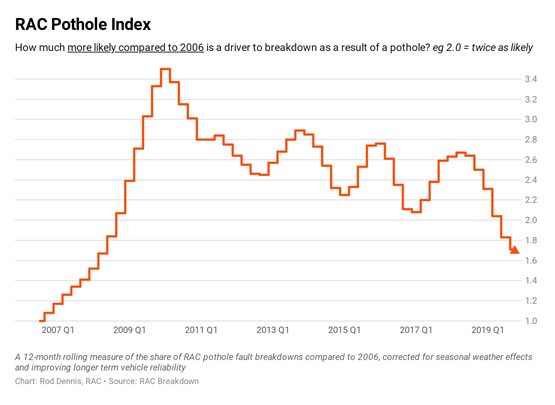
The RAC’s Pothole Index, which is an accurate long-term indicator of the health of the UK’s roads, suggests the widespread problem of potholes and poor-quality roads remains as the Index currently stands at 1.7, down from 1.8 in the third quarter of 2019.


This means drivers are 1.7 times more likely to break down as a result of pothole-related damage than they were back in 2006 when the RAC first started collecting data.


Lyes continued: “We anticipate the Government will pledge further funds to help cash-strapped councils mend potholes in the March Budget, but such pledges are only chipping away at the problem, and they’re unfortunately not addressing the root cause of why so much of the UK is still characterised by crumbling road surfaces.


“What we need is for central Government to think differently about how councils are funded to maintain the roads under their control.


“Short-term commitments of cash, while welcome, are not enough on their own – councils need the security of long-term funding so they can plan proper preventative road maintenance.”


Lyes believes a solution to the UK’s long-term pothole problem is possible. “From this year, the money raised from vehicle excise duty in England will be ring-fenced to help fund motorways and major A-roads over successive five-year periods,” he said. “But as yet, there is no similar model for local roads where the vast majority of drivers begin and end their journeys.


“We believe this could easily be changed by ring-fencing 2p a litre from existing fuel duty revenue to generate £4.7bn of additional funding over five years.


“Pothole-free roads shouldn’t be a ‘nice to have’ in 2020, drivers should surely be able to expect the vast majority of roads they drive on to be of a good standard, especially given they pay around £40bn in motoring-related tax every year.”


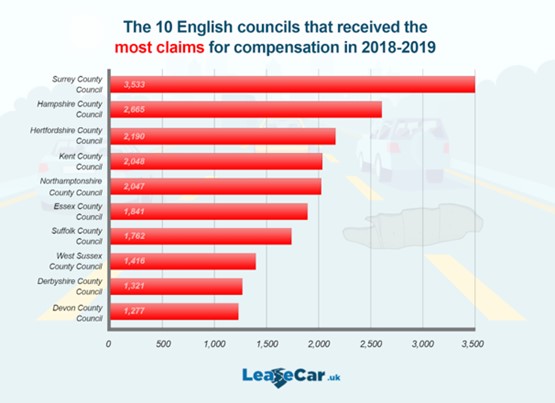
Researchers from car leasing giants LeaseCar.uk have revealed the English councils that received the highest number of compensation requests from vehicle owners due to pothole damage over 2018-2019.


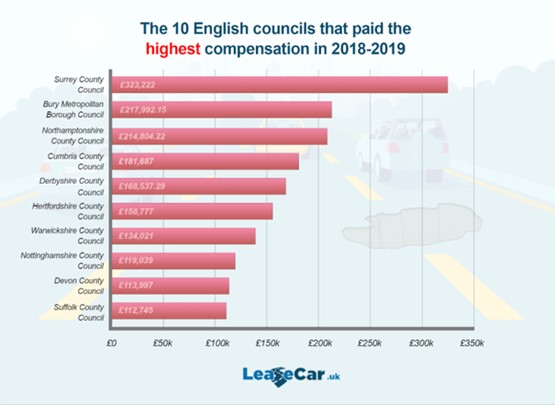
They have also revealed the amounts paid out to motorists, with Surrey topping both lists.


A total of 37,578 relevant claims were made across England during the period in question, with poorly maintained roads meaning councils compensated motorists to the tune of £3.5 million.


Surrey County Council received by far the most claims for pothole damage – 3,533 – and paid out the most in compensation – £323,222.


Hampshire (2,665), Hertfordshire, Kent and Northamptonshire County Councils also faced over 2,000 claims each throughout 2018-2019, with counties such as Essex (1,841) and West Sussex among those comfortably topping 1,000.


Other local authorities paying out substantial amounts of compensation include Bury Metropolitan Borough (£217,992.15) in Greater Manchester.


Cumbria, Derbyshire, Nottinghamshire, Northamptonshire (£214,804.22), Warwickshire, Suffolk and Devon also paid out six figure sums.


The only councils that didn’t have to use a single penny of taxpayers’ money to compensate motorists were the Greater London Boroughs of Islington and Sutton.


Rotherham Metropolitan Borough Council, Sefton Borough Council on Merseyside and St Helens Council were among others to keep compensation for pothole damage to a minimum.


They paid out just £353, £582.60 and £594 respectively, with the local authorities in Harrow, Hounslow, Redbridge and Waltham Forest also received bills of less than £1,000.


Only two claims were issued, meanwhile, against Richmond upon Thames Borough Council – 21 less than any other area in England.


A spokesperson for LeaseCar.uk said: “Taking greater steps to repair and prevent potholes would improve safety for road users and be popular among the voters across the country that councillors are accountable to.


“It could also ultimately reduce councils’ costs by bringing down the number of successful compensation claims by long suffering vehicle owners.


“We’d advise any driver who drives over a significant pothole, or is worried their vehicle may have been damaged, to urgently check their tyres and suspension.”


The data was obtained by Freedom of Information request and covers the period January 1 2018 to October 17 2019.


The full breakdown of English councils and their claims for compensation is available here.


To report a pothole, or to find out if you suffer from damage from one and wonder if you can claim for compensation, visit the RAC’s pothole online guide.


By Graham Hill with thanks to Fleet News

Electric & Hybrid Car Registrations Exceed 72,000 In 2019

Friday, 17. January 2020

More than 72,000 electric and plug-in hybrid cars were registered in 2019, marking the eighth consecutive year of growth.


Pure electric models accounted for 37,850 registrations, overtaking plug-in hybrids for the first time in the annual sales figures. But still make up less than 2% of the total registrations in 2019.


Combined, alternatively fuelled vehicle (AFV) registrations achieved a record 7.4% market share. However, it was hybrid electric vehicles (HEVs) that were the most popular, with registrations of 97,850 units.


Poppy Welch, head of Go Ultra Low, said: “In the context of the wider new car market, it is encouraging to see plug-in car registrations continue to go from strength-to-strength. Looking at the year ahead, 2020 is set to be another fantastic year for electric car uptake.


“With even more new models being released, ongoing government support, as well as the continued expansion of the public charging infrastructure, we’re confident that the next 12 months will be a landmark year for the nation’s switch to electric.”


2020 has the potential to be another strong year for registrations as a host of models are set to be introduced, including the Peugeot e-208, Volkswagen ID3, Vauxhall Corsa-e, Skoda Citigo-e, and Mini Electric just some of the new cars due to hit the roads.


It is also the year that Benefit-in-kind tax is due to drop to 0% for company car drivers choosing a zero-emission vehicle, increasing demand for EVs among fleet customers substantially.


Grant Shapps, Transport Secretary, said: “I want 2020 to be the year electric cars go mainstream. That’s why we are doubling-down our efforts to make owning an electric vehicle the new normal.”


Towns and cities with the highest electric car registrations


Exeter has been revealed as the UK’s greenest motoring hotspot, with the fastest growth in ultra-low emission vehicle (ULEV) ownership since 2018, up more than 150%, according to registration data analysed by Motorway.co.uk.


According to the data, seven of the top ten local authorities for ULEV registrations since 2018 are London boroughs, with Newham and Waltham Forest seeing annual growth of 114% and 82% respectively.


At the bottom of the green motoring table are Sunderland and Wychavon, a district in Worcestershire, where ULEV numbers have grown less than 7% over the past 12 months.


“These figures show a huge disparity between areas that are embracing greener motoring and areas where take-up of ULEVs is in the slow lane. They highlight the need to focus not just at a national level, but also to confront issues at a regional level in areas where ULEV take-up is lagging behind.


“The government is now under tremendous pressure to encourage motorists to move to electric cars and other forms of ultra-low emissions vehicles in time for the 2040 switchover,” said Alex Buttle, director of Motorway.co.uk.


Top 10 local authorities that have seen the fastest growth in ULEV registrations:


Local Authority Number of ULEVs registered

(Q3-2018)

Number of ULEVs registered

(Q3-2019)

% Increase in ULEVs
Exeter 464 1,194 157.3%
Warwick 414 943 127.8%
Newham 307 657 114.0%
Waltham Forest 330 602 82.4%
Redbridge 525 948 80.6%
Islington 570 1,026 80.0%
Tower Hamlets 559 1,003 79.4%
South Northamptonshire 320 571 78.4%
Barking & Dagenham 255 449 76.1%
Enfield 549 958 74.5%


By Graham Hill with thanks to Fleet News

Auto Express Warns Of Reduced Car Choice From 2020

Thursday, 9. January 2020

Thanks to manufacturers registering cars like crazy at the end of 2019, now could be the perfect time to buy a new car


Happy New Year – and it has the potential to be a very happy one indeed if you’re one of those people wandering into car showrooms over the next month. The fact is, there may never be a better time to buy a new car than right now, thanks to manufacturers having to register vehicles like crazy in the last few weeks of 2019 – in the hope of selling cleaner ones over the next 12 months and avoiding huge penalties for excess CO2 emissions.


It’s already clear that the market from which we choose which cars to buy, own and drive is going to be radically different at the end of 2020 from how it is now. More than the proliferation of electrified and pure-electric models and, perversely, the continued gains by the SUV, we’re going to see reduced model ranges, with limited supply on less efficient variants as manufacturers actively force the issue on CO2. They can’t afford not to.


It’s reassuring, then, to read in our scoop this week that Skoda plans to offer its upcoming Octavia vRS with a choice of petrol, plug-in hybrid and even diesel. We remain convinced that different powertrains and fuel sources make sense to different buyers.


But it seems likely that this diverse approach isn’t going to be uniform. Indeed, there have been suggestions that we’re heading into a period where car retailers may be actively trying, at a level never experienced before, to push customers away from the cars they want to buy and towards the models the company desperately needs to sell.


Our advice, as always, is to do your so you know which model, engine and trim best suit your lifestyle and budget. Write it down. Keep it at the front of your mind. And stick to your guns. Then you stand every chance of getting the car you want, at a better price than you might expect. By Grahan Hill thanks to Auto Express

Insurance Black Boxes Flawed & Causing Drivers Problems

Thursday, 9. January 2020

‘Intrusive’ black box technology criticised as insurers force policyholders to defend anomalies in the telematics data from their cars.


Black box car insurance policies – which see location and driving data used to set insurance premiums – have been slammed as “exploitative data-for-discounts schemes”, amid privacy concerns and a series of complaints that malfunctioning black boxes have seen drivers threatened with cancelled insurance policies.


The Financial Ombudsman Service (FOS), which regulates the UK insurance industry, admitted in 2018 that it had received complaints from “a number of people who believed the data their ‘black box’ had collected wasn’t right”. Those growing numbers may be linked to the increasing use of black-box policies, but a worrying number of readers have contacted Auto Express to complain that their telematics devices had gone wrong – sometimes significantly so.


“106mph” in a 30 limit


Emily D wrote to us after her black box provider E-mailed, claiming that she had spent an extended period driving at 106mph in a 30mph limit. As well as being a speed Emily said she would “never dream” of reaching, the location of the alleged incident meant she would have had to travel 120 miles from her home in less than a minute. Her black box also deemed a local road with

a 60mph limit to be a 30mph zone.


Emily contacted her insurer, and it admitted that the results were “bogus”, although the company assured her false readings such as this were “very rare”.


“I wasn’t impressed to say the least,” Emily said. “Is it really worth having a black box if they’re this faulty? It seems insurers need to update or upgrade them, or just stop using them altogether.”


Case study: Ian L’s daughter


Because telematics insurance is typically purchased by new drivers who otherwise struggle to get affordable cover, many of those with malfunctioning black boxes are young, and may not be experienced in handling complex complaints. So when Ian L’s daughter received an E-mail telling her that her insurance would be cancelled within seven days due to her allegedly poor driving, Ian contacted the company on her behalf.


From day one, Ian’s daughter had complained about the accuracy of the black box, which rarely marked her acceleration and braking above 0 out of 100. Ian said his daughter drove sensibly and appropriately, and had even been given discounts for her driving with previous telematics policies.


After hours spent on the phone, Ian was able to get the cancellation delayed while the insurer reviewed the data. Ian asked the company to provide specific journey times where the infringements had allegedly taken place. These investigations uncovered incorrect data had been logged by the black box, and the company agreed to strike the low scores from Ian’s daughter’s records.


Ian told us: “I can see the benefits to insurers of the black-box system, but the heartache it causes when data is inaccurate is not advantageous to good driving habits, as it shifts the focus from correct driving procedures to fear.”


Rising black box complaints


The FOS doesn’t track how many complaints it receives over black box insurance. The organisation does, however, log the total number of complaints it receives for car and motorcycle insurance, and this almost doubled from 7,190 in the 2013/14 financial year, to 12,977 in 2018/19.


While there is no way of telling how many of these complaints related to telematics insurance, the British Insurers’ Brokers Association estimates there were just 296,000 black box policies in 2013, and around one million today.


Commenting on our investigation, Silkie Carlo, director of privacy group Big Brother Watch, said: “Affordable insurance shouldn’t be predicated on intrusive surveillance and profiling.” Carlo said the fact black boxes malfunction is “totally absurd”, and added: “We oppose these exploitative data-for-discounts schemes and urge insurance companies and customers alike to reconsider using them.”


The Association of British Insurers said that black-box insurance was of “particular benefit” to young drivers, and advised: “Where a motorist is unhappy with their device and believes the information recorded is inaccurate, they should speak to their insurer, who should investigate.”


A spokesperson from the FOS said drivers should complain to their insurer if they feel that their black box device has malfunctioned. If this does not solve the issue, they should contact the FOS, which would “decide if the insurer has treated you fairly and [has] the power to put things right if they haven’t”.


Cancelled policies have to be declared forever


While insurance companies will only ask about speeding convictions issued within the last five years, and even drink-drive convictions become ‘spent’ after 11 years, anyone who has ever had an insurance policy cancelled on them – as can happen with malfunctioning black boxes – must declare this for the rest of their motoring life. As a result, cover may be permanently harder and more expensive to secure.


Drivers whose cancelled black-box policies are subsequently overturned on the basis of faulty data are advised by the Financial Ombudsman Service to get written evidence to explain this cancellation to future insurers. However, this will be cold comfort to innocent drivers who are unable to prove that their black boxes have malfunctioned.


Reader’s complaint highlighted box issues


In May 2018, we investigated the case of student Cydney Crean, who had been accused by her insurer of speeding on three separate occasions, despite time-stamped home CCTV footage clearly showing her Fiat 500 parked on her driveway when the alleged offences took place.


Cydney’s insurer said it would cancel her policy, but after our intervention admitted “the clocks changing to British Summer Time” had caused “data inconsistencies” in her black box. Cydney’s insurer maintained she had been speeding, but despite this claim fitted a new telematics device to her car, arranged a 50 per cent discount for the remaining balance of the policy, and offered £150 in compensation. By Graham Hill thanks to Auto Express

Car Parking Firms Forced To Relax Rules On Fines

Thursday, 9. January 2020

The last thing you want to do is have to key in your car registration  number when you are nipping down the shops.


What is worse is when you key in the registration and get a character or number wrong resulting in a fine for not having paid the fee. You then have a fight on your hands but that is about to change.


Car park operators have been told by the British Parking Association not to penalise motorists who make a mistake when typing vehicle details.


It has published a revised code of practice for parking on private land, which includes guidance on grace periods, self-ticketing as well as motorist keying errors.


The enhancements, it says, will ensure Approved Operator Scheme (AOS) members are delivering a high standard of service for motorists.


A minor keying in error is categorised as one letter or number incorrect or letters and numbers in the wrong order.


A major keying in error is one that has multiple number and letter keying errors, the first three digits only have been recorded or a completely incorrect registration number is used.


Steve Clark, BPA head of business operations, said: “Following consultation with key stakeholders, including consumer groups and Government, we are delighted to release the latest version of our leading AOS Code of Practice.


“We recognise that genuine mistakes can occur, which may result in a parking charge being issued even when a motorist can demonstrate they paid for their parking. In recognition of this we have further clarified the situation for all parties.”


He added: “Motorists will still need to appeal, but we expect our members to deal with them appropriately at the first appeal stage.”


The BPA continues to work closely with Government on The Parking (Code of Practice) Act. The Act, it says, supports its call for a standard setting body, a single code of practice, and a single independent appeals service.


John Gallagher, lead adjudicator at Parking on Private Land Appeals (POPLA), welcomed the publication of the revised code.


He said: “The revised code will bring greater clarity for motorists and parking operators alike on issues such as simple keying errors and grace periods.


“The introduction of a section on keying errors, requiring parking operators to cancel Parking Charge Notices in certain circumstances and reduce the amount to only administration costs in others, is particularly welcome.


“This addition to the code means that, for the first time, POPLA will be able to make decisions on keying errors without referral back to the operator.


“We would like to thank the BPA for listening to our feedback on this and other issues – and involving us in ongoing discussions on the best way to ensure a fair system that protects motorists.” By Graham Hill thanks to Fleet News

Claiming Mental Health Damage When Buying A Faulty Car

Thursday, 9. January 2020

This is an interesting case forwarded by a lawyer friend of mine. Buy a faulty car and the law is on your side. Your rights were strengthened by the Consumer Rights Act 2015. Within the first 30 days you can return a faulty car and demand your money back but we all know that life isn’t that simple with dealers pretty much refusing point-blank to take back the car.


This can lead to a lot of distress which isn’t covered by the act but is the point of this case. Here is what was said by the defending lawyer, defending the car dealer:


The driver took the dealer to court claiming that the car he bought was faulty. An element of the claim contained words to the effect that they demanded in the region of £2,000 in compensation for the distress caused – resulting in a deterioration in the buyer’s mental health.


Part of the defence was that if any part of a claim was for damages (compensation) for personal injury (physical, mental or psychological) then the whole claim was subject to compliance with the Pre-Action Protocol on Personal Injury.


And that as the amount sought was over £1,000 the case had to be allocated to fast track not to small claims. £1.000 is the threshold for personal injury claims to be held in the “small claims” track of the county court.  The lawyers invited the court to dismiss the whole of the claim because none of the claimant’s actions prior to issuing the claim had followed the mandatory Pre-Action protocol.


The court held a preliminary hearing and convinced the claimant not to pursue the mental health aspect of the claim.  According to the lawyers, they suspected that the Judge was generally unimpressed by the claimant and encouraged the parties to come to a settlement out of court purely on the issue of the value of the car alone – and nothing else.


The parties agreed to such a settlement there and then, which was endorsed by the court – but not giving the claimant anything towards the substantial issue fee that the claimant had paid to issue the claim in the first place.


Whilst the lawyers were obviously pleased with the outcome this is a real problem. I hear all the time about problems faced by drivers with dealers, both new car and used car dealers, who provide a dreadful service and cause a great deal of unnecessary grief which is never compensated for. Something needs to be done to stop disputes getting to these ridiculous level where consumers are affected mentally. By Graham Hill


A Dealer Scam Costing Them A Fortune

I don’t usually have a lot of sympathy for dealers but when I read about this scam going round catching dealers out I had to feel sorry as they’ve done nothing wrong. It involves taking payment for cars by Debit Card. Here’s the scam as revealed by a lawyer with a warning to car dealers:


The scenario is this. Customer purchases a vehicle. They pay with one, maybe two debit cards. They collect the car (but more usually ask to have it delivered) and are very happy. They are so happy in fact that they later look to purchase a second car.


The previous sale went without issues, there have been no complaints and so you sell the second car. They may come back for a third or more. All is well. Then, out of the blue 3 months later, your bank take all the money for those cars out of your account and so you have no cars, no cash.


The buyer has done a bunk and you are left with a fight on your hands to a) track down the vehicle and b) try and make a civil case that title never passed to your original buyer (the fraudster) and so you can have the car back.


These cases are never straightforward as you, as a car dealer, can imagine as you could find yourself in the position of the dealer who has been the victim of the chargeback or you might be the dealer who purchased the car further down the line in good faith. Who wins? Well, that is for the court to decide as the police will generally consider it a civil matter and each case can be determined on its merits as all these cases will have different facts despite being the similar bigger picture.


Going forward, be aware that chargebacks can typically be made by a cardholder up to 4 months after a sale. Bank transfer is a much better option. If someone is buying multiple cars with debit cards, then ensure it raises a red flag, even when you have all the information needed for the bank to process the transaction and especially, if they ask to have the car delivered.


So it’s not all one-sided with dealers always coming out on top. This scam is costing dealers a great deal of money. OK, sympathy for dealers over! By Graham Hill

We Are Moving Closer To Green Number Plates

Thursday, 9. January 2020

A consultation was launched in October 2019 into the merits of issuing zero emission cars with green number plates. The idea was to be able to identify the greenest of vehicles so that local authorities could, as an incentive, offer drivers cheaper or free parking, possible use of bus lanes etc.


The plates may be all green, have a green verticle bar down one edge or have a large green dot on one side of the plate. Simple plate recognition could identify the cars. Now where did I put my pot of green reflective paint? And that could be the problem. Drivers either modifying their number plates to appear like a ‘green’ number plate or buy a set of dodgy plates made up as though the car is zero-emission.


If the Government gets it right the new plates could also capture snob appeal making drivers of cars with green number plates ‘Holier than though’ to impress the neighbours and work colleagues.


A big boost to the sale of zero-emission cars will be lower lease rates which a couple of manufacturers and leasing companies have already addressed. So far in 2020 we have seen the VW eGolf at its lowest ever rate as well as the Nissan Leaf. Contact GHA Finance for the latest deals and offers.


A personal view from Graham Hill:


As part of this study, the Government is proposing to invest £1.5 billion into the drive towards total zero-emission cars. This includes home chargers built into every new house and increasing the number of charge points.


Now I’m not being funny but I don’t have a tank and pump installed at home to top up my petrol car. Why, because I can pop into my local petrol station and top up in a matter of minutes. The average time is 8-12 minutes. The latest BP 150kW Ultra Fast Chargers take, according to BP and independent checkers around 15 – 20 minutes to provide a complete charge. 10 minutes should provide about 100 miles of charge.


So why are we hell-bent on creating a national network of  home, street and car park chargers when all we should be doing is investing in even faster chargers and batteries capable of withstanding the fast charging. Inevitably there will be many who will charge at home or in car parks as the cost of charging will be cheaper so even if cars are a little longer at charge points it won’t cause congestion as fewer cars will use them as many will be charging at home.


My idea would be a set of charge pads that drivers drive over. The number recognition system tells the charge point whether you have an account or not and a screen entry on the dashboard allows you to select the charge and cost. If you don’t have an account you enter card details into the charge pod.


You then sit in the car for say 10-15 minutes whilst the car is charged. A screen drops down in front of you with advertising on it. The charge to the advertisers could subsidise the cost of electricity. Doesn’t sound like rocket science to me! By Graham Hill

We Need Honesty & Clear Direction Over Diesel From The Government

Thursday, 2. January 2020

Only one in 10 new car sales could be diesel in as little as five years, says a leading academic.


Currently, one-in-four of new cars sold is powered by the fuel, a dramatic decline from the parity with petrol it enjoyed just a few years ago.


Its popularity is also on the wane in the company car market, where it has traditionally dominated thanks to its tax-friendly CO2 performance.


New figures show that the proportion of diesel cars on the FN50 fleet – the UK’s top 50 leasing companies by risk fleet size – fell from almost two-thirds (63.4%) to close to half (50.5%) over the past 12 months.


In terms of vehicles they had ordered in the past year, the flight from diesel was still more pronounced. Almost half of the cars ordered in 2019 were petrol (47.6%), while only two-fifths (38.8%) were diesel.


David Bailey, Professor of Business Economics at the Birmingham Business School, said: “There seems to be no end to the decline in diesels.”


Overall, diesel new car sales are down by more than a fifth in the past year. Some 515,000 units have been sold year-to-date, compared with 650,000 during the previous 12 months, data from the UK automotive trade body, the Society of Motor Manufacturers and Traders (SMMT), shows.


Forecasters say that, with the sharp falls seen in the sale of new diesel cars since 2017, it could lead to an undersupply of used vehicles in 2020 and 2021, which would help sustain residual values. However, it’s unclear whether the decline in new diesel car sales will be mirrored in the used car market. The most recent figures from the SMMT show that demand for used diesels grew by 1.4% in the third quarter, with some 858,442 changing hands.


“A big shift away from diesel is still taking place,” said Bailey. “In late 2015, diesel accounted for more than 50% of the market, by March last year it was down to 32% and it has fallen further since then.”


The UK is not alone in turning its back on the fuel; its decline is being seen across Europe. In the key market of Germany, diesel’s share has fallen below 30% from having accounted for half the market and to a similar level in France, where three-quarters of new car sales were once diesel.


Bailey said: “We are seeing this continuing decline and, while I originally thought the market share for diesel by 2025 would be down to 15%, I now think that’s quite optimistic – it may be as low as 10%.”


Despite its popularity in Europe, diesel has not enjoyed similar market penetration in other countries. “It’s negligible in North America, it’s only 4% at best in China and virtually insignificant elsewhere,” he said.


“If you go back to the turn of the century, diesel as a share of the market in Europe was only 10-15%. We then gave (the fuel) loads of tax breaks, because we thought it was good for the environment.”


Dieselgate followed however, and concerns over the fuel’s impact on air quality has put its market share on a downward trajectory.


Bailey told delegates at a recent Vehicle Remarketing Association (VRA) seminar the trouble is “people are completely freaked out over diesels”.


He said: “They are concerned about falling resale values, they are worried about tighter regulations in cities, higher taxes and its impact on the environment.”


He says Government policy has not helped either, labelling it a “complete shambles”.


“One part of Government has been saying ‘clean diesels are good’, while another part whacks a load of tax on them.”


Government has, however, introduced tax breaks for diesel company cars, which meet strict emissions limits defined by the RDE2 standard.


Company car drivers are exempt from the 4% benefit-in-kind (BIK) diesel surcharge, while fleets benefit from not having to pay the higher first-year rate of VED on new diesel cars.


The NOx limit for the RDE2 standard, which is measured on the road, is up to 1.43 times the Euro 6 lab limit of 80mg/km for diesel and 60mg/km for petrol. Cars achieving this limit are labelled Euro 6d.


Cars achieving RDE1, which allows for a margin of error two times the actual limit, are classified as Euro 6d-temp.


RDE2 will apply to all new registrations from January 1, 2021, before the margin for error – the conformity factor – is removed by 2023.


Peter Golding, managing director at FleetCheck, believes that 2020 could turn out to be a make or break year for diesel, with the success of Euro 6d cars key. However, he acknowledges the outlook is not promising when Bristol’s proposed diesel city centre car ban will not apply to older petrol vehicles, with potentially worse emissions than the latest RDE2 diesels.


“RDE2, effectively, puts diesel on a roughly equal footing with petrol from an emissions point of view,” he said. “The question is whether everyone from legislators to the general public are willing or able to make that distinction.”  By Graham Hill Thanks To Fleet News.

Stolen Prestige Cars Sold Unbelievably Cheaply.

Thursday, 2. January 2020

Car thieves are stealing some of the most desirable cars and selling them on the black market for as little as £1,000, according to vehicle protection and management technology provider AX.


The most sought-after vehicles – usually those with a higher street value – include models from prestige brands such as Audi, BMW and Mercedes.


Despite costing from between £18,000-£100,000 to buy new, the vehicles are stolen and quickly sold on for a fraction of their retail or used value – sometimes for just £1,000.


The investigation by AX further exposes the activities of car theft gangs as Home Office figures show the number of vehicles stolen in Britain has almost doubled in the last five years.


According to an AX source, criminals have put a black-market value of just £1,000 on an Audi A1, while a Range Rover, which costs upwards of £80,000 when new, will go for £1,500-2,000. Once the theft has occurred, the vehicles are typically sold rapidly to a known network which then exports or dismantles them for parts.


The BMW 3 Series, a popular model for fleets, was given a  black market value of just £1,500-£1,800.


Director of Investigative Services at AX Neil Thomas said: “The list is quite shocking, despite my 30 years working in the police force. We know how the criminals operate but, with the UK theft figures in mind, it’s a sharp reminder of the problem car owners and the industry faces.


“Rather than the cars that are stolen most in the UK, this list represents the criminals’ wish list of preferred targets. A typical, current Ford Fiesta, for example, would change hands for little more than £200.


“Business and private owners alike are affected by the increase in thefts, so it’s paramount to take precautions to avoid being targeted, or ensure vehicles have robust covert technology so that they can be recovered. Most tracking devices are simply removed after being stolen.”


Last month, AX revealed that criminals are using WhatsApp groups to plan and execute car thefts as the UK vehicle crime wave continues, while further research also indicates the growing use of messaging application Telegram for organised vehicle theft.


In 2017-18, nearly 112,000 cars were taken illegally, up from 75,308 in the 2013-14 financial year.  By Graham Hill Thanks To Fleet News
Could Hydrogen Powered Vehicles Overtake Electric Vehicles – Major Report?

Thursday, 2. January 2020

Battery electric vehicles (BEVs) dominate the landscape of zero emission motoring.


Government, manufacturers and suppliers are spending billions of pounds to develop and introduce the technology, with more BEVs being launched and more charge points being installed on a weekly basis.


However, BEVs aren’t the only zero-emission option – and, for some, they aren’t even the best option either.


Hydrogen fuel cell electric vehicles (FCEVs) have been sitting in the background for many years. Hyundai brought the first commercially available model – the ix35 – to market in 2013. But the manufacturer has been developing FCEV systems since 1998 when it opened a dedicated R&D centre.


While the technology is lagging far behind BEVs in terms of vehicle availability and infrastructure, analysts such as KPMG believe they have a significant role to play in the future of road transport.


Like BEVs, the technology produces zero tailpipe emissions but also offers much faster refuelling times: a hydrogen station can deliver around 300 miles of range in five minutes, while it would take a 150kW rapid charger one hour to do the same.


The general opinion among transport industry experts is that FCEV technology works better in larger vehicles, such as lorries and buses, while BEVs will suit the majority of passenger car users.


Current market trends support this. There are just two FCEVs currently available to buy in the UK – the Toyota Mirai and Hyundai Nexo – while the Go Ultra Low campaign says there are 30 BEVs, with this number set to expand rapidly.


Nevertheless, the FCEV’s potential has attracted the attention of the Government as it looks to reduce transport emissions: the Office for Low Emission Vehicles has a £23 million fund to accelerate the take-up of hydrogen vehicles and the roll-out of infrastructure.


One beneficiary is the Liverpool City Region combined authority, which was awarded £6.4m earlier this year for a bus project which will see a new hydrogen refuelling station and potentially up to 25 hydrogen buses on the area’s roads.


Meanwhile, London has placed an order for 20 FCEV buses due to start work next year.


‘The larger the vehicle, the more hydrogen makes sense’


“The larger the vehicle, the more hydrogen makes sense,” says Callum Smith, business development officer at ITM Power, which operates seven hydrogen refuelling stations in the UK, with a further six under construction.


“You can fill up a hydrogen bus in roughly 10 minutes. In a battery electric bus you can use almost half of the battery on the heater alone, while there’s no distance compromise with the fuel cell. These will get 250 miles while you are looking at a 100-mile range with the battery electric bus.”


While examples such as this show why it is clear hydrogen is suited to larger vehicles, it may be less obvious why the fuel is relevant for passenger cars.


“I think hydrogen will be really important in heavier vehicles and non-automotive applications, such as shipping,” says Tom Callow, director of communication and strategy at BP Chargemaster.


“What I can’t quite get my head around is how a hydrogen passenger car will end up being a more compelling proposition that a pure EV, other than as a real niche – a 3% type niche – product. The EV charging infrastructure, battery capacity and everything else is accelerating at such a pace I can’t see it stacking up economically.”


However, the argument is not that FCEV should replace BEV in all applications, but should complement it, dependent on user requirements.


“For smaller vehicles and lower distances travelled, BEVs are perfect,” says Paul Marchment, senior business manager at leasing company Arval, which has carried out a series of hydrogen roadshows to raise awareness of the technology.


“You plug them in, drive to the office, and as most people only do 20 miles a day, electric cars will suit them. For the occasional longer trip, they might consider a plug-in hybrid.


“When you get to the drive cycles that demand a lot of distance and a lot of time, that’s where hydrogen works because it’s so easy to fill up.


“I can fill my Toyota Mirai from empty in about four minutes, that 4.5kg of hydrogen gets me about 300 miles and the only emission is water, so what’s not to like?”


Obvious answers are the current lack of availability and cost of FCEVs and the limited refuelling infrastructure.


However, both scenarios will change in the future, according to Jon Hunt, manager alternative fuel at Toyota.


“By 2025, you will start to see all the main carmakers having a fuel cell in the market,” he says. “Between 2025 and 2030 is when you will start to see an acceleration. Again, it won’t be commonplace everywhere but in certain areas: California has mandates, but also the desire, to change and so do markets like the UK.


“Post 2030 is when you will start to see that real push, and that will be driven not only by the adoption of new cars, but simply because you won’t be able to achieve the average emission requirements with any other solution.”


Toyota and Hyundai lead the way


Toyota and Hyundai are leading the development of FCEVs, while Honda also has experience of the technology with its FCX Clarity.


BMW is expected to launch an FCEV in 2022, while Hyundai last year entered a cross-licensing agreement with Audi for fuel cell technology, with the German manufacturer announcing it would intensify its development of hydrogen fuel cell technology by re-establishing its h-tron programme.


It says a limited-volume Audi FCEV could be offered as part of a lease programme by 2021, with volume production of models during the second half of the next decade.


Audi cited concerns over the sourcing of natural resources for battery production and doubts over electric cars being able to deliver on ever-more-demanding customer expectations to explain why it was investing in hydrogen technology.


Renault will launch FCEV versions of its Kangoo ZE and Master ZE battery electric vans next year, providing up to three times the range of the BEV models while taking a fraction of the time to refuel.


The technology will see the Master ZE’s range increase from 75 miles to 218 miles in the Master ZE Hydrogen, with the Kangoo ZE Hydrogen offering 230 miles, a rise of 87 miles.


“These vehicles provide professionals with all the range they require for their long-distance journeys as well as record charging times,” says Denis Le Vot, Alliance SVP of the Renault-Nissan LCV Business Unit.


Vehicle costs will also fall. The two FCEVs available in the UK retail at almost £70,000, but it will not be long until the price of hydrogen cars falls more in line with conventional vehicles.


“It’s difficult to forecast because it is dependent on volumes, but we pretty clearly indicated that around the mid-2020s, you will have price parity with conventional cars,” says Hunt.


This is because the cost of the components is no more than the material cost for a conventional car. FCEVs don’t require the same emissions control systems, the amount of platinum in the fuel stack is not much different than in a diesel catalyst, and there are no oils.


“Overall, at scale you could achieve a lower price point – but it’s that scale you need,” Hunt says.


“We do get a bit too hung up, generally, on the purchase price. In the fleet market, the cost of ownership is more important and the vehicle’s residual value (RV) is the biggest part of that.


“The interesting thing with fuel cells is that your operational costs can be low because in the fuel cell system there is just one maintenance part which is a de-ionising filter like you have at home on your hot water system, which needs replacing every 30,000 miles.


“So, when you look at the maintenance and you consider your RV, the fuel cell system will hold an intrinsic value because the components in the fuel stack itself are designed not to wear out and will still do the same job as it did when made.


“You can put it in another powertrain, you can use it for stationary power, you can recycle 100% of it, so you’ve got a value in the component which is maintained and that means your RV has a bottom because it always has a market.


“You will dispose of your internal combustion engine car when it becomes too expensive to maintain the engine, transmission or other components; you will do the same with a BEV when the battery degrades to a point when it is not usable.


“This simply won’t happen with an FCEV.”


While future launches will increase the number of FCEVs in the UK, the number is currently tiny – combined, 150 Mirai, Nexo and Hyundai ix35 hydrogen-powered cars, and a handful of buses.


Chicken and egg situation


This creates a chicken and egg situation when it comes to providing and expanding the refuelling infrastructure, says Smith. At the moment there are just 17 publically-accessible refuelling stations.


Phil Killingley, deputy head of the Office for Low Emission Vehicles, adds: “You can take different approaches to the roll-out of hydrogen refuelling stations. You can scatter the country and hope the vehicles come along, or, given that the vehicle supply is relatively limited, you can seek to achieve high utilisation of stations with captive fleets and it is the latter approach we have gone for in the UK.”


Hydrogen has the advantage that stations can use renewable energy on site to create hydrogen through electrolysis, meaning that as well as the process being eco-friendly, they do not have to be connected to a wider refuelling network or grid.


However, the infrastructure will never be able to match that of BEVs, with home and work-based charging accounting for a large proportion of its refill requirements.


Alternatively, hydrogen can be created through industrial processes and transported to the stations.


Five of ITM’s stations are in the London area and are used by fleets including private hire firm Green Tomato Cars (see case study, page 30), which is operating around 50 Mirai models, and the Metropolitan Police which has 21.


“Our stations are based on who has got a fleet that wants them,” says Smith. “For example, there is a gap in the network between Sheffield and Aberdeen and we could easily put a station in there, but if there is not a fleet to use it, then it wouldn’t be a project we would go ahead with.”


Smith says a great example of how it can roll-out hydrogen refuelling stations is its Birmingham bus project, which will open in Q1 next year to provide fuel for 20 hydrogen buses.


“The reason our project in Birmingham is so key is that it concentrates on that fleet of buses, and we can then say let’s put a public refuelling station on it as well,” he adds.


“That’s how I think the refuelling infrastructure will initially be expanded.”


How safe are fuel cell vehicles?


“A lot of people say ‘hydrogen, it’s going to explode’ and hydrogen does have a high energy density, but if you manage it safely then it does a good job and is super safe,” says Sylvie Childs, senior product manager at Hyundai.


Its Nexo was the first FCEV crash-tested by Euro NCAP and achieved the maximum five-star safety rating.


“Its rating should dispel concerns around how hydrogen fuel cell powered vehicles perform in a crash,” says Matthew Avery, director of research at Thatcham Research.


“With the Nexo, Hyundai has successfully demonstrated that alternative fuelled vehicles need not

pose a risk to car safety.”


Toyota has taken a similarly thorough approach to safety for Mirai: each of the materials chosen for its hydrogen tank has been selected to contain the fuel safely. Its carbon fibre-wrapped polymer-lined tanks absorb five times the crash energy of steel.


In a collision, the hydrogen system shuts off to prevent the gas from travelling to potentially damaged systems outside of the tank. By Graham Hill Thanks To Fleet News