Buyer’s Rights Questioned When Buying Ex Demonstrator

Saturday, 26. July 2014

For those that think that the days of scams in the motor industry are a thing of the past – think on! In the piece sent out last Friday I explained that I would happily buy an ex lease or ex daily rental car but avoid an ex demonstrator like the plague!

Thinking of a change but unsure as to the best way to finance your car? Then you need a copy of my car finance book, Car Finance – A Simple Guide by Graham Hill. Click on the link below to buy the best car finance book on the market, available as a Kindle Book and Paper Back.

Someone who probably agrees with me is John Quinn who bought an ex demonstrator Range Rover Vogue. As most of the Range Rovers dropping off the end of the production line at Land Rover are destined for the Middle East, China or Russia there was a long waiting list so as John couldn’t wait he paid the full retail price of a new car for a demonstrator.

The car was 6 months old with 3,000 miles on the clock when he bought it. The Range Rover was then sold on to a private buyer who complained to John that the heated and electric seats weren’t working. The car was returned by John to the supplying main dealer for them to fix the problem under the warranty.

However, they found that the seats had been swapped by the dealer with those fitted in a Vogue SE to satisfy a customer. They then found that the wiring of the seats in the SE was not compatible with a Vogue so the electrics would never work and as the seats were changed it invalidated the warranty on the seats.

The dealer refused to pay for the repair and Land Rover passed it straight back to the dealer – and rightly so. A big thing was made over the price that John had paid and he wouldn’t have paid full price if he had known that the seats would no longer function. First of all the price is totally irrelevant other than to maybe add a little weight to John’s argument but it isn’t material.

What is material is what he bought. Did he buy the car he was told he was buying? The change of seats was explained to John but it wasn’t mentioned that they weren’t working and never would. When buying a used car you buy it as seen so whilst a car may have an LX badge on the boot and say that it is an LX in the registration document it doesn’t have to conform to LX spec. as I’ve mentioned in the past.

This would change of course if the dealer selling you the car confirmed that the car matched the original manufacturers spec of the car. If the dealer knew the seats weren’t working they had an obligation to tell the buyer so he has a chance here as they ‘withheld material information about the car that could influence the buying decision’.

However, they have argued that they weren’t aware that the electrics weren’t working and common sense tells you if you know that the seats have been changed you would check that the electrics work OK – if it was likely to affect your buying decision. The argument continues between himself, the dealer and the manufacturer but yet again it raises some interesting questions, which, in this case, looks as though will only be resolved in court.

But the bottom line is that when you buy an ex demonstrator it could have been driven harder than a hire car and you are buying a used car that could hide all sorts of scary things that you should be, but often aren’t, made aware of. Buy or lease a new car from a reputable dealer or broker and you remove much of the risk.

Don’t go for the cheapest because you may be subject to a scam, the ex demonstrator that has been clocked by the dealer supplying a lease car via a dodgy broker (bucket shop). The new car that was intended for the daily rental market in ‘sub spec’ condition sold to a leasing company as a full spec brand new car. You know the rest as I bang on about it enough. By Graham Hill

Government U Turn On Motorway Speed Limits

Friday, 25. July 2014

Now here’s an idea that I threw out there a couple of years ago which attracted the usual amount of attention that my ideas receive but am I disappointed – nah cos I just keep on throwing the ideas out there till one day I get recognised as the man that made a difference.

Thinking of a change but unsure as to the best way to finance your car? Then you need a copy of my car finance book, Car Finance – A Simple Guide by Graham Hill. Click on the link below to buy the best car finance book on the market, available as a Kindle Book and Paper Back.

I have just read that the Government has made yet another U turn regarding motorway speed limits. It wasn’t that long ago when Stephen Hammond said that it was the Government’s plan to introduce an 80mph speed limit on motorways. We then received the caveat that this would be a ‘zero tolerance’ limit.

In other words, crack on at 81 mph and you’re nicked sunshine. But chat to any traffic cop and they say that they use as a very rough guide, speed limit + 10% + 3mph before they light up your rear view mirror with a mass of blue lights. So let me see (gets out calculator), umm, 70mph + 10% = 77mph + 3mph = would you believe it 80mph.

So no sodding change! Added to which, for fear of losing votes, Mr Hammond’s boss came out immediately after and said he wasn’t considering a change to motorway speed limits. Back to square 1. But not quite because the greenies amongst us, having heard Mr Hammond, decided to make the case for the environment and insist that rather than increase the speed limit the Government should decrease it to 60mph. Good grief!

So then the Government decided that they should carry out experiments on stretches of ‘Smart’ motorways, currently undergoing widening, where it would be possible to set limits on specific stretches of road whilst the Highways Agency stood at the side and assessed the air quality under different conditions.

Having decided that this was a good idea (I don’t for the record) and to be in place as soon as the motorway improvements were completed on the M1 and M3, Transport Secretary, Patrick McLoughlin, has decided to shelve the idea and instructed the Highways Agency to look for other ways to improve air quality rather than drop speed limits.

This announcement was not necessarily a vote winner, more likely not a vote loser. Look the answer is simple. It is already an offence to hog the centre lane on a motorway but why not go one step further and say if there are no cars to the left of a driver he must move over or be fined, flogged and receive 3 points.

This would result in the freeing up of tens of thousands of motorway miles and help traffic flow. My original suggestion was rather than impose a fine and points make the tar on the inside lane fine and therefore low noise in the car, middle lane a little courser and outside lane much courser increasing the noise, at speed, in the cabin.

Constant drumming in the car whilst hogging the outside lane would soon move them over! Sorted – job done! Thank you very much! By Graham Hill

60KM/H Speed limit sign in Australia.

60KM/H Speed limit sign in Australia. (Photo credit: Wikipedia)

Excuses Given For Illegally Stopping On Hard Shoulders

Thursday, 24. July 2014

Years ago, a well-known comedian, Jasper Carrott, had a routine that included a part where he read out reasons given to an insurance company by drivers trying to explain the cause of their car accident. They all sounded ridiculous but apparently quite genuine and very funny.

Thinking of a change but unsure as to the best way to finance your car? Then you need a copy of my car finance book, Car Finance – A Simple Guide by Graham Hill. Click on the link below to buy the best car finance book on the market, available as a Kindle Book and Paper Back.

I was reminded of this routine whilst reading the causes given to the Highways Agency why people had stopped on the hard shoulder of a motorway. I should point out that it is illegal to stop on a hard shoulder unless there is an emergency. It is also illegal to drive down the lane of a motorway if a red X is displayed above it, something that is appearing more frequently as the Highways Agency open up hard shoulders for drivers to drive along at various times of the day.

Between July and September last year there were 2,062 instances of drivers braking the law by stopping on hard shoulders for reasons other than an actual emergencies. According to the Highways Agency, drivers that ignore the law could face a fine and points on their licence if they break either law.

The Central Motorway Police Group sent out over 700 letters to motorists misusing hard shoulders between September 2013 and April 2014 resulting in just 20% repeat offences. They seemed to be quite happy with that! Why aren’t they banning the drivers for 5 years for a repeat offence, ridiculous?

HA1-000949

HA1-000949 (Photo credit: Highways Agency)

Anyway, here are the ten most dopey reasons given by drivers as to why they stopped on the hard shoulder:

  • One motorist pulled over because they saw fire” on their dashboard display, it later turned out it was the name of the Adele track they were listening to.
  • One motorist parked up and fell asleep on the M6.
  • People stopping to read a map or check their sat-navs.
  • Traffic officers stopped with two cars on the hard shoulder – the owners were half way through the selling and buying process for one of the cars.
  • One driver realised their car insurance policy was up for renewal – they were ringing around for quotes to renew.
  • A group of motorcyclists parked on the hard shoulder on the M1 to review their route and have a drink.
  • Taxi drivers waiting on the hard shoulder around Heathrow airport for their client’s flights to arrive.
  • A mobile phone operator, stopping at regular intervals in their private car carrying out signal tests on the hard shoulder.
  • A driver who stopped to pick flowers.
  • Have you broken down Sir? No, came the reply, we are taking pictures of our new born grandchild (in their open top sports car) as it is a lovely day.

Sadly not in the same league as Jasper Carrott, who is making a comeback by the way, but all pretty dopey and potentially dangerous! By Graham Hill

UK Drivers To Pay To Drive On German Roads

Wednesday, 23. July 2014

I’ve just found another little snippet of information. If you are planning a trip to Germany in the future you may have to pay a toll to use their roads from 2016 if proposals announced by the German Government go ahead. Foreign drivers would have to purchase a permit costing 10 euros (£7.90) for 10 days or 100 euros for a year long permit, depending on your car’s emissions.

Thinking of a change but unsure as to the best way to finance your car? Then you need a copy of my car finance book, Car Finance – A Simple Guide by Graham Hill. Click on the link below to buy the best car finance book on the market, available as a Kindle Book and Paper Back.

Germany’s transport minister said Germans would also have to pay but would be offset by a tax cut elsewhere. They estimate that the toll will raise 2.5 billion euros over 4 years. Germany is one of the few European mainland countries that doesn’t charge cars.

Next door neighbours France and Austria have tolls but don’t distinguish between nationals and foreigners. According to the report I read it is still unsure whether Germany will be allowed to carry out its plan because of its discrimination against foreigners.

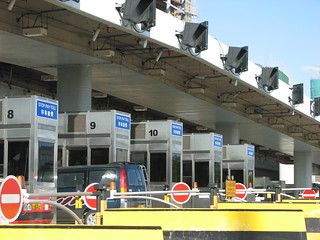
Toll Booths, Hong Kong

Toll Booths, Hong Kong (Photo credit: Ian Muttoo)

But re-reading the report it says that they will also be charging German drivers but giving tax cuts elsewhere to offset the cost. Maybe I misunderstood! Is it me? Anyway, watch this space. By Graham Hill

Hidden Cost Of Holiday Car Hire

Wednesday, 23. July 2014

It would seem that more and more Brits are hiring cars whilst on holiday. So as we come up to the serious holiday season it is quite timely for me to give you a bit of advice that could save you a lot of money if you are one of them. In a survey carried out by the Post Office it revealed that more than half of British holidaymakers hiring cars in Europe could face a huge hidden rental bill.

Thinking of a change but unsure as to the best way to finance your car? Then you need a copy of my car finance book, Car Finance – A Simple Guide by Graham Hill. Click on the link below to buy the best car finance book on the market, available as a Kindle Book and Paper Back.

The survey revealed that 56% of UK holidaymakers aren’t protecting themselves from accidents or theft with excess waiver insurance (EWI). Three quarters don’t bother with cover for glass, tyre or undercarriage damage. On average this extra insurance, payable on arrival, is about 12% of the cost of the excess but drivers are either not aware or ignore this insurance and run the risk of being hundreds of pounds out of pocket.

And don’t think the excess is the same as your domestic car insurance policy if you have an accident whilst in say Spain or Portugal of say £250, oooh no! The average accidental excess in Spain is £839 and in Portugal is £903 but the EWI and tyre and glass cover is just £99.10 and £87.55 respectively for 7 days cover.

Oh, and if you venture off the main roads in Greece, Spain or many other holiday countries you could hit a pothole that makes our potholes look like dimples causing all manner of expensive damage to wheels, suspension, brakes, undercarriage etc. Andrew Brown of Post Office Travel Money said, ‘It’s a false economy to cut costs by sticking to the basic cost when booking car rental online.

English: An old AVIS Car Rental advert on a si...

English: An old AVIS Car Rental advert on a side of a building. (Photo credit: Wikipedia)

What’s more don’t leave it till you get to your holiday destination to find out what the hire car will really cost. Calculate all the costs by doing your homework in advance to find out the realistic price of car rental and holiday motoring.’ Good advice there from Mr Brown. Happy holiday! By Graham Hill

Would Changing British Summertime Prevent Accidents?

Tuesday, 22. July 2014

I know we seem to be a nation of moaners in this country when it comes to weather conditions but there are few other countries in the world where they have a huge expanse of water on one side and the equivalent to a duck pond the other. Walk north for a few miles and you are stepping onto a glacier but take a few steps in the opposite direction and you’re negotiating sand dunes.

Thinking of a change but unsure as to the best way to finance your car? Then you need a copy of my car finance book, Car Finance – A Simple Guide by Graham Hill. Click on the link below to buy the best car finance book on the market, available as a Kindle Book and Paper Back.

And it doesn’t stop at ground level, racing around above us, when it feels like it, is the notoriously unpredictable jet stream. Add it all together and we end up with cars, the majority of which still don’t have air conditioning as standard because ‘it’s never that hot for that long’, and heating systems that don’t seem to have changed much since my dad’s Ford Consul.

But when it comes to adapting to weather conditions there is something we need to do, which the Government has the power to change and that is British Summertime. Not because of the inconvenience of re-setting your watch, phone, tablet, computer, laptop, electric toothbrush and all things electric twice every year but it is also dangerous.

Pedestrians have long made the argument against the annual change but statistics regarding car accidents are continue to add weight to the argument that we need to revert to GMT all year round. Typical of us Brits, we invent time by way of Greenwich Mean Time, the standard against which time around the world is measured, then we quite randomly add on the odd hour, then remove it a few months later for reasons that are now lost in the mists of time (I’m sure someone will enlighten me).

But this is all getting serious, as I witnessed myself a couple of days ago. At this time of year, when the skies are clearer and the sun at its most powerful, it reaches eye level during the rush hour. This, according to the AA has led to a quadrupling of head on crashes with lorries, believed to be caused by the long shadows cast by lorries, made even more dangerous when cars are turning.

Glare

Glare (Photo credit: theevilmightyf)

As a result the AA has come up with some suggestion to help prevent accidents:

  • Always keep the windscreen clear both inside and out. I always keep a glass cleaner spray and kitchen roll in the boot to clean the outside, especially useful towards the end of the summer when bugs splatter themselves on your windscreen.
  • If blinded slow down immediately. It is tempting to carry on regardless to let the glare pass but by then it may be too late.
  • If driving at sunset, anticipate the effects of glare on you and other drivers. Drivers heading west or through terrain where the sun may appear suddenly need to expect to travel more slowly than usual.

I really do think we should be taking another look at the need to adjust our time twice every year. By Graham Hill

Finance Application Successes And Failures Revealed

Wednesday, 18. June 2014

Following on from my last piece it seems that 1 in 6 applications for finance were rejected last year according to statistics revealed by OceanFinance.co.uk. It will be interesting to see how this compares to 2014 following the introduction of the new Financial Conduct Authority (FCA) rules in April of this year.

Thinking of a change but unsure as to the best way to finance your car? Then you need a copy of my car finance book, Car Finance – A Simple Guide by Graham Hill. Click on the link below to buy the best car finance book on the market, available as a Kindle Book and Paper Back.

They found that more than a third of the adult population (38.6%) applied for finance of some form or another over the last 12 months. This was an increase from 2013 when 33% applied for one or more of the popular credit products. Men are more likely to apply than women by quite a margin, 43.6% vs 34.4% over the last 12 months.

The age group most likely to apply for credit are 25 – 34 at 60.6% whilst only 17% of the over 55’s applied for credit according to the stats. The most likely decline would be if you apply for an overdraft at nearly one in five declines (18.6%). 16% of those applying for a personal loan get declined.

The good news for applicants last year, not so sure the same will apply this year, is that car finance applications were most successful with just 11% being rejected. Applications for a first mortgage was the type of  finance that lenders liked the most as they were most likely to be accepted, no doubt helped along by the Government incentives reducing the risk. 84.5% of all applications were accepted over the last 12 months.

The type of lender most likely to lend to applicants are what are known as ‘crowd lenders’ or ‘peer to peer lenders’ with an acceptance rate of 86%. It was also found that rather than operate a straight accept or decline process applicants were offered a higher rate of interest if they were felt to be higher risk, particularly when applying for credit cards.

I fear that this will all change dramatically over the coming year – for the worse! By Graham Hill

Heavy FCA Fines Make Life Difficult For Lenders

Tuesday, 17. June 2014

As the new rules imposed upon consumers and small businesses via lenders by the new Financial Conduct Authority (FCA) start to take affect there is a worrying undercurrent starting to gather momentum. Earlier this year I was in a meeting with directors of one of the biggest lenders in the car finance industry.

Thinking of a change but unsure as to the best way to finance your car? Then you need a copy of my car finance book, Car Finance – A Simple Guide by Graham Hill. Click on the link below to buy the best car finance book on the market, available as a Kindle Book and Paper Back.

I asked what they believed the effect would be of the forthcoming FCA regulations and the rules that had started to filter through. Their response was, at the time, quite dismissive. They pointed out that they had been in the motor finance industry since 1959 and by now they actually knew how to underwrite a customer.

Whilst they weren’t prepared to share actual numbers with me they explained that the amount of delinquency was minimal (that’s the amount of defaults and arrears) and it was certainly manageable so the idea of a Government body telling them what they needed to look out for when underwriting a customer was frankly – ludicrous!

The idea that you needed to carry out some strange affordability tests and have copies of umpteen bills and proofs was simply several steps too far. We all had a bit of a laugh, a cup of tea and a chocolate Hob Nob before moving onto the next item for discussion.

Fast forward a couple of months and that same company is suddenly asking for more information, copies of tax returns, 3 months bank statements and a tree’s worth of paperwork to prove the person is who they say they are. So what has happened? Fines, that’s what has happened. The lenders who are new to the rules of the FCA have been told that if they don’t tow the line they will be fined – and I mean FINED!

Last year the FSA and FCA dished out £472 million in fines, even what many would consider to be minor breaches attracted fines measured in tens of thousands of pounds. So suddenly lenders have had a wake up call and who suffers? Other than brokers like me, the customers – that’s you!

Let me give you an unbelievable example, traditionally lawyers have been extremely low risk applicants as they generally operate as partners which means that all of their personal assets are on the line when taking out finance. In a recent application, out of 5 partners 4 had houses worth over £1 million and not one had a mortgage, the fifth had a house worth £800,000 with a £200,000 mortgage on it.

The company had been trading over 20 years and neither the company nor the partners had a blemish against them. Perfect you would think. Ohhh no, we even had last 3 months bank statements available showing a balance never less than £70,000 but their year end is September so the last accounts to be completed were for September 2013, which had not been finalised so the last audited accounts available were 2012, too old for the lender, or should I say the FCA when testing for affordability.

The lender then wanted management accounts, which the company doesn’t run. As the senior partner pointed out, they make obscene amounts of money, as explained by their accountants once a quarter, so why would they need to know how much they spent on paper clips or stamps? So no accounts dated within the last 12 months and no management accounts – customer declined.

After appeal we managed an acceptance but with a much larger initial rental to which the customer said no – or words to that effect. The times are certainly changing and in my opinion – not for the better. But the real reason for writing this piece is to warn you if you are due to arrange finance for a new car.

First of all forget the fact that you have had finance before, many funders now ignore that totally, you will be treated as a brand new customer. Make sure that you prepare for finance as I explain in my book, Car Finance – A Simple Guide (available on Amazon), make sure that your last 3 months bank statements are looking good and if they don’t, wait till they do and make sure there are no returned (bounced cheques/direct debits) items on the statements, that would be a straight decline.

Get a copy of your credit report and see what it says, make sure there are no mistakes on there, it is simple enough and that extra bit of preparation could be the difference between getting a car or not. Oh and use a proper broker that can make sure that he can help you along the process, you often only have one shot at finance so don’t let a bucket shop blow it for you. By Graham Hill

Thieves Can Now Use Technology To Break Into Your Car

Tuesday, 17. June 2014

I was quite shocked to read that crooks no longer need to break a window to get into your car and forget about the tea leaves that  break into your house to nick your car keys along with the family silver and the contents of your fridge.

Thinking of a change but unsure as to the best way to finance your car? Then you need a copy of my car finance book, Car Finance – A Simple Guide by Graham Hill. Click on the link below to buy the best car finance book on the market, available as a Kindle Book and Paper Back.

Apparently the new techie toe rags can get into your car in less than 10 seconds with a computer or special gadget. Software or special gadgets that you can buy online fool your car’s computer that a smart key is present or it can be plugged into the car’s ECU to produce a ‘blank key.’

Not quite sure how you do that without breaking into the car in the first place? Anyway, it would seem that 47% of all car thefts in London last year were carried out using this method. That’s 9,870 out of 21,000. But the worst is yet to come.

When the police were asked how this type of crime could be prevented their only suggestion was to have a Thatcham approved tracking device fitted which operates separately to the ECU enabling the police to track and recover. Is that it? No fancy blocking device or an alarm that senses when an outside device is connecting to the ECU that isn’t approved? A bloody tracker!

What good is that after the event when some thief has driven your pride and joy like a bat out of hell for 5,000 miles? Worrying – very worrying! As a PS I have found out that manufacturers are more than aware of the problem and are addressing it – so there you have it.

New Braking System Will Save Many Lives

Monday, 16. June 2014

Many years ago, when my namesake was racing cars I watched a demonstration by one of the F1 drivers showing how to avoid a skid by rapidly tapping the brake pedal. The driver applied and released the brakes in quick succession which gave greater control as the tyres moved round increasing the grip and avoiding a skid.

Thinking of a change but unsure as to the best way to finance your car? Then you need a copy of my car finance book, Car Finance – A Simple Guide by Graham Hill. Click on the link below to buy the best car finance book on the market, available as a Kindle Book and Paper Back.

It is the principal that developed into what has now been used for many years called ABS. Thousands of lives have been saved as a result of the fitting of ABS to all cars but now Thatcham have called for the latest brake development to be added to ABS and ESP as standard requirements on all new cars.

The new system known as Autonomous Electronic Braking (AEB) is already available or fitted to 23% of all new cars but Thatcham feels that more should be done by the Government to encourage the fitting of this technology by offering a £500 incentive to drivers that have it fitted.

Thatcham claims that the device would save 1,220 lives over 10 years and reduce casualties by 136,000. So what is AEB? It detects vehicles in front and applies the brakes in an emergency in time to prevent a front to end accident. In the more sophisticated systems the ‘radar’ can detect pedestrians and cyclists as well as solid vehicles.

At the moment if the system is fitted to a company car this will increase the driver’s benefit in kind tax and class 1A National Insurance Contributions, this is wrong according to Thatcham as the device is as much for the benefit of those outside the vehicle as inside.

Thatcham have shown that with AEB third party injury claims drop by 18%, whilst studies in the USA have put the reduction at 26%. Amazingly in Switzerland and Sweden front to rear crashes would drop by 31% and 48% respectively.

Whilst I have seen various claims relating to the benefits of AEB it is clear that this technology, if fitted, could save lives so I’m behind Thatcham and hope that they can convince the Government to do something to encourage the fitting of this life saving technology.

It might also help to prevent some of the crash for cash insurance claims so maybe the insurance companies should contribute something. Just a thought!