Frightening Increases in CO2 Emissions Following WLTP Findings Will Cause Changes To Car Choices.

Thursday, 27. February 2020

I mentioned last week that as of the 1st April 2020 the new WLTP emissions ratings come into force. This will affect drivers’ benefit in kind tax if you drive a company car but it could also affect the 1st year road fund licence costs which could also increase the rental costs as this is part of the ‘on the road’ cost of the car. So if you’ve been quoted on a car that will be delivered after 1st April you could be paying a little more per month.


Some company cars could disappear from choice lists as new emissions test results put them beyond CO2 thresholds used by fleets.


Data published by manufacturers show some vehicles that were below 130g/km or 110g/km, using the NEDC-correlated CO2 figure, now fall outside those key benchmarks, thanks to the tougher testing regime.


The new CO2 values, derived from the Worldwide harmonised Light vehicle Test Procedure (WLTP), will be used for tax purposes for all new cars registered from April.


However, as manufacturers begin to publish the data, fleets are finding that the new test has seen CO2 values for some cars increase.


For example, the BMW 520d M Sport originally had a NEDC-correlated CO2 figure of 108g/km, but under WLTP it has risen to 131g/km.


It’s a similar story for the Volvo XC40 D3 R Design, which will increase from 127g/km to 144g/km, and the Volkswagen Tiguan 2.0 TDI SE L, which will rise from 122g/km to 156g/km.


“We’re seeing a lot of vehicles breaching the 110g/km and even the 130g/km cap,” said David Bushnell, principal consultant at Alphabet GB.


It means some familiar models on today’s choice lists will have to be replaced by more tax-efficient, hybrid or fully electric versions.


Bushnell says the impact of WLTP on fleets will be comparable to the “re-set” of company car policies in 2002, when taxation moved from mileage to CO2.


Emissions caps for vehicles used by some fleets have followed the downward trajectory of the threshold for capital allowances and lease rental restrictions.


The main threshold for capital allowances and lease rental restrictions was reduced from 130g/km to 110g/km in 2018, after originally being cut from 160g/km in 2013.


Under capital allowance rules, cars bought by companies that emit up to 50g/km are eligible for 100% write-down in the first year; for those emitting 51-110g/km, it’s 18% a year; and for more than 110g/km it is 6% a year.


Under the lease rental restriction, new cars with emissions of 110g/km or less are eligible for 100% of their lease payments to be offset against corporation tax. For those with emissions of 111g/km or more, only 85% is claimable.


The Government refused to consider the impact of WLTP on capital allowances and the lease rental restriction when last year it launched a consultation on what it should do to mitigate its effect on company car tax and vehicle excise duty (VED).


Bushnell called for their inclusion at the time but says Treasury “weren’t prepared to talk about the (110g/km) derogation and now we’re seeing a lot of vehicles impacted”.


Fleets have used the CO2 thresholds to benchmark their emissions cap to ensure they are as tax efficient as possible.


Nick Hardy, sales and marketing director at Ogilvie Fleet, says 130g/km became the norm for many companies, with an increasing number choosing the lower 110g/km cap.


Faced with some cars potentially falling outside company car policies, because of an increase in CO2, he urged fleets not to be tempted to increase their cap to simply maintain vehicle choice.


He explained: “It’s not the right thing to do; it completely defeats what we’re all trying to achieve.”


However, in the short term, while WLTP CO2 data is still missing on many models (see page 4), Bushnell thinks fleets could consider a temporary removal of CO2 caps.


He said: “It’s not exactly palatable, but the issue is we could be delivering a car that we perceive is below the cap, but then by the time it’s configured and registered, it’s actually over the cap.”


Not only are large swathes of CO2 data missing for base models, but the impact of vehicle options on the final figure is also an issue for fleets.


Bushnell urged fleet operators to allow wholelife costs to guide vehicle choice.


Wholelife costs take account of several factors, including fuel, employer Class 1A National Insurance Contributions, service, maintenance and repair, and insurance, as well as any cash allowances paid to employees.


Bushnell said: “You’ve got to be looking at your choice list on a wholelife cost basis, but there are still a lot of businesses that don’t.”


PricewaterhouseCoopers (PwC) has previously reported that just 32% of employers offering company cars use wholelife costs to determine the vehicles available.

Share My Blogs With Others: These icons link to social bookmarking sites where readers can share and discover new web pages.
  • MisterWong
  • Y!GG
  • Webnews
  • Digg
  • del.icio.us
  • StumbleUpon
  • Reddit
  • Alltagz
  • Ask
  • Bloglines
  • Facebook
  • YahooMyWeb
  • Google Bookmarks
  • LinkedIn
  • MySpace
  • TwitThis
  • Squidoo
  • MyShare
  • YahooBuzz
  • De.lirio.us
  • Wikio UK
  • Print
  • Socializer
  • blogmarks

Massive Drop In Emission Peaks In London Shows The Controls Are Working.

Thursday, 27. February 2020

Efforts to clean up the air in London appear to be paying off according to the latest figures revealed by the Mayor of London.


Data from air quality monitoring sensors around the Capital show a 97% reduction in the number of hours that air quality exceeded legal limits.


In 2019, London’s air quality exceeded the hourly legal limit for around 100 hours. This compares favourably to the 4000 hours recorded in 2016.


However, there are still many locations where pollution levels remain high – including for particulate matter – for example at the monitoring site in Vauxhall, which preliminary research indicates may be being impacted by a nearby ventilation shaft from the Tube.


The Mayor of London Sadiq Khan said: “Toxic air is a national health crisis contributing to thousands of premature deaths ever year. I have taken bold action in London with measures such as the world’s first Ultra Low Emission Zone and Low Emission Bus Zones, and it’s undeniable that these are making a difference to the air we breathe.


“We’re doing all we can in the capital, with proven results, so there are no excuses left for the Government’s failure to match our levels of ambition.”


Between 2004 to 2017, London breached the permitted number of exceedances for NO2 within the first week of the year. In 2019, only one site breached and it did not occur until July.


There have also been significant reductions in Londoner’s long-term exposure to air pollution, with every monitoring site in the capital recording a reduction in annual average NO2 levels. Londonwide, there has been an average reduction of 21% between 2016 and 2019.


Significant NO2 reductions have occurred where the Mayor has introduced Low Emission Bus Zones – areas where only buses that meet the cleanest emission standards can operate.


At Putney High Street in Wandsworth, NO2 levels have stayed within legal limits so far this year, compared to 1,279 hours of illegal levels in 2016.


At Brixton Road in Lambeth NO2 levels remained within legal limits for the entirety of 2019 and so far this year, compared to 530 hours above the legal limit in 2016. In 2017, this site saw London’s first breach of annual pollution limits just five days into the new year, and in 2018 it occurred within a month.


On Oxford Street in Westminster, NO2 exceeded legal limits for 168 hours in 2016. In 2019 monitors did not record a single hour above legal limits. However, there is also an annual average legal limit which Oxford Street did not meet, which is why further action is needed. By Graham Hill thanks to Fleet News.

Share My Blogs With Others: These icons link to social bookmarking sites where readers can share and discover new web pages.
  • MisterWong
  • Y!GG
  • Webnews
  • Digg
  • del.icio.us
  • StumbleUpon
  • Reddit
  • Alltagz
  • Ask
  • Bloglines
  • Facebook
  • YahooMyWeb
  • Google Bookmarks
  • LinkedIn
  • MySpace
  • TwitThis
  • Squidoo
  • MyShare
  • YahooBuzz
  • De.lirio.us
  • Wikio UK
  • Print
  • Socializer
  • blogmarks

New European Project To Design Next Generation Lithium-Ion Batteries

Thursday, 27. February 2020

I’ve said it many times that it is my belief that the panic over electric vehicle charging infrastructure is unfounded. We can already super fast charge an electric car up to 80% capacity in about the same time that it takes to fill up a petrol or diesel car and pay for it.


At the same time the new purpose built electric cars are increasing their ranges dramatically so within a short period of time we will no longer need charging ponts attached to lamp posts and trees.


On to the report.


A European battery research project aims to develop the next generation of batteries for electric vehicles (EVs).


The Coventry University’s Centre for Advanced Low Carbon Propulsion Systems (C-ALPS) is involved in the Sense project, which includes five research institutes and six industrial companies from seven European countries working together over the next four years.


Swedish company Northvolt, which intends to set up two large-scale production facilities (gigafactories) for vehicle batteries in Europe in the next few years, is also a partner on the project.


The research project is coordinated by Empa researcher Corsin Battaglia and his team. Coventry University’s work on the project is led by Tazdin Amietszajew, assistant professor in battery diagnostics at C-ALPS. The EU is funding Sense with 10 million euros (£8.3m).


The demand for batteries for electric cars will increase dramatically in the next few years. At present, more than 90% of these batteries come from Asia.


In response, the EU Commission set up the European Battery Alliance in 2017 to build up competences and production capacities for this key technology in Europe.


Experts estimate that the European demand for lithium-ion batteries alone will require 10 to 20 so-called ‘gigafactories’ – large-scale production facilities for batteries.


The research in the Sense project is part of this European Battery Alliance initiative and is supported by the EU research funding programme Horizon 2020.


The 11 research partners of Sense – five research institutes and six industrial companies – are conducting research on next-generation lithium-ion batteries – the so-called ‘Generation 3b’.


In contrast to current traction batteries, this next generation will have higher energy density and improved cell chemistry and battery management system: instead of pure graphite anodes, the aim is to use silicon-graphite composites.


The content of critical cobalt in the cathode will be further reduced. New additives in the electrolyte and interphase design approaches will slow down battery aging and extend cycle life.


New sensors will also contribute to a longer service life and improve fast charging capability by supplying data from inside the battery cells to the battery management system. This data should allow a much more refined temperature management compared to today’s lithium-ion cells.


The sustainability of Generation 3b cells is also expected to exceed that of the current generation.


The cathode will be manufactured without the use of flammable and toxic solvents, which will greatly simplify the series production of the cells and reduce their cost, it says.


All aspects of Sense re-search are geared towards producing the next generation of cells in European gigafactories.


To be competitive in the future, cost-effective and raw material-saving production methods are therefore crucial.


The Sense project also considers the second life use of decommissioned vehicle batteries as stationary storage units and, finally, the recycling of the batteries.


The research partners of Empa, which is leading the project, are the Westfälische Wilhelms-Universität Münster, the Forschungszentrum Jülich, Coventry University, the Austrian Institute of Technology, and the companies Solvionic, FPT Motorenforschung, Lithops, Northvolt, Enwires and Huntsman Advanced Materials.


The Swedish company Northvolt plays a decisive role in the research project. The company was co-founded in 2016 by two former Tesla employees, who were involved in the construction of the Tesla gigafactory in Nevada (USA).


Northvolt is currently planning the first European gigafactory with a production capacity of 32 GWh per year to be built in Sweden.


A further gigafactory with an annual production of 16 GWh is to be built as a joint venture with Volkswagen in Salzgitter (Germany). For comparison, the Tesla Gigafactory in Nevada currently produces around 30 GWh of batteries per year, according to management.


Experts from Northvolt will advise the Sense researchers through regular briefings.


By the end of the project, a series of battery cell prototypes will have been developed.


A demonstrator with 1 kWh storage capacity will demonstrate the capabilities of the battery cell Generation 3b.


At the end of the project, the production technology developed will find its way into industry in the form of patents.


The four-year Sense research project ends in spring 2024.


Corsin Battaglia’s team at Empa is involved in another European research project called Solidify. It looks even further into the future and is developing future-generation batteries – so-called solid-state lithium-metal batteries.


In contrast to today’s lithium-ion batteries and those of Generation 3b, these solid-state batteries will no longer contain any liquid, flammable components.


They are therefore safer and more tolerant to elevated temperatures, can deliver higher power, and can be charged and discharged faster, it says.


According to experts, these batteries – called Generation 4b – could be ready for the market in about 10 years.


At half the weight and half the size, they should deliver the same storage capacity as today’s lithium-ion batteries. Production costs are also expected to be cut in half.


New electrode architectures are necessary, as are cost-effective innovative production methods for the cathode of these batteries, it says. The anode will consist of metallic lithium.


The Solidify research project started on January 1 and will also run for four years. By Graham Hill thanks to Fleet News

Share My Blogs With Others: These icons link to social bookmarking sites where readers can share and discover new web pages.
  • MisterWong
  • Y!GG
  • Webnews
  • Digg
  • del.icio.us
  • StumbleUpon
  • Reddit
  • Alltagz
  • Ask
  • Bloglines
  • Facebook
  • YahooMyWeb
  • Google Bookmarks
  • LinkedIn
  • MySpace
  • TwitThis
  • Squidoo
  • MyShare
  • YahooBuzz
  • De.lirio.us
  • Wikio UK
  • Print
  • Socializer
  • blogmarks

Moveable Barriers To Be Deployed On M20 To Avoid Disruption

Friday, 21. February 2020

Highways England will have a new type of barrier at its disposal that can be deployed within hours to manage traffic on the M20 during periods of cross-channel disruption.


The technology will be designed to ensure that the M20 is kept open at times of disruption, whilst also allowing the motorway to retain three lanes, a hard shoulder and 70mph speed limits in both directions during normal traffic conditions.


This will be a marked improvement in comparison to Operation Brock which required a month of overnight closures to deploy the metal barrier required for the contraflow system previously used. The new system should be in operation by the end of the year.


Transport Secretary Grant Shapps said: “After listening to frustrated residents and businesses affected by Operations Brock and Stack, we’ve invested in a new solution to boost Kent’s resilience and keep its vital road network moving, even at times of disruption.


“This state-of-the-art technology can be deployed quickly, simply and safely, ensuring motorists across the county can get to where they need to be with minimum fuss, whatever the circumstances.”


Moveable barriers are already used in cities around the world, including Auckland, Sydney, San Francisco and Vancouver.


The technology has been chosen by the Department for Transport and Highways England as a long-term solution to Operation Brock and Stack and will ensure Kent is prepared for any disruption on the Short Strait, such as from industrial action or bad weather.


The new solution also means that Highways England’s work on an ‘off road’ replacement for Operation Stack has been stopped. As part of this, previous Highways England plans for a new large lorry holding area in Kent are no longer being pursued.  By Graham Hill thanks to Fleet News

Share My Blogs With Others: These icons link to social bookmarking sites where readers can share and discover new web pages.
  • MisterWong
  • Y!GG
  • Webnews
  • Digg
  • del.icio.us
  • StumbleUpon
  • Reddit
  • Alltagz
  • Ask
  • Bloglines
  • Facebook
  • YahooMyWeb
  • Google Bookmarks
  • LinkedIn
  • MySpace
  • TwitThis
  • Squidoo
  • MyShare
  • YahooBuzz
  • De.lirio.us
  • Wikio UK
  • Print
  • Socializer
  • blogmarks

Warning That Alcohol Related Crashes On The Increase

Friday, 21. February 2020

The number of people killed in road accidents where the driver was over the drink drive limit has not dropped since 2010.


Provisional figures released by the Department for Transport (DfT) estimate there were 240 such deaths in 2018, exactly the same rate of fatalities ten years ago.


The total number of casualties caused by drink driving increased to 8,700 in 2018, up 1% from 2017.


The number of accidents where a driver was over the alcohol limit rose by 4% to 5,900 in 2018, compared with the previous year.


Road safety charity IAM RoadSmart is calling for the government to introduce a ‘smarter’ package of measures to tackle this important issue.


Measures being advocated by IAM RoadSmart include a further lowering of the drink-drive limit in England and Wales to match Scotland, wider use of drink-drive rehabilitation courses and also following the example of Scotland by seizing the vehicles of repeat offenders.


Neil Greig, director of policy and research at IAM RoadSmart, said: “Once again progress on reducing the toll of death and injuries from drink-driving has stalled.


“There is no one simple answer to reducing these figures, but IAM RoadSmart believe we now need a much smarter package of measures from the government including a lower drink-drive limit to reinforce good behaviour, fast-track of evidential roadside testing machines to release police resources and tailored approaches to help drivers with alcohol problems.


“Rehabilitation courses work and we think all those convicted of drink-driving should be sent on one automatically rather than having to opt in.


“More use of alcohol interlocks and extra penalties such as vehicle forfeiture, as used in Scotland, could all be part of a more joined-up approach to the problem.”


Hunter Abbott, managing director of breathalyser firm AlcoSense, says that nly 42% of drivers involved in an accident in 2018 were breath-tested by police.


“This has declined steadily since 2008, when 55% of motorists were breathalysed after a collision,” he said. “Of those who actually were tested following an accident, more than 3,800 were over the limit – at 4.4%, that’s the highest failure rate for 10 years”.


The overall number of breath tests is also the lowest on record.


Just 320,988 drivers were tested by police at the roadside in 2018, according to Home Office figures – less than half the 670,023 breathalysed in 2009.


“Casualties will not reduce until better enforcement is in place, combined with stricter limits and drink driving awareness campaigns”, continued Abbott.


“England and Wales have the highest drink drive limit in the developed world, far above the ‘point of intoxication’ when the cognitive effects of alcohol on a person are measurable.


“At the English/Welsh limit, despite not contravening the law, research shows you are 13 times more likely to be involved in a fatal accident than when sober.


“We call on the Government to increase the number of road traffic officers, in order to restore roadside breath testing to the levels of a decade ago.


“The Home Office should also stop ignoring robust scientific evidence and the advice of road safety experts – the drink drive limit should be reduced from its current dangerously high level.”


Abbott is the founder of AlcoSense and a member of the Parliamentary Advisory Council for Transport Safety (PACTS).


Greig concluded: “Drink-drivers are simply not getting the message, and these figures will not improve until policy changes.”  By Graham Hill thanks to Flett News

Share My Blogs With Others: These icons link to social bookmarking sites where readers can share and discover new web pages.
  • MisterWong
  • Y!GG
  • Webnews
  • Digg
  • del.icio.us
  • StumbleUpon
  • Reddit
  • Alltagz
  • Ask
  • Bloglines
  • Facebook
  • YahooMyWeb
  • Google Bookmarks
  • LinkedIn
  • MySpace
  • TwitThis
  • Squidoo
  • MyShare
  • YahooBuzz
  • De.lirio.us
  • Wikio UK
  • Print
  • Socializer
  • blogmarks

Electric Vehicles Present A Challenge To Auction Houses And Dealerships

Friday, 21. February 2020

The Vehicle Remarketing Association (VRA) is concerned that some of its members could face a “charging crisis”.


The industry body, which represents businesses that handle, sell, inspect, transport or manage more than 1.5 million used cars and vans every year, says the demands for power on some sites will be considerable.


VRA chairman Sam Watkins explained: “We have some members who process tens of thousands of vehicles every month.


“Currently, it is just a question of ensuring that there is sufficient fuel in the tank of each but looking ahead, a large proportion will be EVs, especially following the Government’s 2035 commitment.


“Those remarketing companies will need to make sure that EVs are charged to a useable degree simply to move them around, and comply to best practise for storage scenarios.


“Once an EV has a flat battery, the movement of it becomes a challenge as they must be handled in line with correct safety protocols which differ from internal combustion engines.


“Really, the only way at present to ensure that they will all have sufficient power is to install a lot of chargers – perhaps hundreds on some large sites that are used for storage by manufacturers and leasing companies.”


Watkins believes that this could potentially place huge demands on local electricity supplies.


“We already know of major remarketing operations whose plans for new sites have been dictated, at least in part, by the availability of power infrastructure that is capable of the necessary charging capacity,” she said.


The issue did not affect just large remarketing companies but also individual dealerships, many of whom were already operating from cramped sites.


Watkins continued: “If you are selling and servicing large numbers of EVs, then charging again becomes a concern and it is not inconceivable that even a medium-sized dealership might need a dozen chargers on-site until new charging solutions are evolved.


“We are looking at a situation where the remarketing of EVs might require careful consideration by many different kinds of business in our sector purely to ensure that sufficient charging is available.


“In saying this, we are aware that the charging picture changes all the time and that new solutions are being introduced to the market. As things stand, however, there is certainly potential for what you might call a charging crisis.”


The charger issue was raised at the VRA’s January meeting, which took place at Bruntingthorpe in Leicestershire and was attended by more than 40 members.

Watkins said: “This was just one of the emerging issues discussed at the meeting and illustrates how the VRA is an essential resource for remarketing businesses who want to find out how other businesses are tackling new problems and new opportunities.”  By Graham Hill thanks to Fleet News

Share My Blogs With Others: These icons link to social bookmarking sites where readers can share and discover new web pages.
  • MisterWong
  • Y!GG
  • Webnews
  • Digg
  • del.icio.us
  • StumbleUpon
  • Reddit
  • Alltagz
  • Ask
  • Bloglines
  • Facebook
  • YahooMyWeb
  • Google Bookmarks
  • LinkedIn
  • MySpace
  • TwitThis
  • Squidoo
  • MyShare
  • YahooBuzz
  • De.lirio.us
  • Wikio UK
  • Print
  • Socializer
  • blogmarks

WLTP Emissions Figures Still Not Totally Available Causing Confusion

Friday, 21. February 2020

The latest emission figures are measured by attaching equipment to cars and physically driving cars on public roads to simulate real-world driving conditions. This is fine for standard cars but the manufacturers should also assess the emissions when fitted with options and extras.


For example if a car has bigger wheels fitted the emissions can increase. But without that information drivers could be exposed to higher Benefit In Kind tax and Road Tax could increase.


Businesses should therefore consider reviewing their fleet policies due to a lack of WLTP CO2 data for some cars, says the British Vehicle Rental and Leasing Association.


The WLTP CO2 value, derived from the new emissions test, will be used for tax purposes from April, but a shortage of reliable data threatens to disrupt the move to a new VED and company car tax regime, it says.


VED and company car tax for newly registered vehicles will use CO2 figures based on the more accurate WLTP standard from April 1 and 6 respectively.


However, many vehicle manufacturers are struggling to provide WLTP data for their cars, with the result that BVRLA members currently only have accurate CO2, electric mileage range or RDE2 compliance (latest NOx emissions standard) information for around 80% of base (pre-option) models.


With average lead times for cars at around 9-12 weeks from ordering, this data gap is hindering the leasing sector’s ability to provide accurate quotes on many different vehicles and their various configurations and options.


“The introduction of WLTP-based motoring taxes is adding yet another layer of complexity and confusion to a fleet sector that is already having to cope with a deluge of new automotive technology and local authority air quality measures,” said BVRLA chief executive, Gerry Keaney.


“The BVRLA and its members are working with OEMs and third-party data providers to bridge this gap, but in the meantime, we would recommend customers consult with their lease providers to assess the impact on their fleet policies and procurement.”


WLTP CO2 data is available for the entire BMW range at www.bmw.co.uk. Rob East, general manager of Corporate Sales at BMW UK, said: “With the BIK tax liability a key consideration for many company car drivers when choosing a new vehicle, it’s imperative that we provide our customers with this information.


“This transparency allows them quickly to make an informed decision as to whether their favoured BMW works for them from a tax point of view. Without WLTP details, they simply have no way of knowing.”


He added: “Ensuring the easy availability of these details underlines our drive to make it as straightforward as possible for business customers to purchase a new BMW.


“It also reflects the increased level of interest that there is in our key corporate models such as the new 1 Series and new 3 Series.”


The BVRLA has contacted the SMMT, which represents vehicle manufacturers, to offer its support in addressing the WLTP data shortage. It is also working with HMRC on its forthcoming WLTP communications plan. By Graham Hill thanks to Fleet News

Share My Blogs With Others: These icons link to social bookmarking sites where readers can share and discover new web pages.
  • MisterWong
  • Y!GG
  • Webnews
  • Digg
  • del.icio.us
  • StumbleUpon
  • Reddit
  • Alltagz
  • Ask
  • Bloglines
  • Facebook
  • YahooMyWeb
  • Google Bookmarks
  • LinkedIn
  • MySpace
  • TwitThis
  • Squidoo
  • MyShare
  • YahooBuzz
  • De.lirio.us
  • Wikio UK
  • Print
  • Socializer
  • blogmarks

Government Electric Car Grant To Be Withdrawn At The End Of March

Friday, 21. February 2020

The future of the plug-in car and van grant is expected to be revealed by the new Chancellor in the Budget in March.


The electric car and van subsidy was cut in 2018 by £1,000 and fleets were told it would no longer apply to hybrid cars with a range of less than 70 zero emission miles.


The Government said the reduction in funding – from £4,500 to £3,500 – for the cleanest cars, and withdrawing the grant completely for the likes of the Mitsubishi Outlander PHEV and the Toyota Prius Plug-in, was a sign of its success.


Talking to delegates at the ICFM’s annual conference last summer, deputy head of the Office for Low Emission Vehicles (OLEV), Phil Killingley, acknowledged that incentives will be of continued importance beyond 2020, but stressed the detail was still being “talked through”.


Meanwhile, the Treasury told the Telegraph that “consumers incentives will continue to play a role beyond 2020”.


A Whitehall source said: “We have always said we would phase out the subsidies gradually, but there are other ways we can help people to go electric.”


BVRLA chief executive, Gerry Keaney, says that the Budget on March 11 will be an opportunity to set the tone for a new decade in which the transition to decarbonised road transport will be won or lost.


“Fleets are being asked to invest billions of pounds in new electric vehicle technology and infrastructure, which comes at a hefty price premium to its petrol and diesel alternatives,” he said.


“To achieve these goals the Government must provide a clear support package through to at least 2025. It must preserve the Plug in Car and Van Grants, maintain a strong set of tax incentives and tackle the huge and often arbitrary costs associated with fleet charging infrastructure.”  By Graham Hill thanks to Fleet News

Share My Blogs With Others: These icons link to social bookmarking sites where readers can share and discover new web pages.
  • MisterWong
  • Y!GG
  • Webnews
  • Digg
  • del.icio.us
  • StumbleUpon
  • Reddit
  • Alltagz
  • Ask
  • Bloglines
  • Facebook
  • YahooMyWeb
  • Google Bookmarks
  • LinkedIn
  • MySpace
  • TwitThis
  • Squidoo
  • MyShare
  • YahooBuzz
  • De.lirio.us
  • Wikio UK
  • Print
  • Socializer
  • blogmarks

Public Transport Deficiencies Fuels Greater Use Of Cars

Friday, 21. February 2020

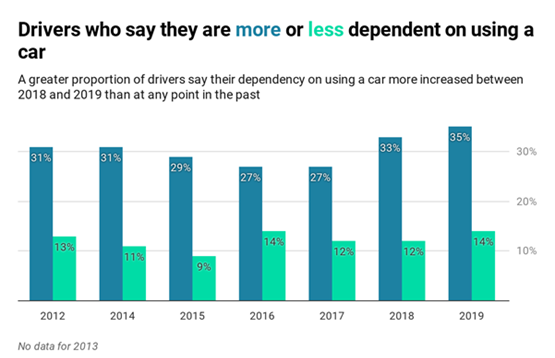
One in three drivers (35%) say they are more dependent on using their car than 12 months ago, with public transport seen as an expensive and unreliable alternative.


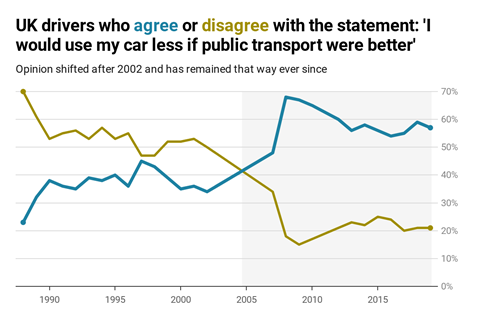
The data, released as part of the latest RAC Report on Motoring, shows that most drivers would use their cars less if public transport was better.


At a time when the Government and local councils are keen for drivers to use their cars less frequently to improve air quality and cut congestion, the RAC believes the findings are a stark reminder that many people, especially those who live outside the biggest cities, remain dependent on their cars for many types of journeys.


Just 14% of drivers say they have become less dependent than a year ago, though this has also increased from 12% in 2018 indicating a small rise in those saying they are less dependent on their vehicles.


The top reasons drivers give for using their cars more are a greater need to transport family members (28%), family and friends moving further away (24%) and, perhaps most strikingly, a reduction in the provision or quality of public transport (25%) – with drivers in the North East (42%) significantly more likely to call this out as a reason for them increasingly turning to the car.


Drivers are particularly frustrated by the lack of feasible alternatives to the car for the journeys they need to make, according to the data.


More than half (57%) say they would be willing to use their cars less if the quality of public transport was better, and agreement with this statement has been high for an incredible 11 consecutive years.


Around half of drivers (53%) say they are frustrated by the lack of feasible alternative modes of transport for long journeys, with a similar proportion (52%) saying the same about short journeys. These figures both rise to 55% for drivers aged between 25 and 44.


Frustrations with public transport


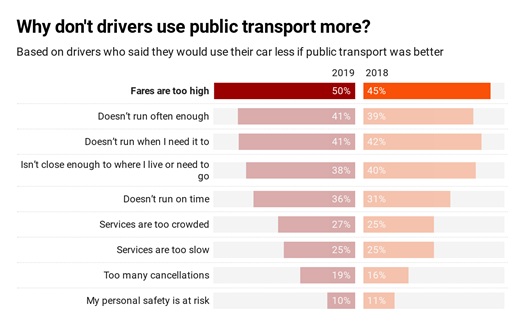
Among drivers who would be willing to use public transport more, half (50%) say the reason they don’t use public transport more is that fares are too high – up by five percentage points on last year – while 41% say services are not frequent enough.


Meanwhile, a growing number of people (36% – up from 31% in 2018) say that a lack of punctuality is a significant barrier to them using public transport as an alternative to driving, and 38% say services don’t run where they need them to.


Of those who would be willing to consider using public transport if services were better, almost a third (31%) say they would make more use of it if there was greater availability of services – a figure that rises to 40% for rural motorists, reflecting to some extent the significant cuts that were made to rail services following the Beeching Report and, more recently, to rural bus services as highlighted last year by the Parliamentary Transport Committee.


The RAC’s findings also show that motorists who live in London are more likely to use alternatives to their cars compared to drivers elsewhere in the UK.


In the capital, on average 38% of each driver’s weekly journeys are made either by public transport, walking or cycling, compared with a national average of just 24%.


For those who live in villages or other rural areas, cars typically account for an enormous 85% of all journeys, with just 15% currently represented by public transport, cycling or walking.


RAC data insight spokesman Rod Dennis said: “These findings present the stark reality for so many people in the UK – that for good or bad, in 2020 the car remains an essential means of getting about whether that is for commuting, dropping off and collecting children or going to visit family and friends.


“While the car might be the obvious choice for many people’s journeys, especially for those who have already invested a lot of money in buying or leasing one, it is also clear just how frustrated many drivers are with the lack of decent alternatives for some of their trips.


“For more than a decade now, drivers have been saying that they are willing to use their cars less if public transport was better – and this year’s figures indicate it’s the high cost and low frequency of services that are the biggest problems cited by drivers. At the same time,


“The ongoing challenge for national and local government, and combined authorities, is therefore to deliver credible alternatives to the car for specific journeys that are regularly completed by a lot of people.


“Connecting large residential areas with popular locations for work would surely be a good starting point – giving drivers the opportunity to swap sitting in daily traffic jams for a fast, frequent alternative.


“Greater investment in walking and cycling infrastructure could also go a long way to encouraging drivers to use of their cars less, especially for short journeys that make up around a quarter of all drivers’ trips.


“But it remains the case that short of cheap, reliable and integrated public transport systems operating all over the UK, it is very difficult to see things changing radically in the years ahead.


“The car remains an integral part of so many people’s lives, whether that is for carrying heavy shopping, transporting family members or going to visit friends in all the corners of the UK.”


In charts and tables: car dependency in the UK

Source: RAC Report on Motoring 2019


  More dependent Less dependent No change
All drivers
Drivers aged 17-24
Drivers aged 25-44
Drivers aged 45-64
Drivers aged 75+
Drivers in towns and cities
Drivers in rural areas

The problems with public transport: insights into bus and rail use

At the end of last year, the Campaign for Better Transport’s Future of Rail report indicated that the cost of rail fares has increased by 47% over the last 10 years, with motoring costs having gone up by 32% over the same period.

The same organisation’s Future of the Bus report also found that national and local funding for buses is now almost £400m a year lower than it was a decade ago.

The last National Travel Survey also showed that bus use is falling across much of England.

Last May meanwhile, the Parliamentary Transport Committee published a report which called for the introduction of a national bus strategy to address the paucity of services available outside of London, where bus provision is regulated by Transport for London.

The committee said that more than 3,000 bus routes had been reduced, withdrawn or altered since 2010-11.

By Graham Hill Thanks To Fleet News

Share My Blogs With Others: These icons link to social bookmarking sites where readers can share and discover new web pages.
  • MisterWong
  • Y!GG
  • Webnews
  • Digg
  • del.icio.us
  • StumbleUpon
  • Reddit
  • Alltagz
  • Ask
  • Bloglines
  • Facebook
  • YahooMyWeb
  • Google Bookmarks
  • LinkedIn
  • MySpace
  • TwitThis
  • Squidoo
  • MyShare
  • YahooBuzz
  • De.lirio.us
  • Wikio UK
  • Print
  • Socializer
  • blogmarks

Just To Prove That The Law Can Be Daft

Friday, 21. February 2020

I know that you like to read legal stories that make no sense whatsoever – so here is one that makes no sense whatsoever. It shows that you can be held responsible for the health and safety of anyone who breaks into your property! Totally ridiculous.


The article revolves around the following incident. Click on the link before reading further


https://garagewire.co.uk/news/thief-crushed-to-death-while-stealing-catalytic-converter/


The question was asked – what liability could there be on the garage where someone breaks in and ends up getting injured or getting killed when they are there unlawfully?


Some people think that if you have broken into someone else’s property with ill intent then you deserve anything and everything you get.  This is not so in the eyes of the law – as Norfolk farmer Tony Martin found when he shot burglars encroaching into his home in 1999 killing one of them – as he was sent to prison initially for murder but downgraded to manslaughter due to diminished responsibility.


It is the Occupiers’ Liability Act 1984 which imposes a duty of care on landowners (occupiers) to take reasonable care for the safety of trespassers in respect of any risk of their suffering by reason of any danger due to the state of the premises – or to things done or omitted to be done on them.


The threshold test is set out in Section 1 (3) of the Act which provides that a duty is owed to trespassers in respect of any such risk if


(a)        The occupier is aware of the danger or has reasonable grounds to believe that it exists;


(b)        The occupier knows or has reasonable grounds to believe that the trespasser is in the vicinity of the danger or that he may come into the vicinity of the danger; and


(c)        The risk is one against which, in all the circumstances of the case, the occupier may reasonably be expected to offer the trespasser some protection.


As you can imagine, cases turn on their specific facts such as several years ago when the High Court in Buckett v Staffordshire County Council dismissed a claim brought against them by a Claimant after he fell through a skylight whilst trespassing on the roof a school when he was aged 16.  The court decided that even though his presence on the roof near the skylight ought reasonably to have been foreseen, the council did not owe a duty of care under the Occupiers’ Liability Act 1984 as the skylight’s structure, makeup and location on the roof did not constitute a danger.


Even though children trespassing on the roof and proximity to the skylight was foreseeable, the claimant’s injuries were caused by his own action of jumping onto the skylight.  And because the skylight was not faulty or inherently dangerous, the council was not liable.


This followed a principle set by the House of Lords in Tomlinson v Congleton Borough Council in 2004 where a 12 year old was injured falling on a fire escape when trespassing.  As the fire escape was not defective, in need of repair or otherwise dangerous, the council had no liability. You see what I mean – totally dopey! By Graham Hill

Share My Blogs With Others: These icons link to social bookmarking sites where readers can share and discover new web pages.
  • MisterWong
  • Y!GG
  • Webnews
  • Digg
  • del.icio.us
  • StumbleUpon
  • Reddit
  • Alltagz
  • Ask
  • Bloglines
  • Facebook
  • YahooMyWeb
  • Google Bookmarks
  • LinkedIn
  • MySpace
  • TwitThis
  • Squidoo
  • MyShare
  • YahooBuzz
  • De.lirio.us
  • Wikio UK
  • Print
  • Socializer
  • blogmarks