Government Plans To Make Smart Motorways Safer Still Leave Drivers At Risk

Tuesday, 24. March 2020

GEM Motoring Assist has welcomed Government plans to improve the safety of smart motorways, but warned motorists will still face being stranded in the road.


The road safety group was one of many organisations to express concern recently at the risks posed by the absence of hard shoulders, the cost-saving increase in distance between refuge areas and the problems relating to vehicles being stranded in motorway lanes.


It has criticised the lack of clear information relating to the use of smart motorways, and has called for an end to the use of smart motorway jargon, such as ‘all-lane running’ and ‘live lanes’, which will mean nothing to the average driver.


GEM road safety officer Neil Worth said: “The toll of deaths, injuries and near-misses on smart motorways in recent years is unacceptably high, so we are relieved that the government has listened to the valid concerns of road safety groups.”


The Government announced a series of measures to improve the safety of smart motorways earlier this month, following a review commissioned by transport secretary Grant Shapps.


The Government plans include: scrapping the use of motorway hard shoulders at busy times; increasing in the number of places vehicles can stop in an emergency on motorways where hard shoulders have been removed; increasing the number of traffic officer patrols; providing better signage; and improving public information and awareness, including what to do in an emergency.


Read more about the Government’s 18-point smart motorway plan here


However, Worth said: “We remain concerned that enough is being done to reduce risk for those motorists unfortunate enough to experience a breakdown on a stretch of smart motorway.


“Although under these plans there will thankfully be more places to pull over in an emergency, we warn that many drivers who break down will still face the real risk of finding themselves stuck on the carriageway, with no protection whatsoever.”


GEM Motoring Assist was established in 1932, as an independent driver-based road safety association. By Graham Hill thanks to Fleet News

Share My Blogs With Others: These icons link to social bookmarking sites where readers can share and discover new web pages.
  • MisterWong
  • Y!GG
  • Webnews
  • Digg
  • del.icio.us
  • StumbleUpon
  • Reddit
  • Alltagz
  • Ask
  • Bloglines
  • Facebook
  • YahooMyWeb
  • Google Bookmarks
  • LinkedIn
  • MySpace
  • TwitThis
  • Squidoo
  • MyShare
  • YahooBuzz
  • De.lirio.us
  • Wikio UK
  • Print
  • Socializer
  • blogmarks

All Road User Charges Suspended In London

Tuesday, 24. March 2020

All road-user charges will be suspended in the capital from today (Monday, March 23) until further notice, Transport for London (TfL) has announced.


The congestion charge and fees for the Ultra Low Emission Zone (ULEZ) have been suspended during the coronavirus outbreak to ensure London’s critical workers are able to travel round London in the way that best suits them.


The Mayor of London, Sadiq Khan, said the move also supports the supply chain, the effort to keep supermarkets fully stocked and the city’s continued operation.


Government advice is that people need to limit social contact and travel should only be undertaken if absolutely necessary.


The roads need to be kept clear for the emergency services and critical workers who need to get around by car, said TfL. Drivers are asked to consider the wider implications when thinking about using their vehicles.


To keep the public transport network running TfL has already reduced the number of stations open and are ensuring they are appropriately staffed.


For some critical workers, in the current circumstances, driving to work will be the simplest option, which is why the charges have been lifted.


To further support vital hospital staff getting into work during these challenging times, NHS workers will be given a code that waives the 24-hour access fee for Santander Cycles, meaning any journey under 30 minutes is free.


In addition to free access, docking stations near hospitals are being prioritised to ensure there is a regular supply of bikes for medical staff to use.


Khan said: “People should not be travelling, by any means, unless they really have to. London’s roads should now only be used for essential journeys.


“To help our critical workers get to work and for essential deliveries to take place, I have instructed TfL to temporarily suspend the Congestion Charge, ULEZ and Low Emission Zone from Monday.”


Paul Cowperthwaite, TfL’s general manager of road User charging, explained that London’s critical workforce is wider than just the core emergency services.


“Emergency services workers are absolutely fundamental to our response, but supermarket workers, utilities engineers, refuse collectors, and many more, also need to be able to travel to keep the city functioning,” he said. “This is why we have temporarily suspended road user charging in the capital.”  By Graham Hill Thanks To Fleet News

Share My Blogs With Others: These icons link to social bookmarking sites where readers can share and discover new web pages.
  • MisterWong
  • Y!GG
  • Webnews
  • Digg
  • del.icio.us
  • StumbleUpon
  • Reddit
  • Alltagz
  • Ask
  • Bloglines
  • Facebook
  • YahooMyWeb
  • Google Bookmarks
  • LinkedIn
  • MySpace
  • TwitThis
  • Squidoo
  • MyShare
  • YahooBuzz
  • De.lirio.us
  • Wikio UK
  • Print
  • Socializer
  • blogmarks

Lack Of Trained Electric Vehicle Repairers Set To Become A Major Problem As Sales Increase.

Tuesday, 17. March 2020

Electric vehicle drivers are set to face longer periods of downtime in the event of a mechanical failure or collision if automotive aftersales businesses don’t adapt more quickly to handle new models.


As CO2 caps and taxation are expected to push more drivers into electrified cars over the coming years, and environmentally-conscious businesses seek to increase their electric van fleets, dealerships, workshops and bodyshops are under greater pressure to deal with repairs and maintenance to the batteries and high-voltage electrical components in these vehicles.


While maintaining an electric or hybrid car or van is often no more difficult than one powered by a combustion engine, technicians must be specially trained in order to avoid getting shocked by the electrical system.


EVs with a driveline fault, or those involved in a collision can prove the most difficult to deal with as manufacturers are often slow to release technical repair information and roll out training.


Michael Brown, fleet manager at Virgin Media, said: “You need to build in things like if an EV is involved in an accident, it’s going to have to go to a specialised dealer to be repaired. There is also a higher risk of the vehicle getting written off if the battery is damaged.


“We’ve had problems with Teslas. Someone had a rear bumper repaired and it was literally just a new bumper needed to be put on. Our approved bodyshop wasn’t allowed to touch it, so they had to put it on a recovery truck, drive it 200 miles to a Tesla-approved repairer and then the driver sat there and waited while it got repaired.”


The number of plug-in cars on UK roads is low at the moment, accounting for less than 1%. Many of them are in the hands of private buyers as fleets have struggled to get hold of high volumes of stock.


This year, a number of manufacturers promise to increase EV fleet volumes, meaning there will be more on the road doing more miles.


By 2030, the National Grid predicts there will be between 2.7 and 10.6 million EVs on UK roads. As part of its Road to Zero Strategy, the Government plans to end the sale of petrol, diesel and hybrid cars altogether by 2035.


Pete Eden, national business process and technical manager at the National Body Repair Association (NBRA), said: “Most OEMs have prog-rammes in place that see hybrids and EVs are recovered and taken to facilities that have trained personnel to repair them. They also have recovery agents in place trained to lift such vehicles safely.”


But not all UK dealers have the personnel or equipment to work on electrified vehicles – yet.


“EV/hybrid tooling is widely available now, the main thing missing from the repair of EVs/hybrids is knowledge,” Eden added.


Paul Taylor, fleet manager at Morgan Sindall, said manufacturers are still playing catch up when it comes to maintaining EVs.


He explained: “The problem, particularly with electric commercial vans, for us in the outlying areas is getting the maintenance done because they’ve not got that big a range. When we put our first few (electric vans) in at Heathrow, the supplier told me where the nearest dealer was and I said I couldn’t get there.”


Work is being done to boost the level of EV-trained technicians in the industry, which currently stands at about 5% according to the Institute of the Motor Industry (IMI).


Sue Robinson, director of the National Franchised Dealers Association (NFDA), which represents franchised car and commercial vehicle retailers in the UK, said: “Due to the rapid growth of the EV market, franchised dealers and manufacturers are quickly retraining their staff and, as a result, there is currently no expectation of longer waiting times for repair and servicing of EVs.


The organisation launched its own Electric Vehicle Approved (EVA) scheme last year, which requires that retailers have enough EV trained technical staff so customers will not face ‘unreasonable wait times and barriers to servicing or emergency repair work’.


More than 60 dealerships have now been ‘EV approved’ responsible for several major brands. These include Nissan, Volkswagen, Kia, Hyundai, Renault, Audi, Mitsubishi, JLR, BMW and Volvo.


Last October, the IMI’s TechSafe standards for car technicians working with EVs were officially endorsed by the Government’s Office for Low Emission Vehicles (OLEV).


The accreditation is designed to give fleet operators and EV drivers confidence that their vehicle is being maintained or repaired by competent individuals.


Allianz Partners UK, which provides roadside assistance technicians to work on behalf of OEMs, is ensuring its entire workforce achieves the accreditation. Its technical development manager Ian Burchette, said: “As EVs become more popular we have a duty of care as an assistance provider to protect not only our technicians when they repair these vehicles, but also the public and our partners.


“We have always invested in the continual professional development of our technicians, making sure they are trained to the highest level. The skills and professionalism of our roadside assistance technicians are at the heart of our success, and this new commitment enables us to continue to deliver the best customer service on behalf of our manufacturer clients.”


The AA told Fleet News that all its technicians are trained to work on EVs, minimising the wait time in the event of a call-out.


A spokesperson said that, while the most common reason for a call-out was a flat tyre, easily fixed at the roadside, if the vehicle was to suffer a failure of the driveline components, the technician would not attempt a roadside repair and, instead, the vehicle would be recovered to a suitable workshop.


Bodyshops replace workshops


Much of the danger involved in the handling of EVs and hybrids is best understood by the body repair industry, where risks from damaged components are higher, leaving it best placed to handle repairs of these vehicles.


Graham O’Neill, CEO of ACIS, a distributor to the accident repair market, predicts 21st century bodyshops will replace traditional mechanical garages and servicing centres as EVs become mainstream.


He says bodyshops will become vehicle “hospitals” with all the expertise to perform battery transplants.


“Bodyshops are different to what they used to be, and the more professional ones are certainly ahead of the game when it comes to EV training on how to repair vehicles safely.


“We have put many of these bodyshop technicians through the ACIS EV and ADAS (advanced driver assistance systems) training programmes, as the demand is there,” O’Neill said.


It’s possible that in the future there won’t be servicing of engines, simply the replacement of the batteries or the repair of electronic components.


Currently, many dealerships are already outsourcing these services to manufacturer-approved bodyshops because they don’t have the room or the ability to recalibrate the vehicle’s ADAS systems post-repair.


“This outsourcing extends the process and the complexity and cost to drivers who are increasingly looking to reduce their key-to-key time so they can get back on the road as fast as possible. Today’s bodyshops have become more agile and customer-centric,” O’Neill added.


Initially, manufacturers only provided training to approved bodyshops, making it difficult for the independents to attend. This has changed, according to Eden, who says there is a “growing market” offering training on hybrid/EV systems.


“The OEMs don’t always get the vehicle directed to them as some are insured independently. These vehicles find their way into independent repair facilities. Today, many of the UK independent repair shops are investing in the equipment to repair EVs and hybrids,” Eden said.


How Norway is coping with EV repair and maintenance


Norway is often seen as a benchmark for electric vehicle adoption. In just a few years, the country has achieved a rapid growth of EVs on its roads, enabling it to have Europe’s lowest average CO2 emissions.


The country’s network of workshops and recovery agents has been forced to adapt rapidly to this changing dynamic.


Car manufacturers have been instrumental, by internally certifying Norwegian mechanics to be able to handle the high-voltage batteries and other diagnostic tools required to repair and maintain the vehicles.


Erik Lorentzen, head of analysis and consultancy at the Norwegian EV Association, said: “In 2019, the market share for new EVs reached 42%. It was a significant growth of 30% compared with 2018. So, of course, we have seen a significant growth in workshops offering service and repair on electric cars, by providing both the necessary tools and certification.


“This increases competition. The Norwegian EV Association has been encouraging this for a number of years since it benefits all EV owners.” By Graham Hill thanks to Fleet News.

Share My Blogs With Others: These icons link to social bookmarking sites where readers can share and discover new web pages.
  • MisterWong
  • Y!GG
  • Webnews
  • Digg
  • del.icio.us
  • StumbleUpon
  • Reddit
  • Alltagz
  • Ask
  • Bloglines
  • Facebook
  • YahooMyWeb
  • Google Bookmarks
  • LinkedIn
  • MySpace
  • TwitThis
  • Squidoo
  • MyShare
  • YahooBuzz
  • De.lirio.us
  • Wikio UK
  • Print
  • Socializer
  • blogmarks

Rise In Number Of Speeders Opting For Awareness Course Over Points/Fines

Tuesday, 17. March 2020

A record number of people avoided penalty points on their licence last year, after taking driver awareness courses.


The figures, from the National Driver Offender Retraining Scheme, show almost 1.5 million people, including company car and van drivers, chose to take a course, rather than add points and face a possible ban.


That equates a threefold increase in the past nine years, when a little more than 467,000 drivers attended a course.


In 2019, the vast majority – some 86% (1.28m) of drivers – avoided points by taking a speed awareness course, up 8.1% (96,000) on the previous year.


This was followed by almost 107,000 drivers, who were sent on the ‘national motorway awareness course’ for offences committed on smart motorways, including breaking variable speed limits, ignoring red ‘X’ signs and wrongly stopping in emergency lay-bys.


The course was introduced three years ago.


A further 76,000-plus drivers took the ‘what’s driving us?’ course aimed at drivers caught tailgating or using a mobile phone at the wheel.


The classroom-based courses can cost up to £100 and take about four hours to complete.


Research by the RAC Foundation – based on Home Office data for 2018-19 – suggests that 44% of all speeding offences detected in England and Wales result in someone being sent on a course.


“It would be good to think that as more and more people pass through the doors of these courses, so our roads are getting safer,” said Steve Gooding, director of the RAC Foundation. “For some, at least, that appears to be true. The challenge is in making the lessons stick once the motorists attending them are back out in the often all-too-aggressive world of modern traffic.”


Analysis of 5,000 UK business drivers over a 12-month period revealed that they exceeded speed limits by 19.4%, on average (48mph on a 40mph stretch and so on).


The data, from telematics firm Airmax Remote, also showed that there were, on average, eight speeding events per mile.


Richard Perham, managing director of Airmax Remote, said: “Speeding is a major issue, especially for businesses that rely on fleets – not only from a safety point of view, but also the impact on fuel economy and poor mpg.


“It is imperative that drivers who are guilty of speeding are given the appropriate training to ensure that they comply with road speed limits.


“Not only can businesses suffer from a poor profile resulting from speeding (as company branding can appear on a vehicle), the extreme of this is a corporate manslaughter case and if the driver responsible for a fatal accident is known to have a long history of speeding, then blame can be placed on the business.”


Home Office figures show there were 2,386,780 speeding offences detected in England and Wales in 2018-19 – a 37% rise on the 1,740,217 detected in 2011-12.


It was also 4% higher than the 2,292,534 speeding offences recorded in 2017-18.


The total number of all motoring offences detected across the two countries in 2018-19 was 2,837,661, meaning speeding accounted for 84% of them.


Of the 2,386,780 speeding offences detected in 2018-19: 44% resulted in the offender being sent on a speed awareness course; 34% attracted fixed penalty notices (FPNs); 12% were later cancelled; and 10% resulted in court action.


The analysis – based on Home Office data and carried out by Dr Adam Snow of Liverpool John Moores University and Doreen Lam of the RAC Foundation – reveals the headline figure for those caught speeding hides large variations between constabularies.


West Yorkshire topped the list with 181,867 people caught speeding in 2018-19; second was Avon and Somerset (159,210) followed by the Metropolitan Police, including City of London (157,494).


At the other end of the scale Wiltshire Constabulary caught only 807 people speeding, Cleveland caught 11,937 and Derbyshire 12,256. Wiltshire turned off its speed cameras in 2010.


Across the 43 constabularies of England and Wales, the vast majority (97%) of offences were detected by speed cameras.


The variations across police forces will, in part, be down to geographical area, road type and traffic volume. They will also be created by local policing priorities.


Gooding concluded: “The simple rule for drivers who don’t want to risk ending up with a speeding ticket is not to break the limit in the first place.”  By Graham Hill thanks to Fleet News.

Share My Blogs With Others: These icons link to social bookmarking sites where readers can share and discover new web pages.
  • MisterWong
  • Y!GG
  • Webnews
  • Digg
  • del.icio.us
  • StumbleUpon
  • Reddit
  • Alltagz
  • Ask
  • Bloglines
  • Facebook
  • YahooMyWeb
  • Google Bookmarks
  • LinkedIn
  • MySpace
  • TwitThis
  • Squidoo
  • MyShare
  • YahooBuzz
  • De.lirio.us
  • Wikio UK
  • Print
  • Socializer
  • blogmarks

The Implications of VAT On Monthly PCH Payments

Tuesday, 17. March 2020

The Government will have to help businesses to recover from the effects of Coronavirus. In the US they have cut interest rates to 0% down from 1.75% which is a massive drop aimed at stimulating the economy.


However, the UK’s Bank Of England was only at 0.75% in the first place so dropping to 0.25% was never going to have the shot in the arm effect that the massive drop in the US would have on its economy.over there.


So one of the rumours flying around at the moment to stimulate the UK economy is a temporary drop in VAT.


Some are suggesting a drop from 20% to 15% with some suggesting a drop of as much as 10% to a standard rate of 10%.


This would immediately affect the quotes going out as soon as the drop is confirmed by the Chancellor but how will it affect you if you already have an agreement?


Well, years ago I was criticised for showing my monthly figures for a PCH excluding VAT. The reason for this was to make it clear that your monthly payments can be adjusted in line with the current VAT rate.


So to be clear if the VAT rate is dropped and you have an ongoing PCH agreement your monthly payments will also drop accordingly.


So if you are currently paying £200 + VAT you’ll be paying £240 per month. But if the rate drops from 20% to 10% your payments will drop to £220 per month.


However, when the rate increases you will be back to where you were. But you will enjoy a short term benefit which you wouldn’t enjoy if you had a PCP. By Graham Hill

Share My Blogs With Others: These icons link to social bookmarking sites where readers can share and discover new web pages.
  • MisterWong
  • Y!GG
  • Webnews
  • Digg
  • del.icio.us
  • StumbleUpon
  • Reddit
  • Alltagz
  • Ask
  • Bloglines
  • Facebook
  • YahooMyWeb
  • Google Bookmarks
  • LinkedIn
  • MySpace
  • TwitThis
  • Squidoo
  • MyShare
  • YahooBuzz
  • De.lirio.us
  • Wikio UK
  • Print
  • Socializer
  • blogmarks

Coronavirus And Sanitising Your Car Without Damage

Tuesday, 17. March 2020

In this article I’m warning about Coronavirus and how to best protect the inside of your car without damage. Whilst most of us are taking precautions at work and at home it’s easy to forget about our cars. And if we remember to protect our cars you should know that some cleaners that we use on work surfaces are not suitable for the inside of your car and can cause serious damage.


For example, bleach and hydrogen peroxide both kill the virus but can damage your upholstery. And I’m not talking neat I’m talking about those chemicals as a constituent part of the cleaner. So it’s important that you check the component parts of any cleaner that you intend to use. Another dodgy ingredient is ammonia. You should not use any ammonia-based product on car touchscreens as they can damage the anti-glare and anti-fingerprint coatings.


If you are the only person in your car then the risk is reduced but of course if you participate in a car share or you regularly rent cars you need to take more care. Make sure you have some sanitiser gel to use in the car and to share with passengers. Then also treat the steering wheel (considered to be one of the highest sources of germs that you will regularly come into contact with – higher than a toilet seat).


Clean the gear shift, door handles, inside and out, indicator and windscreen wiper stalks, buttons, touch screens, armrests, grab handles, seat adjusters, in fact anything that you or a passenger may have come into contact with.


So having checked the ingredients for the above you also don’t want to pay over the odds for product that is aimed at auto interiors but are being sold at a premium. So what can you use that is cheap? Experts recommend Isopropyl Alcohol as being the most effective against Coronavirus and safe for the interior of your car. The most effective contain over 70% alcohol.


Manufacturers of product in the US suggest that most, if not all car surfaces have been tested safe to be cleaned with Isopropyl alcohol, from plastic to metal and leather, even soft cloth upholstery. If in doubt consult the manufacturer/dealer and if you are really worried use their proprietary product. Don’t forget if you use say a bleach-based product and it damages the leather seats etc.and the car is being handed back at the end of the agreement you could be charged a substantial amount to repair/replace the damaged seating.


Vigorous washing with soap and water can also destroy a coronavirus. Coronaviruses are surrounded by a protective envelope that helps them to infect other cells, and destroying that envelope can effectively disarm them.


“Friction from cleaning also participates in the destruction,” says Stephen Thomas, M.D., chief of infectious diseases and director of global health at Upstate Medical University in Syracuse. “You want to do the best with what you have, so even soap and water can chip away at the risk.”


Soap and water are also safe for most car interiors—especially fabrics and older leather that may have begun to crack. Just be sure not to scrub too hard, says Larry Kosilla, president of car detailing company AMMO NYC and host of a popular YouTube channel about car detailing.


Most car leathers and imitation leathers have urethane coatings for protection, which is safe to clean with alcohol. But most leathers are dyed, and cleaning too vigorously can remove the dye.


Kosilla says he’s heard from car owners who think their light-colored leather is getting dirtier as they scrub it, which isn’t the case. “It’s not getting dirtier, you’re removing all the color on top,” he says.


Take care of your leather upholstery after you clean it, says John Ibbotson, chief automotive services manager at CR. “You should use a good leather cleaner, then a good leather conditioner afterwards,” he says.


If your car has fabric upholstery, Kosilla warns against cleaning it with too much water or too much soap. “The goal is not to create too many suds. If you get suds, you’ll have suds forever,” he says. In addition, if you soak through the fabric down to the cushion beneath, it could end up creating a musty smell or encouraging mould growth in the cushions. Instead, Kosilla recommends lightly agitating the fabric with a small amount of water and laundry detergent.


Both Stout and Kosilla recommend cleaning all surfaces with a microfiber cloth. That’s because they’re made of fabric that consists of tiny little loops that capture and sweep away dirt and dust particles before they can scratch delicate or shiny plastic surfaces. By comparison, the dirt and debris in your car can stick to even the cleanest paper towels or napkins and scratch surfaces—”like sandpaper,” Kosilla says.


Once you’re finished cleaning, don’t forget to wash your hands before and after driving. It’s a good habit to get into even outside of the spread of COVID-19, as it will keep your steering wheel and other frequently touched surfaces in your car from looking dingy.


“The number one thing is to clean your hands,” Kosilla says. “You can clean your steering wheel, but if you have dirty hands, you put that dirt back on.”


Washing your hands is still one of the best ways to defend yourself against COVID-19, says Thomas.


“It is known that coronaviruses can persist on surfaces, but as of right now we still think infections via respiratory transmission are still primarily the main route from person to person,” he says.


So there you have it, views that I’ve collated from the UK, US and other countries. The thing is don’t panic but take extra precautions and hopefully, you’ll be safe and virus free. By Graham Hill

Share My Blogs With Others: These icons link to social bookmarking sites where readers can share and discover new web pages.
  • MisterWong
  • Y!GG
  • Webnews
  • Digg
  • del.icio.us
  • StumbleUpon
  • Reddit
  • Alltagz
  • Ask
  • Bloglines
  • Facebook
  • YahooMyWeb
  • Google Bookmarks
  • LinkedIn
  • MySpace
  • TwitThis
  • Squidoo
  • MyShare
  • YahooBuzz
  • De.lirio.us
  • Wikio UK
  • Print
  • Socializer
  • blogmarks

Coronavirus And The Effect On Car Manufacturing.

Tuesday, 17. March 2020

Manufacturers insist that lead times and the availability of parts for the aftermarket are not being impacted by the spread of coronavirus (Covid-19).


However, with the number of people contracting the illness growing globally each day, some have suggested parts shortages cannot be ruled out longer term.


Hubei province in China – the centre of the outbreak – is a major hub for vehicle parts production and shipments.


In 2019, China exported car parts to a value of more than $60 billion, (£47bn) according to customs data.


Dr Ralph Speth, CEO of Jaguar Land Rover (JLR), which produces almost 400,000 vehicles per year at its three factories in the UK, told attendees at the opening of the National Automotive Innovation Centre in Coventry the supply of parts was a concern.


“This is an issue for the complete car automotive industry,” he said. “We don’t know how long it will take before the supply chain comes on stream again in China.”


A JLR spokesman told Fleet News: “While we cannot rule out the possibility of parts shortages impacting production the longer the disruption continues, we do not currently expect to stop production in our plants as a result of parts shortages.”


Nissan said it had restarted operations in three of its plants in China, but at this time, the restart timing of Xiangyang Plant (Hubei Province) and Zhengzhou Plant (Henan Province) had not been determined.


The spokesman added: “In Japan, we are planning or have carried out temporary production adjustments at certain plants. There has been no impact on our plants outside China.”


Toyota says it is investigating the impact, with parts also produced by Chinese suppliers, but stressed at this stage it did expect an impact on the availability of product in the UK.


Mercedes-Benz told Fleet News that it gradually started production in China last month and all of its other plants were running as planned.


“Currently the supply is secured,” a spokesman said. “Possible effects depend on the development of the general corona situation, as suppliers, transport logistics, etc. are also affected by the government regulations in China.”


Meanwhile, Fiat Chrysler Automobiles (FCA), BMW, Kia, Vauxhall, and the Volkswagen Group, including Audi, Škoda and Seat, all said they were closely monitoring the situation.


The World Health Organisation (WHO) has said that the world is in “uncharted territory” on the coronavirus outbreak, while the Organisation for Economic Cooperation and Development (OECD) has warned the global economy could grow at its slowest rate since 2009.


The think tank has forecast growth of just 2.4% in 2020, down from 2.9% in November. But it said a longer “more intensive” outbreak could halve growth to 1.5%.


The forecast came after the Bank of England vowed to help stabilise markets, which suffered steep losses at the end of February.


Coronavirus is already forcing businesses to suspend operations in China and elsewhere as officials try to contain its spread.


The OECD forecasts the global economy could recover to 3.3% growth in 2021, assuming the epidemic peaks in China in the first quarter of this year and other outbreaks prove mild and contained. But it said the picture would be much worse if the virus spread throughout Asia, Europe and North America.


David Leggett, automotive editor at analytics firm GlobalData, said: “With a typical car containing 20,000 parts, some Chinese-sourced content in every car is a given.


“Procurement managers at the car companies will be struggling to get visibility on where the critical supply-chain pinch points are – both in terms of what they directly source and also what comes in from tier one suppliers in the form of sub-assemblies and their sourcing difficulties further down the supply-chain.”


Leggett added that carmakers will look at options such as switching to alternative supply sources, but for some critical parts that may be very difficult to do in the short-term – thus halting production when supply dries up.


“All they can do is closely monitor the situation and look at risk mitigation measures where they can,” he said.


“Buffer stocks to ride out supply disruptions will be limited due to the predominance of ‘just-in-time’ lean manufacturing processes that keep inventory levels low.”

Share My Blogs With Others: These icons link to social bookmarking sites where readers can share and discover new web pages.
  • MisterWong
  • Y!GG
  • Webnews
  • Digg
  • del.icio.us
  • StumbleUpon
  • Reddit
  • Alltagz
  • Ask
  • Bloglines
  • Facebook
  • YahooMyWeb
  • Google Bookmarks
  • LinkedIn
  • MySpace
  • TwitThis
  • Squidoo
  • MyShare
  • YahooBuzz
  • De.lirio.us
  • Wikio UK
  • Print
  • Socializer
  • blogmarks

Drivers In The UK Spend More Time Stuck In Traffic

Wednesday, 11. March 2020

Latest Government statistics have revealed that UK drivers spent more time stuck in traffic in 2019 than the year before.

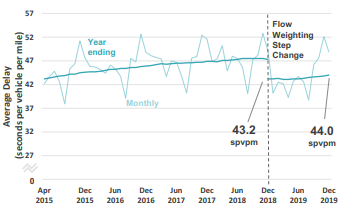
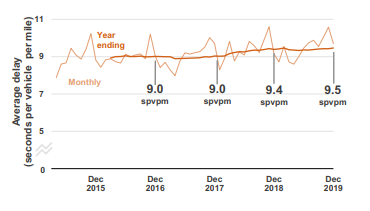
In 2019, the average delay on the Strategic Road Network increased by 0.1 seconds per vehicle per mile (up 0.9% on 2018). The average delay on local ‘A’ roads increased by 0.8 seconds per vehicle per mile (1.8% increase on 2018), according to statistics from the Government’s latest statistical release.

The findings from the Department for Transport’s Travel time measures for the Strategic Road Network and local ‘A’ roads, England: January to December 2019 show that on the Strategic Road Network (SRN) in 2019, the average delay is estimated to be 9.5 seconds per vehicle per mile compared to speed limits, a 0.9% increase on the previous year.


The statistical release also shows that the average speed of drivers was 58.8mph, down 0.5% from 2018.

The reliability of travel times is measured using the Planning Time Index which shows 67.3% of additional time is needed compared to speed limits on average, on individual roads sections to ensure on time arrival. This figure is up 1.1 percentage points in comparison to 2018.

On local ‘A’ roads in 2019, the average delay is estimated to be 44.0 seconds per vehicle per mile compared to free flow, up 1.8% compared to 2018.

The average speed on local ‘A’ roads was 25.3 mph, no change compared to the previous year.

If you want to read the full document, you can find it here: https://assets.publishing.service.gov.uk/government/uploads/system/uploads/attachment_data/file/870292/travel-time-measures-srn-local-a-roads-2019.pdf   By Graham Hill thanks to Fleet News.

Share My Blogs With Others: These icons link to social bookmarking sites where readers can share and discover new web pages.
  • MisterWong
  • Y!GG
  • Webnews
  • Digg
  • del.icio.us
  • StumbleUpon
  • Reddit
  • Alltagz
  • Ask
  • Bloglines
  • Facebook
  • YahooMyWeb
  • Google Bookmarks
  • LinkedIn
  • MySpace
  • TwitThis
  • Squidoo
  • MyShare
  • YahooBuzz
  • De.lirio.us
  • Wikio UK
  • Print
  • Socializer
  • blogmarks

European New Car CO2 Emissions Reach An Unexpected High

Wednesday, 11. March 2020

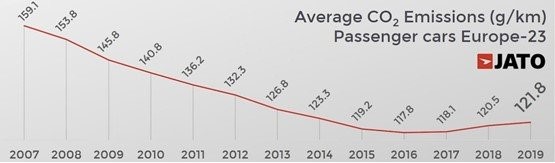
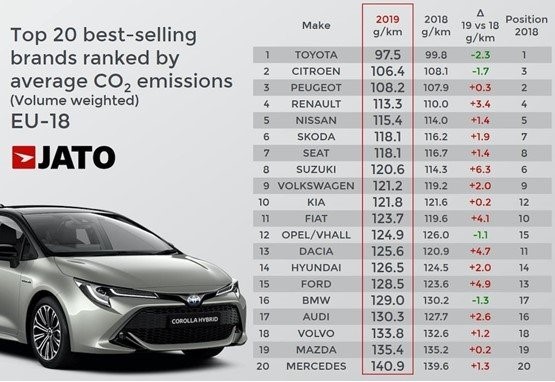
New car CO2 emissions have continued to rise and have hit the highest average since 2014. Only a rapid increase in electric vehicles will reverse this trend, says JATO Dynamics.


Data from the business has revealed that, last year, the volume weighted average CO2 emissions for European markets were at their highest levels since 2014. The average for the 23 European markets totalled 121.8g/km under the NEDC regime.


Felipe Munoz, JATO Dynamics’ global analyst, said: “As expected, the combination of fewer diesel registrations and more SUVs continued to have an impact on emissions. We don’t anticipate any change to this trend in the mid-term, indeed these results further highlight the industry’s need to adopt EVs at a rapid pace to reach emissions targets.”


Average CO2 emissions (NEDC) measured in 2019 increased for the third year running, despite new regulation designed to curtail this.


The data also shows that although last year’s average was 1.3g/km higher than in 2018, the increase was in fact lower than the difference between the 2017 and 2018 results – where the growth was 2.4g/km.


Despite an increase of electric vehicle (EV) models contributing positively on emission levels, the move away from diesel had a negative impact.


Munoz said: “The average emissions of electrified vehicles, was 63.2g/km, almost half that produced by diesel and petrol vehicles. The problem arose because EVs only accounted for 6% of total registrations, which is not yet a high enough figure to create a positive change.”


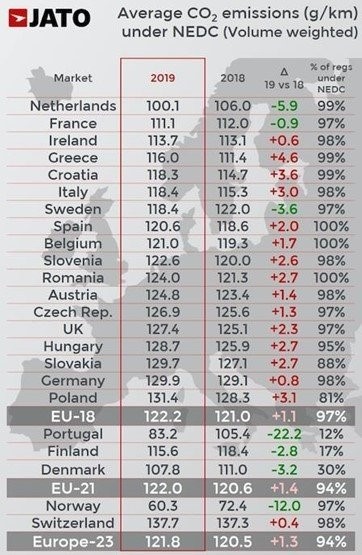
Four of the five major markets in Europe posted higher averages in 2019 than in 2018. Average emissions for Germany, Britain, Italy, and Spain increased, ranging from a rise of 0.8g/km for Germany to an increase of 3.0g/km for Italy.


JATO believes this was in part caused by marked changes in attitude and regulations around the use of diesel fuels, pushing people to drive higher CO2 emitting petrol vehicles.


France was the only market to see better results, as its average fell from 112.0g/km in 2018, to 111.1g/km last year. Despite this positive change, its emission levels were still higher than the averages they recorded in 2016 and 2017.


Pure electric cars have a 2% market share in France, the highest share among all five major markets.


Toyota holds its position as the top 20 best-selling brand with the lowest average CO2 emissions in Europe, as well as seeing the largest decrease since 2018, with its average failing by 2.3g/km.


JATO says Toyota’s success is based on its popular hybrid range, with registrations making up 60% of the brand total volume in 2019.


In the group ranking, Toyota was behind Tesla. Along with Lexus brand, Toyota posted an average of 99.0g/km of CO2 in 2019, 14.3g/km less than the next best in the ranking, PSA. At group level, Nissan Group, Renault Group, Mitsubishi and Suzuki posted average emissions lower than the total market’s average of 121.8g/km. Volkswagen Group recorded an average of 123.6g/km.

Citroen was the brand with the second-lowest average emissions and was the second-best performer.


The average CO2 emissions for SUVs was 131.5g/km, higher than emissions posted from city-cars (107.7g/km), subcompacts (109.2g/km), compacts (115.3g/km), midsize (117.9g/km), and executive cars (131g/km).


“The SUV segment of the market urgently needs more electrified models. To date, the focus for EVs has been on traditional hatchbacks and sedans, leaving very few choices in the SUV market. If these vehicles want to keep gaining traction and avoid future sanctions, they need to be electrified” says Munoz. By Graham Hill thanks to Fleet News

Share My Blogs With Others: These icons link to social bookmarking sites where readers can share and discover new web pages.
  • MisterWong
  • Y!GG
  • Webnews
  • Digg
  • del.icio.us
  • StumbleUpon
  • Reddit
  • Alltagz
  • Ask
  • Bloglines
  • Facebook
  • YahooMyWeb
  • Google Bookmarks
  • LinkedIn
  • MySpace
  • TwitThis
  • Squidoo
  • MyShare
  • YahooBuzz
  • De.lirio.us
  • Wikio UK
  • Print
  • Socializer
  • blogmarks

Tyre Pollution 1,000 Times Worse Than Exhaust Emissions

Wednesday, 11. March 2020

Pollution from tyre wear can be 1,000 times worse than what comes out of a car’s exhaust, according to a new study by Emissions Analytics.


Harmful particle matter from tyres – and also brakes – is being exacerbated by the increasing popularity of large, heavy vehicles such as SUVs, and growing demand for electric vehicles, which are heavier than standard cars because of their batteries.


Exhaust emissions have been rapidly reduced by car makers as a result of the pressure placed on them by European emissions standards. New cars now emit very little in the way of particulate matter but there is growing concern around ‘non-exhaust emissions’.


Non-exhaust emissions (NEE) are particles released into the air from brake wear, tyre wear, road surface wear and resuspension of road dust during on-road vehicle usage. No legislation is in place to limit or reduce NEE, but they cause a great deal of concern for air quality.


Richard Lofthouse, senior researcher at Emissions Analytics, said: “It’s time to consider not just what comes out of a car’s exhaust pipe but particle pollution from tyre and brake wear. Our initial tests reveal that there can be a shocking amount of particle pollution from tyres – 1,000 times worse than emissions from a car’s exhaust.


“What is even more frightening is that while exhaust emissions have been tightly regulated for many years, tyre wear is totally unregulated – and with the increasing growth in sales of heavier SUVs and battery-powered electric cars, non-exhaust emissions are a very serious problem.”


NEEs are currently believed to constitute the majority of primary particulate matter from road transport, 60% percent of PM2.5 and 73% percent of PM10 – and in its 2019 report ‘Non-Exhaust Emissions from Road Traffic’ by the UK Government’s Air Quality Expert Group (AQEG), it recommended that NEE are immediately recognised as a source of ambient concentrations of airborne particulate matter, even for vehicles with zero exhaust emissions of particles – such as EVs.


To understand the scale of the problem, Emissions Analytics performed some initial tyre wear testing. Using a popular family hatchback running on brand new, correctly inflated tyres, it found that the car emitted 5.8g/km of particles.


Compared with regulated exhaust emission limits of 4.5mg/km, the tyre wear emission is higher by a factor of more than 1,000.


Emissions Analytics notes that this could be even higher if the vehicle had tyres which were underinflated, or the road surfaces used for the test were rougher, or the tyres used were from a budget range – all very recognisable scenarios in ‘real world’ motoring.


Nick Molden, CEO of Emissions Analytics, said: “The challenge to the industry and regulators is an almost complete black hole of consumer information, undone by frankly out of date regulations still preoccupied with exhaust emissions. In the short term, fitting higher quality tyres is one way to reduce these NEEs and to always have tyres inflated to the correct level.


“Ultimately, though, the car industry may have to find ways to reduce vehicle weight too. What is without doubt on the horizon is much-needed regulation to combat this problem. Whether that leads to specific types of low emission, harder wearing tyres is not for us to say – but change has to come.”


Mike Hawes, SMMT chief executive responded to the findings: “Making sensationalist claims based on testing of a single vehicle is not credible and, quite frankly, irresponsible. Emissions from safety-critical brakes, tyres and road surfaces are very difficult to measure, and a challenge already taken seriously by the sector, governments and a UN global group, which are working together to better understand, and agree, how to test them in a scientific way. Further, there is no evidence to suggest that electric vehicles have a propensity to emit more non-exhaust particulates than any other – in fact, their regenerative braking systems mean wear is significantly reduced.” By Graham Hill with thanks to Fleet News

Share My Blogs With Others: These icons link to social bookmarking sites where readers can share and discover new web pages.
  • MisterWong
  • Y!GG
  • Webnews
  • Digg
  • del.icio.us
  • StumbleUpon
  • Reddit
  • Alltagz
  • Ask
  • Bloglines
  • Facebook
  • YahooMyWeb
  • Google Bookmarks
  • LinkedIn
  • MySpace
  • TwitThis
  • Squidoo
  • MyShare
  • YahooBuzz
  • De.lirio.us
  • Wikio UK
  • Print
  • Socializer
  • blogmarks