Touchscreen Development Could Compromise Safety

Thursday, 14. April 2022

VNC Automotive has questioned the automotive industry’s rush to replace conventional controls with touchscreens.

7

The software company says that manufacturers are at risk of alienating customers, compromising safety, and drawing the ire of regulatory bodies.

“Car manufacturers are locked in a race,” says Tom Blackie, CEO of VNC Automotive. “Not the kind that demands ever-increasing power outputs or shrinking zero-to-sixty times, however. Instead, the results of this contest are measured in inches.”

With each new model launch, vehicle manufacturers push the boundaries a little further, it says, with a race to expand the digital real estate, and make it more prominent.

Tablet-sized screens perched on the dashboard originally became popular and were soon joined by digital instrument clusters before infotainment systems were defined by the emergence of Tesla, with almost everything controlled by a giant screen in the middle of the dashboard.

It meant that even the most basic interaction, from changing the radio station to turning on the headlights, required the driver to delve into a menu.

However, with its technology installed in more than 35 million vehicles worldwide, VNC Automotive questions whether today’s touch-based interfaces are really the best solution.

“Having a giant touchscreen interface is really about saving hardware costs by implementing everything in software,” says Blackie.

“Recently, though, there’s been growing disquiet as years of ergonomic study and usability experience are abandoned in the rush to cram everything onto a single screen.”

A recent study by the UK’s Transport Research Laboratory and road safety charity IAM Roadsmart found that drivers took their eyes off the road for as long as 20 seconds when asked to play a track from Spotify using a touchscreen interface, long enough to travel a distance of 630 metres at 70mph – more than a third of a mile.

During that time, many drivers struggled to maintain their lane position, while some failed to respond to a simulated emergency event.

Overall, reaction times increased by up to 57% when interacting with these devices; driving while over the alcohol limit by comparison only increases reaction times by 12%.

In light of this research, Fleet News reported how recent changes to law around the use of mobile phones while driving were a “missed opportunity”, according to road safety experts.

Dissatisfaction with the proliferation of these interfaces isalso  growing among drivers, suggests VNC Automotive, and with the European Commission estimating that driver distraction is a factor in up to 30% of all accidents in Europe, it seems likely legislators will soon feel compelled to step in.

“The sluggishness that plagued early systems has now largely been addressed, but the lack of physical feedback on activating a touchpoint still demands that drivers glance at the screen for visual confirmation,” explained Blackie.

“With many cars lacking a convenient surface to brace against, the task of aiming at a small control with an extended arm in a car that’s bouncing around can quickly become a repetitive one, prolonging the time spent diverting focus from the road.”

Haptic feedback systems have improved from early electromagnetic actuators mounted behind a sprung display to clever electrostatic technologies that can even replicate different textures.

However, there remains the challenge of muscle-memory: in the past, drivers could feel their way to their favourite radio station, says VNC Automotive. Now, the function of a touchpoint varies depending on context.

Not only that, but the design of the interface itself is critical to reducing the demands for a driver’s attention.

Frequently used controls, it explains, should be styled to stand out from their surroundings; icons should be easily discernible; the status of a function should be readily apparent at a glance; colours should be chosen to avoid wash-out in sunlight. These are considerations that should be given precedence over all others.

Some OEMs believe the answer is more screens. The Honda e and Mercedes EQS, for example, both feature a swath of screens across the dashboard, offering a digital landscape almost as wide as the car itself.

This marks a clear departure from the days of infotainment systems optimised for use by the driver alone; now, passengers are afforded equal access.

“Shifting the focus to the passengers in the vehicle allows each occupant to enjoy an individual experience,” continued Blackie.

“Once you make it easier for people to select their own entertainment, it frees the driver-focused interfaces of the burden of being both a control surface and a point of content consumption.

“At that point, we can redesign the UI and UX to regain the ease of usability that’s been lost.”  By Graham Hill thanks to Fleet News

Share My Blogs With Others: These icons link to social bookmarking sites where readers can share and discover new web pages.
  • MisterWong
  • Y!GG
  • Webnews
  • Digg
  • del.icio.us
  • StumbleUpon
  • Reddit
  • Alltagz
  • Ask
  • Bloglines
  • Facebook
  • YahooMyWeb
  • Google Bookmarks
  • LinkedIn
  • MySpace
  • TwitThis
  • Squidoo
  • MyShare
  • YahooBuzz
  • De.lirio.us
  • Wikio UK
  • Print
  • Socializer
  • blogmarks

Successful Payouts To Drivers As A Result Of Potholes

Thursday, 14. April 2022

Councils and road authorities in England, Scotland and Wales have paid out almost £13 million for vehicle damage caused by potholes between January 2018 and October 2021, new research suggests.

Motorists across England, Scotland and Wales submitted more than 145,000 compensation claims to councils, with 37,366 motorists receiving compensation, on average, of £347 – a success rate of 25%.

The cost of filling a pothole has previously been estimated to cost £47.

National Highways (formerly Highways England), in charge of England’s trunk roads, was the highest paying authority, stumping up just over £865,000 in compensation.

The research, from What Car?, comes after The Asphalt Industry Alliance published its latest ALARM report, with local authorities in England and Wales facing a nine-year backlog of road repairs estimated to cost more than £12 billion.

Five county and city councils were found to have paid more than half a million in compensation between 2018 and October 2021, including Lincolnshire County Council, Surrey County Council, Lancashire County Council, Staffordshire County Council, and Stoke-on-Trent City Council.

Lincolnshire County Council received the highest number of damage claims across the four years, with 8,810 claims, of which 4,313 were successful, costing the local authority more than £760,000 – £177 per claim.

Wiltshire Council was found to have the highest share of compensation claims paid, with 86% of the 1,594 claims paid, totalling £302,000 over the four-year period.

Slough Borough Council and Stoke-on-Trent City Councils were the second and third highest, paying out 65% and 62% of all claims, respectively.

In total, 11 councils across Britain paid more than half of all claims.

Not all local authorities answered the Freedom of Information request; 344 responded while 161 said they were unable to provide figures as road compensation often fell under the remit of county and city councils, rather than borough or district councils.

Meanwhile, a survey of motorists it conducted found almost one in four 24% motorists had damaged their vehicle in the past 18 months from hitting a pothole.

Two-thirds of respondents were aware they could claim for the damage caused from their local roads authority, though only one in 10 had ever done so.

Top 20 councils and road authorities per pothole compensation 

PositionCouncil or Road AuthorityTotal ClaimsClaims successfulShare of claims paid outTotal Payout (£)
1Highways England 4,7812,70756.62%865,254.75 
2Lincolnshire County Council8,8104,31348.96%764,588.00 
3Surrey County Council6,38089314.00%608,284.00 
4Lancashire County Council4,0161,90347.39%520,745.26 
5Staffordshire County Council5,6591,50226.54%517,367.00 
6Stoke-on-Trent City Council1,43089262.38%507,055.78 
7Oxfordshire County Council3,5781,51241.11%378,770.00 
8Cambridgeshire County Council2,66694235.33%354,931.56 
9Rotherham Metropolitan Borough Council804759.33%350,500.00 
10Dumfries and Galloway Council1,56858537.31%324,111.39 
11Wiltshire Council1,5941,38186.64%302,911.10 
12Shropshire Council2,41281133.62%282,454.13 
13Dudley Metropolitan Borough46323851.40%262,862.49 
14West Northamptonshire Council*2,99577025.71%234,961.87 
15Derbyshire County Council2,09977236.78%222,264.60 
16Hampshire County Council6,04673212.11%219,284.22 
17Northumberland County Council1,40966347.05%196,450.00 
18Warwickshire County Council1.15351544.67%189,853.00 
19Flintshire County Council60024841.33%177,205.00 
20Devon County Council2,73472026.34%170,069.00 

*As of the April 1, 2021, South Northamptonshire Council, Northamptonshire County Council, Northampton Borough Council and Daventry District Council ceased to exist and formed the new West Northamptonshire Unitary Council. The data provided prior to the April 1, 2021, relates to those claims submitted to Northamptonshire County Council and covers the County as a whole. The data provided since April 1, 2021, relates to the West Northamptonshire area of the County only.

By Graham Hill Thanks To Fleet News

Share My Blogs With Others: These icons link to social bookmarking sites where readers can share and discover new web pages.
  • MisterWong
  • Y!GG
  • Webnews
  • Digg
  • del.icio.us
  • StumbleUpon
  • Reddit
  • Alltagz
  • Ask
  • Bloglines
  • Facebook
  • YahooMyWeb
  • Google Bookmarks
  • LinkedIn
  • MySpace
  • TwitThis
  • Squidoo
  • MyShare
  • YahooBuzz
  • De.lirio.us
  • Wikio UK
  • Print
  • Socializer
  • blogmarks

Greater London Has More Speed Cameras Than Anywhere Else In UK

Thursday, 7. April 2022

Greater London has been identified as having the largest number of speed cameras in the UK, with almost 1,000 speed traps located across the Capital.

The camera hotspots include spot speed sites, red-light cameras, ‘speed on’ green sites and average speed cameras.

London has 0.6 speed cameras per square Km, the highest proportion of any region. Derbyshire, which has the second highest number of cameras in the UK, has a density of 0.3 cameras per square Km.

The data was obtained by short-term insurance provider Go Shorty, by means of a Freedom of Information Request.

RankAreaCameras currently installed
1Greater London995
2Derbyshire958
3West Yorkshire402
4Humberside266
5Devon and Cornwall115
6Essex100
7Bedfordshire97
8Kent84
9South Wales69
10Gwent67

The organisation also gathered data on the highest speeds captured in each region. Nottinghamshire topped the list, with one driver caught travelling at 191mph. The offence was committed on the M1 Southbound, between junctions 26 and 25.

Eight constabularies in the UK reported speeders caught travelling at 150mph or more.

RankConstabularySpeed
1Nottinghamshire Police191mph
2Humberside Police163mph
3West Yorkshire Police159mph
4Essex Police158mph
5Kent Police157mph
6Gwent Police155mph
7Sussex Police151mph
8Lincolnshire Police151mph
9Derbyshire Police148mph
10Lancashire Police147mph

Almost half of fixed speed cameras are not working, however, according to a separate study answered by 26 out of 44 police forces.

Of the 1,092 fixed speed cameras, 523 are inactive. Wiltshire Police reported that they have no fixed or mobile cameras but just rely on handheld cameras.

Some areas – like North Yorkshire, Durham, and Northamptonshire – have no fixed speed cameras working at all. Some of the cameras started to be switched off 10 years ago when funding arrangements were changed, and they became too expensive to replace.

The findings, from a BBC Panorama investigation, come as death rates on UK roads have plateaued over the past decade, after previously declining for 30 years. The death rate on the country’s roads increased by 5% in 2020.  By Graham Hill thanks to Fleet News

Share My Blogs With Others: These icons link to social bookmarking sites where readers can share and discover new web pages.
  • MisterWong
  • Y!GG
  • Webnews
  • Digg
  • del.icio.us
  • StumbleUpon
  • Reddit
  • Alltagz
  • Ask
  • Bloglines
  • Facebook
  • YahooMyWeb
  • Google Bookmarks
  • LinkedIn
  • MySpace
  • TwitThis
  • Squidoo
  • MyShare
  • YahooBuzz
  • De.lirio.us
  • Wikio UK
  • Print
  • Socializer
  • blogmarks

Warnings Regarding The Increase In Demand For Electricity As Electric Cars Increase

Thursday, 7. April 2022

Demands on the UK’s electricity network are set to rocket as the country moves closer to the ambition of a net zero economy by 2050.

National Grid estimates overall electricity consumption in that year will be 890tWh, almost three times as high as 2020’s figure of 304tWh.

Much of this will be down to the increased use of electricity in energy-consuming sectors such as industry and heating, but the electrification of the UK’s road transport network will also have a significant impact.

National Grid expects EVs to account for more than 80tWh. “Questions will be raised about how they will be charged as the demand on the electricity supply grows,” it says in its 2021 Future Energy Scenarios report.

“Smart charging, where EV owners release some control on the best time to charge to third parties or automation based on price, will be an effective tool to support the local and national electricity networks.”

The most basic form of smart charging allows the user to manually set the times a vehicle will be charged, allowing them to make savings by taking advantage of the time-of-use tariffs which feature lower electricity prices at times of high supply and low demand, such as at night between 1am and 5am.

Fleets which operate a back-to-base model where vehicles are plugged in at a depot can use this to stagger charging times to help avoid a costly electricity network upgrade that may be needed if all their EVs are charged at the same time.

“In some cases, the cost to electrify the site could be higher than the cost of the vehicles, making the transition commercially unviable,” says Nicole Thompson, director of social innovation and head of co-creation partnerships for Hitachi Vantara.

The next step in smart charging is to use artificial intelligence so the chargers communicate with the electricity network to respond to changes in the level of supply, demand and cost.

For this, the user would specify the level of charge required and the time the vehicle is needed by, and the system would manage the flow of energy to the battery to ensure this happens.

Greater flexibility

“There is much more renewable energy coming on to the grid now and that’s really good news for a whole host of reasons,” says Ben Fletcher, associate director of EV at smart battery hardware and software company Moixa.

“It also means that having the flexibility where you can decide what vehicle is – and isn’t – charging and work with the grid is super important in probably a way that hasn’t been as important before, especially with the size of EV fleet that’s coming.

“That’s where the smartness comes in. There are electricity tariffs which are helping to support like Octopus Agile, which tracks the wholesale price of electricity.

“That’s a ground-breaking tariff and is a fantastic tool that has the ability to change every half-hour, but you have to be on top of it and tracking what’s going on as well as triangulating it back to when you actually need your vehicle to be ready by.

“The smartness will allow customers to make the most of these kinds of tariffs alongside the energy companies and the National Grid in the transition to more and more renewable energy.”

Moixa is a partner in the EV Fleet-centred Local Energy System (EFLES) project, which aims to show how artificial intelligence (AI) can break down the barriers to electrification for fleet operators by maximising the cost and carbon savings from EVs.

Supported by the Government’s Industrial Strategy Challenge Fund for Research and Innovation, other project partners are UK Power Networks, UPS and Cross River Partnership.

It builds on the Smart Electric Urban Logistics (SEUL) trial from 2017 to 2019 which saw Cross River Partnership, UPS and UK Power Networks develop charging technology at UPS’s Camden depot to meet the challenge of charging an EV fleet without a costly upgrade of the local power network.

“We started off with EVs in London back in 2008 and had an expensive power upgrade, which could take us up to 63 EVs,” says Claire Thompson-Sage, sustainable development co-ordinator at UPS.

“We reached that limit in 2017, so we worked with the SEUL project to develop smart grid technology to enable us to have a fully-electrified fleet in London, which we’re aiming towards now.

“The (EFLES) project is built on looking at how we can optimise the power.”

Thompson-Sage says that, as UPS charges its vehicles overnight, it uses very little power during the day and it will use the project to look at how it manages its energy systems, including on-site solar panels and static battery storage.

Capital expenduture savings of 70%

The SEUL project identified capital expenditure savings of around 70% through using a smart charging solution instead of upgrading the local electricity network.

ELFES takes this a step further and the integration of Moixa’s GridShare platform will monitor and analyse a multitude of data sources at the depot including energy prices, power demand and weather forecasts to optimise charging for when energy is cleanest and cheapest, while also using on-site energy storage and solar power generation.

“SEUL was about managing capital costs, but what about operational costs?,” asks Sefinat Otaru, ELFES project manager, Cross River Partnership.

“This was how this project came about and, once it wraps up next year, it’s going to be very much about sharing the results and just helping other organisations that are interested make connections with the right people so that, hopefully, they will pick up the ball and keep it rolling.”

Smart charging for fleets is also the subject of a number of other trials, such as the Fleet Connected Smart Charging (FCSM) project.

This is led by data science company Miralis Data, energy management company Envisij and EV charging firm Mina.

It aims to produce a smart charging solution to optimise the electricity capacity of a site to enable fleets to transition to EVs quicker and more efficiently.

During the project, which has secured funding from the Office for Zero Emission Vehicles, Envisij will report real-time and projected site power capacity and site demand, while Miralis will devise a smart charging solution to optimise the remaining capacity, charging vehicles within cost and capacity parameters. The solution is expected in 2022.

The Government has also identified smart charging as having a key role to play and the Automated and Electric Vehicles Act 2018 gives it the powers through secondary legislation to mandate that all charge points sold or installed in the UK have smart functionality.

In 2019, it introduced the requirement that all Government-funded home EV charge points must use smart technology and it is now proposing that home and workplace chargers installed from May must be pre-programmed to switch off during peak hours (8-11am and 4-10pm) to ease pressure on the National Grid.

Owners and fleets will be able to override the pre-set times to take account of night workers and people who have different schedules.

Smart charging not for all

While the number of smart chargers – both at homes and at businesses – are rapidly increasing, smart charging may not suit all drivers, says Fletcher, adding: “There will be some people who will take their vehicle home and they might be on 24-hour call, so they need to charge the vehicle as quickly as possible.

“For them, it’s go home and put the vehicle on charge immediately because that person needs the confidence that if they are called out in the middle of the night, they’ll be able to respond.

“Other drivers will have a much more predictable duty cycle. They may get home at 6pm and leave at 7am the next day, giving a window of opportunity where the charging can be optimised against the relevant tariff to make sure that both work in terms of money and CO2.

“That would benefit the fleet manager in terms of the costs that are being put in, but it’s also benefiting the user because they’re not thinking about any charging schedules.”

National Grid’s Future Energy Scenario also highlights the role vehicle-to-grid (V2G) – which enables battery electric vehicles (BEVs) to provide energy storage services to the electricity network – can play.

This allows users to plug their BEV in to charge and, potentially, sell any surplus electricity back to the local and national networks at peak times.

The Project Sciurus trial found the simulated annual revenue for a driver using V2G was £340 compared with using an unmanaged charger. In contrast, smart charging could capture £120 from tariff optimisation.

The initiative, which project partner Cenex says is the world’s largest V2G trial, began in 2018 and has more than 320 V2G units installed in UK homes.

Participants are able to set their preferences for charging parameters and remain in control of when their vehicles are ready to use. They get paid a fixed rate for every kWh exported to the grid.

Participants are able to set their preferences for charging parameters and remain in control of when their vehicles are ready to use. They get paid a fixed rate for every kWh exported to the grid.

In its Project Sciurus White Paper, Cenex analysed the plug-in behaviour of users over a 12-month period, looking at different user-types, and found that, although domestic V2G propositions are suitable for a range of drivers, ‘utility style fleet vans’ are among the prime candidates for the technology.

The low-carbon consultancy describes this category as small vans used to carry small volumes of tools and equipment between domestic appointments.

They are owned by a company, but kept by the driver and charged at home or on public networks.

However, Cenex points out the home the vehicle would be connected to would not be the property of the company and, therefore, is unlikely to support V2G activities with the vehicle at the premises unless there are financial or other benefits for the organisation.

V2G drawbacks

While there are other benefits to a fleet opting to install V2G technology, for example the potential to preserve the health of a battery, there are also drawbacks.

Currently the cost of a V2G charging unit is around £4,000 to £6,000, which is significantly more than a smart charger.

Other trials are also taking place in the UK, such as Western Power Distribution’s Electric Nation initiative, which features 100 Nissan EV owners in the Midlands, south-west England and South Wales.

Some industry figures are less convinced about the role V2G will play in the future of the wider charging ecosystem.

“The way I explain it to people is that smart charging gives you 90% of the benefits of V2G for 10% of the complexity,” says Erik Fairbarn, founder and chief executive of Pod Point.

“For that reason, I don’t think it’s a very significant part of charging in most cases, but if you’re talking about depots of buses or fleets of vehicles in a particular location, there are use cases there which I think it could make sense in.

“But if we’re talking broadly across the charging ecosystem, it’s probably one to keep an eye on but I wouldn’t expect much to happen there in the short-term.”

Fletcher adds: “The answer to the question ‘will V2G work for me?’ is ‘it depends’. It depends on the type of fleet and the way the vehicles are used.

“There will be points when the grid is under immense stress but to have the benefit of feeding power back to the grid at those times, the vehicles actually need to be plugged in and available.

“That will absolutely fit in with how the duty cycle of some fleets work, but for other fleets it might be more difficult.

“When you’re talking about BEVs and V2G it’s easy to fall into the trap of talking about them as batteries with wheels, but the key point to remember here is that people actually buy vehicles to get from point A to point B.

“That has to be at the heart of running a BEV. The smartness and V2G needs to be there to enable the vehicles to move things or people from A to B as easily and efficiently as possible, not to have supporting the grid as its main function.”  By Graham Hill thanks to Fleet News

Share My Blogs With Others: These icons link to social bookmarking sites where readers can share and discover new web pages.
  • MisterWong
  • Y!GG
  • Webnews
  • Digg
  • del.icio.us
  • StumbleUpon
  • Reddit
  • Alltagz
  • Ask
  • Bloglines
  • Facebook
  • YahooMyWeb
  • Google Bookmarks
  • LinkedIn
  • MySpace
  • TwitThis
  • Squidoo
  • MyShare
  • YahooBuzz
  • De.lirio.us
  • Wikio UK
  • Print
  • Socializer
  • blogmarks

Micro-Chip Shortage Continues To Stifle New Car Registrations

Thursday, 7. April 2022

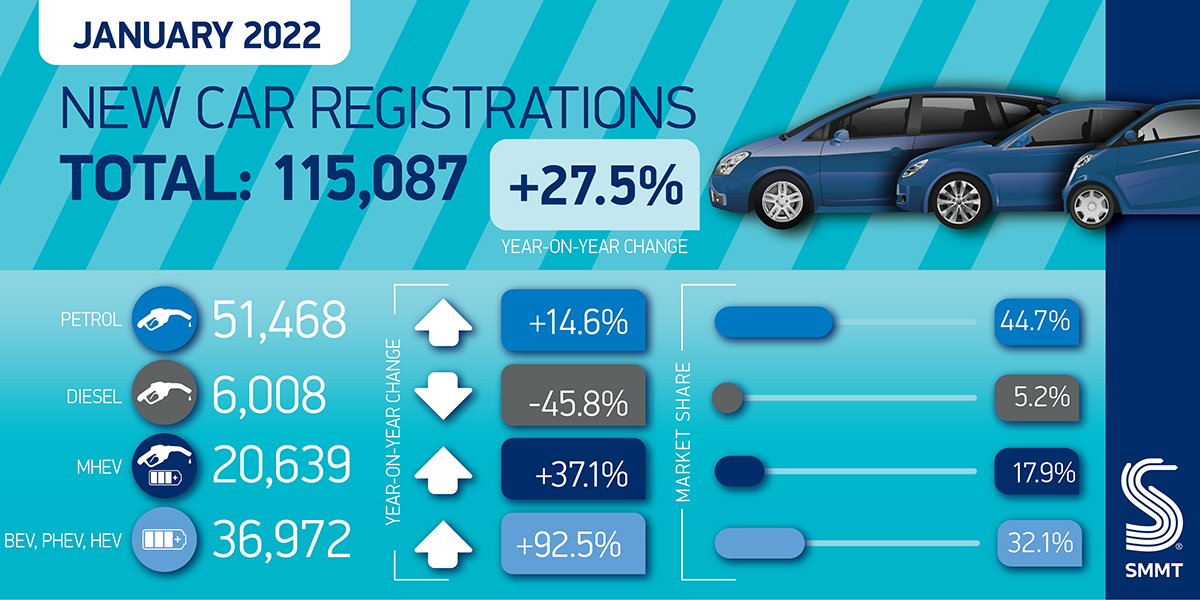
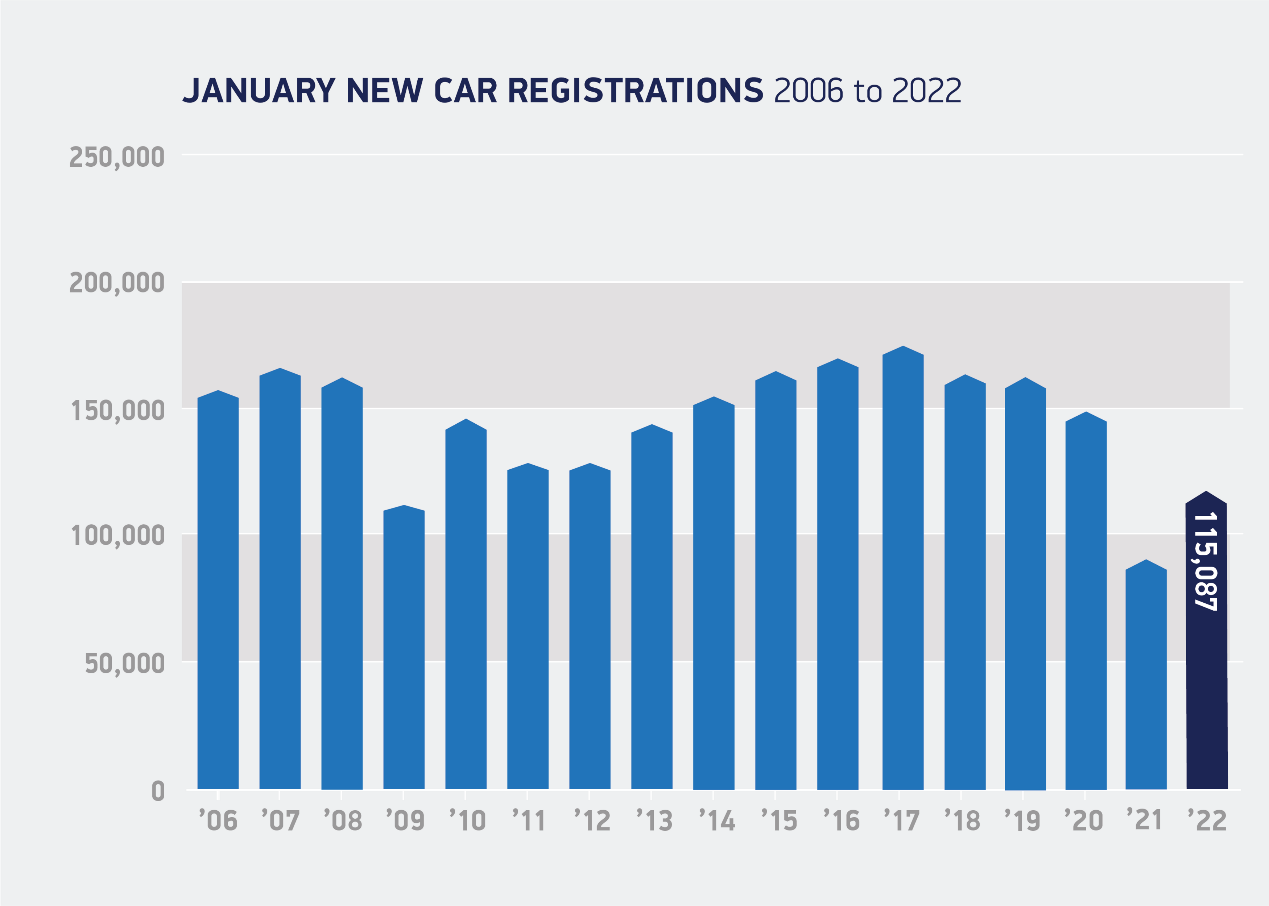
New car registrations are more than a fifth down on pre-pandemic levels, with the global semiconductor shortage continuing to impact supply, according to new figures from the Society of Motor Manufacturers and Traders (SMMT).

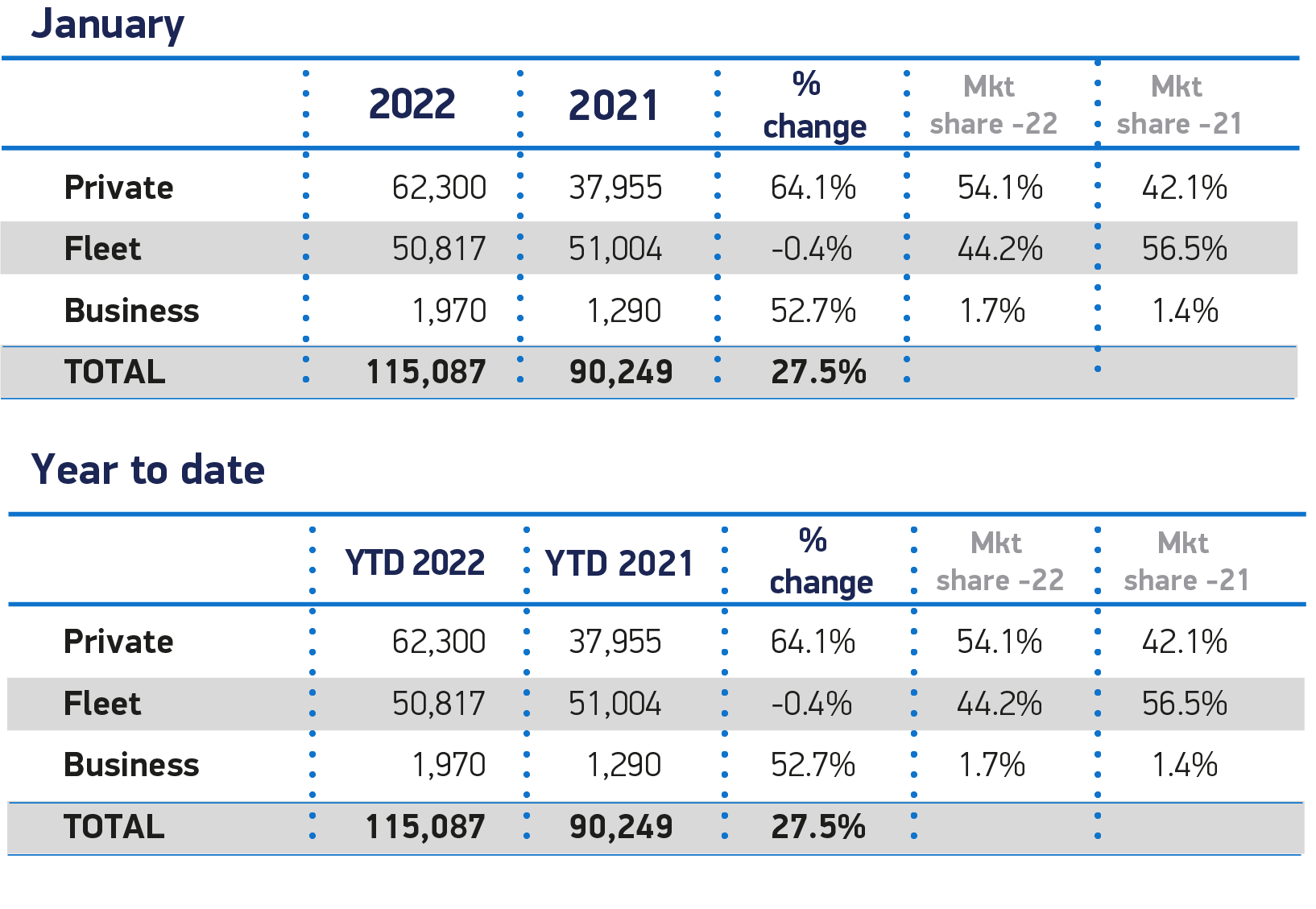
Fleet and business registrations were up by just 0.1% in January compared to the start of last year, with 52,787 new company cars registered.

Private registrations were almost double those seen in January 2021, with 62,300 new cars sold last month compared to the 37,955 units that were registered last year when showrooms were closed.

Year-on-year it means the new car market is 27.5% up on January 2021, but the market remains well below pre-pandemic levels, 22.9% lower than in January 2020.

Mike Hawes, chief executive of the SMMT, said, “Given the lockdown-impacted January 2021, this month’s figures were always going to be an improvement, but it is still reassuring to see a strengthening market.”

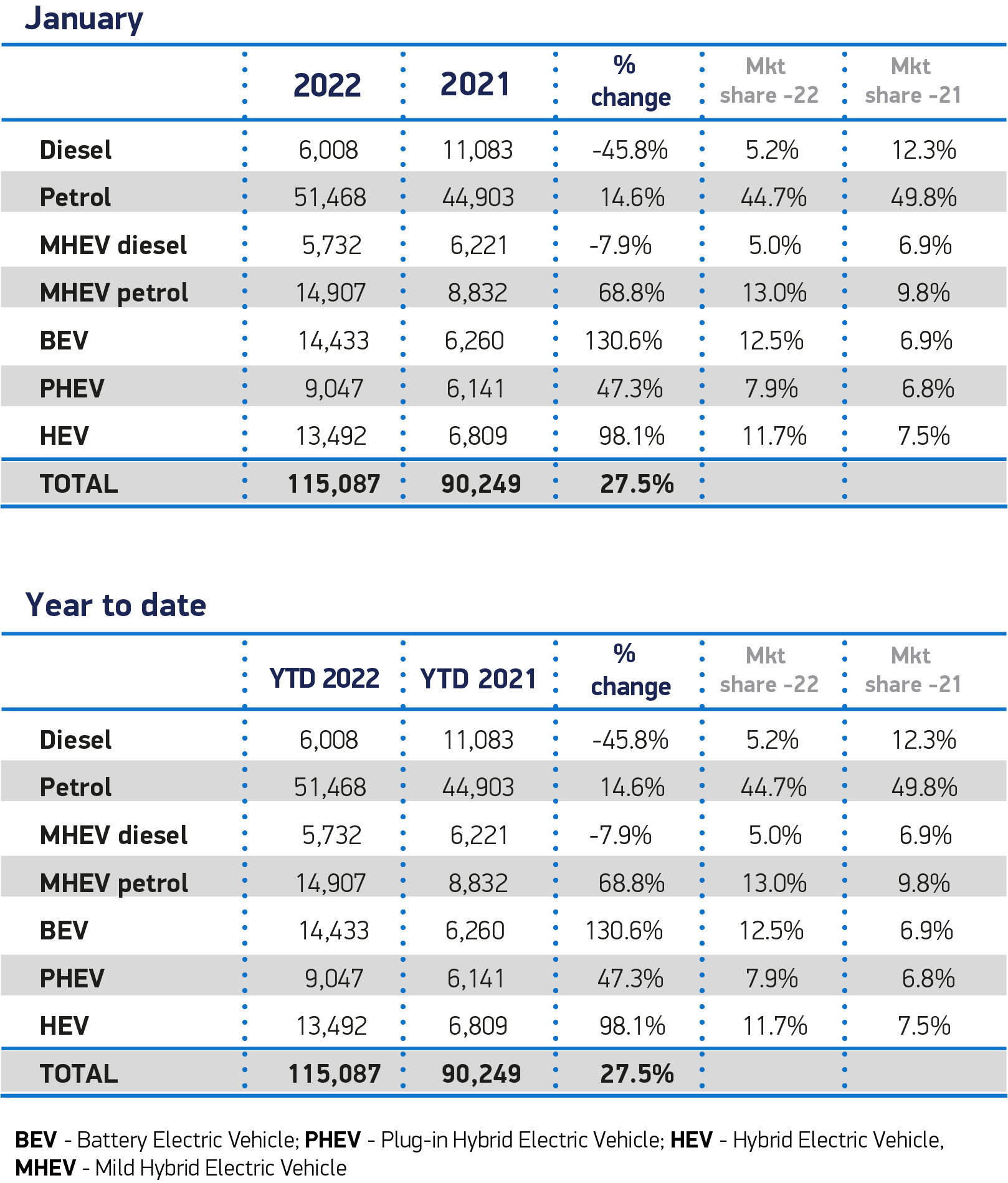
Electric vehicles (EVs) continue to bolster growth, with battery electric (BEV), plug-in hybrid (PHEV) and hybrid (HEV) cars accounting for 71.5% of the uplift in registrations.

Plug-in vehicles enjoyed another bumper month, with 14,433 BEVs and 9,047 PHEVs registered, equal to some 20.4% of the market. With 13,492 HEVs also registered, almost one in three new cars joining British roads in January was electrified.

Despite the challenges of 2021, with manufacturers battling against global semiconductor shortages, new trading arrangements and Covid impacts, including shuttered showrooms and staff shortages, it was a record year for zero and ultra-low emission vehicles.

As a result, new data shows that average new car CO2 emissions fell by 11.2%, to its lowest ever recorded level of 119.7g/km.

There are now more than 140 plug-in car models available to UK buyers, with almost 50 more scheduled for release in 2022.

Hawes said: “Once again it is electrified vehicles that are driving the growth, despite the ongoing headwinds of chip shortages, rising inflation and the cost-of-living squeeze. 2022 is off to a reasonable start, however, and with around 50 new electrified models due for release this year, customers will have an ever-greater choice, which can only be good for our shared environmental ambitions.”

Cutting CO2 even further, however, will require more drivers to switch to electric and other zero emission technologies, says the SMMT.

One of the obstacles remains perceptions of a lack of charging infrastructure, which must be built ahead of demand – and that demand is increasing exponentially.

The rapid pace of change is underlined by the latest market outlook, which forecasts registrations of BEVs and PHEVs to grow by 61% and 42% respectively in 2022, meaning that, by the end of the year, almost one in four new cars would come with a plug.

Overall, total new car registrations are expected to rise 15.2% on 2021, to 1.897 million units. This is a downward revision from October’s outlook of 1.96 million, as the ongoing semiconductor shortage, increasing costs of living and rising interest rates are expected to dampen some demand in 2022.

A 2022 market of 1.897 million would still be down 17.9% on the pre-pandemic 2019, but the recovery is expected to continue into 2023, with the market projected to climb above two million units for the first time since 2019.

Meryem Brassington, electrification propositions lead at Lex Autolease said: “The electric vehicle industry has had every challenge thrown at it over the last 12 months, with labour and material shortages threatening to stall the good progress that has been made. However, today’s figures reaffirm its robustness to keep up with the demands of motorists across the country.

“As we accelerate towards the 2030 ICE ban deadline, Government departments and industry bodies must continue to work together to ensure the UK remains the most attractive place for electric vehicle production.

“Recent manufacturer commitments from Jaguar Land Rover and Bentley, and the announcements of a battery recycling plant and Gigafactory by Britishvolt, have brought renewed impetus for the Road to Zero policy, helping to make certain that more vehicles on the roads are truly sustainable.

“Today’s publication of the Transport Committee road pricing report will also spark a wider conversation around the future for EV users, so we look forward to better understanding the implications and next steps.” 

Jon Lawes, managing director of Hitachi Capital Vehicle Solutions, says that the latest SMMT figures illustrate the demand for EVs is only going one way, following a record-breaking year for EV registrations in 2021.

“With motorists increasingly realising the cost and environmental benefits of EVs, and a growing variety of EV models on the market, we will continue to see healthy EV registration figures and in the coming months we can expect to reach the watershed moment where one in two new cars registered will be an EV.

“However, the well-documented semiconductor shortage is hampering OEMs ability to efficiently allocate EVs across all areas of the market where strong demand is present.

“To negate these issues, fleets should look to leasing providers offering innovative, flexible solutions with the reassurance of price protection to facilitate the continued surge in EV uptake once the backlog has subsided.

“In the meantime, clarity from the Government on how it plans to counteract the potential tipping point of EV tax breaks and Salary Sacrifice schemes coming to an end would be welcomed across the board.”

https://cdn.fleetnews.co.uk/web-clean/1/root/smmt-new-car-registrations-january-final-january-registrations-2006-to-2022.png

By Graham Hill thanks to Fleet News

Share My Blogs With Others: These icons link to social bookmarking sites where readers can share and discover new web pages.
  • MisterWong
  • Y!GG
  • Webnews
  • Digg
  • del.icio.us
  • StumbleUpon
  • Reddit
  • Alltagz
  • Ask
  • Bloglines
  • Facebook
  • YahooMyWeb
  • Google Bookmarks
  • LinkedIn
  • MySpace
  • TwitThis
  • Squidoo
  • MyShare
  • YahooBuzz
  • De.lirio.us
  • Wikio UK
  • Print
  • Socializer
  • blogmarks

Proposals To Introduce Road Charging As We Move To Electric Cars

Thursday, 7. April 2022

MPs on the Transport Committee are urging the Government to reform motoring taxation by introducing a ‘pay-as-you-drive’ scheme using telematics technology.

The switch to electric vehicles (EVs), it says, means current road tax revenues of £35 billion a year from fuel duty and vehicle excise duty (VED) could disappear by 2050 unless ministers act now.

In the Transport Committee’ report on road pricing published today (Friday, February 4), it says that the Government should consider a road pricing mechanism that uses telematics technology to charge drivers according to distance driven, factoring in vehicle type and time of day.

MPs say they have not seen a viable alternative to a road pricing system based on telematics, suggesting it is the only route the Government can take if it wants to reform motoring taxes and plug the potential shortfall in revenues.

However, it says that any new system of road taxation must be revenue neutral and assess the impact on high-mileage drivers, such as road hauliers and those in rural communities, and on those least able to adapt to increased motoring costs.

“It’s time for an honest conversation on motoring taxes,” said Huw Merriman MP, chair of the Transport Committee.

“The Government’s plans to reach net zero by 2050 are ambitious. Zero emission vehicles are part of that plan. However, the resulting loss of two major sources of motor taxation will leave a £35bn black hole in finances unless the Government acts now – that’s 4% of the entire tax-take.

“Only £7bn of this goes back to the roads; schools and hospitals could be impacted if motorists don’t continue to pay.”  

The Transport Committee, which launched its road pricing inquiry in 2020, considered the implications of accelerating the shift to zero emission vehicles, including bus and freight vehicles, and the case for using new technology to introduce some form of road pricing.

The ban on the sale of new petrol and diesel vehicles from 2030 will result in a corresponding decline in two significant sources of Treasury revenue.

As sales of electric vehicles increase, Treasury revenue from motoring taxation will decrease, because neither fuel duty nor vehicle excise duty are currently levied on electric vehicles.

MPs say that without reform, policies to deliver net zero emissions by 2050 will result in zero revenue for the Government from motoring taxation.

“We need to talk about road pricing,” continued Merriman. “Innovative technology could deliver a national road-pricing scheme which prices up a journey based on the amount of road, and type of vehicle, used.

“Just like our current motoring taxes but, by using price as a lever, we can offer better prices at less congested times and have technology compare these directly to public transport alternatives.

“By offering choice, we can deliver for the driver and for the environment.”

However, he stressed: “Road pricing should not cost motorists more, overall, or undermine progress on active travel.”

The report is also recommending that the Treasury and the Department for Transport (DfT) should join forces to set up an arm’s length body to examine solutions and recommend a new road charging mechanism by the end of 2022.

Merriman said: “Work should begin without delay. The situation is urgent. New taxes, which rely on new technology, take years to introduce.

“A national scheme would avoid a confusing and potentially unfair and contradictory patchwork of local schemes but would be impossible to deliver if this patchwork becomes too vast. 

“The countdown to net zero has begun. Net zero emissions should not mean zero tax revenue.”

The AA’s president, Edmund King, AA president, says it has been obvious for some time that the transition to zero emission vehicles will mean the Treasury will have to recoup the £35bn currently taken in fuel duty and VED.

The merits of a national road pricing scheme to plug the shortfall from road taxes, including fuel duty, were expected to be investigated as part of the Government’s Net Zero Strategy, which was published in October, but were omitted from the final report.

The Treasury, following the March 2020 Budget, launched a consultation which covered the future of VED, with direct reference to EVs, yet it has still not published its findings.

Motorists ‘support’ road pricing alternative

King believes that, while many drivers accept the principle of ‘pay-as-you-go’, according to research conducted by the AA, they do not trust politicians to deliver a fair system.

“Hence, we agree with the committee that any new taxation proposals should be put forward by a body at arm’s length to Government and any new scheme should be revenue neutral and we believe the charges should be set independently,” he said.

However, while the committee wants any new system to totally replace fuel duty and VED, the AA argues that a transition period would be required to still encourage the take-up of EVs.

Five years ago, in a short-listed joint-submission to the Wolfson Economics Prize with economist Deirdre King, the AA suggested a ‘Road Miles’ system that would be gradually introduced, with every driver receiving an allowance of 3,000 free miles – one third more for those in rural areas or with disabilities – and thereafter a small charge per mile would be levied.

“Whatever system put forward must be equitable or it will back-fire,” said King.

Research from the RAC also suggests that drivers broadly support the principle of ‘the more you drive, the more tax you should pay’, with nearly half (45%) saying a ‘pay per mile’ system would be fairer than the current regime.

RAC head of roads policy Nicholas Lyes said: “Whatever any new taxation system looks like, the most important thing is that it’s simple and fair to drivers of both conventional and electric vehicles.

“Ministers should also consider ringfencing a sizeable proportion of revenue for reinvestment into our road and transport network.

“The Treasury needs get moving on this sooner rather than later.”

It is a sense of urgency shared by Ben Foulser, head of future mobility at KPMG UK. He explained: “With rapid adoption of zero emission vehicles underway and a 2030 ban on the sales of conventional petrol and diesel vehicles looming, it’s vital that progress is accelerated on developing our future road pricing system.”

As acknowledged in the transport committee report, there are a number of local clean air and congestion charging schemes in existence in the UK already. “Any national system developed needs to incorporate those, rather than add to them,” continued Foulser.

“I hope that this report prompts the start of an open conversation with the public about future road charging and the role of such a demand management tool in reducing congestion.”

The Transport Committee report comes in the wake of separate research from Element Energy, which was commissioned by the Mayor of London.

The report sets out that to achieve required reduction in car use in the capital will need a new kind of road user charging system implemented by the end of the decade at the latest.

Such a system, says the Mayor, Sadiq Khan, could abolish all existing road user charges – such as the congestion charge and ULEZ – and replace them with a scheme where drivers pay per mile, with different rates depending on how polluting vehicles are, the level of congestion in the area and access to public transport.

The future of motoring taxation

Commenting on the Transport Committee report, Toby Poston, director of corporate affairs at trade body the British Vehicle Rental and Leasing Association (BVRLA), says that road pricing involves a “total rethink” about the way we tax motorists and incentivise transport behaviour.

“It is a controversial topic, and one that successive Governments have chosen to avoid,” added Poston, who gave evidence to the Committee in October.

“Policymakers have to get off the fence and start providing a roadmap for the future of motoring taxation.

“BVRLA members have set out their road pricing principles, and we are delighted that the Transport Select Committee agrees with so many of them, particularly the need to make any system revenue neutral and think about the needs of essential road users.

“Like the Committee, we think the work should start now and the fleet sector is ready to help explore the technologies and policies that will deliver an efficient and effective road pricing system.

“A key role in the implementation of the required technologies sits with multiple government agencies. We need to see them working in close collaboration, receiving additional support in order to meet the challenges of this monumental shift.”  By Graham Hill thanks to Fleet News

Share My Blogs With Others: These icons link to social bookmarking sites where readers can share and discover new web pages.
  • MisterWong
  • Y!GG
  • Webnews
  • Digg
  • del.icio.us
  • StumbleUpon
  • Reddit
  • Alltagz
  • Ask
  • Bloglines
  • Facebook
  • YahooMyWeb
  • Google Bookmarks
  • LinkedIn
  • MySpace
  • TwitThis
  • Squidoo
  • MyShare
  • YahooBuzz
  • De.lirio.us
  • Wikio UK
  • Print
  • Socializer
  • blogmarks

Is The Government On Track For Net Zero With Just 1 in 80 Cars On The Road Electric?

Friday, 25. March 2022

Ten years ago, just six electric cars were available, accounting for less than one in 1,000 new car registrations. Today, there are now more than 140 models on the market, with electric vehicles (EVs) accounting for more than one in six new cars and one in 28 vans registered.

However, just one in 80 cars on the road runs on electricity, with the UK aiming for one in three by 2030 if net zero ambitions are to be met, says the Society of Motor Manufacturers and Traders (SMMT).

The challenges are examined in Plugging the Gap, an updated blueprint for delivering the zero emission transition from the SMMT. 

Private motorists accounted for just a third of new plug-in registrations in 2021, with uptake far higher among businesses and fleets.

The SMMT says that this is down to fleets benefitting from “generous fiscal incentives”, such as low benefit-in-kind (BIK) tax.

Meanwhile, purchase incentives have been rolled back dramatically over the past year, with the UK’s EV adoption now falling behind some European markets which offer more attractive incentive packages.

Further growth in this market, however, depends as much on charge point provision as affordability, says the SMMT.

Research it has carried out reveals that the ratio of public standard chargers to electric vehicles has rapidly deteriorated, with just one charger for every 32 plug-ins across the UK compared with one for every 16 just 12 months ago, and significant regional variations.

The industry is calling on all parties integral to the drive to zero, including charge point operators and Government, to help ‘plug the gap’ between infrastructure roll-out and uptake.

Mike Hawes, SMMT chief executive, said: “The UK automotive industry has set out its intent – to meet the challenge of net zero – and has backed that ambition with cash, investing massively during Britain’s first electric decade.

“As we enter the second, the stakes are higher, with some of the world’s toughest regulation coming, regulation that will seek to determine the pace of change in a market constantly buffeted by headwinds.

“But mandates on manufacturers alone will not drive the market. Delivering net zero needs a competitive industry and a competitive market.

“We need a holistic strategy with binding targets on charge point provision, attractive fiscal and purchase incentives, and a reliable, accessible and affordable user experience.

“We need a universal right to charge electric vehicles, for all drivers, wherever they live, wherever they travel and whatever their needs.”

SMMT has advocated a nationally coordinated, locally delivered infrastructure plan, with binding targets for charge points that match those imposed on vehicle manufacturers.

Overseen by a regulator, such a plan would put consumers at the heart of the transition, accelerating charge point provision and addressing charging anxiety among drivers and businesses.

It would also help the one in three households that do not have off-street parking and would therefore be reliant on public charging, to make the switch, it says.

Furthermore, a vibrant, well-supported market would help attract greater industrial investment, creating jobs and supporting economic growth.

Gigafactory investment, it says, is essential if the UK is to achieve the 60GWh capacity it needs by 2030, a capability that would support the production of around one million electric vehicles a year.

This, in turn, would enable the industry to exploit the benefits of the UK’s ambitious trade agenda, maximising locally originating content to achieve tariff-free exports to key growth markets worldwide, and help Britain to realise a zero-emission future with greater resilience and self-sufficiency in battery production and the wider electrified supply chain.

While overall UK gigafactory capacity is currently just 2GWh, major battery production commitments that will come online in the coming years are estimated to take UK capability to around 41GWh by 2027.

The EU, meanwhile, is forecast to have a capacity of up to 1.5TWh by 2040, with more than 25 gigafactories either under construction or in development.

For the UK to become a location of choice for potential investors, therefore, Government must create the right conditions, with a streamlined process for obtaining the necessary permits and licences, easy access to skilled and productive labour, and competitively priced clean energy, concludes the SMMT.  By Graham Hill thanks to Fleet News

Share My Blogs With Others: These icons link to social bookmarking sites where readers can share and discover new web pages.
  • MisterWong
  • Y!GG
  • Webnews
  • Digg
  • del.icio.us
  • StumbleUpon
  • Reddit
  • Alltagz
  • Ask
  • Bloglines
  • Facebook
  • YahooMyWeb
  • Google Bookmarks
  • LinkedIn
  • MySpace
  • TwitThis
  • Squidoo
  • MyShare
  • YahooBuzz
  • De.lirio.us
  • Wikio UK
  • Print
  • Socializer
  • blogmarks

Egg launches subscription-based home EV charging service

Friday, 25. March 2022

Egg has launched a new subscription-based charging offer for drivers of electric vehicles (EVs), which provides a home charger for a fixed monthly fee.

The service costs £30 per month and includes installation and maintenance.

“The reality of buying an electric vehicle is that it involves a lot of research and a considerable upfront cost. EVs are an unknown entity to most drivers and the second-hand market is presently very small, though growing,” said Egg CEO Thomas Newby.

“Installing a home charge point should be the most painless part of the process. Egg’s proposition is simple – one affordable, monthly cost that keeps your car moving and offers complete peace of mind.”  

The launch comes as the government’s Electric Vehicle Homecharge Scheme (EVHS) draws to a close for many homeowners on March 31, 2022. The EVHS grant has now been dropped by the Government. It contributed up to 75% of the cost of installing a home charge point, capped at £350. 

Without EVHS, the average cost of hardware and installation for a fast home charge point is estimated to be in excess of £1,000.

Egg says its monthly subscription ensures that EV owners and drivers can continue to access home-charging without a hefty upfront cost, even after the EVHS scheme has now ended.

Paying monthly offers flexibility for customers – especially those who might be considering a house move, or company car drivers who are personally responsible for the cost of installing a home charger if opting for an EV.

Along with home chargers for electric vehicles, Egg also offers renewable energy solutions for homes and businesses, including solar panels and battery storage. By Graham Hill thanks to Fleet News

Share My Blogs With Others: These icons link to social bookmarking sites where readers can share and discover new web pages.
  • MisterWong
  • Y!GG
  • Webnews
  • Digg
  • del.icio.us
  • StumbleUpon
  • Reddit
  • Alltagz
  • Ask
  • Bloglines
  • Facebook
  • YahooMyWeb
  • Google Bookmarks
  • LinkedIn
  • MySpace
  • TwitThis
  • Squidoo
  • MyShare
  • YahooBuzz
  • De.lirio.us
  • Wikio UK
  • Print
  • Socializer
  • blogmarks

Highways England Will Not Be Held Accountable For Smart Motorway Deaths

Friday, 25. March 2022

Highways England bosses will not face corporate manslaughter charges for deaths caused by two collisions on all-lane running sections of the M1 in South Yorkshire.

South Yorkshire Police concluded that the organisation cannot be held liable for the offence because, in legal terms, it did not owe road users a ‘relevant duty of care’ under the terms set out in the Corporate Manslaughter and Corporate Homicide Act 2007.

The investigation was launched following concerns expressed by senior coroner Nicola Mundy at the pre-inquest review into the death of Nargis Begum.

Begum was killed in September 2018 when another vehicle collided with her husband’s Nissan Qashqai, which had broken down on the M1.

A separate collision, which led to the deaths of Jason Mercer and Alexandru Murgeanu in June 2019, was also investigated by South Yorkshire Police. In both instances, the lack of a hard shoulder was considered a contributing factor to the deaths.

Assistant chief constable Sarah Poolman, of South Yorkshire Police, said: “I would like to express my heartfelt sympathies to the families and loved ones of those who have lost their lives on the smart motorway in South Yorkshire. Families and campaigners are fighting with dignity and admirable determination in their search for answers and action following these tragedies.

“The force launched a ‘scoping exercise’ to ascertain whether there is a reasonable suspicion that Highways England may have committed the criminal offence of corporate manslaughter. Within our terms of reference, we also included the incident which led to the deaths of Jason Mercer and Alexandru Murgeanu.

“As part of our work, we sought specialist advice from the Crown Prosecution Service (CPS). Having considered the CPS advice, we have concluded that in the circumstances, Highways England cannot be held liable for the offence of corporate manslaughter.”

Following the death of Begum, a death by careless driving investigation was launched into the driver of the vehicle involved in the collision. A file was submitted to the CPS and charges were not authorised. The driver was subsequently released with no further action.

Lorry driver Prezemyslaw Szuba was jailed for 10 months for causing the deaths of Mercer and Murgeanu by careless driving. He claimed the collision would have been avoidable if there had been a hard shoulder.

The Department for Transport (DfT) is halting the rollout of new, all-lane running smart motorway schemes until five years of safety data is available.

The move has been welcomed by MPs and campaigners, who have been calling for the construction of new smart motorways to be paused while safety concerns were addressed.

A Transport Committee report, published last year, concluded there was not enough safety and economic data to justify continuing with the Government’s plans to roll out an additional 300 miles of all-lane running motorway by 2025.

The report said Government plans to remove the hard shoulder from all future smart motorways and use the lane for live traffic are “premature”.  By Graham Hill thanks to Fleet News

Share My Blogs With Others: These icons link to social bookmarking sites where readers can share and discover new web pages.
  • MisterWong
  • Y!GG
  • Webnews
  • Digg
  • del.icio.us
  • StumbleUpon
  • Reddit
  • Alltagz
  • Ask
  • Bloglines
  • Facebook
  • YahooMyWeb
  • Google Bookmarks
  • LinkedIn
  • MySpace
  • TwitThis
  • Squidoo
  • MyShare
  • YahooBuzz
  • De.lirio.us
  • Wikio UK
  • Print
  • Socializer
  • blogmarks

Electricity Demands Set To Rise By 3 Times The Current Capacity By 2050.

Friday, 25. March 2022

Demands on the UK’s electricity network are set to rocket as the country moves closer to the ambition of a net zero economy by 2050.

National Grid estimates overall electricity consumption in that year will be 890tWh, almost three times as high as 2020’s figure of 304tWh.

Much of this will be down to the increased use of electricity in energy-consuming sectors such as industry and heating, but the electrification of the UK’s road transport network will also have a significant impact.

National Grid expects EVs to account for more than 80tWh. “Questions will be raised about how they will be charged as the demand on the electricity supply grows,” it says in its 2021 Future Energy Scenarios report.

“Smart charging, where EV owners release some control on the best time to charge to third parties or automation based on price, will be an effective tool to support the local and national electricity networks.”

The most basic form of smart charging allows the user to manually set the times a vehicle will be charged, allowing them to make savings by taking advantage of the time-of-use tariffs which feature lower electricity prices at times of high supply and low demand, such as at night between 1am and 5am.

Fleets which operate a back-to-base model where vehicles are plugged in at a depot can use this to stagger charging times to help avoid a costly electricity network upgrade that may be needed if all their EVs are charged at the same time.

“In some cases, the cost to electrify the site could be higher than the cost of the vehicles, making the transition commercially unviable,” says Nicole Thompson, director of social innovation and head of co-creation partnerships for Hitachi Vantara.

The next step in smart charging is to use artificial intelligence so the chargers communicate with the electricity network to respond to changes in the level of supply, demand and cost.

For this, the user would specify the level of charge required and the time the vehicle is needed by, and the system would manage the flow of energy to the battery to ensure this happens.

Greater flexibility

“There is much more renewable energy coming on to the grid now and that’s really good news for a whole host of reasons,” says Ben Fletcher, associate director of EV at smart battery hardware and software company Moixa.

“It also means that having the flexibility where you can decide what vehicle is – and isn’t – charging and work with the grid is super important in probably a way that hasn’t been as important before, especially with the size of EV fleet that’s coming.

“That’s where the smartness comes in. There are electricity tariffs which are helping to support like Octopus Agile, which tracks the wholesale price of electricity.

“That’s a ground-breaking tariff and is a fantastic tool that has the ability to change every half-hour, but you have to be on top of it and tracking what’s going on as well as triangulating it back to when you actually need your vehicle to be ready by.

“The smartness will allow customers to make the most of these kinds of tariffs alongside the energy companies and the National Grid in the transition to more and more renewable energy.”

Moixa is a partner in the EV Fleet-centred Local Energy System (EFLES) project, which aims to show how artificial intelligence (AI) can break down the barriers to electrification for fleet operators by maximising the cost and carbon savings from EVs.

Supported by the Government’s Industrial Strategy Challenge Fund for Research and Innovation, other project partners are UK Power Networks, UPS and Cross River Partnership.

It builds on the Smart Electric Urban Logistics (SEUL) trial from 2017 to 2019 which saw Cross River Partnership, UPS and UK Power Networks develop charging technology at UPS’s Camden depot to meet the challenge of charging an EV fleet without a costly upgrade of the local power network.

“We started off with EVs in London back in 2008 and had an expensive power upgrade, which could take us up to 63 EVs,” says Claire Thompson-Sage, sustainable development co-ordinator at UPS.

“We reached that limit in 2017, so we worked with the SEUL project to develop smart grid technology to enable us to have a fully-electrified fleet in London, which we’re aiming towards now.

“The (EFLES) project is built on looking at how we can optimise the power.”

Thompson-Sage says that, as UPS charges its vehicles overnight, it uses very little power during the day and it will use the project to look at how it manages its energy systems, including on-site solar panels and static battery storage.

Capital expenduture savings of 70%

The SEUL project identified capital expenditure savings of around 70% through using a smart charging solution instead of upgrading the local electricity network.

ELFES takes this a step further and the integration of Moixa’s GridShare platform will monitor and analyse a multitude of data sources at the depot including energy prices, power demand and weather forecasts to optimise charging for when energy is cleanest and cheapest, while also using on-site energy storage and solar power generation.

“SEUL was about managing capital costs, but what about operational costs?,” asks Sefinat Otaru, ELFES project manager, Cross River Partnership.

“This was how this project came about and, once it wraps up next year, it’s going to be very much about sharing the results and just helping other organisations that are interested make connections with the right people so that, hopefully, they will pick up the ball and keep it rolling.”

Smart charging for fleets is also the subject of a number of other trials, such as the Fleet Connected Smart Charging (FCSM) project.

This is led by data science company Miralis Data, energy management company Envisij and EV charging firm Mina.

It aims to produce a smart charging solution to optimise the electricity capacity of a site to enable fleets to transition to EVs quicker and more efficiently.

During the project, which has secured funding from the Office for Zero Emission Vehicles, Envisij will report real-time and projected site power capacity and site demand, while Miralis will devise a smart charging solution to optimise the remaining capacity, charging vehicles within cost and capacity parameters. The solution is expected in 2022.

The Government has also identified smart charging as having a key role to play and the Automated and Electric Vehicles Act 2018 gives it the powers through secondary legislation to mandate that all charge points sold or installed in the UK have smart functionality.

In 2019, it introduced the requirement that all Government-funded home EV charge points must use smart technology and it is now proposing that home and workplace chargers installed from May must be pre-programmed to switch off during peak hours (8-11am and 4-10pm) to ease pressure on the National Grid.

Owners and fleets will be able to override the pre-set times to take account of night workers and people who have different schedules.

Smart charging not for all

While the number of smart chargers – both at homes and at businesses – are rapidly increasing, smart charging may not suit all drivers, says Fletcher, adding: “There will be some people who will take their vehicle home and they might be on 24-hour call, so they need to charge the vehicle as quickly as possible.

“For them, it’s go home and put the vehicle on charge immediately because that person needs the confidence that if they are called out in the middle of the night, they’ll be able to respond.

“Other drivers will have a much more predictable duty cycle. They may get home at 6pm and leave at 7am the next day, giving a window of opportunity where the charging can be optimised against the relevant tariff to make sure that both work in terms of money and CO2.

“That would benefit the fleet manager in terms of the costs that are being put in, but it’s also benefiting the user because they’re not thinking about any charging schedules.”

National Grid’s Future Energy Scenario also highlights the role vehicle-to-grid (V2G) – which enables battery electric vehicles (BEVs) to provide energy storage services to the electricity network – can play.

This allows users to plug their BEV in to charge and, potentially, sell any surplus electricity back to the local and national networks at peak times.

The Project Sciurus trial found the simulated annual revenue for a driver using V2G was £340 compared with using an unmanaged charger. In contrast, smart charging could capture £120 from tariff optimisation.

The initiative, which project partner Cenex says is the world’s largest V2G trial, began in 2018 and has more than 320 V2G units installed in UK homes.

Participants are able to set their preferences for charging parameters and remain in control of when their vehicles are ready to use. They get paid a fixed rate for every kWh exported to the grid.

In its Project Sciurus White Paper, Cenex analysed the plug-in behaviour of users over a 12-month period, looking at different user-types, and found that, although domestic V2G propositions are suitable for a range of drivers, ‘utility style fleet vans’ are among the prime candidates for the technology.

The low-carbon consultancy describes this category as small vans used to carry small volumes of tools and equipment between domestic appointments.

They are owned by a company, but kept by the driver and charged at home or on public networks.

However, Cenex points out the home the vehicle would be connected to would not be the property of the company and, therefore, is unlikely to support V2G activities with the vehicle at the premises unless there are financial or other benefits for the organisation.

V2G drawbacks

While there are other benefits to a fleet opting to install V2G technology, for example the potential to preserve the health of a battery, there are also drawbacks.

Currently the cost of a V2G charging unit is around £4,000 to £6,000, which is significantly more than a smart charger.

Other trials are also taking place in the UK, such as Western Power Distribution’s Electric Nation initiative, which features 100 Nissan EV owners in the Midlands, south-west England and South Wales.

Some industry figures are less convinced about the role V2G will play in the future of the wider charging ecosystem.

“The way I explain it to people is that smart charging gives you 90% of the benefits of V2G for 10% of the complexity,” says Erik Fairbarn, founder and chief executive of Pod Point.

“For that reason, I don’t think it’s a very significant part of charging in most cases, but if you’re talking about depots of buses or fleets of vehicles in a particular location, there are use cases there which I think it could make sense in.

“But if we’re talking broadly across the charging ecosystem, it’s probably one to keep an eye on but I wouldn’t expect much to happen there in the short-term.”

Fletcher adds: “The answer to the question ‘will V2G work for me?’ is ‘it depends’. It depends on the type of fleet and the way the vehicles are used.

“There will be points when the grid is under immense stress but to have the benefit of feeding power back to the grid at those times, the vehicles actually need to be plugged in and available.

“That will absolutely fit in with how the duty cycle of some fleets work, but for other fleets it might be more difficult.

“When you’re talking about BEVs and V2G it’s easy to fall into the trap of talking about them as batteries with wheels, but the key point to remember here is that people actually buy vehicles to get from point A to point B.

“That has to be at the heart of running a BEV. The smartness and V2G needs to be there to enable the vehicles to move things or people from A to B as easily and efficiently as possible, not to have supporting the grid as its main function.” By Graham Hill thanks to Fleet News

Share My Blogs With Others: These icons link to social bookmarking sites where readers can share and discover new web pages.
  • MisterWong
  • Y!GG
  • Webnews
  • Digg
  • del.icio.us
  • StumbleUpon
  • Reddit
  • Alltagz
  • Ask
  • Bloglines
  • Facebook
  • YahooMyWeb
  • Google Bookmarks
  • LinkedIn
  • MySpace
  • TwitThis
  • Squidoo
  • MyShare
  • YahooBuzz
  • De.lirio.us
  • Wikio UK
  • Print
  • Socializer
  • blogmarks