3 Million MOT Extensions Allowed Since TheStart Of Lockdown

Thursday, 11. June 2020

A Freedom of Information (FOI) request submitted by MoneySuperMarket has revealed that more than 3m (3,025,345) cars and vans had their MOT extended since March 30.


Broken down by EU class, that is 2,788,594 passenger vehicles and 236,751 light goods up to 3000kg – roughly 65,000 cars per day. MoneySuperMarket predicts there could be another 1m cars with MOT extensions by June 1.


MOTs are automatically being extended by six months if it was due to expire on or after March 30 and if its eligible. However, it has recently been updated on May 27, that a MOT extension will no longer apply if you take your vehicle for a MOT and it fails. Your vehicle will need to be fixed and pass its MOT before you can use it again.


The Driver and Vehicle Standards Agency (DVSA) highlights that safety remains its top priority and drivers are at risk of prosecution if found to be driving unsafe vehicles. Vehicles must be kept in a roadworthy condition and garages remain open for essential repair work.


Car servicing and repair company, Kwik Fit, has said it expects to see a significant demand in MOT requests post the six-month extension period, as current trends suggest that most drivers will wait until the MOT extension is over before arranging for their MOT to be completed.


As a result, there will be a significant demand for MOT tests in October, November and towards the end of 2020, putting pressure on capacity, the company says.


According to statistics provided by MoneySuperMarket, of all MOTs due this year, 18% were due in April and May. Data based on drivers using the MoneySuperMarket car monitor, showed that October is expected to be the busiest month as 15% of all MOTs are due in within the month.


However, Kwik Fit says it is taking measures to increasing capacity at more than 500 MOT test centres across the UK and would encourage drivers to book the MOT in advance of the extended due date, especially if the vehicle is being used more regularly during that time.


Kwik Fit estimates that 25% of fleet drivers who could have deferred their MOT have still had a test on their vehicle. However, most drivers it would have expected during the weeks since the introduction of the MOT extension have chosen not to visit, due to the restrictions in place for lockdown.


New research by Kwik Fit also revealed that almost 1.1 million unroadworthy vehicles are set to return to the roads as lockdown begins to ease. An estimated 1,096,000 vehicles which would have received a six-month extension, would have failed a test with dangerous or major defects had they undergone a MOT.


Dan Joyce, fleet director at Kwik Fit, said: “Of the fleet vehicles which received an automatic extension, our experience tells us that around one in five would have failed a test if they had received one.


“Therefore, our on-going message to drivers whom have been using their vehicle or will now start to use their vehicle again whilst lockdown restriction are eased over the coming weeks and months, is to consider the roadworthiness and general condition of the vehicle prior to using it again more regularly.”


Kwik Fit have continued to offer MOT slots throughout its network during the MOT extension period and says that although volumes have significantly reduced during this time, it has seen some demand for MOT’s from key workers and people using their vehicles to continue with essential journeys during lockdown.


Three quarters of a million MOT tests still carried out in April

But despite the MOT extension, three quarters of a million tests were still carried out in April, figures from Motorway.co.uk have revealed.


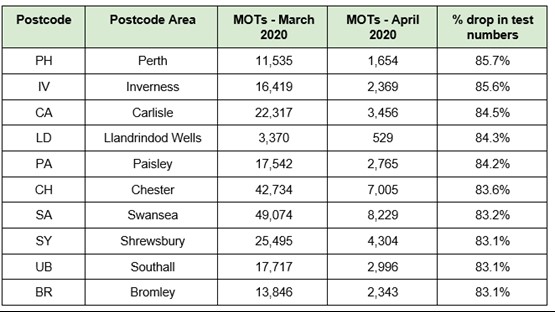
A Freedom of Information (FOI) request to the Driver and Vehicle Standards Agency (DVSA) made by the car selling comparison website showed that 746,157 MOTs were carried out in April 2020, down 80% on March 2020 – where 3,723,524 motorists took their vehicles for a MOT.


Perth in Central Scotland saw the biggest drop in MOTs last month, with tests down 85.7%, in comparison to March. Inverness saw 85.6% fewer MOTs in April, than in March.


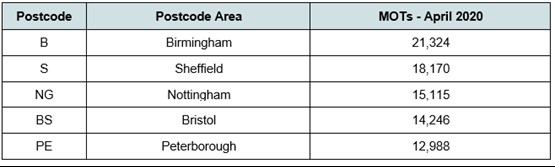
More than 20,000 motorists in the Birmingham area (21,324) took their vehicles for a MOT in April, and 18,170 tests were carried out by garages in the ‘S’ postcode area (Sheffield) last month.


Alex Buttle, director at Motorway.co.uk, said: “These figures from the DVSA show that despite motorists having the opportunity to postpone their MOT test, many have chosen not to do so. There could be several reasons why; with general car maintenance, ongoing value and safety issues likely at the forefront of many drivers’ minds.


“Saying that, the number of MOTs in April was still substantially lower than March figures, and we expect to see a similarly low level of testing in May, as lockdown restrictions have only been eased slightly this month.”


Automotive aftermarket ready to deal with MOT demand when 6-month exemption is lifted

New automotive aftermarket sector-specific guidance to ‘keep millions of vehicles roadworthy’ has been published by the Garage Equipment Association (GEA), Independent Automotive Aftermarket Federation (IAAF), Institute of the Motor Industry (IMI), Scottish Motor Trade Association (SMTA) and the Society of Motor Manufacturers and Traders (SMMT).


The UK automotive aftermarket sector has signalled its readiness to cope with increased demand for MOT tests, service, maintenance and repair with the publication of Covid-19: Industry Guidance and Best Practice for Automotive Aftermarket.


Although workshops have been allowed to stay open throughout the lockdown, helping to keep vehicles roadworthy for essential journeys, guidance will help companies of all types and sizes in the aftermarket operate safely while minimising the risk of Covid-19 transmission.


Mike Hawes, chief executive at the Society of Motor Manufacturers and Traders, said: “It is timely that the aftermarket can assure customers and colleagues that it is ready to re-open safely to ensure workers’ vehicles remain roadworthy.”


The best-practice guidance covers the entire aftermarket sector, including workshops, warehouses, mobile operations and parts distributors and covers every aspect of their operations, from clear communications with customers and colleagues to social distancing, sanitisation and hygiene, and collection/delivery of vehicles from vulnerable owners.


It is designed to complement government advice and help the aftermarket sector demonstrate safe practices for employees and customers across all points of interaction. It comes as vehicle mileages start to climb and the sector calls for an end to the six-month MOT extension.


Hawes said: “With government advice stating that workers should avoid public transport when returning to work, the use of private cars is likely to rise more sharply than it already has over recent weeks. Given many of these vehicles have been idle for weeks, a reconsideration of the six-month MOT extension needs to be made as soon as possible.”


The vital role of the aftermarket sector in supporting safe mobility of the UK workforce has been underlined as the IMI echoes the SMMT call for the six-month exemption to be scrapped.


Steve Nash, chief executive officer at the Institute of the Motor Industry, said: “There are serious risks in the extension remaining in place now. If vehicles are coming back onto the roads in volume it is vital for all road users’ safety that they are roadworthy.


“The other issue is that if all motorists wait up to six months from when their MOT expired to get their vehicle tested, there is going to be a big backlog of tests in the Autumn and Winter which could significantly overwhelm the sector. That’s without considering the likelihood of the market shrinking because many businesses are unlikely to be able to survive without work coming in.


“The SMMT’s proposal to scrap the extension makes a lot of sense for road safety and will be a vital boost for a currently beleaguered sector.” By Graham Hill thanks to Fleet News

Share My Blogs With Others: These icons link to social bookmarking sites where readers can share and discover new web pages.
  • MisterWong
  • Y!GG
  • Webnews
  • Digg
  • del.icio.us
  • StumbleUpon
  • Reddit
  • Alltagz
  • Ask
  • Bloglines
  • Facebook
  • YahooMyWeb
  • Google Bookmarks
  • LinkedIn
  • MySpace
  • TwitThis
  • Squidoo
  • MyShare
  • YahooBuzz
  • De.lirio.us
  • Wikio UK
  • Print
  • Socializer
  • blogmarks

DVLA Issues A Scam Alert To Motorists

Wednesday, 13. May 2020

  • DVLA has recorded a 20% rise in the number of scams reported
  • These are all cons linked to DVLA services, such as vehicle taxation
  • Some 1,538 fraud cases were raised to the agency in the final 3 months of 2019
  • It provided examples of common scams that have been used in recent months


Motorists are being targeted by fraudsters using a range of different scam tactics in a bid to trick them into handing over money.


That’s according to a fresh warning by the DVLA last February, which has provided examples of scams it has been alerted to and traced in recent months.


There has been a 20 per cent rise in fraud attempts handed to the DVLA, with 1,538 reports made to agency in the last three months of 2019, new figures show.


Car owners have alerted the DVLA to a number of different con tactics being employed by scam artists.


Motorists have said they have been swindled out of money and targeted by fraudsters using fake DVLA websites, emails, texts and social media messages.


It has warned drivers that these are becoming more prominent, having received 1,275 scam reports in the final three months of 2018 – some 263 fewer than in the final quarter of last year.


To raise awareness of the types of fraudulent communication motorists might receive, the DVLA has released images of recent scams it has been alerted to.


It hopes this will help motorists be aware of what to look out for and issue a clear warning that if something offered online or by text message appears too good to be true, then it almost certainly is.


Scammers are targeting unsuspecting customers with links to services that don’t exist and messages of tax refunds, all of which are fake.


The reports also show that driver and vehicle documents are for sale on the internet.


The agency says anyone who is concerned about any calls, texts, emails or suspicious activity online, to always report these to the police via Action Fraud immediately.


DVLA chief information security officer David Pope said: ‘We’ve released examples of real life scams to help motorists understand when a scam is at work.


‘These websites and messages are designed to trick people into believing they can access services that simply don’t exist such as removing penalty points from driving licences.


‘All our tax refunds are generated automatically after a motorist has told us they have sold, scrapped or transferred their vehicle to someone else so we don’t ask for anyone to get in touch with us to claim their refund.


‘We want to protect the public and if something seems too good to be true, then it almost certainly is. The only trusted source of DVLA information is GOV.UK.


‘It is also important to remember never to share images on social media that contain personal information, such as your driving licence and vehicle documents.’


A spokesperson for Action Fraud added: ‘This can be a stressful time of year, sorting out finances for the year ahead. Fraudsters are aware of this and are using different ways to trick people.


‘Taking a couple of minutes to familiarise yourself with a few simple online safety tips can be significant in protecting yourself from becoming a victim of online fraud.


‘You should always be cautious when sharing personal information online and avoid being scammed by only using GOV.UK for government services online, such as the DVLA.


‘If you believe you have been a victim of fraud, please report it to us.’


Note: If you want to see the sample emails being sent out go to the original article by clicking here:


https://www.thisismoney.co.uk/money/cars/article-8037209/DVLA-says-cons-used-fraudsters-trick-motorists-handing-money.html


By Graham Hill thanks to This Is Money

Share My Blogs With Others: These icons link to social bookmarking sites where readers can share and discover new web pages.
  • MisterWong
  • Y!GG
  • Webnews
  • Digg
  • del.icio.us
  • StumbleUpon
  • Reddit
  • Alltagz
  • Ask
  • Bloglines
  • Facebook
  • YahooMyWeb
  • Google Bookmarks
  • LinkedIn
  • MySpace
  • TwitThis
  • Squidoo
  • MyShare
  • YahooBuzz
  • De.lirio.us
  • Wikio UK
  • Print
  • Socializer
  • blogmarks

Warning To Take Care Of Your Battery During Lockdown.

Wednesday, 13. May 2020

The number of drivers visiting Kwik Fit over the past four weeks needing a new battery has been double the usual rate for the time of year.


Battery failures traditionally spike in the winter months due to the greater demands placed on them in starting cold engines.


The impact of the lockdown has seen battery failures over the past month increase to levels similar to the average for January over the past five years.


While this has mainly affected older vehicles, motorists with newer cars have also found their batteries struggling, says Kwik Fit.


The number of fleet vehicles, such as company cars, requiring new batteries has risen by around 10% compared to the same period last year. This is a significant indicator of the extent of the problem as not only are fleet owned vehicles newer than the average, they are more likely to have advanced batteries, to support ‘start-stop’ technology.


Roger Griggs, communications director at Kwik Fit, said: “Most of us associate battery failure with the winter months and having to call out a breakdown service to get us started after Christmas holidays.


“The lock down has had a dramatic effect on motoring and has been positive in helping control the spread of the virus, but this is one area which is storing up potential problems for motorists.


“We certainly don’t encourage anyone to use their car unnecessarily, but we hope that our advice will help some people avoid a nasty surprise when they next need their car.”


Kwik Fit’s battery experts advise motorists to take the following steps to help avoid encountering battery problems:


  • If you are not using your car at all, start the car once or twice a week and let the engine run for at least 15 minutes (stay in your car when you are doing this and the car must be outside).
  • Bear in mind that a colder engine takes more out of the battery to start, so if possible start your car during the warmer part of the day rather than first thing in the morning.
  • Check under the bonnet and inspect the battery terminals for signs of corrosion. Clean any corrosion and residue away from the terminals to allow a good clean connection with the battery.
  • If your car is parked on a driveway or garage, consider buying a trickle charger which can be plugged into the mains and keep your battery charge topped up – always follow the guidance in your vehicle’s owners handbook prior to connecting a trickle charger.
  • Check your battery’s age – most batteries are stamped with date codes and a battery more than five years old may be at risk of failure, especially if the car is only making short or infrequent trips.


By Graham Hill thanks to Fleet News

Share My Blogs With Others: These icons link to social bookmarking sites where readers can share and discover new web pages.
  • MisterWong
  • Y!GG
  • Webnews
  • Digg
  • del.icio.us
  • StumbleUpon
  • Reddit
  • Alltagz
  • Ask
  • Bloglines
  • Facebook
  • YahooMyWeb
  • Google Bookmarks
  • LinkedIn
  • MySpace
  • TwitThis
  • Squidoo
  • MyShare
  • YahooBuzz
  • De.lirio.us
  • Wikio UK
  • Print
  • Socializer
  • blogmarks

Virtual Speed Awareness Courses Introduced To replace Classroom Courses

Wednesday, 13. May 2020

DriveTech is helping to fill the gap with online speed awareness courses after a classroom-based option was halted due to coronavirus.


Having reconfigured course delivery online via the Microsoft Teams platform, it has delivered classes to 22,000 motorists helping them avoid a police prosecution.


The National Police Chiefs’ Council (NPCC) lead for Roads Policing suspended classroom-based speed awareness courses for 12 weeks in March.


More than 1.2 million drivers attended a speed awareness course last year. The courses usually cost between £80 and £100, but motorists avoid paying a Fixed Penalty Notice or picking up penalty points on their driving licence.


DriveTech, which works in partnership with police and UKROEd, had to move rapidly to rebook around 50,000 classroom delegates bookings prior to the lockdown, to avoid motorists facing the alternative of prosecution, points and fines.


With revised digital course content needed, and DriveTech’s body of 175 trainers needing upskilling to deliver the virtual online experience, it says that the challenge was considerable.


Five weeks on from the first day of digital course delivery on March 27 (a week after lockdown measures affected venue participation), DriveTech says it is delighted that online course capacity is now matching the former levels of classroom supply.


Des Morrison, director of police business at DriveTech, said: “We reflect now on a pretty hectic few weeks, but it is satisfying to now see our digital delivery performing well and with some excellent customer feedback – both from our police force customers, delighted by our professional response in a crisis, and delegates.”


DriveTech is now delivering the three mainstream courses digitally – National Speed Awareness, National Motorway Speed Awareness, and What’s Driving you? and delegate feedback, as measured by Net Promoter Scores (NPS) has been at world class levels, it says.


In addition to placing the first priority on satisfying a backlog of delegates already booked onto a venue-based course, DriveTech is now taking bookings for new delegates from across the country.  By Graham Hill thanks to Fleet News

Share My Blogs With Others: These icons link to social bookmarking sites where readers can share and discover new web pages.
  • MisterWong
  • Y!GG
  • Webnews
  • Digg
  • del.icio.us
  • StumbleUpon
  • Reddit
  • Alltagz
  • Ask
  • Bloglines
  • Facebook
  • YahooMyWeb
  • Google Bookmarks
  • LinkedIn
  • MySpace
  • TwitThis
  • Squidoo
  • MyShare
  • YahooBuzz
  • De.lirio.us
  • Wikio UK
  • Print
  • Socializer
  • blogmarks

Pothole Related Breakdowns Increase During First Quarter Of 2020

Wednesday, 13. May 2020

The number of vehicles requiring recovery due to pothole damage has increased rapidly according to the RAC.


It rescued almost 3,500 motorists with pothole damaged cars in the first quarter of 2020, an increase of 64% on Q4 2019.


The number of cars damaged by potholes requiring recovery, between January and March, is 4.5% higher than in the same period last year, despite the Coronavirus lockdown reducing the number of vehicles on the road in the last nine days of the March.


Breakdowns resulting from damaged shock absorbers, broken springs and distorted wheels – that are most likely to be attributable to poor road surfaces – made up 1.6% of all the RAC’s call-outs for its individual members.


This was considerably up on Q4 2019 when the figure stood at 0.9% and marginally up on the same period a year ago – 1.5%.


The RAC’s Pothole Index suggests the overall standard of the roads has improved a little as the Index currently stands at 1.6, down from 2.3 in the same period last year and slightly down on Q4 2019 (1.7).


This does mean however that drivers are still 1.6 times more likely to break down as a result of pothole-related damage than they were back in 2006 when the RAC first started collecting data.


RAC head of roads policy Nicholas Lyes said: “The jump in pothole-related breakdowns from the last three months of the year to the first quarter of the next year is always the largest as winter weather has the greatest effect of all in wearing down our roads.


“Many parts of the country suffered very wet weather conditions throughout February. It’s still likely that the storms and floods were major factors in why the number of pothole-related breakdowns was higher than the same period last year.


“In his Budget in March, the Chancellor committed to funding our local roads and it is clear that the economic recovery as the UK emerges from the COVID-19 pandemic will need to be built on solid infrastructure – which of course needs to include good quality roads.


“Moreover, it will also be interesting to see if lower traffic volumes during the UK’s lockdown will help prevent further deterioration of roads as fewer wheels going over weaknesses in the asphalt should contribute to less surface wear.”  By Graham Hill Thanks To Fleet News

Share My Blogs With Others: These icons link to social bookmarking sites where readers can share and discover new web pages.
  • MisterWong
  • Y!GG
  • Webnews
  • Digg
  • del.icio.us
  • StumbleUpon
  • Reddit
  • Alltagz
  • Ask
  • Bloglines
  • Facebook
  • YahooMyWeb
  • Google Bookmarks
  • LinkedIn
  • MySpace
  • TwitThis
  • Squidoo
  • MyShare
  • YahooBuzz
  • De.lirio.us
  • Wikio UK
  • Print
  • Socializer
  • blogmarks

Survey Reveals That Electric Cars Are Driven Further Than Petrol Cars

Wednesday, 13. May 2020

Electric cars are driven for 26% more miles in their first three years on the road than petrol models, research from the RAC Foundation has found.


The analysis, which pre-dates the steep fall in road traffic seen since the start of the coronavirus pandemic, is based on the MOT data for 516,936 vehicles.


It found battery electric cars cover an average of 9,435 miles per year over their first three years, compared to a petrol car’s 7,490.


Diesel cars are driven the most, and cover an average of 12,496 miles in each of their first three years.


Steve Gooding, director of the RAC Foundation, said: “Unsurprisingly people with diesels have been doing most mileage, probably seeking better long-distance fuel economy, but this study is also evidence that battery-electric powered cars are not just trophy vehicles signalling their owners’ green credentials but prior to the lockdown were racking up the miles as everyday transport.


“Tens of millions of people still drive petrol and diesel-powered cars, but this data suggests that owners of electric cars have found them to be a practical proposition, running up the sort of big annual mileages that many of us need to do, challenging preconceptions about their range and the ease of re-charging.


“The next big question is what will happen when the Covid-19 lockdown ends?


“Some say our travel behaviour might change quite dramatically as we’ve mastered on-line meetings in place of the office routine, but any ongoing desire for social-distancing might yet draw us back to our own cars for the trips we make once the travel restrictions are lifted.”


The research found a Mitsubishi Outlander plug-in hybrid – the most common PHEV on the road – averages 12,500 miles a year.


RAC Foundation reports the battery electric Tesla Model S covered an average annual mileage of 12,392, the Nissan Leaf 8,241 and the Renault Zoe 5,736.


The analysis also found there was a big difference between petrol and diesel versions of the same model. By Graham Hill thanks to Fleet News

Share My Blogs With Others: These icons link to social bookmarking sites where readers can share and discover new web pages.
  • MisterWong
  • Y!GG
  • Webnews
  • Digg
  • del.icio.us
  • StumbleUpon
  • Reddit
  • Alltagz
  • Ask
  • Bloglines
  • Facebook
  • YahooMyWeb
  • Google Bookmarks
  • LinkedIn
  • MySpace
  • TwitThis
  • Squidoo
  • MyShare
  • YahooBuzz
  • De.lirio.us
  • Wikio UK
  • Print
  • Socializer
  • blogmarks

MOT Test Stations Set To Be Flooded After Lockdown

Wednesday, 13. May 2020

The Driver and Vehicle Standards Agency (DVSA) issued guidance towards the end of last month that a car, van or motorcycle’s MOT expiry date could be extended by six months if it was due on or after March 30.


The DVSA currently carries out 30 million MOTs a year through 23,000 test centres. But, with all this summer’s MOTs effectively being pushed back into the autumn/winter period, that could put unprecedented pressure on the system and leave drivers scrambling to find MOT slots.


Terry Hiles, general manager at Licence Check which is now part of the Ebbon-Dacs Group, said: “The six-month MOT extension raises concerns about the potential backlog of tests that will need to be carried out later this year.


“Centres will be twice as busy as normal during the autumn/winter period as 12 months’ demand will be effectively shoehorned into a six-month time frame.


“Employers will need to have in place robust systems in place to ensure MOTs are carried out on the new dates rather than the regular anniversary date that they may have become accustomed to.


“So MOT reminders and alerts to drivers will be vitally important.


“MOTs will need to be attended to once lockdown ends and many drivers may need a prompt to help them remember the new expiration date.


“One option could be to sign with the .gov.uk website for its text message reminder service so that drivers are sent reminders of their new date.”


Currently, some 10% of vehicles fail an MOT due to defective brakes, 13% for suspension faults and 8% for illegal tyres.


With a percentage of the nation’s cars not being MOT’d for a further six months, the chances of some of them being driven in an unroadworthy state could rise dramatically.


Drivers could face fines of up to £2,500, be banned from driving and get three penalty points for driving a vehicle in a dangerous condition, regardless of whether they are being operated under a six-month MOT extension or not.


The DVSA’s official guidance on its website says that insurance will still be valid, that drivers can still tax their vehicle and the vehicle’s record will be updated so the police can see they have a valid MOT during the six-month extension.


But insurance cover is likely to be invalidated if the vehicle is driven in a dangerous or defective state and the emphasis is on drivers to keep their vehicles in a roadworthy condition.


The DVSA advice is to take your vehicle to be repaired at the nearest open garage if it’s unsafe. These are allowed to stay open during the Coronavirus outbreak.


Licence Check said this uncertainty puts the onus on employers, especially those with large numbers of grey fleet drivers who use their own vehicles on company business, to have in place robust systems to ensure that vital checks are being carried out,  such as MOTs, as soon as possible once lockdown is over to ensure continuing compliance. By Graham Hill thanks to Fleet News

Share My Blogs With Others: These icons link to social bookmarking sites where readers can share and discover new web pages.
  • MisterWong
  • Y!GG
  • Webnews
  • Digg
  • del.icio.us
  • StumbleUpon
  • Reddit
  • Alltagz
  • Ask
  • Bloglines
  • Facebook
  • YahooMyWeb
  • Google Bookmarks
  • LinkedIn
  • MySpace
  • TwitThis
  • Squidoo
  • MyShare
  • YahooBuzz
  • De.lirio.us
  • Wikio UK
  • Print
  • Socializer
  • blogmarks

Goodyear Launches CoronaVirus Highways Heroes Scheme

Wednesday, 13. May 2020

Goodyear has launched a new scheme to celebrate the ‘Highway Heroes’ who are continuing to keep the country moving during lockdown.


From the delivery drivers keeping supermarkets stocked to the haulage companies transporting vital supplies, the purpose of the initiative is to shine a light on those who are continuing to go the extra mile within the logistics industry.


In order to recognise these individuals for their vital efforts, Goodyear wants the public to nominate its ‘Highway Heroes’ via the company’s commercial page on LinkedIn.


For each #HighwayHero nomination, Goodyear will donate 2 Euros to the COVID-19 Solidarity Response Fund for the World Health Organization (WHO) for the first 5,000 nominations up to a maximum of 10,000 Euros.


Each month, starting in April, a deserving nominee will be chosen at random and awarded a set of Goodyear EfficientGrip Performance 2 tyres for their personal vehicle.


David Howe, commercial sales general manager at Goodyear UK&I, said: “It’s no secret that this is an unprecedented period, for businesses and families alike. While the rest of us are safe at home though, we want to show our thanks to those who are still on the roads.


“From delivery drivers, many of whom we are proud to call customers, to those providing vital roadside support, such as our very own TruckForce technicians, now, more than ever, we are pleased to show our appreciation of these Highway Heroes.”


As well as the Highway Heroes scheme, Goodyear has also provided a Driver Tyre Check Guide. Also available via the company’s commercial LinkedIn page. The guide will help fleet managers and drivers to carry out thorough pre-trip inspections of their tyres, ensuring their fleets are ready to hit the road.


“While the nation observes social distancing measures, many drivers and fleet managers will be relying on their own experience to keep their vehicles operational. It’s a great honour to be able to support many of these essential fleets, and we want to continue to do our part.


To that end, we’re pleased to offer our Driver Tyre Check Guide, providing advice that will help to keep tyres in top condition and vehicles on the road. Together, we can keep our nation moving,” Howe added. By Graham Hill thanks to Fleet News

Share My Blogs With Others: These icons link to social bookmarking sites where readers can share and discover new web pages.
  • MisterWong
  • Y!GG
  • Webnews
  • Digg
  • del.icio.us
  • StumbleUpon
  • Reddit
  • Alltagz
  • Ask
  • Bloglines
  • Facebook
  • YahooMyWeb
  • Google Bookmarks
  • LinkedIn
  • MySpace
  • TwitThis
  • Squidoo
  • MyShare
  • YahooBuzz
  • De.lirio.us
  • Wikio UK
  • Print
  • Socializer
  • blogmarks

Massive Drop In Oil Price Still Not Reflected At The Pumps

Saturday, 2. May 2020

The price of US oil has recently turned negative for the first in history as the coronavirus pandemic has caused global demand to collapse – but this is not yet being reflected fully at the fuel pumps.


Earlier last month, oil producing countries agreed to collectively slash global output by an unprecedented 10 million barrels a day, or about 10%. However, demand has dropped by 30 million barrels a day or more.


The price of a barrel of West Texas Intermediate (WTI), the benchmark for US oil, fell as low as minus $37.63 a barrel as oil producers are paying buyers to take it over fears that storage capacity could run out in May.


The impact on Brent Crude – the benchmark used by Europe and the rest of the world, has been less as there is still capacity in which to store it: it has fallen 8.9% to less than $26 a barrel.


According to the Fleet News Regional Fuel Prices tool, average petrol prices in the UK have fallen 11p a litre in the past month, but the wholesale cost of fuel has dropped by much more than that.


Currently, the average price of a litre of diesel is 111.64p, with unleaded at 106.91ppl. One month ago, they were 122.01ppl and 118.69ppl respectively.


Once tax and fuel duty have been factored in, the RAC calculates that under normal circumstances petrol prices should be about £1 a litre.


RAC fuel spokesman Simon Williams said: “The oversupply of oil continues to suppress the barrel price and it’s clear now that plans by some of the world’s largest oil-producing nations to limit production haven’t yet been enough to lift the price – there’s currently too little demand for oil in the first place.


“It’s right that retailers charge a fair price for fuel that reflects the price of the raw product, and in theory petrol prices could fall below £1 per litre if the lower wholesale costs were reflected at the pumps – but at the same time people are driving very few miles so they’re selling vastly lower quantities of petrol and diesel at the moment.


“This means many will be at pains to trim their prices any further.


“We also continue to be concerned about smaller forecourts that provide a vital service in areas where the supermarkets don’t have a foothold as many are already finding conditions tough with sales having fallen off a cliff since lockdown.


“It would be bad news all round if these forecourts shut up shop for good.”


Luke Bosdet, fuel price spokesman for the AA, added: “It is likely that once Covid-19 is defeated there will be calls for a review of UK pump prices during the current oil and commodity fuel price crash, as there were in the years after the 2008 to 2012 price spikes.”


At the end of March supermarket giants Morrisons and Asda reduced their fuel prices by 12p per litre for petrol and 8ppl for diesel as the coronavirus Covid-19 crisis continues.


The cuts follow a plunge in oil prices caused by a trade war between Russia and Saudi Arabia, which saw Saudi Arabia – which produces about 10% of the world’s oil – decide to slash prices and ramp up its production.  By Graham Hil thanks to Fleet News

Share My Blogs With Others: These icons link to social bookmarking sites where readers can share and discover new web pages.
  • MisterWong
  • Y!GG
  • Webnews
  • Digg
  • del.icio.us
  • StumbleUpon
  • Reddit
  • Alltagz
  • Ask
  • Bloglines
  • Facebook
  • YahooMyWeb
  • Google Bookmarks
  • LinkedIn
  • MySpace
  • TwitThis
  • Squidoo
  • MyShare
  • YahooBuzz
  • De.lirio.us
  • Wikio UK
  • Print
  • Socializer
  • blogmarks

Number Of Vehicles On UK Roads Exceeds 40 Million For The First Time Ever

Saturday, 2. May 2020

The number of vehicles registered for use on UK roads has exceeded 40 million for the first time, according to data from the Society of Motor Manufacturers and Traders (SMMT).


Analysis shows that more than 35 million cars and five million commercial vehicles were in use in the UK in 2019, an increase of 1% on the previous year.


The total includes more than 750,000 low, ultra-low and zero emission vehicles. The number of these cars grew by 26% last year, with 11,832 hybrids, 144,335 plug-in hybrids and 92,913 battery electric vehicles now in use.


Birmingham has the second highest number of battery electric and plug-in hybrid vehicles after Greater London, with some 24,000 zero and ultra-low emission cars on the city’s roads.


Light commercial vehicles grew by  2.7% on the previous year to 4.5m units, surging by 28% in the last decade. Passenger cars, meanwhile, increased 0.8% in the same period. The number of heavy goods vehicles grew by 0.4% to 608,000 – the largest number delivering for Britain since 1990.


Many of these vehicles are helping to provide transport for essential workers, deliveries and emergency services. Some 25,000 ambulance and fire service vehicles, together with more than 20,000 supermarket delivery trucks and lorries are keeping the nation safe, supermarket shelves stocked, and the flow of food, medicine and care to vulnerable people going during the coronavirus crisis.


Mike Hawes, SMMT Chief Executive, said, “As the UK continues to battle the coronavirus pandemic, keeping food, medical supplies and the people serving on the front line moving has never been so important – and these figures show the essential role Britain’s vehicle fleet plays for society. They also provide evidence that industry’s ongoing investment into ever cleaner, safer and more reliable vehicle technology is paying off, even as demand for mobility grows. To ensure this trend continues, we must get the right support for businesses and their workers in place now so that when this crisis is over, the sector can help get the whole country and our economy back on the move.”


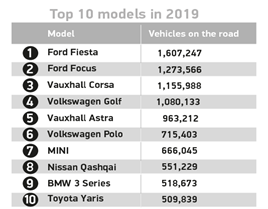
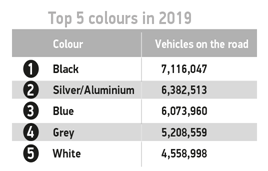
Most popular cars


The SMMT’s Motorparc data reveals black as the most commonly seen car colour on the UK’s roads, with more than a fifth (7.1m) clad in the paint.


There are more superminis on UK roads than any other category of car, with the Ford Fiesta and Vauxhall Corsa the most common models.


The BMW 3 Series is the only premium badge car to feature in the top 10 list, with more than half a million examples on UK roads.


By Graham Hill thanks to Fleet News

Share My Blogs With Others: These icons link to social bookmarking sites where readers can share and discover new web pages.
  • MisterWong
  • Y!GG
  • Webnews
  • Digg
  • del.icio.us
  • StumbleUpon
  • Reddit
  • Alltagz
  • Ask
  • Bloglines
  • Facebook
  • YahooMyWeb
  • Google Bookmarks
  • LinkedIn
  • MySpace
  • TwitThis
  • Squidoo
  • MyShare
  • YahooBuzz
  • De.lirio.us
  • Wikio UK
  • Print
  • Socializer
  • blogmarks