Another Blow For Smart Motorways – Recovery Firms To Avoid Broken Down Cars In Red X Lanes.

Friday, 3. July 2020

Official guidelines say recovery firms should “not rely on a red X closure sign” when helping broken-down vehicles.

Recovery firms are not allowed to stop and help motorists whose vehicles have broken down on smart motorway lanes that have been closed with ‘red X’ signs.

Instead, staff from firms like the AA, Green Flag and RAC must wait for police or Highways England vehicles to physically close the lane or tow the vehicle to a refuge area, according to official guidance.

The ‘best practice guidelines’ from the Survive Group – formed of senior police officers, Highways England and all major recovery firms – says breakdown operatives should “Never work in a live lane of a motorway lane unless the lane has been closed by a Police vehicle, HE [Highways England] Traffic Officer vehicle or Impact Protection Vehicle…Do not rely on a red X closure sign.”

The recommendations mean the organisations involved in drafting the guidelines consider closed lanes on all-lane-running smart motorways too dangerous a place for breakdown operatives to work, even when red X signs on overhead gantries have informed motorists they must use other lanes.

While it is illegal to drive in closed ‘red X’ lanes, 180,000 drivers received warning letters in the 18 months between 2017 and summer 2018 for the offence – which is now enforced by cameras and results in three penalty points and a £100 fine.

The revelation that breakdown firms are not allowed to stop in ‘red X’ lanes is the latest in a slew of controversies related to smart motorways. In September last year accident data revealed the number of fatal motorway collisions increased by a fifth in 2018 compared to 2017.

A damning report written for Highways England and unearthed by the AA, meanwhile, found breaking down in the live lane of a smart motorway during off-peak hours is 216 per cent more dangerous than doing so on a conventional motorway.

Proponents of smart motorways – which are a cost-effective way of increasing traffic capacity compared to expanding or building new roads – highlight that motorways remain the safest type of road in the country, and also cite evidence that smart motorways are safer than conventional motorways in other respects.

That hasn’t stopped Transport Secretary Grant Shapps ordering an investigation into the roads, however, having told MPs: “we know people are dying on smart motorways”.

Edmund King, president of the AA, which has long campaigned against smart motorways, said: “Being stuck in a live lane is incredibly dangerous. The official advice is keep your seat belt and hazard lights on and dial 999.

“It is not safe for breakdown organisations to recover vehicles unless the lane is closed and has a physical presence sat behind the casualty vehicle. This is either the Police with blue flashing lights or Highways England Traffic Officers with red flashing lights.

“This highlights the severity of breaking down in a live lane and further emphasises our calls for double the number of Emergency Refuge Areas. Providing drivers with more places of relative safety would reduce the risk of vehicles being stuck in a lane of fast moving traffic.”

A spokesperson for Highways England said: “The Transport Secretary has asked the Department for Transport to carry out, at pace, an evidence stocktake to gather the facts about smart motorway safety. We are committed to safety and are supporting the Department in its work on this.  By Graham Hill Thanks To TheSurvive Group & AutoExpress

Share My Blogs With Others: These icons link to social bookmarking sites where readers can share and discover new web pages.
  • MisterWong
  • Y!GG
  • Webnews
  • Digg
  • del.icio.us
  • StumbleUpon
  • Reddit
  • Alltagz
  • Ask
  • Bloglines
  • Facebook
  • YahooMyWeb
  • Google Bookmarks
  • LinkedIn
  • MySpace
  • TwitThis
  • Squidoo
  • MyShare
  • YahooBuzz
  • De.lirio.us
  • Wikio UK
  • Print
  • Socializer
  • blogmarks

Photocard Licence Renewals To Be Extended To 7 Months

Thursday, 25. June 2020

The Government has granted a seven-month extension to drivers whose photocard driving licence expires between the start of February and the end of August.

The move aims help those drivers who might have had problems getting a suitable photo taken during the Covid-19 outbreak or have otherwise struggled to contact the reduced Driver and Vehicle Licensing Agency (DVLA) service.

Normally drivers are required to renew their photocard licence every 10 years, and bus and lorry drivers every five years.

Licence Check general manager, Terry Hiles, said: “This move is a welcome initiative at this very difficult time as it gives drivers more time to renew their photocard licences.”

The extension will be automatically applied to drivers with a photocard licence due to expire due to expire between February 1 and August 31, 2020. A renewal reminder will be sent before the seven-month period ends by the DVLA (Driver and Vehicle Licensing Agency).

However, Hiles explained: “The DVLA will not be automatically updating those driver records which should have been renewed between February and August with the new extension details and will continue to show the existing expiry date currently held on the driving licence on its own system.”

The DVLA will only update its records once drivers have made an application to renew their licence once the end of the seven-month extension period has been reached.

As a result, Hiles says that the extension will not be shown on any of the DVLA’s enquiry services, such as the View/Share service which drivers can currently use to check their own licence details are accurate, and which they can use to generate a unique code by which employers or third parties, such as daily rental companies, can check drivers’ licences for validity.

Licence Check told Fleet News it has taken steps to ensure that customers of its cloud-based DAVIS system will be provided with the extended date for all driver records in the qualifying period.

“This will reflect the correct legally applicable date, but it does mean we will be out of step with the information held by the DVLA as its driver records will not have been changed,” said Hiles.

“Our primary concern is to avoid false alerts and unnecessary checking for our customers, especially where customers have set the service to conduct additional checks upon expiration dates.We don’t want to flag up urgent warnings to customers when there is no reason to do so.”

Licence Check customers will also be automatically notified of pending photocard expirations for their drivers in advance of the new renewal date, and any automatic rechecks will be made on the revised date as normal.

With around 41 million category B driving licences for passenger cars and 8 million provisional licences in circulation, the new ruling could affect many business drivers who will now be able to drive for an additional seven months on what would have otherwise been an invalid licence.

The penalty for drivers who drive without the correct photocard licence, which should be renewed every 10 years to take into account changes in appearance, is a fine of up to £1,000.

The new extension does not extend to the driver’s actual entitlement to drive a vehicle – through age, medical condition or as a vocational driver – which will need to renewed in the normal way to allow continued driving. For vocational drivers, such as HGV or PSV drivers, this is every five years.

DVLA chief executive, Julie Lennard, said: “This extension will make it easier for drivers who need to update their photocard licence with a new photograph. This means as long as they have a valid licence, drivers will be able to continue to make essential journeys.

“The extension is automatic so drivers do not need to do anything and will be sent a reminder to renew their photocard before the extension ends.”

A car (Group 1) licence generally remains in force until the driver reaches 70, unless revoked or surrendered.

At aged 70 the driver must renew their entitlement to drive every three years if they wish to continue to hold a valid licence.

Bus and lorry (Group 2) licence holders aged 45 and over are required to renew their entitlement to drive every five years.

Holders of short- term medical licences will also need to renew their entitlement to drive. The seven-month extension does not apply to renewal of entitlement to drive.

The DVLA’s online services to renew your driving licence and replace a driving licence are available for those drivers who need to renew their entitlement to drive or replace a lost or stolen licence. By Graham Hill thanks to Fleet News

Share My Blogs With Others: These icons link to social bookmarking sites where readers can share and discover new web pages.
  • MisterWong
  • Y!GG
  • Webnews
  • Digg
  • del.icio.us
  • StumbleUpon
  • Reddit
  • Alltagz
  • Ask
  • Bloglines
  • Facebook
  • YahooMyWeb
  • Google Bookmarks
  • LinkedIn
  • MySpace
  • TwitThis
  • Squidoo
  • MyShare
  • YahooBuzz
  • De.lirio.us
  • Wikio UK
  • Print
  • Socializer
  • blogmarks

Land Rover Still Haven’t Solved Their Car Theft Problem.

Thursday, 25. June 2020

A £120,000 Range Rover Autobiography was stolen from a supermarket carpark in Walthamstow, London, in just 80 seconds by thieves taking advantage of weaknesses in the keyless entry system.

Keyless car thefts are increasingly common, as criminal groups reverse-engineer the latest manufacturer security tech to steal valuable vehicles quickly and discreetly.

The vehicle was recovered by the Metropolitan Police within 12 hours, thanks to the fitment of a tracking device.

Clive Wain, head of Police liaison for Tracker, said: “It is believed that this vehicle was stolen by professional criminals who followed the owner to the supermarket from her home, waiting for an opportunity to steal the prestige model.

“At home, the valuable car was always well protected on the driveway, with a wheel clamp fitted and a van parked across the driveway entrance to prevent any chance of theft. CCTV footage of the supermarket carpark clearly shows the thieves breaking into the car and driving away in less than two minutes, in an undisputable case of organised crime and keyless car theft.”

The car’s owner, Mrs Syuleyman, initially did not believe the car would ever be recovered. She said: “I know the risk of theft is high for such a valuable car, particularly as it has had some additional modifications.

That is why we always protect the car so carefully when it is parked at home. I never imagined it could be stolen so quickly and easily from a public carpark while I was shopping a few metres away.

In 2019, 92% of the cars Tracker recovered were taken without using the keys, up from 88% in 2018 and 26% higher than four years earlier.

Wain continued: “When Mrs Syuleyman’s car was recovered, it appeared that the thieves had searched it for tracking devices before leaving it parked unaccompanied to see if the police would track its whereabouts. 

Because the Tracker device was professionally installed, the thieves  were unable to find it, leaving the police to quickly  track its location. Without a Tracker installed, it is unlikely this story would have had a happy ending.”  B y Graham Hill thanks to Fleet News.

Share My Blogs With Others: These icons link to social bookmarking sites where readers can share and discover new web pages.
  • MisterWong
  • Y!GG
  • Webnews
  • Digg
  • del.icio.us
  • StumbleUpon
  • Reddit
  • Alltagz
  • Ask
  • Bloglines
  • Facebook
  • YahooMyWeb
  • Google Bookmarks
  • LinkedIn
  • MySpace
  • TwitThis
  • Squidoo
  • MyShare
  • YahooBuzz
  • De.lirio.us
  • Wikio UK
  • Print
  • Socializer
  • blogmarks

EU And UK To Introduce New Regulations To Prevent Fraudulent Emissions Testing

Thursday, 25. June 2020

The Government is consulting on the adoption of new EU type approval legislation, which gives authorities enhanced powers of scrutiny over manufacturers and test agencies.

The consultation period began on June 1 2020 and will run until June 26 2020.

Following the dieselgate scandal, where it was revealed that some manufacturers had installed devices that enable cars to defeat emissions testing procedures in order to provide lower tailpipe emissions, the UK and other European countries worked together to strengthen the regulatory framework.

This resulted in the introduction of the Real Driving Emissions (RDE) test.

Concurrently with these developments, new regulatory framework was developed to improve wider aspects of the functioning of the type approval system, such as market surveillance and enforcement, giving authorities enhanced powers of scrutiny over manufacturers and test agencies.

A number of important measures were adopted as Regulation (EU) 2018/858, which the Government proposes to bring into effect in the UK.

It will provide the Vehicle Certification Agency with enhanced powers of scrutiny over manufacturers and give the DVSA enhanced powers by enabling it to issue civil penalties for non-compliance with type approval regulations.

This consultation also contains a proposal that where new passenger vehicles (cars and buses) are fitted with a radio, that radio must be capable of receiving digital radio stations, in line with the European Electronic Communications Code. This is not part of the type approval system but simply applies to all new passenger vehicles placed on the market after 21 December 2020.

The (currently draft) regulations are required to ensure the UK fulfils its obligations under the EU Withdrawal Agreement to transpose EU law into domestic statute until the end of the Transition Period. This obligation will expire at the end of the Transition Period, on 31 December 2020. By Graham Hill thanks to Fleet News

Share My Blogs With Others: These icons link to social bookmarking sites where readers can share and discover new web pages.
  • MisterWong
  • Y!GG
  • Webnews
  • Digg
  • del.icio.us
  • StumbleUpon
  • Reddit
  • Alltagz
  • Ask
  • Bloglines
  • Facebook
  • YahooMyWeb
  • Google Bookmarks
  • LinkedIn
  • MySpace
  • TwitThis
  • Squidoo
  • MyShare
  • YahooBuzz
  • De.lirio.us
  • Wikio UK
  • Print
  • Socializer
  • blogmarks

MOT’s Automatically Extended By A Further 3 Months.

Thursday, 25. June 2020

A Freedom of Information (FOI) request submitted by MoneySuperMarket has revealed that more than 3m (3,025,345) cars and vans had their MOT extended since March 30.

Broken down by EU class, that is 2,788,594 passenger vehicles and 236,751 light goods up to 3000kg – roughly 65,000 cars per day. MoneySuperMarket predicts there could be another 1m cars with MOT extensions by June 1.

MOTs are automatically being extended by six months if it was due to expire on or after March 30 and if its eligible. However, it has recently been updated on May 27, that a MOT extension will no longer apply if you take your vehicle for a MOT and it fails. Your vehicle will need to be fixed and pass its MOT before you can use it again.

The Driver and Vehicle Standards Agency (DVSA) highlights that safety remains its top priority and drivers are at risk of prosecution if found to be driving unsafe vehicles. Vehicles must be kept in a roadworthy condition and garages remain open for essential repair work.

Car servicing and repair company, Kwik Fit, has said it expects to see a significant demand in MOT requests post the six-month extension period, as current trends suggest that most drivers will wait until the MOT extension is over before arranging for their MOT to be completed.

As a result, there will be a significant demand for MOT tests in October, November and towards the end of 2020, putting pressure on capacity, the company says.

According to statistics provided by MoneySuperMarket, of all MOTs due this year, 18% were due in April and May. Data based on drivers using the MoneySuperMarket car monitor, showed that October is expected to be the busiest month as 15% of all MOTs are due in within the month.

However, Kwik Fit says it is taking measures to increasing capacity at more than 500 MOT test centres across the UK and would encourage drivers to book the MOT in advance of the extended due date, especially if the vehicle is being used more regularly during that time.

Kwik Fit estimates that 25% of fleet drivers who could have deferred their MOT have still had a test on their vehicle. However, most drivers it would have expected during the weeks since the introduction of the MOT extension have chosen not to visit, due to the restrictions in place for lockdown.

New research by Kwik Fit also revealed that almost 1.1 million unroadworthy vehicles are set to return to the roads as lockdown begins to ease. An estimated 1,096,000 vehicles which would have received a six-month extension, would have failed a test with dangerous or major defects had they undergone a MOT.

Dan Joyce, fleet director at Kwik Fit, said: “Of the fleet vehicles which received an automatic extension, our experience tells us that around one in five would have failed a test if they had received one.

“Therefore, our on-going message to drivers whom have been using their vehicle or will now start to use their vehicle again whilst lockdown restriction are eased over the coming weeks and months, is to consider the roadworthiness and general condition of the vehicle prior to using it again more regularly.”

Kwik Fit have continued to offer MOT slots throughout its network during the MOT extension period and says that although volumes have significantly reduced during this time, it has seen some demand for MOT’s from key workers and people using their vehicles to continue with essential journeys during lockdown.

Three quarters of a million MOT tests still carried out in April

But despite the MOT extension, three quarters of a million tests were still carried out in April, figures from Motorway.co.uk have revealed.

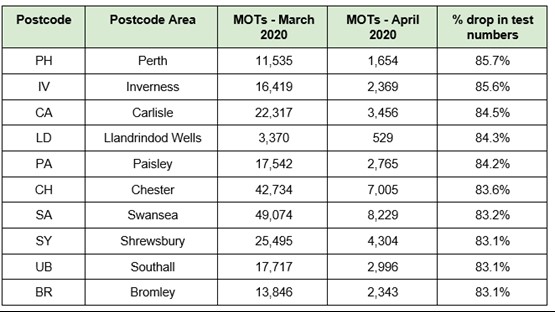
A Freedom of Information (FOI) request to the Driver and Vehicle Standards Agency (DVSA) made by the car selling comparison website showed that 746,157 MOTs were carried out in April 2020, down 80% on March 2020 – where 3,723,524 motorists took their vehicles for a MOT.

Perth in Central Scotland saw the biggest drop in MOTs last month, with tests down 85.7%, in comparison to March. Inverness saw 85.6% fewer MOTs in April, than in March.

https://cdn.fleetnews.co.uk/web/1/root/postcode-areas-with-the-largest-drop-in-mots_w555_h555.png

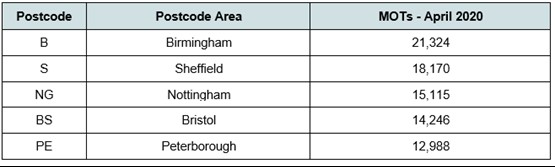
More than 20,000 motorists in the Birmingham area (21,324) took their vehicles for a MOT in April, and 18,170 tests were carried out by garages in the ‘S’ postcode area (Sheffield) last month.

https://cdn.fleetnews.co.uk/web/1/root/areas-with-the-most-mots-in-april_w555_h555.png

Alex Buttle, director at Motorway.co.uk, said: “These figures from the DVSA show that despite motorists having the opportunity to postpone their MOT test, many have chosen not to do so. There could be several reasons why; with general car maintenance, ongoing value and safety issues likely at the forefront of many drivers’ minds.

“Saying that, the number of MOTs in April was still substantially lower than March figures, and we expect to see a similarly low level of testing in May, as lockdown restrictions have only been eased slightly this month.”

Share My Blogs With Others: These icons link to social bookmarking sites where readers can share and discover new web pages.
  • MisterWong
  • Y!GG
  • Webnews
  • Digg
  • del.icio.us
  • StumbleUpon
  • Reddit
  • Alltagz
  • Ask
  • Bloglines
  • Facebook
  • YahooMyWeb
  • Google Bookmarks
  • LinkedIn
  • MySpace
  • TwitThis
  • Squidoo
  • MyShare
  • YahooBuzz
  • De.lirio.us
  • Wikio UK
  • Print
  • Socializer
  • blogmarks

The Truth About The Latest Diesel Engines

Thursday, 25. June 2020

Once the fuel of choice for the company car driver, diesel’s dominance among fleets has been on the wane for some time.

Its reputation tarnished and the attraction of tax-busting hybrid and battery electric vehicles (BEVs) difficult to ignore, numbers have continued to dwindle.

Industry leaders say they cannot see a way back for the embattled fuel and this is despite diesel beginning its fightback last year, when the first cars complying with the latest emissions standard began joining UK fleets.

Cars qualifying for the so-called RDE2 standard do not attract the 4% diesel company car tax surcharge, while fleets benefit from not having to pay the higher first-year rate of VED.

Shaun Sadlier, head of consultancy at Arval UK, says the savings from choosing a RDE2 diesel company car can run into “thousands of pounds” over a typical three-to-four-year lease contract.

“Fleets operating RDE2 cars also benefit from lower Class 1A NICs and first-year VED costs in comparison with a non-compliant model,” he said.

Mercedes-Benz, Jaguar Land Rover (JLR) and BMW were among the first to offer RDE2 cars. Rob Morris, national fleet operations manager, at Mercedes-Benz, says that its RDE2-compliant engines were a “popular choice” with customers.

All Mercedes-Benz cars produced from this month (June) will meet the stricter standard.

Vauxhall has become the first volume manufacturer to offer the emissions standard across its range.

James Taylor, general sales director at Vauxhall, told Fleet News: “That means all new Vauxhalls avoid the 4% diesel surcharge on benefit-in-kind (BIK), offering savings to our customers of up to £22 and £43 per month for 20% and 40% taxpayers, compared with the same (non-compliant) models.”

STRICTER LIMITS

The on-the-road Real Driving Emissions (RDE) test was introduced alongside the new emissions testing regime, the Worldwide harmonised Light vehicle Test Procedure (WLTP), in two stages.

RDE1 was introduced in September 2017 for new car type approvals and applied to all new car registrations from September, last year. Vehicles compliant with this standard are designated Euro 6d-Temp. The stricter RDE2 standard came into force from January for new type approvals and will be applicable to all new cars, which will be labelled Euro 6d, from January 2021.

Cars certified to RDE1 (Euro 6d-Temp) must emit less than 2.1 times the Euro 6 NOx limit of 80mg/km for diesel and 60mg/km for petrol engines. This conformity factor tightens to 1.43 times for RDE2-compliant (Euro 6d) vehicles.

In 2023, it’s expected conformity factors will be removed, aligning laboratory and on-road emissions limits.

Alongside Vauxhall, other Groupe PSA brands have become RDE2-compliant, including all Citroën and DS diesel models, plus the majority of Peugeots now also meet the stricter emissions standard.

RDE2 models include all 1.5-litre and 2.0-litre BlueHDI-powered Citroëns and DSs, with manual and EAT8 automatic transmissions.

BlueHDi versions of the Peugeot 3008 and 508 have also qualified, along with the new 208 and 2008.

Martin Gurney, who is responsible for fleet and used vehicle sales for Peugeot, Citroën and DS in the UK, says Groupe PSA has been “working hard” to ensure its vehicles are compliant ahead of schedule.

He added: “These early announcements should reassure customers that we are committed to engineering clean and efficient powertrains for all drivers. The fact that most of our diesel models already meet the forthcoming RDE2 standards speaks volumes about the development that goes into our engines.”

BMW continues to add RDE2 models, while Hyundai says it will add further RDE2 engines to its line-up to join the i10, later this year.

Other manufacturers, such as Audi, Škoda, Renault and Kia, which do not currently have any RDE2 cars, say launches in the second half of the year will see compliant models come through.

But will a wider choice of cars, which avoid the 4% surcharge, be enough to halt the demise of diesel?

DIESEL’S DECLINE

The leasing industry is reporting growing interest from savvy fleets, but all admit the focus is shifting to zero emission motoring.

Figures from the Fleet News FN50 show that the proportion of diesel cars on the FN50 fleet – the UK’s top 50 leasing companies by risk fleet   size – fell from almost two-thirds (63.4%) to almost half (50.5%) in 2019.

In terms of vehicles they had ordered, the flight from diesel was still more pronounced. Almost half of the cars ordered last year were petrol (47.6%), while only two-fifths (38.8%) were diesel.

Jon Lawes, managing director of Hitachi Capital Vehicle Solutions, has seen a growing fleet interest in RDE2 diesel cars.

However, he says this is when there is a direct comparable alternative available for the model they want.

He explained: “WLTP has been responsible for the wholesale rise of CO2, irrespective of RDE categorisation, and, therefore, we’ve seen a continued negative shift in perception of diesel vehicles.”

WLTP CO2 values for company cars registered after April 6, which are typically higher than those derived from the old emissions testing regime for comparable vehicles, are now used for tax purposes.

Their use has coincided with a new company car tax regime to try to take account of the hike in emissions, which also includes a new zero percentage rate for battery electric vehicles (BEVs).

PLUG-IN INCENTIVES

Lawes says he expects a “continuing overall decline” in diesel market share as more fleets opt for plug-in hybrid or BEV alternatives.

However, he did offer a glimmer of hope for diesel powertrains. “We expect RDE2 models will cause this decline to plateau as this will provide a favourable cost-effective option for some sectors and drivers.”

David Bushnell, principal consult-ant at Alphabet (GB), said: “For those high mileage drivers, where diesel is still probably the number one choice for fleets, the selection of an RDE2 vehicle will clearly make sense in terms of personal taxation and national insurance costs.

“It’s also an existing technology that many drivers are comfortable using. But, even here, we’re seeing mild hybrid technology coming in to reduce drivetrains’ CO2 output.”

However, he says the “clear additional tax benefits” for choosing plug-in hybrid and battery electric vehicles, revealed in the Budget, will prove hard to ignore.

Chris Chandler, principal consultant at Lex Autolease, has seen a similar trend. He said: “The cost savings and environmental benefits of a plug-in hybrid or full electric alternative are more attractive at the moment.

“The main question we’re being asked by fleets on a daily basis is how they can start – or accelerate – their transition along the ‘Road to Zero’.

“The availability of RDE2 vehicles and how to optimise diesel fleets seems to be far lower down fleet managers’ agendas.”

GROWING INTEREST

Chandler’s comments appear to be backed up by the results of a recent Energy Saving Trust survey.

It revealed that one-in-three UK fleet managers expect half of their company car fleet to be electric by 2025, and seven-in-10 fleet managers are preparing to buy an electric car within two years.

Matthew Walters, head of consultancy and customer data services at LeasePlan UK, said: “From our conversations with fleet managers, it’s evident WLTP is still the main consideration when it comes to compliance-related tax savings and how this impacts the vehicle selection process.”

He expects sales of internal combustion vehicles (ICEs) to fall as electric vehicles become more available and increasingly affordable.

Lex Autolease has seen a significant increase in demand for plug-in hybrid and full electric vehicles over the past 12 months, especially since the 0% BIK tax announcement.

Chandler says a “good awareness” of wholelife costs in the market is driving the shift towards low and zero-emission driving.

He said: “Rather than pay 25-30% tax on a RDE2-compliant diesel vehicle, company car drivers seem to be more focused on taking advantage of the tax benefits of plug-in hybrid and pure electric cars.”

As a result, the UK’s largest vehicle leasing company, Lex Autolease, says it doesn’t anticipate increased availability and understanding of RDE2-compliant models will significantly slow the decline of diesel.

Chandler added: “RDE2-compliant models will simply account for a growing proportion of the existing diesel market.”  By Graham Hill thanks to Fleet News

Share My Blogs With Others: These icons link to social bookmarking sites where readers can share and discover new web pages.
  • MisterWong
  • Y!GG
  • Webnews
  • Digg
  • del.icio.us
  • StumbleUpon
  • Reddit
  • Alltagz
  • Ask
  • Bloglines
  • Facebook
  • YahooMyWeb
  • Google Bookmarks
  • LinkedIn
  • MySpace
  • TwitThis
  • Squidoo
  • MyShare
  • YahooBuzz
  • De.lirio.us
  • Wikio UK
  • Print
  • Socializer
  • blogmarks

As More Businesses Return To Work It Is Believed That 1.1 Million Cars Will Be On The Road Illegally.

Thursday, 25. June 2020

New research by Kwik Fit has revealed that almost 1.1 million unroadworthy vehicles are set to return to the roads as lockdown begins to ease.

The research found that an estimated 1,096,000 vehicles which would have received a six-month MOT extension, would have failed a test with dangerous or major defects had they undergone a MOT.

Of these unroadworthy vehicles, it is estimated that some 316,000 would have dangerous defects, while the remaining 780,000 vehicles would fail with major defects.

The research also found that only 24% of vehicles that were originally due a MOT test has been tested since March 30, where vehicles were provided an automatic six-month extension to its expiry date.

49% of drivers who have received, or are due to receive a MOT extension, will go to the end of that period without getting their car tested.

Roger Griggs, communications director at Kwik Fit, said: “It has been interesting to see that many drivers have still had their car MOTed despite receiving an extension, because they want the reassurance a test provides.

“The extension has been very helpful to drivers during the lockdown, but as Covid-19 prevention measures begin to ease, we urge the government to remove the automatic extension in order to prevent dangerous and illegal cars taking to the roads unchecked.”

Kwik Fit analysed the latest Driver and Vehicle Standards Agency (DVSA) data, along with its own statistics.

Kwik Fit says that many drivers will be knowingly driving an unsafe vehicle, as 8% of those who will wait for the end of the extension to get their vehicle tested, said they will do so as they believe there is something wrong with their vehicle and do not want to risk it failing. One in five drivers are waiting to the end of the extension to save money.

Griggs said: “Our research found that the most common reason people were giving for going to the end of the extension without a test was that they ‘knew their car was safe’. Unfortunately, our experience shows that many people who think their car is safe are driving a vehicle with dangerous or major defects – the physical MOT test is a vital way to help ensure the safety of those drivers, and the other road users around them.”

Most drivers (71%) would like the government to end the MOT extension now. A third of drivers (31%) in Kwik Fit’s study said they want the extension to be stopped immediately, with a further 19% saying when traffic gets to a quarter of normal levels and 20% saying when it gets to half the usual volume. Government data shows that traffic returned to 50% of normal levels on May 15.

Fewer than one in five drivers (18%) think that the government should keep the MOT extension in place until vehicle use gets back to previous levels. Those who have had their car tested, or will do so, despite receiving an extension, are more than twice as likely to believe that the extension should be stopped immediately, compared to those who will not get their car tested until the end of  extension period (42% compared to 20%).

Kwik Fit’s research found that those who have had their car tested, irrespective of the extension, have been driving more miles under lockdown than the average (27.2 miles compared to 20.4 miles). Kwik Fit says this could indicate that those drivers needing to make more journeys value the peace of mind a MOT provides regarding their car’s condition.

The law requires vehicle owners to keep their vehicles roadworthy, even if they have received a MOT extension.

Kwik Fit advises that any driver concerned about the condition of their car shouldn’t wait for their next MOT, they can visit a Kwik Fit centre for a vehicle safety check. By Graham Hill thanks to Fleet News

Share My Blogs With Others: These icons link to social bookmarking sites where readers can share and discover new web pages.
  • MisterWong
  • Y!GG
  • Webnews
  • Digg
  • del.icio.us
  • StumbleUpon
  • Reddit
  • Alltagz
  • Ask
  • Bloglines
  • Facebook
  • YahooMyWeb
  • Google Bookmarks
  • LinkedIn
  • MySpace
  • TwitThis
  • Squidoo
  • MyShare
  • YahooBuzz
  • De.lirio.us
  • Wikio UK
  • Print
  • Socializer
  • blogmarks

VW Emissions Scandal Court Update

Thursday, 25. June 2020

VW has lost the first major ruling in a landmark High Court lawsuit by owners in England and Wales affected by the Dieselgate emissions scandal.

The class action lawsuit, which could be the largest consumer action in English legal history, involves almost 90,000 owners of Audi, Seat, Skoda and Volkswagen models. They are claiming for compensation over the installation of illegal ‘defeat devices’ to cheat European emissions standards.

Lawyers for the owners say Volkswagen knowingly “cheated” these rules put in place to “save lives”  by installing an unlawful device designed to detect a rolling road test and alter the combustion process to reduce nitrous oxide (NOx) emissions by up to 40 times.


The judge in the case, Mr Justice Waksman, ruled that “the software function in issue in this case is indeed a defeat device” under the classification defined by the European Union. The judge claimed he was “far from alone in this conclusion”, noting various courts and industry bodies that agree with the verdict.

He called Volkswagen’s defence “highly flawed” and “absurd”, adding: “A software function which enables a vehicle to pass the test because it operates the vehicle in a way which is bound to past the test and in which it does not operate own the road is a fundamental subversion of the test and the objective behind it.”

After the ruling, the head of group litigation at Slater and Gordon, which represents around 70,000 of the claimants, said in a statement: “This damning judgement confirms what our clients have known for a long time, but which Volkswagen has refused to accept: namely that Volkswagen fitted defeat devices into millions of vehicles in the UK in order to cheat emissions tests.”

Volkswagen responded that it is “disappointed” in today’s ruling but that the “judgement relates only to preliminary issues”. The company intends to appeal.

“To be clear, today’s decision does not determine liability or any issues of causation or loss for any of the causes of action claimed,” it said in a statement. “Volkswagen remains confident in our case that we are not liable to the claimants as alleged and the claimants did not suffer any loss.”

The first hearing began in December 2019, looking at whether the company’s ‘EA189’ diesel engine (sold in 1.2-litre, 1.6-litre and 2.0-litre capacities) featured such a device.

Despite today’s ruling, there are still further phases of the case, including determining ‘causation’ – i.e. whether or not the defeat device caused damage. These are due to play out at the end of this year or early 2021. If the verdict goes against Volkswagen, it could be ordered to pay hundreds of millions of pounds in compensation.

Volkswagen hasn’t paid compensation to any UK owners, claiming the cars weren’t fitted with a ‘defeat device’ under UK law. Previous rulings to the contrary in other countries, such as the US, carry no weight in the UK, hence the need for the class action proceedings.  By Graham Hill thanks to Autocar

Share My Blogs With Others: These icons link to social bookmarking sites where readers can share and discover new web pages.
  • MisterWong
  • Y!GG
  • Webnews
  • Digg
  • del.icio.us
  • StumbleUpon
  • Reddit
  • Alltagz
  • Ask
  • Bloglines
  • Facebook
  • YahooMyWeb
  • Google Bookmarks
  • LinkedIn
  • MySpace
  • TwitThis
  • Squidoo
  • MyShare
  • YahooBuzz
  • De.lirio.us
  • Wikio UK
  • Print
  • Socializer
  • blogmarks

Could Volvo ‘Big Brother’ Controls Spread Through The Industry

Saturday, 20. June 2020

Volvo has limited all its new cars to a maximum speed of 112mph, as part of its commitment to road safety.


The Swedish brand announced the initiative last year and started limiting vehicles from the beginning of 2020.


As well as the speed cap, every Volvo car will now also come with a Care Key, which allows Volvo drivers to set additional limitations on the car’s top speed. The new initiative is similar to the Ford MyKey, which enables owners to set a maximum speed and other restrictions, such as loud the stereo can be turned up.


“We believe that a car maker has a responsibility to help improve traffic safety,” said Malin Ekholm, head of the Volvo Cars Safety Centre. “Our speed limiting technology, and the dialogue that it initiated, fits that thinking.


The speed cap and Care Key help people reflect and realise that speeding is dangerous, while also providing extra peace of mind and supporting better driver behaviour.”


The top speed limit has proven to be controversial since it was announced, with some observers questioning the rights of car makers to impose such limitations through available technology.


From 2022, all new cars sold in the UK must be fitted with a speed limiter linked to traffic sign recognition or GPS data, however they can still be overridden by the driver.


The Volvo system has no override, meaning flagship models such as its S60 and S90 T8 twin engine variants may be less desirable when compared to rivals, which are limited to 155mph.


Volvo says that above certain speeds, in-car safety technology and smart infrastructure design are no longer enough to avoid severe injuries and fatalities in the event of an accident, however.  By Graham Hill thanks to Fleet News


Share My Blogs With Others:
These icons link to social bookmarking sites where readers can share and discover new web pages.

  • MisterWong
  • Y!GG
  • Webnews
  • Digg
  • del.icio.us
  • StumbleUpon
  • Reddit
  • Alltagz
  • Ask
  • Bloglines
  • Facebook
  • YahooMyWeb
  • Google Bookmarks
  • LinkedIn
  • MySpace
  • TwitThis
  • Squidoo
  • MyShare
  • YahooBuzz
  • De.lirio.us
  • Wikio UK
  • Print
  • Socializer
  • blogmarks

Cap HPI Confirm That There Is No Drastic Drop In Used Car Prices

Saturday, 20. June 2020

Initial analysis of the impact of the coronavirus pandemic on used car values does not show a “seismic” shift in prices being achieved, suggests Cap HPI.


However, it is urging caution and warned vendors to expect “volatile” price movements over the coming weeks.


Cap HPI says that more vehicles are beginning to be sold at auction, with pricing data volumes increasing by 70% in the week commencing May 4, compared to two weeks earlier, in the middle of April.


From the start of the lockdown, the company stated that it would be analysing both used car retail and wholesale data, but it would not adjust used values while there was insufficient data to portray the market accurately.


Between March and May 10, no values were moved, but now that cars are selling in more volume, it says they need to be adjusted to reflect sold prices and allow the trade to buy and sell optimally.


The latest data shows that average wholesale selling prices have increased steadily from around £4,000 to more than £7,000, suggesting vendors are now more confident of selling slightly more expensive cars.


Early indications suggest a 2% to 5% downward movement for some of those models and ranges older than five-years-old.


Derren Martin, head of valuations UK at Cap HPI, explained: “The previous five years have seen an average drop of 4% during April and May at the five-year-old age point, and last year witnessed a 6.3% drop. So, the movements we are currently seeing in the middle of this pandemic are by no means seismic. We are reflecting the data as volumes slowly increase.”


Cap HPI reported a 2.2% fall in used car values on March 27. The total cumulative Live movement during March, leading to April’s monthly values, was an average drop of 2.2% (-£275) at the three-year, 60,000-mile point, the majority of which happened in the final 10-days of valuing. For newer used cars, the drop was 1.8% (-£425) at the one-year, 20,000-mile point.


In April, Cap HPI observed around 7,500 sold records and that number has already been exceeded by the middle of May.


Furthermore, both Manheim and CD Auction have reported they have started online sales, while BCA has continued its online offering during the pandemic.


Cap HPI says that, while wholesale records are still well below usual volumes, there is now enough data for prices to be reflected to assist the industry.


Martin continued: “We are now in a position to confidently move values in line with the market, taking a prudent approach using our editorial expertise, no algorithms, to analyse the data.


“Initially, we will be moving values on older vehicles in mainstream sectors, where there is enough evidence to accurately reflect current prices, by looking at each generation of model individually.”


However, he said: “No overall market movements will be applied. At the current time, younger used cars will not be moved in value as that end of the market is still very much in a hiatus.”


The data company says outliers, unrepresentative volumes and prices will not be reflected to move values.


It has also made the decision not to move values of younger cars or of cars in niche sectors, due to the paucity of data available.


For now, it says that valuation movements will only be made on cars between around five and 20-years old. The situation will be reviewed on an ongoing basis.


The analysts at Cap HPI are also analysing retail advertised prices in large volumes, although it says movements on retail price have been negligible.


Martin concluded: “We can see how retail and trade values operate differently in the market and this continues to be true during the pandemic.


“It’s more important than ever to take a careful, considered view from the evidence and it is likely to be a volatile time for used car prices over the next few weeks, whilst supply and demand dynamics work themselves out.


“We would recommend the industry keeps a very close eye on our daily valuations as they may move in either direction.”  By Graham Hill thanks to Fleet News


Share My Blogs With Others:
These icons link to social bookmarking sites where readers can share and discover new web pages.

  • MisterWong
  • Y!GG
  • Webnews
  • Digg
  • del.icio.us
  • StumbleUpon
  • Reddit
  • Alltagz
  • Ask
  • Bloglines
  • Facebook
  • YahooMyWeb
  • Google Bookmarks
  • LinkedIn
  • MySpace
  • TwitThis
  • Squidoo
  • MyShare
  • YahooBuzz
  • De.lirio.us
  • Wikio UK
  • Print
  • Socializer
  • blogmarks