Working From Home & Using A Private Car Will Have Serious Consequences.

Friday, 10. July 2020

Long-term changes to the way people work could result in more employees becoming grey fleet drivers.

As the lockdown is slowly lifted, employers are wrestling with what the ‘new normal’ might entail, including where staff will work in the future.

Millions of employees have been working from home during the pandemic and many expect that, with technologies like Miscrosoft Office Teams and Zoom allowing people to connect virtually, it’s a trend that will continue.

A Fleet News survey showed an overwhelming majority of fleet decision-makers – close to three-quarters (73.4%) – were working from home; one in 10 were dividing their working day between the office and home, and just 15.4% were still in the office full-time.

The latest picture will be revealed in the June digital edition of Fleet News, which will be published next week.

Meanwhile, a separate Fleet News poll suggested that for many, some two-thirds (68.1%) of respondents, working from home will become their ‘new normal’.

Paul Hollick, co-chair of the Association of Fleet Professionals (AFP), warns this could have significant consequences for fleets, with more employees joining the ranks of those that drive their car for work, the so-called grey fleet.

Employers have a legal obligation to ensure that grey fleet vehicles are reasonably safe to use, are fit for purpose and are lawfully on the road.

Companies also typically pay Approved Mileage Allowance Payments (AMAPs) to reimburse fuel used in the course of a work trip at 45p per mile.

“Grey fleet could become a bit of a battleground, because of Covid-19,” warned Hollick. “Employees won’t be office-based (in the future), they’ll be home-based, which means their contract of employment might be changed.

“If the employee is classed as home-based rather than office-based a journey from home to the office will then become a business trip.”

Furthermore, Hollick says that, with people wary of public transport, employees are turning to used vehicles in the sub-£3,000 bracket to stay mobile, which could end up being driven for work purposes. 

New figures from the Department for Transport (DfT) show how hard public transport has been hit. Journeys by national rail are 8% of typical levels and London tube use stands at just 14%.

During the first full day of lockdown (Tuesday, March 24), car use fell to less than half (44%) of the expected level. Light commercial vehicle (LCV) use stood at 55%, HGV use at 84%.

Three months later and the day after retail outlets were allowed to open for the first time on Monday, June 15, car use had risen, but was still only at 70%. Van use and HGV use had grown to 84% and 92%, respectively.

In line with Government advice to avoid public transport, cycling use has doubled during some weekdays and trebled at the weekend.  By Graham Hill thanks to Fleet News

Share My Blogs With Others: These icons link to social bookmarking sites where readers can share and discover new web pages.
  • MisterWong
  • Y!GG
  • Webnews
  • Digg
  • del.icio.us
  • StumbleUpon
  • Reddit
  • Alltagz
  • Ask
  • Bloglines
  • Facebook
  • YahooMyWeb
  • Google Bookmarks
  • LinkedIn
  • MySpace
  • TwitThis
  • Squidoo
  • MyShare
  • YahooBuzz
  • De.lirio.us
  • Wikio UK
  • Print
  • Socializer
  • blogmarks

Drivers Taking Huge Risks When Driving CarsWith Dangerous Defects

Friday, 10. July 2020

One in 10 cars on the road could be classified as having ‘dangerous defects’, according to analysis of the latest Driver and Vehicle Standards Agency (DVSA) data by BookMyGarage.

Department for Transport (DfT) figures show that defective tyres were a contributing factor in 17 fatal accidents in 2018 and caused a total of 459 accidents in the year.

Faulty brakes were also to blame for more than 500 accidents and 15 fatalities.

Karen Rothberg, managing director at BookMyGarage, said: “It was a sensible policy during lockdown, when vehicle use was limited, but the whole point of the MOT is to make sure dangerous vehicles are not on our roads for the sake of the driver, passengers and other road users.

“The Government is taking a serious safety risk now though and we urge motorists to take a common-sense view.”

Following the DVSA announcement that it is ending the MOT exemption on August 1, BookMyGarage said, “millions on could still be driving without a valid certificate until end of January 2021”.

Vehicles were granted the six-month exemption from MOT testing in March, to help slow the spread of the virus.

However, as the lockdown is gradually lifted, all cars, motorcycles or vans due a MOT test from August 1, will now be required to get a test certificate.

The RAC has warned that hundreds of thousands of vehicles due to be tested this summer could end up causing a backlog if drivers take advantage of the six-month extension.

BookMyGarage expects the average failure rate during 2020 to increase as a result of the exemption.

Testers classify failures as minor, major and dangerous defects, with one in three vehicles failing their MOT every day in normal conditions.

The most dangerous defect recorded by more than 65,000 MOT testers across the UK between July and September 2019 were tyres, which made up 58.1% of all dangerous defects recorded, followed by brakes (29.3%), suspension (5.5%), chassis (2.4%) and lights (2.0%).

Two-in five (40%) fleets have postponed non-essential service, maintenance and repair (SMR) work, during the coronavirus crisis, according to a Fleet News survey.

Five million fewer MOT tests carried out in April and May 2020 than in the same months last year, according to DVSA figures.

BookMyGarage is advising motorists not to risk ‘maxing out’ on the August 1 exemption if they can, and get their vehicles tested as soon as possible.  By Graham Hill thanks to Fleet News

Share My Blogs With Others: These icons link to social bookmarking sites where readers can share and discover new web pages.
  • MisterWong
  • Y!GG
  • Webnews
  • Digg
  • del.icio.us
  • StumbleUpon
  • Reddit
  • Alltagz
  • Ask
  • Bloglines
  • Facebook
  • YahooMyWeb
  • Google Bookmarks
  • LinkedIn
  • MySpace
  • TwitThis
  • Squidoo
  • MyShare
  • YahooBuzz
  • De.lirio.us
  • Wikio UK
  • Print
  • Socializer
  • blogmarks

Traffic Volumes Already Close To Pre-Pandemic Levels

Friday, 10. July 2020

The number of vehicles using UK roads has almost returned to normal, following the relaxation of Coronavirus lockdown rules.

Lorry traffic is now at 97% of what it was pre-lockdown, while van traffic has reached 92% of its usual level.

Overall traffic levels have reached 83% of those recorded before the March 23 lockdown began.

The data, published by the Department of Transport, highlights the changing attitudes of commuters and travellers in a post-Covid world.

Public transport usage remains at less than a third of its usual level, as people continue to socially distance and work from home.

Car usage, meanwhile, has reached 79% of its usual level, despite a significant reduction in commuting and business travel – suggesting that the public is simply avoiding public transport and opting to drive.

Rail travel was recorded at just 13% of expected levels at the start of the week, while the London Underground is only seeing 19% of its usual footfall.

Steve Gooding, director of the RAC Foundation, said: “In terms of lorry traffic it’s almost as if Coronavirus didn’t happen, with volumes staying close to pre-lockdown levels throughout.

What’s interesting is the extent to which van traffic has come back, which could be good news for the economy and for congestion if those vans aren’t heading into town in the rush hour but are instead making home deliveries throughout the day and into the evening.

“The fact that car traffic is back to four fifths of what it was before the lockdown shouldn’t surprise us, given the Government’s ongoing advice to avoid public transport, but since the Government is also advising us to work from home if we can it begs the question of what these car trips are about and how different they are to our traditional commuting patterns.”

Cycle use has boomed since the Coronavirus outbreak, growing to 140% of normal levels.

INRIX studied the vehicle-miles travelled (VMT) across Europe during the pandemic and found that in the UK specifically, VMT fell by 56% during the week of March 23 alone.

It stagnated for about a month, then began to rise throughout May and June with the reopening of recreational sites and retail locations. Notably, weekend travel remains strong across the UK.

The effects of reduced VMT are reflected in lower travel times and faster vehicle speeds across the UK. By June, drivers around Edinburgh saw the largest speed increases out of all cities studied, with a 69% jump in speed during the 8:00AM rush hour, while drivers in Belfast during the afternoon commute saw a 12% increase in travel speeds.

However, as VMT continues to grow, travel speeds have started to retract. Speeds around London have fallen from their April highs significantly (when VMT was at its lowest point), dropping 26% in the AM commute and 36% in the PM commute.

Despite the drops in speeds, however, rush hour travel is still more than 20% faster in June than it was in February.

As cities continue to rebound from Covid-related lockdowns, traffic congestion will continue to rise, says INRIX. However, it believes that the intensity of congestion may not reach ‘normal’ levels for a while if telecommuting habits, the prevalence of online shopping and public transport and cycling use change. By Graham Hill thanks to Fleet News

Share My Blogs With Others: These icons link to social bookmarking sites where readers can share and discover new web pages.
  • MisterWong
  • Y!GG
  • Webnews
  • Digg
  • del.icio.us
  • StumbleUpon
  • Reddit
  • Alltagz
  • Ask
  • Bloglines
  • Facebook
  • YahooMyWeb
  • Google Bookmarks
  • LinkedIn
  • MySpace
  • TwitThis
  • Squidoo
  • MyShare
  • YahooBuzz
  • De.lirio.us
  • Wikio UK
  • Print
  • Socializer
  • blogmarks

Vehicle Thefts Increase By Over 50%

Friday, 10. July 2020

Vehicle thefts have risen to highest level in four years, as more than 150,000 cars, vans and motorcycles were reported as stolen in 2018-19.

It’s an increase of 10,000 vehicles when compared to the year before and a 56% (54,932) increase compared to four years earlier, according to data analysed by RAC Insurance.

All but three of the police forces that responded to a Freedom of Information request recorded an increase in the numbers of vehicles stolen in their force areas from 2014-15 and 2018-19.

The largest increases were recorded by Kent Police (up 12,550 to 40,726 thefts in 2018-19, a 45% increase), Metropolitan Police (up 9,635 to 30,773 thefts, a 46% increase) and West Midlands Police (up 5,677 to 10,372 thefts, a 121% increase).

Six forces recorded a more than doubling in the number of vehicles stolen between 2014-15 and 2018-19, with the biggest jumps in Suffolk (up 172% from 347 to 945 thefts), Surrey (up 133% from 661 to 1,543 thefts) and the West Midlands.

Only Lincolnshire, the City of London and Police Scotland recorded a reduction in thefts during this period, with reductions of 28, 29 and 473 thefts respectively.

Most police forces (32) also recorded a rise in vehicle thefts year-on-year, between 2017-18 and 2018-19. Kent, again, saw the largest rise, as well as the largest number of overall vehicles stolen in 2018-19 (up 2,575 to 40,726 thefts, 7% more than in 2017-18), followed by Essex (up 1,056 to 5,409 thefts, 24% more than in 2017-18) and the West Midlands (up 836 to 10,372 thefts, 9% more than 2017-18).

When looking at the biggest percentage increases over this 12 month period, Suffolk witnessed the highest jump with 44% more thefts (945 in 2018-19 compared to 655 a year earlier), followed by Bedfordshire (37% increase, from 1,056 to 1,445 thefts) and North Wales (32% increase, from 464 to 612 thefts).

RAC Insurance spokesperson Simon Williams said: “These figures paint a rather disturbing picture – vehicle thefts are on the rise almost everywhere, and in some parts of the country numbers are rocketing.

“It’s also not the case that the rises in crime are confined to a few larger urban areas, with many police forces covering more rural areas also seeing big increases.

“While vehicle crime is at far lower levels today than it was in the early 1990s, thanks to improvements in vehicle security, and the number of vehicles licensed to be driven on the UK’s roads is higher than at any point in the past, it’s still concerning that so many more vehicles are being stolen than just a few years ago.”

The average fleet loses around £16,000 per year as a result of vehicle or equipment theft, according to Verizon Connect.

Its research found that businesses have at least one vehicle stolen each year.

The average loss increases to nearly £50,000 for those businesses that have between 101-250 vehicles, as the number of vehicles stolen rises to three for businesses of this size.

Some of the increases in recent years can be put down to a rise in thefts of vehicles that are easier to steal, such as motorbikes and mopeds that are less likely to have immobilisers. Government data also shows that thieves generally use keys to access vehicles in around half of crimes, which suggests that drivers need to do more to keep their keys safe.

Tracker data suggests that nine out of 10 van thefts were performed using the keys.

In a fifth of cases (18% in 2018), thieves were able to access vehicles because they weren’t locked in the first place.

Company car drivers and fleets are being warned by Tracker to be wary of opportunistic criminals looking to steal cars to fill a replacement parts gap caused by COVID-19.

The stolen vehicle recovery company says that police across the country are already fighting an increase in ‘chop shops’ – where stolen vehicles are stripped down and expensive parts sold on. But, it argues, the lack of legitimate parts could increase their popularity and profitability still further. By Graham Hill thanks to Fleet News

Share My Blogs With Others: These icons link to social bookmarking sites where readers can share and discover new web pages.
  • MisterWong
  • Y!GG
  • Webnews
  • Digg
  • del.icio.us
  • StumbleUpon
  • Reddit
  • Alltagz
  • Ask
  • Bloglines
  • Facebook
  • YahooMyWeb
  • Google Bookmarks
  • LinkedIn
  • MySpace
  • TwitThis
  • Squidoo
  • MyShare
  • YahooBuzz
  • De.lirio.us
  • Wikio UK
  • Print
  • Socializer
  • blogmarks

Surprising Conditions That Drivers Must Report To The DVLA

Friday, 10. July 2020

If you suffer from illnesses that could affect your ability to drive, you’re required by the DVLA to inform them.

However, while some might be quite obvious, the DVLA has a list of health conditions that you might be surprised to learn put you at risk of a £1,000 fine if you don’t declare them.

Car hire comparison site StressFreeCarRental has scoured the full list of conditions to find the less obvious ones you should know about…

Diabetes

If you have diabetes that is treated by insulin, and the insulin treatments last more than three months, you must inform the DVLA. This also applies to gestational diabetes, or if you are at risk of low blood sugar, known as hypoglycaemia.

Vertigo

While most people associate vertigo with being at height, this is specifically known as ‘height vertigo’. Regular vertigo sufferers can get attacks anywhere, making it feel like the world around them is spinning. If you suffer from sudden, disabling, or recurrent vertigo you must tell the DVLA.

Déjà vu

This is something mostly written off as an odd feeling that you’ve been somewhere before, but it can be much more serious. The DVLA must be informed if you suffer from seizures or epilepsy that cause déjà vu.

Sleep apnoea

Obstructive sleep apnoea is a condition that causes the throat to relax and narrow during sleep, which can cause difficulty breathing. It’s one of a number of sleeping disorders that the DVLA must be told about, including narcolepsy and cataplexy.

Labyrinthitis

Labyrinthitis has nothing to do with mazes, it’s actually an inner ear condition that causes dizziness, nausea and loss of hearing. Since all of these things could affect your ability to drive, you must inform the DVLA if you have it.

Heart palpitations

This condition results in the sufferer becoming more aware of their heartbeat, which may feel like it’s pounding or fluttering, or perhaps beating irregularly. While the NHS says they are usually not a sign of something serious, the DVLA requires you to declare if you regularly suffer from them.

By Graham Hill thanks to AOL Cars

Share My Blogs With Others: These icons link to social bookmarking sites where readers can share and discover new web pages.
  • MisterWong
  • Y!GG
  • Webnews
  • Digg
  • del.icio.us
  • StumbleUpon
  • Reddit
  • Alltagz
  • Ask
  • Bloglines
  • Facebook
  • YahooMyWeb
  • Google Bookmarks
  • LinkedIn
  • MySpace
  • TwitThis
  • Squidoo
  • MyShare
  • YahooBuzz
  • De.lirio.us
  • Wikio UK
  • Print
  • Socializer
  • blogmarks

Calls For Driver Eyesight Rules To Be Strengthened

Friday, 3. July 2020

What is the minimum vision standard required to drive on UK roads? And how can you check your own eyesight before driving?

Your eyes are obviously a crucial tool for driving a car safely, and the DVLA (Driver and Vehicle Licencing Agency) lays down detailed rules describing the standards of vision required for driving a car in the UK.

Drivers have their vision checked when they take their driving test, but from that point on, it’s the responsibility of individual drivers to report any problems that develop with their eyesight to the DVLA.

You should NOT drive a car if you believe that your eyesight may fall below the required standard. If you need to confirm that your eyesight is up to standard, visit an optician, and definitely do not drive there, no matter how far.

Standards of vision required for driving

The basic eyesight standard required for driving is simple. To drive a car legally in the UK you must be able to read a car number plate from a distance of 20 metres.

If you need to wear glasses or contact lenses for driving, you should be wearing them when you attempt to read the number plate, and the number plate should be of the current design that’s been standard on UK cars since September 2001.

In addition to this basic requirement, you must have a visual acuity measurement of at least 6/12 (or 0.5) on the Snellen scale, again while wearing any glasses or contact lenses that you need for driving.

While this sounds ominous, if you’ve visited an optician, the Snellen scale will be familiar to you as the wall chart with the rows of letters or numbers that get smaller as you read down. This chart is used to measure visual acuity, your central vision that you use to see detail.

Normal visual acuity is called 6/6, which means that from 6 metres away (the first number) you can read all 6 lines of the chart. Someone who could only read the first line of the chart would receive a rating of 6/60 which means that from 6 metres they could only read what someone with normal vision could read from 60 metres away.

If the second line of the chart is the ‘36’ line, someone with standard vision could read it from 36 metres, but if your Snellen score was 6/36 you would only be able to read it from 6 metres.

The 6/12 minimum vision standard for driving a car in the UK means that you can read from 6 metres what someone with standard vision could read from 12. This is half the distance, hence the conversion to the decimal 0.5.

Driving test eyesight check

Before your practical driving test, the examiner will test your eyesight by asking you to read the number plate of a parked vehicle that’s 20 metres away. If you can’t do this, then your test is immediately over and you will not be permitted to drive the car. Your provisional driving licence will also be revoked.

If you reapply for your driving licence, the DVLA will ask you to take a full eye test with the DVSA (Driver and Vehicle Standards Agency) which will take place at a local driving test centre. You’ll have to pass this before you get your licence back and then pass the number plate eye test before you take your practical driving test.

Online driving eyesight tests

There are a number of online driving eyesight tests that you can find on the Internet that may give you some idea if there is a problem with your eyesight.

However, these have no diagnostic value and should not be taken as the only indication of whether you’re safe to drive.

A better course of action is to test yourself by trying to read a car number plate from 20 metres and contacting your doctor and the DVLA if you struggle to do so.

What if there’s a problem with your eyesight?

There is no mandatory retesting of driver’s eyesight in the UK, and it is the driver’s responsibility to report any deterioration in their eyesight to the DVLA.

If you believe that your eyesight has diminished to the point that you are no longer safe to drive, or if you have any concerns that this could be the case, you should not drive a car. See a doctor and have your eyesight evaluated before getting behind the wheel.

If you do not tell the DVLA about any medical condition that affects your driving, you could be liable for a fine of up to £1,000 and you could be prosecuted if you are involved in an accident.

The DVLA publishes a list of health conditions that can affect your driving that may be useful to check whether you need to contact them. If there’s any doubt, however, contact your doctor before driving.

Eyesight tests for HGV and bus drivers

The eyesight standards required to drive an HGV or a bus in the UK are more stringent than for cars. To get your HGV licence, you must have a visual acuity of at least 6/7.5 (or 0.8) on the Snellen scale in your best eye. Your worst eye must be at least 6/60 (or 0.1).

If you take the test wearing glasses, their corrective power can’t be more than 8 dioptres and you must have an uninterrupted visual field of at least 160 degrees. This field of vision must include an extension of at least 70 degrees left and right plus at least 30 degrees down.  By Graham Hill thanks to Auto Express

Share My Blogs With Others: These icons link to social bookmarking sites where readers can share and discover new web pages.
  • MisterWong
  • Y!GG
  • Webnews
  • Digg
  • del.icio.us
  • StumbleUpon
  • Reddit
  • Alltagz
  • Ask
  • Bloglines
  • Facebook
  • YahooMyWeb
  • Google Bookmarks
  • LinkedIn
  • MySpace
  • TwitThis
  • Squidoo
  • MyShare
  • YahooBuzz
  • De.lirio.us
  • Wikio UK
  • Print
  • Socializer
  • blogmarks

Are The Car Manufacturers Still Conning Us Over Fuel Consumption?

Friday, 3. July 2020

New petrol, diesel and hybrid cars are, on average, 5.4% less efficient than their official WLTP fuel consumption figures suggest, according to new research by What Car?

It tested 56 new models under its independent True MPG test, to determine its real-world fuel economy. The figure was then compared to the manufacturer’s claimed figure.

On average, vehicles were 5.4% less efficient than the WLTP figures suggested, but the research revealed significant differences between models.

The worst performers were found to be more than 20% less efficient than their official figures, while the best performers were found to be 15% more efficient.

The tougher and longer WLTP emissions and type approval test was introduced in 2017 by the European Commission and became mandatory for all new vehicles from September 2018 onwards.

The WLTP test replaced the previous New European Driving Cycle (NEDC) type approval test, which dated back to the 1980s, with the aim of providing more accurate fuel consumption figures for new car buyers.  

The new WLTP test is significantly more accurate than the NEDC test, according to What Car?’s figures. In a previous study of 159 vehicles tested under the NEDC protocol, there was an average discrepancy of 20.2% between True MPG and the manufacturer quoted figures – with the worst performers as much as 40% less efficient than advertised.

Steve Huntingford, editor of What Car?, said: “For years, most buyers have taken the official fuel economy figures with a grain of salt. Our research shows that while the latest test is more accurate, there are still large differences on some makes and models, which is why it’s important for buyers to do their research before buying.”

Worst real-world MPG performers:

MakeModelEngineTrimAverage True MPGWLTP CombinedShortfall
VolvoXC40T4R-Design Pro27.134.8-22.1%
VolvoV60D4Momentum Pro40.149.5-19.0%
RenaultClioTCe 100Iconic44.454.3-18.2%
BMW3 Series320dSport47.257.6-18.1%
VolvoXC40D4First Edition35.442.7-17.1%
BMW3 Series TouringM340iM Sport28.033.6-16.7%
BMW1 Series118iM Sport36.342.8-15.2%
VolvoS60T5R-Design Plus32.538.2-14.9%
FordFocus1.5 Ecoblue 120ST-Line52.461.4-14.7%
KiaSportage2.0 CRDi 48V  GT-Line S  35.740.9-12.7%

Best real-world MPG performers:

MakeModelEngineTrimAverage True MPGWLTP CombinedImprovement
HondaCR-V2.0 i-MMD HybridSR47.440.915.9%
MazdaMX-52.0GT Sport Nav+45.140.910.3%
SkodaKaroq1.5 TSISE L44.240.59.1%
DaciaLogan StepwayTce 90Comfort47.744.37.7%
SkodaSuperb Estate2.0 TDI 150SE54.851.56.4%
PeugeotRifter1.5 Blue HDiGT Line50.547.95.4%
VolkswagenPolo1.0 TSIBeats51.849.64.4%
SeatAteca1.5 TSIFR44.542.84.1%
AudiQ540 TDIS line39.037.73.4%
CitroenBerlingoPuretech 110Flair41.139.83.3%

By Graham Hill thanks to Fleet News and What Car

Share My Blogs With Others: These icons link to social bookmarking sites where readers can share and discover new web pages.
  • MisterWong
  • Y!GG
  • Webnews
  • Digg
  • del.icio.us
  • StumbleUpon
  • Reddit
  • Alltagz
  • Ask
  • Bloglines
  • Facebook
  • YahooMyWeb
  • Google Bookmarks
  • LinkedIn
  • MySpace
  • TwitThis
  • Squidoo
  • MyShare
  • YahooBuzz
  • De.lirio.us
  • Wikio UK
  • Print
  • Socializer
  • blogmarks

Road Deaths Spiral In 2019 To 2010 Levels

Friday, 3. July 2020

The following came as a stark warning as we finally see pubs and bars open for the first time in 4 months. With fewer police cruising the streets checking motorists I’ve personally seen a lot of drivers exceeding speed limits so with pubs and bars opening are we likely to see drivers risking drink driving believing that they will get away with it?

I would hope not but please be more aware of the likely danger that some reckless drivers may present!

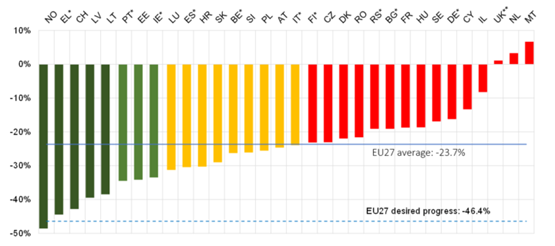
The UK appears to be failing in its approach to road safety, with provisional data suggesting there were more road deaths in 2019 than in 2010.

The Baltic States, together with Greece and Portugal, were the best performing countries in the EU according to a new report published today by the European Transport Safety Council (ETSC).

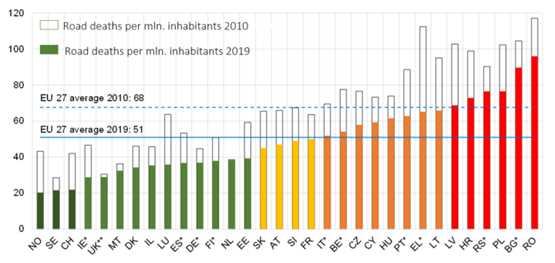
The new analysis shows that two of Europe’s traditional leaders on road safety: the UK and the Netherlands, while remaining relatively safe when compared on road mortality, had more road deaths in 2019 than in 2010.

In the UK, there were 1,905 road deaths in 2010; provisional figures suggest there were 1,926 deaths in 2019.

France, Sweden and Germany have also shown disappointing progress over the last nine years with only modest reductions in deaths.

Bulgaria and Romania remain Europe’s worst performers in terms of road mortality and have also made below-average reductions in recent years.

Estonia will be awarded this year’s ETSC Road Safety Performance Index (PIN) after significantly improving road mortality (road deaths per million inhabitants).

The EU, and its Member States, agreed a target to cut road deaths by half in the decade to 2020. However, with one year left until full data for 2020 are available, that target will almost certainly be missed, says ETSC.

That is likely to be the case even taking account of the significant drop in road deaths that have occurred in several countries in recent months as a result of Covid-19 lockdown policies.

Antonio Avenoso, Executive Director of the European Transport Safety Council, said: “While progress across Europe has disappointed over the last nine years, some countries have been quietly undergoing a road safety revolution.  We’re delighted to award Estonia this year for its remarkable progress, following Ireland’s win in 2019.

“Overall, EU Member States will need to step up a gear to hit the new targets for 2030.  But the recent response to the Covid-19 epidemic may signal a way forward.

“A dramatic shift to walking and cycling in urban areas, combined with infrastructure changes and lower speed limits, could have a massive impact on road death and injury.”

However, Avenoso added: “If we just revert to business-as-usual after this crisis, the results could be even worse than before.

“There are danger signs already in the large numbers of speeding offences being reported as lockdowns are lifted, which only adds to the work of overstretched police and emergency services.”

Road safety in the EU is likely to see a boost over the next decade thanks to new legislation on minimum vehicle and infrastructure safety standards agreed last year.

But much will depend on the detailed technical standards for the new laws, which are currently being worked out.

ETSC is particularly concerned about the requirements for Intelligent Speed Assistance (ISA) technology for new cars, and “direct vision” standards (to improve visibility around the vehicle for drivers) for new Heavy Goods Vehicles, which both risk being watered down following motor industry pressure.

https://cdn.fleetnews.co.uk/web/1/root/etsc-relative-change-in-road-deaths-between-2010-and-2019_w555_h555.png

Relative change in road deaths between 2010 and 2019: *National provisional estimates used for 2019, as final figures for 2019 are not yet available at the time of going to print. **UK data for 2019 are the provisional total for Great Britain for the year ending June 2019 combined with the total for Northern Ireland for the calendar year 2019.

https://cdn.fleetnews.co.uk/web/1/root/etsc-road-mortality_w555_h555.png

Road mortality (road deaths per million inhabitants) in 2019 (with mortality in 2010 for comparison): *National provisional estimates used for 2019, as final figures for 2019 are not yet available at the time of going to print. **UK data for 2019 are the provisional total for Great Britain for the year ending June 2019 combined with the total for Northern Ireland for the calendar year 2019.  By Graham Hill thanks to Fleet News

Share My Blogs With Others: These icons link to social bookmarking sites where readers can share and discover new web pages.
  • MisterWong
  • Y!GG
  • Webnews
  • Digg
  • del.icio.us
  • StumbleUpon
  • Reddit
  • Alltagz
  • Ask
  • Bloglines
  • Facebook
  • YahooMyWeb
  • Google Bookmarks
  • LinkedIn
  • MySpace
  • TwitThis
  • Squidoo
  • MyShare
  • YahooBuzz
  • De.lirio.us
  • Wikio UK
  • Print
  • Socializer
  • blogmarks

Green Number Plates To Identify Electric Cars Later This Year

Friday, 3. July 2020

The Government has given the go-ahead for pure electric vehicles (EVs) to be identified by a green number plate.

I must admit that having read this report I’m mystified. There has to be something more than a simple green stripe on the side of the number plates to identify the vehicle as being electric. If that’s the only change it will make forging the plates extremely easy. In the 21st century is that the best that we can do?

The new registration plates, which will be rolled out from the autumn, aim to make it easier for cars to be identified as zero-emission vehicles, helping local authorities design and put in place new policies to incentivise people to own and drive them.

For example, drivers could benefit from local initiatives such as cheaper parking and cost-free entry into zero-emission zones where those with a green number plate will be recognised as eligible.

The plates will be identifiable by a green flash on the left-hand side and will be available for zero emission vehicles only.

Transport secretary Grant Shapps said: “Green number plates could unlock a number of incentives for drivers and increase awareness of cleaner vehicles on our roads, showing people that a greener transport future is within our grasp.”

The Government launched a consultation on introducing green number plates for zero emission cars last autumn, highlighting their use by countries like Norway, Canada, and China.

A similar scheme was trialled in Ontario with drivers of EVs given free access to toll lanes and high occupancy vehicle lanes. Ontario saw an increase in EV registrations.

Lauren Pamma, electrification propositions lead in Lloyds Banking Group’s motor finance and leasing division, said: “It’s encouraging to see that despite the challenges presented by the coronavirus outbreak, sustainability remains high on the agenda for fleets.

“Our business customers have a relatively strong understanding of the environmental and wholelife cost benefits of having EVs on fleet – especially when it comes to tax and national insurance costs – and remain focussed on making the transition where they can.

“For private drivers, the more tangible benefits might be a greater draw – such as access to emissions-restricted zones and better parking spaces, and the cost savings associated with both.

“Making zero-emission vehicles easier to identify on the roads could help to communicate this message and boost advocacy.”

Tom Clarke, head of electric vehicle strategy at LV (Liverpool Victoria) General Insurance, added: “The introduction of green number plates from autumn is excellent news, especially given the current climate.

“Drivers looking to make the switch to electric really need to understand the cost benefits of owning one, and as more cities look to introduce zero and low emission zones, it’s positive that drivers will be able to save money on any charges in force.

“Ultimately, this move will encourage the uptake of electric cars, and help the UK towards its ambition of net zero emissions by 2050, as drivers become more aware of the benefits of owning an electric car.”

Alongside the decision to give the new number plate design the go-ahead today (Tuesday, June 16), the Department for Transport (DfT) has also announced £12 million funding for research into the zero-emission market to develop greener vehicles and help improve vehicle charging technology.

The funding, made available through the Office for Low Emission Vehicles (OLEV) and delivered through Innovate UK, will see £10m for a new Zero Emission Vehicle Innovation Competition.

It will invite applicants to bid for project funding to support advancements in both battery electric and hydrogen vehicles, as well as charging infrastructure.

OLEV is also providing £2m to UK small and medium businesses to support their research into zero-emission vehicles in areas such as battery technology, which could be used by major vehicle manufacturers in future electric vehicle production.

The funding, says the Government, will help these businesses to drive local economic growth through research and development projects in areas including charging infrastructure and zero emission vehicles, which could in turn create over 6,000 skilled jobs.

Shapps concluded: “We’re supporting small businesses to develop the transport tech of the future through a multi-million pound investment, ensuring that UK businesses remain at the forefront of low carbon innovation and research.’’  By Graham Hill thanks to Fleet News

Share My Blogs With Others: These icons link to social bookmarking sites where readers can share and discover new web pages.
  • MisterWong
  • Y!GG
  • Webnews
  • Digg
  • del.icio.us
  • StumbleUpon
  • Reddit
  • Alltagz
  • Ask
  • Bloglines
  • Facebook
  • YahooMyWeb
  • Google Bookmarks
  • LinkedIn
  • MySpace
  • TwitThis
  • Squidoo
  • MyShare
  • YahooBuzz
  • De.lirio.us
  • Wikio UK
  • Print
  • Socializer
  • blogmarks

Period Of Grace When Entering Variable Speed Camera Controls

Friday, 3. July 2020

Smart motorway technology may be under fire, but Highways England bosses are standing by their policy of placing variable speed limits on sections of the motorway.

The variable speed limit is signalled on the overhead gantries, advising motorists of a changing speed limit from the standard 70mph. While many drivers believe that the signals are only an advisory message, thousands of drivers will suggest otherwise after a five junction stretch of the M1 brought in £6.2m in fines.

Now, one of the UK’s leading motoring publications, Auto Express, has revealed that there is a grace period in effect to lower your speed when the variable speed comes into action.

More than 60,000 speeding tickets have been issued between junction 30 and 35a on the M1 in Yorkshire, demonstrating that getting done for speeding on the motorway is no longer a myth.

With speed cameras re-calibrating to meet the new limit, it is important to note the government agency’s advice to get your speed in line.

Speaking to Auto Express, Highways England said: “Following a change in the speed displayed by signals there is a 60-second grace period before HADECS3 cameras start enforcement, giving time for drivers to adapt to the new mandatory speed limit, especially when speed limits are reduced due to slow-moving or queuing traffic up ahead.”

The national speed limit is 70mph, but the speed can be adjusted to 60, 50 or even 40mph if deemed necessary by Highways England. And it is worth noting also that motorists can be caught on camera even if the 70mph is in place. By Graham Hill thanks to Auto Express

Share My Blogs With Others: These icons link to social bookmarking sites where readers can share and discover new web pages.
  • MisterWong
  • Y!GG
  • Webnews
  • Digg
  • del.icio.us
  • StumbleUpon
  • Reddit
  • Alltagz
  • Ask
  • Bloglines
  • Facebook
  • YahooMyWeb
  • Google Bookmarks
  • LinkedIn
  • MySpace
  • TwitThis
  • Squidoo
  • MyShare
  • YahooBuzz
  • De.lirio.us
  • Wikio UK
  • Print
  • Socializer
  • blogmarks