CO2 Legislation Set To Destroy The Classic Car Industry

Thursday, 21. October 2021

Boris Johnson is urged to protect Britain’s classic cars industry amid new eco regulations, with campaigners warning 100,000 jobs could be at risk

  • Angry campaigners say the classic car industry is at risk from green regulations
  • They say the industry is being targeted by complex rules on import and exports
  • The Historic and Classic Vehicles Alliance is being launched today to help issue

Boris Johnson is being urged to save Britain’s world-leading historical and classic car industry from green regulations and bureaucracy.

Campaigners are warning the Prime Minister, an ex-motoring columnist, that 100,000 jobs depend on the heritage sector, which has a turnover worth £18.3billion a year from international sales.

They say the industry is ‘in peril’ due to unfairly targeted environmental regulations and complex new rules for exporting and importing cars and parts to and from the EU.

Campaigners are setting up the Historic and Classic Vehicles Alliance trade group to fight for workers including engineers, specialist restorers, dealers and parts suppliers. They hope to keep alive a sector that prizes cars from everyday Fords to luxury Rolls-Royces.

The alliance, supported by Tory MP and former transport minister Nus Ghani, also aims to highlight how the UK’s three million classic cars are relatively green and sustainable because they are maintained through quality craftsmanship.

Recently launched the alliance said: ‘More than 100,000 jobs are in peril as a combination of bureaucracy and poorly-focused environmental legislation threatens Britain’s world leading classic vehicle industry.

Tory MP and former transport minister Nus Ghani supports the newly formed alliance

‘With economic revival a top priority as the UK strives to recover from the Covid pandemic, highly-skilled engineers, restorers, craftsmen and parts suppliers face uncertainty over their livelihoods.’

It added: ‘Many businesses and owners find themselves trapped in a bureaucratic nightmare as they navigate red tape surrounding the movement of vehicles and parts for sales, restoration, competition preparation and events.’

The sector’s contribution to the UK economy is huge, it says.

The three million classic and historical cars on UK roads are valued at over £12billion, support 113,000 jobs, create an annual international trade turnover worth £18.3billion, and generate around £3billion tax revenue to the exchequer to help fund schools, hospitals, roads, transport and other public spending.

Significantly, the industry is spread ‘the length and breadth of the country’ with clusters of specialists operating in the West Midlands, Lancashire, Kent and Sussex – and only 5% of activity based in London, it points out: ‘The trade, in which British craft skills and engineering excellence lead the world, supports around 113,000 jobs in thousands of specialist small businesses and supply chain firms. It also provides training places and apprenticeship schemes, giving opportunities to young people’.

The new alliance also aims to ‘bust the myths and popular misconceptions’ surrounding classic cars pointing out that the well-maintained vehicles are relatively green and sustainable because they prolong the life of great pieces of craftsmanship ‘rather than surrendering to built-in obsolescence.’

They are typically better maintained and driven sparingly – around 16 times a year covering an average 1,200 miles – and producing just a fifth (20%) of CO2 emissions from using a computer and a mobile phone for a year.  By Graham Hill thanks to The Daily Mail

Share My Blogs With Others: These icons link to social bookmarking sites where readers can share and discover new web pages.
  • MisterWong
  • Y!GG
  • Webnews
  • Digg
  • del.icio.us
  • StumbleUpon
  • Reddit
  • Alltagz
  • Ask
  • Bloglines
  • Facebook
  • YahooMyWeb
  • Google Bookmarks
  • LinkedIn
  • MySpace
  • TwitThis
  • Squidoo
  • MyShare
  • YahooBuzz
  • De.lirio.us
  • Wikio UK
  • Print
  • Socializer
  • blogmarks

DVLA Releases The Latest Banned Car Registration Plates

Thursday, 21. October 2021

Latest DVLA list of banned UK registrations reveals which 71-plates are too rude for the road.

The Driver and Vehicle Licensing Agency (DVLA) has released its latest list of banned number plates, revealing which 71-reg combinations are deemed too offensive to be seen on the UK’s roads.

Registrations referring to the Covid-19 pandemic aren’t allowed this time around, with CO71 VD, CO71 ONA, CO71 RNA and AN71 VAX all on the list of suppressed plates. Combinations with connotations of violence have also been banned, including BR71 GUN, BR71 KLL and BR71 WAR.

There also appears to be a ban on overt or potentially offensive political statements made in number plates – drivers aren’t allowed to display EU71 BAD, FA71 ST, AN71 USA, TA71 BAN or any combination starting with NA71.

It’s hard to fathom why someone may want PR71 CK, BA71 ARD or AS71 HOL on show at each end of their car, but nevertheless these have also been forbidden as a precaution, along with EA71 NOB, EA71 POO and FR71 GGN.

Some serious thought goes into deciding which number plates need to go on the DVLA’s list of suppressed registrations. Twice a year, the public body tasks its best and brightest with finding every combination of the newly released format that shouldn’t see the light of day.

The criteria for plates to be banned is if they “may cause offence, embarrassment or are in poor taste”. The DVLA points out that it’s only a small minority of combinations that end up on the suppressed list, with the vast majority of registrations being publicly available.

That said, drivers who were hoping to have BO71 LOX, FA71 NNY or GU71 LTY attached to their vehicles will be disappointed this time round, as will those wanting PE71 RVT, TT71 XXX or HA71 SH.

The DVLA sent the newly updated list of banned number plates to Auto Express under a freedom of information request. By Graham Hill thanks to Auto Express

Share My Blogs With Others: These icons link to social bookmarking sites where readers can share and discover new web pages.
  • MisterWong
  • Y!GG
  • Webnews
  • Digg
  • del.icio.us
  • StumbleUpon
  • Reddit
  • Alltagz
  • Ask
  • Bloglines
  • Facebook
  • YahooMyWeb
  • Google Bookmarks
  • LinkedIn
  • MySpace
  • TwitThis
  • Squidoo
  • MyShare
  • YahooBuzz
  • De.lirio.us
  • Wikio UK
  • Print
  • Socializer
  • blogmarks

New Electronic Breathalyser Launched With Instant Results

Thursday, 21. October 2021

New product: Breath Alcohol Tester – Kenwood Car Audio CAX-AD100

KENWOOD’s premium analyser is quick to respond and has a highly accurate measurement. The sensor is heated to accelerate the reaction, plus heating removes dirt and impurities adhering to the sensor.   

Supports straw method and open blow method 2-way measurement

Supports 2-way measurement of straw method and open blow method. The straw method is less affected by the environment than the open blow method that blows exhaled air directly. This enables more accurate measurement.

Stylish design & compact design

Compact design that fits in one hand with a clean and slim design, so you can easily use it at home, or when you are on a business trips.The sensor cover has to be closed when you are not using the unit, so it protects the highly sensitive sensor.

5000 times long-term sensor and life notification function

The sensor can measure up to as many as 5000 times. When you exceed this amount of measurements, the sensor replacement mark will flash to inform you of the lifestatus.   

Measurement timing Electronic sound

At the time of measurement, the countdown of the digital display starts, and the timing is notified by electronic sound.   

LCD display of alcohol value during exhalation

Clear measurement is possible with a digital display from 0,00mg / l without cutting the low concentration area of alcohol

* 0.05mg / l or less is displayed as 0.05 mg / l   

Power saving design and automatic power off function

Power-saving design that can measure 1200 times with 2 AA alkaline batteries. Even if the power is left on, the power will be turned off automatically after 1 minute, so you avoid depleted batteries.  By Graham Hill thanks to Kenwood

Share My Blogs With Others: These icons link to social bookmarking sites where readers can share and discover new web pages.
  • MisterWong
  • Y!GG
  • Webnews
  • Digg
  • del.icio.us
  • StumbleUpon
  • Reddit
  • Alltagz
  • Ask
  • Bloglines
  • Facebook
  • YahooMyWeb
  • Google Bookmarks
  • LinkedIn
  • MySpace
  • TwitThis
  • Squidoo
  • MyShare
  • YahooBuzz
  • De.lirio.us
  • Wikio UK
  • Print
  • Socializer
  • blogmarks

National Park Latest Car Parks To Install EV Charge Points

Thursday, 21. October 2021

Lake District National Park has installed a network of 28 electric vehicle charging points across its locations.

The chargers will not only support its own fleet of BMW i3s but are also open to the public. The move is one of Lake District National Park Authority’s low carbon projects to promote a cleaner and more sustainable environment across the Lake District.

To support its fleet electrification plans, Lake District National Park Authority appointed AMP EV to install Rolec’s range of AC fast and DC rapid chargers.

Emma Moody, lead strategy advisor for recreational & sustainable transport at Lake District National Park Authority said: “We are showcasing what can be done in terms of travelling more sustainably and are leading by example by using electric vehicles for our staff to get out and about in the Lake District.

“We ask visitors to travel to and around the Lake District in a more environmentally friendly way, and this improved network of charging points throughout the Park makes travelling by electric vehicle easier and more convenient.” By Graham Hill thanks to Fleet News

Share My Blogs With Others: These icons link to social bookmarking sites where readers can share and discover new web pages.
  • MisterWong
  • Y!GG
  • Webnews
  • Digg
  • del.icio.us
  • StumbleUpon
  • Reddit
  • Alltagz
  • Ask
  • Bloglines
  • Facebook
  • YahooMyWeb
  • Google Bookmarks
  • LinkedIn
  • MySpace
  • TwitThis
  • Squidoo
  • MyShare
  • YahooBuzz
  • De.lirio.us
  • Wikio UK
  • Print
  • Socializer
  • blogmarks

Top Tips For Electric Vehicle Drivers To Get The Most Out Of Their Batteries

Thursday, 21. October 2021

By Adam Hall, director of energy services at Drax

We’re on the road to a greener future, and EVs are a sizeable chunk of the journey. Widespread adoption across the UK is imminent, as we make quick and efficient progress on the transition away from petrol and diesel cars towards electric. Behind the EVolution are the fleet operators, who have been leading the charge since the early days.

Until now, concerns around range has prevented many fleet managers from making the switch. However, vehicle manufacturers have been visibly working to address this. As a result, most EV models today have a range over and above the average fleet driver’s needs. And with over 25,000 devices in the UK, drivers should never be too far from their next charge.

There have also been questions about battery life. But the lifespan of EVs isn’t something fleet managers need to worry about. Most EVs even have an 8–10-year or 100,000-mile warranty. That’s more than average for a traditional petrol or diesel powered car.

That said, looking after an EV is slightly different to looking after a petrol or diesel car. So, here are a few top tips on how fleet managers can maximise their fleet’s charge efficiency and help drivers to take extra care of their vehicle batteries.

Keep an eye on the weather forecast

Much like traditional car engines, some climate conditions are more optimum than others for getting maximum efficiency.

Batteries expend more energy in cold weather, for example, with more resources going to warming up the battery and the passenger cabin. While this won’t stop an EV performing well in most weather conditions, drivers might notice a range reduction in extremely cold temperatures.

One study found that the ideal temperature for driving was 21.5 C, with cars achieving 115% of expected range. At extreme temperatures, drivers will notice an impact on total range – dropping to 75% of expected range, on average, at temperatures above 40 C and below -5 C, which isn’t something we see too often in the UK.

To maximise efficiency, drivers should try to pre-condition their EV battery before driving on a cold morning. By running the motor for a short amount of time before starting their journey, they’ll ensure the battery and EV are running efficiently despite the surrounding air temperature.

As EV technology advances, more cars are likely to include automatic pre-conditioning based on pre-programmed set-off times.

For passenger warmth, a top tip is to forgo heating fans and instead default to using heated seats or steering wheels instead. This directly warms the driver and any passengers, which is far more efficient than trying to heat the whole passenger cabin.

Try to keep battery charge between 20% and 80%

Think of an EV battery like a phone battery. There are certain things you can do to prolong a phone’s battery life, like not letting it run out of battery or leaving it on charge overnight.

The battery in an EV works in a similar way, although it much more advanced power management systems to prevent degradation. Drivers should make sure they have somewhere between 20% and 80% charge most of the time and resist the urge to charge to 100%, unless they’re heading on a long road trip.

Rapid chargers aren’t always the answer

While many drivers will want to charge their vehicles as quickly as possible, it’s worth taking the time to slow down when possible. Some fleet operators require their drivers to use rapid chargers due to businesses needs and availability of infrastructure. However, in many cases rapid chargers are faster than what is realistically needed.

Therefore, it’s worth exploring alternative options. A ‘fast’ charger which runs from between 7 and 22kW is often more than enough, and that’s what drivers will likely have at home.

Plan routes ahead of time

Drivers who take long trips on A-roads and motorways should check ahead for alternative routes, providing this doesn’t have a negative impact on operational efficiency. Driving regularly at high speeds for long durations can use larger amounts of energy, requiring more frequent charging. Taking slower roads, where possible, can help reduce unnecessary load on the battery.

Avoid harsh braking

Regenerative braking is a key feature in EVs, taking kinetic energy from the motion of the car and converting it into electricity. Drivers should relax their feet on the accelerator rather than breaking. The electric motor will act as a generator, creating reverse torque to the front wheels, slowing the car down. Using this technique not only reduces the load on the battery in an EV, but drivers can also save energy by recapturing up to 10% in normal conditions and 30% going downhill.

It’s a good idea not to rush around, too – regular, harsh acceleration could take a toll on an EV’s range and battery health, in the same way it will deplete fuel efficiency in petrol or diesel-powered vehicles

EV batteries have a longer lifespan than you think

Generally speaking, well managed EV batteries don’t deteriorate quickly and should last around 10-20 years. That’s a lot longer than a petrol or diesel car battery, and this’ll only increase as technology evolves.

After that, EV batteries can actually be broken down into smaller cells and re-used in a second life, such as for renewable energy storage in homes and businesses.

The battery life extends far beyond the life of the vehicle, so give it the extra care it deserves, and you’ll reap the rewards. By Graham Hill thanks to Fleet News

Share My Blogs With Others: These icons link to social bookmarking sites where readers can share and discover new web pages.
  • MisterWong
  • Y!GG
  • Webnews
  • Digg
  • del.icio.us
  • StumbleUpon
  • Reddit
  • Alltagz
  • Ask
  • Bloglines
  • Facebook
  • YahooMyWeb
  • Google Bookmarks
  • LinkedIn
  • MySpace
  • TwitThis
  • Squidoo
  • MyShare
  • YahooBuzz
  • De.lirio.us
  • Wikio UK
  • Print
  • Socializer
  • blogmarks

New Invention Will Prevent Vehicles From Aquaplaning

Thursday, 21. October 2021

A new device has been developed to prevent vehicles from aquaplaning and losing traction control due to adverse road conditions.

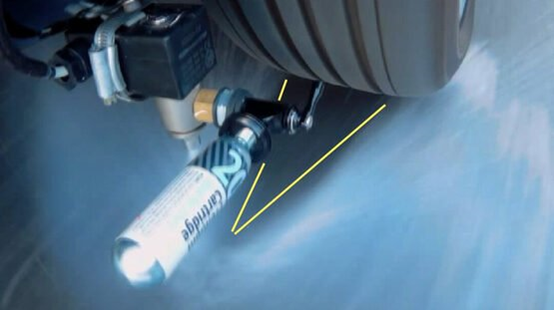
The Run Dry Traction System (RDTS) works by firing a jet of compressed gas close to the front of the wheel, removing surface water in front of the tyre to ensure the vehicle has a dry patch of road ahead, to ensure grip is not compromised by road contaminants such as water, sand and gravel.

The device has been developed by Professor Mike Blundell and Ravi Ranjan from Coventry University’s Research Centre for Future Transport and Cities, following a two-year research project.

Professor Mike Blundell, professor of vehicle dynamics and impact at Coventry University, said: “Our tests demonstrate that RDTS has the potential to make a huge impact on vehicle safety in a whole host of conditions.

“The prospect of producing something that could even save lives on the road is extremely exciting and after some initial success with testing, we’re now eager to look into manufacturing potential and further research to take this concept to the next level.

“A device like this really could be the difference between life and death if it can help vehicles to stop safely within certain distances and that’s why we’re so keen to continue developing this concept.”

The prototype product aims to prevent aquaplaning and loss of traction in a variety of road conditions.

Aquaplaning, also referred to as hydroplaning, happens when a layer of surface water builds up between a vehicle’s tyres and the road surface, leading to a complete loss of grip.

This can occur with as little as 2-3mm of standing water on the road surface when vehicles are travelling at a variety of speeds and is a leading cause of road traffic accidents. By Graham Hill thanks to Fleet News

Share My Blogs With Others: These icons link to social bookmarking sites where readers can share and discover new web pages.
  • MisterWong
  • Y!GG
  • Webnews
  • Digg
  • del.icio.us
  • StumbleUpon
  • Reddit
  • Alltagz
  • Ask
  • Bloglines
  • Facebook
  • YahooMyWeb
  • Google Bookmarks
  • LinkedIn
  • MySpace
  • TwitThis
  • Squidoo
  • MyShare
  • YahooBuzz
  • De.lirio.us
  • Wikio UK
  • Print
  • Socializer
  • blogmarks

RAC Warns Of Fuel Crisis Before The End Of The Year

Thursday, 21. October 2021

The average price of a litre of petrol and diesel rose in September to make a tank £12 more expensive than a year ago, according to new RAC Fuel Watch data.

Unleaded increased by 1.5p to 136.83p while diesel rose by 2.5p to 139.25p, making the price of petrol 22p a litre more expensive than a year ago (114.61p 30 September 2020) and diesel 21p dearer (118.10p).

RAC said both fuels are at prices last seen eight years ago in autumn 2013, with petrol only being 5.65p off the all-time high of 142.48p and diesel 8.68p off the record of 147.93p.

The rise at the pumps has not been driven by the fuel delivery crisis but by a 10.65% increase in the price of oil from $71.29 to $78.88 throughout September, said the RAC.

Simon Williams, fuel spokesman at the RAC, said: “Not only are motorists struggling to put fuel in their vehicles, but they are also having to pay through the nose for it as the rising cost of a barrel of oil is causing further pain at the pumps.

“As life moves ever closer to normal as the world gets to grips with Covid-19, demand for oil is outpacing supply, and with producer group OPEC+ deciding on Monday not to release more oil, the barrel price has now broken through the $80-mark for the first time in more than three years.

“This looks likely to spell further misery for drivers at the pumps as we head towards Christmas, especially as some analysts are predicting the price could even hit $90 before the end of the year.

“If this were to happen, we could see the average price of unleaded hit a new record of around 143p per litre. Diesel would shoot up to 145p which is only 3p off the record high of 147.93 in April 2021.”

According to the RAC, for those who have filled up a 55-litre family car with petrol at the end of September, they would have paid £75.26 – up 85p in September and £12.22 on 12 months ago.

A full tank of diesel is now £76.59 – up £1.40 in September and £11.63 more than a year ago, the data found.

The RAC said prices at four major supermarkets were 4p a litre cheaper than the UK average while at motorway services they were 15p more expensive for petrol at 151.55p and 156.35p for diesel.

Asda sold the cheapest unleaded at 132p while Sainsbury’s offered the lowest price diesel at 134.28p.

Williams added: “Drivers have had to endure the average price of petrol going up for 10 out of the last 12 months and now, because of the supply crisis, many have had great difficulty getting hold of it just so they can go about their daily lives.

“While we’ve heard of some smaller retailers taking advantage of the situation by charging very high prices for their fuel, these cases appear to be few and far between, with most retailers acting responsibly.

“As forecourts’ fuel stocks return to normal drivers will inevitably switch from worrying about whether they can get the petrol or diesel they need to just how much a fill-up is costing them.

Regional pump prices

Unleaded01/09/202130/09/2021Change
UK average135.29136.831.54
East135.88137.031.15
East Midlands134.90136.491.59
London136.21137.911.70
North East133.70135.792.09
North West134.87137.042.17
Northern Ireland132.02133.561.54
Scotland135.22135.990.77
South East136.09137.981.89
South West135.71137.271.56
Wales134.67136.011.34
West Midlands135.18136.491.31
Yorkshire and The Humber134.28136.292.01
Diesel01/09/202130/09/2021Change
UK average136.71139.252.54
East137.38139.582.20
East Midlands136.27138.652.38
London137.46139.952.49
North East135.44138.102.66
North West136.38138.972.59
Northern Ireland132.78135.462.68
Scotland136.50138.892.39
South East137.77140.342.57
South West137.28139.692.41
Wales136.37138.922.55
West Midlands136.83139.202.37
Yorkshire and The Humber136.09139.032.94

By Graham Hill thanks to RAC & Fleet News

Share My Blogs With Others: These icons link to social bookmarking sites where readers can share and discover new web pages.
  • MisterWong
  • Y!GG
  • Webnews
  • Digg
  • del.icio.us
  • StumbleUpon
  • Reddit
  • Alltagz
  • Ask
  • Bloglines
  • Facebook
  • YahooMyWeb
  • Google Bookmarks
  • LinkedIn
  • MySpace
  • TwitThis
  • Squidoo
  • MyShare
  • YahooBuzz
  • De.lirio.us
  • Wikio UK
  • Print
  • Socializer
  • blogmarks

Dreadful New Car Registrations For September

Thursday, 21. October 2021

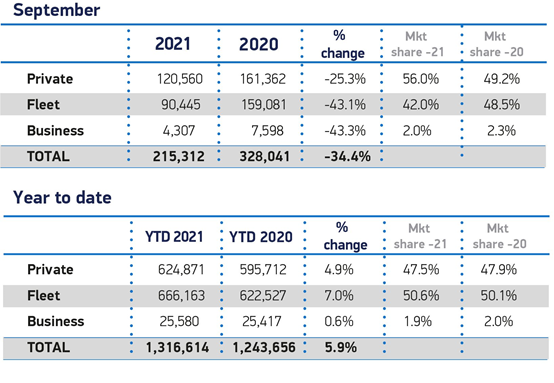
The semiconductor shortage is being blamed for poor fleet and business new car registrations, with the company car market recording a 43.4% year-on-year fall, new figures suggest.

Last month, 94,752 new cars were registered to fleet and business, compared to 166,679 units registered in September 2020, according to new data from the Society of Motor Manufacturers and Traders (SMMT).

Year-to-date, however, new company car sales are almost 7% up on where they were this time last year, with 691,743 fleet and business registrations compared to 647,944 during the first nine months of 2020. 

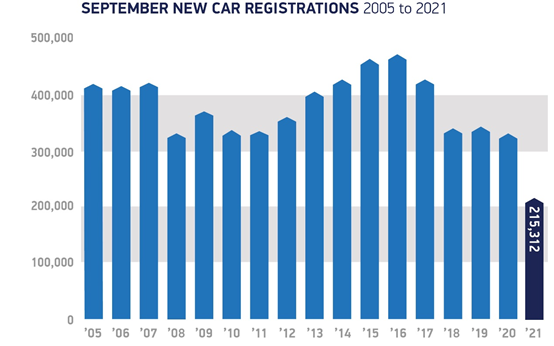
Fleet and business accounted for 44% of overall new car sales during the month. Overall, 215,312 new cars were registered in September, some 34% down on September 2020’s figures.

It was the weakest UK new car market figures for September recorded since 1998 ahead of the introduction of the two-plate system in 1999.

September is typically the second busiest month of the year for the industry, but with the ongoing shortage of semiconductors impacting vehicle availability, the 2021 performance was also down 44.7% on the pre-pandemic 10-year average, SMMT figures suggest.

SMMT chief executive, Mike Hawes, said: “This is a desperately disappointing September and further evidence of the ongoing impact of the Covid pandemic on the sector.

“Despite strong demand for new vehicles over the summer, three successive months have been hit by stalled supply due to reduced semiconductor availability, especially from Asia.”

New electric vehicle uptake

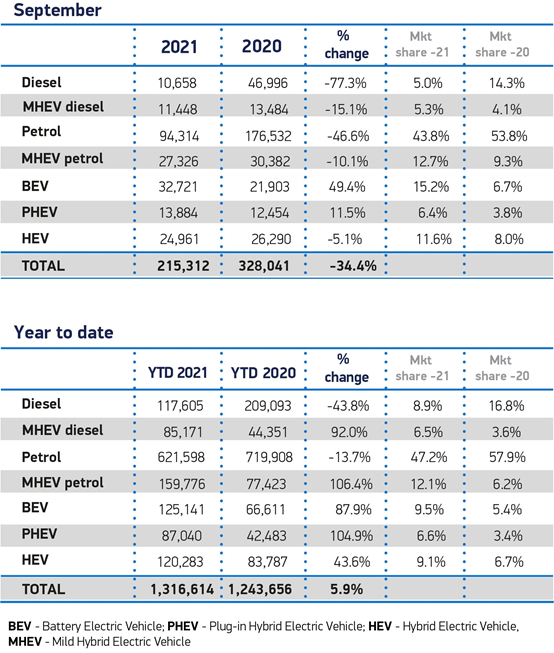
September was the best month ever for new battery electric vehicle (BEV) uptake. With a market share of 15.2%, 32,721 BEVs were registered in the month.

In fact, the September performance was only around 5,000 vehilces shy of the total number registered during the whole of 2019.

Plug-in hybrid (PHEV) share also grew to 6.4%, meaning more than one in five new cars registered in September was zero-emission capable.

Meanwhile, hybrid electric vehicles (HEVs) grew their overall market share from 8% in 2020 to 11.6%, with 24,961 registered in the month.

Hawes said that despite supply challenges, the “rocketing uptake” of plug-in vehicles, especially battery electric cars, demonstrates the increasing demand for these new technologies.

Jamie Hamilton, automotive director and head of electric vehicles at Deloitte, said: “With battery electric vehicles outpacing even plug-in hybrid this month, this demonstrates a level of consumer confidence that the charging infrastructure will be in place.

“However, gaps still remain and a more equitable rollout of public charging points would ensure EVs are also accessible to those households without off-street parking.

“Petrol and diesel shortages may have also inadvertently created some charge anxiety, so ensuring more visible charging points will only strengthen public confidence in EV feasibility.”

Meryem Brassington, electrification propositions lead at Lex Autolease, added: “The recent fuel shortage will only have further heightened awareness of the importance of transitioning to an electric future. As EVs continue to rise in popularity, industry must work collaboratively to ensure there isn’t a tipping point of demand outstripping supply.”

Vehicle supply impact to last into 2023

All drivers whether fleet or consumer face delays of more than one year for certain new car and van models, while others are being delivered with missing features, as the global semiconductor shortage worsens.

And some automotive industry executives do not see the problem ending any time soon.

One is predicting the disruption could last until 2023. Speaking at the IAA Munich auto show last month (September 7-12), Daimler CEO Ola Kallenius said soaring demand for semiconductors means the auto industry could struggle to source enough of them throughout next year and into 2023, though the shortage should be less severe by then.

The carmaker has cut its annual sales forecast for its car division, projecting deliveries will be roughly in line with 2020, rather than up significantly.

Critics are predicting the crisis will have a greater impact on automotive than the coronavirus pandemic. Almost 95% of fleets responding to a Fleet News poll said they were experiencing vehicle delays.

Fleets are being urged to sit tight and continue to place orders for new vehicles, while also being warned that existing models may have to remain on the road for in excess of an extra 12 months.

Matthew Walters, head of consultancy services at LeasePlan, said: “The impact on fleet is pretty severe.

“Last year, we saw a number of formal extensions for companies during the worst of Covid-19 where vehicles couldn’t be delivered and where vehicles couldn’t be collected. These vehicles needed to be extended outside their primary contract term.

“Now we’re in a situation moving into next year where, as an industry, we are likely to see an extension programme again.

“I think it’s a similar period of activity with our customers now, to help them understand what it means for their current order bank, when their orders will be delivered and what that means for their replacement cycles.

“The customer still needs to place orders for vehicles to get themselves in the queue and we are working with them and being open and frank as to when those vehicles are going to be delivered.”

By Graham Hill thanks to Fleet News

Share My Blogs With Others: These icons link to social bookmarking sites where readers can share and discover new web pages.
  • MisterWong
  • Y!GG
  • Webnews
  • Digg
  • del.icio.us
  • StumbleUpon
  • Reddit
  • Alltagz
  • Ask
  • Bloglines
  • Facebook
  • YahooMyWeb
  • Google Bookmarks
  • LinkedIn
  • MySpace
  • TwitThis
  • Squidoo
  • MyShare
  • YahooBuzz
  • De.lirio.us
  • Wikio UK
  • Print
  • Socializer
  • blogmarks

New Unique Marker Halves The Theft Of Catalytic Converters

Friday, 15. October 2021

Police are appealing to fleet workshops, garages and MOT test centres to support a new initiative targeting the theft of catalytic converters and other components.

The SmartWater Group, which is spearheading the new, policebacked scheme, wants them to become accredited registration hubs, after the unique identifier proved to be a deterrent.

In a recent SmartWater trial with the National Infrastructure Crime Reduction Partnership (NICRP) and the British Transport Police (BTP), thefts of catalytic converters more than halved.

Thefts peaked in March, when 3,245 catalytic converters were stolen, but they have been declining since, with 1,378 recorded in July – a 57% fall. Key to that decrease was a joint operation codenamed Goldiron, which recovered more than 1,000 stolen catalytic converters in April.

The operation, which was coordinated by the British Transport Police (BTP) and involved experts from SmartWater’s intelligence unit, the Centre for Infrastructure and Asset Protection (CIAP), also resulted in more than 50 arrests.

Over a five-day period, officers and partner agencies visited 926 sites, stopped 664 vehicles, recovered 1,037 stolen catalytic converters and 297 items of stolen property and identified 244 offences.

Rachael Oakley, director at CIAP, says SmartWater is a “highly-proven deterrent to criminals and rogue scrap metal dealers as it makes stolen parts too hot to handle”.

The heat-resistant solution, which is invisible to the naked eye but glows yellow under UV light, leaves a long lasting and unique identifier.

Oakley explained: “The combination of the materials that is put into the solution makes each individual vial unique.

“The registration of this bottle is what’s key. Every item marked with SmartWater is registered on our database.”

NATIONAL SMARTWATER DATABASE

It can be applied by brush in 10 minutes and only a fragment of SmartWater is required to link it to a specific vehicle on the ‘National Asset Database’, which is operated by CIAP on behalf of the police.

NICRP lead and BTP Superintendent, Mark Cleland, said: “Thanks to the support of the Home Office in creating the NICRP, our joint working with SmartWater and other industry partners, and the drive by enforcement partners across the UK, we have made a real impact in tackling metal and catalytic converter crime.

“While arrests continue to be made, it is the preventative approach through the forensic marking of catalytic converters that gives motorists the opportunity to protect their property and stop the crime in the first place.”

Catalytic converters have been targeted because they contain a honeycomb coated with precious metals such as platinum, palladium and rhodium which help to filter harmful gases from the vehicles’ exhaust systems.

The RAC says that when the global value of these metals increases it usually leads to a spike in thefts. Prices of rhodium hit a record high earlier this year, up more than 200% since March 2020.

In an effort to deter criminals from targeting Toyota’s cars, the carmaker joined forces with police and SmartWater earlier this year to covertly mark the catalytic converters on more than 100,000 cars.

The initiative is costing Toyota more than £1 million and will be provided to existing owners for free.

Oakley, who met the Society of Motor Manufacturers and Traders (SMMT) with the British Transport Police to discuss the initiative, believes other manufacturers are watching with interest.

OTHER SMARTWATER APPLICATIONS

She also told Fleet News that, while catalytic converters were a focus, the forensic marking could be applied to other high-value vehicle components, which could be targeted by criminal gangs.

She explained: “We can basically react to where there might be a crime spike or a trend and if fleets are asking us to help with solutions, we can look at what we can do to make sure SmartWater can assist with that.

“Criminals will move quickly; the prices of precious metals will start to come down and they’ll move on to something else.

“What we’re seeing is that’s likely to be something like hybrid batteries or electric vehicle cables.

“We’d like to get ahead of the game by putting in the preventive measures to stop these crimes becoming the issue that catalytic converter crime has become.”  By Graham Hill thanks to Fleet News

Share My Blogs With Others: These icons link to social bookmarking sites where readers can share and discover new web pages.
  • MisterWong
  • Y!GG
  • Webnews
  • Digg
  • del.icio.us
  • StumbleUpon
  • Reddit
  • Alltagz
  • Ask
  • Bloglines
  • Facebook
  • YahooMyWeb
  • Google Bookmarks
  • LinkedIn
  • MySpace
  • TwitThis
  • Squidoo
  • MyShare
  • YahooBuzz
  • De.lirio.us
  • Wikio UK
  • Print
  • Socializer
  • blogmarks

HGV Learner Driver Training And Testing Changes Frightens The Experts!

Friday, 15. October 2021

Fleet News at 10 panellists criticised the Government’s attempts to ease the shortage of HGV drivers by proposing drivers only take one test for both rigid and artics, instead of two separate tests, plus removing the reverse exercise element from the test.

Matt Hammond, head of fleet at M Group Services, said: “It’s ridiculous. You need to work up to an artic – it’s an incredibly skilled job and you learn your trade as you go through from 7.5-tonne to rigid to artic.”

He added: “The problem isn’t drivers getting through the test – this isn’t a new problem. It’s come because nobody wants to drive an HGV. It’s not a shortage of drivers; it’s a shortage of drivers who want to drive an HGV. We need to review the whole industry and how we treat these guys.”

Lorna McAtear, National Grid fleet manager, described the proposals as “bonkers”.

“I’m hoping the changes don’t come in. It’s a sticking plaster, a reaction not a response. There is no respect for what is an incredibly skilled job,” she said.

“It’s hard to recruit young people and females when you have shoddy facilities out on the road. We expect people to work overnight unsavoury hours, not get as much money for it – there’s just no respect. We have to make this industry attractive again.”

Viewer Renny Thomson, a former LGV driver and instructor and now a health and safety adviser, agreed that the underlying root cause of the shortage is “the way that drivers are treated – by the general public and motorists, by the distribution centres where they deliver, by the Government for not having a policy to encourage truck stops and by motorway services not being fully open overnight to provide welfare facilities”.

However, he added that the proposal was to move assessment of reversing and coupling/uncoupling out of the DVSA Testing procedure so that it was carried out by 3rd party training providers. They would, he insisted, still be tested/assessed on their ability to reverse.

Hammond responded: “For me, the concern is it’s fast tracking the whole process and the experience the driver will get from working through the system. It takes years to get the experience; they are looking to short-cut a system that shouldn’t be short-cut.”

Meanwhile, viewer Graham Telfer, fleet manager at Gateshead Council, had concerned over the skills and knowledge of some trainers, pointing out: “Unlike car driving trainers who are on Government Register, HGV trainers are not required to register or have a qualification.” By Graham Hill thanks to Fleet News.

Share My Blogs With Others: These icons link to social bookmarking sites where readers can share and discover new web pages.
  • MisterWong
  • Y!GG
  • Webnews
  • Digg
  • del.icio.us
  • StumbleUpon
  • Reddit
  • Alltagz
  • Ask
  • Bloglines
  • Facebook
  • YahooMyWeb
  • Google Bookmarks
  • LinkedIn
  • MySpace
  • TwitThis
  • Squidoo
  • MyShare
  • YahooBuzz
  • De.lirio.us
  • Wikio UK
  • Print
  • Socializer
  • blogmarks