Latest Car Registrations Show A Drop With Calls For More Incentives To Go EV

Thursday, 5. March 2020

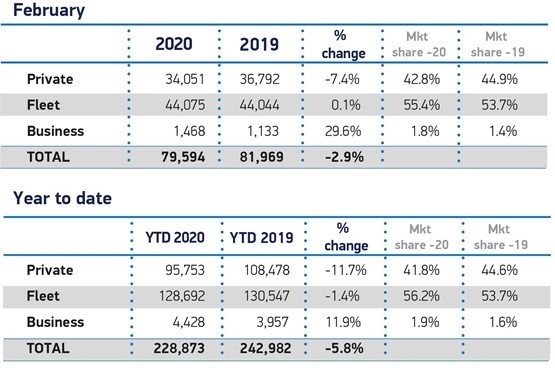
Fleet and business new car registrations fell slightly in February, when compared to the same month last year, according to data published today by the Society of Motor Manufacturers and Traders (SMMT).


There were 45,543 new cars registered to fleet and business in the month, an increase of about 1% on February 2019.


Year-to-date fleet and business new car registrations stand at 133,120 units, a 1% decline when compared to last year.


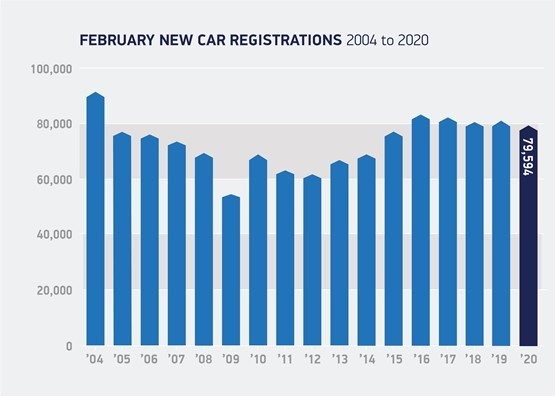
Overall, the UK new car market declined 2.9% in February, with 79,594 models were registered in the month. Registrations by private buyers were responsible for the bulk of the overall loss, down some 7.4% as 2,741 fewer people took delivery of new cars.


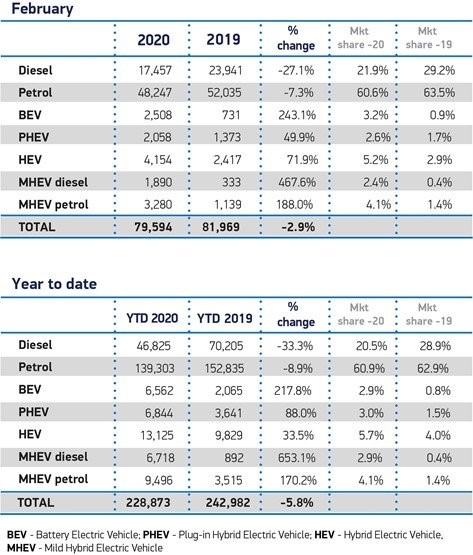
Demand for both diesel and petrol cars fell in the month, with registrations down 27.1% and 7.3% respectively, with diesel now accounting for just over a fifth of sales (21.9%).


Hybrids (HEVs) recorded an uplift of 71.9% to 4,154 units, while registrations of zero emission capable cars also continued to enjoy growth, with battery electric vehicles (BEVs) rising more than three-fold to 2,508 units and plug-in hybrids (PHEVs) up 49.9% to 2,058.


However, these vehicles still make up just 5.8% of the market; and BEVs only 3.2%, showing the scale of the challenge ahead.


The news comes as SMMT calls on the Chancellor to use next week’s Budget to announce bold new measures to make new-tech zero emission-capable cars, including plug-in hybrids, more affordable for mass market buyers.


In 2020, manufacturers will bring more than 23 new battery electric and 10 plug-in hybrid electric cars to the UK to add to the more than 65 already on sale, but take up of these new models depends on affordability and the provision of adequate charging infrastructure.


SMMT is calling for the removal of VAT from all new battery electric, plug-in hybrid electric and hydrogen fuel cell electric cars – a move which would cut the purchase price of an average family battery electric run-around by some £5,600.


Combined with additional measures, including the long term continuation of the critical plug-in car grant at current levels and its reintroduction for plug-in hybrids; and exemption from VED and insurance premium tax, the upfront cost of these vehicles could be cut by as much as £10,000, helping to deliver greater cost parity with conventionally powered vehicles and making them a viable option for many more buyers, it says.


Based on current market forecasts, SMMT calculations show that the removal of VAT could increase sales of battery electric cars alone to just under one million between now and 2024, resulting in an additional CO2 saving of 1.2 million tonnes over this period.


However, this must be part of a comprehensive package of incentives implemented alongside substantial investment in charging infrastructure to ensure a sustainable transition for consumers and businesses of all incomes, regions and lifestyles, it says.


Only by addressing both these issues can the government’s accelerated ambitions for zero emission vehicle sales be met.


Mike Hawes, SMMT chief executive, said: “Another month of decline for the new car market is especially concerning at a time when fleet renewal is so important in the fight against climate change.


“Next week’s Budget is the Chancellor’s opportunity to reverse this trend by restoring confidence to the market and showing that government is serious about delivering on its environmental ambitions.


“Industry has invested in the technology, with a huge influx of new zero- and ultra-low emission models coming to market in 2020, and we now need Government to match this with a comprehensive package of incentives and infrastructure spending to accelerate demand.


“To drive the transition to zero emission motoring, we need carrots, not sticks – as the evidence shows, talk of bans and penalties only means people hang on to their older, more polluting vehicles for longer.


“It’s time for a change of approach, which means encouraging the consumer to invest in the cleanest new car that best suits their needs.


“If that is to be electric, Government must take bold action to make these vehicles more affordable and as convenient to recharge as their petrol and diesel equivalents are to refuel.”


Michael Woodward, UK automotive lead, Deloitte, believes the key to maintaining growth of EVs will be investment in the supporting infrastructure.


“Where consumers were once deterred by battery range anxiety, this has now shifted to charging anxiety with access to charging now being seen as the biggest barrier to buying a full EV for UK customers,” he said.


“Manufacturers are doing their part by bringing new models to the market and adding range to batteries. What consumers need now is clarity on joined-up, long-term infrastructure development and continued financial incentives could be key to future EV growth.”


Jon Lawes, managing director at Hitachi Capital Vehicle Solutions, concluded: “The industry will be eagerly anticipating the Government’s Spring Budget next week, where further measures to support the transition to zero-emission vehicles are expected to be announced.


“As SMMT calculations have shown, the removal of VAT on electric and hybrid vehicles is one step that could support this transition, however, for any solution to be effective, clarity on considerations including Clean Air Zones, infrastructure investment and plug-in car grant incentives will also be pivotal to help achieve the UK’s zero emission targets.”


By Graham Hill thanks to Fleet News

Share My Blogs With Others: These icons link to social bookmarking sites where readers can share and discover new web pages.
  • MisterWong
  • Y!GG
  • Webnews
  • Digg
  • del.icio.us
  • StumbleUpon
  • Reddit
  • Alltagz
  • Ask
  • Bloglines
  • Facebook
  • YahooMyWeb
  • Google Bookmarks
  • LinkedIn
  • MySpace
  • TwitThis
  • Squidoo
  • MyShare
  • YahooBuzz
  • De.lirio.us
  • Wikio UK
  • Print
  • Socializer
  • blogmarks

Safety Body Warns Of Dangers If Cars Are Not Properly Serviced And Maintained

Thursday, 5. March 2020

Whilst the report was aimed at business users it also applies to consumers so worth reading what Brake, the safety body has to say.


Failure to comply with basic vehicle standards can result in tragic consequences, according to the latest report released by Brake’s Global Fleet Champions.


‘Vehicle maintenance and mechanics’ outlines the consequences of not complying with vehicle standards and explains how to improve maintenance and checking procedures to ensure vehicles remain a valuable resource.


The report outlines that regular checking and servicing of safety-critical components such as brakes and tyres can fix small problems early on, removing the need for costly repairs and expensive insurance claims.


John Eastman from the Institute of Road Transport Engineers believes that fleet managers should take a systematic approach towards the maintenance of vehicles. He said that preventative maintenance has several benefits, not least the improved safety, reliability and wellbeing of people who drive for work and other road users.


The report also features advice from Autoglass, who advises fleet managers on how to effectively maintain advanced driver-assistance systems (ADAS) to ensure the technology works effectively.


Jeremy Rochfort, national sales manager for Autoglass said: “The adoption rate of ADAS in fleet vehicles is much higher as fleet cars tend to be newer and come with up-to-date safety features. However, our research shows that keeping up to date with technology ranks low down on fleet decision-maker’s priorities.


“That’s why we’re committed to educating the fleet industry on the importance of ADAS calibration and investing in our technical expertise and capabilities to ensure we can match the rising demand for these services.”


The report follows the recent release of the road safety report launched by Brake.


Global Fleet Champions is a not-for-profit global campaign to prevent crashes and reduce pollution caused by vehicles used for work purposes. ByGraham Hill thanks to Fleet News

Share My Blogs With Others: These icons link to social bookmarking sites where readers can share and discover new web pages.
  • MisterWong
  • Y!GG
  • Webnews
  • Digg
  • del.icio.us
  • StumbleUpon
  • Reddit
  • Alltagz
  • Ask
  • Bloglines
  • Facebook
  • YahooMyWeb
  • Google Bookmarks
  • LinkedIn
  • MySpace
  • TwitThis
  • Squidoo
  • MyShare
  • YahooBuzz
  • De.lirio.us
  • Wikio UK
  • Print
  • Socializer
  • blogmarks

Frightening Increases in CO2 Emissions Following WLTP Findings Will Cause Changes To Car Choices.

Thursday, 27. February 2020

I mentioned last week that as of the 1st April 2020 the new WLTP emissions ratings come into force. This will affect drivers’ benefit in kind tax if you drive a company car but it could also affect the 1st year road fund licence costs which could also increase the rental costs as this is part of the ‘on the road’ cost of the car. So if you’ve been quoted on a car that will be delivered after 1st April you could be paying a little more per month.


Some company cars could disappear from choice lists as new emissions test results put them beyond CO2 thresholds used by fleets.


Data published by manufacturers show some vehicles that were below 130g/km or 110g/km, using the NEDC-correlated CO2 figure, now fall outside those key benchmarks, thanks to the tougher testing regime.


The new CO2 values, derived from the Worldwide harmonised Light vehicle Test Procedure (WLTP), will be used for tax purposes for all new cars registered from April.


However, as manufacturers begin to publish the data, fleets are finding that the new test has seen CO2 values for some cars increase.


For example, the BMW 520d M Sport originally had a NEDC-correlated CO2 figure of 108g/km, but under WLTP it has risen to 131g/km.


It’s a similar story for the Volvo XC40 D3 R Design, which will increase from 127g/km to 144g/km, and the Volkswagen Tiguan 2.0 TDI SE L, which will rise from 122g/km to 156g/km.


“We’re seeing a lot of vehicles breaching the 110g/km and even the 130g/km cap,” said David Bushnell, principal consultant at Alphabet GB.


It means some familiar models on today’s choice lists will have to be replaced by more tax-efficient, hybrid or fully electric versions.


Bushnell says the impact of WLTP on fleets will be comparable to the “re-set” of company car policies in 2002, when taxation moved from mileage to CO2.


Emissions caps for vehicles used by some fleets have followed the downward trajectory of the threshold for capital allowances and lease rental restrictions.


The main threshold for capital allowances and lease rental restrictions was reduced from 130g/km to 110g/km in 2018, after originally being cut from 160g/km in 2013.


Under capital allowance rules, cars bought by companies that emit up to 50g/km are eligible for 100% write-down in the first year; for those emitting 51-110g/km, it’s 18% a year; and for more than 110g/km it is 6% a year.


Under the lease rental restriction, new cars with emissions of 110g/km or less are eligible for 100% of their lease payments to be offset against corporation tax. For those with emissions of 111g/km or more, only 85% is claimable.


The Government refused to consider the impact of WLTP on capital allowances and the lease rental restriction when last year it launched a consultation on what it should do to mitigate its effect on company car tax and vehicle excise duty (VED).


Bushnell called for their inclusion at the time but says Treasury “weren’t prepared to talk about the (110g/km) derogation and now we’re seeing a lot of vehicles impacted”.


Fleets have used the CO2 thresholds to benchmark their emissions cap to ensure they are as tax efficient as possible.


Nick Hardy, sales and marketing director at Ogilvie Fleet, says 130g/km became the norm for many companies, with an increasing number choosing the lower 110g/km cap.


Faced with some cars potentially falling outside company car policies, because of an increase in CO2, he urged fleets not to be tempted to increase their cap to simply maintain vehicle choice.


He explained: “It’s not the right thing to do; it completely defeats what we’re all trying to achieve.”


However, in the short term, while WLTP CO2 data is still missing on many models (see page 4), Bushnell thinks fleets could consider a temporary removal of CO2 caps.


He said: “It’s not exactly palatable, but the issue is we could be delivering a car that we perceive is below the cap, but then by the time it’s configured and registered, it’s actually over the cap.”


Not only are large swathes of CO2 data missing for base models, but the impact of vehicle options on the final figure is also an issue for fleets.


Bushnell urged fleet operators to allow wholelife costs to guide vehicle choice.


Wholelife costs take account of several factors, including fuel, employer Class 1A National Insurance Contributions, service, maintenance and repair, and insurance, as well as any cash allowances paid to employees.


Bushnell said: “You’ve got to be looking at your choice list on a wholelife cost basis, but there are still a lot of businesses that don’t.”


PricewaterhouseCoopers (PwC) has previously reported that just 32% of employers offering company cars use wholelife costs to determine the vehicles available.

Share My Blogs With Others: These icons link to social bookmarking sites where readers can share and discover new web pages.
  • MisterWong
  • Y!GG
  • Webnews
  • Digg
  • del.icio.us
  • StumbleUpon
  • Reddit
  • Alltagz
  • Ask
  • Bloglines
  • Facebook
  • YahooMyWeb
  • Google Bookmarks
  • LinkedIn
  • MySpace
  • TwitThis
  • Squidoo
  • MyShare
  • YahooBuzz
  • De.lirio.us
  • Wikio UK
  • Print
  • Socializer
  • blogmarks

WLTP Emissions Figures Still Not Totally Available Causing Confusion

Friday, 21. February 2020

The latest emission figures are measured by attaching equipment to cars and physically driving cars on public roads to simulate real-world driving conditions. This is fine for standard cars but the manufacturers should also assess the emissions when fitted with options and extras.


For example if a car has bigger wheels fitted the emissions can increase. But without that information drivers could be exposed to higher Benefit In Kind tax and Road Tax could increase.


Businesses should therefore consider reviewing their fleet policies due to a lack of WLTP CO2 data for some cars, says the British Vehicle Rental and Leasing Association.


The WLTP CO2 value, derived from the new emissions test, will be used for tax purposes from April, but a shortage of reliable data threatens to disrupt the move to a new VED and company car tax regime, it says.


VED and company car tax for newly registered vehicles will use CO2 figures based on the more accurate WLTP standard from April 1 and 6 respectively.


However, many vehicle manufacturers are struggling to provide WLTP data for their cars, with the result that BVRLA members currently only have accurate CO2, electric mileage range or RDE2 compliance (latest NOx emissions standard) information for around 80% of base (pre-option) models.


With average lead times for cars at around 9-12 weeks from ordering, this data gap is hindering the leasing sector’s ability to provide accurate quotes on many different vehicles and their various configurations and options.


“The introduction of WLTP-based motoring taxes is adding yet another layer of complexity and confusion to a fleet sector that is already having to cope with a deluge of new automotive technology and local authority air quality measures,” said BVRLA chief executive, Gerry Keaney.


“The BVRLA and its members are working with OEMs and third-party data providers to bridge this gap, but in the meantime, we would recommend customers consult with their lease providers to assess the impact on their fleet policies and procurement.”


WLTP CO2 data is available for the entire BMW range at www.bmw.co.uk. Rob East, general manager of Corporate Sales at BMW UK, said: “With the BIK tax liability a key consideration for many company car drivers when choosing a new vehicle, it’s imperative that we provide our customers with this information.


“This transparency allows them quickly to make an informed decision as to whether their favoured BMW works for them from a tax point of view. Without WLTP details, they simply have no way of knowing.”


He added: “Ensuring the easy availability of these details underlines our drive to make it as straightforward as possible for business customers to purchase a new BMW.


“It also reflects the increased level of interest that there is in our key corporate models such as the new 1 Series and new 3 Series.”


The BVRLA has contacted the SMMT, which represents vehicle manufacturers, to offer its support in addressing the WLTP data shortage. It is also working with HMRC on its forthcoming WLTP communications plan. By Graham Hill thanks to Fleet News

Share My Blogs With Others: These icons link to social bookmarking sites where readers can share and discover new web pages.
  • MisterWong
  • Y!GG
  • Webnews
  • Digg
  • del.icio.us
  • StumbleUpon
  • Reddit
  • Alltagz
  • Ask
  • Bloglines
  • Facebook
  • YahooMyWeb
  • Google Bookmarks
  • LinkedIn
  • MySpace
  • TwitThis
  • Squidoo
  • MyShare
  • YahooBuzz
  • De.lirio.us
  • Wikio UK
  • Print
  • Socializer
  • blogmarks

Government Electric Car Grant To Be Withdrawn At The End Of March

Friday, 21. February 2020

The future of the plug-in car and van grant is expected to be revealed by the new Chancellor in the Budget in March.


The electric car and van subsidy was cut in 2018 by £1,000 and fleets were told it would no longer apply to hybrid cars with a range of less than 70 zero emission miles.


The Government said the reduction in funding – from £4,500 to £3,500 – for the cleanest cars, and withdrawing the grant completely for the likes of the Mitsubishi Outlander PHEV and the Toyota Prius Plug-in, was a sign of its success.


Talking to delegates at the ICFM’s annual conference last summer, deputy head of the Office for Low Emission Vehicles (OLEV), Phil Killingley, acknowledged that incentives will be of continued importance beyond 2020, but stressed the detail was still being “talked through”.


Meanwhile, the Treasury told the Telegraph that “consumers incentives will continue to play a role beyond 2020”.


A Whitehall source said: “We have always said we would phase out the subsidies gradually, but there are other ways we can help people to go electric.”


BVRLA chief executive, Gerry Keaney, says that the Budget on March 11 will be an opportunity to set the tone for a new decade in which the transition to decarbonised road transport will be won or lost.


“Fleets are being asked to invest billions of pounds in new electric vehicle technology and infrastructure, which comes at a hefty price premium to its petrol and diesel alternatives,” he said.


“To achieve these goals the Government must provide a clear support package through to at least 2025. It must preserve the Plug in Car and Van Grants, maintain a strong set of tax incentives and tackle the huge and often arbitrary costs associated with fleet charging infrastructure.”  By Graham Hill thanks to Fleet News

Share My Blogs With Others: These icons link to social bookmarking sites where readers can share and discover new web pages.
  • MisterWong
  • Y!GG
  • Webnews
  • Digg
  • del.icio.us
  • StumbleUpon
  • Reddit
  • Alltagz
  • Ask
  • Bloglines
  • Facebook
  • YahooMyWeb
  • Google Bookmarks
  • LinkedIn
  • MySpace
  • TwitThis
  • Squidoo
  • MyShare
  • YahooBuzz
  • De.lirio.us
  • Wikio UK
  • Print
  • Socializer
  • blogmarks

Is It Safe To Pay A Deposit When Ordering A Car?

Friday, 21. February 2020

As many of my readers know I have written about this in the past because it can be very confusing. My work with the BBC and various motoring journals has highlighted some of the crooked methods to extract large ‘deposits’ from customers then mis-state the law in order to prevent paying money back when the customer decides not to go ahead with a purchase.


A law firm has given advice to dealers as follows:


It has long been thought that if a consumer decides to pull out of a car purchase having paid a deposit, that the car dealer is automatically entitled to retain that deposit.  However, there are several important considerations that need to be met before that is allowable, the first of which is especially relevant.


  1. The Consumer Rights Act 2015 says that a contract term may be considered unfair (and thus unenforceable) if it is “A term which has the object or effect of permitting the trader to retain sums paid by the consumer where the consumer decides not to conclude or perform the contract, without providing for the consumer to receive compensation of an equivalent amount from the trader where the trader is the party cancelling the contract. We are advising that your terms/conditions, order form and any document that makes reference to a non-refundable deposit, be reworded as below, followed (where possible) by the consumer’s signature:


“By paying a deposit you are entering into a legally binding contract.  If you change your mind and do not pay the balance due, you will be in breach of contract and we will be entitled to retain the deposit in full and not return it to you.  However, if we are in breach of contract and do not agree to sell you the car upon payment of the balance, we will return your deposit in full and you may be entitled to additional compensation from us up to the full value of the deposit amount”.


  1. The amount of deposit is the most you can retain. You cannot retain a deposit and then on top of that seek losses such as prep time or having to re-advertise or re-selling at a lower value.  The whole purpose of a deposit is that it gives certainty as to what can be lost in the event of contractual beach – regardless of whether your actual loss is greater or less than the amount of the deposit.  HOWEVER………


  1. The deposit figure must be proportionate to the value of the vehicle – you cannot simply seek to punish the buyer by making him pay a hugely disproportionate deposit and retaining it if he or she does not pay the balance. The Court of Appeal ruled in 2016 (and gave a new test of what is allowable) and removed the test of “reasonable pre-estimate of loss” and “penalty clauses” and replaced it with this, somewhat wordy conclusion:


“The true test is whether the impugned provision is a secondary obligation which imposes a detriment on the contract-breaker out of all proportion to any legitimate interest of the innocent party in the enforcement of the primary obligation. The innocent party can have no proper interest in simply punishing the defaulter. His interest is in performance or in some appropriate alternative to performance.[Emphasis added].”


  1. Whilst the courts – and only the courts can decide – we think that a deposit that is greater than 10-15% of the value of the car might be seen as difficult to justify except in very rare circumstances. Maybe where something is being built to such an unusual, bespoke and personal specification that the sale to anyone else other than the actual buyer would be compromised substantially or could only be re-sold at a price significantly less than agreed with the intended buyer (who then did not pay the balance after the deposit was made).


  1. Where a deposit is taken in contemplation that the car will be financed by, say a hire-purchase agreement, the deposit must be refunded if the consumer withdraws from the deal BEFORE all three parties sign the finance agreement – as set out by Section 57 of the Consumer Credit Act 1974 (Withdrawal from a Prospective Agreement). This does NOT form an obligation to fund the purchase of the car by some other means.


  1. Where the consumer cancels the credit agreement within 14 days of all parties signing the credit agreement, then there IS an obligation to buy the car by some alternative means BUT we will argue that this obligation is between the consumer and the finance company (not the dealer) as the finance company have bought the car from the dealer, has good title in it and the dealer is not in breach of contract. Again, though, some finance companies may, in their terms and conditions have a clause that states that the dealer has to indemnify them in the event that this happens!


So, anyone who tells you that the law of refunds of deposits is straight-forward, invite them to read the above!


My advice has always been to pay as little deposit as possible if you need to pay a deposit to secure a car. If possible pay with a credit card as this gives you greater rights. Even the suggestion of 10 – 15% is not reasonable in my opinion.


You can also get your deposit back if it was paid towards the finance of the car as shown above. So if you are paying a deposit and intend the money to be used to pay towards the HP or PCP agreement you should make sure that you make that clear to the dealer and have it written on the receipt. But beware that when the contract has been executed (all parties have signed it) you cannot cancel the contract without the risk of being in breach. Don’t sign the contract till the last minute.


If you have a large deposit to pay towards the finance keep it till the last minute. We only provide contract hire and personal contract hire and we take no money whatsoever until you have received your car. The safest way. The initial rental is taken by direct debit after the car has been delivered and signed for.  By Graham Hill


Share My Blogs With Others: These icons link to social bookmarking sites where readers can share and discover new web pages.
  • MisterWong
  • Y!GG
  • Webnews
  • Digg
  • del.icio.us
  • StumbleUpon
  • Reddit
  • Alltagz
  • Ask
  • Bloglines
  • Facebook
  • YahooMyWeb
  • Google Bookmarks
  • LinkedIn
  • MySpace
  • TwitThis
  • Squidoo
  • MyShare
  • YahooBuzz
  • De.lirio.us
  • Wikio UK
  • Print
  • Socializer
  • blogmarks

4 Year Lease Agreements And Your Warranty

Friday, 21. February 2020

There has been an increase of late in extensions and customers taking out 4 year PCP, PCH and contract hire agreements. This is done mainly to save money on the monthly rental but after allowing for the various costs that come into play after 3 years you may find that it’s a false saving.


When I looked to extend the lease on my Mercedes E Class I checked with my local dealer and was quoted nearly £900 for a 1 year extension to the Mercedes warranty. Had I leased my car over 4 years the lease cost would have been just £18 + VAT less per month when compared to the 3 year rate.


Then there are other subscriptions such as the Sat Nav which generally come with free updates for 3 years but you have to pay the subscription thereafter. Roadside assistance is also generally included for a minimum of 3 years with all new cars so there’s another extra to pay for. It all adds up.


On top of that, there is service and maintenance and possibly another pair of tyres. Obviously, as the car gets older it requires more wear and tear parts to ne replaced, brake discs, suspension dampers, filters etc.


So this raises the question as to whether it’s worth taking a car over 4 years given the fact that you will need to take out an extended warranty that could represent around half of the down payment on the next car, which of course comes with a new car warranty.


There are of course cars that come with 5 and even 7 year warranties but on closer inspection, you will find that a large number of components drop off cover after 3 years as a result of normal wear and tear. So things are not always as they seem. You could, of course, Google the market for a lower-priced warranty than the manufacturer’s own. However, whilst they love to take your money there are some that hate paying it back out.


Beware of betterment! As cars get older the warranty companies will try it on. Let’s say in the 4th year you have a problem with the gearbox. The manufacturer or the warranty company agrees to replace it under the warranty but as the car is, say three and a half years old they have a betterment clause in their warranty that says, if the replacement part puts the car in a better condition than it was before the part went faulty that you should contribute to the replacement.


So the replacement gearbox could cost you 2 or even £3,000 towards the cost of the replacement gearbox. It’s a scandal. So if you are going to take out a 4-year contract or extend a 3 year contract, check the true cost of that last year and if you extend the warranty check the betterment clause. Also check out Warranty Direct. They may be a little more expensive than some other 3rd party warranties but the have some of the best terms and conditions and no betterment charges. By Graham Hill

Share My Blogs With Others: These icons link to social bookmarking sites where readers can share and discover new web pages.
  • MisterWong
  • Y!GG
  • Webnews
  • Digg
  • del.icio.us
  • StumbleUpon
  • Reddit
  • Alltagz
  • Ask
  • Bloglines
  • Facebook
  • YahooMyWeb
  • Google Bookmarks
  • LinkedIn
  • MySpace
  • TwitThis
  • Squidoo
  • MyShare
  • YahooBuzz
  • De.lirio.us
  • Wikio UK
  • Print
  • Socializer
  • blogmarks

Ban On The Sale Of Petrol & Diesel Vehicles Brought Forward To 2035

Thursday, 6. February 2020

The ban on the sale of new petrol and diesel cars and vans will be brought forward to 2035 and will now include hybrids.


The Government had previously announced they would end the sale of new fossil fuel vehicles from 2040 but would still allow the sale of hybrid vehicles that had a zero-emission capability.


However, speaking at the Conservative party conference last October, transport secretary Grant Shapps hinted at bringing the date forward.


Launching the next UN climate conference COP26 today (Tuesday February 4), the Prime Minister Boris Johnson will confirm the much tougher, stricter timetable.


Shapps said: “This Government’s £1.5 billion strategy to make owning an electric vehicle as easy as possible is working – last year alone, a fully electric car was sold every 15 minutes.


“We want to go further than ever before. That’s why we are bringing forward our already ambitious target to end the sale of new petrol and diesel cars to tackle climate change and reduce emissions.”


The Government says it will continue to work with all sectors of industry to accelerate the rollout of zero emission vehicles.


But, the Society of Motor Manufacturers and Traders (SMMT), which represents car and van makers in the UK, says the Government has set the new target without a plan showing how it intends to get there.


Mike Hawes, SMMT chief executive, said: “Manufacturers are fully invested in a zero emissions future, with some 60 plug-in models now on the market and 34 more coming in 2020. However, with current demand for this still expensive technology still just a fraction of sales, it’s clear that accelerating an already very challenging ambition will take more than industry investment.


“This is about market transformation, yet we still don’t have clarity on the future of the plug-in car grant – the most significant driver of EV uptake – which ends in just 60 days’ time, while the UK’s charging network is still woefully inadequate.


“If the UK is to lead the global zero emissions agenda, we need a competitive marketplace and a competitive business environment to encourage manufacturers to sell and build here.


“A date without a plan will merely destroy value today. So we therefore need to hear how government plans to fulfil its ambitions in a sustainable way, one that safeguards industry and jobs, allows people from all income groups and regions to adapt and benefit, and, crucially, does not undermine sales of today’s low emission technologies, including popular hybrids, all of which are essential to deliver air quality and climate change goals now.”


Helen Clarkson, CEO of the international non-profit The Climate Group, welcomed the “more ambitious” target from the Government.


However, she said: “We believe that this could still be sooner – and that to be a global leader, especially post-Brexit, a 2030 phase-out commitment is required; without this, we risk being out of step with our international peers.


“Our business campaign for the 100% adoption of electric vehicles by 2030, EV100, has 62 corporate members, many of which are British, including AstraZeneca, BT, Centrica, Foxtons, Mitie, RBS, SSE and Unilever. Businesses are showing what is possible and The Climate Group would love to see this level of ambition matched.”


Through EV100, the UK has the second highest number of corporate fleet vehicles committed to switching to electric, after Germany.


Government policy must be strong and consistent to accelerate this transition, and to help the UK become a world leader on electric vehicles, it says.


So far, eight countries have already committed to more ambitious phase-out dates than the UK, while Scotland has had a 2032 phase-out date for new petrol and diesel vehicles in place since 2017.


The RAC was not surprised by the Government’s plan to bring forward the date to ban the sale of petrol and diesel vehicles.


RAC head of policy Nicholas Lyes said: “A more ambitious target should be the catalyst for faster change, but there are clearly many hurdles to cross.


“Manufacturers face a great challenge in switching their production from conventional powertrains to cleaner electric technology.


“More electric vehicles (EVs) will also require a great deal of investment in charging infrastructure – particularly for those who rely on on-street parking outside their homes.”


Lyes also believes that we should not overlook the role plug-in hybrid vehicles could play in bridging the gap to going completely electric.


“In the meantime we urge the Government to extend the plug-in car grant for at least another three years to help those that want to go electric, but who are put off by the high initial costs,” he said.


“At a local level, authorities should also incentivise their use with cheaper parking rates and lower residents’ parking permit fees.” By Graham Hill thanks to Fleet News

Share My Blogs With Others: These icons link to social bookmarking sites where readers can share and discover new web pages.
  • MisterWong
  • Y!GG
  • Webnews
  • Digg
  • del.icio.us
  • StumbleUpon
  • Reddit
  • Alltagz
  • Ask
  • Bloglines
  • Facebook
  • YahooMyWeb
  • Google Bookmarks
  • LinkedIn
  • MySpace
  • TwitThis
  • Squidoo
  • MyShare
  • YahooBuzz
  • De.lirio.us
  • Wikio UK
  • Print
  • Socializer
  • blogmarks

Contract Hire & PCP Excess Mileage Charges Are Increasing

Thursday, 6. February 2020

According to Fleet News a challenging used car market in 2019 has had a significant negative impact on the optimism of leasing companies for residual values (RVs) in 2020, the Fleet News FN50 survey suggests.


With prices achieved for ex-lease cars falling month-on-month for at least the first nine months of last year, leasing companies have seen disposal profits eroded across the board. For end-user fleets, the past 12 months have proved a wise time to have outsourced RV risk.


In several cases, defleeted cars have failed to achieve the residual value forecast for them back in 2015 and 2016, and the majority of FN50 leasing companies have little faith that the situation will change this year.


More than half (52%) think RVs will fall in 2020, and only 15% forecast a rise.


This outlook is significantly gloomier than forecasts made this time last year for 2019, when 36% predicted residual values would fall, but it is more positive than the 12-month outlooks in both 2016 and 2017, when leasing companies were gripped by a doomsday scenario for the UK’s EU exit.


Brexit continues to blight the automotive sector, with the Society of Motor Manufacturers and Traders (SMMT) attributing the decline in both new and used car sales in 2019 to consumer confidence being “undermined by political and economic uncertainty”. The result is a temporary loss of appetite for big ticket purchases, it says, with vehicle owners holding onto their cars for longer.


Under normal circumstances, a decline in new car sales and a steady rise in new car prices should prompt an uplift in used car sales as buyers switch to secondhand models. But this tipping point in the supply-demand balance of the used car market has failed to materialise.


Cap HPI reports that franchised dealer groups have focused on their new car sales to qualify for quarterly manufacturer bonuses, at the expense of the used cars on their forecourts, and any shortfall in stock from fewer part-exchanges has been more than offset by the availability of used stock returning to the market after the record new cars sales of 2015 and 2016.


The result is FN50 leasing companies anticipating an average decline of 2.2% in RVs over the next 12 months. Among the 52% of leasing companies who predict a decrease, the average drop is 5.6%, a greater reduction than the 4.4% forecast a year earlier.


Even the most optimistic leasing companies are less bullish than previous years, with those forecasting an increase average a rise of 4.9%, compared with 3.6% in 2018 and 3% in 2017.


However, pricing experts are less bearish about the next 12 months.


“Things are not going to be as bad as they appeared over the first half of this year,” said Andrew Mee, Cap HPI head of forecast. “It’s our view that the market correction is pretty much over now.”


The far steeper than normal month-on-month drops in used car values in the second quarter of 2019 have come to an end, adds Mee, who says the “market is now behaving much more normally. Values will not increase, but they are not falling like they did earlier this year”.


Moreover, ‘peak diesel’ may have already occurred, with the sharp falls in the sale of new diesel cars in 2017 and 2018 potentially leading to an undersupply of used vehicles in 2020 and 2021. “And that will be good news,” said Mee.


But uncertainty remains. As one leasing director asked, will the rapidly evaporating demand for new diesel cars, down 20.3% year-on-year in 2019, and 30% lower in 2018 than 2017, be mirrored in the used car market, or will lower supply create a shortage that drives up prices?


Similar uncertainty is starting to bedevil the forecasting of residual values for electric and hybrid company cars. Company car drivers keen to minimise their benefit-in-kind (BIK) tax bills are fuelling double, and even triple digit, growth in the sales of some alternative fuel vehicles, but will this demand be matched in the used car sector where the tax advantages are far more limited?


In the short term at least, Mee sees a windfall heading the way of leasing companies with electric and hybrid cars on their fleets. Electric cars are worth significantly more now than they were a year ago, he says.


“Leasing companies will have been cautious in their RV forecasts, so they are in for a nice surprise, especially for smaller battery electric models like the Nissan Leaf, Renault Zoe and Citroën C-Zero,” said Mee. “Hybrid cars have not been such a strong story, but their values have not fallen in line with petrol and diesel prices because they are around in smaller volumes and are seen as green alternatives to petrol and diesel.”


The critical figures for leasing companies, of course, are not book values, but the differentials between the RV forecasts made at the start of leases and the disposal prices achieved at the end.


Grosvenor Contracts Leasing is one of the few FN50 members with a positive outlook for residual values in 2020, having returned better defleet figures this year than last. The company’s commitment to preparing vehicles to the highest standards prior to auction – “dealers don’t want to be buying work,” said Shaun Barritt, CEO, Grosvenor Group – has underpinned the prices it achieves and maintained high first-time conversion rates.


Above all, the company’s success lies in

envisaging ideal forecourts in three or four years’ time, says Barritt, ensuring a broad mix of cars.


“Problems arise when you are bulk buying and bulk supplying, but seldom do we have very high volumes of one make or model,” he said.


This issue is repeatedly raised by smaller leasing companies, who compare their broad model mix and ability to be nimble when remarketing with the lack of flexibility of the largest FN50 companies that have to remarket scores and even hundreds of similar vehicles into a soft used car market.


In Northern Ireland, Donnelly Fleet sells virtually all of its passenger cars via nine used car centres run by the Donnelly Group dealer network.


“We are not dealing with big scales, so we’re not going to flood our forecourts with 30 or 40 identical vehicles,” said Tony Magee, general manager, Donnelly Fleet.


“The market here is smaller and a sizeable deal could see six-to-15 vehicles coming back, so I can put one into each of our centres. With these volumes we can be more optimistic about RVs.”


Even so, Donnelly Fleet is putting in contingencies across all fuel types, rather than writing residual value forecasts at 100% of Cap Monitor, adopting a position shared by many FN50 firms.


The turbulence in the used car market, which saw book values tumble by about 15% between January and August, last year, has cost leasing companies about £800 per car at disposal.


“You would have to go back 15 years to find drops like that,” said Nick Hardy, sales and marketing director of Ogilvie Fleet.


He adds that after years of relative stability, the leasing industry had become accustomed to relatively low levels of depreciation, making the drop in values such a bombshell last year.


Previously, market falls of the magnitude experienced in the first nine months of 2019 would have seen leasing companies encourage their clients into contract extensions, but such protection appears to have been absent this year.


Figures provided for the FN50 show that the proportion of cars returned late has actually fallen by seven percentage points to 32% in 2019, compared with 2018. Interestingly, the two companies with the most bullish forecasts for 2020 have very few late returned cars.


“Nothing should stop us being optimistic. I am cautiously optimistic that the worst is over. People will still want to change their cars,” said Hardy. By Graham Hill thanks to Fleet News

Share My Blogs With Others: These icons link to social bookmarking sites where readers can share and discover new web pages.
  • MisterWong
  • Y!GG
  • Webnews
  • Digg
  • del.icio.us
  • StumbleUpon
  • Reddit
  • Alltagz
  • Ask
  • Bloglines
  • Facebook
  • YahooMyWeb
  • Google Bookmarks
  • LinkedIn
  • MySpace
  • TwitThis
  • Squidoo
  • MyShare
  • YahooBuzz
  • De.lirio.us
  • Wikio UK
  • Print
  • Socializer
  • blogmarks

UK Drivers Risk Speeding Fines When Overtaking

Friday, 24. January 2020

UK drivers are risking their licences by breaking the speed limit when overtaking, shocking government figures have shown.


According to official stats, in 2017 almost 8,000 vehicles were involved in collisions when overtaking – and over half (55%) of these were cars.


Safety chiefs are now urging motorists to watch their speed when overtaking to avoid putting themselves and other road users at risk – and avoid getting hit with heavy fines or even losing their licence.


The Royal Society for the Prevention of Accidents (RoSPA) is keen to set aside myths that speeding is acceptable when overtaking another vehicle.


“The common-sense message is do not overtake unless you are sure you can complete the manoeuvre safely and without causing risk or inconvenience to another road user,” warns an RoSPA spokesman.


“Although you should complete an overtaking manoeuvre quickly, never exceed the speed limit for the road.”


As rule 125 of the Highway Code states, the speed limit is the absolute maximum you should drive on any particular road. This does not exclude overtaking.


Exceeding the speed limit for any reason is dangerous as well as illegal and could see you hit with penalty points, a hefty fine, or even being banned from the roads entirely.


While overtaking is, of course, legal, there are strict rules about how and when it is safe to overtake – the most fundamental being that you should only overtake ‘when it is safe and legal to do so’.


If you’re caught speeding while overtaking, you could collect a fine up to £2,500 and six points on your licence, depending on your speed and the road you’re caught on.


Should you get 12 penalty points or more in any three-year period, you’ll have your licence revoked. By Graham Hill thanks to the RAC

Share My Blogs With Others: These icons link to social bookmarking sites where readers can share and discover new web pages.
  • MisterWong
  • Y!GG
  • Webnews
  • Digg
  • del.icio.us
  • StumbleUpon
  • Reddit
  • Alltagz
  • Ask
  • Bloglines
  • Facebook
  • YahooMyWeb
  • Google Bookmarks
  • LinkedIn
  • MySpace
  • TwitThis
  • Squidoo
  • MyShare
  • YahooBuzz
  • De.lirio.us
  • Wikio UK
  • Print
  • Socializer
  • blogmarks