CoronaVirus Will Have A Major Effect On Used Car Prices And Lease Rates

Saturday, 11. April 2020

New analysis from used vehicle pricing specialist Indicata has revealed the potential impact Coronavirus will have on the daily rental and leasing sectors.


In its free-to-download White Paper, Indicata looks at the short, medium, and long-term effects of Covid-19 on the European used car industry, particularly rental and leasing companies.


The research includes analysis of nine million used vehicle advertisements across Europe each day. It highlights that Northern Europe saw a sales fall of 21.5% between March 11 and 18, while southern Europe, including Italy saw sales fall by 44% during the same period.


A clear correlation between infection rates and the fall in used car sales between March 11-18 versus the same period in February, was uncovered.


As the virus progresses, Indicata says re-marketers will need to know the country-by-country market trends to identify the most effective sales channels.


Andy Shields (pictured), global business unit director at Indicata, authored the White Paper. He said: “The relationship between the increase in the number of people with Covid-19 and the measures each individual government introduces to fight the pandemic is already having a detrimental impact on European rental and leasing companies.


“Countries will have different challenges at different times and it’s all about equipping companies with the right data to help assist them in making fast decisions.”


He says that rental companies are likely to have contracted their annual volumes with OEMs already and now need to re-assess current contracts.


“In many cases contracts will be defaulted on, such is the loss of demand in the rental industry,” Sheilds explains.


This will leave OEMs with a stock of unregistered, and in some cases registered ready for delivery, new vehicles the rental industry does not want.


In addition, de-fleets will be happening, and rental companies may try and hold risk vehicles until after the initial social distancing. However, when there is significant volatility on demand and differences between country the capacity to absorb stock at any one time becomes more challenging.


According to Sheilds, the challenge for the leasing industry will be to manage the current volatility in the market while respecting the fact that there may be no short-term recovery in residual values.


In 2008/9, many leasing companies extended vehicle contracts. With the risk used vehicle prices will be depressed for an extended period, an immediate run on vehicles may not be ideal. Even so, vehicles will still need to be remarketed over the downturn.


The White Paper also looks at how the last recession played out for both the new and used car markets across Europe and how those same trends may repeat in a world dominated by Covid-19.  By Graham Hill thanks to Fleet News

Share My Blogs With Others: These icons link to social bookmarking sites where readers can share and discover new web pages.
  • MisterWong
  • Y!GG
  • Webnews
  • Digg
  • del.icio.us
  • StumbleUpon
  • Reddit
  • Alltagz
  • Ask
  • Bloglines
  • Facebook
  • YahooMyWeb
  • Google Bookmarks
  • LinkedIn
  • MySpace
  • TwitThis
  • Squidoo
  • MyShare
  • YahooBuzz
  • De.lirio.us
  • Wikio UK
  • Print
  • Socializer
  • blogmarks

New Car Sales Drop Through The Floorboards!

Saturday, 11. April 2020

New car sales across Europe have plummeted, reaching a four-year low for the month of February.


Jato Dynamics revealed in its monthly report on the European region’s 27 car-selling nations that a total of 1,063,264 new vehicles found owners last month, compared to 1,143,852 in February 2019 – a decline of 7% year-on-year and just 11.3% up on 2015’s 955,113 units.


The performance leaves the sector 7.3% down by volume year-to-date, at 2,194,706 units.


Felipe Munoz, global analyst at Jato, said that the situation in Europe’s new car sector was “rapidly deteriorating” – even ahead of March’s escalation of the COVID-19 coronavirus outbreak – due to complex regulation, lack of available homologated cars, and increasing pressure on the economy.


“All of these factors are having a detrimental impact on consumer confidence”, he added.


At the top end of the new vehicle sales rankings, the region’s long-time best-seller, Volkswagen’s Golf, was dethroned by the new Renault Clio.


Jato says this is a result of Renault’s new Clio having been available to the market for a longer period of time than the recently-launched eighth-generation Golf.


Other changes included a shift away from SUVs, with none appearing in the top 10 ranking.


Mid-size cars posted the highest growth among all segments, thanks to strong performances by the BMW 3 Series and the Volkswagen Passat.


The BMW and VW models’ combined registrations made up 31% of the whole midsize segment volume, while sales of the Tesla Model 3 fell by 6%.


According to Jato’s data, alternative fuel vehicles (AFV) were once again delivered growth in February, despite the market’s downward trajectory.


It showed that AFV registrations jumped from 75,400 units in February 2019 to 135,500 units last month.


The increase of over 80% came at the expense of diesel and petrol cars which saw significantly fewer registrations, however.


Munoz said: “So far this year, electrified vehicles have been the only lifeline for manufacturers operating in Europe.


“This is good news, as the industry’s electrification plans have finally seen a positive response from consumers.”


The shift towards AFVs is now starting to place pressure on the previously buoyant SUV market, according to Jato.


Registrations for SUVs fell by 1.7% to 415,300 units last month, taking the year-to-date total to 865,500 units – down 1.4% year-on-year.


The SUV segment still retains the largest overall market share, however.


Jato said that the fall in registrations was due to the compact SUVs, declining by 3.7% in contrast to the strong growth experienced by large SUVs, which saw an increase of 17%.  By Graham Hill thanks to Fleet News

Share My Blogs With Others: These icons link to social bookmarking sites where readers can share and discover new web pages.
  • MisterWong
  • Y!GG
  • Webnews
  • Digg
  • del.icio.us
  • StumbleUpon
  • Reddit
  • Alltagz
  • Ask
  • Bloglines
  • Facebook
  • YahooMyWeb
  • Google Bookmarks
  • LinkedIn
  • MySpace
  • TwitThis
  • Squidoo
  • MyShare
  • YahooBuzz
  • De.lirio.us
  • Wikio UK
  • Print
  • Socializer
  • blogmarks

Large Increase In Cost Of Electric Vehicles.

Friday, 3. April 2020

The cost of electric vehicle (EV) base models has risen by 18% since 2013, according to research from Cap HPI.


However, it says drivers are now enjoying significantly more technology and performance to compensate for the higher investment.


The analysis shows that selected EVs have 48% more battery life, almost two thirds (60%) extended range and a quarter (23%) improvement in higher engine performance.


The research reviewed base versions of the BMW i3, Kia Soul Electric, Nissan Leaf and Renault Zoe. All of the automobiles reviewed fell into a price range of £18,000 to £35,000.


The number of models in this category has jumped 360% since 2012 to now account for 23 models and 132 derivatives.


To accommodate this growing sector and meet market demand, Cap HPI has made significant increases in the data volumes available for battery electric vehicles over the past 12 months.


The company has also added new data fields including battery capacity and fast charging information during a recent major upgrade of EV data.


The increase in data volume and accessibility will empower the automotive industry to provide more accurate vehicle identification and drive accurate valuations, the total cost of ownership figures and a host of other data services, says Cap HPI.


Jon Clay, head of vehicle identification at Cap HPI, explained: “We continue to invest and innovate to ensure the industry has the depth and accuracy of data required to work efficiently.


“Advancements in technology mean the process of harnessing new vehicle data is speeding up and can be used in new ways to drive a digital customer journey.


“The pace of changes continues to accelerate with the number of EV derivatives doubling in the last year.


“As technology advances, Cap HPI will continue to look at new ways to use the data for the benefit of customers across the supply chain.”


The EV data offers a detailed list of fields to cater for several variables within the category. As an example, there are four stages of battery charge speed relating to all the different manufacturer information along with more standard fields.


The new set of fields is available in three formats in total, NVD SQL, NVD CSV (Car Enhanced Technical CSV) and NVD JSON (Car Enhanced Technical) JSON and will receive updates alongside the standard engine types currently available. By Graham Hill thanks to Fleet News.

Share My Blogs With Others: These icons link to social bookmarking sites where readers can share and discover new web pages.
  • MisterWong
  • Y!GG
  • Webnews
  • Digg
  • del.icio.us
  • StumbleUpon
  • Reddit
  • Alltagz
  • Ask
  • Bloglines
  • Facebook
  • YahooMyWeb
  • Google Bookmarks
  • LinkedIn
  • MySpace
  • TwitThis
  • Squidoo
  • MyShare
  • YahooBuzz
  • De.lirio.us
  • Wikio UK
  • Print
  • Socializer
  • blogmarks

Update On Delivery Overcharge & How You Can Claim.

Friday, 3. April 2020

Compensation could be owed to UK business that bought or leased new cars and vans between October 2006 and September 2015, as a result of legal action taken against five shipping firms for price fixing.


MOL, “K” Line, NYK, WWL/EUKOR and CSAV were found to have violated EU competition law by the European Commission on February 21, 2018. The EC held that the shippers had coordinated rates, allocated tenders, coordinated reductions of capacity in the market and exchanged commercially sensitive information to maintain or increase the price of intercontinental shipping of new vehicles.


The companies were fined £343m by the EU and now class representative Mark McLaren has filed a claim against them for overcharging UK consumers and businesses, instructing law firm Scott+Scott UK LLP.


McLaren said: “When UK consumers and businesses purchased or leased a new car, they paid more for the delivery of that car than they should have done, as a result of a long-running cartel by five of the world’s leading maritime shipping companies. I have spent much of my career working in consumer protection and I strongly believe that compensation should be paid when consumers are harmed by such deliberate, unlawful conduct.”


Affected vehicles include those from Ford, Vauxhall, Volkswagen, Peugeot, BMW, Mercedes, Nissan, Toyota, Citroen and Renault.


The claim is being brought in the Competition Appeal Tribunal as a collective action on an opt-out basis, so that all eligible consumers and businesses will benefit from any damages awarded without incurring any legal fees or risk of adverse costs.  The value of the claim is believed to be in excess of £150 million – or up to £60 per vehicle.


Businesses or consumers that purchased one or more new cars, or light commercial vehicles, between October 2006 and September 2015 are automatically included within the class.


Class members will not pay costs or fees to participate in this legal action. The legal action is being funded by Woodsford Litigation Funding.  There are no legal or other fees, or any risk of adverse costs, for class members.


For additional information or to register interest, visit https://www.cardeliverycharges.com  By Graham Hill thanks to Fleet News


Share My Blogs With Others: These icons link to social bookmarking sites where readers can share and discover new web pages.
  • MisterWong
  • Y!GG
  • Webnews
  • Digg
  • del.icio.us
  • StumbleUpon
  • Reddit
  • Alltagz
  • Ask
  • Bloglines
  • Facebook
  • YahooMyWeb
  • Google Bookmarks
  • LinkedIn
  • MySpace
  • TwitThis
  • Squidoo
  • MyShare
  • YahooBuzz
  • De.lirio.us
  • Wikio UK
  • Print
  • Socializer
  • blogmarks

Covid-19 Effect On Used Car Values

Friday, 3. April 2020

While 2020 got off to a strong start with demand from Britain’s car dealers keeping wholesale values of used cars above the usual seasonal levels, and the strongest February since 2012, the market is now showing signs of weakness.


As you would expect, we are keeping a very close, daily, eye on retail footfall, auction attendance and prices in the trade and retail data. Today (23/3/2020) the values in Live are down 1.5% since last month on average, but there has been a marked change in the market since the beginning of last week.


There is the likelihood that demand will continue to decline, and with it, values in the short term. Our forecasting team is currently predicting values to drop by more than the seasonal norm over the coming weeks.


Our short-term forecasts for the coming months will be worse than otherwise would have been the case, as the effects of COVID-19 continue to be felt.


At present, our longer-term forecasts for one to five years in the future are likely to remain broadly unchanged, as we wait to see longer-term impacts on new car registrations, especially following plant closures from many manufacturers.


A fall in registrations this year could help support used values in the long term, and there are also a great many other factors which could yet influence values in various directions.


The automotive industry is navigating uncharted waters, and the coming months will provide an unprecedented challenge as the UK has to adapt to new ways of working, socialising and shopping.


To keep customers informed on a fast-moving market Cap HPI is reviewing daily data feeds that are received from trade and retail sources, and the changes reflected accordingly.


The team of experienced industry experts is supported by data analysts and scientists who ensure that the data is reflected in all valuation products. Our Business Continuity Plan has been enacted and our valuation services will continue to function as normal.


Be assured that values are set by Cap HPI using an unrivalled breadth of data sources, big data technology and a team of editors who scrutinise trends and movements in the market in real-time.


The team of experts is supported by data analysis and audit managers, who ensure the quality of the data.


As a call to action, I would encourage all customers to use the data and tools at their disposal. The market is changing daily, and situations such as this are the reason Cap Live was developed.  By Graham Hill Thanks To Fleet News

Share My Blogs With Others: These icons link to social bookmarking sites where readers can share and discover new web pages.
  • MisterWong
  • Y!GG
  • Webnews
  • Digg
  • del.icio.us
  • StumbleUpon
  • Reddit
  • Alltagz
  • Ask
  • Bloglines
  • Facebook
  • YahooMyWeb
  • Google Bookmarks
  • LinkedIn
  • MySpace
  • TwitThis
  • Squidoo
  • MyShare
  • YahooBuzz
  • De.lirio.us
  • Wikio UK
  • Print
  • Socializer
  • blogmarks

Checking That Your Vehicle Is Safe To Drive

Friday, 27. March 2020

The following information is guidance provided by the Government. During the MOT 6 month exemption period you must ensure that the vehicle is still roadworthy and safe to drive.


You’re responsible for making sure your vehicle is always safe to drive (‘roadworthy’). It can be unsafe even if you have a current MOT certificate.


You can be fined up to £2,500, be banned from driving and get 3 penalty points for driving a vehicle in a dangerous condition.


Checks you should carry out


Every time you drive you should check:

  • the windscreen, windows and mirrors are clean
  • all lights work
  • the brakes work


Your vehicle’s handbook will tell you how often to check the:

  • engine oil
  • water level in the radiator or expansion tank
  • brake fluid level
  • battery
  • windscreen and rear window washer bottles – top up with windscreen washer fluid if necessary
  • tyres – they must have the correct tread depth and be free of cuts and defects


The handbook will also tell you when your vehicle needs to be serviced.


Tyre tread


Tread must be a certain depth depending on the type of vehicle:

  • cars, light vans and light trailers – 1.6 millimetres (mm)
  • motorcycles, large vehicles and passenger-carrying vehicles – 1mm

Mopeds only need to have visible tread.


There must be tread across the middle three-quarters and around the entire tyre.


By Graham Hill – reprinted from Government website

Share My Blogs With Others: These icons link to social bookmarking sites where readers can share and discover new web pages.
  • MisterWong
  • Y!GG
  • Webnews
  • Digg
  • del.icio.us
  • StumbleUpon
  • Reddit
  • Alltagz
  • Ask
  • Bloglines
  • Facebook
  • YahooMyWeb
  • Google Bookmarks
  • LinkedIn
  • MySpace
  • TwitThis
  • Squidoo
  • MyShare
  • YahooBuzz
  • De.lirio.us
  • Wikio UK
  • Print
  • Socializer
  • blogmarks

Car Delivery Con To Lead To Overcharge Claims From New Car Buyers & Lessees.

Tuesday, 24. March 2020

Millions of motorists have been ripped off in a £150million delivery scheme to inflate the price of new cars, it is claimed.


Eight in ten new cars have seen price increases of up to £60 after shipping firms conspired to fix delivery costs, according to a lawsuit.


A total of 17million cars are said to have been affected over ten years. Now lawyers are to launch a US-style ‘class action’ against five of the world’s biggest shipping firms to try to win money back for consumers.


Customers affected include those who bought from Ford, Vauxhall, Volkswagen, Peugeot, BMW, Mercedes-Benz, Nissan, Toyota, Citroen and Renault, between October 2006 and September 2015.


At the heart of the case is a line near the end of every customer’s new-car bill which reads: ‘Plus delivery.’


The exact amount of ‘overpayment’ owed per customer will vary based on how far the car may have travelled, including from the Far East and the US.


The maximum overpayment is £60 with an average of about £9 per car. But if a family has bought or leased a number of new cars over the decade the sums quickly add up, according to legal firm Scott+Scott which is bringing the action.


The ‘class action’ – a group legal suit under the Consumer Rights Act 2015 – has been filed in the Competition Appeal Tribunal on behalf of consumers and businesses who purchased or leased new cars and vans between 2006 and 2015.


In 2018, EU watchdogs found the five shipping firms guilty of running an anti-competitive price-fixing cartel – and fined them £330million.


They ruled that the firms had coordinated tenders, allocated customers, conspired on capacity reductions, and exchanged commercially sensitive pricing information to maintain or increase shipping prices.


All the companies had acknowledged their involvement and agreed to settle the cases, watchdogs said.


The shippers were caught out by a so-called ‘ratters’ charter’ which gives immunity to the first member of any cartel to blow the whistle on their partners. This gives guilty firms an incentive to ‘rat’ first on the others to avoid hefty fines.


Lawyers say car-makers are not the guilty parties, pointing out that they too were outraged by the rip-off.


The five companies are Japanese carriers MOL, K Line, and NYK, Sweden’s WWL/EUKOR, and Chile’s CSAV. Although not household names, their role in moving cars around the world is huge.


The case is being led by Mark McLaren, formerly of consumers’ group Which? A pre-trial hearing is expected in the autumn.


He said: ‘When UK consumers and businesses purchased or leased a new car, they paid more for the delivery than they should have done… I strongly believe that compensation should be paid when consumers are harmed by such deliberate, unlawful conduct.’


David Scott, of Scott+Scott, said: ‘Consumers and businesses who bought or leased a new Ford, Volkswagen, Peugeot, BMW, Mercedes or Toyota, for example, are owed money.’


He added: ‘Just because these international shipping companies aren’t household names shouldn’t mean that they are able to get away with it.’


If the ‘class action’ case is won anyone who bought an affected car will be automatically entitled to money back. All they need to do is provide their details and proof of purchase or lease and they will get paid.


The shippers have already been hit be penalties beyond the EU, including Australia, China, Japan and the US.  By Graham Hill thanks to the Daily Mail

Share My Blogs With Others: These icons link to social bookmarking sites where readers can share and discover new web pages.
  • MisterWong
  • Y!GG
  • Webnews
  • Digg
  • del.icio.us
  • StumbleUpon
  • Reddit
  • Alltagz
  • Ask
  • Bloglines
  • Facebook
  • YahooMyWeb
  • Google Bookmarks
  • LinkedIn
  • MySpace
  • TwitThis
  • Squidoo
  • MyShare
  • YahooBuzz
  • De.lirio.us
  • Wikio UK
  • Print
  • Socializer
  • blogmarks

Lack Of Trained Electric Vehicle Repairers Set To Become A Major Problem As Sales Increase.

Tuesday, 17. March 2020

Electric vehicle drivers are set to face longer periods of downtime in the event of a mechanical failure or collision if automotive aftersales businesses don’t adapt more quickly to handle new models.


As CO2 caps and taxation are expected to push more drivers into electrified cars over the coming years, and environmentally-conscious businesses seek to increase their electric van fleets, dealerships, workshops and bodyshops are under greater pressure to deal with repairs and maintenance to the batteries and high-voltage electrical components in these vehicles.


While maintaining an electric or hybrid car or van is often no more difficult than one powered by a combustion engine, technicians must be specially trained in order to avoid getting shocked by the electrical system.


EVs with a driveline fault, or those involved in a collision can prove the most difficult to deal with as manufacturers are often slow to release technical repair information and roll out training.


Michael Brown, fleet manager at Virgin Media, said: “You need to build in things like if an EV is involved in an accident, it’s going to have to go to a specialised dealer to be repaired. There is also a higher risk of the vehicle getting written off if the battery is damaged.


“We’ve had problems with Teslas. Someone had a rear bumper repaired and it was literally just a new bumper needed to be put on. Our approved bodyshop wasn’t allowed to touch it, so they had to put it on a recovery truck, drive it 200 miles to a Tesla-approved repairer and then the driver sat there and waited while it got repaired.”


The number of plug-in cars on UK roads is low at the moment, accounting for less than 1%. Many of them are in the hands of private buyers as fleets have struggled to get hold of high volumes of stock.


This year, a number of manufacturers promise to increase EV fleet volumes, meaning there will be more on the road doing more miles.


By 2030, the National Grid predicts there will be between 2.7 and 10.6 million EVs on UK roads. As part of its Road to Zero Strategy, the Government plans to end the sale of petrol, diesel and hybrid cars altogether by 2035.


Pete Eden, national business process and technical manager at the National Body Repair Association (NBRA), said: “Most OEMs have prog-rammes in place that see hybrids and EVs are recovered and taken to facilities that have trained personnel to repair them. They also have recovery agents in place trained to lift such vehicles safely.”


But not all UK dealers have the personnel or equipment to work on electrified vehicles – yet.


“EV/hybrid tooling is widely available now, the main thing missing from the repair of EVs/hybrids is knowledge,” Eden added.


Paul Taylor, fleet manager at Morgan Sindall, said manufacturers are still playing catch up when it comes to maintaining EVs.


He explained: “The problem, particularly with electric commercial vans, for us in the outlying areas is getting the maintenance done because they’ve not got that big a range. When we put our first few (electric vans) in at Heathrow, the supplier told me where the nearest dealer was and I said I couldn’t get there.”


Work is being done to boost the level of EV-trained technicians in the industry, which currently stands at about 5% according to the Institute of the Motor Industry (IMI).


Sue Robinson, director of the National Franchised Dealers Association (NFDA), which represents franchised car and commercial vehicle retailers in the UK, said: “Due to the rapid growth of the EV market, franchised dealers and manufacturers are quickly retraining their staff and, as a result, there is currently no expectation of longer waiting times for repair and servicing of EVs.


The organisation launched its own Electric Vehicle Approved (EVA) scheme last year, which requires that retailers have enough EV trained technical staff so customers will not face ‘unreasonable wait times and barriers to servicing or emergency repair work’.


More than 60 dealerships have now been ‘EV approved’ responsible for several major brands. These include Nissan, Volkswagen, Kia, Hyundai, Renault, Audi, Mitsubishi, JLR, BMW and Volvo.


Last October, the IMI’s TechSafe standards for car technicians working with EVs were officially endorsed by the Government’s Office for Low Emission Vehicles (OLEV).


The accreditation is designed to give fleet operators and EV drivers confidence that their vehicle is being maintained or repaired by competent individuals.


Allianz Partners UK, which provides roadside assistance technicians to work on behalf of OEMs, is ensuring its entire workforce achieves the accreditation. Its technical development manager Ian Burchette, said: “As EVs become more popular we have a duty of care as an assistance provider to protect not only our technicians when they repair these vehicles, but also the public and our partners.


“We have always invested in the continual professional development of our technicians, making sure they are trained to the highest level. The skills and professionalism of our roadside assistance technicians are at the heart of our success, and this new commitment enables us to continue to deliver the best customer service on behalf of our manufacturer clients.”


The AA told Fleet News that all its technicians are trained to work on EVs, minimising the wait time in the event of a call-out.


A spokesperson said that, while the most common reason for a call-out was a flat tyre, easily fixed at the roadside, if the vehicle was to suffer a failure of the driveline components, the technician would not attempt a roadside repair and, instead, the vehicle would be recovered to a suitable workshop.


Bodyshops replace workshops


Much of the danger involved in the handling of EVs and hybrids is best understood by the body repair industry, where risks from damaged components are higher, leaving it best placed to handle repairs of these vehicles.


Graham O’Neill, CEO of ACIS, a distributor to the accident repair market, predicts 21st century bodyshops will replace traditional mechanical garages and servicing centres as EVs become mainstream.


He says bodyshops will become vehicle “hospitals” with all the expertise to perform battery transplants.


“Bodyshops are different to what they used to be, and the more professional ones are certainly ahead of the game when it comes to EV training on how to repair vehicles safely.


“We have put many of these bodyshop technicians through the ACIS EV and ADAS (advanced driver assistance systems) training programmes, as the demand is there,” O’Neill said.


It’s possible that in the future there won’t be servicing of engines, simply the replacement of the batteries or the repair of electronic components.


Currently, many dealerships are already outsourcing these services to manufacturer-approved bodyshops because they don’t have the room or the ability to recalibrate the vehicle’s ADAS systems post-repair.


“This outsourcing extends the process and the complexity and cost to drivers who are increasingly looking to reduce their key-to-key time so they can get back on the road as fast as possible. Today’s bodyshops have become more agile and customer-centric,” O’Neill added.


Initially, manufacturers only provided training to approved bodyshops, making it difficult for the independents to attend. This has changed, according to Eden, who says there is a “growing market” offering training on hybrid/EV systems.


“The OEMs don’t always get the vehicle directed to them as some are insured independently. These vehicles find their way into independent repair facilities. Today, many of the UK independent repair shops are investing in the equipment to repair EVs and hybrids,” Eden said.


How Norway is coping with EV repair and maintenance


Norway is often seen as a benchmark for electric vehicle adoption. In just a few years, the country has achieved a rapid growth of EVs on its roads, enabling it to have Europe’s lowest average CO2 emissions.


The country’s network of workshops and recovery agents has been forced to adapt rapidly to this changing dynamic.


Car manufacturers have been instrumental, by internally certifying Norwegian mechanics to be able to handle the high-voltage batteries and other diagnostic tools required to repair and maintain the vehicles.


Erik Lorentzen, head of analysis and consultancy at the Norwegian EV Association, said: “In 2019, the market share for new EVs reached 42%. It was a significant growth of 30% compared with 2018. So, of course, we have seen a significant growth in workshops offering service and repair on electric cars, by providing both the necessary tools and certification.


“This increases competition. The Norwegian EV Association has been encouraging this for a number of years since it benefits all EV owners.” By Graham Hill thanks to Fleet News.

Share My Blogs With Others: These icons link to social bookmarking sites where readers can share and discover new web pages.
  • MisterWong
  • Y!GG
  • Webnews
  • Digg
  • del.icio.us
  • StumbleUpon
  • Reddit
  • Alltagz
  • Ask
  • Bloglines
  • Facebook
  • YahooMyWeb
  • Google Bookmarks
  • LinkedIn
  • MySpace
  • TwitThis
  • Squidoo
  • MyShare
  • YahooBuzz
  • De.lirio.us
  • Wikio UK
  • Print
  • Socializer
  • blogmarks

Coronavirus And Sanitising Your Car Without Damage

Tuesday, 17. March 2020

In this article I’m warning about Coronavirus and how to best protect the inside of your car without damage. Whilst most of us are taking precautions at work and at home it’s easy to forget about our cars. And if we remember to protect our cars you should know that some cleaners that we use on work surfaces are not suitable for the inside of your car and can cause serious damage.


For example, bleach and hydrogen peroxide both kill the virus but can damage your upholstery. And I’m not talking neat I’m talking about those chemicals as a constituent part of the cleaner. So it’s important that you check the component parts of any cleaner that you intend to use. Another dodgy ingredient is ammonia. You should not use any ammonia-based product on car touchscreens as they can damage the anti-glare and anti-fingerprint coatings.


If you are the only person in your car then the risk is reduced but of course if you participate in a car share or you regularly rent cars you need to take more care. Make sure you have some sanitiser gel to use in the car and to share with passengers. Then also treat the steering wheel (considered to be one of the highest sources of germs that you will regularly come into contact with – higher than a toilet seat).


Clean the gear shift, door handles, inside and out, indicator and windscreen wiper stalks, buttons, touch screens, armrests, grab handles, seat adjusters, in fact anything that you or a passenger may have come into contact with.


So having checked the ingredients for the above you also don’t want to pay over the odds for product that is aimed at auto interiors but are being sold at a premium. So what can you use that is cheap? Experts recommend Isopropyl Alcohol as being the most effective against Coronavirus and safe for the interior of your car. The most effective contain over 70% alcohol.


Manufacturers of product in the US suggest that most, if not all car surfaces have been tested safe to be cleaned with Isopropyl alcohol, from plastic to metal and leather, even soft cloth upholstery. If in doubt consult the manufacturer/dealer and if you are really worried use their proprietary product. Don’t forget if you use say a bleach-based product and it damages the leather seats etc.and the car is being handed back at the end of the agreement you could be charged a substantial amount to repair/replace the damaged seating.


Vigorous washing with soap and water can also destroy a coronavirus. Coronaviruses are surrounded by a protective envelope that helps them to infect other cells, and destroying that envelope can effectively disarm them.


“Friction from cleaning also participates in the destruction,” says Stephen Thomas, M.D., chief of infectious diseases and director of global health at Upstate Medical University in Syracuse. “You want to do the best with what you have, so even soap and water can chip away at the risk.”


Soap and water are also safe for most car interiors—especially fabrics and older leather that may have begun to crack. Just be sure not to scrub too hard, says Larry Kosilla, president of car detailing company AMMO NYC and host of a popular YouTube channel about car detailing.


Most car leathers and imitation leathers have urethane coatings for protection, which is safe to clean with alcohol. But most leathers are dyed, and cleaning too vigorously can remove the dye.


Kosilla says he’s heard from car owners who think their light-colored leather is getting dirtier as they scrub it, which isn’t the case. “It’s not getting dirtier, you’re removing all the color on top,” he says.


Take care of your leather upholstery after you clean it, says John Ibbotson, chief automotive services manager at CR. “You should use a good leather cleaner, then a good leather conditioner afterwards,” he says.


If your car has fabric upholstery, Kosilla warns against cleaning it with too much water or too much soap. “The goal is not to create too many suds. If you get suds, you’ll have suds forever,” he says. In addition, if you soak through the fabric down to the cushion beneath, it could end up creating a musty smell or encouraging mould growth in the cushions. Instead, Kosilla recommends lightly agitating the fabric with a small amount of water and laundry detergent.


Both Stout and Kosilla recommend cleaning all surfaces with a microfiber cloth. That’s because they’re made of fabric that consists of tiny little loops that capture and sweep away dirt and dust particles before they can scratch delicate or shiny plastic surfaces. By comparison, the dirt and debris in your car can stick to even the cleanest paper towels or napkins and scratch surfaces—”like sandpaper,” Kosilla says.


Once you’re finished cleaning, don’t forget to wash your hands before and after driving. It’s a good habit to get into even outside of the spread of COVID-19, as it will keep your steering wheel and other frequently touched surfaces in your car from looking dingy.


“The number one thing is to clean your hands,” Kosilla says. “You can clean your steering wheel, but if you have dirty hands, you put that dirt back on.”


Washing your hands is still one of the best ways to defend yourself against COVID-19, says Thomas.


“It is known that coronaviruses can persist on surfaces, but as of right now we still think infections via respiratory transmission are still primarily the main route from person to person,” he says.


So there you have it, views that I’ve collated from the UK, US and other countries. The thing is don’t panic but take extra precautions and hopefully, you’ll be safe and virus free. By Graham Hill

Share My Blogs With Others: These icons link to social bookmarking sites where readers can share and discover new web pages.
  • MisterWong
  • Y!GG
  • Webnews
  • Digg
  • del.icio.us
  • StumbleUpon
  • Reddit
  • Alltagz
  • Ask
  • Bloglines
  • Facebook
  • YahooMyWeb
  • Google Bookmarks
  • LinkedIn
  • MySpace
  • TwitThis
  • Squidoo
  • MyShare
  • YahooBuzz
  • De.lirio.us
  • Wikio UK
  • Print
  • Socializer
  • blogmarks

Drivers In The UK Spend More Time Stuck In Traffic

Wednesday, 11. March 2020

Latest Government statistics have revealed that UK drivers spent more time stuck in traffic in 2019 than the year before.

In 2019, the average delay on the Strategic Road Network increased by 0.1 seconds per vehicle per mile (up 0.9% on 2018). The average delay on local ‘A’ roads increased by 0.8 seconds per vehicle per mile (1.8% increase on 2018), according to statistics from the Government’s latest statistical release.

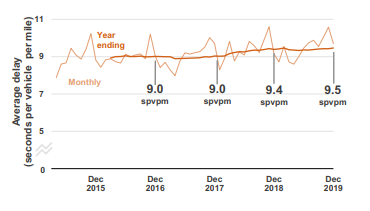
The findings from the Department for Transport’s Travel time measures for the Strategic Road Network and local ‘A’ roads, England: January to December 2019 show that on the Strategic Road Network (SRN) in 2019, the average delay is estimated to be 9.5 seconds per vehicle per mile compared to speed limits, a 0.9% increase on the previous year.


The statistical release also shows that the average speed of drivers was 58.8mph, down 0.5% from 2018.

The reliability of travel times is measured using the Planning Time Index which shows 67.3% of additional time is needed compared to speed limits on average, on individual roads sections to ensure on time arrival. This figure is up 1.1 percentage points in comparison to 2018.

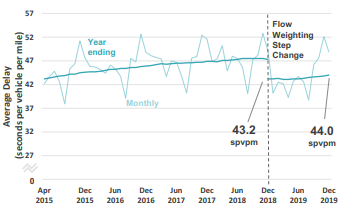
On local ‘A’ roads in 2019, the average delay is estimated to be 44.0 seconds per vehicle per mile compared to free flow, up 1.8% compared to 2018.

The average speed on local ‘A’ roads was 25.3 mph, no change compared to the previous year.

If you want to read the full document, you can find it here: https://assets.publishing.service.gov.uk/government/uploads/system/uploads/attachment_data/file/870292/travel-time-measures-srn-local-a-roads-2019.pdf   By Graham Hill thanks to Fleet News.

Share My Blogs With Others: These icons link to social bookmarking sites where readers can share and discover new web pages.
  • MisterWong
  • Y!GG
  • Webnews
  • Digg
  • del.icio.us
  • StumbleUpon
  • Reddit
  • Alltagz
  • Ask
  • Bloglines
  • Facebook
  • YahooMyWeb
  • Google Bookmarks
  • LinkedIn
  • MySpace
  • TwitThis
  • Squidoo
  • MyShare
  • YahooBuzz
  • De.lirio.us
  • Wikio UK
  • Print
  • Socializer
  • blogmarks