Working From Home & Using A Private Car Will Have Serious Consequences.

Friday, 10. July 2020

Long-term changes to the way people work could result in more employees becoming grey fleet drivers.

As the lockdown is slowly lifted, employers are wrestling with what the ‘new normal’ might entail, including where staff will work in the future.

Millions of employees have been working from home during the pandemic and many expect that, with technologies like Miscrosoft Office Teams and Zoom allowing people to connect virtually, it’s a trend that will continue.

A Fleet News survey showed an overwhelming majority of fleet decision-makers – close to three-quarters (73.4%) – were working from home; one in 10 were dividing their working day between the office and home, and just 15.4% were still in the office full-time.

The latest picture will be revealed in the June digital edition of Fleet News, which will be published next week.

Meanwhile, a separate Fleet News poll suggested that for many, some two-thirds (68.1%) of respondents, working from home will become their ‘new normal’.

Paul Hollick, co-chair of the Association of Fleet Professionals (AFP), warns this could have significant consequences for fleets, with more employees joining the ranks of those that drive their car for work, the so-called grey fleet.

Employers have a legal obligation to ensure that grey fleet vehicles are reasonably safe to use, are fit for purpose and are lawfully on the road.

Companies also typically pay Approved Mileage Allowance Payments (AMAPs) to reimburse fuel used in the course of a work trip at 45p per mile.

“Grey fleet could become a bit of a battleground, because of Covid-19,” warned Hollick. “Employees won’t be office-based (in the future), they’ll be home-based, which means their contract of employment might be changed.

“If the employee is classed as home-based rather than office-based a journey from home to the office will then become a business trip.”

Furthermore, Hollick says that, with people wary of public transport, employees are turning to used vehicles in the sub-£3,000 bracket to stay mobile, which could end up being driven for work purposes. 

New figures from the Department for Transport (DfT) show how hard public transport has been hit. Journeys by national rail are 8% of typical levels and London tube use stands at just 14%.

During the first full day of lockdown (Tuesday, March 24), car use fell to less than half (44%) of the expected level. Light commercial vehicle (LCV) use stood at 55%, HGV use at 84%.

Three months later and the day after retail outlets were allowed to open for the first time on Monday, June 15, car use had risen, but was still only at 70%. Van use and HGV use had grown to 84% and 92%, respectively.

In line with Government advice to avoid public transport, cycling use has doubled during some weekdays and trebled at the weekend.  By Graham Hill thanks to Fleet News

Share My Blogs With Others: These icons link to social bookmarking sites where readers can share and discover new web pages.
  • MisterWong
  • Y!GG
  • Webnews
  • Digg
  • del.icio.us
  • StumbleUpon
  • Reddit
  • Alltagz
  • Ask
  • Bloglines
  • Facebook
  • YahooMyWeb
  • Google Bookmarks
  • LinkedIn
  • MySpace
  • TwitThis
  • Squidoo
  • MyShare
  • YahooBuzz
  • De.lirio.us
  • Wikio UK
  • Print
  • Socializer
  • blogmarks

Drivers Taking Huge Risks When Driving CarsWith Dangerous Defects

Friday, 10. July 2020

One in 10 cars on the road could be classified as having ‘dangerous defects’, according to analysis of the latest Driver and Vehicle Standards Agency (DVSA) data by BookMyGarage.

Department for Transport (DfT) figures show that defective tyres were a contributing factor in 17 fatal accidents in 2018 and caused a total of 459 accidents in the year.

Faulty brakes were also to blame for more than 500 accidents and 15 fatalities.

Karen Rothberg, managing director at BookMyGarage, said: “It was a sensible policy during lockdown, when vehicle use was limited, but the whole point of the MOT is to make sure dangerous vehicles are not on our roads for the sake of the driver, passengers and other road users.

“The Government is taking a serious safety risk now though and we urge motorists to take a common-sense view.”

Following the DVSA announcement that it is ending the MOT exemption on August 1, BookMyGarage said, “millions on could still be driving without a valid certificate until end of January 2021”.

Vehicles were granted the six-month exemption from MOT testing in March, to help slow the spread of the virus.

However, as the lockdown is gradually lifted, all cars, motorcycles or vans due a MOT test from August 1, will now be required to get a test certificate.

The RAC has warned that hundreds of thousands of vehicles due to be tested this summer could end up causing a backlog if drivers take advantage of the six-month extension.

BookMyGarage expects the average failure rate during 2020 to increase as a result of the exemption.

Testers classify failures as minor, major and dangerous defects, with one in three vehicles failing their MOT every day in normal conditions.

The most dangerous defect recorded by more than 65,000 MOT testers across the UK between July and September 2019 were tyres, which made up 58.1% of all dangerous defects recorded, followed by brakes (29.3%), suspension (5.5%), chassis (2.4%) and lights (2.0%).

Two-in five (40%) fleets have postponed non-essential service, maintenance and repair (SMR) work, during the coronavirus crisis, according to a Fleet News survey.

Five million fewer MOT tests carried out in April and May 2020 than in the same months last year, according to DVSA figures.

BookMyGarage is advising motorists not to risk ‘maxing out’ on the August 1 exemption if they can, and get their vehicles tested as soon as possible.  By Graham Hill thanks to Fleet News

Share My Blogs With Others: These icons link to social bookmarking sites where readers can share and discover new web pages.
  • MisterWong
  • Y!GG
  • Webnews
  • Digg
  • del.icio.us
  • StumbleUpon
  • Reddit
  • Alltagz
  • Ask
  • Bloglines
  • Facebook
  • YahooMyWeb
  • Google Bookmarks
  • LinkedIn
  • MySpace
  • TwitThis
  • Squidoo
  • MyShare
  • YahooBuzz
  • De.lirio.us
  • Wikio UK
  • Print
  • Socializer
  • blogmarks

Vehicle Thefts Increase By Over 50%

Friday, 10. July 2020

Vehicle thefts have risen to highest level in four years, as more than 150,000 cars, vans and motorcycles were reported as stolen in 2018-19.

It’s an increase of 10,000 vehicles when compared to the year before and a 56% (54,932) increase compared to four years earlier, according to data analysed by RAC Insurance.

All but three of the police forces that responded to a Freedom of Information request recorded an increase in the numbers of vehicles stolen in their force areas from 2014-15 and 2018-19.

The largest increases were recorded by Kent Police (up 12,550 to 40,726 thefts in 2018-19, a 45% increase), Metropolitan Police (up 9,635 to 30,773 thefts, a 46% increase) and West Midlands Police (up 5,677 to 10,372 thefts, a 121% increase).

Six forces recorded a more than doubling in the number of vehicles stolen between 2014-15 and 2018-19, with the biggest jumps in Suffolk (up 172% from 347 to 945 thefts), Surrey (up 133% from 661 to 1,543 thefts) and the West Midlands.

Only Lincolnshire, the City of London and Police Scotland recorded a reduction in thefts during this period, with reductions of 28, 29 and 473 thefts respectively.

Most police forces (32) also recorded a rise in vehicle thefts year-on-year, between 2017-18 and 2018-19. Kent, again, saw the largest rise, as well as the largest number of overall vehicles stolen in 2018-19 (up 2,575 to 40,726 thefts, 7% more than in 2017-18), followed by Essex (up 1,056 to 5,409 thefts, 24% more than in 2017-18) and the West Midlands (up 836 to 10,372 thefts, 9% more than 2017-18).

When looking at the biggest percentage increases over this 12 month period, Suffolk witnessed the highest jump with 44% more thefts (945 in 2018-19 compared to 655 a year earlier), followed by Bedfordshire (37% increase, from 1,056 to 1,445 thefts) and North Wales (32% increase, from 464 to 612 thefts).

RAC Insurance spokesperson Simon Williams said: “These figures paint a rather disturbing picture – vehicle thefts are on the rise almost everywhere, and in some parts of the country numbers are rocketing.

“It’s also not the case that the rises in crime are confined to a few larger urban areas, with many police forces covering more rural areas also seeing big increases.

“While vehicle crime is at far lower levels today than it was in the early 1990s, thanks to improvements in vehicle security, and the number of vehicles licensed to be driven on the UK’s roads is higher than at any point in the past, it’s still concerning that so many more vehicles are being stolen than just a few years ago.”

The average fleet loses around £16,000 per year as a result of vehicle or equipment theft, according to Verizon Connect.

Its research found that businesses have at least one vehicle stolen each year.

The average loss increases to nearly £50,000 for those businesses that have between 101-250 vehicles, as the number of vehicles stolen rises to three for businesses of this size.

Some of the increases in recent years can be put down to a rise in thefts of vehicles that are easier to steal, such as motorbikes and mopeds that are less likely to have immobilisers. Government data also shows that thieves generally use keys to access vehicles in around half of crimes, which suggests that drivers need to do more to keep their keys safe.

Tracker data suggests that nine out of 10 van thefts were performed using the keys.

In a fifth of cases (18% in 2018), thieves were able to access vehicles because they weren’t locked in the first place.

Company car drivers and fleets are being warned by Tracker to be wary of opportunistic criminals looking to steal cars to fill a replacement parts gap caused by COVID-19.

The stolen vehicle recovery company says that police across the country are already fighting an increase in ‘chop shops’ – where stolen vehicles are stripped down and expensive parts sold on. But, it argues, the lack of legitimate parts could increase their popularity and profitability still further. By Graham Hill thanks to Fleet News

Share My Blogs With Others: These icons link to social bookmarking sites where readers can share and discover new web pages.
  • MisterWong
  • Y!GG
  • Webnews
  • Digg
  • del.icio.us
  • StumbleUpon
  • Reddit
  • Alltagz
  • Ask
  • Bloglines
  • Facebook
  • YahooMyWeb
  • Google Bookmarks
  • LinkedIn
  • MySpace
  • TwitThis
  • Squidoo
  • MyShare
  • YahooBuzz
  • De.lirio.us
  • Wikio UK
  • Print
  • Socializer
  • blogmarks

Cap HPI Confirm That There Is No Drastic Drop In Used Car Prices

Saturday, 20. June 2020

Initial analysis of the impact of the coronavirus pandemic on used car values does not show a “seismic” shift in prices being achieved, suggests Cap HPI.


However, it is urging caution and warned vendors to expect “volatile” price movements over the coming weeks.


Cap HPI says that more vehicles are beginning to be sold at auction, with pricing data volumes increasing by 70% in the week commencing May 4, compared to two weeks earlier, in the middle of April.


From the start of the lockdown, the company stated that it would be analysing both used car retail and wholesale data, but it would not adjust used values while there was insufficient data to portray the market accurately.


Between March and May 10, no values were moved, but now that cars are selling in more volume, it says they need to be adjusted to reflect sold prices and allow the trade to buy and sell optimally.


The latest data shows that average wholesale selling prices have increased steadily from around £4,000 to more than £7,000, suggesting vendors are now more confident of selling slightly more expensive cars.


Early indications suggest a 2% to 5% downward movement for some of those models and ranges older than five-years-old.


Derren Martin, head of valuations UK at Cap HPI, explained: “The previous five years have seen an average drop of 4% during April and May at the five-year-old age point, and last year witnessed a 6.3% drop. So, the movements we are currently seeing in the middle of this pandemic are by no means seismic. We are reflecting the data as volumes slowly increase.”


Cap HPI reported a 2.2% fall in used car values on March 27. The total cumulative Live movement during March, leading to April’s monthly values, was an average drop of 2.2% (-£275) at the three-year, 60,000-mile point, the majority of which happened in the final 10-days of valuing. For newer used cars, the drop was 1.8% (-£425) at the one-year, 20,000-mile point.


In April, Cap HPI observed around 7,500 sold records and that number has already been exceeded by the middle of May.


Furthermore, both Manheim and CD Auction have reported they have started online sales, while BCA has continued its online offering during the pandemic.


Cap HPI says that, while wholesale records are still well below usual volumes, there is now enough data for prices to be reflected to assist the industry.


Martin continued: “We are now in a position to confidently move values in line with the market, taking a prudent approach using our editorial expertise, no algorithms, to analyse the data.


“Initially, we will be moving values on older vehicles in mainstream sectors, where there is enough evidence to accurately reflect current prices, by looking at each generation of model individually.”


However, he said: “No overall market movements will be applied. At the current time, younger used cars will not be moved in value as that end of the market is still very much in a hiatus.”


The data company says outliers, unrepresentative volumes and prices will not be reflected to move values.


It has also made the decision not to move values of younger cars or of cars in niche sectors, due to the paucity of data available.


For now, it says that valuation movements will only be made on cars between around five and 20-years old. The situation will be reviewed on an ongoing basis.


The analysts at Cap HPI are also analysing retail advertised prices in large volumes, although it says movements on retail price have been negligible.


Martin concluded: “We can see how retail and trade values operate differently in the market and this continues to be true during the pandemic.


“It’s more important than ever to take a careful, considered view from the evidence and it is likely to be a volatile time for used car prices over the next few weeks, whilst supply and demand dynamics work themselves out.


“We would recommend the industry keeps a very close eye on our daily valuations as they may move in either direction.”  By Graham Hill thanks to Fleet News


Share My Blogs With Others:
These icons link to social bookmarking sites where readers can share and discover new web pages.

  • MisterWong
  • Y!GG
  • Webnews
  • Digg
  • del.icio.us
  • StumbleUpon
  • Reddit
  • Alltagz
  • Ask
  • Bloglines
  • Facebook
  • YahooMyWeb
  • Google Bookmarks
  • LinkedIn
  • MySpace
  • TwitThis
  • Squidoo
  • MyShare
  • YahooBuzz
  • De.lirio.us
  • Wikio UK
  • Print
  • Socializer
  • blogmarks

More Drivers Are Avoiding Various Motor Fines

Saturday, 20. June 2020

The volume of motoring fines and penalties incurred by company car and van drivers increased by 3% in 2019, new figures from Lex Autolease show.


This compares to a 60% year-on-year cumulative increase over the past three years, suggesting a slower rate of increase than in previous years.


This was also reflected in the value of fines incurred by drivers, which did not grow for the first-time last year, bucking the trend of yearly increases from £10.7 million in 2016 to £17.1m 2019.


The percentage of drivers caught by bus lane cameras fell for the first time by 17% year-on-year, with fines issued for congestion charges and council parking also falling by 6% and 4% respectively.


Mersey Flow and Dartford Crossing fines also saw a year-on-year decrease with the total number of penalty notices issued falling by more than two fifths (44%) from 54,618 in 2018 to 30,391 in 2019.


However, the picture is not entirely positive, says the country’s largest vehicle leasing company.


The percentage of motorists penalised in private car parks rose by 6% year-on-year to £6.2m, and illegal junction-box stops and red-route driving fines increased by almost a fifth (19%) to £6.3m during the same period.


Lex Autolease analysed data from more than 361,000 company cars and vans to identify trends in behaviour and driver safety.


Kim Morris, motor operations director at Lex Autolease, said: “Company car drivers are often more likely to incur fines and penalties on the roads when compared to ordinary motorists, as the pressure to hit deadlines and attend meetings on time can sometimes lead to poor driver behaviour.


“The majority of fines can be easily avoided and if not closely monitored can quickly add up to expensive outgoings for employers – especially those with larger fleets.”


She believes that the emphasis fleet managers have placed upon driver health and safety in recent years is starting to pay off, with a considerable slowing in the rise of the number of fines incurred and a decrease in the number of fines for commonplace offences, including bus lane driving and congestion charges.


However, she said: “Our analysis shows that there’s still more businesses can do to educate their employees to bring these numbers down further.


“Continuing to invest further in driver education can help to modify employees’ driving habits and in turn save businesses unnecessary outgoings each month.”


She concluded: “As the new tax changes for alternatively-fuelled vehicles gather momentum, driver education will become even more important for fleets to make sure avoidable fines and penalties do not offset the cost saving benefits of low or zero emission vehicles.”  By Graham Hill thanks to Fleet News


Share My Blogs With Others:
These icons link to social bookmarking sites where readers can share and discover new web pages.

  • MisterWong
  • Y!GG
  • Webnews
  • Digg
  • del.icio.us
  • StumbleUpon
  • Reddit
  • Alltagz
  • Ask
  • Bloglines
  • Facebook
  • YahooMyWeb
  • Google Bookmarks
  • LinkedIn
  • MySpace
  • TwitThis
  • Squidoo
  • MyShare
  • YahooBuzz
  • De.lirio.us
  • Wikio UK
  • Print
  • Socializer
  • blogmarks

Latest Diesel Engines Are The Cleanest Ever And Cleaner Than Petrol

Thursday, 11. June 2020

I’ve included the following report because it illustrates a point that I’ve been making for some time now that diesels are now cleaner than petrol cars and as we are years away from all cars being electric should they still be demonised and disregarded by drivers?


The fact is that whilst sales of petrol vehicles now massively exceeds the sale of diesels, if you are environmentally aware but not in a position to drive an electric vehicle should you immediately opt for petrol? Petrol emits more CO2 than diesel so if we’re not careful we will see the opening up of holes in the ozone layer – remember those? So read the report, aimed at the fleet industry, and draw your own conclusions.


Once the fuel of choice for the company car driver, diesel’s dominance among fleets has been on the wane for some time.


Its reputation tarnished and the attraction of tax-busting hybrid and battery electric vehicles (BEVs) difficult to ignore, numbers have continued to dwindle.


Industry leaders say they cannot see a way back for the embattled fuel and this is despite diesel beginning its fightback last year, when the first cars complying with the latest emissions standard began joining UK fleets.


Cars qualifying for the so-called RDE2 standard do not attract the 4% diesel company car tax surcharge, while fleets benefit from not having to pay the higher first-year rate of VED.


Shaun Sadlier, head of consultancy at Arval UK, says the savings from choosing a RDE2 diesel company car can run into “thousands of pounds” over a typical three-to-four-year lease contract.


“Fleets operating RDE2 cars also benefit from lower Class 1A NICs and first-year VED costs in comparison with a non-compliant model,” he said.


Mercedes-Benz, Jaguar Land Rover (JLR) and BMW were among the first to offer RDE2 cars. Rob Morris, national fleet operations manager, at Mercedes-Benz, says that its RDE2-compliant engines were a “popular choice” with customers.


All Mercedes-Benz cars produced from this month (June) will meet the stricter standard.


Vauxhall has become the first volume manufacturer to offer the emissions standard across its range.


James Taylor, general sales director at Vauxhall, told Fleet News: “That means all new Vauxhalls avoid the 4% diesel surcharge on benefit-in-kind (BIK), offering savings to our customers of up to £22 and £43 per month for 20% and 40% taxpayers, compared with the same (non-compliant) models.”


STRICTER LIMITS


The on-the-road Real Driving Emissions (RDE) test was introduced alongside the new emissions testing regime, the Worldwide harmonised Light vehicle Test Procedure (WLTP), in two stages.


RDE1 was introduced in September 2017 for new car type approvals and applied to all new car registrations from September, last year. Vehicles compliant with this standard are designated Euro 6d-Temp. The stricter RDE2 standard came into force from January for new type approvals and will be applicable to all new cars, which will be labelled Euro 6d, from January 2021.


Cars certified to RDE1 (Euro 6d-Temp) must emit less than 2.1 times the Euro 6 NOx limit of 80mg/km for diesel and 60mg/km for petrol engines. This conformity factor tightens to 1.43 times for RDE2-compliant (Euro 6d) vehicles.


In 2023, it’s expected conformity factors will be removed, aligning laboratory and on-road emissions limits.


Alongside Vauxhall, other Groupe PSA brands have become RDE2-compliant, including all Citroën and DS diesel models, plus the majority of Peugeots now also meet the stricter emissions standard.


RDE2 models include all 1.5-litre and 2.0-litre BlueHDI-powered Citroëns and DSs, with manual and EAT8 automatic transmissions.


BlueHDi versions of the Peugeot 3008 and 508 have also qualified, along with the new 208 and 2008.


Martin Gurney, who is responsible for fleet and used vehicle sales for Peugeot, Citroën and DS in the UK, says Groupe PSA has been “working hard” to ensure its vehicles are compliant ahead of schedule.


He added: “These early announcements should reassure customers that we are committed to engineering clean and efficient powertrains for all drivers. The fact that most of our diesel models already meet the forthcoming RDE2 standards speaks volumes about the development that goes into our engines.”


BMW continues to add RDE2 models, while Hyundai says it will add further RDE2 engines to its line-up to join the i10, later this year.


Other manufacturers, such as Audi, Škoda, Renault and Kia, which do not currently have any RDE2 cars, say launches in the second half of the year will see compliant models come through.


But will a wider choice of cars, which avoid the 4% surcharge, be enough to halt the demise of diesel?


DIESEL’S DECLINE


The leasing industry is reporting growing interest from savvy fleets, but all admit the focus is shifting to zero emission motoring.


Figures from the Fleet News FN50 show that the proportion of diesel cars on the FN50 fleet – the UK’s top 50 leasing companies by risk fleet size – fell from almost two-thirds (63.4%) to almost half (50.5%) in 2019.


In terms of vehicles they had ordered, the flight from diesel was still more pronounced. Almost half of the cars ordered last year were petrol (47.6%), while only two-fifths (38.8%) were diesel.


Jon Lawes, managing director of Hitachi Capital Vehicle Solutions, has seen a growing fleet interest in RDE2 diesel cars.


However, he says this is when there is a direct comparable alternative available for the model they want.


He explained: “WLTP has been responsible for the wholesale rise of CO2, irrespective of RDE categorisation, and, therefore, we’ve seen a continued negative shift in perception of diesel vehicles.”


WLTP CO2 values for company cars registered after April 6, which are typically higher than those derived from the old emissions testing regime for comparable vehicles, are now used for tax purposes.


Their use has coincided with a new company car tax regime to try to take account of the hike in emissions, which also includes a new zero percentage rate for battery electric vehicles (BEVs).


PLUG-IN INCENTIVES


Lawes says he expects a “continuing overall decline” in diesel market share as more fleets opt for plug-in hybrid or BEV alternatives.


However, he did offer a glimmer of hope for diesel powertrains. “We expect RDE2 models will cause this decline to plateau as this will provide a favourable cost-effective option for some sectors and drivers.”


David Bushnell, principal consult-ant at Alphabet (GB), said: “For those high mileage drivers, where diesel is still probably the number one choice for fleets, the selection of an RDE2 vehicle will clearly make sense in terms of personal taxation and national insurance costs.


“It’s also an existing technology that many drivers are comfortable using. But, even here, we’re seeing mild hybrid technology coming in to reduce drivetrains’ CO2 output.”


However, he says the “clear additional tax benefits” for choosing plug-in hybrid and battery electric vehicles, revealed in the Budget, will prove hard to ignore.


Chris Chandler, principal consultant at Lex Autolease, has seen a similar trend. He said: “The cost savings and environmental benefits of a plug-in hybrid or full electric alternative are more attractive at the moment.


“The main question we’re being asked by fleets on a daily basis is how they can start – or accelerate – their transition along the ‘Road to Zero’.


“The availability of RDE2 vehicles and how to optimise diesel fleets seems to be far lower down fleet managers’ agendas.”


GROWING INTEREST


Chandler’s comments appear to be backed up by the results of a recent Energy Saving Trust survey.


It revealed that one-in-three UK fleet managers expect half of their company car fleet to be electric by 2025, and seven-in-10 fleet managers are preparing to buy an electric car within two years.


Matthew Walters, head of consultancy and customer data services at LeasePlan UK, said: “From our conversations with fleet managers, it’s evident WLTP is still the main consideration when it comes to compliance-related tax savings and how this impacts the vehicle selection process.”


He expects sales of internal combustion vehicles (ICEs) to fall as electric vehicles become more available and increasingly affordable.


Lex Autolease has seen a significant increase in demand for plug-in hybrid and full electric vehicles over the past 12 months, especially since the 0% BIK tax announcement.


Chandler says a “good awareness” of wholelife costs in the market is driving the shift towards low and zero-emission driving.


He said: “Rather than pay 25-30% tax on a RDE2-compliant diesel vehicle, company car drivers seem to be more focused on taking advantage of the tax benefits of plug-in hybrid and pure electric cars.”


As a result, the UK’s largest vehicle leasing company, Lex Autolease, says it doesn’t anticipate increased availability and understanding of RDE2-compliant models will significantly slow the decline of diesel.


Chandler added: “RDE2-compliant models will simply account for a growing proportion of the existing diesel market.”  By Graham Hill thanks to Fleet News.


Share My Blogs With Others:
These icons link to social bookmarking sites where readers can share and discover new web pages.

  • MisterWong
  • Y!GG
  • Webnews
  • Digg
  • del.icio.us
  • StumbleUpon
  • Reddit
  • Alltagz
  • Ask
  • Bloglines
  • Facebook
  • YahooMyWeb
  • Google Bookmarks
  • LinkedIn
  • MySpace
  • TwitThis
  • Squidoo
  • MyShare
  • YahooBuzz
  • De.lirio.us
  • Wikio UK
  • Print
  • Socializer
  • blogmarks

Sanitisation – Another Cost To Bear?

Thursday, 11. June 2020

Sanitisation costs for cars and vans bei g delivered and returning from garages are beginning to appear.


Dealers and garages are currently “working out” who pays the cost of sanitisation on cars and vans that are delivered to their new owners or undergo service, maintenance and repair (SMR).


There appears to be general agreement among all parties that vehicles will need sanitising thoroughly before they are handed over or handed back after service and maintenance to the customer or employee with a company car.


But who is to pay for cleaning products, PPE equipment and the time taken? These costs can’t simply be absorbed by the dealers and garages.


Tim Meadows, vice president and commercial director at Epyx, said: “This is a development that we are just starting to see through our 1link Service Network SMR platform, which is used by fleets totalling four million vehicles, as lockdown starts to ease.


“Sanitisation is becoming recognised as an essential part of almost any visit by a vehicle to a workshop. The car or van is potentially touched by many people as part of almost any SMR process, and the potential spread of infection needs to be minimised.


“However, that sanitisation has a cost and is starting to appear as a formal charge on some job sheets. The question is, who pays?”


Meadows says that garages “understandably” see it as an additional cost that they shouldn’t have to bear. “Their customers, equally understandably, feel the same,” he said.


The issue is especially acute where, on lower Service Maintenance and Repair bills, it could be interpreted as a disproportionate amount, added Meadows.


“If you are having £1,000 of work done, then a potential £10 item doesn’t stick out but, if your car is in the workshop for a MOT test or even just having a small repair, it becomes more noticeable.”


Leasing companies that already work on very small margins are working with dealers and manufacturers to arrive at a compromise to avoid increased delivery costs


Meadows continued: “Some of the fleets that use 1link Service Network have hundreds of thousands of maintenance jobs every year and adding £10 to each suddenly becomes a very large sum of money.


“Equally, this is a significant cost for garages to absorb. However efficient they become at sanitisation, this is something that takes time and money.”


Meadows believes that one thing that the industry had seen during the coronavirus crisis is a “very strong spirit of co-operation”.


“Everyone recognises that they are facing the same issues and they need to resolve them together,” he said. “We are sure that sensible solutions will be found to this problem.”


I agree, it’s not the end of the world, an extra £10 for most jobs is not over the top, it’s more the concern on the part of the customer that the sanitisation has been carried out. So many changes to our lives, not just in the short term but forever. By Graham Hill thanks also to Fleet News


Share My Blogs With Others:
These icons link to social bookmarking sites where readers can share and discover new web pages.

  • MisterWong
  • Y!GG
  • Webnews
  • Digg
  • del.icio.us
  • StumbleUpon
  • Reddit
  • Alltagz
  • Ask
  • Bloglines
  • Facebook
  • YahooMyWeb
  • Google Bookmarks
  • LinkedIn
  • MySpace
  • TwitThis
  • Squidoo
  • MyShare
  • YahooBuzz
  • De.lirio.us
  • Wikio UK
  • Print
  • Socializer
  • blogmarks

New Report Recommends Battery Condition Reports To Improve Electric Vehicle Resale Values

Thursday, 11. June 2020

Autovista Group has published a new whitepaper outlining how a report outlining the remaining battery life of an electric vehicle (EV) could improve its residual value.


Created in partnership with battery analytics specialist TWAICE and TÜV Rheinland, the document states that driving profile has a major impact on how long a battery lasts and in the absence of documentation of how a driver has treated the battery, residual value formation remains below its full potential.


“Used car programmes and extended warranties are already powerful signals that help address the information asymmetry between buyer and seller. But the BEV represents a new challenge for the market,” said Christof Engelskirchen, chief economist at Autovista Group.


“We know that how the battery is treated over the 8-10 years of its lifetime has a major impact on range and therefore suitability for daily use, but car manufacturers provide no systematic transparency on battery treatment and quality.”


Munich-based TWAICE has the technology in place to evaluate the true remaining quality of a battery based on how it was treated. It creates a digital twin of a battery and can simulate the impact of operating conditions, driving style, and charging behaviour.


Jonas Keil, battery engineer at TWAICE, said: “Many people underestimate the impact of battery treatment. At the three-year point with 28,000 miles on the clock, a battery that has been poorly treated will perform worse on promised range by about 5% – and this gap will only increase as battery quality, once lost, cannot be recovered.”


Autovista Group has simulated that improved and verifiable battery quality, provided in the form of a Battery Health Report, delivers up to £400 higher remarketing results for a three-year-old used C-segment BEV in Germany.


Dr. Matthias Schubert, executive vice president mobility at TÜV Rheinland, added: “Numerous long-term tests have shown that the aging pattern of EV batteries can vary widely amongst individual cases, depending on the user profile. An assessment of the remaining capacity and expected performance lifetime is a decisive precursor to establishing residual value.”


The full potential of a Battery Health Report can only be realised if information on battery treatment becomes available as a standard data item on every used BEV transaction, similar to information on age, mileage and equipment.  By Graham Hill thanks to Fleet News.


Share My Blogs With Others:
These icons link to social bookmarking sites where readers can share and discover new web pages.

  • MisterWong
  • Y!GG
  • Webnews
  • Digg
  • del.icio.us
  • StumbleUpon
  • Reddit
  • Alltagz
  • Ask
  • Bloglines
  • Facebook
  • YahooMyWeb
  • Google Bookmarks
  • LinkedIn
  • MySpace
  • TwitThis
  • Squidoo
  • MyShare
  • YahooBuzz
  • De.lirio.us
  • Wikio UK
  • Print
  • Socializer
  • blogmarks

Coronavirus Will See A Move From Public Transport To Private Cars Especially Electric Vehicles

Thursday, 11. June 2020

Business travellers and commuters continue to steer clear of public transport, preferring to drive rather than travel by bus or train, new data from Transport Focus shows.


Having tracked transport usage over the past four weeks, the independent UK watchdog says survey results show public transport has remained consistently low.


Before the outbreak, 43% nationally used public transport at least a few times a month, while 80% used the car.


But just 2% of respondents said they had used a bus in the past week, which has remained unchanged since Transport Focus began its weekly survey.


In terms of trains and the London Underground, usage has again remained unchanged over the period, with only 1% of respondents saying they had travelled on either.


More than a third (36%) of respondents said they were avoiding public transport on Government advice, unchanged from the previous week.


Two out of five respondents (39%) said they would not use public transport for any reason until they felt completely safe.


However, almost one in eight said they would begin using public transport again when shops were open again or when their employer asked them to return to work.


During the first few weeks of the pandemic, there was much debate about the use of face masks.


Last month, the Government updated its advice and for the first time recommended their use in when in an enclosed space where social distancing is not possible.


Examples given include short periods indoors in crowded areas, such as when using public transport or visiting some shops.


Six out of ten respondents (62%) said think that wearing a face mask while using public transport should be a requirement in the most recent study. That was similar to the previous week’s result (63%) but has increased from the 51% seen in week one of the survey.


Until social distancing can be guaranteed on public transport, however, 71% said they would continue to avoid its use.


A consistent six out of 10 (60%) said they will more likely to drive in the future.


Driving retained its top spot, with 53% reporting usage of their car, unchanged from the previous week and a 5% increase on the 48% from a fortnight ago.


Drivers, however, are continuing to report an increase in the volume of traffic they are encountering, with 38% of respondents saying roads are ‘moderately’ busier in the past week – up from 33% in the previous week.


Traffic on the motorway, they say, is very light but local roads are much busier than they were a couple of weeks ago.


As lockdown restrictions are gradually lifted more businesses are re-opening and staff are returning to work. However, the proportion of people who say they expect to work from home more often in the future has increased since the survey was first conducted.


In week one, 40% said they expected to be spending more time working from home, compared to more than half (52%) of respondents now.


A Fleet News poll currently shows that two-thirds of respondents (66%) expect working from home to be their ‘new normal’ in the future. By Graham Hill thanks to Fleet News


Share My Blogs With Others:
These icons link to social bookmarking sites where readers can share and discover new web pages.

  • MisterWong
  • Y!GG
  • Webnews
  • Digg
  • del.icio.us
  • StumbleUpon
  • Reddit
  • Alltagz
  • Ask
  • Bloglines
  • Facebook
  • YahooMyWeb
  • Google Bookmarks
  • LinkedIn
  • MySpace
  • TwitThis
  • Squidoo
  • MyShare
  • YahooBuzz
  • De.lirio.us
  • Wikio UK
  • Print
  • Socializer
  • blogmarks

3 Million MOT Extensions Allowed Since TheStart Of Lockdown

Thursday, 11. June 2020

A Freedom of Information (FOI) request submitted by MoneySuperMarket has revealed that more than 3m (3,025,345) cars and vans had their MOT extended since March 30.


Broken down by EU class, that is 2,788,594 passenger vehicles and 236,751 light goods up to 3000kg – roughly 65,000 cars per day. MoneySuperMarket predicts there could be another 1m cars with MOT extensions by June 1.


MOTs are automatically being extended by six months if it was due to expire on or after March 30 and if its eligible. However, it has recently been updated on May 27, that a MOT extension will no longer apply if you take your vehicle for a MOT and it fails. Your vehicle will need to be fixed and pass its MOT before you can use it again.


The Driver and Vehicle Standards Agency (DVSA) highlights that safety remains its top priority and drivers are at risk of prosecution if found to be driving unsafe vehicles. Vehicles must be kept in a roadworthy condition and garages remain open for essential repair work.


Car servicing and repair company, Kwik Fit, has said it expects to see a significant demand in MOT requests post the six-month extension period, as current trends suggest that most drivers will wait until the MOT extension is over before arranging for their MOT to be completed.


As a result, there will be a significant demand for MOT tests in October, November and towards the end of 2020, putting pressure on capacity, the company says.


According to statistics provided by MoneySuperMarket, of all MOTs due this year, 18% were due in April and May. Data based on drivers using the MoneySuperMarket car monitor, showed that October is expected to be the busiest month as 15% of all MOTs are due in within the month.


However, Kwik Fit says it is taking measures to increasing capacity at more than 500 MOT test centres across the UK and would encourage drivers to book the MOT in advance of the extended due date, especially if the vehicle is being used more regularly during that time.


Kwik Fit estimates that 25% of fleet drivers who could have deferred their MOT have still had a test on their vehicle. However, most drivers it would have expected during the weeks since the introduction of the MOT extension have chosen not to visit, due to the restrictions in place for lockdown.


New research by Kwik Fit also revealed that almost 1.1 million unroadworthy vehicles are set to return to the roads as lockdown begins to ease. An estimated 1,096,000 vehicles which would have received a six-month extension, would have failed a test with dangerous or major defects had they undergone a MOT.


Dan Joyce, fleet director at Kwik Fit, said: “Of the fleet vehicles which received an automatic extension, our experience tells us that around one in five would have failed a test if they had received one.


“Therefore, our on-going message to drivers whom have been using their vehicle or will now start to use their vehicle again whilst lockdown restriction are eased over the coming weeks and months, is to consider the roadworthiness and general condition of the vehicle prior to using it again more regularly.”


Kwik Fit have continued to offer MOT slots throughout its network during the MOT extension period and says that although volumes have significantly reduced during this time, it has seen some demand for MOT’s from key workers and people using their vehicles to continue with essential journeys during lockdown.


Three quarters of a million MOT tests still carried out in April

But despite the MOT extension, three quarters of a million tests were still carried out in April, figures from Motorway.co.uk have revealed.


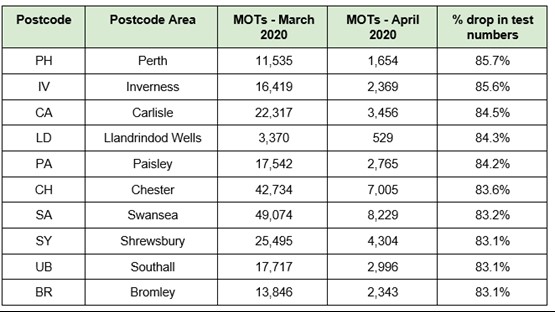
A Freedom of Information (FOI) request to the Driver and Vehicle Standards Agency (DVSA) made by the car selling comparison website showed that 746,157 MOTs were carried out in April 2020, down 80% on March 2020 – where 3,723,524 motorists took their vehicles for a MOT.


Perth in Central Scotland saw the biggest drop in MOTs last month, with tests down 85.7%, in comparison to March. Inverness saw 85.6% fewer MOTs in April, than in March.


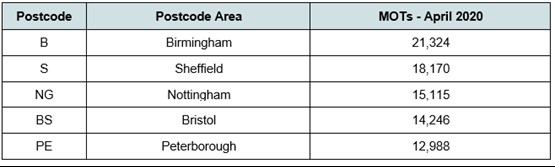
More than 20,000 motorists in the Birmingham area (21,324) took their vehicles for a MOT in April, and 18,170 tests were carried out by garages in the ‘S’ postcode area (Sheffield) last month.


Alex Buttle, director at Motorway.co.uk, said: “These figures from the DVSA show that despite motorists having the opportunity to postpone their MOT test, many have chosen not to do so. There could be several reasons why; with general car maintenance, ongoing value and safety issues likely at the forefront of many drivers’ minds.


“Saying that, the number of MOTs in April was still substantially lower than March figures, and we expect to see a similarly low level of testing in May, as lockdown restrictions have only been eased slightly this month.”


Automotive aftermarket ready to deal with MOT demand when 6-month exemption is lifted

New automotive aftermarket sector-specific guidance to ‘keep millions of vehicles roadworthy’ has been published by the Garage Equipment Association (GEA), Independent Automotive Aftermarket Federation (IAAF), Institute of the Motor Industry (IMI), Scottish Motor Trade Association (SMTA) and the Society of Motor Manufacturers and Traders (SMMT).


The UK automotive aftermarket sector has signalled its readiness to cope with increased demand for MOT tests, service, maintenance and repair with the publication of Covid-19: Industry Guidance and Best Practice for Automotive Aftermarket.


Although workshops have been allowed to stay open throughout the lockdown, helping to keep vehicles roadworthy for essential journeys, guidance will help companies of all types and sizes in the aftermarket operate safely while minimising the risk of Covid-19 transmission.


Mike Hawes, chief executive at the Society of Motor Manufacturers and Traders, said: “It is timely that the aftermarket can assure customers and colleagues that it is ready to re-open safely to ensure workers’ vehicles remain roadworthy.”


The best-practice guidance covers the entire aftermarket sector, including workshops, warehouses, mobile operations and parts distributors and covers every aspect of their operations, from clear communications with customers and colleagues to social distancing, sanitisation and hygiene, and collection/delivery of vehicles from vulnerable owners.


It is designed to complement government advice and help the aftermarket sector demonstrate safe practices for employees and customers across all points of interaction. It comes as vehicle mileages start to climb and the sector calls for an end to the six-month MOT extension.


Hawes said: “With government advice stating that workers should avoid public transport when returning to work, the use of private cars is likely to rise more sharply than it already has over recent weeks. Given many of these vehicles have been idle for weeks, a reconsideration of the six-month MOT extension needs to be made as soon as possible.”


The vital role of the aftermarket sector in supporting safe mobility of the UK workforce has been underlined as the IMI echoes the SMMT call for the six-month exemption to be scrapped.


Steve Nash, chief executive officer at the Institute of the Motor Industry, said: “There are serious risks in the extension remaining in place now. If vehicles are coming back onto the roads in volume it is vital for all road users’ safety that they are roadworthy.


“The other issue is that if all motorists wait up to six months from when their MOT expired to get their vehicle tested, there is going to be a big backlog of tests in the Autumn and Winter which could significantly overwhelm the sector. That’s without considering the likelihood of the market shrinking because many businesses are unlikely to be able to survive without work coming in.


“The SMMT’s proposal to scrap the extension makes a lot of sense for road safety and will be a vital boost for a currently beleaguered sector.” By Graham Hill thanks to Fleet News


Share My Blogs With Others:
These icons link to social bookmarking sites where readers can share and discover new web pages.

  • MisterWong
  • Y!GG
  • Webnews
  • Digg
  • del.icio.us
  • StumbleUpon
  • Reddit
  • Alltagz
  • Ask
  • Bloglines
  • Facebook
  • YahooMyWeb
  • Google Bookmarks
  • LinkedIn
  • MySpace
  • TwitThis
  • Squidoo
  • MyShare
  • YahooBuzz
  • De.lirio.us
  • Wikio UK
  • Print
  • Socializer
  • blogmarks