Mitsubishi Suspected Of Emissions Cheating In Germany

Friday, 24. January 2020

Mitsubishi has come under investigation in Germany amid reports that some of its models are fitted with an emissions cheating device.


German police raided 10 sites in several locations including Frankfurt, Hanover and Regensburg as part of the investigation. Among the companies being investigated is parts supplier Denso, producer of diesel injectors and pumps for Mitsubishi models, which is said to be co-operating with investigators.


Three properties searched belong to manufacturing group Continental AG, which is reported to be listed as a witness in the case.


An official statement from German prosecutors said: “There is a suspicion that the engines are equipped with a so-called shutdown device.” A similar component identified on 11 million Volkswagen Group models in 2014 sparked the notorious Dieselgate scandal.


A Mitsubishi spokesman in Germany confirmed to motoring magazine Automobilwoche that the company was under investigation but emphasised that Mitsubishi Europe, as an importer, isn’t involved in development or production of new cars.


An official statement said: “Mitsubishi Motors will of course collaborate and contribute to this investigation.”


The engines in question are 1.6-litre and 2.2-litre four-cylinder diesel units that were sold as conforming to Euro 5 and Euro 6 emissions requirements. German police have asked anyone who has acquired a car with either motor since 2014 to contact them. By Graham Hill thanks to Autocar

Share My Blogs With Others: These icons link to social bookmarking sites where readers can share and discover new web pages.
  • MisterWong
  • Y!GG
  • Webnews
  • Digg
  • del.icio.us
  • StumbleUpon
  • Reddit
  • Alltagz
  • Ask
  • Bloglines
  • Facebook
  • YahooMyWeb
  • Google Bookmarks
  • LinkedIn
  • MySpace
  • TwitThis
  • Squidoo
  • MyShare
  • YahooBuzz
  • De.lirio.us
  • Wikio UK
  • Print
  • Socializer
  • blogmarks

Diesel Uncertainty – One Reason Why Jaguar Land Rover Is Shedding Jobs.

Friday, 24. January 2020

Jaguar Land Rover (JLR) will make 500 job cuts at its Evoque and Discovery Sport SUV-producing Halewood manufacturing plant on Merseyside.


In what Unite the union described as “a further blow to the UK car industry” the premium carmaker will cut jobs as part of a move from a a three-shift system to a two-plus shift system, in April, in an effort to deliver flexibility efficiencies and enable sustainable growth.


The move is part of its Project Charge programme which, it claimed, had achieved a total of £1.7 billion of a £2.5bn operational savings as it reported losses in August last year – seven months after the announcement of 4,500 job cuts across the business.


Quoted in the Liverpool Echo newspaper, a JLR spokeswoman claimed that the decision to restructure shift patterns at the Halewood plant would deliver “significant operating efficiencies at the plant, while enabling us to meet the growing customer demand for our new Range Rover Evoque and Land Rover Discovery Sport”.


The manufacturing plant currently employs 4,000 people with around 500 agency staff.


Unite said that the proposed job losses would comprise a mixture of permanent employees and agency staff and accounts for over 10% of the plant’s workforce.


The union has negotiated that the loss of the permanent employees will be through an enhanced voluntary redundancy scheme.


Unite national officer, Des Quinn, said: “This is a further blow to the UK car industry in general and to our members at Halewood in particular.


“Unite will be ensuring that the commitment to limit job losses to voluntary redundancies is fully honoured.


“The challenges being faced at JLR are also being experienced by other UK car factories.


“The UK’s car industry has plummeted from being the jewel in the crown of the UK’s manufacturing sector in a few short years, directly as a result of government inaction.


“Until the government ensures that there is long-term frictionless trade and no tariffs with the European Union along with meaningful investment in the infrastructure to ensure the success of electric vehicles, the UK’s car industry will continue to experience severe challenges.”


In July last year JLR announced its plan to spend close to £1bn installing electric tooling in its Castle Bromwich factory to build three new electrified models, the first of which will be the next generation all-electric Jaguar XJ EV.


JLR said that its free cash flow was negative £719 million after £795 million of investment spending in the quarter, but added that this represented a £954 million improvement year-on-year.


The UK Government has announced that it would underwrite JLR’s EV programme spending to the tune of £500 million as part of a £625 million loan facility expected to be completed in the coming months and amortize over five years.


Global sales fell by 5.9% for the OEM in 2019 as 557,706 vehicles were sold worldwide.


Overall sales were hit particularly hard by a 13.5% decline in registrations in China.


In the UK Jaguar sales declined 2.6% to 36,069 (2018: 37,019) as Land Rover declined 1.7% from 77,906 in 2018 to 76,546. By Graham Hill thanks to Automotive Management On-Line

Share My Blogs With Others: These icons link to social bookmarking sites where readers can share and discover new web pages.
  • MisterWong
  • Y!GG
  • Webnews
  • Digg
  • del.icio.us
  • StumbleUpon
  • Reddit
  • Alltagz
  • Ask
  • Bloglines
  • Facebook
  • YahooMyWeb
  • Google Bookmarks
  • LinkedIn
  • MySpace
  • TwitThis
  • Squidoo
  • MyShare
  • YahooBuzz
  • De.lirio.us
  • Wikio UK
  • Print
  • Socializer
  • blogmarks

Call For All Motorists To Have An Eye-Test In 2020

Friday, 17. January 2020

Drivers should book an eyesight test in 2020, says GEM Motoring Assist.


This, according to the road safety organisation, would help in reducing collisions and injuries on the UK’s roads.


GEM road safety officer Neil Worth, said: “What better time than the year 2020 to get your vision checked properly and ensure the risks you face as a driver or rider are as low as possible?


“You should only drive when you’re sure you can see properly.


“After all, poor eyesight is linked to more than 3,000 fatal and serious injury collisions every year.


“We continue to be concerned that there are too many people driving whose eyesight has deteriorated to a dangerous level.


“This puts their own safety at risk, as well as the safety of others sharing the same road space.”


The eyesight test was introduced to the driving test in 1937 and has only been changed in minor ways over the years to reflect changing number plate sizes.


It is the only eyesight test drivers are required to take until they reach the age of 70.


Opticians should examine a driver’s field of view, as is done in America, to check whether motorists can see and react to what’s happening around them, according to GEM.


Worth added: “So this year we are encouraging drivers to ensure their eyesight goes beyond 20/20.


“After all, 20/20 is only an expression of normal visual acuity, but the requirements for safe driving go beyond clarity of central vision.


“A detailed professional eye examination will mean any problems can be identified and – in the vast majority of cases – corrected, meaning the risks are reduced considerably.


“So many people are staying behind the wheel into their eighties and beyond.


“This, coupled with the greater volume of traffic and an increase in distractions, both inside and outside the vehicle, points to the clear need for more regular and detailed eyesight testing.”


“Asking someone to read a number plate at 20.5 metres (67 feet) cannot on its own be a measure of their fitness to continue driving.


“A proper eye test will also measure peripheral awareness, eye coordination, depth perception, ability to focus and colour vision.”


GEM has called for drivers to have an eye test every two years, ensuring there are no safety concerns about their vision and to deal with any issues at an early stage.


The organisation is also calling for every new driver to produce evidence of a recent eye test when first applying for a licence, and to obtain a mandatory vision test every 10 years in line with licence renewal. By Graham Hill thanks to Fleet News

Share My Blogs With Others: These icons link to social bookmarking sites where readers can share and discover new web pages.
  • MisterWong
  • Y!GG
  • Webnews
  • Digg
  • del.icio.us
  • StumbleUpon
  • Reddit
  • Alltagz
  • Ask
  • Bloglines
  • Facebook
  • YahooMyWeb
  • Google Bookmarks
  • LinkedIn
  • MySpace
  • TwitThis
  • Squidoo
  • MyShare
  • YahooBuzz
  • De.lirio.us
  • Wikio UK
  • Print
  • Socializer
  • blogmarks

What Should You Do If You Hit An Animal Whilst Driving?

Friday, 17. January 2020

More than half of all drivers have either hit or had a near miss with an animal on UK roads, new research from GoCompare Car Insurance suggests.


Two-thirds (68%) of respondents, meanwhile, said they would not know what to do if they hit a larger animal, such as a deer or a badger while driving.


The animals most likely to be involved in an incident with a car are:


  • Bird e.g. pigeon (27%)
  • Cat (23%)
  • Large game bird e.g. pheasant (20%)
  • Deer (18%)
  • Dog (17%)
  • Rabbit (17%)


When asked what kind of road the accident happened on, two-thirds (68%) of drivers said they had been on a country road, followed by one in four (24%) on a town or city road.


While the animal running out into the road was the biggest reason for the incident (66%), driving at night was blamed by 22% of drivers. Driving too fast or being distracted contributed to 8% of the incidents.


The research also showed that animal-related accidents can happen at any time of day with broad daylight (32%) being the most common of the driving conditions, followed by evening/dusk (29%).


When asked what action they took, 39% of drivers admitted to driving on after hitting an animal, with those living in Scotland (47%) being the least likely to stop.


What is clear from the research, however, is the impact that hitting an animal or having a near-miss can have on the driver and the car.


When asked how they felt after hitting or nearly hitting an animal, only 16% of the drivers involved said they weren’t affected by the incident at all.


Men were nearly three times more likely to feel unaffected (21%) than women (8%). More than half (55%) admitted they were shaken by the incident, while 28% said they have slowed their driving down as a result. Fewer than one in ten (8%) said the incident had affected their confidence when driving.


In terms of vehicle damage, 18% of drivers who hit an animal sustained damage to their vehicle, with 10% resulting in an insurance claim.


Comparing genders, men were twice as likely to badly damage their car after hitting an animal compared to women.


Animal involved with car incident Percentage of drivers reporting
Bird 27.5%
Cat 22.7%
Gamebird 20.0%
Deer 17.8%
Rabbit 17.1%
Dog 16.9%
Squirrel 16.0%
Fox 15.7%
Hedgehog 11.9%
Sheep 10.3%
Badger 8.9%
Cattle 6.6%
Horse 6.6%
Other or unidentified 5.8%


Lee Griffin, founder and CEO of GoCompare said: “Sadly, as our research shows, accidents and near misses with animals on our roads are something most drivers have experienced.


“While some encounters may not be dangerous, a close call with an animal on the road can happen anywhere and at any time. They can leave drivers badly shaken or worse, lead to accidents and expensive repair bills.


“Animals are unpredictable and as a result, these incidents are unexpected but are increasingly common, as we all spend more time in our cars.


“Often the type of animal isn’t the issue. The action taken by a driver to avoid a bird can be just as dangerous as hitting a large mammal.


“Drivers on country roads need to take particular care, especially when driving at dusk or in the dark at this time of year when daylight time is shorter.


“But the reality is that we all need to be more aware of the likelihood of meeting an animal of some kind on the road.


“Being mindful of our speed and the distractions around us will help reduce the risk of a serious accident if the worst does happen.”


What is clear is that many drivers wouldn’t know what to do in the event of an accident involving an animal, but GoCompare has spoken to Adam Grogan, head of wildlife at the RSPCA.


He said: “Each year the RSPCA receives and attends several thousand calls regarding road traffic accidents involving deer. As a result of this, we always urge people to be cautious when driving in an area with known wildlife nearby and pay heed to warning signs indicating that wild animals may be around.


“If you do hit an animal while driving, we would advise people to stop and check (if it’s safe to do so), as the animal may be more seriously injured than they appear.


“If you find an injured wild animal, contact the RSPCA’s 24-hour emergency line on 0300 1234 999 for further advice on what to do.


“Always report any deer-vehicle collisions to the police and try to remember to record any deer-vehicle incidents at Deer Aware.


“Animals can scratch and bite when frightened, particularly if they are injured, so be cautious and apply common sense.


“Please do not try to handle or transport any injured deer, foxes, badgers, otters, swans, geese or birds of prey; keep a safe distance from them and call our emergency line for assistance.


“Always wear gloves when handling all other animals and please take them to a vet for treatment where possible.


“We also urge people to take care in dangerous locations, like a busy road, and ask people to always report any animal obstructing a highway to the police and call for help if you can’t reach the animal safely.”


Find out more about what to do if you find an injured wild animal on the RSPCA’s website.


Richard Leonard, head of road safety at Highways England, added: “We urge drivers to look out for animal warning signs which let you know that animals are known to be about in the area, or likely to be roaming across the road.


“You may be well-travelled and on a known route where you’ve never seen an animal before – but there may one in nearby foliage or woodlands.


“We want everyone to reach their destination safely – so my top tip is if you see an animal warning signs slow down, remain vigilant and keep your distance.”


Key points


  • By law, you are required to tell the police if you’ve hit a dog, horse, cattle, sheep, pig or goat.
  • If you hit any animal, it’s best to report it to the police, particularly if it could be a pet, so that the owner can be informed.
  • If you see a dead animal by the roadside, you can contact the local council


By Graham Hill thanks to Fleet News and GoCompare

Share My Blogs With Others: These icons link to social bookmarking sites where readers can share and discover new web pages.
  • MisterWong
  • Y!GG
  • Webnews
  • Digg
  • del.icio.us
  • StumbleUpon
  • Reddit
  • Alltagz
  • Ask
  • Bloglines
  • Facebook
  • YahooMyWeb
  • Google Bookmarks
  • LinkedIn
  • MySpace
  • TwitThis
  • Squidoo
  • MyShare
  • YahooBuzz
  • De.lirio.us
  • Wikio UK
  • Print
  • Socializer
  • blogmarks

Car Manufacturers Likely To Be Fined £12.5bn For Missing Emissions Targets

Friday, 17. January 2020

CO2 is the main contributor to global warming so the switch from low CO2 diesels to higher CO2 petrol cars was always going to cause a problem. Diesel SUV’s will always kick out far less CO2 than their petrol equivalents but with little guidance from the Government I’ve seen a major switch to petrol cars with big petrol engines. We need some proper information from the Government if we are to improve the atmosphere before we arrive at a total UK car parc of electric vehicles.


On to the report.


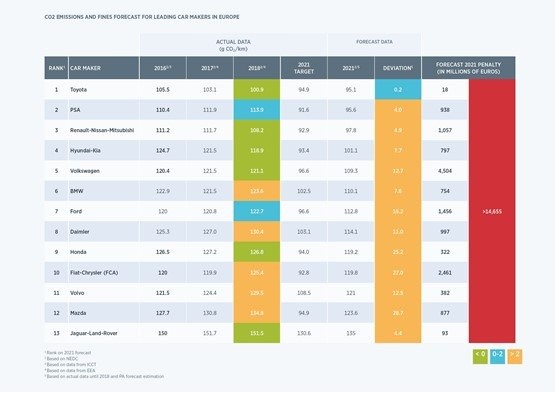
Europe’s 13 top car manufacturers are predicted to miss their 2021 CO2 emissions targets and face fines of more than €14.5bn (£12.5bn), according to analysis by PA Consulting.


The latest figures suggest a backwards step on previous predictions.


Average CO2 emissions have increased across the board, mainly due to an increase in the sale of SUVs, higher-powered and heavier cars, a lack of low-emission options in showrooms and a shifting preference for petrol cars after the diesel scandal.


Michael Schweikl, automotive expert at PA Consulting, says: “Despite this ‘four steps forward, one step back’ situation, the good news is that there are many options open to car makers to reduce emissions and minimise future fines. But the urgency of the situation means they have to act quickly.


“Car makers are running out of time to improve performance quickly enough to avoid fines. Marketing, sales and pricing strategies that increase the take-up of low-emissions vehicles will be essential in getting manufacturers closer to the targets.”


Volkswagen could be fined as much as €4.5bn (£3.86bn) due to its high sales volumes across Europe.


Renault-Nissan-Mitsubishi and Volvo also look set to fall short.


Jaguar Land Rover would face the biggest impact from fines, according to PA’s analysis, facing a bill worth 400% of its 2018 profit.


Manufacturers face a number of options, which include discounting electric and plug-in hybrid vehicles to boost their sales, taking high-polluting vehicles off the market, developing service schemes that increase low-emission vehicle use, exploring mergers with other car makers and developing open platforms to extend electric tech.


PA ranks each manufacturer by its CO2 performance forecast for 2021.


Toyota remains the best performer, PSA is now second, overtaking Renault-Nissan-Mitsubishi. Volvo, Volkswagen, Daimler and BMW are further from their target than last year. Jaguar Land Rover still has the highest CO2 emissions and is now in danger of missing its specific target.


PA’s analysis suggests that car brands would need to sell more than 2.5 million extra battery electric vehicles to stand any chance of meeting their targets, a 1,280% increase by 2021.


Production capacity constraints make this almost impossible – Volkswagen’s new production lines for the ID3, for example, have a capacity to produce 100,000 units in 2020.


From a country perspective, the report reveals all except Norway and the Netherlands saw a worsening in their overall figures.


Norway has reduced emissions from 83.7g CO2/km in 2017 to 72.4g CO2/km in 2018 and sales of electric vehicles accounted for 31.2% of new car sales.


The Netherlands was the second-best performer, but a long way behind Norway, with emissions of 106g CO2/km and sales of fully electric vehicles making up six per cent of the total.


The UK saw a decline in emissions performance from 120.8 CO2/km to 125.1 CO2/km but an increase in electric vehicles sales to 0.7% of all new registrations.


Schweikl added: “Car makers will need to adapt to an enormous change in what they do as they move from the technology of combustion engines to low-emission electric vehicles. While much exciting technological development is already underway, manufacturers cannot underestimate the complexity, cost and cultural change required.”   By Graham Hill thanks to Fleet News

Share My Blogs With Others: These icons link to social bookmarking sites where readers can share and discover new web pages.
  • MisterWong
  • Y!GG
  • Webnews
  • Digg
  • del.icio.us
  • StumbleUpon
  • Reddit
  • Alltagz
  • Ask
  • Bloglines
  • Facebook
  • YahooMyWeb
  • Google Bookmarks
  • LinkedIn
  • MySpace
  • TwitThis
  • Squidoo
  • MyShare
  • YahooBuzz
  • De.lirio.us
  • Wikio UK
  • Print
  • Socializer
  • blogmarks

Survey Reveals The Top Ten Worst Driving Habits

Friday, 17. January 2020

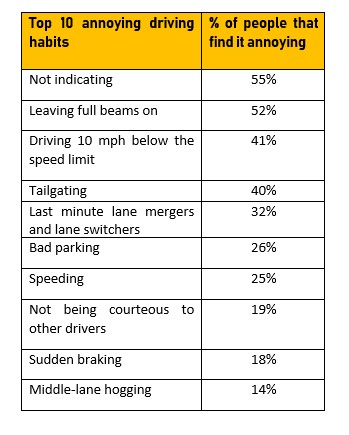
UK drivers have revealed that ‘not indicating’ is the most annoying driving habit.


In a survey compiled by Click4Reg, drivers outlined the top 10 things that regularly irritate them on the road.


Not indicating was voted as the worst driving habit by 55% of respondents.


More than half (52%) also felt that ‘leaving full beams on’ was annoying, placing it second. The study shows that women find this habit more annoying than men (55% of women stated it annoyed them, compared to only 49% of men).


Driving 10 mph below the speed limit seems to infuriate many UK drivers, with 39% finding it frustrating.


Of those that voted in the survey, 87% also admitted doing at least one of the annoying habits.


Looking at the difference between genders, 39% of females stated that their worst driving habit was bad parking while nearly half of men (43%) admitting their worst habit was speeding.


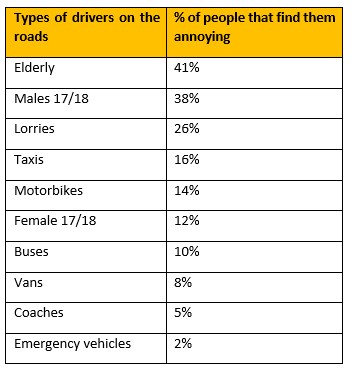
The study also asked its participants which drivers they found most annoying on the roads. Elderly drivers were picked as the most irritating, despite young drivers being much more likely to cause a crash.


Young male drivers were rated the second most annoying and lorry drivers appeared in third, with 26% finding them irritating.


By Graham Hill with thanks to Fleet News and Click4Reg.

Share My Blogs With Others: These icons link to social bookmarking sites where readers can share and discover new web pages.
  • MisterWong
  • Y!GG
  • Webnews
  • Digg
  • del.icio.us
  • StumbleUpon
  • Reddit
  • Alltagz
  • Ask
  • Bloglines
  • Facebook
  • YahooMyWeb
  • Google Bookmarks
  • LinkedIn
  • MySpace
  • TwitThis
  • Squidoo
  • MyShare
  • YahooBuzz
  • De.lirio.us
  • Wikio UK
  • Print
  • Socializer
  • blogmarks

Electric Vehicles Battery Storage To Ease Consumer Electric Peak Demand

Friday, 17. January 2020

The Electric Vehicle Energy Taskforce has made a series of recommendations to enable the efficient integration of electric vehicles (EVs).


The Electric Vehicle Energy Taskforce, which is comprised of 350 organisations, was established in September 2018, following the Zero Emission Vehicle Summit, held in Birmingham.


The Low Carbon Vehicle Partnership was asked to convene and facilitate the work of the Taskforce.


It was charged with making suggestions to Government and industry to ensure that the energy system is ready for and able to facilitate and exploit the mass take up of EVs.


Yesterday, it submitted 21 key proposals to enable the efficient integration of EVs in a new report.


The proposals include:


  • Placing consumer needs at the centre of the EV transition.


  • Providing financial incentives to EV drivers to ensure that the potential energy storage capacity of millions of electric vehicles is used to reduce peak demand.


  • Prioritising ease of access to public charge points and introducing greater standardisation across the charging network to provide easy access for all.


  • Establishing an independent body to promote the benefits of smart charging through a major publicity campaign to ensure EV drivers are confident and well informed.


  • Co-ordinating energy and transport planning to ensure we have the right infrastructure in the right place.


  • An AA Populus survey of more than 17,000 motorists found that the vast majority underestimate their potential monthly savings from running an EV.


The survey found that the average car driver thinks they can save around £30 a month; less than half the actual saving possible.


The same survey found that an overwhelming majority of car drivers believe that easy inter-operability between charge points is a key factor in deciding whether or not drivers will buy an EV.


Philip New, chief executive of the Energy Systems Catapult and the EV Energy Taskforce chair, said: “Ensuring that the mass roll-out of electric vehicles delivers benefits for both drivers and the wider energy system requires actions from industry, Government and the regulator, including creating the new markets and policies that can unlock EVs’ huge potential.”


In order to meet climate change targets, the Government has already announced that conventionally powered cars will be phased out by 2040.


The Committee on Climate Change estimates that the new net zero target could mean that this date will be brought forward. National Grid ESO’s Future Energy Scenarios show that 11.9 million vehicles could be electric by 2030.


The Taskforce expects electric vehicles to become ubiquitous on Britain’s roads, providing a significant challenge – and opportunity – for the UK’s electricity network.


Coordinating the introduction of a smart charging infrastructure will enable network operators to balance demand and supply through an electricity grid increasingly incorporating intermittent renewable energy sources, it says.


EV drivers willing to charge their vehicles during periods of low electricity demand or when surplus renewable energy is being generated will benefit from lower fuel costs in the transition ahead.


Three important recommendations also relate to the correct use of consumers’ personal data and the means to ensure people’s privacy is properly protected and smart charging of EVs is secure.


Minister for the future of transport George Freeman said: “Government commissioned the Taskforce to advise how we can best work with industry to make sure the energy system is ready for the transition to electric vehicles. This report provides important evidence to shape the next stage of our Road to Zero roadmap.”


Business Minister Nadhim Zahawi added: “This report takes us a step closer towards the mass uptake of electric vehicles on our streets – providing guidance to ensure our energy system is prepared for an electric transport revolution and helping consumers top-up their vehicle more cheaply and conveniently on the go.”


Andy Eastlake, LowCVP’s managing director, concluded: “Developing a multi-stakeholder co-ordinated view on what is needed to liberate the electric vehicle smart charging sector has been vital in providing ‘no regret’ proposals to government and industry.”   By Graham Hill thanks to Fleet News

Share My Blogs With Others: These icons link to social bookmarking sites where readers can share and discover new web pages.
  • MisterWong
  • Y!GG
  • Webnews
  • Digg
  • del.icio.us
  • StumbleUpon
  • Reddit
  • Alltagz
  • Ask
  • Bloglines
  • Facebook
  • YahooMyWeb
  • Google Bookmarks
  • LinkedIn
  • MySpace
  • TwitThis
  • Squidoo
  • MyShare
  • YahooBuzz
  • De.lirio.us
  • Wikio UK
  • Print
  • Socializer
  • blogmarks

RAC Patrols Called Out To A Pothole Breakdown Every Hour

Friday, 17. January 2020

The RAC saw a 20% upturn in pothole-related breakdowns in the last quarter of 2019, compared to the same period the year before.


It attended more than 2,000 breakdowns in the three months to the end of 2019 believed to be as a result of potholes – 300 more than during the same period in 2018.


The breakdown data, released to coincide with National Pothole Day, also showed that of all the breakdowns experienced by RAC members in 2019, just short of 9,200 were for pothole-related faults such as distorted wheels, broken suspensions springs and damaged shock absorbers.


While this was down from 13,000 in 2018, a year which saw a dramatic increase in potholes following the so-called ‘Beast from the East’, it still represented 1.1% of all breakdowns attended.


Between October and December 2019, 0.9% of all breakdowns were for pothole-related faults, up from 0.8% in the previous three months (July to September 2019) and up from 0.8% in the fourth quarter of 2018.


RAC head of roads policy Nicholas Lyes said: “We might so far be experiencing a milder but wetter winter than in the last couple of years, but our figures clearly show the problem of potholes has not gone away.


“Our patrols are still attending on average around one pothole-related breakdown every hour of the day.”


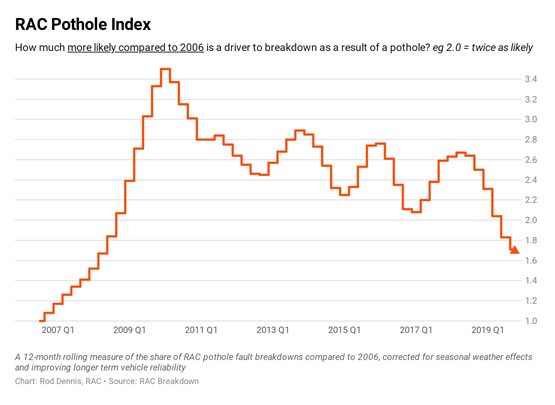
The RAC’s Pothole Index, which is an accurate long-term indicator of the health of the UK’s roads, suggests the widespread problem of potholes and poor-quality roads remains as the Index currently stands at 1.7, down from 1.8 in the third quarter of 2019.


This means drivers are 1.7 times more likely to break down as a result of pothole-related damage than they were back in 2006 when the RAC first started collecting data.


Lyes continued: “We anticipate the Government will pledge further funds to help cash-strapped councils mend potholes in the March Budget, but such pledges are only chipping away at the problem, and they’re unfortunately not addressing the root cause of why so much of the UK is still characterised by crumbling road surfaces.


“What we need is for central Government to think differently about how councils are funded to maintain the roads under their control.


“Short-term commitments of cash, while welcome, are not enough on their own – councils need the security of long-term funding so they can plan proper preventative road maintenance.”


Lyes believes a solution to the UK’s long-term pothole problem is possible. “From this year, the money raised from vehicle excise duty in England will be ring-fenced to help fund motorways and major A-roads over successive five-year periods,” he said. “But as yet, there is no similar model for local roads where the vast majority of drivers begin and end their journeys.


“We believe this could easily be changed by ring-fencing 2p a litre from existing fuel duty revenue to generate £4.7bn of additional funding over five years.


“Pothole-free roads shouldn’t be a ‘nice to have’ in 2020, drivers should surely be able to expect the vast majority of roads they drive on to be of a good standard, especially given they pay around £40bn in motoring-related tax every year.”


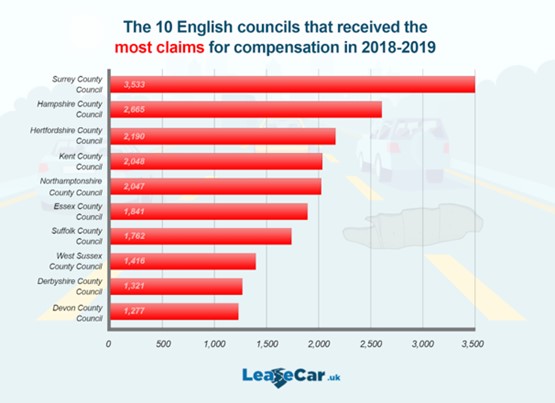
Researchers from car leasing giants LeaseCar.uk have revealed the English councils that received the highest number of compensation requests from vehicle owners due to pothole damage over 2018-2019.


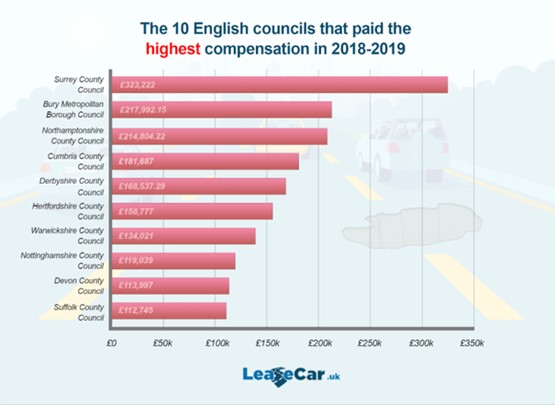
They have also revealed the amounts paid out to motorists, with Surrey topping both lists.


A total of 37,578 relevant claims were made across England during the period in question, with poorly maintained roads meaning councils compensated motorists to the tune of £3.5 million.


Surrey County Council received by far the most claims for pothole damage – 3,533 – and paid out the most in compensation – £323,222.


Hampshire (2,665), Hertfordshire, Kent and Northamptonshire County Councils also faced over 2,000 claims each throughout 2018-2019, with counties such as Essex (1,841) and West Sussex among those comfortably topping 1,000.


Other local authorities paying out substantial amounts of compensation include Bury Metropolitan Borough (£217,992.15) in Greater Manchester.


Cumbria, Derbyshire, Nottinghamshire, Northamptonshire (£214,804.22), Warwickshire, Suffolk and Devon also paid out six figure sums.


The only councils that didn’t have to use a single penny of taxpayers’ money to compensate motorists were the Greater London Boroughs of Islington and Sutton.


Rotherham Metropolitan Borough Council, Sefton Borough Council on Merseyside and St Helens Council were among others to keep compensation for pothole damage to a minimum.


They paid out just £353, £582.60 and £594 respectively, with the local authorities in Harrow, Hounslow, Redbridge and Waltham Forest also received bills of less than £1,000.


Only two claims were issued, meanwhile, against Richmond upon Thames Borough Council – 21 less than any other area in England.


A spokesperson for LeaseCar.uk said: “Taking greater steps to repair and prevent potholes would improve safety for road users and be popular among the voters across the country that councillors are accountable to.


“It could also ultimately reduce councils’ costs by bringing down the number of successful compensation claims by long suffering vehicle owners.


“We’d advise any driver who drives over a significant pothole, or is worried their vehicle may have been damaged, to urgently check their tyres and suspension.”


The data was obtained by Freedom of Information request and covers the period January 1 2018 to October 17 2019.


The full breakdown of English councils and their claims for compensation is available here.


To report a pothole, or to find out if you suffer from damage from one and wonder if you can claim for compensation, visit the RAC’s pothole online guide.


By Graham Hill with thanks to Fleet News

Share My Blogs With Others: These icons link to social bookmarking sites where readers can share and discover new web pages.
  • MisterWong
  • Y!GG
  • Webnews
  • Digg
  • del.icio.us
  • StumbleUpon
  • Reddit
  • Alltagz
  • Ask
  • Bloglines
  • Facebook
  • YahooMyWeb
  • Google Bookmarks
  • LinkedIn
  • MySpace
  • TwitThis
  • Squidoo
  • MyShare
  • YahooBuzz
  • De.lirio.us
  • Wikio UK
  • Print
  • Socializer
  • blogmarks

Electric & Hybrid Car Registrations Exceed 72,000 In 2019

Friday, 17. January 2020

More than 72,000 electric and plug-in hybrid cars were registered in 2019, marking the eighth consecutive year of growth.


Pure electric models accounted for 37,850 registrations, overtaking plug-in hybrids for the first time in the annual sales figures. But still make up less than 2% of the total registrations in 2019.


Combined, alternatively fuelled vehicle (AFV) registrations achieved a record 7.4% market share. However, it was hybrid electric vehicles (HEVs) that were the most popular, with registrations of 97,850 units.


Poppy Welch, head of Go Ultra Low, said: “In the context of the wider new car market, it is encouraging to see plug-in car registrations continue to go from strength-to-strength. Looking at the year ahead, 2020 is set to be another fantastic year for electric car uptake.


“With even more new models being released, ongoing government support, as well as the continued expansion of the public charging infrastructure, we’re confident that the next 12 months will be a landmark year for the nation’s switch to electric.”


2020 has the potential to be another strong year for registrations as a host of models are set to be introduced, including the Peugeot e-208, Volkswagen ID3, Vauxhall Corsa-e, Skoda Citigo-e, and Mini Electric just some of the new cars due to hit the roads.


It is also the year that Benefit-in-kind tax is due to drop to 0% for company car drivers choosing a zero-emission vehicle, increasing demand for EVs among fleet customers substantially.


Grant Shapps, Transport Secretary, said: “I want 2020 to be the year electric cars go mainstream. That’s why we are doubling-down our efforts to make owning an electric vehicle the new normal.”


Towns and cities with the highest electric car registrations


Exeter has been revealed as the UK’s greenest motoring hotspot, with the fastest growth in ultra-low emission vehicle (ULEV) ownership since 2018, up more than 150%, according to registration data analysed by Motorway.co.uk.


According to the data, seven of the top ten local authorities for ULEV registrations since 2018 are London boroughs, with Newham and Waltham Forest seeing annual growth of 114% and 82% respectively.


At the bottom of the green motoring table are Sunderland and Wychavon, a district in Worcestershire, where ULEV numbers have grown less than 7% over the past 12 months.


“These figures show a huge disparity between areas that are embracing greener motoring and areas where take-up of ULEVs is in the slow lane. They highlight the need to focus not just at a national level, but also to confront issues at a regional level in areas where ULEV take-up is lagging behind.


“The government is now under tremendous pressure to encourage motorists to move to electric cars and other forms of ultra-low emissions vehicles in time for the 2040 switchover,” said Alex Buttle, director of Motorway.co.uk.


Top 10 local authorities that have seen the fastest growth in ULEV registrations:


Local Authority Number of ULEVs registered

(Q3-2018)

Number of ULEVs registered

(Q3-2019)

% Increase in ULEVs
Exeter 464 1,194 157.3%
Warwick 414 943 127.8%
Newham 307 657 114.0%
Waltham Forest 330 602 82.4%
Redbridge 525 948 80.6%
Islington 570 1,026 80.0%
Tower Hamlets 559 1,003 79.4%
South Northamptonshire 320 571 78.4%
Barking & Dagenham 255 449 76.1%
Enfield 549 958 74.5%


By Graham Hill with thanks to Fleet News

Share My Blogs With Others: These icons link to social bookmarking sites where readers can share and discover new web pages.
  • MisterWong
  • Y!GG
  • Webnews
  • Digg
  • del.icio.us
  • StumbleUpon
  • Reddit
  • Alltagz
  • Ask
  • Bloglines
  • Facebook
  • YahooMyWeb
  • Google Bookmarks
  • LinkedIn
  • MySpace
  • TwitThis
  • Squidoo
  • MyShare
  • YahooBuzz
  • De.lirio.us
  • Wikio UK
  • Print
  • Socializer
  • blogmarks

Auto Express Warns Of Reduced Car Choice From 2020

Thursday, 9. January 2020

Thanks to manufacturers registering cars like crazy at the end of 2019, now could be the perfect time to buy a new car


Happy New Year – and it has the potential to be a very happy one indeed if you’re one of those people wandering into car showrooms over the next month. The fact is, there may never be a better time to buy a new car than right now, thanks to manufacturers having to register vehicles like crazy in the last few weeks of 2019 – in the hope of selling cleaner ones over the next 12 months and avoiding huge penalties for excess CO2 emissions.


It’s already clear that the market from which we choose which cars to buy, own and drive is going to be radically different at the end of 2020 from how it is now. More than the proliferation of electrified and pure-electric models and, perversely, the continued gains by the SUV, we’re going to see reduced model ranges, with limited supply on less efficient variants as manufacturers actively force the issue on CO2. They can’t afford not to.


It’s reassuring, then, to read in our scoop this week that Skoda plans to offer its upcoming Octavia vRS with a choice of petrol, plug-in hybrid and even diesel. We remain convinced that different powertrains and fuel sources make sense to different buyers.


But it seems likely that this diverse approach isn’t going to be uniform. Indeed, there have been suggestions that we’re heading into a period where car retailers may be actively trying, at a level never experienced before, to push customers away from the cars they want to buy and towards the models the company desperately needs to sell.


Our advice, as always, is to do your so you know which model, engine and trim best suit your lifestyle and budget. Write it down. Keep it at the front of your mind. And stick to your guns. Then you stand every chance of getting the car you want, at a better price than you might expect. By Grahan Hill thanks to Auto Express

Share My Blogs With Others: These icons link to social bookmarking sites where readers can share and discover new web pages.
  • MisterWong
  • Y!GG
  • Webnews
  • Digg
  • del.icio.us
  • StumbleUpon
  • Reddit
  • Alltagz
  • Ask
  • Bloglines
  • Facebook
  • YahooMyWeb
  • Google Bookmarks
  • LinkedIn
  • MySpace
  • TwitThis
  • Squidoo
  • MyShare
  • YahooBuzz
  • De.lirio.us
  • Wikio UK
  • Print
  • Socializer
  • blogmarks