New Code Of Practice For EV Home Charge Points

Thursday, 5. March 2020

The first electric vehicle (EV) code of practice has been launched to ensure that consumers receive fair treatment from domestic charge point installers.


The Electric Vehicle Consumer Code (EVCC) aims to reduce the mis-selling of home energy generating systems such as photovoltaic (PV) and battery storage and improve installation quality.


The code is a voluntary scheme which domestic charge point installation businesses can subscribe to, identifying them as reputable.


The code draws on experience from the Renewable Energy Consumer Code (RECC) for small-scale renewable technologies. Both the Electric Vehicle Consumer Code and the Renewable Energy Consumer Code are administered by Renewable Energy Assurance Limited (REAL).


Virginia Graham OBE, chief executive of Renewable Energy Assurance, said: “RECC has played a foundational role in enforcing high consumer protection standards in the small-scale renewable energy industry since 2006.


“We aim to extend the lessons learnt from that sector into the rapidly-growing world of EV home charge points.”


The launch of the code follows the Government’s announcement made in February that intends to consult on bringing forward the date banning the sale of new internal combustion engine cars and vans from 2040 to 2035.


Transport minister Rachel Maclean said: “Zero emission vehicles are cutting transport emissions and improving air quality, making our communities healthier, better places to live. Having the right rules and regulations on charge point installation standards is important and we want to see industry showing leadership in this area.


“We welcome the Electric Vehicle Consumer Code which aims to protect both people and installers of electric charge points in homes across the UK.”


There are currently around 1,000 businesses in the UK authorised to install domestic charge points through the Government’s Electric Vehicle Homecharge Scheme – one in four of these are also a RECC member.


Nina Skorupska CBE, chief executive at the Renewable Energy Association (REA), said: “The EV charging industry is committed to best practice. Decarbonisation of the UK transport sector is our aim, but to achieve this we need to bring consumers with us on the journey and ensure they are confident about the low-carbon products and services on the market.”


Installer Joju Solar supports the introduction of the Electric Vehicle Consumer Code.


Chris Jardine, technical director of Joju Solar, said: “As an experienced installer of EV home charge points, Joju is well-placed to support this important consumer protection initiative. With the EV charge point sector set to grow exponentially we need to ensure consumers have the confidence they need to play their full part.”  By Graham Hill thanks to Fleet News

Share My Blogs With Others: These icons link to social bookmarking sites where readers can share and discover new web pages.
  • MisterWong
  • Y!GG
  • Webnews
  • Digg
  • del.icio.us
  • StumbleUpon
  • Reddit
  • Alltagz
  • Ask
  • Bloglines
  • Facebook
  • YahooMyWeb
  • Google Bookmarks
  • LinkedIn
  • MySpace
  • TwitThis
  • Squidoo
  • MyShare
  • YahooBuzz
  • De.lirio.us
  • Wikio UK
  • Print
  • Socializer
  • blogmarks

Coronavirus Fears Have Been Given As The Reason For The Drop In Diesel Cost

Thursday, 5. March 2020

Diesel drivers enjoyed the 11th biggest monthly drop in pump prices since 2000, with the price of the fuel falling 4p per litre (ppl) in February, according to RAC Fuel Watch data.


Petrol fell by 3p (2.93p) a litre to 124.02p – its 19th biggest drop in a month. Diesel was down by 4.24p to 127.04ppl, which means the cost of filling up a 55-litre family car with diesel is £2.33 cheaper at £69.87. For petrol it is £1.61p less than it was in January at £68.21.


Asda is leading the way among the big four supermarket fuel retailers by selling petrol for 116.78ppl – 3.5p lower than it was at the start of February and 3.5p cheaper than its closest competitor.


It also reduced diesel by 5.9p to 118.8ppl which makes it 4p cheaper than its nearest rival.


The average price charged for unleaded between all supermarket sites is 119.19ppl and 121.62ppl for diesel – around 5p less than the UK average prices.


The pump price reductions have been driven by a $10 slump in the price of a barrel of oil from a high of $60.28 on 20 February to $50.41 by the close of the month.


Over the course of the whole month though the reduction was far smaller at just $3, with a barrel having started February at $53.48.


As a result, the wholesale price of unleaded dropped to below 90p a litre before delivery, retailer margin and VAT.


The last time a price as low as this was seen was at the end of January 2019 which led to an average UK pump price of around 119ppl – 5p less than the current average.


The diesel wholesale price finished February at 92ppl – the last time this was recorded was at the end of August 2017 which also translated to a forecourt price of around 119ppl – 8ppl lower than the current UK average price for diesel.


RAC is calling on retailers to keep cutting their pump prices so drivers are charged a fair price which properly reflects the large reductions on the wholesale market.


RAC fuel spokesman Simon Williams said: “While it is good drivers are benefitting from lower forecourt prices, in reality the wholesale price is such that the big four supermarkets, which dominate UK fuel retailing, should cut their prices again.


“At the moment both fuels are 6p a litre too expensive which means for petrol we should really be seeing a UK average of 118p.


“Unfortunately, we don’t think diesel will come down to the 2017 price of 119p a litre due to wholesale prices only dropping to 92p a litre briefly as a result of oil suffering its biggest weekly decline in more than four years.”


Williams says that the oil price has slumped due to the spread of the coronavirus prompting fears of slower global demand, which may well lead to a move from oil producer group OPEC and its allies to restrict production when they stage an extraordinary meeting in Vienna on Friday (March 6).


“If they decide to take action to prop up the barrel price it would very likely put an end to falling forecourt fuel prices,” said Williams.


Regional fuel price variation


Regional average unleaded pump prices


Unleaded 03/02/2020 27/02/2020 Change
UK average 126.95 124.02 -2.93
North East 125.63 122.38 -3.25
Yorkshire And The Humber 126.42 123.37 -3.05
West Midlands 127.21 124.17 -3.04
East Midlands 127.33 124.32 -3.01
Scotland 126.16 123.15 -3.01
Wales 125.81 122.83 -2.98
South East 128.06 125.13 -2.93
North West 126.49 123.56 -2.93
East 127.33 124.55 -2.78
London 127.73 125.00 -2.73
South West 126.78 124.06 -2.72
Northern Ireland 124.45 122.00 -2.45

Regional average diesel pump prices

Diesel 03/02/2020 27/02/2020 Change
UK average 131.28 127.04 -4.24
North East 129.85 125.29 -4.56
Wales 130.70 126.26 -4.44
North West 130.75 126.37 -4.38
East 132.02 127.67 -4.35
Scotland 130.87 126.61 -4.26
Yorkshire And The Humber 130.70 126.48 -4.22
East Midlands 131.54 127.33 -4.21
South East 132.51 128.31 -4.20
West Midlands 131.39 127.22 -4.17
South West 131.45 127.37 -4.08
London 131.69 127.68 -4.01
Northern Ireland 128.34 124.59 -3.75


Share My Blogs With Others: These icons link to social bookmarking sites where readers can share and discover new web pages.
  • MisterWong
  • Y!GG
  • Webnews
  • Digg
  • del.icio.us
  • StumbleUpon
  • Reddit
  • Alltagz
  • Ask
  • Bloglines
  • Facebook
  • YahooMyWeb
  • Google Bookmarks
  • LinkedIn
  • MySpace
  • TwitThis
  • Squidoo
  • MyShare
  • YahooBuzz
  • De.lirio.us
  • Wikio UK
  • Print
  • Socializer
  • blogmarks

Latest Car Registrations Show A Drop With Calls For More Incentives To Go EV

Thursday, 5. March 2020

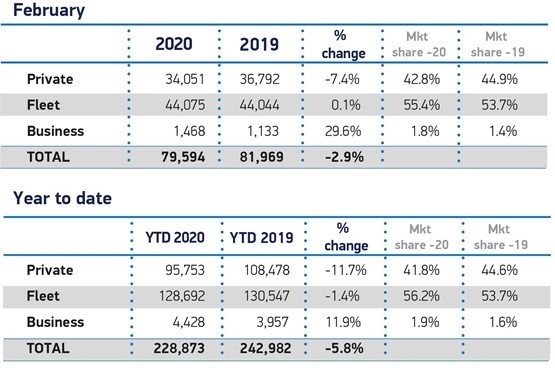
Fleet and business new car registrations fell slightly in February, when compared to the same month last year, according to data published today by the Society of Motor Manufacturers and Traders (SMMT).


There were 45,543 new cars registered to fleet and business in the month, an increase of about 1% on February 2019.


Year-to-date fleet and business new car registrations stand at 133,120 units, a 1% decline when compared to last year.


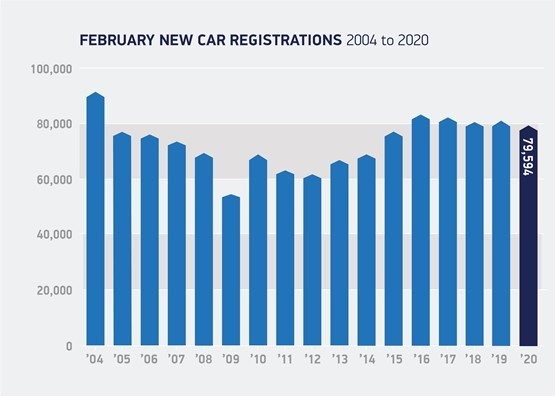
Overall, the UK new car market declined 2.9% in February, with 79,594 models were registered in the month. Registrations by private buyers were responsible for the bulk of the overall loss, down some 7.4% as 2,741 fewer people took delivery of new cars.


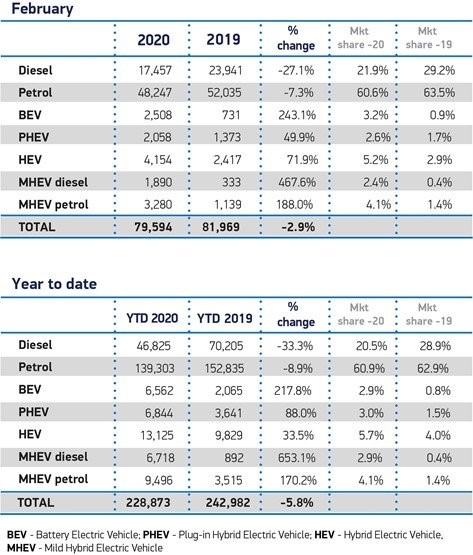
Demand for both diesel and petrol cars fell in the month, with registrations down 27.1% and 7.3% respectively, with diesel now accounting for just over a fifth of sales (21.9%).


Hybrids (HEVs) recorded an uplift of 71.9% to 4,154 units, while registrations of zero emission capable cars also continued to enjoy growth, with battery electric vehicles (BEVs) rising more than three-fold to 2,508 units and plug-in hybrids (PHEVs) up 49.9% to 2,058.


However, these vehicles still make up just 5.8% of the market; and BEVs only 3.2%, showing the scale of the challenge ahead.


The news comes as SMMT calls on the Chancellor to use next week’s Budget to announce bold new measures to make new-tech zero emission-capable cars, including plug-in hybrids, more affordable for mass market buyers.


In 2020, manufacturers will bring more than 23 new battery electric and 10 plug-in hybrid electric cars to the UK to add to the more than 65 already on sale, but take up of these new models depends on affordability and the provision of adequate charging infrastructure.


SMMT is calling for the removal of VAT from all new battery electric, plug-in hybrid electric and hydrogen fuel cell electric cars – a move which would cut the purchase price of an average family battery electric run-around by some £5,600.


Combined with additional measures, including the long term continuation of the critical plug-in car grant at current levels and its reintroduction for plug-in hybrids; and exemption from VED and insurance premium tax, the upfront cost of these vehicles could be cut by as much as £10,000, helping to deliver greater cost parity with conventionally powered vehicles and making them a viable option for many more buyers, it says.


Based on current market forecasts, SMMT calculations show that the removal of VAT could increase sales of battery electric cars alone to just under one million between now and 2024, resulting in an additional CO2 saving of 1.2 million tonnes over this period.


However, this must be part of a comprehensive package of incentives implemented alongside substantial investment in charging infrastructure to ensure a sustainable transition for consumers and businesses of all incomes, regions and lifestyles, it says.


Only by addressing both these issues can the government’s accelerated ambitions for zero emission vehicle sales be met.


Mike Hawes, SMMT chief executive, said: “Another month of decline for the new car market is especially concerning at a time when fleet renewal is so important in the fight against climate change.


“Next week’s Budget is the Chancellor’s opportunity to reverse this trend by restoring confidence to the market and showing that government is serious about delivering on its environmental ambitions.


“Industry has invested in the technology, with a huge influx of new zero- and ultra-low emission models coming to market in 2020, and we now need Government to match this with a comprehensive package of incentives and infrastructure spending to accelerate demand.


“To drive the transition to zero emission motoring, we need carrots, not sticks – as the evidence shows, talk of bans and penalties only means people hang on to their older, more polluting vehicles for longer.


“It’s time for a change of approach, which means encouraging the consumer to invest in the cleanest new car that best suits their needs.


“If that is to be electric, Government must take bold action to make these vehicles more affordable and as convenient to recharge as their petrol and diesel equivalents are to refuel.”


Michael Woodward, UK automotive lead, Deloitte, believes the key to maintaining growth of EVs will be investment in the supporting infrastructure.


“Where consumers were once deterred by battery range anxiety, this has now shifted to charging anxiety with access to charging now being seen as the biggest barrier to buying a full EV for UK customers,” he said.


“Manufacturers are doing their part by bringing new models to the market and adding range to batteries. What consumers need now is clarity on joined-up, long-term infrastructure development and continued financial incentives could be key to future EV growth.”


Jon Lawes, managing director at Hitachi Capital Vehicle Solutions, concluded: “The industry will be eagerly anticipating the Government’s Spring Budget next week, where further measures to support the transition to zero-emission vehicles are expected to be announced.


“As SMMT calculations have shown, the removal of VAT on electric and hybrid vehicles is one step that could support this transition, however, for any solution to be effective, clarity on considerations including Clean Air Zones, infrastructure investment and plug-in car grant incentives will also be pivotal to help achieve the UK’s zero emission targets.”


By Graham Hill thanks to Fleet News

Share My Blogs With Others: These icons link to social bookmarking sites where readers can share and discover new web pages.
  • MisterWong
  • Y!GG
  • Webnews
  • Digg
  • del.icio.us
  • StumbleUpon
  • Reddit
  • Alltagz
  • Ask
  • Bloglines
  • Facebook
  • YahooMyWeb
  • Google Bookmarks
  • LinkedIn
  • MySpace
  • TwitThis
  • Squidoo
  • MyShare
  • YahooBuzz
  • De.lirio.us
  • Wikio UK
  • Print
  • Socializer
  • blogmarks

Electric Vehicle Charge Points At Supermarkets Increases Substantially

Thursday, 5. March 2020

For years I’ve suggested that supermarket car parks are the best place for EV chargers to be installed. Unlike street parking and normal car parks visitors to supermarket car parks are very short term ranginf from just 15 minutes to an hour and a half.


From the supermarket’s point of view it generates extra income, keeps shoppers in the shop for longer and at times when the shops would be fairly empty, in the evenings, those wanting to charge their cars would be encouraged to shop outside of peak times, so I’m pleased to see the increase.


Here’s the report:


The number of electric vehicle (EV) charge points at supermarkets has doubled in the last two years, according to data analysed by Zap-Map and the RAC.


Research shows 542 EV charger units were installed by supermarkets from the end of October 2017 to the end of 2019, taking the total on their sites to 1,115 – a growth of 95%.


This means 6.5% of all the UK’s public charge points are located at supermarkets, with growth in-line with the overall growth of public charge points.


The number of stores offering charging facilities has also doubled with 608 supermarket sites now catering for battery electric and plug-in hybrid vehicles which equates to 5% of all supermarkets.


When looking at each supermarket’s store portfolios, Asda has the greatest proportion of locations where an EV can be charged – 122 of its 633 sites (19%).


Morrisons is in second spot with EV charging available at 89 of its 494 stores (18%), while Waitrose comes in third place with 14% – 49 of 349 stores.


Tesco currently only has 4% of stores with charging capability but it has highest total number of stores with charging facilities (142 of 3,961 stores).


An initiative by Volkswagen, Tesco and Pod Point has seen its free to use EV charging points installed in 100 stores.


Launched last year, the partnership aims to install around 2,400 complimentary charging points for electric vehicles (EVs) installed in Tesco store carparks.


Currently, 15% of supermarket charge points are capable of rapid charging. Morrisons leads the way with 84 rapid chargers, making for 59% of its total number of chargers. Lidl is second with 63% of its 76 units (48) equipped with rapid charging. Co-op is in third with 18% of 88 chargers (16) capable of delivering its EV-owning customers with a rapid charge.


Melanie Shufflebotham, co-founder of Zap-Map, said: “It is very encouraging to see supermarkets increasingly embracing electric vehicle charging at their stores with a dramatic shift in the number of chargers being installed over the course of the last two years.


“Our research shows that while the majority of charging is done at home, most EV drivers use the public network more than once a month. While a robust rapid infrastructure across the country is essential for longer journeys, having charge points in supermarkets provides EV drivers an excellent way to ‘graze‘ energy while doing an everyday task.


“With 89% of EV drivers taking the availability of charge points into account when selecting their parking, providing charging can be a real differentiator locally in the competitive supermarket sector. This seems to be recognised by some supermarkets, notably Tesco and Sainsbury’s, providing EV charging for free.”  By Graham Hill thanks to Fleet News

Share My Blogs With Others: These icons link to social bookmarking sites where readers can share and discover new web pages.
  • MisterWong
  • Y!GG
  • Webnews
  • Digg
  • del.icio.us
  • StumbleUpon
  • Reddit
  • Alltagz
  • Ask
  • Bloglines
  • Facebook
  • YahooMyWeb
  • Google Bookmarks
  • LinkedIn
  • MySpace
  • TwitThis
  • Squidoo
  • MyShare
  • YahooBuzz
  • De.lirio.us
  • Wikio UK
  • Print
  • Socializer
  • blogmarks

Safety Body Warns Of Dangers If Cars Are Not Properly Serviced And Maintained

Thursday, 5. March 2020

Whilst the report was aimed at business users it also applies to consumers so worth reading what Brake, the safety body has to say.


Failure to comply with basic vehicle standards can result in tragic consequences, according to the latest report released by Brake’s Global Fleet Champions.


‘Vehicle maintenance and mechanics’ outlines the consequences of not complying with vehicle standards and explains how to improve maintenance and checking procedures to ensure vehicles remain a valuable resource.


The report outlines that regular checking and servicing of safety-critical components such as brakes and tyres can fix small problems early on, removing the need for costly repairs and expensive insurance claims.


John Eastman from the Institute of Road Transport Engineers believes that fleet managers should take a systematic approach towards the maintenance of vehicles. He said that preventative maintenance has several benefits, not least the improved safety, reliability and wellbeing of people who drive for work and other road users.


The report also features advice from Autoglass, who advises fleet managers on how to effectively maintain advanced driver-assistance systems (ADAS) to ensure the technology works effectively.


Jeremy Rochfort, national sales manager for Autoglass said: “The adoption rate of ADAS in fleet vehicles is much higher as fleet cars tend to be newer and come with up-to-date safety features. However, our research shows that keeping up to date with technology ranks low down on fleet decision-maker’s priorities.


“That’s why we’re committed to educating the fleet industry on the importance of ADAS calibration and investing in our technical expertise and capabilities to ensure we can match the rising demand for these services.”


The report follows the recent release of the road safety report launched by Brake.


Global Fleet Champions is a not-for-profit global campaign to prevent crashes and reduce pollution caused by vehicles used for work purposes. ByGraham Hill thanks to Fleet News

Share My Blogs With Others: These icons link to social bookmarking sites where readers can share and discover new web pages.
  • MisterWong
  • Y!GG
  • Webnews
  • Digg
  • del.icio.us
  • StumbleUpon
  • Reddit
  • Alltagz
  • Ask
  • Bloglines
  • Facebook
  • YahooMyWeb
  • Google Bookmarks
  • LinkedIn
  • MySpace
  • TwitThis
  • Squidoo
  • MyShare
  • YahooBuzz
  • De.lirio.us
  • Wikio UK
  • Print
  • Socializer
  • blogmarks

Government To Give Cash To Local Authorities To Fix Roads

Thursday, 5. March 2020

Just as I noticed that a lot of our local pot holes had been filled I read, not before time, that the Government has finally taken some action, albeit nothing like enough.


The Government has awarded 32 local authorities a share of £93.4 million to repair roads and bridges.


A further £900,000 will fund scientists, innovators, academics and tech-focused start-ups to research new ways to future proof the UK’s roads.


One of the projects to receive funding for tech projects will see the development of a new AI-powered app to detect potholes in real-time, using mobile phone sensors to measure when cyclists ride over or swerve to avoid them.


It is hoped the app will help local authorities to quickly identify when potholes are forming and take quicker action to fill them.


Another project known as Shape-Pot will create 3D pothole models to create a fully autonomous repair platform capable of automatic, uniform repairs – accelerating the transport network of the future.


Senior lecturer at the University of Liverpool Paolo Paoletti said: “The Shape-Pot project has the potential to change the way roads and their defects are managed, promoting a data-driven approach to management and improving efficiency – making roads safer and more accessible.


“Thanks to the T-TRIG funding, the team will create a proof-of-principle autonomous robotic platform to characterise road surface, a first step toward autonomous maintenance of roads.”


The Freight Transport Association (FTA) welcomed the investment. Christopher Snelling, head of UK policy at FTA, said: “Businesses within the logistics sector rely on efficient, effective road networks to keep goods moving across the UK, but too often, these operators are forced to travel along damaged, congested roads which increase journey times and can cause costly damage to vehicles.


“These businesses are paying the price for an ongoing lack of investment in the road network; the performance of the UK economy has also suffered as a result.”


However, he said it was “disappointing” that the funding package fell short of being able to tackle the poor state of roads across the nation.


“Taxes on UK road transport are the highest in Europe,” continued Snelling. “HGVs alone pay enough tax to fund more than 90% of the current amount spent on road maintenance in the UK.


“More investment is needed urgently and we hope that this is the first step in the creation and completion of a more comprehensive road improvement strategy.” By Graham Hill Thanks To Fleet News.

Share My Blogs With Others: These icons link to social bookmarking sites where readers can share and discover new web pages.
  • MisterWong
  • Y!GG
  • Webnews
  • Digg
  • del.icio.us
  • StumbleUpon
  • Reddit
  • Alltagz
  • Ask
  • Bloglines
  • Facebook
  • YahooMyWeb
  • Google Bookmarks
  • LinkedIn
  • MySpace
  • TwitThis
  • Squidoo
  • MyShare
  • YahooBuzz
  • De.lirio.us
  • Wikio UK
  • Print
  • Socializer
  • blogmarks

Tesla Driver Dies On Autopilot Playing A Game On Phone

Thursday, 27. February 2020

An investigation into a fatal crash involving a Tesla Model X being driven on autopilot in Mountain View, Calfornia, has found that the driver was distracted using his mobile phone.


The National Transportation Safety Board (NTSB) held a public board meeting on Tuesday ( February 25) during which it determined the probable cause for the fatal March 23, 2018, crash.


Based on the findings of its investigation the NTSB issued a total of nine safety recommendations whose recipients include the National Highway Traffic Safety Administration, the Occupational Safety and Health Administration, SAE International, Apple and other manufacturers of portable electronic devices.


The NTSB also reiterated seven previously issued safety recommendations.


The NTSB determined the Tesla autopilot system’s limitations, the driver’s overreliance on the autopilot and the driver’s distraction – likely from a mobile phone game app – caused the crash.


It found that the Tesla vehicle’s ineffective monitoring of driver engagement was determined to have contributed to the crash.


Systemic problems with the California Department of Transportation’s repair of traffic safety hardware and the California Highway Patrol’s failure to report damage to a crash attenuator led to the Tesla striking a damaged and non-operational crash attenuator, which the NTSB said contributed to the severity of the driver’s injuries.


“This tragic crash clearly demonstrates the limitations of advanced driver assistance systems available to consumers today,” said NTSB chairman Robert Sumwalt.


“There is not a vehicle currently available to US consumers that is self-driving. Period. Every vehicle sold to US consumers still requires the driver to be actively engaged in the driving task, even when advanced driver assistance systems are activated.


“If you are selling a car with an advanced driver assistance system, you’re not selling a self-driving car. If you are driving a car with an advanced driver assistance system, you don’t own a self-driving car.”


He continued: “In this crash we saw an overreliance on technology, we saw distraction, we saw a lack of policy prohibiting cell phone use while driving, and we saw infrastructure failures that, when combined, led to this tragic loss.


“The lessons learned from this investigation are as much about people as they are about the limitations of emerging technologies.


“Crashes like this one, and thousands more that happen every year due to distraction, are why ‘Eliminate Distractions’ remains on the NTSB’s Most Wanted List of Transportation Safety Improvements.”


The 38-year-old driver of the 2017 Tesla Model X P100D electric vehicle (EV) died from multiple blunt-force injuries after his SUV entered the gore area of the US-101 and State Route 85 exit ramp and struck a damaged and non-operational crash attenuator at a speed of 70.8 mph.


The Tesla was then struck by two other vehicles, resulting in the injury of one other person.


The Tesla’s high-voltage battery was breached in the collision and a post-crash fire ensued. Witnesses removed the Tesla driver from the vehicle before it was engulfed in flames.


The NTSB learned from Tesla’s ‘Carlog’ data (data stored on the non-volatile memory SD card in the media control unit) that during the last 10 seconds prior to impact the Tesla’s autopilot system was activated with the traffic-aware cruise control set at 75 mph.


Between six and 10 seconds prior to impact, the SUV was traveling between 64 and 66 mph following another vehicle at a distance of about 83 feet.


The Tesla’s lane-keeping assist system (autosteer) initiated a left steering input toward the gore area while the SUV was about 5.9 seconds and about 560 feet from the crash attenuator.


No driver-applied steering wheel torque was detected by autosteer at the time of the steering movement and this hands-off steering indication continued up to the point of impact.


The Tesla’s cruise control no longer detected a lead vehicle ahead when the SUV was about 3.9 seconds and 375 feet from the attenuator, and the SUV began accelerating from 61.9 mph to the preset cruise speed of 75 mph.


The Tesla’s forward collision warning system did not provide an alert and automatic emergency braking did not activate. The SUV driver did not apply the brakes and did not initiate any steering movement to avoid the crash.


The driver was an avid gamer and game developer. A review of mobile phone records and data retrieved from his Apple iPhone 8 Plus showed a game application was active and was the frontmost open application on his phone during his trip to work.


The driver’s lack of evasive action combined with data indicating his hands were not detected on the steering wheel, is consistent with a person distracted by a portable electronic device.


Seven safety issues were identified in the crash investigation:


Seven safety issues were identified in the crash investigation:

  • Driver Distraction
  • Risk Mitigation Pertaining to Monitoring Driver Engagement
  • Risk Assessment Pertaining to Operational Design Domain (the operating conditions under which a driving automation system is designed to function)
  • Limitations of Collision Avoidance Systems
  • Insufficient Federal Oversight of Partial Driving Automation Systems
  • Need for Event Data Recording Requirements for Driving Automation Systems
  • Highway Infrastructure Issues

To address these safety issues the NTSB made nine safety recommendations that seek:

  • Expansion of NHTSA’s New Car Assessment Program testing of forward collision avoidance system performance.
  • Evaluation of Tesla autopilot- equipped vehicles to determine if the system’s operating limitations, foreseeability of misuse, and ability to operate vehicles outside the intended operational design domain pose an unreasonable risk to safety.
  • Collaborative development of standards for driver monitoring systems to minimize driver disengagement, prevent automation complacency and account for foreseeable misuse of the automation.
  • Review and revision of distracted driving initiatives to increase employers’ awareness of the need for strong cell phone policies prohibiting portable electronic device use while driving.
  • Modification of enforcement strategies for employers who fail to address the hazards of distracted driving.
  • Development of a distracted driving lock-out mechanism or application for portable electronic devices that will automatically disable any driver-distracting functions when a vehicle is in motion.
  • Development of policy that bans nonemergency use of portable electronic devices while driving by all employees and contractors driving company vehicles, operating company issued portable electronic devices or when using a portable electronic device to engage in work-related communications.

Lessons learned from the emergency response to the post-crash fire will be incorporated into a separate NTSB report on electric vehicle battery fires. That report is expected to be released in the third quarter of calendar year 2020.  By Graham Hill thanks to Fleet News

Share My Blogs With Others: These icons link to social bookmarking sites where readers can share and discover new web pages.
  • MisterWong
  • Y!GG
  • Webnews
  • Digg
  • del.icio.us
  • StumbleUpon
  • Reddit
  • Alltagz
  • Ask
  • Bloglines
  • Facebook
  • YahooMyWeb
  • Google Bookmarks
  • LinkedIn
  • MySpace
  • TwitThis
  • Squidoo
  • MyShare
  • YahooBuzz
  • De.lirio.us
  • Wikio UK
  • Print
  • Socializer
  • blogmarks

The Truth About The Cost Of Charging Electric Vehicles, – Shocking (get it?)

Thursday, 27. February 2020

The cost of using a public charge point can vary by as much as nine times depending when and where the vehicle is recharged, research from the RAC Foundation suggests.


The analysis, available here, shows overnight charging at home can typically be done for as little as 8p per kWh but can be as high as 69p per kWh at a public rapid charge point.


This means that the fuel costs for a 100-mile journey in a 2018 Nissan Leaf could be anywhere between £2.67 and £23.


By comparison – based on official fuel consumption figures – the same journey in a 1.5 litre petrol-engine Ford Focus would cost around £12 in fuel, while a similar Ford Focus with a diesel engine might do it using around £10 of fuel.


The RAC Foundation research comes as What Car? reveals its own analysis. It found that a driver would pay £45.89 to charge an Audi E-tron from 10% to 80% at an Ionity ultra-rapid charger.


However, do the same charge on a domestic charger at an average night-time energy tariff of 7p per kWh and it would cost £4.66.


Using the Ionity charging network makes the E-tron even pricier to run than an equivalent diesel Audi Q7, says What Car?


The E-tron costs 34p per mile, while a Q7 50 TDI, which averages 27.2mpg, costs 22p per mile.


Ionity is one of a small number of extremely fast 350kW charging networks, capable of replenishing an EVs batteries in 30-40 minutes.


However, some slower public charging networks are also far pricier than charging at home, says What Car?


Getting the same battery boost for an E-tron at both a 50kW Shell Recharge point and a 50kW Ecotricity socket costs £25.94, although Ecotricity rates are cheaper for its home energy customers.


What Car? found that car owners who regularly need to use public charging networks could save money by signing up for a scheme with a one-off or a monthly fee because these often have a lower energy usage rate.


Sign up for a Source London Full plan and it will cost £4 a month, but just £6.32 every time you charge your car up.


Consumers also need to watch out for the hidden costs of using public chargers. Some EV-charger equipped car parks in London charge £9 per hour for parking with no discount for those using the chargers, and What Car?’s research found overstay fees levied by charging networks to discourage that ranged from £10 to £21 per hour.


Steve Gooding, director of the RAC Foundation, said: “Consumers are so sensitive to the cost of filling-up that petrol and diesel prices are routinely displayed to the tenth of a penny.


“Even at the extremes there is unlikely to be more than a 30-40% price differential between the keenest supermarket and the most expensive motorway service area. Not so with electricity. The cost of recharging your battery-powered car can differ dramatically with prices highly dependent on where and when you plug-in, what speed you recharge at and who is operating the facility and providing the power.


“The good news is that overnight charging at domestic rates at home can cost as little as a few pence per kilowatt hour.


“However, contrast that with the dizzying news that you could pay as much as ten times that if you decide to ‘fill up’ at certain ultra-rapid chargepoints on the motorway network.


“The canny consumer is going to have a good deal more homework to make sure their electric car delivers the scale of savings they’re expecting.”


What Car? editor Steve Huntingford added: “Although there are still a lot of slow (3kW) public charging points that are free to use, you’ll have to pay if you want a quick energy fix. And this is where the costs can rack up if you don’t research the various networks in advance.”


What Car? examples of public charging costs for an Audi E-tron


Network Cost per kWh 10-80% charge
Ionity (350kW) £0.69 £45.89
Polar Contactless (150kW) £0.40 £26.60


Ecotricity (22kW, 43kW, 50kW) £0.39 £25.94
Shell Recharge (50kW, 150kW) £0.39 £25.94
Instavolt (50kW to 125kW) £0.35 £23.28
Polar Instant (150kW) £0.35 £23.28
Genie Point (43kW, 50kW) £0.30 £20.95^
Polar Contactless (43kW, 50kW) £0.30 £19.95
ESV EV Solutions (43kW, 50kW) £0.29 £19.29
ESV EV Solutions (43kW, 50kW) £0.25 £16.63<
Polar Instant (43kW, 50kW) £0.25 £16.63
Pod Point (43kW, 50kW) £0.23 £15.30
Charge Your Car*** (43kW, 50kW) 25p per min £13.85*
Ubitricity (5.5kW) £0.20 £13.45>
Polar Plus (150kW) £0.20 £13.30**
Ecotricity domestic customers £0.19 £12.64
Polar Plus (43kW, 50kW) £0.15 £9.98**
Source London Flexi (22kW) £0.12 £7.91***
Source London Full (22kW) £0.10 £6.32


^ includes £1.00 fee per charge; < £4.00 monthly fee; *kWh rates vary depending on location; > £9.99 monthly fee, plus £0.15 per charge; ** £7.85 monthly fee; ***£10.00 sign-up fee.


By Graham Hill thanks to Fleet News

Share My Blogs With Others: These icons link to social bookmarking sites where readers can share and discover new web pages.
  • MisterWong
  • Y!GG
  • Webnews
  • Digg
  • del.icio.us
  • StumbleUpon
  • Reddit
  • Alltagz
  • Ask
  • Bloglines
  • Facebook
  • YahooMyWeb
  • Google Bookmarks
  • LinkedIn
  • MySpace
  • TwitThis
  • Squidoo
  • MyShare
  • YahooBuzz
  • De.lirio.us
  • Wikio UK
  • Print
  • Socializer
  • blogmarks

New 20mph Speed Limit To Be Introduced In London From Next Week

Thursday, 27. February 2020

Transport for London (TfL) will be introducing a new 20mph speed limit across 8.9km of the capital’s roads within the Congestion Charging Zone from Monday (March 2).


TfL will recalibrate all the speed cameras and a dedicated Metropolitan Police speed enforcement team will target speeding drivers across London from April.


Speed is a factor in around 37% of collisions in London where a person dies or is seriously injured, which is why reducing the speed limit is key to the Mayor’s Vision Zero commitment to eliminate death and serious injury from London’s transport network, says TfL.


The Mayor of London, Sadiq Khan, said: “I am absolutely determined to do everything I can to eradicate all deaths and serious injuries on London’s roads and these new measures are a vital step along the way to helping us to achieve this.


“By cutting speed limits on TfL’s roads within the Congestion Zone we are saving lives, while at the same time making our streets more appealing for Londoners to walk and cycle around the capital.”


Andy Cox, Metropolitan Police Detective Superintendent, added: “Excessive speed unfortunately remains a common cause of serious and fatal collisions across London and the consequences can be devastating for those involved and their families.


“Safe speeds are key to achieving the Vision Zero ambition and it’s vital that those driving or riding on our roads respect the law on speed limits. We will actively target speeding and dangerous drivers and ensure they are dealt with robustly.”


Figures from 2016, 2017 and 2018 show 131 people were killed in speed-related collisions on London’s streets.


A further 2,256 people were reported as seriously injured in collisions where speed was recorded as a contributory factor.


Cutting speeds from 30mph to 20mph significantly reduces the likelihood and severity of these collisions, saving lives, says TfL.


People walking and cycling are particularly vulnerable to speeding vehicles and nine pedestrians have already tragically died on London’s roads this year.


Jeremy Leach, London Campaign coordinator for 20’s Plenty, said: “Getting maximum speeds down to 20mph has a huge impact on making roads feel and be safe for all Londoners and 20’s Plenty is really pleased that reducing speeds is right at the heart of TfL’s plans for safe streets across London. This though is only the first part of a wider programme to tackle the dangers that speeding causes to us all.


“We look forward to news of more 20mph limits on TfL’s Red Route roads and more encouragement for the last few London boroughs to go 20, all supported by the huge commitment that the Metropolitan Police are putting into tackling speeding drivers.”


The changes mirror the lower speed limits already in place across many borough roads in central London.


A new TfL marketing campaign will focus on the changes coming into force on 2 March, highlighting the importance of lower speeds and encouraging road users to comply with the new 20mph speed limits. The campaign is live across radio, print and digital advertising.


Over the next five years, TfL will work with boroughs and the public to introduce lower speed limits more widely across the capital.


TfL aims to introduce safer speed limits across a further 140km of its road network, focusing on high-risk sections of road, town centres where people walk and cycle, and streets neighbouring ambitious local speed reduction programmes led by London boroughs.


Achieving lower speeds in London is vital for achieving TfL’s Vision Zero commitment to eliminate deaths and serious injuries from the transport network by 2041.  By Graham Hill thanks to Fleet News

Share My Blogs With Others: These icons link to social bookmarking sites where readers can share and discover new web pages.
  • MisterWong
  • Y!GG
  • Webnews
  • Digg
  • del.icio.us
  • StumbleUpon
  • Reddit
  • Alltagz
  • Ask
  • Bloglines
  • Facebook
  • YahooMyWeb
  • Google Bookmarks
  • LinkedIn
  • MySpace
  • TwitThis
  • Squidoo
  • MyShare
  • YahooBuzz
  • De.lirio.us
  • Wikio UK
  • Print
  • Socializer
  • blogmarks

Tracker Reveals The UK’s Most Stolen Vehicles – Very Interesting!

Thursday, 27. February 2020

The Range Rover Sport was the number one choice for thieves in 2019, jumping from eighth place in the Tracker Most Stolen and Recovered League Table in 2018.


It replaces the BMW X5 which topped the chart in 2018 and now sits at number two. This in turn, has pushed the 2018 number two, the Mercedes-Benz C Class, to third place in 2019.


Range Rover, BMW and Mercedes-Benz dominate the Tracker league table in 2019.


Furthermore, analysis of theft data recorded by Tracker reveals that 92% of the cars it recovered last year were taken without using the keys. This is an increase from 2018’s figure which stood at 88% and a worrying increase of 26% compared with four years ago. The figure in 2016 stood at 66%.


“Our data has revealed that keyless car theft continues to rise, with nine out of 10 of the stolen cars we recovered in 2019 taken this way,” explained Clive Wain, head of police liaison for Tracker.


“Thieves exploit keyless technology by using sophisticated equipment, which can hijack the car key’s signal from inside an owner’s home and remotely fool the system into unlocking the doors and start the engine. This is commonly known as a relay attack.”


To help prevent car owners falling victim to keyless car theft, traditional visual deterrents, such as crook locks and wheel clamps can help deter thieves and are a good investment to make, according to Wain.


However, he said: “In the event of a car being stolen, vehicle tracking technology will not only help police close the net on thieves but see a stolen vehicle returned to its rightful owner.”


Premium vehicles are frequently stolen to order by organised criminal groups. The cars are often shipped abroad, predominantly to Eastern Europe and North Africa.


The most expensive vehicle recovered by Tracker in 2019 was a Range Rover SV Autobiography, valued at £150,000. However, cars at the lower end of the market are still a target, with a VW Polo valued at £575 being the least expensive car recovered.


“Thanks to our long-standing working relationship with all UK police forces, 54 suspected thieves were arrested in connection with the vehicles we recovered last year,” continued Wain. “In addition to the vehicles recovered by Tracker, 67 other non-Tracker fitted stolen vehicles were also found as a result.”


Top Models Stolen & Recovered in 2019


  1. Range Rover Sport


  1. BMW X5


  1. Mercedes-Benz C Class


  1. Range Rover Vogue


  1. Land Rover Discovery


  1. BMW X6


  1. Range Rover Evoque


  1. BMW 3 Series


  1. Range Rover Autobiography


  1. Mercedes E Class


Top Models Stolen & Recovered in 2019


  1. BMW X5


  1. Mercedes-Benz C Class


  1. BMW 3 Series


  1. Mercedes E Class


  1. BMW 5 Series


  1. Range Rover Vogue


  1. Land Rover Discovery


  1. Range Rover Sport


  1. Mercedes S Class


  1. Mercedes GLE


By Graham Hill thanks to Fleet News

Share My Blogs With Others: These icons link to social bookmarking sites where readers can share and discover new web pages.
  • MisterWong
  • Y!GG
  • Webnews
  • Digg
  • del.icio.us
  • StumbleUpon
  • Reddit
  • Alltagz
  • Ask
  • Bloglines
  • Facebook
  • YahooMyWeb
  • Google Bookmarks
  • LinkedIn
  • MySpace
  • TwitThis
  • Squidoo
  • MyShare
  • YahooBuzz
  • De.lirio.us
  • Wikio UK
  • Print
  • Socializer
  • blogmarks