Widespread Criticism Of The Government’s Cut In EV Grant

Friday, 17. December 2021

The decision to cut the plug-in car and van grant by up to £1,000 and change the eligibility criteria has been criticised by the fleet and leasing industry.

The Department for Transport (DfT) said the reduction would make its “available funding go further” and help more businesses and consumers make the switch.

Announcing its Net Zero Strategy in October, the Government confirmed £620 million funding for zero emission vehicle grants and EV infrastructure, including funding for local EV infrastructure, with a focus on local on street residential charging.

The additional money for the plug-in grant, however, came after ministers said the grant would reduce as electric vehicle (EV) adoption rates increase.

It also warned that it was “unlikely” it will be able to give advance notice of cuts to the plug-in car and van grant after a reduction in the grant for the purchase of electric vehicles (EVs) was announced without any notice in March.

The electric car grant was cut from £3,000 to £2,500 and models that cost more than £35,000 were excluded.

Mike Hawes, chief executive of trade body the Society of Motor Manufacturers and Traders (SMMT), said: “Slashing the grants for electric vehicles once again is a blow to customers looking to make the switch and couldn’t come at a worse time, with inflation at a 10-year high and pandemic-related economic uncertainty looming large.

“Industry and Government ambition for decarbonised road transport is high, and manufacturers are delivering ever more products with ever better performance. But we need to move the market even faster – from one in a hundred cars on the road being electric, to potentially one in three in just eight years – which means we should be doubling down on incentives.

“Other global markets are already doing so whereas we are cutting, expecting the industry to subsidise the transition, and putting up prices for customers. UK drivers risk being left behind on the transition to zero-emission motoring.”

Richard Jones, managing director at Lex Autolease and Black Horse at Lloyds Banking Group, said that the industry understood policymakers will need to continuously review the grants available as the uptake in EVs continues to accelerate. 

However, he told Fleet News that the announcement to reduce the eligibility threshold from £35,000 to £32,000 for electric cars impacts around 60% of the vehicles available in the market, increasing rentals on new orders on a 36-month agreement by around £70 a month overnight.

He added: “We hope that Government departments and industry bodies continue to work together to maximise the opportunities to encourage EV uptake and reassure manufacturers that the UK is leading the EV charge.”

Jon Lawes, managing director of Hitachi Capital Vehicle Solutions, agreed. He said: “Last minute cuts are counter intuitive to achieving the ambitious targets set by Government to reduce carbon emissions and has the potential to dampen the strong demand for zero emission vehicles we’ve seen in recent months.”

Despite the growth of EV registrations, Lawes says the market remains in its “infancy” and total cost of ownership (TCO), especially across LCVs, can be “challenging” for fleet operators who need to adopt.

“The Government rationale to reducing eligibility at this juncture for the second time this year is confusing, as we know financial incentives to encourage EV adoption are an important factor within the vehicle renewal decision making process,” he said.

“In light of these changes, we are working closely with our customers to recalculate their TCO so they can readily factor this development within their decision making.”

Gerry Keaney, chief executive of the British Vehicle Rental and Leasing Association (BVRLA), said that financial incentives, such as the plug-in grant, had proven vital to fleets and consumers making the switch to an EV.

“Subsidies cannot run forever, but the fleet sector relies on certainty, reducing these grants will have a negative impact on this,” he said.

Electric car subscription service, Onto, also believes the changes risk slowing down electric car adoption rates, ultimately putting the climate change goals at risk.

Co-founder and CEO of Onto, Rob Jolly, said: “We heard at COP26 the government’s focus was on getting people into electric cars quickly, and yet this decision will only slow down the adoption of EVs.

“We know that range anxiety is the number one consumer concern and reducing the cap to £32,000 means customers have no choice but to buy smaller cars with smaller ranges.

“We understand that the money-pot is finite and the grant must be lowered £1,500 to make economical sense, however we strongly disagree with the reduction of the cap – in fact it should have stayed at £50,000 to give consumers choice and help them make the switch.”

Sue Robinson, chief executive of the National Franchised Dealers Association (NFDA), which represents franchised car and commercial vehicle dealers in the UK, says the cut is “extremely disappointing” and warned it could “derail” the progress.

She added: “Cutting the grant strongly disincentivises EV adoption across the UK. This, in turn, will exacerbate the unequal, regional EV uptake gap.

“While the market share of EVs is growing at an impressive rate, it is premature to reduce the levels of this support to the consumer and send the wrong message to the public, especially as other G7 nations continue to ramp up consumer support.”

Tanya Sinclair, policy director for UK and Ireland at ChargePoint, said: “We understand the Government’s broad programme of grants and incentives was always designed to stimulate the early EV market and, over a decade since their inception, the EV market continues to develop at pace.

“We look forward to the Government announcing a long-term, more sustainable successor to the grant schemes which can incentivise EV uptake, such as fiscal incentives and road pricing.”  By Graham Hill thanks to Fleet News

Share My Blogs With Others: These icons link to social bookmarking sites where readers can share and discover new web pages.
  • MisterWong
  • Y!GG
  • Webnews
  • Digg
  • del.icio.us
  • StumbleUpon
  • Reddit
  • Alltagz
  • Ask
  • Bloglines
  • Facebook
  • YahooMyWeb
  • Google Bookmarks
  • LinkedIn
  • MySpace
  • TwitThis
  • Squidoo
  • MyShare
  • YahooBuzz
  • De.lirio.us
  • Wikio UK
  • Print
  • Socializer
  • blogmarks

Cost Of Insurance Repair Claims Exceed Personal Injury Claims

Thursday, 9. December 2021

McCarron Coates is warning drivers that the world of insurance claims is evolving, with the cost of vehicle repairs now outweighing those of personal injury claims for the first time in many years.

The shift in balance between the two main components that make up the total claim value is not down to any changes in legislation, such as the 2021 Whiplash Reforms, but due to the soaring cost of vehicle parts and repairs, says the fleet insurance specialist.

The costs, it explains, are partly driven by difficulties in obtaining parts post-Brexit, while repairs costs also have an element of inflation within them due to overall labour shortages.

However, for the most part, McCarron Coates says it is because there are few simple repairs now, with so many different and interlinked electronic components within vehicles that any reasonably significant prang is likely to see many parts of a vehicle needing to be replaced.

The issue is exacerbated when the vehicle is an electric vehicle (EV).  The battery is a hugely expensive part of an EV and any damage to it is likely to result in a large repair bill or even a quick total write-off, it says.

The cost of an EV claim is also influenced by repair delays, with an EV repair taking significantly longer to complete than one on a vehicle with an internal combustion engine (ICE).

Sometimes, an EV has to be sent to a specialist repair centre, meaning the time off the road – and time during which an expensive hired vehicle might be required – is even longer.

McCarron Coates believes some insurers have not yet been able to accumulate enough knowledge with which to calculate the right level of insurance premium for the EV risk and so are levying extremely high compulsory excesses, of a level of around £1500, rather than the £500 we might expect to traditionally see on a fleet policy.

“The cost of vehicle repairs is driving up overall claims costs and that is not good news for any fleet operator, as it will translate into higher premiums in the months to come,” said Ian McCarron, director at McCarron Coates.

“Operators need to make sure their fleet bucks the trend, by enhancing their risk management, addressing the reasons for accidents and trying to keep their vehicles out of the repair shop.

“That, in turn, will increase operational efficiencies within the business and reduce the amount of time that the business has to give to claims handling.”

The insurance broker’s advice to fleet transport operators is to do all they can to manage their risks on the road better, seeking to avoid the accidents that could land their vehicles in the repair cycle, for some time.

The focus should be on enhanced driver training, an analysis of individual drivers’ weak points, so that these can be addressed, and on the use of telematics, to help increase driver awareness of the hazards around, it says.

McCarron concluded: “It is essential that fleet operators act now, instilling a better driving culture and the principle of trying to keep the vehicle, its driver and all other third parties safe, at all costs.”  By Graham Hill thanks to Fleet News

Share My Blogs With Others: These icons link to social bookmarking sites where readers can share and discover new web pages.
  • MisterWong
  • Y!GG
  • Webnews
  • Digg
  • del.icio.us
  • StumbleUpon
  • Reddit
  • Alltagz
  • Ask
  • Bloglines
  • Facebook
  • YahooMyWeb
  • Google Bookmarks
  • LinkedIn
  • MySpace
  • TwitThis
  • Squidoo
  • MyShare
  • YahooBuzz
  • De.lirio.us
  • Wikio UK
  • Print
  • Socializer
  • blogmarks

Mercedes Introduces New Finger Print Tech To Allow In-Car Payments

Thursday, 9. December 2021

Mercedes-Benz drivers will be able to make purchases for fuel, parking, and other services and goods, through the MBUX connectivity and infotainment suite from Spring next year.

Payments usually made through mobile devices, or manually on credit cards or with cash, will be able to be made through the vehicle’s infotainment and connectivity suite, using Visa’s fancy security technology.

The Future

Taking one more step into the future, Daimler Mobility has formed a new partnership with transaction system provider, Visa to integrate in-car payments for goods and services. Fancy, albeit barely pronounceable, titles aside, the Cloud Token Framework and Delegated Authentication products are Visa’s way of ensuring robust digital security for the consumer.

To use the payment services from the centre display screen, drivers will be required to use biometric ‘fingerprint’ technology to verify their identity. There will also be two-factor authentication to make sure drivers aren’t unknowingly paying for random unauthorised transactions.

Mercedes in-car payments

What do the bosses say?

Deputy CEO of Visa Europe, Antony Cahill, said: ‘This is a powerful example of how the world’s leader in digital payments and the inventor of the automobile are able to combine their technologies to create the next generation of smart solutions for the automobility sector, providing the driver and passengers with a completely new in-car connected commerce experience.’

This new payment feature will be facilitated by Mercedes pay, a service from Daimler Mobility, a mobility and digitalisation business unit of Daimler Group. CEO of Daimler Mobility, Franz Reiner, explains: ‘Mercedes pay is our competence centre for in-car payment. In partnership with Visa, Daimler aims to offer native in-car payments in a secure and user-friendly way.’

What this means for you

It broadly means that you’ll be able to make in-car payments if you’re signed up to Mercedes’ latest all-singing all-dancing infotainment system. In the short-term, this might not make much of a difference to your life. But in the long-term, this is the first step into cars becoming service providers and not just metal boxes to cart you around in. By Graham Hill thanks to Parkers

Share My Blogs With Others: These icons link to social bookmarking sites where readers can share and discover new web pages.
  • MisterWong
  • Y!GG
  • Webnews
  • Digg
  • del.icio.us
  • StumbleUpon
  • Reddit
  • Alltagz
  • Ask
  • Bloglines
  • Facebook
  • YahooMyWeb
  • Google Bookmarks
  • LinkedIn
  • MySpace
  • TwitThis
  • Squidoo
  • MyShare
  • YahooBuzz
  • De.lirio.us
  • Wikio UK
  • Print
  • Socializer
  • blogmarks

Audi Extends The Range Of Existing e-Tron Models With A Software Update

Thursday, 9. December 2021

Drivers of Audi e-tron models manufactured between 2019 and 2020 can unlock an additional 12 miles of range with a free software update.

The upgrade is applicable to 55 Quattro variants, built between September 2018 and November 2019, of which there are 1,655 in the UK.

It can be installed at an Audi service centre.

The update expands the usable capacity of the car’s 95kWh battery to to 86kWh and optimises the control of the front electric motor.

In normal driving mode, the motor attached to the rear axle is responsible for propulsion. For improved efficiency, the front electric motor is now almost completely disconnected and powered off – and only when more power is needed do both motors come into play.

The update also improves cooling. The thermal management system, which consists of four separate circuits, regulates the temperature of the high-voltage components more efficiently. Modifying the control system made it possible to reduce the volume flow rates in the coolant circuit, thus reducing energy consumption.

The cooling system is the basis for fast DC charging, long battery life, and consistent driving performance, even under high loads.

“At Audi, we deliver progress through technology – and there’s no clearer demonstration of that than the free software and range update we’ve just launched for our existing e-tron 55 quattro customers,” said Andrew Doyle, director of Audi UK.

“As we shift our focus to the world of electric vehicles, we’re channelling our pioneering spirit and world-renowned technological expertise into the reinvention of our company as a leading light in the field of sustainable mobility.” By Graham Hill thanks to Fleet News

Share My Blogs With Others: These icons link to social bookmarking sites where readers can share and discover new web pages.
  • MisterWong
  • Y!GG
  • Webnews
  • Digg
  • del.icio.us
  • StumbleUpon
  • Reddit
  • Alltagz
  • Ask
  • Bloglines
  • Facebook
  • YahooMyWeb
  • Google Bookmarks
  • LinkedIn
  • MySpace
  • TwitThis
  • Squidoo
  • MyShare
  • YahooBuzz
  • De.lirio.us
  • Wikio UK
  • Print
  • Socializer
  • blogmarks

October Used Car Prices in Auction Hit 2nd Highest On Record.

Wednesday, 1. December 2021

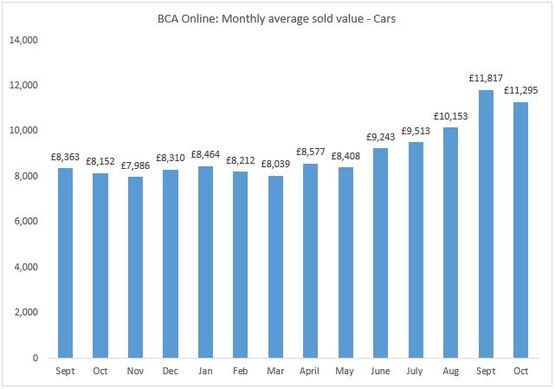
Used car values reached the second highest on record at BCA in October with the average car selling for £3,000 more than a year ago.

October used car values averaged £11,295 at BCA, maintaining the pattern of consistently high average used car values this year. Year-on-year, average monthly values are up 38.6%.

Stuart Pearson, COO BCA UK, said: “October felt like the first month for a long time, where the market started to behave exactly as it usually would at this time of year. Whilst prices remained resilient, many people took the opportunity to get away which shifted the supply and demand dynamic back in favour of the buyer for the first time in a long time.”

The weekly data highlights the stability of average values at BCA throughout October.  Values remained around £11,700 for much of the month, before dipping just below £11,000 at the end of October.  At the highest weekly point in October, year-on-year values were ahead of the same week in 2020 by 49%.

Pearson added: “The market may have eased back from some of the frenzied activity seen in recent months, however with very little certainty around new car supply, average used car values remain robust.  It doesn’t feel like it would take a lot to change for the market to reignite, particularly as we move towards the opportunity that the New Year presents for retailers.”  By Graham Hill thanks to Fleet News

Share My Blogs With Others: These icons link to social bookmarking sites where readers can share and discover new web pages.
  • MisterWong
  • Y!GG
  • Webnews
  • Digg
  • del.icio.us
  • StumbleUpon
  • Reddit
  • Alltagz
  • Ask
  • Bloglines
  • Facebook
  • YahooMyWeb
  • Google Bookmarks
  • LinkedIn
  • MySpace
  • TwitThis
  • Squidoo
  • MyShare
  • YahooBuzz
  • De.lirio.us
  • Wikio UK
  • Print
  • Socializer
  • blogmarks

Critical Shortfall Of Electric Vehicle Technicians Predicted

Thursday, 25. November 2021

The UK faces an electric vehicle (EV) skills gap, with too few technicians to service the volume of zero emissions vehicles predicted to be on UK roads by 2030, according to the Institute of the Motor Industry (IMI).

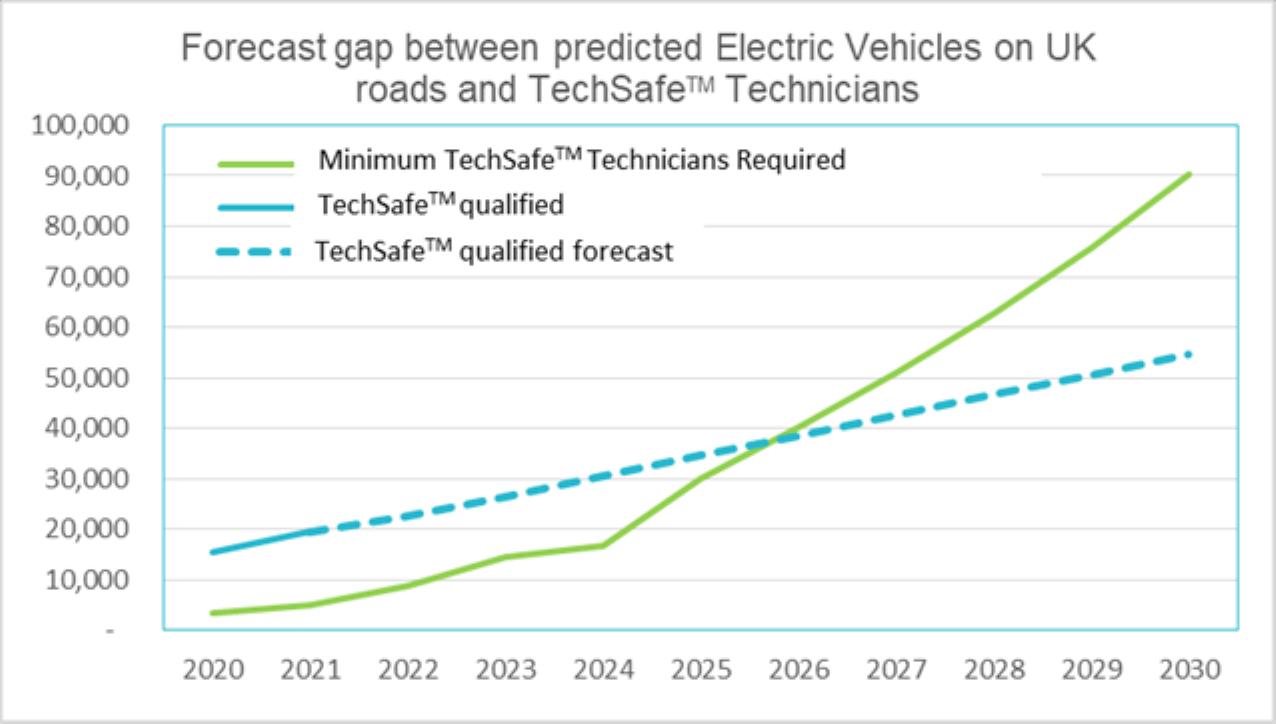
It says that 90,000 technicians will be required to provide a sufficient workforce ahead of the Government’s Road to Zero deadline.

However, whilst the automotive sector is working hard to retrain and upskill, because of the accelerated adoption of EVs, the IMI is predicting that there will be a shortfall of 35,700 technicians by 2030, with 2026 marking the point at which the skills gap will materialise.

Steve Nash, CEO of the Institute of the Motor Industry, explained: “As of 2020, there were 15,400 qualified TechSafe technicians in the UK. That number represents just 6.5% of the UK automotive sector and was already giving us cause for concern.

“Our new analysis paints an even more challenging picture. The pace of EV adoption is accelerating, even while the issues around infrastructure remain a barrier.

“Once the charging network is fit for purpose, combined with electric vehicles becoming more financially accessible, the next big challenge will be how to ensure we have a workforce adequately qualified to provide the essential servicing, maintenance and repair to keep these vehicles safe on the roads. And that’s where we believe Government attention – and funds – should be focused now.”

Plug-in cars are expected to account for more than a fifth (21.5%) of all new car registrations next year, according to the Society of Motor Manufacturers and Traders (SMMT). 

New plug-in vehicle uptake rates have accelerated so rapidly that more EVs will join Britain’s roads in 2021 than during the whole of the last decade, says the SMMT.

A total of 271,962 new BEVs and PHEVs were registered between 2010 and 2019. However, the SMMT now expects Britain to break its plug-in records, forecasting that businesses and consumers will take up around 287,000 of the latest zero-emission capable cars during 2021 alone – around one in six new cars.

Based on current forecasts, BEV registrations are also expected to exceed those of diesel by the end of 2022.

The rise is even more remarkable given that 2021 is expected to be a relatively weak year for new car registrations, some 30% below the average recorded over the past decade.

Nash said: “Whether it’s looking at incentives to retrain the existing workforce or ensuring that school-leavers and people changing the direction of their career are excited about the prospects of working in such a fast-moving sector, there needs to be a mind-shift in how to fix the widening skills gap.

“Significant investment is being ploughed into infrastructure, but the government still seems to be ignoring the fact that without a skilled workforce, it will fail in its decarbonisation ambitions.”

Using the SMMT’s upper scenario on EV adoption, the IMI predicts that the number of TechSafe qualified technicians required by 2030 is 90,000.

As of 2020 there were 15,400 qualified, and using current forecast trends, by 2030 there could be a shortfall of 35,700 qualified technicians, risking the safety of technicians and undermining confidence that EVs can be serviced, maintained and repaired by a garage with the right skills.

The forecast also indicates that the gap could materialise as soon as 2026 thus risking the Government’s 2030 green ambitions.

Faced with the potentially fatal consequences of an inadequately skilled workforce, the IMI is repeating its plea for the Government to commit funding to support EV skills training.

It is suggesting a £15 million boost would play a critical role, contributing towards training for up to 75,000 technicians. In the context of the £1.9 billion investment committed by Government in the 2020 Spending Review to supporting the transition to zero emission vehicles for charging infrastructure and consumer incentives, the IMI believes this is a modest figure.

It would make a significant difference, particularly for the independent sector which historically has less training opportunities compared to the franchise network which is supported by manufacturer academies, with the result that consumers will have less choice, says the IMI.

“The current gaping chasm in EV skills not only presents a safety threat for those who may risk working on high voltage vehicle systems without appropriate training and qualifications; it also means the premium on skills could add to costs for motorists, creating another, unnecessary deterrent to the switch to EV”, concluded Nash.

“The Government wants the adoption of EV to continue at a pace – the investment in EV charging needs to be matched by an investment in EV skills training to help employers ensure the workforce is EV-ready and electrified motoring doesn’t come at a premium.”  By Graham Hill thanks to Fleet News

Share My Blogs With Others: These icons link to social bookmarking sites where readers can share and discover new web pages.
  • MisterWong
  • Y!GG
  • Webnews
  • Digg
  • del.icio.us
  • StumbleUpon
  • Reddit
  • Alltagz
  • Ask
  • Bloglines
  • Facebook
  • YahooMyWeb
  • Google Bookmarks
  • LinkedIn
  • MySpace
  • TwitThis
  • Squidoo
  • MyShare
  • YahooBuzz
  • De.lirio.us
  • Wikio UK
  • Print
  • Socializer
  • blogmarks

Plans To Install 190,000 Kerbside Chargers Unveiled.

Thursday, 25. November 2021

Connected Kerb, the electric vehicle (EV) infrastructure company, has announced plans to install 190,000 public on-street EV chargers, worth up to £1.9bn, by 2030.

The company has secured new partnerships for 10,000 public on-street EV chargers across the UK in 2021, the majority of which will be deployed across West Sussex and Kent, announced today (November 8).

It said the investment will revolutionise access to EV charging for drivers without off-street parking and help support mass market charging for workplaces and fleets.

Dr Chris Pateman-Jones, chief executive officer at Connected Kerb, said: “Our rollout of public chargers – one of the most ambitious the UK has ever seen – encapsulates that future, helping individuals and businesses to confidently make the switch to electric, reducing their carbon footprint and cutting air pollution.

“Targets are important – for an industry so critical to the decarbonisation of transport, we need goals to work towards and objectives to which we are all accountable. However, they need to be met with action.

“With deals confirmed for 10,000 chargers this year alone and 30,000 more expected next year, we are demonstrating that we’re getting on with the job and delivering the change that needs to happen – not just talking about it.”

Deals for a further 30,000 chargers are expected conclude next year, as part of the company’s ambition to ‘level up’ charging across the UK.

Transport minister, Trudy Harrison said: “Providing reliable and affordable on-street charging is vital as we work to decarbonise transport and level up across the country.

“It’s great to see Connected Kerb and local authorities working together as the Government commits £2.5bn towards electric vehicle grants and the development of EV infrastructure in our towns and cities.”

The UK government’s Office for Zero Emission Vehicles meets 75% of the cost of installations through the On-Street Residential Charging Scheme (ORCS), while Connected Kerb provides the remaining 25%, it said.

Kent County Council has also announced it has chosen Connected Kerb to deploy at least 600 chargers by 2023.

Charge point installations have been announced today as part of tenders with councils including: Coventry (300 chargers), Cambridge (360) and Plymouth (100), and recently, Milton Keynes (250), Warrington (30), Medway (30), and Glasgow City Council, East Lothian Council, Shropshire County Council and Hackney Council, as part of the Agile Streets trial (100).

Lord Gerry Grimstone, minister for investment at the Department for International Trade and Business, Energy and Industrial Strategy, said: “Connected Kerb’s significant investment in electric vehicle chargers will support the UK’s commitment to green growth and ambitious net zero targets.

“Investments like this will be vital to help reduce emissions and limit the rise in global temperatures whilst driving jobs, growth and levelling up across the country.”

Neil Isaacson, CEO of Liberty Charge, also welcomed Connected Kerb’s ambition to install 190,000 charge points in the UK by 2030.

“We are pleased to see that it shares our vision that EV charging needs to be accessible to all, anywhere and at anytime. Our industry has a key role to play, today, in tackling the chronic deficit in on-street charging in the UK, and supporting local authorities in providing their residents with reliable, safe and high-quality vehicle charging to inspire the confidence required for EV adoption,” he said.

“At Liberty Charge, we understand the vast breadth and depth of the challenges that local authorities are facing with regards to restricted budgets, legislation, location of chargers, resident pressure (both for and against EV installations), quality and longevity of equipment, the diversity of technology and simply the time required from planning to installation. And we believe it is vital that we instil trust that our ambitions can be delivered.

“That’s why, working in partnership with Virgin Media O2, we’re already installing charge points and committing to ongoing maintenance, helping local authorities to give confidence to drivers looking to adopt EVs. And, crucially, helping them to make a difference to the environment and communities in which they live.

“Our recent initiatives include Hammersmith and Fulham, Waltham Forest, Wandsworth, West and North Northamptonshire Councils, and Croydon.”  By Graham Hill thanks to Fleet News

Share My Blogs With Others: These icons link to social bookmarking sites where readers can share and discover new web pages.
  • MisterWong
  • Y!GG
  • Webnews
  • Digg
  • del.icio.us
  • StumbleUpon
  • Reddit
  • Alltagz
  • Ask
  • Bloglines
  • Facebook
  • YahooMyWeb
  • Google Bookmarks
  • LinkedIn
  • MySpace
  • TwitThis
  • Squidoo
  • MyShare
  • YahooBuzz
  • De.lirio.us
  • Wikio UK
  • Print
  • Socializer
  • blogmarks

More Mercedes Models Believed To Have Had Emissions Defeat Devices Fitted.

Friday, 19. November 2021

My Comment: Many customers have asked if they should join the class actions being heavily publicised against Mercedes and others. It is your choice but I have yet to be convinced that any cases taken to court in the UK would succeed because it would require that owners or lessees to demonstrate financial loss, which I can’t see.

 Governments may be able to take manufacturers to court or maybe fine them for using devices to give false emissions readings causing greater harm to the environment but individually I believe we would struggle.

 As is mentioned below few cases succeed against Daimler in Germany, a country that makes it easier to take companies to court for ethical reasons. I believe that this is more of a data mining exercise with the claims companies simply collecting information on claimants which they can use as they feel fit because you will have signed a contract to enable exactly that. On to the latest article.

Mercedes-Benz is facing fresh allegations of using illegal defeat devices to cheat emissions tests, this time affecting its Euro 6 compliant six-cylinder 3.0-litre BlueTec engine.

Deutsche Umwelthilfe (Environmental Action Germany) has published a report identifying eight previously unknown defeat devices in certain Mercedes E-Class E350 diesel models.

In DUH’s view, these defeat devices result in nitrogen oxide emissions on the road being up to 500% above the legally prescribed limit.

Jürgen Resch, DUH’s national director, said: “It shows us for the first time how the company succeeds in complying with the legal limits in the test laboratory, while literally flooding our cities with harmful nitrogen oxides during real road use.

“The manipulation of the exhaust gas purification is not carried out because it is necessary for physical reasons or for the purpose of engine protection. The reason is as simple as it is cynical: it is about maximising profits at the expense of the environment and the health of city residents.”

The DUH tested a 2016 Mercedes E350 CDI Estate and found evidence of multiple ‘defeat devices’. It said the devices activate in driving situations that are common in road use conditions and stated that even under normal driving conditions, at least one defeat device almost always actively prevents the improvement of emissions

Three of the defeat devices identified by the DUH are said to depend on an “ageing factor” that reduces the amount of Adblue used as the vehicle’s milage increases. The report stated: “There is no plausible physical reason for the existence of any of them.”

The German Federal Motor Transport Authority (KBA) said it sees no evidence of previously unknown defeat devices at Mercedes-Benz in the DUH report.

“In the report, eight defeat devices of the relevant model with the OM 642 diesel engine are named. We are aware of these,” said a KBA spokesman on Friday. They have already been checked and found to be “not inadmissible”.

The KBA had already demanded a software update for the model under investigation in the DUH report. The defeat devices were removed in the updated software and the nitrogen oxide emissions were subsequently also below the legal limit value during road testing.

Mercedes is among a number of car makers facing legal action for emissions misrepresentation.

The DUH report suggests that other Mercedes vehicles with comparable engines and technologies contain comparable illegal defeat devices.

Mercedes-Benz told Car magazine: “The outlined calibrations are known. In our view, these are not to be assessed as illegal defeat devices in the interaction and overall context of the highly complex emission control system.

“The vast majority of rulings in German regional courts and higher regional courts continue to be in Daimler’s favour: In approximately 95%of cases, the courts rule in favour of the company.

“At the regional court level, there are more than 15,500 decisions dismissing lawsuits in favour of the company; in only about 900 cases was the decision against the company.

“There are now around 900 decisions in our favour at the higher regional courts, and only three decisions against us.

“The German Federal Court of Justice (BGH) has also confirmed key points of Daimler AG’s legal opinion in several decisions.”  By Graham Hill thanks to Fleet News

Share My Blogs With Others: These icons link to social bookmarking sites where readers can share and discover new web pages.
  • MisterWong
  • Y!GG
  • Webnews
  • Digg
  • del.icio.us
  • StumbleUpon
  • Reddit
  • Alltagz
  • Ask
  • Bloglines
  • Facebook
  • YahooMyWeb
  • Google Bookmarks
  • LinkedIn
  • MySpace
  • TwitThis
  • Squidoo
  • MyShare
  • YahooBuzz
  • De.lirio.us
  • Wikio UK
  • Print
  • Socializer
  • blogmarks

Johnson Matthey Announcement Causes Shares To Plummet & Set Back To UK Battery Development.

Friday, 12. November 2021

Chemicals company Johnson Matthey has scrapped plans to capture a slice of the market for electric car batteries in a surprise move that saw its shares tumble up to 20%.

It said rivals were too far ahead in the technological race, and the battery chemicals arm would go up for sale.

Johnson Matthey is a major producer of catalytic converters that clean exhaust emissions from petrol and diesel cars.

But with the pending ban on such cars, it needs alternative revenue sources.

The company is thought to have spent hundreds of millions of pounds trying to commercialise a chemicals project called eLNO, aimed at improving the efficiency of batteries.

There were high hopes the company would play a key role in helping the UK develop a large-scale electric battery manufacturing sector.

But chief executive Robert MacLeod, who also announced on Thursday he would step down next year, said the potential returns from the battery division could not justify further investment.

He said: “This decision will allow us to accelerate our investment and focus on more attractive growth areas, especially where we have leadership positions such as in hydrogen technologies, circularity and the decarbonisation of the chemicals value chain,”

Development of better-performing lithium-ion batteries is key to producing electric cars that can travel further on a single charge. The market is dominated by companies in China, South Korean and Japan.

An exit from the market would more strongly tie Johnson Matthey’s fate to the internal combustion engine at a time when the future of transport looks to be electric, said Hargreaves Lansdown analyst Laura Hoy.

“Ultimately the group will be starting over from square one as it looks for ways to change alongside the new greener auto industry,” she said.

Charlie Bentley, analyst at Jefferies, said that while the development of hydrogen transport will grow, “it is very hard to believe these can be sufficient revenue drivers and replace the very significant earnings” from Johnson Matthey’s current operations.

Mr MacLeod is being replaced in March next year by Liam Condon, the head of Germany’s Bayer crop science unit.

“After nearly eight years as chief executive, the time is right for me to move on. I am confident in our future growth prospects,” said Mr MacLeod.  By Graham Hill thanks to the BBC

Share My Blogs With Others: These icons link to social bookmarking sites where readers can share and discover new web pages.
  • MisterWong
  • Y!GG
  • Webnews
  • Digg
  • del.icio.us
  • StumbleUpon
  • Reddit
  • Alltagz
  • Ask
  • Bloglines
  • Facebook
  • YahooMyWeb
  • Google Bookmarks
  • LinkedIn
  • MySpace
  • TwitThis
  • Squidoo
  • MyShare
  • YahooBuzz
  • De.lirio.us
  • Wikio UK
  • Print
  • Socializer
  • blogmarks

Recent Fuel Shortage Crisis Has Caused A Third Of Drivers To Consider Electric Cars

Friday, 5. November 2021

Survey also shows young drivers were more likely to panic buy fuel than older motorists.

Recent fuel shortages have made a third of UK motorists more likely to buy an electric vehicle (EV), according to new research out this week. A study of 2,000 UK drivers by Volkswagen Financial Services found 35 percent of those questioned said they would be more likely to go electric thanks to the fuel shortage.

The shortages of late September and early October of this year saw queues at petrol stations amid a panic buying spree after a small number of petrol stations announced they were unable to get fuel deliveries. As a result, some petrol stations limited the amount customers could buy, while others had to close pumps because they ran out of fuel.

Volkswagen Financial Services’ study found 30 percent of 18-24-year-olds and 31 percent of 25-34-year-olds admitted to panic-buying fuel. In comparison, just seven percent of 55-64-year-olds made the same admission, as did a mere three percent of 65-74-year-olds.

Regionally, the south-east – one of the regions hit hardest by the fuel shortage – saw the most widespread panic buying, with 17 percent confessing they had headed to the pumps unnecessarily. That number fell to just seven percent in Scotland.

Perhaps more importantly, though, the Volkswagen Financial Services survey shows the impact of the shortage on buyers’ intentions, with more than a third saying they are more likely to go electric when they come to change their car. Similarly, 32 percent of Brits say they are likely to buy a second-hand electric vehicle when the time comes to change their car.

“Electric vehicles have never been more popular than they are today and it’s clear from our research that the recent fuel crisis has only accelerated the surge in demand for electric cars and their new technologies,” said Rebecca Whitmore, the electric vehicle senior product owner at Volkswagen Financial Services UK. “However, to meet the government’s decarbonisation targets, we need the take-up of EVs to be much higher.

“The average length of each car journey in the UK is fewer than 10 miles, so there’s still a lot of work to be done to alter the wider public’s perception of their driving habits, because an electric car would slot into the average person’s daily life more seamlessly than they probably imagine. As EV technology continues to improve and these vehicles continue to become more affordable and accessible, it won’t be too long before we have mainstream adoption in the UK.”  By Graham Hill thanks to Motor1.com

Share My Blogs With Others: These icons link to social bookmarking sites where readers can share and discover new web pages.
  • MisterWong
  • Y!GG
  • Webnews
  • Digg
  • del.icio.us
  • StumbleUpon
  • Reddit
  • Alltagz
  • Ask
  • Bloglines
  • Facebook
  • YahooMyWeb
  • Google Bookmarks
  • LinkedIn
  • MySpace
  • TwitThis
  • Squidoo
  • MyShare
  • YahooBuzz
  • De.lirio.us
  • Wikio UK
  • Print
  • Socializer
  • blogmarks