Fiat Chrysler Automobiles (FCA) is the latest manufacturer to face an emissions-based legal battle in the UK, as law firm PGMBM claims the manufacturer misled customers through the use of emissions ‘defeat’ devices.
PGMBM, which has also launched legal action against Mercedes-Benz and the Renault Nissan Alliance, says up to half a million of vehicles with FCA Group engines, manufactured since 2008, could be affected in England and Wales, .
Owners could be due £10,000 in compensation, if the claim is successful.
PGMBM managing partner Tom Goodhead said: “Fiat Chrysler Automobiles have misled drivers about the true diesel emissions that many of their vehicles produce. This is yet another instance of a huge automotive firm conning consumers – with a significant impact on the environment and our collective wellbeing.
“FCA must be held to account for these practices, and this case will give consumers the opportunity to pursue some justice and be compensated for being misled by a company that they may have trusted.
“Legally, consumers could be entitled to anything up to the full cost of the affected vehicles. But based on similar legal actions around the world, we believe that £10,000 per claimant should be expected.”
The car maker’s offices, including those of truck maker CNH, in Germany, Switzerland and Italy were raided in July, following claims that some of the company’s engines produced illegal levels of emissions.
According the PGMBM, potentially illegal software was used in the engine management systems used in Alfa Romeo, Jeep, Fiat and Suzuki cars, plus Iveco and Fiat commercial vehicles.
Affected engines, highlighted in the investigation, include Euro 5 and 6 variants of the 1.3-litre, 1.6-litre and 2.0-litre Multijet diesel engine.
A full list of potentially affected models can be viewed below.
In 2019, FCA agreed to a settlement worth $800 million to resolve claims from the US Justice Department and the state of California relating to the use of illegal software that produced false results on diesel-emissions tests.
The new claim alleges that FCA committed fraud by manufacturing vehicles whose true diesel emissions far exceeded the limits imposed by EU and UK laws.
An FCA spokesperson said: “FCA believes this claim to be totally without merit and we will vigorously defend ourselves against it.”
Potentially affected vehicles with FCA’s diesel engine:
Make / Model
1.3 litre
1.6 litre
2.0 litre
3.0 litre
3.0 litre (V6)
Fiat
500 500C 500L 500X Doblo Fiorino Panda Punto Punto Evo Grande Punto Qubo Tipo
500L 500X Bravo Doblo Grande Punto Punto Evo Scudo Talento Tipo
500X Bravo Doblo Ducato Scudo Talento
Ducato
–
Alfa Romeo
MiTo
Guilietta MiTo
159 Brera Guilietta Spider
–
–
Jeep
–
Compass Renegade
Cherokee Compass Renegade
–
Grand-Cherokee Commander
Suzuki
–
SX4 Vitara S-Cross
–
–
–
Iveco
All models
By Graham Hill thanks to Fleet News
Share My Blogs With Others:These icons link to social bookmarking sites where readers can share and discover new web pages.
Used car values dipped by 2.1% in October – the first fall since March – and look set to fall further, while wholesale sold prices fell across the board, according to new data from at Cap HPI.
It says that there has been a drop off in trade demand, with buyers becoming more reluctant to pay high prices for used stock.
“The market appears to now be undergoing some realignment,” explained Derren Martin, head of valuations UK at Cap HPI.
“There are several factors at play. Values do tend to drop in the final quarter of the year, by varying degrees, as demand drops away in the run-up to Christmas and supply levels usually increase.
“We do appear to be experiencing that drop off in trade demand, but it is exacerbated this year by economic uncertainty, high prices and reasonable predictions that the consumer appetite for used cars that has driven up prices cannot last forever.”
Both city cars and superminis have seen the most increases over the last few months but experienced above-average falls in October.
City cars reduced by an average of 2.9% (£150) at the three-year point, with larger drops for the Citroen C1, Skoda Citigo, Vauxhall Viva and Volkswagen Up.
Superminis reduced by 2.5% (£200) in October, with some of the most heavily affected at the three-year age being the Ford Fiesta, Hyundai i20 and Kia Rio.
Younger used cars were less affected by a pricing move, with franchise dealers switching customers from new to used when availability was an issue.
All other mainstream sectors experienced a downturn in values, with lower medium (C-sector) cars, the next most heavily affected.
SUVs, although still dropping in price, have held up slightly better than most, despite being almost one-third of wholesale volume now.
Large SUV models have performed the best in terms of price, moving down in value overall by just 0.5% (£150) at three-years-old.
Volumes seem to have been steady, and manufacturers have continued to steer these vehicles back into their dealer network whenever they can, particularly if volumes are low, says Cap HPI.
The supply of electric vehicles being offered in the used wholesale market continues to grow; year-to-date disposal volumes have increased by around 20% over the same period last year.
While there is no doubt that there is a demand for used EVs, Cap HPI says that an increase in supply and the premium they attract over a petrol or diesel vehicle still acts as a barrier to the mass market.
Martin concluded: “2020 has been completely different from any other year in history and that includes what has happened to values of used cars, rising against all expectations.
“It is particularly difficult to predict what may happen, with so much uncertainty due to localised lockdowns – whether or not car retailers can sell and deliver cars in Wales remains a grey area at the time of writing.
“Whilst trade volumes are not as high as in previous years due to lower than normal registration volumes, and leased vehicles are still on extensions, plus new car supply issues, it is still highly unlikely that demand for wholesale stock will overtake supply for the remainder of the year.
“As a result, with values remaining higher than they were a year ago, by over five per cent on average despite the recent Live drops, we are forecasting that values will continue to drop in November.” By Graham Hill thanks to Fleet News
Share My Blogs With Others:These icons link to social bookmarking sites where readers can share and discover new web pages.
Manufacturers are warning leasing companies that they cannot guarantee company car prices beyond the end of the year, even for some models being ordered now.
In letters sent to vehicle lease provides by major carmakers, including BMW, Jaguar Land Rover and Mercedes-Benz, they say that the threat of a ‘no deal’ Brexit is to blame for the potential price hike.
If no deal is reached and ratified before December 31, World Trade Organisation (WTO) non-preferential rules, including a 10% tariff on cars and up to 22% on vans and trucks would apply.
That would equate to a price increase of almost £3,000 on the average UK exported car to the EU, a £2,000 price increase on UK vans exported to the EU and a price increase of £1,800 on cars and vans imported from the EU, if fully passed on to UK consumers, according to UK Automotive Trade Report from the Society of Motor Manufacturers and Traders.
It adds that additional customs duties, costs and complexity would significantly disrupt sourcing of parts and components from the EU.
A price hike could see rentals increased and result in company car drivers paying more in benefit-in-kind (BIK) tax thanks to higher P11d prices.
Mercedes-Benz says in a letter sent to leasing companies, that it will guarantee the prices of all Mercedes-Benz and Smart cars ordered before Saturday (October 31), that have a quoted UK delivery date on its ordering system prior to December 31, regardless of its arrival date into the UK.
Mercedes-Benz said: “Should a customs duty tariff become applicable on cars imported into the UK after leaving the EU Customs Union and Single Market, we would look to increase the price of our cars accordingly, to offset the amount of the tariff (unless covered by the stated price protection).
“The increase would be applicable to all vehicles and factory fitted options, whether marked sold or unsold and regardless of the order, allocation date or sales channel. This would potentially vary model by model.”
BMW issued its warning a few weeks before MB, saying that “unless there is a free trade agreement with the EU, additional customs duties are likely to be applied to BMW and MINI vehicles imported into the UK”.
“This means that any vehicles which are delivered into the UK on or after January 1, 2021, regardless of date ordered, may have additional customs duties imposed on them,” it said.
“Should there be a no-deal Brexit, BMW UK will provide details of the implications of that including any price changes for vehicles as soon as possible.”
It added that “orders must be confirmed within the BMW Retailer ordering system on, or before December 31 to receive price protection against the economic price increase”.
“Any unfilled orders will be highlighted to you by the supplying retailer or leasing company and will not be price protected. Economic price protection does not include the potential additional customs duties.”
It was similar warning from Jaguar Land Rover (JLR), which said it is “not in a position to guarantee pricing for vehicles that are registered after December 31”.
All vehicles, regardless of build location, it says may be subject to a price increase when registered from January 1, 2021.
Meanwhile, Volkswagen Group in a letter sent to leasing companies, on behalf of its VW, Audi, Seat, VW Commercial Vehicles and Skoda brands, says it is closely monitoring developments surrounding the UK’s transitional period.
As part of its preparations, it says that it has established an understanding of all Brexit eventualities and is “confident” of its readiness.
Actions it has taken include: obtaining an EORI number (used for customs declarations); optimising stock availability to mitigate the risk of supply constraints; appointing customs agents allowing it to import cars and parts into the UK in line with HMRC regulations; and implementing and tested required systems changes.
It adds that in the event of a ‘no deal’ Brexit, the “application of import tariffs and/or increases to prices are required, then we will communicate our plans to deal with this as quickly as possible”.
“In the meantime, we reserve the right to amend the price/discount of vehicles at any time if a change to regulation, legislation, application of tariffs, duties, taxes or other charge/event causes an increase to the costs of supply of vehicles,” it said.
Trade talks between the EU and the UK Government are ongoing.
Northern Ireland Secretary Brandon Lewis said the extended talks were “a very good sign” a deal can be done.
But he told the BBC: “We have got to make sure it is a deal that works, not just for our partners in Europe… but one that works for the United Kingdom.”
The two sides are thought to be working on legal texts, but Whitehall sources have indicated major sticking points – like fishing rights and competition rules – remain unresolved.
The UK left the EU on January 31 but has been in a transition period – continuing to follow EU rules and pay into the bloc – while the two sides try to agree a post-Brexit trade agreement. By Graham Hill thanks to Fleet News
Share My Blogs With Others:These icons link to social bookmarking sites where readers can share and discover new web pages.
The country’s biggest leasing company, funding some 350,000-plus cars and vans, has seen its pre-tax profits plummet, according to its annual accounts.
Lex Autolease, part of the Black Horse Group, reported £153 million in pre-tax profits in 2019, a 27% (£57m) year-on-year decline from the £210m achieved in 2018.
As the fleet size remains pretty constant at 350,000 this indicates a pre-tax profit of less than £450 per car.
Revenues for the leasing giant, meanwhile, were up £125m (5.4%), from £2.38 billion to £2.5bn over the same period.
It equated to a profit margin of 6.1% – down on the 8.8% it achieved the previous year.
It says in its annual accounts for the year ending December 31, 2019, that the decrease in the company’s profits was “principally driven by decreased revenue” generated from its leased fleet, which had declined by 9% year on year.
This, it explains, was due to the uncertainties around tax legislation having an impact on corporate customers and resulting in fleet downsizing, as well as customers looking towards products such as personal contract purchase (PCP) agreements over traditional contract hire.
Lex Autolease also expects this downward trajectory to continue for the next 12 months due to the impact of Covid-19.
Operating leases account for more than 90% of Lex Autolease’s funded fleet, with the leasing company receiving £1.41bn in rentals in 2019 – £71m less than the previous year. Meanwhile, proceeds from disposals grew more than £192m, from £823m to more than £1.01bn. By Graham Hill thanks to Fleet News
Share My Blogs With Others:These icons link to social bookmarking sites where readers can share and discover new web pages.
The classification of journeys is causing a headache for fleets, because of the rise of homeworking due to coronavirus, says the Association of Fleet Professionals (AFP).
Describing the problem as ‘The New Commute’, the AFP says that problems revolve around whether an employee’s home is now officially their place of work.
AFP chairman Paul Hollick explained: “If someone is working from home rather than the office, then it raises the question of which is actually their place of work. This is important when it comes to both expenses and risk management.
“For example, if someone now drives their own car to the office once a week, are they allowed to reclaim their travel costs using AMAP rates, as they would for any other business journey that they undertake?
“The other major issue is whether, if someone now uses their own car to travel from home to work, whether that is now seen as a business journey from a risk management point of view, rather a commute.”
HMRC rules
Hollick says that the HMRC rules in this area were often inconsistently applied. Normally, they were based on the employee’s contract of employment showing that they were home-based but there was also a reasonableness test, to ensure that the employee is working from home rather than the office for a proportionally greater length to time.
“As always with points of taxation,” Hollick explains, “it is better to have hard and fast rules but these are open to local interpretation and fleets can potentially suffer from a lack of uniformity.”
He added that the issue of risk management was probably clearer but also open to some degree of interpretation.
“Any employees who work from home for the majority of time but sometimes visit the office using their own vehicles have, strictly speaking, all become grey fleet – and should be subject to all the usual grey fleet management practices,” he said.
“Again, we have yet to hear from any fleets who have been in touch with the Health and Safety Executive about this but it is an area that would benefit from future clarification.”
The pandemic is creating a series of questions for fleets that AFP members were currently discussing and to which they were attempting to find solutions.
“The New Commute is just one of a series of issues that we are working hard to resolve for members but sharing best practice ideas,” said Hollick.
“It is at times such as now, when so much surrounding fleet management is fluid, that the AFP can really add value.”
The AFP was formed in March from the merging of the Association of Car Fleet Operators (ACFO) and the Institute of Car Fleet Management (ICFM). By Graham Hill thanks to Fleet News
Share My Blogs With Others:These icons link to social bookmarking sites where readers can share and discover new web pages.
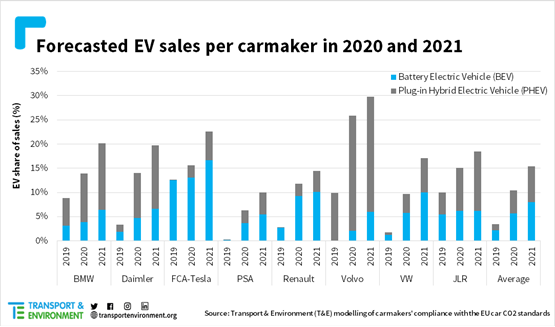
Electric cars are set to treble their market share in Europe this year, but an environmental campaign group is warning the UK could face long lead times in 2021.
Despite the pandemic, electric vehicle (EV) sales have surged since January 1 and will reach 10% this year and 15% in 2021, says Transport & Environment (T&E).
But, with carmakers having to meet targets to reduce the average emissions of the cars they sell in Europe, or pay fines, T&E says the UK supply of EVs is likely to dry up next year in the absence of British regulations equivalent to those in Europe.
Greg Archer, UK director at T&E, said: “Electric car sales are booming thanks to emissions standards. Next year, one in every seven cars sold in Europe will be a plug-in. European manufacturers have EVs to sell, but from January they’ll have no incentive to sell them in the UK unless the Government requires them to do so.”
From 2021, UK sales of EVs will not help manufacturers achieve EU standards. T&E says that the Government has so far failed to make parliamentary time available for equivalent new UK regulations to encourage sales here. These must be introduced by the end of October to be in place by January and maintain supplies of electric cars to the UK, it says.
Furthermore, it claims that the current draft regulation contains errors that will lead to about a fifth less EVs being sold in the UK than was likely if it had remained a part of the existing EU scheme. This is despite Government claims that the rules are equivalent to those in the EU.
The Department for Transport (DfT) has dismissed the claims.
Archer continued: “The electric car is becoming mainstream, but we risk turning off the tap in Britain.
“Carmakers will prioritise EV sales in markets where laws and tax breaks encourage them most, but the UK’s proposed standards are too weak and maybe too late.
“Government needs to quickly introduce regulations equivalent to the EU’s in 2021, or demand for electric cars will outstrip available supply and drivers will be left with long waits to secure their new electric car which will be more expensive.”
More people are wanting to travel on their own in their own vehicle due to Covid-19, leading to an increase in private car usage for business journeys, says Jaama.
As a result, the fleet software company believes the management of grey fleet drivers should be a priority for employers.
As mentioned below if employees are now working from home then travelling to the office will now be classed as a business trip.
“Duty of care information needs to be captured and managed properly to ensure drivers are only using grey fleet vehicles which are safe, legal and appropriate for business use,” explained Martin Evans, managing director of Jaama, and director of the Association of Fleet Professionals (AFP).
“Companies who just pay allowances and mileage reimbursements without any diligence do so at their peril.”
Jaama says the buoyancy of the used car sector for four to seven-year- old sub-£10,000 cars, suggests more people are updating their own car to carry out more journeys for work purposes.
Evans continued: “Many fleet managers need to make a concerted effort to ensure they gain control of their grey fleet to avoid big problems in the future. All the signs are that the grey fleet car parc will continue to grow over the coming years.”
Fleet News has previously reported how long-term changes to the way people work could result in more employees becoming grey fleet drivers.
Paul Hollick, co-chair of the Association of Fleet Professionals (AFP), warned that this could have significant consequences for fleets, with more employees joining the ranks of those that drive their car for work, the so-called grey fleet.
Employers have a legal obligation to ensure that grey fleet vehicles are reasonably safe to use, are fit for purpose and are lawfully on the road.
Companies also typically pay Approved Mileage Allowance Payments (AMAPs) to reimburse fuel used in the course of a work trip at 45p per mile.
“Grey fleet could become a bit of a battleground, because of Covid-19,” warned Hollick. “Employees won’t be office-based (in the future), they’ll be home-based, which means their contract of employment might be changed.
“If the employee is classed as home-based rather than office-based a journey from home to the office will then become a business trip.” By Graham Hill thanks to Fleet News
Share My Blogs With Others:These icons link to social bookmarking sites where readers can share and discover new web pages.
One in five (18%) of drivers aged 17-24 admit to taking part in video calls while behind the wheel, while almost a third (29%) of all drivers make and take calls on handheld phones, new research from the RAC suggests.
The illegal use of handheld mobile devices has been studied by the RAC since the 2016 Report on Motoring highlighted the issue was at ‘epidemic levels’.
However, this latest data suggests tougher penalties introduced in 2016, have failed to change in behaviour among motorists, particularly younger drivers.
With police resources stretched, four out of five (79%) drivers told the RAC they support the introduction of camera technology to identify illegal mobile phone use in the UK, with the vast majority (52%) strongly in favour of this happening.
RAC road safety spokesperson Simon Williams said: “Our figures highlight what many drivers already know – that the problem of illegal phone use at the wheel has far from disappeared.”
Furthermore, Williams says that the situation is not helped by mobile phone laws. Mobile phone use that doesn’t involve telecommunications, such as checking text messages, recording a video or changing pre-downloaded music, is not covered by the legislation, although drivers could be convicted for not being in proper control of their vehicles.
He added: “It’s significant that motorists are united in their desire to see camera-based technology, like that already in use in other countries, introduced on our roads to catch drivers who risk everyone’s safety by breaking the law in this way.
“If the behaviour of those who continue to think it’s safe to use a handheld phone while driving upwards of a tonne of metal is ever going to change, they need to believe there’s a reasonable chance of being caught.”
An increased popularity in video call services from the likes of WhatsApp and Snapchat are particularly concerning, with younger drivers more than twice as likely to say they make or receive video calls while driving – on average 8% of all UK drivers say they do this, with the figure rising to 13% among those aged 25 to 44.
Equally concerning is just under one-in-10 drivers aged 17 to 24 (9%) say they play games on their phones while driving, making them three-times more likely to do this compared to the average UK driver.
Other drivers’ use of handheld phones is the second biggest overall motoring-related concern identified in the 2020 RAC Report on Motoring research, after the state of local roads – a third of all UK drivers surveyed (32%) say the issue concerns them and strikingly nearly eight-in-10 (79%) now want to see camera technology introduced to catch drivers acting illegally.
The 29% of drivers of all ages in 2020 that say they make and receive calls on handheld phones while driving is a five percentage point increase on last year and the highest proportion since 2016.
While younger drivers are still more likely to do so (42%, down from 51% last year), those in the 25 to 44 age group are also statistically more likely to break the law in this way (32% admit to doing so, almost unchanged on 2019’s figure of 33%).
More positively, the proportion of drivers admitting to other dangerous activities such as checking or sending text messages or taking photos or video appear to be reducing – although it is unclear whether this is simply down to lower overall car use this year as a result of the pandemic.
Less than one in 10 (8%) of all drivers say they text or send other messages while driving, down from 14% last year and from a high of 20% in 2016.
But young drivers are again much more likely to break the law – 15% of those aged 17 to 24 say they are doing it in 2020, although this is down substantially on 2019 (37%).
More than one-in-10 motorists (14%) this year say they check texts or other app notifications while driving, down from 17% in 2019. Among younger drivers, the proportion is 22%, down from 35% last year.
Williams said: “While there’s been a reduction in some elements of this dangerous activity, more people say they are making and taking calls now than at any point since 2016, shortly before tougher penalties were introduced.
“Our findings from 2016 were a watershed moment which led to the UK Government calling for people to make illegal mobile phone use while driving as socially unacceptable as drink-driving.
“The fact drivers still state it’s their second biggest motoring concern of all shows that more progress still needs to be made here.”
Brake, the road safety charity, is calling for a complete ban on the use of a phone when driving, including hands-free.
The road safety campaigners claim this view is supported by evidence, which shows hands-free devices impairing driving as much as hand-held and are urging the Government to provide clarity in the law, before more lives are lost.
Joshua Harris, director of campaigns for Brake said: “Any use of a phone behind the wheel is dangerous but the fact that such a large proportion of young people admit to making video calls and playing games when driving really beggars belief.
“We need clarity in the law around phone use behind the wheel, and we need it now. The Government must implement a full ban on phone use when driving, including hands-free, to make the dangers crystal clear to the public and to crack-down on this reckless behaviour. The police must also be provided with the right tools and investment to enforce the roads effectively.
“In the wrong hands, a car is a lethal weapon and even a moment’s distraction from the road can have catastrophic consequences. More than 75 people are killed on UK roads every day and with driver distraction levels seemingly on the rise, the Government must step in and act, now.”
Inspector Frazer Davey, of the Avon and Somerset Police Roads Policing unit, said that the importance of concentrating on driving “cannot be overstated”.
“Using a mobile phone while in charge of a car puts you and everyone else at risk. The consequences of allowing yourself to be distracted while you are driving can be catastrophic. It’s simply not worth it.”
Type of handheld mobile phone use while driving
2020 and 2019 figure (all drivers)
2020 and 2019 figure (drivers aged 17-24)
Make and receive calls
29%, up from 23%
42%, down from 51%
Send texts, social media posts or use the internet
8%, down from 14%
15%, down from 37%
Check texts, social media posts or app notifications
14%, down from 17%
22%, down from 35%
Take photos or record video
6%, down from 13%
14%, down from 35%
Make or receive video calls
8%
18%
Play a game on a mobile phone
3%
9%
Source: representative sample of UK drivers from RAC Report on Motoring. UK sample size: 3,068 By Graham Hill thanks to Fleet News
Share My Blogs With Others:These icons link to social bookmarking sites where readers can share and discover new web pages.
I warned of this situation even before we voted to exit the EU. Whenever the EU arranged a trade deal with a country outside the EU bloc in order for the goods (not just cars) to be considered European and therefore qualify for free tariffs the majority of the product, in this case the car, had to be manufactured within Europe.
Some reports suggested 51% others as high as 60% had to be manufactured within the EU. I raised the question at the time that whilst we would possibly end up with a deal with Europe resulting in duty free sales of cars both to and from the EU it still meant that we would be outside the EU.
So what did this mean? Whilst in Europe we have movement of components backwards and forwards but as long as the majority of the cost of a car was sourced in Europe it met the conditions attached to free trade with other countries.
So let’s look at an example, not genuine but for illustration. The EU has a Free Trade deal with South Korea. Mercedes sell cars to South Korea duty free based on the cars being predominantly manufactured in Europe by value. So currently the Mercedes is made using UK parts, say dashboards, screens, interiors etc. all considered to be EU parts.
The UK content accounts for say 10% of the cost of the car contributing to say 55% made in the EU. The rest is sourced from say China, India, US etc. Once out of the EU the EU content drops to 45% as we no longer contribute to the EU portion which means that the car now falls outside the free trade rules and becomes subject to duty charges.
I was ignored at the time as I was told that this would all come out in the trade deal. It hasn’t and could easily lead to European manufacturers replacing UK parts with parts manufacture in the EU.
And it gets worse.
When we manufacture items in the UK we often source components from outside the EU but under the rules of origin we have been able to use parts from outside the UK but the finished item can still be sold as British. The technical term is Cumulation.
It seems that many of the components used in UK car manufacturing come in from Turkey and Japan. It seems that according to our chief negotiator David Frost the EU has thrown out the practice of cumulation insisting that 60% of the component cost of anything sold to the EU must be sourced in the UK to qualify for free trade.
Component parts from Turkey and Japan that have traditionally been regarded as part of ‘made in the UK’ under cumulation rules will in future fall outside the UK content. Which means that whilst we could have a free trade deal between us and the EU if vehicles don’t contain sufficient UK components to meet the rules, tariffs will have to be paid.
This will certainly be bad news for Jaguar Landrover, Ford, Nissan and Vauxhall all of which use a lot of parts from Turkey and Japan and sell many vehicles into Europe.
Frost has also confirmed that the EU has rejected the UK’s request for electric cars, batteries and bicycles to be treated leniently under the rules of origin if the majority of components come from elsewhere.
Sadly it seems that the originally agreed Theresa May withdrawal agreement had addressed and resolved this issue – according to the Guardian. 2 years ago the average British produced content of cars built in the UK was about 44% which means they will all fall foul of the country of origin rules.
As I understand it if we come out with a deal, components that are made in the EU that feed into British made items will pass the rules of origin test but components from outside the EU won’t in the future. We have some difficult times ahead. By Graham Hill
Share My Blogs With Others:These icons link to social bookmarking sites where readers can share and discover new web pages.
Every so often I receive directions to dealerships by solicitors to protect them from consumer claims. Anything to avoid carrying out a repair or paying back money. In this missive, they explain what a dealer should do when it comes to carrying out repairs as a gesture of goodwill.
Dealerships often have a policy on when they will allow goodwill repairs. They may be offered because the warranty has recently run out, the problem is recurring due to possible driver error, or because the customer just likes to complain and it gets them off your back.
Most customers will accept goodwill gestures for what they are, a goodwill gesture and not a legal obligation. But there is always one customer who tries it on, pushing to get all they can out of you, taking advantage of your generosity.
There is a danger that you carry out a goodwill repair to something that didn’t exist at the point of sale or has been described as falling within the constraints of the Consumer Rights Act, giving the customer the impression the problem is the dealer’s responsibility and the problem existed when they bought the car.
By carrying out a repair, you are potentially taking ownership of the problem. The repair must resolve the problem brought to you in the first place or else you could be pursued to court on the basis that your repair caused the fault that is now being complained about.
A goodwill repair can blow up in your face as it could infer an extension to the warranty or that there is a warranty on the parts that you fit. This is made worse if you suspect that the problem has been caused by the customer driving or modifications carried out.
Your repairs could mask the true cause of the original problem and make it difficult to prove further down the line.
If legal proceedings are issued by the customer, goodwill repairs can also make it more difficult in your defence to argue that there was nothing wrong with the vehicle when sold. Judges don’t generally need too much persuading to conclude that a vehicle was faulty at the point of sale.
This doesn’t mean that goodwill repairs should not be carried out. They are an important tool in generating loyal customers, especially as for many consumers it’s how a complaint is dealt with that can say far more about you than how the sale was dealt with.
However, it is important you document your decision by making it clear it is a goodwill repair – it is not under the warranty, there is no warranty for any new parts fitted as part of(s) provision, and it is in no way an admission the vehicle has any defects or issues. By Graham Hill
Share My Blogs With Others:These icons link to social bookmarking sites where readers can share and discover new web pages.