Greater Education Is Needed As Drivers Of Plug-In Hybrids Fail To Minimise Running Costs

Thursday, 8. April 2021

A warning has been issued to fleet operators who are turning to Plug-In Hybrid (PHEV) cars without instructing their drivers as to how to get the most out of them. Some advice is the same for drivers of PHEV’s generally so I thought it would benefit all my readers by including here.

It reminded me of a very early case whereby a large company, having read of the benefits to the environment and seeing fuel consumption figures of over 140mpg they moved most of their company car fleet over to the newly launched Mitsubishi Outlander.

Their fleet manager was astonished to see average MPG figures of 27, much less than they had achieved with their diesel fleet. They had overlooked the fact that drivers needed the facilities at home or at work to plug-in the cars to an electric supply in order to achieve the high numbers of miles per gallon. Most cars were not being plugged in at all with drivers believing that the cars would self-charge anyway.

Here is what Fleet News says:

Employers need to undertake due diligence on driver charging facilities as electric vehicles (EVs) start to make their way onto fleets in larger numbers, says the Association of Fleet Operators (AFP).

Chair Paul Hollick said that this was especially important for drivers of petrol hybrid electric vehicles (PHEVs) who could potentially choose not to charge them and instead continually fuel up at the pump.

He explained: “Our members are rapidly gaining practical experience of operating EVs and one of the things that is becoming clear is that you can’t just have a short chat with a driver about the fact that they want to adopt an EV as their company car and then hand them the keys.

“Fleets need to ensure that drivers have a good understanding of their charging options, have their own charging facilities that are not just a standard socket and, in the case of PHEVs, will always charge the car even when there is option to avoid doing so.

“It’s a case of carrying out some basic due diligence so that you are gaining the maximum operational and environmental benefit from EVs and PHEVs, while minimising some of the potential pitfalls.”

In most cases drivers are paying for their own home charger although, in some cases with larger employers, a third party will provide installation on some kind of preferential terms.

However, there is a different picture for drivers of electric vans, where most employers are paying for the charger to be installed on the basis that it is a job-need requirement that they are effectively stipulating.

Sometimes, the fitting of the charger is being added to the monthly lease rate in order to provide a higher degree of affordability.

Hollick added that some fleets were stipulating that EV and PHEV drivers should sign a declaration covering basic points of vehicle operation.

“These employers are asking their drivers to ensure that they keep their vehicle adequately charged, that they have a charger available on their drive and even, where there is only on-street parking, that some form of charger is easily available.

“The conditions for PHEVs are tighter. We’ve all come across a few instances in recent years where drivers have chosen these vehicles to minimise personal taxation and then used them purely as an internal combustion engined car. This makes them extremely expensive to operate and destroys any environmental advantage. Analysis shows that a poorly used PHEV is more expensive to operate than a petrol of diesel equivalent.

“Creating a declaration that electric power will be used as often as possible for PHEVs is a potentially effective solution to this issue and something that we have seen a number of fleets now adopt. It makes the driver aware of their responsibilities and that shows them that their employer takes these matters seriously.”  By Graham Hill thanks to Fleet News

Share My Blogs With Others: These icons link to social bookmarking sites where readers can share and discover new web pages.
  • MisterWong
  • Y!GG
  • Webnews
  • Digg
  • del.icio.us
  • StumbleUpon
  • Reddit
  • Alltagz
  • Ask
  • Bloglines
  • Facebook
  • YahooMyWeb
  • Google Bookmarks
  • LinkedIn
  • MySpace
  • TwitThis
  • Squidoo
  • MyShare
  • YahooBuzz
  • De.lirio.us
  • Wikio UK
  • Print
  • Socializer
  • blogmarks

Latest Information On Car Warranties

Sunday, 21. March 2021

Buy a new car, and it’ll come with a warranty. Here we explain what it covers and what it doesn’t, and for how long.

If you’ve recently bought a new car then it will have come with a warranty. And with new cars becoming increasingly complex – just look at the number of vehicles that feature hybrid technology these days – it’s never been more important to be familiar with the cover your warranty provides.

Used cars bought from dealers usually have a warranty of some kind too but the original manufacturer’s warranty that comes with all cars from new is the most comprehensive.

So what is a warranty? It’s a written guarantee that your new car won’t suffer any major mechanical problems over a certain period of time, and that if it does, the cost of repairs will be met by the manufacturer or dealer.

The warranty will outline exactly what parts of the car are covered, and for how long. This either takes the form of a time limit, a mileage limit, or both. All manufacturers have their own variations for the vehicles they sell.

In any case, your car’s warranty is a legal document that means you don’t need to worry about footing the bill for any big problems that might occur in your first few years of ownership.

The majority of new car warranties will last for three years, although some carmakers cover the first two years and leave the dealer to provide the remaining twelve months.

New car warranties are usually issued automatically, meaning you don’t have to negotiate to get one. But if you intend to keep your car longer than is covered by the warranty, most manufacturers and dealers will let you buy an extended warranty.

This will cost you a bit more money, but in most cases you should still get a similar degree of cover as provided by the existing warranty.

What will your car warranty cover?

The whole car will be covered by a warranty, but there will be different warranties covering different parts of the car, such as for the car’s paintwork and a guarantee against corrosion, too.

If you’re buying an electric vehicle or plug-in hybrid, you’ll find that the battery and drive system will usually be covered by a second guarantee that runs alongside the standard warranty.

If you’re buying a used car, there are warranties available to you, too. Buy a pre-owned car from a franchise dealer, and there is likely to be a warranty available, depending on the car’s age – indeed, if the car is new enough, it’ll still be covered by the original guarantee, as the warranty coverage on a new car is transferable between owners.

Breakdown firms such as the AA and RAC also offer warranty coverage on used cars, which some non-franchise car dealers use to help give their business a higher profile and their customers extra peace of mind.

Even if you buy privately, companies such as Warrantywise can supply you with warranty cover to help you out in the event of something going wrong with a used car.

Much like car insurance, these companies will take into consideration the age and condition of the car before offering you a quote for 12 months of cover. Taking out a used car warranty can be a useful safety net, especially if you’re running an expensive car that has been bought used for a bargain amount, and gives added peace of mind if a used car doesn’t come up to scratch. 

Below we run down the different types of warranty that are associated with new and used cars, from the standard new car warranty to paint and battery cover in EVs, through to extended warranties and used car cover.

What is a new car warranty?

A new car warranty is the guarantee that car manufacturers issue when they sell a new car. Each car maker will have a set warranty that applies to all of the cars that it sells in the UK. The majority of car makers offer a three-year warranty, although the main exceptions to this are Hyundai, Mitsubishi (both five years) and Kia (seven years).

Some makers have offered longer warranty periods in the past than they do now, the last being Renault, which offered a four-year warranty until recently. Vauxhall also offered a lifetime warranty for a while. This was limited to the first registered owner of the car, and also had caveats that meant the car must be serviced at a Vauxhall franchise.

However, with very little uptake on such cover and an increasing number of buyers now running cars for three years on finance, the three-year warranty has held out, and both Renault and Vauxhall stick with the standard three-year cover.

While three years is a fairly standard time period for a new car warranty, manufacturers also add a mileage limit to the warranty to ensure the vehicle is covered for what it determines to be a fair amount of time. So the warranty will last for the time period or the distance quoted, whichever comes first.

The amount of miles you can cover varies according to which manufacturer you choose. Some offer a 36,000-mile limit, while others offer unlimited mileage. As an example of the differences, Mitsubishi’s five-year cover has a 62,500-mile limit, while Hyundai, which also offers a five-year warranty, has unlimited mileage for private buyers.

Likewise, Kia’s seven-year warranty has a mileage limit of 100,000 miles, so for some high-mileage drivers, the Hyundai warranty could be more attractive.

The wording of the new car warranty will provide a general overview that gives a new car buyer an idea of what is covered, but more importantly, there will be a lot of small print that will explain what isn’t covered.

The overall objective of the new car warranty is to ensure that a car’s major mechanical components (the engine, gearbox, suspension, electrical system and safety systems) work as they should throughout the duration of the warranty. And if anything should go wrong, then the manufacturer will cover the cost of rectifying the fault.

As a result, you will find that so-called ‘wear and tear’ items and consumables, such as the tyres, brakes, belts, fluids and lubricants, wipers, bulbs and fuses won’t be covered by the warranty. It won’t cover damage to wheels from kerbing, either, or if the interior trim has squeaks or rattles. There will also be wording within the warranty that puts the onus on the car’s owner to drive it normally and treat the car properly, as misuse could invalidate the warranty.

This can include using a sports car on a race track, or an SUV for severe off-roading, or even an MPV or family car that has seen use as a taxi or for private hire.

If the manufacturer can find the car has been modified – such as the ECU being reprogrammed, a non-standard exhaust system has been fitted, or if the odometer has been tampered with – then these modifications are likely to invalidate the car’s warranty, too.

What is an extended warranty?

An extended warranty isn’t the five- or seven-year guarantees dished out by makers such as Hyundai, Mitsubishi or Kia. Instead, an extended warranty refers to the extra cover that new car buyers can pay for to give added peace of mind.

The extended warranty will be an option that some car manufacturers offer as an optional extra when you spec up a new car, while many manufacturers also offer existing owners the option to extend their car’s warranty before the standard warranty expires.

Manufacturers offer this longer warranty because there isn’t as much stress put on an EV’s battery as there would be in a conventional combustion-engined car. Again, the usual small print about tampering and modification of the battery pack applies, and just like the standard warranty for the rest of the car, the battery warranty is transferable when the car is sold on.

What is a paintwork or perforation warranty?

Paintwork warranties are designed to guarantee the quality and finish of a vehicle’s bodywork. They are usually accompanied by a perforation warranty, which guarantees the bodywork against any rust or corrosion that may occur because of faults in the vehicle building process.

The paintwork warranty usually lasts for the same length of time as the standard warranty, so normally three years, because the paintwork is the first form of defence against the elements. That means the paint is prone to damage from stone chips, scratches, bird lime and tree sap, which can have a deteriorating effect on paint.

After three years it will be hard to determine whether paint damage is a result of poor production or wear and tear, which is why the paintwork warranty is only as long as the vehicle’s overall warranty.

A perforation warranty will last for a longer period, and it guarantees against rust and corrosion that are the result of poor manufacture. A perforation warranty will be clearly worded to guarantee against corrosion that comes from a source within the bodywork, ie: not caused by external damage. Some warranties explicitly state that the bodywork has to have a hole all the way through it before the manufacturer will take action.

The duration of the perforation warranty will vary between manufacturers, and it may also vary between models, depending on where each model is built. On the whole, anti-perforation warranties last for 12 years, although some makers sometimes have models that are an exception to the general rule, when they are built at a different plant, for example.

What is an approved used car warranty?

An approved used car warranty will be a level of cover that is offered on approved used cars sold via a franchised dealer. Usually, the used cars that a manufacturer approved dealer has on sale will be less than three years old, so most will have some of their existing warranty cover still to run.

But to give used car buyers added peace of mind, a used car warranty will be offered to anybody buying a used car from the franchise.

The used car warranty will be included on an approved used car once it has been given a full inspection to make sure it meets the standards expected by the manufacturer.

Usually the used car warranty will be valid for 12 months, and there will be small print to say if there’s a mileage limit that you need to stick to so that you get the full year of cover.

In general terms, the used car warranty will offer the same amount of cover as a new car warranty, because the cars it is issued against will be nearly new, so there is a low risk of a warranty claim being made against such a car. However, it’s always worth checking the small print to see what the used car warranty covers because not all manufacturer cover will be the same.

What is a used car warranty?

If you’re buying a used car outside of the UK’s franchise dealer network or want warranty cover for an older car then you still can. However the warranty cover will be entirely dependent on where you buy your used car from.

Second-hand car dealers don’t have to offer warranty cover of any description, but those that want to raise their profile and trade on a good reputation will offer a used car warranty to keep their customers happy.

One of the favourite ways of doing this is by offering a warranty provided by the AA or RAC. The breakdown firms will carry out a multi-point inspection on a used vehicle before providing warranty cover, while the cover will last for at least six months. And as you would expect, these warranties will also be accompanied by breakdown cover for the same period.

What is private warranty cover?

If you’re buying privately, there is still warranty cover that you can take out so that your new purchase won’t leave you out of pocket. Again, the AA and RAC provide warranty cover direct to buyers, and it can be tailored to suit any car, irrespective of age, mileage or condition.

Of course, the older the car, the amount you pay is likely to rise, and what is covered is also likely to be limited to the major mechanical components.

Another option is the aftermarket warranty, provided by companies such as Warrantywise and Warranty Direct. These firms offer warranty coverage on older cars up to a certain age and mileage, and you buy the warranty in a similar way to car insurance.

That means you can pay in a lump sum or monthly repayments for your convenience. Again, these warranties are flexible, so you can pick how long the warranty lasts (it should be transferable with the car if you sell it on), and there are different levels of cover depending on the car’s age, mileage and previous history. By Graham Hill thanks to Auto Express

Share My Blogs With Others: These icons link to social bookmarking sites where readers can share and discover new web pages.
  • MisterWong
  • Y!GG
  • Webnews
  • Digg
  • del.icio.us
  • StumbleUpon
  • Reddit
  • Alltagz
  • Ask
  • Bloglines
  • Facebook
  • YahooMyWeb
  • Google Bookmarks
  • LinkedIn
  • MySpace
  • TwitThis
  • Squidoo
  • MyShare
  • YahooBuzz
  • De.lirio.us
  • Wikio UK
  • Print
  • Socializer
  • blogmarks

Europeans Caught On Camera Speeding In The UK And Brits Doing The Same In The EU Will No Longer Be Fined Thanks To Brexit

Sunday, 21. March 2021

The UK’s departure from the EU means British drivers snared by speed cameras on roads in Europe will no longer be sent fines. And those Britons, resident in the EU, who return to the UK in foreign registered cars will also avoid fines.

As a member of the EU, Britain had signed up to a directive that allowed member states to share the contact details of those caught by speed cameras.

The directive was introduced because data revealed that a high percentage of speeding offences were committed by foreign drivers who were escaping the financial penalties.

Naturally Britain’s departure from the EU on January 1st meant that for the foreseeable future British holidaymakers and second-home owners driving in EU countries will not be issued fines if they are snared.

The same goes for drivers of EU-registered cars travelling on roads in the UK who are caught speeding or committing other driving offences caught on camera.

Since Britain signed up to the directive and began the data sharing in 2019, hundreds of thousands of British holidaymakers have been fined.

In France alone some 444,378 fines were sent to British drivers in 2019 which according to French driving site Caradisiac was the equivalent of between €30 to €60 million.

With such big sums of money at stake it’s no surprise some EU countries are intent on negotiating bilateral agreements with the UK to ensure contact details are shared in future.

“We will initiate bilateral negotiations with the UK, in order to reach an agreement like we have with Switzerland,” a French Interior Ministry spokesperson told Caradisiac.

But the UK is unlikely to be a in rush to enter into those talks, not least because of the ongoing pandemic that has crippled travel to and from the EU, but also because it just might not be worth it financially.

The UK avoided signing up to the cross-border directive for many years because it believed it just wasn’t profitable to process the fines abroad given the relatively small number of European-based drivers caught speeding in the UK.

But Beware: For certain EU countries like Spain and France where British holidaymakers and second-home owners often travel by car, it’s a different matter.

British drivers who are pulled over by local police in the EU for speeding or other offences will still have to pay their fines, however.

It is also the case that in the UK British police have the right to take a ‘Roadside Deposit’ if the driver doesn’t have a UK address. But with the vast majority of speeders being caught by cameras with so few police on our roads we could lose some substantial fine income.

France’s ministry of interior lamented the fact that Britain was no longer in the EU. In a statement to The Local a spokesperson said: “The purpose of the directive is to put an end to the impunity of motorists who commit offences in a Member State other than that of their residence, to improve road safety throughout the EU and to guarantee the equal treatment between drivers whether or not they are residents of the Member State where the offence was committed.

Through this exchange system, Member States can identify the owners of vehicles with which the infringement has been committed in their territory and send them notifications of infringements.”

Reminder

The 2015 European Directive, nicknamed Cross-Border Directive does not only target drivers caught on camera speeding or running red lights.

It covers six other offences:

  1. failure to wear a seat belt
  2. driving while intoxicated
  3. driving under drugs
  4. the non-wearing of a helmet by two-wheeler drivers
  5. driving on a prohibited lane
  6. mobile phone use while driving

By Graham Hill thanks to The Local

Share My Blogs With Others: These icons link to social bookmarking sites where readers can share and discover new web pages.
  • MisterWong
  • Y!GG
  • Webnews
  • Digg
  • del.icio.us
  • StumbleUpon
  • Reddit
  • Alltagz
  • Ask
  • Bloglines
  • Facebook
  • YahooMyWeb
  • Google Bookmarks
  • LinkedIn
  • MySpace
  • TwitThis
  • Squidoo
  • MyShare
  • YahooBuzz
  • De.lirio.us
  • Wikio UK
  • Print
  • Socializer
  • blogmarks

How To Claim For Pothole Damage As Claims Increase!

Sunday, 21. March 2021

Local councils across England have been handed £500 million to fill millions of potholes over the course of the next financial year.

In the 2020 Budget, the Chancellor announced a £2.5 billion Potholes Fund for the 2020/21 to 2024/25 financial years. The Department for Transport has confirmed that the 2021/22 money has now been allocated. With potholes costing an average of £50 to fill, it’s expected that around 10 million craters on thousands of roads will be repaired.

The South-West received £90,031,000 – more than any other region. The South-East has been allocated £82,693,000, the East of England has been given £68,534,000 and the North-West has received £66,467,000.

The East Midlands, West Midlands and Yorkshire and the Humber have been allocated £57,358,000, £54,486,000 and £51,940,000 respectively. Finally, the North-East has received £28,492,000.

The £500 million allocated for just one year of the Potholes Fund is more than the entire £296 million Pothole Action Fund that covered 2015/16 to 2020/21.

Transport minister Baroness Vere said: “The funding allocated today will help councils ensure roads in their area are kept up to standard, and that the potholes that blight road users can be dealt with promptly.”

Jack Cousens, head of roads policy for the AA, said the UK’s local road network is “in desperate need of repair”.

“Last month, just 15 per cent of our members told us that residential roads were in a good condition,” he added. “However, studies show that residential roads in England get resurfaced on average every 119 years. If your street is lucky enough to be chosen we’d recommend a socially distanced celebration, as it will probably be a once in a lifetime event!”

How To Claim For Pothole Damage

Thinking about a claim for pothole damage compensation? Read our handy pothole claims guide for the key dos and don’ts.

Potholes, and the damage they can cause, is a growing problem for motorists in the UK. Local councils point to years of underinvestment and squeezed resources as reasons for cutting spending on essential pothole repair work, but that doesn’t help when you’re facing a hefty bill for pothole damage to your car. But is there any way of gaining compensation? This is our guide to making pothole claims.

The total damage caused by hitting potholes costs unfortunate UK motorists an incredible £730 million every year, with the average individual pothole repair bill totting up to almost £110 per motorist. Potholes can cause damage to tyres, wheels, the suspension, exhaust and even the bodywork, while drivers of low-slung sporty models with expensive low-profile tyres on big alloy wheels can fare much worse than the average car, too. The number of potholes could also be a factor in the growing popularity of high-riding crossovers and SUVs.

However, according to the Asphalt Industry Alliance it would take councils 14 years just to catch up with all the backlog of pothole repairs needed to UK roads if they carry on fixing them at the current rate. One council has even attempted to skirt the pothole problem by increasing the minimum ‘official depth’ of a pothole from 40mm to 60mm in an attempt to defer essential pothole repairs until the problems worsen.

Making your claim for pothole damage

Given the amount of money raised by government on road tax and fuel tax, it’s perfectly understandable when damage caused by the pothole menace makes motorists want to hold authorities to account.

However while it is possible in some cases to hold a local council (or the Highways Agency when main roads are affected) responsible for car damage caused by unrepaired potholes, it’s not as straightforward as many would like.

Section 58 of the Highways Act 1980

Local authorities typically refuse all claims as a first step, quoting Section 58 of the Highways Act 1980. Section 58 offers a ‘catch all’ defence, and means the council is saying it took all reasonable steps to maintain the road, and that potholes were dealt with in a timely manner.

Unfortunately council officers use Section 58 routinely in rejecting claims, even when they know this isn’t true. They do so on legal advice, as lawyers know most pothole damage claimants will give up at the first hurdle.

From then on, it’s down to you to do the detective work to determine whether the council has indeed carried out its inspections and maintenance to the required standard – which generally means in accordance with the Well-Maintained Highways Code of Practice.

This may be time-consuming and difficult, as you’ll probably need to use Freedom of Information requests to determine whether the council has failed in its statutory obligations. Specialist websites like the warranty industry-funded Potholes.co.uk can offer detailed help and support, but meanwhile here’s what you need to do if you fall foul of a damaging pothole on the road:

Pothole damage – essential steps to make a successful claim

1. Take notes and photographs at the scene

When it’s safe to do so, pull over to make a note of the exact location of the pothole that damaged your car. You should also record its size, depth and shape, and contact details for any witnesses. It may help a later claim if you can take supporting photographs on your mobile phone to record as much of the information as possible. Never take chances with safety at the scene of the incident though, or things could get very much worse when the next car comes around the corner!

2. Repair the damage

If you need immediate roadside repairs then you can’t do much else but follow the advice of your breakdown service or the garage you’ve called out. If repairs can wait, then it’s worthwhile getting several quotes from different repairers so you can show as part of any subsequent claim that you’ve acted to achieve the best price.

3. Report the pothole

Be a good citizen and do your bit to help make sure fellow motorists don’t fall into the same trap by alerting the council (or Highways Agency). There’s an easy way to do that by using the official online pothole reporting service.

4. Submit your claim

Write a calm letter to the local council (or Highways Agency) outlining the incident where damage was caused, the extent of the damage, and that you hold the council liable. They should respond within a couple of weeks, most likely with a Section 58 defence – but you never know, and might be lucky!

5. Decide whether to pursue your claim

Now for the tricky bit. You will have to use your investigative powers to determine whether the council has indeed fulfilled its statutory Section 58 obligations. You are entitled to ask relevant questions about the scheduling and quality of inspections and repairs on the road in question. You must subsequently determine whether you have a realistic case for pursuing your claim.

If so, write again to the council outlining your grounds for argument. It may be that the council agrees to pay up on receipt of your evidence, but if they don’t you are then faced with a choice of court action. A small claims court action is very cheap and easy via the latest web-based system called Money Claim Online, but whether it’s worth pursuing or not will depend on the cost of repairs, the amount of time you can afford, and the level of your moral outrage.  By Graham Hill thanks to Auto Express

Share My Blogs With Others: These icons link to social bookmarking sites where readers can share and discover new web pages.
  • MisterWong
  • Y!GG
  • Webnews
  • Digg
  • del.icio.us
  • StumbleUpon
  • Reddit
  • Alltagz
  • Ask
  • Bloglines
  • Facebook
  • YahooMyWeb
  • Google Bookmarks
  • LinkedIn
  • MySpace
  • TwitThis
  • Squidoo
  • MyShare
  • YahooBuzz
  • De.lirio.us
  • Wikio UK
  • Print
  • Socializer
  • blogmarks

The Cheapest Way To Charge Your EV Batteries Revealed

Thursday, 25. February 2021

According to EV information website Zap-Map, there are 21,068 public chargers in the UK, of which 3908 are rapid chargers and 11 are ultra-rapid. If you don’t mind using one of the slower options, you should still be able to charge for free or a minimal fee.

Pod Point and Source London are among the larger companies that offer free charging (in some cases after a small initial fee) at certain locations.

It’s also worth investigating which smaller public charging companies are operating in your area. The Energise network only has a small number of charging points in southeast England, but once you’ve paid a £1 connection fee, its units are free to use.

Kent County Council also has a small number of chargers available on the same basis. There are similar options in many parts of the UK.

Another low-cost option is the ZeroNet network, which is run by the Zero Carbon World charity. Chargers are mostly in the car parks of hotels, restaurants and other hospitality industry locations, and many businesses offer free charging for customers, although parking charges might be payable while the charger is in use.

Potentially the cheapest way to charge away from home is to use the Zap-Home and Zap-Work network of chargers; the former are at EV owners’ homes and the latter on the premises of small businesses. Coverage is good all over the UK and the chargers can be used by anyone who’s registered with Zap-Map. Many are free, and those that aren’t free cost £3 to £5 per charge.

New code of practice for home charger installers

The Electric Vehicle Consumer Code for Home Chargepoints (EVCC) is a code of practice that’s been introduced for companies installing EV chargers to consumers. It has been designed to ensure that manufacturers, suppliers and installers of home chargers meet specific high standards so that consumers can have the confidence to use them for installation.

EVCC logo

Companies signing up to the EVCC commit to no-pressure selling techniques and a high level of customer service and aftersales care. If a customer has a problem with an EVCC-registered company, they can go through a formal complaint process and use a free mediation service provided by Renewable Energy Assurance Ltd, which is a non-profit organisation with experience in operating codes of conduct for renewable energy companies.

Car insurance for electric cars

LV is the first mainstream car insurer to offer a policy specifically for owners of electric vehicles.

The policy includes a roadside recharging service in case your car runs out of juice anywhere in the UK (courtesy of a tie-up with specialist assistance provider AFF) or free recovery to the nearest charging point. Using these services won’t affect your no-claims discount.

The policy also provides accidental damage, fire and theft cover for your car’s battery pack, plus your charging cables, wallbox and adapters. By Graham Hill thanks to What Car

Share My Blogs With Others: These icons link to social bookmarking sites where readers can share and discover new web pages.
  • MisterWong
  • Y!GG
  • Webnews
  • Digg
  • del.icio.us
  • StumbleUpon
  • Reddit
  • Alltagz
  • Ask
  • Bloglines
  • Facebook
  • YahooMyWeb
  • Google Bookmarks
  • LinkedIn
  • MySpace
  • TwitThis
  • Squidoo
  • MyShare
  • YahooBuzz
  • De.lirio.us
  • Wikio UK
  • Print
  • Socializer
  • blogmarks

Nearly Half Of Drivers Dangerously Ignore Vehicle Warning Lights

Thursday, 25. February 2021

A survey of 2,000 UK adults has revealed that 46% of drivers ignore the alerts.

One in five claim they will drive for two or three days before investigating issues.

Two in five ignore them hoping they’ll go off and a third leave them in fear of expensive repair bills.

Motorists are being warned to not ignore illuminated dashboard warning lights in their cars when they return to the road after – or during – the third national lockdown.

A survey of 2,000 UK adults by dealer group Robins & Day revealed that almost half fail to immediately address the alerts, with many neglecting them out of laziness.

And by continuing to use their car when a warning light is telling them not to, motorists are risking causing more damage to their motors and could see repair costs spiral.

The dealer network’s poll found that 46 per cent of adults ignore a warning light on the dashboard of their car.

Of the 2,000 people surveyed, 19 per cent said they would continue to use their vehicle for two or three days with a warning light illuminated before seeking to get the problem sorted.

This is the case even if the warning light is red to signify it is a serious issue that need immediate action.

Amber, orange or other colour lights often mean something needs checking by a garage but the vehicle can still be driven.

When asked why they don’t action the warnings by taking the car to a dealership or garage, two in five (40 per cent) said they disregard it as a fault with the dashboard light itself, expecting it to go off again sooner or later.

Incredibly, over a third (34 per cent) try to push it to the back of their mind over fears of expensive repairs, while another quarter (24 per cent) cast the issue aside out of sheer laziness.

Explaining the results of its study, the dealer group said: ‘Whilst it is completely reasonable not to know every single light on a dashboard, ensuring you have enough knowledge of the basics to help you diagnose a potential problem with your vehicle will prove to be a priceless skill, should an issue arise.

‘However, our study found that just a fifth (21 per cent) of UK drivers could identify the basic warning lights on their dashboard such as ‘low tyre pressure’ and ‘check oil’. Fifteen per cent of those surveyed believed they could identify all of the basic warning lights unaided, if required.

‘Our research also highlighted that three per cent of Brits did not know that their car manual was there to help them to identify any issues with their vehicle.’

You could fail an MOT

While failing to remedy a dashboard warning light can cause a more expensive problem, it can also cause issues if you’re taking your car for an MOT test.

Under current rules, some warning lights can result in an automatic fail.

These include alerts for problems with airbags, the electronic parking brake, electronic stability control, headlight main beam, electronic power steering, brake fluid level or issue with the seatbelt pre-tensioner.

The Law & Your Insurance

Failing to investigate the cause of a dashboard warning light is also illegal. More than one in ten drivers (12%) do not know this and 10% are unaware it can invalidate their insurance policy, according to Robins & Day.  By Graham Hill thanks to This Is Money & Robins &Day

Share My Blogs With Others: These icons link to social bookmarking sites where readers can share and discover new web pages.
  • MisterWong
  • Y!GG
  • Webnews
  • Digg
  • del.icio.us
  • StumbleUpon
  • Reddit
  • Alltagz
  • Ask
  • Bloglines
  • Facebook
  • YahooMyWeb
  • Google Bookmarks
  • LinkedIn
  • MySpace
  • TwitThis
  • Squidoo
  • MyShare
  • YahooBuzz
  • De.lirio.us
  • Wikio UK
  • Print
  • Socializer
  • blogmarks

With Car Showrooms Still Struggling To Open Is Virtual Reality The Way Forward?

Thursday, 25. February 2021

It is always risky predicting The Next Big Thing, but Abarth might just have it. It’s not the 595 Scorpioneoro you see here which, while unquestionably a stylish special edition, is based on a car that’s been on sale for well over a decade. No, the really exciting thing is how potential owners can try the car out.

Because Abarth has just started a trial that will see prospective 595 buyers sent a wooden crate, inside which rest Bose headphones and a virtual reality (VR) headset. Pre-loaded on this headset is a three-minute film, which takes viewers on a ‘virtual test drive’ through stunning Welsh vistas in a 595 Scorpioneoro.

I’ve tried VR in the past, and let’s just say that when used for corporate videos, the experience is underwhelming. But what Abarth has done with its virtual test drive – the world’s first, no less – is nothing short of spectacular.

Beginning on Black Rock Sands beach in North Wales, we’re introduced to both the car and our co-driver, Stef Vilaverde, a died-in-the-wool Abarth fan and YouTuber. The beginning is short, but gives time to appreciate the surroundings. In front of you stands the car, but tilt your head up (in the real world) and you can see the sky and clouds.

Turn around and you’re faced with headland cliffs, the camera angle and audio moving with your eyes and ears; it really looks and sounds like you’re stood on the Welsh coast. No time to dwell on the scenery, though, as the roar of the 595’s exhaust draws you back to the car in time to see it blast across the sands.

We’re in the passenger seat for most of the rest of the test drive, and as far as your eyes and ears are concerned, you’re in the car. Turn your head to the left and watch the crystal-clear lake waters of Llyn Ogwen pass by; face ahead and Snowdon looms into view ahead of the 595’s bonnet; look inside the cabin and you can make out details like the Scorpioneoro’s limited-edition plaque.

It’s an immersive experience, and when Stef activates the sports exhaust and gives the 595’s 163bhp 1.4-litre engine a blast, the audio is as engaging as the visuals. Another camera angle sees looking from outside the car at road level; facing forwards reveals rushing tarmac, turning behind shows the bonnet of the 595 bobbing away, inches from your eyes.

There are a couple of limitations. Even though the gear has to be returned to Abarth, the cost of VR headsets means it’s doubtful every manufacturer could offer every customer a VR drive (Abarth’s trial is operating only from Vospers dealership in Exeter – for now).

And while the wooden crate the gear arrived in is a cool nod to past Abarths (which had performance upgrades in a similar box) the crate itself is too large and heavy to be handled easily by all.

But with real-world test drives likely to be problematic for some time, VR could be an important tool for car makers, dealerships and, of course, buyers – not least because as well as leaving me yearning to drive a 595 Scorpioneoro, the virtual world brought excitement and variety after months being cooped up.

How does virtual reality work?

VR films are created using a camera with multiple lenses that film 360-degree footage with no blind spots; a 360-degree microphone with several channels is also used. Software stitches the recordings into a seamless ‘bubble’ of footage; camera mounts that might be in shot are also removed.

A VR headset displays the all-encompassing footage on two small screens directly in front of your eyes, motion sensors determining where you are looking; tilt your head up, for example, and the footage follows, mimicking what your eyes would see if they were the camera.  By Graham Hill thanks to Auto Express

Share My Blogs With Others: These icons link to social bookmarking sites where readers can share and discover new web pages.
  • MisterWong
  • Y!GG
  • Webnews
  • Digg
  • del.icio.us
  • StumbleUpon
  • Reddit
  • Alltagz
  • Ask
  • Bloglines
  • Facebook
  • YahooMyWeb
  • Google Bookmarks
  • LinkedIn
  • MySpace
  • TwitThis
  • Squidoo
  • MyShare
  • YahooBuzz
  • De.lirio.us
  • Wikio UK
  • Print
  • Socializer
  • blogmarks

Vauxhall Added To List Of Diesel Manufacturers Found To Use ‘Defeat Devices’

Thursday, 18. February 2021

It should come as no surprise to anyone in the industry that another car manufacturer has been accused of using emissions defeat devices to fool the emissions tests. I was one of the first to say that when VW were found to be using such devices that the problem goes industrywide. It was common knowledge that this was going on, it was just a matter of time before they were found out.

It all started years ago when manufacturers would tape up car doors and remove trim and even door mirrors to reduce drag when checking fuel consumption. They did similar things when emission rules were introduced but when inspectors finally started to check the tests they had to come up with something more creative.

On to the report:

Vauxhall is the latest manufacturer to face claims that some of its diesel engines were fitted with emissions ‘cheating’ devices or software.

It follows similar accusations against Mercedes-Benz, Fiat-Chrysler and the Renault-Nissan alliance, in the wake of the Volkswagen ‘dieselgate’ scandal.

Law firm Milberg London says it is launching a case against Vauxhall for drivers who bought or leased certain models manufactured between 2009 and 2019.

A statement issued by the car maker said: “Vauxhall Motors is not aware of any such claim and rejects any accusation of using illegal defeat devices. Our vehicles meet the applicable regulations.”

More than a million people could receive compensation if the claim is successful.

Edward Cardington, partner at Milberg London LLP and lead lawyer for the Vauxhall Pay Up Campaign, said: “The Vauxhall Pay Up campaign has set out to prove that Vauxhall cheated both the emissions tests and hardworking British drivers.

“Motorists were promised a combination of low environmental impact and high driving performance that appears to have been impossible in real driving conditions. Put simply, clean diesel looks like a myth and Vauxhall’s cars did not provide the performance drivers paid for.”

The Vauxhall Pay Up campaign will claim under the Consumer Protection from Unfair Trading regulations. These laws state that customers who were sold products with misleading information could receive anything between 25% and 75% of the cost of the product they purchased in compensation.

Potentially affected models highlighted by Milberg London include diesel versions of the following Vauxhall models: Astra, Cascada, Corsa, Insignia, Mokka, Movano and Zafira. By Graham Hill thanks to Fleet News

Share My Blogs With Others: These icons link to social bookmarking sites where readers can share and discover new web pages.
  • MisterWong
  • Y!GG
  • Webnews
  • Digg
  • del.icio.us
  • StumbleUpon
  • Reddit
  • Alltagz
  • Ask
  • Bloglines
  • Facebook
  • YahooMyWeb
  • Google Bookmarks
  • LinkedIn
  • MySpace
  • TwitThis
  • Squidoo
  • MyShare
  • YahooBuzz
  • De.lirio.us
  • Wikio UK
  • Print
  • Socializer
  • blogmarks

Potholes Still Causing Major Problems Despite Drop In Car Use

Thursday, 18. February 2021

RAC patrols attended almost 1,500 call-outs in the last three months of 2020 for pothole related breakdowns, despite reduced traffic volumes as a result of the coronavirus pandemic.

Analysis of fourth quarter RAC breakdowns for National Pothole Day reveals there were 1,461 call-outs for damaged shock absorbers, broken suspension springs and distorted wheels reveals, representing nearly 1% (0.9%) of all RAC attendances.

While the pothole proportion of all RAC breakdowns is down on the previous quarter, it is identical to the same period in 2019 and slightly higher than 2018 (0.8%). The RAC says this is concerning given the lower traffic volumes brought about by coronavirus travel restrictions as in theory, less traffic should mean less damage to road surfaces.

Looking across the UK, the South East saw the largest number of vehicle problems most likely to be caused by potholes at 242 – equating to 17% of all the pothole-related call-outs dealt with by the RAC’s expert local patrols.

While this could be attributed to the region being more densely populated, this is unlikely to be the case for the South West which saw 12% of all the RAC’s pothole breakdowns (173), almost the same number as the North West (170).

The RAC’s Pothole Index, which is a long-term indicator of the health of the UK’s roads available, suggests the overall standard of road surfaces has been improving since the start of 2019. Having begun at 1.0 in 2006, the index currently stands at 1.44 which means drivers are nearly one and a half times as likely to experience damage caused by a pothole as they were 15 years ago.

RAC head of roads policy Nicholas Lyes said: “While the actual number of pothole-related call-outs our patrols have attended is down significantly compared to the same time in 2019 due to lower traffic volumes in the pandemic, they account for the same proportion (0.9%) of all RAC rescues which clearly demonstrates there are still far too many poorly maintained roads.

“We realise council budgets are under incredible pressure due to the coronavirus, but we badly need the Government to recognise the significance of local roads and take a fresh look at how to fund them.

“The Government’s approach of allocating funding to councils from various pots on an annual basis means authorities are always having to play catch-up by fixing potholes rather than focusing on preventative maintenance. We would prefer to see them make five-year funding settlements which would allow councils to make longer-term plans for their roads.

This could be funded by introducing a similar scheme to the National Roads Fund which ringfences money paid in vehicle excise duty by road users in England for the upkeep of major roads.”  By Graham Hill thanks to Fleet News

Share My Blogs With Others: These icons link to social bookmarking sites where readers can share and discover new web pages.
  • MisterWong
  • Y!GG
  • Webnews
  • Digg
  • del.icio.us
  • StumbleUpon
  • Reddit
  • Alltagz
  • Ask
  • Bloglines
  • Facebook
  • YahooMyWeb
  • Google Bookmarks
  • LinkedIn
  • MySpace
  • TwitThis
  • Squidoo
  • MyShare
  • YahooBuzz
  • De.lirio.us
  • Wikio UK
  • Print
  • Socializer
  • blogmarks

Electric Vehicles Achieve Strong Resale Values As VW Leads The Way

Thursday, 18. February 2021

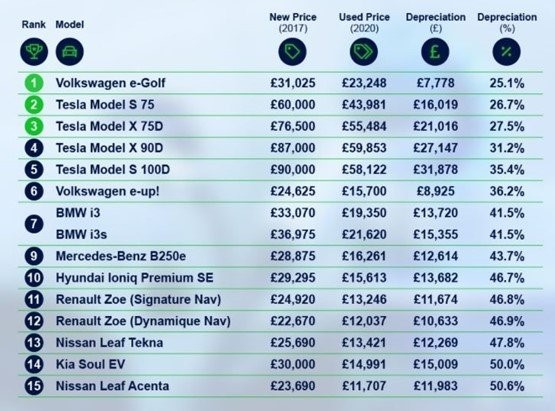
The Volkswagen e-Golf has achieved the strongest residual value in the electric car market, according to a study by CompareTheMarket.

The electric version of the Golf was ranked the top EV with the lowest depreciation of £7,778 (25.1%) after three years, with used models selling for an average price of £23,248 – three quarters of its new price three years ago.

It is followed by two Teslas, the Model S 75 (26.7% depreciation) and Model X 75D (27.5%)

https://cdn.fleetnews.co.uk/web/1/root/compare-the-market-ev-residuals_w555_h555.jpg

The research reveals how much electric and hybrid cars deprecate in value by comparing ‘new’ prices for the most common plug-in and hybrid vehicles to their used prices to reveal the vehicles which hold their value the most.

As Teslas are among the most expensive EVs and benefit from regular software updates, it could help the models retain their value, CompareTheMarket said.

According to the research, the models that were ‘the worst’ at holding their values were the Hyundai Ioniq Premium SE, which has a depreciation of £13,682 (46.7%), Renault Zoe Signature Nav, which has a depreciation of £11,674 (46.8%) and the Renault Zoe Dynamique Nav which depreciates by £10,633 (46.9%).

Find out about the latest EVs and plug-in hybrids coming to market in 2021 in our latest digital edition of Fleet News.

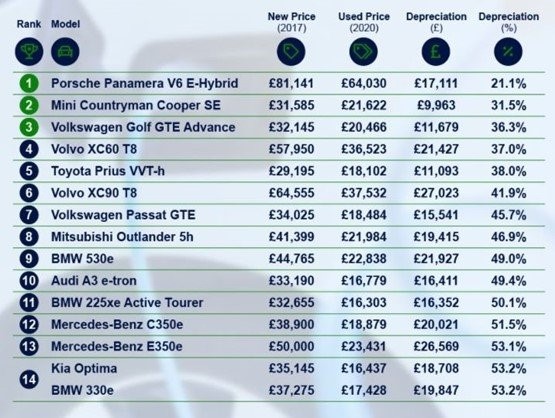
When looking at plug-in hybrids, the Porsche Panamera E-Hybrid was found to have ‘the best’ resale value over the last three years, with depreciation of 21%.

This is followed by Mini’s hybrid offering, the Countryman Cooper SE (31.5%) and another version of the VW Golf, the GTE Advance (36.3%).

The hybrids found to have the highest depreciation were the Kia Optima, which depreciates by £18,708 (53.2%), the Mercedes-Benz E350e (53.1%), Mercedes-Benz C5350e (51.5%), BMW 225xe Active Tourer (50.1%) and the Audi A3 e-tron (49.4%).

CompareTheMarket said, ‘the worst’ performing hybrids lose more of their value than electric cars, whereas ‘the best’ performing electric cars do not hold their value as well as hybrids.

Dan Hutson, head of motor insurance at CompareTheMarket, said: “EVs are becoming increasingly popular, and now that they have been in circulation for a while we are seeing them come onto the second-hand market, which is great news for people wanting to buy an EV or hybrid at a lower price.

“As the technology improves and cars become cheaper, we are sure to see greater adoption, which is the greener step forward that we need.” By Graham Hill thanks to Fleet News

Share My Blogs With Others: These icons link to social bookmarking sites where readers can share and discover new web pages.
  • MisterWong
  • Y!GG
  • Webnews
  • Digg
  • del.icio.us
  • StumbleUpon
  • Reddit
  • Alltagz
  • Ask
  • Bloglines
  • Facebook
  • YahooMyWeb
  • Google Bookmarks
  • LinkedIn
  • MySpace
  • TwitThis
  • Squidoo
  • MyShare
  • YahooBuzz
  • De.lirio.us
  • Wikio UK
  • Print
  • Socializer
  • blogmarks