New Research Exposes Tired Driving Trend

Friday, 16. July 2021

The following warning applies to all drivers although the report was aimed at company car or fleet drivers.

Company car and van drivers are being urged not to drive for longer than two hours without taking a break, after new research revealed a worrying trend in tired driving.

The survey, from road safety organisation IAM RoadSmart, found that one-in-10 drivers had momentarily closed their eyes because they were so tired.

The same number (10%) of drivers also admitted that they had hit the rumble strip, while two-in-five (40%) had turned down the heating or rolled down the windows in order to stop them from being tired.

Neil Greig, IAM RoadSmart director of policy and research, said: “Fatigue behind the wheel is a very serious problem, perhaps more concerning than previously thought of.

“The potential carnage that could result from even one accident doesn’t bear thinking about.”

More than half of drivers said they were very concerned about fatigue when driving long distances, while encouragingly around a quarter of drivers had pulled over for a rest or a coffee as the road safety experts advise.

“Driving a long distance needs pre-planning to ensure there are plenty of available rest places and to make sure there’s enough time to complete the journey if delays are encountered,” explained Greig.

“Never drive for longer than two hours without a break and take particular care if driving when you would normally be asleep. This is even more important as the country reopens after the pandemic and not all facilities may be available yet.

“Drivers can then concentrate on staying alert behind the wheel rather than staving off tiredness by trying to reach their end destination without adequate rest breaks.”  By Graham Hill thanks to Fleet News

Share My Blogs With Others: These icons link to social bookmarking sites where readers can share and discover new web pages.
  • MisterWong
  • Y!GG
  • Webnews
  • Digg
  • del.icio.us
  • StumbleUpon
  • Reddit
  • Alltagz
  • Ask
  • Bloglines
  • Facebook
  • YahooMyWeb
  • Google Bookmarks
  • LinkedIn
  • MySpace
  • TwitThis
  • Squidoo
  • MyShare
  • YahooBuzz
  • De.lirio.us
  • Wikio UK
  • Print
  • Socializer
  • blogmarks

Germany Reacts To The Global Microchip Shortage In Its Usual Efficient Manner

Friday, 16. July 2021

Bosch has opened a €1 billion (£860m) semiconductor fabrication facility in Dresden, Germany – the largest single investment the company has ever made.

Production in Dresden will start as early as July – six months earlier than planned, with the first semiconductors made in the new plant to be installed in Bosch power tools.

For automotive customers, chip production will start in September, three months earlier than planned.

With the automotive sector facing a global semiconductor shortage and fleets facing increased SMR costs and lead times due to the microchip crisis, Bosch says that the new factory will be an important part of the semiconductor manufacturing network.

Harald Kroeger, Bosch board member with responsibility for the Mobility Solutions, says automotive microchips are the “ultimate discipline” in semiconductor technology.

“This is because in cars these small building blocks have to be especially robust,” he explained. “Nowhere else are they subjected to such strong vibrations and extreme temperatures.”

He says that demand for automotive semiconductors is rising. As recently as 1998, the value of semiconductors in a car was 170 euros (£145), by 2023 it will have exceeded 600 euros (£514).

However, chairman of the board of management of Robert Bosch GmbH, Volkmar Denner, stressed that the new semiconductor factory would not solve the chip shortage, but would help “contribute” to the increasing demand.

“We can provide some help, but we certainly cannot resolve that overall shortage,” he said.

Every car- and van-maker is being impacted by the computer chip crisis, with some delivery times for cars lengthening from three to six months, and many new vans not expected to be delivered until 2022.

Vehicle production lines have been temporarily halted, focus has been shifted to high demand vehicles and some options are not being offered.

Furthermore, with the auto industry facing tough new emissions targets, lower emitting models have been prioritised in some cases.

Bosch says the semiconductor shortage could last well into next year.  By Graham Hill thanks to Fleet News

Share My Blogs With Others: These icons link to social bookmarking sites where readers can share and discover new web pages.
  • MisterWong
  • Y!GG
  • Webnews
  • Digg
  • del.icio.us
  • StumbleUpon
  • Reddit
  • Alltagz
  • Ask
  • Bloglines
  • Facebook
  • YahooMyWeb
  • Google Bookmarks
  • LinkedIn
  • MySpace
  • TwitThis
  • Squidoo
  • MyShare
  • YahooBuzz
  • De.lirio.us
  • Wikio UK
  • Print
  • Socializer
  • blogmarks

New Emissions Collusion Between Manufacturers Revealed.

Friday, 16. July 2021

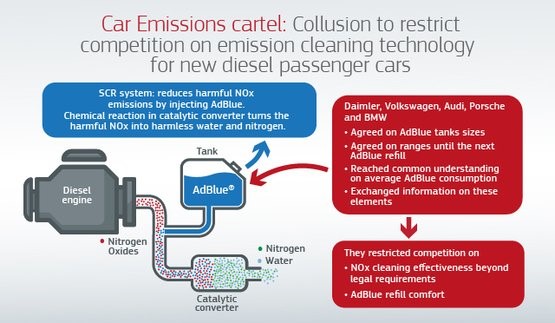
The European Commission has fined BMW and Volkswagen Group €875,189,000 (£751m) for colluding with Daimler on the development of NoX treatment technology.

Daimler was not fined, as it revealed the existence of the cartel to the Commission.

According to the European Commission’s report, Audi, BMW, Daimler, Porsche and VW held regular technical meetings to discuss the development of AdBlue systems, also known as selective catalytic reduction (SCR)-technology.

During these meetings, and for more than five years, the car manufacturers colluded to avoid competition on cleaning better than what is required by law despite the relevant technology being available.

Daimler, BMW and Volkswagen group reached an agreement on AdBlue tank sizes and ranges and a common understanding on the average estimated AdBlue-consumption. They also exchanged commercially sensitive information on these elements.

Executive vice-president of the Commission, Margrethe Vestager, said: “The five car manufacturers possessed the technology to reduce harmful emissions beyond what was legally required under EU emission standards. But they avoided to compete on using this technology’s full potential to clean better than what is required by law.

“So today’s decision is about how legitimate technical cooperation went wrong. And we do not tolerate it when companies collude. It is illegal under EU Antitrust rules. Competition and innovation on managing car pollution are essential for Europe to meet our ambitious Green Deal objectives. And this decision shows that we will not hesitate to take action against all forms of cartel conduct putting in jeopardy this goal.”

Green group Transport & Environment (T&E) believes that in the wake of Dieselgate, this latest scandal shows car manufacturers “cannot be trusted” to put people’s health and the climate before profit.

Julia Poliscanova, senior director for vehicles and emobility at the organisation, said: “Carmakers cannot be trusted to clean up cars. First they cheated on emissions tests, then they colluded to delay cleaner vehicles even though they had the technology. Only an EU target to switch to 100% emissions-free cars by 2035 will be enough to decarbonise by mid-century and avoid climate catastrophe.” By Graham Hill thanks to Fleet News

Share My Blogs With Others: These icons link to social bookmarking sites where readers can share and discover new web pages.
  • MisterWong
  • Y!GG
  • Webnews
  • Digg
  • del.icio.us
  • StumbleUpon
  • Reddit
  • Alltagz
  • Ask
  • Bloglines
  • Facebook
  • YahooMyWeb
  • Google Bookmarks
  • LinkedIn
  • MySpace
  • TwitThis
  • Squidoo
  • MyShare
  • YahooBuzz
  • De.lirio.us
  • Wikio UK
  • Print
  • Socializer
  • blogmarks

Are Fleet Drivers Sufficiently Trained To Protect Other Drivers?

Friday, 9. July 2021

Fleet operators are most worried about the use of mobile phones, speeding, eating or drinking behind the wheel and tired driving, according to a Webfleet Solutions survey.

Almost three-quarters (73%) of UK fleet decision-makers say poor driving behaviour is negatively impacting their business.

The findings, from a survey of 1,050 European fleet decision makers and published in the European Road Safety Report 2021, suggest that the use of mobile phones and other devices (71%), followed by speeding (69%), eating or drinking behind the wheel (68%), and driving while fatigued (67%) are their biggest areas of concern.

More than two-thirds (68%) of UK commercial fleets have vehicles involved in road collisions every year, and 61% say that, on average, they have at least one insurance claim a month made against their company by other road users.

“Significant investment is being made in developing more powerful hardware and software to make vehicles safer,” said Beverley Wise, sales director UK and Ireland for Webfleet Solutions.

“Telematics, for example, can improve the safety of commercial fleets by offering powerful insights into driver behaviour. Fleet managers and decision makers can access a range of valuable data points from each driver trip, with an overview of incidents like speeding, harsh steering, or sudden braking.

“This data can be paired with vehicle camera footage, offering fleet managers context of why these events occur. 

“Driver-facing cameras, using Artificial Intelligence (AI), also assist in better driving by detecting various types of unsafe behaviours and alerting the driver to correct their course before an accident occurs.”

Wise says that the integrated solution gives fleet managers “full transparency and clarity”, allowing them to protect their drivers from non-fault claims and coach them to drive more safely.

According to the European Road Safety Report survey, UK fleet decision makers were most likely to have adopted reversing and side camera technology to help improve road safety (40%) and half (51%) of businesses said they were offered a lower premium if they adopted a telematics system.

Driven largely by the positive impact connected cameras can have on insurance claims, the stringent new vision regulations coming into force in parts of the UK will also play a role in connected camera uptake.


“This latest research underlines the need to improve road safety of UK fleets, and the best way to achieve that is through better driving habits and improved visibility,” added Wise.

“Legislative change will certainly encourage uptake of technology in the coming years but fleet decision makers should aim to be one step ahead and use technology and telematics to their competitive advantage.”  By Graham Hill thanks to Fleet News

Share My Blogs With Others: These icons link to social bookmarking sites where readers can share and discover new web pages.
  • MisterWong
  • Y!GG
  • Webnews
  • Digg
  • del.icio.us
  • StumbleUpon
  • Reddit
  • Alltagz
  • Ask
  • Bloglines
  • Facebook
  • YahooMyWeb
  • Google Bookmarks
  • LinkedIn
  • MySpace
  • TwitThis
  • Squidoo
  • MyShare
  • YahooBuzz
  • De.lirio.us
  • Wikio UK
  • Print
  • Socializer
  • blogmarks

Toyota And Lexus Launch A New 10 Year Warranty

Friday, 25. June 2021

The ‘Relax’ programme covers new and used Toyota and Lexus vehicles, with the scheme applying retrospectively to second-hand models.

Toyota and Lexus have launched an industry-leading warranty programme that provides up to 10 years’ cover for new and used cars, vans and pick-up trucks.

The ‘Relax’ scheme adds a year’s warranty to a vehicle each time it is serviced at a Toyota or Lexus dealer. There is no extra cost for the programme, servicing costs are unchanged, and vehicles are eligible until they are 10 years old or have covered 100,000 miles.

Relax comes with every new Toyota or Lexus, and also applies retrospectively to models already on the market, as long as they are under 10 years old and have covered fewer than 100,000 miles. This means if you were to go out today and buy a nine-year-old, 90,000-mile Prius, you could add a year’s manufacturer warranty to it simply by getting it serviced at a Toyota dealer.

The scheme also applies to vehicles that have been maintained outside the Toyota and Lexus dealer networks: bringing a car back in for a main or interim service will activate Relax for a year. Vehicles used commercially, including taxis, are covered, as are all powertrain types, including hybrids, electric cars and the hydrogen Toyota Mirai. 

A number of manufacturers offer warranties that extend beyond the once-traditional three-year period; Renault and Hyundai provide five years’ cover, while Kia gives a seven-year/100,000-mile warranty.

Toyota previously offered a five-year/100k-mile policy, and Lexus a three-year/60k one. Relax replaces both these with a three year, 60,000-mile warranty as standard, and this can be extended each time a vehicle is serviced at a main dealer.

The scheme works in the same way for vehicles with longer service intervals: the Toyota Proace van, for example, has a two-year maintenance schedule, and so has two years of warranty added each time it is serviced. Toyota’s previous warranty scheme, introduced in 2010, remains valid, with Relax beginning at the end of the five-year period.

Toyota’s price promise, which sees dealers match service quotes from independent garages within 10 miles, is also unchanged. Rob Giles from Toyota GB called Relax “game-changing”, while adding that it brings “compelling business benefits” for the firm.

Why is Toyota doing this?

Relax is good news for consumers, so is likely to attract new buyers in and of itself. Toyota also expects a “significant growth” in dealer footfall, upping servicing income and tempting more people with new cars. Residual values are also likely to increase, and with PCP deals paying off depreciation, over time this could theoretically have a positive impact on new-car finance.

Plus the firms’ exposure to warranty costs is proportionally low: our Driver Power data shows 9.6 per cent of Toyota and 11.1 per cent of Lexus owners had issues with their cars; the industry average was 17.34 per cent. By Graham Hill thanks to Auto Express

Share My Blogs With Others: These icons link to social bookmarking sites where readers can share and discover new web pages.
  • MisterWong
  • Y!GG
  • Webnews
  • Digg
  • del.icio.us
  • StumbleUpon
  • Reddit
  • Alltagz
  • Ask
  • Bloglines
  • Facebook
  • YahooMyWeb
  • Google Bookmarks
  • LinkedIn
  • MySpace
  • TwitThis
  • Squidoo
  • MyShare
  • YahooBuzz
  • De.lirio.us
  • Wikio UK
  • Print
  • Socializer
  • blogmarks

Plans To Allow Driverless Vehicles On Our Roads Later This Year

Friday, 25. June 2021

‘Self-driving’ vehicles fitted with Automated Lane Keeping System (ALKS) could be permitted on the roads later this year, in the wake of a government consultation on the safe use of the technology.

The UK government has set out how vehicles fitted with ALKS technology will be allowed to use the roads. It said it would work to facilitate a data sharing agreement between insurers and manufacturers, and to ensure manufacturers provide sufficient driver information to help them understand how to safely use automated vehicles.

A separate consultation on changes to the Highway Code to clarify rules on safe use has been launched, proposing to add a new section setting out expectations for users of automated vehicles.

Driverless cars expert Ben Gardner of Pinsent Masons, the law firm behind Out-Law, said: “The introduction of ALKS is likely to be the first of many gradual steps as we see increasing levels of autonomy in road vehicles. However, at this stage, it will not be possible for drivers to reap the full benefits of these advanced driving features as other existing driving laws will also need to be reviewed and, if deemed appropriate, amended or withdrawn altogether.

“Arguably the current speed restrictions could limit how frequently this technology is deployed and prohibitions on using handheld devices whilst at the wheel will remain in force. As a result, in the short term, drivers will not be fully released from their driving responsibilities and free to do other tasks,” Gardner said.

“However, as regulatory reviews continue and new advanced driving features come to market, we will begin to see a phased evolution of what road vehicles are technically and legally capable of doing – together with the benefits of increased productivity and, more importantly, reduced congestion and accidents,” Gardner said.

ALKS controls a vehicle’s movement without the need for driver intervention and is designed to keep a car in its motorway lane at speeds of up to 37 miles per hour – for example when there is heavy, slow-moving traffic.

The system can only be activated through a deliberate action by the driver and when the driver is in the car’s driving seat and available. It can also only be used on roads where pedestrians and cyclists are not present.

The government launched a consultation into the use of ALKS on motorways last summer and received 186 responses (45 page / 2.4MB PDF) from individuals and organisations, including from manufacturers and insurers.

Although respondents felt that drivers needed to understand ALKS capabilities and limitations to use it safely, only a minority proposed mandatory training. Respondents said manufacturers had a responsibility to ensure drivers understood how to use vehicles, and there was widespread support for a public awareness campaign to educate all road uses about ALKS.

The proposed new section in the Highway Code on automated vehicles sets out the requirements for drivers. It notes that drivers are not responsible for automated vehicles when they are driving themselves, and drivers do not need to pay attention to the road in these circumstances. However, they do need to pay attention to instructions about when it is appropriate to engage the self-driving function.

Drivers should remain in the driving seat if a vehicle is designed to require them to resume driving after being prompted to, and are still responsible for the vehicle being in a roadworthy condition.

Drivers will be permitted to perform other activities if they are using vehicles that can safely drive themselves. The government said it intended to consult later this year on amending the regulation concerning the use of screens in vehicles, and would consider changes to the use of screens by drivers of automated vehicles.

The government is also planning to commission research to scope the technical requirements needed for enabling motorway-based automated driving systems to operate at higher speeds and change lanes. By Graham Hill thanks to Pinsent Masons

Share My Blogs With Others: These icons link to social bookmarking sites where readers can share and discover new web pages.
  • MisterWong
  • Y!GG
  • Webnews
  • Digg
  • del.icio.us
  • StumbleUpon
  • Reddit
  • Alltagz
  • Ask
  • Bloglines
  • Facebook
  • YahooMyWeb
  • Google Bookmarks
  • LinkedIn
  • MySpace
  • TwitThis
  • Squidoo
  • MyShare
  • YahooBuzz
  • De.lirio.us
  • Wikio UK
  • Print
  • Socializer
  • blogmarks

Police Success In Recovering Large Haul Of Stolen Catalytic Converters

Friday, 25. June 2021

Police forces have recovered more than 1,000 stolen catalytic converters and arrested more than 50 people.

The joint operation to tackle catalytic converter theft, codenamed Goldiron, was coordinated by the British Transport Police (BTP).

Police forces joined experts from the Joint Unit for Waste Crime (JUWC), led by the Environment Agency, Smartwater Group, and motor industry, to carry out synchronised enforcement action, intelligence-led site visits, forensic marking and educational events.

Over a five-day period last month, officers and partner agencies made 56 arrests, visited 926 sites, stopped 664 vehicles, recovered 1,037 stolen catalytic converters and 297 items of stolen property; and identified 244 offences.

During the visits and checks, officers searched for stolen metal and examined trader’s financial records to ensure they were complying with the 2013 Scrap Metal Dealers Act.

The JUWC also coordinated a series of waste site inspections to ensure businesses held environmental permits and met other legal requirements.

Furthermore, catalytic converter marking demonstrations were also held to educate and encourage drivers to protect their vehicles. More than 1,610 vehicles were forensically marked by officers and partner agencies.

National Police Chiefs’ Council lead for metal crime, BTP Assistant Chief Constable Charlie Doyle, said that the “positive results” are testament to why it’s vital to share information and specialist knowledge to disrupt those operating in this area of crime.

“By taking a multi-agency approach, we are maximising our ability to identify those who are involved in catalytic converter theft, making it harder for them to sell stolen metal and gain from their criminal activities,” he added.

Catalytic converters clean harmful gases before they exit a vehicle’s exhaust pipe and are stolen for the precious metal they contain. These metals have surged in value recently, leading to organised crime networks to commit more offences.

A national conference took place in November last year to create a cross-agency plan focussed on prevention and detection and this was the second week of action that has taken place since.

National Police Chiefs’ Council lead for vehicle crime, Cheshire Police Assistant Chief Constable Jenny Simms, said: “Policing and law enforcement agencies will continue to focus on catalytic converter theft and ensure that this low risk/ high-reward crime is relentlessly targeted, and offenders are brought to justice.”

The RAC and Ageas say that vehicles parked during lockdown are being targeted by criminals stealing catalytic converters for their precious metals.

There has been a “marked rise” in the theft of catalytic converters since the start of the first lockdown just over a year ago, says Ageas Insurance.

Three-in-10 of all theft claims reported are now related to catalytic converters. Before the lockdown catalytic converter theft only accounted for around one-in-five.

Toyota is working with police and Smartwater to covertly mark the catalytic converters on more than 100,000 cars in an attempt to deter thieves.

The initiative is costing the car maker more than £1m and will be provided to existing Toyota owners for free.

Police say that reports of catalytic converter theft should be made as soon as possible to increase the chances of detection.

People are encouraged to report any suspicious activity to the police by calling 101, or 999 if an offence is in progress. If you spot something at a railway station, contact BTP by texting 61016 or calling 0800 40 50 40.  By Graham Hill thanks to Fleet News

Share My Blogs With Others: These icons link to social bookmarking sites where readers can share and discover new web pages.
  • MisterWong
  • Y!GG
  • Webnews
  • Digg
  • del.icio.us
  • StumbleUpon
  • Reddit
  • Alltagz
  • Ask
  • Bloglines
  • Facebook
  • YahooMyWeb
  • Google Bookmarks
  • LinkedIn
  • MySpace
  • TwitThis
  • Squidoo
  • MyShare
  • YahooBuzz
  • De.lirio.us
  • Wikio UK
  • Print
  • Socializer
  • blogmarks

Toyota Invest £1 million To Combat Catalytic Converter Theft

Friday, 18. June 2021

Toyota is working with police and Smartwater to covertly mark the catalytic converters on more than 100,000 cars in an attempt to deter thieves.

The initiative is costing the car maker more than £1m and will be provided to existing Toyota owners for free.

Rob Giles, Toyota (GB) director of Customer Services, said: “Catalytic converter theft is a very serious problem in the UK and the effects on victims of this crime are emotional as well as financial.

“We’re pleased to be starting this initiative, working closely with the police, not only to help them with their efforts to combat this crime but also to send a clear message to criminals that if they choose to target a Toyota or Lexus car there is now a far higher chance of getting caught.”

Toyota hopes that the marking programme will dissuade rogue scrap metal dealers who are happy to pay cash for stolen converters, now that the risk of being caught is greater than before.

Thieves are targeting the catalytic converters in older hybrid models, like the Toyota Prius, because the catalyst in a hybrid has a lower work load than in a non-electrified vehicle, meaning it is in better condition.

In more modern Toyota and Lexus cars the catalysts are of a different design and are not typically targets for theft as a result.

According to Ageas Insurance, three-in-10 of all theft claims reported are now related to catalytic converters. Before the Coronavirus lockdown, catalytic converter theft only accounted for around one-in-five.

Catalytic converters contain a honeycomb coated with precious metals such as platinum, palladium and rhodium which help to filter harmful gases from the vehicles’ exhaust systems.

The RAC says that when the global value of these metals increase it usually leads to a spike in thefts. Prices of rhodium hit a record highs earlier this year, up more than 200% since March 2020.

Toyota is offering the Smartwater marking free to all Toyota and Lexus owners, who simply need to call their local Toyota or Lexus retailer to arrange a visit.

It has also issued 20,000 Smartwater kits to police to support their local anti-catalyst theft initiatives. The company is also working with the AA, Toyota’s road-side partner, so its patrols can point customers to where they can get a free kit.  By Graham Hill thanks to Fleet News

Share My Blogs With Others: These icons link to social bookmarking sites where readers can share and discover new web pages.
  • MisterWong
  • Y!GG
  • Webnews
  • Digg
  • del.icio.us
  • StumbleUpon
  • Reddit
  • Alltagz
  • Ask
  • Bloglines
  • Facebook
  • YahooMyWeb
  • Google Bookmarks
  • LinkedIn
  • MySpace
  • TwitThis
  • Squidoo
  • MyShare
  • YahooBuzz
  • De.lirio.us
  • Wikio UK
  • Print
  • Socializer
  • blogmarks

Global Microchip Shortage Stops VW And Daimler/Mercedes Production

Friday, 18. June 2021

The semiconductor shortage has forced Daimler and Volkswagen to cut the working hours at some of their plants.

Every car- and van-maker is being impacted by the computer chip crisis, with some delivery times for cars lengthening from three to six months, and many new vans not expected to be delivered until 2022.

Daimler is reducing working hours this week at its Bremen and Rastatt plants, a spokeswoman told Reuters, adding that the situation was “volatile”, and it was not possible to make a forecast on the impact.

Volkswagen will cut working hours at its Wolfsburg factory next week, a spokesman said.

Volkswagen chief executive, Herbert Diess, said last month that it was in “crisis mode” over the shortage, adding that the impact would intensify and hit profits in the second quarter, which ends in two weeks.

Ford was among the first auto motive companies to highlight the potential impact of chip availability on first quarter production, earlier this year.

“The global semiconductor shortage is affecting automakers around the world as well as other industries, including consumer electronics companies,” a Ford spokesman explained.

“Ford is concentrating on how to best use our allocation of semiconductors to deliver high-demand vehicles to customers.”

The manufacturer has reported it could lose half of all planned production in quarter two of 2021.

The factory in Turkey that builds the Ford Transit for the European market was closed until June 13.

The Focus production line in Germany will be on limited production for much of next month, while closures of varying length will impact Galaxy, Kuga, Mondeo, S-Max and Transit Connect production until July 31.

Closures will also impact the Fiesta and Puma production lines in Germany and Romania respectively, although to a much smaller degree.

The Ford spokesman said it was looking at a number of factors to manage the chip shortage, including overall consumer demand by nameplate, the individual vehicle’s contribution to its fuel economy commitments and its ability to make up for the short-term production loss later this year.

Stellantis – parent company of the merged PSA and FCA Groups – saw eight of its 44 global plants idled at some point in Q1, with production losses due to chip shortages down around 190,000 units or 11% of planned output.  By Graham Hill thanks to Fleet News

Share My Blogs With Others: These icons link to social bookmarking sites where readers can share and discover new web pages.
  • MisterWong
  • Y!GG
  • Webnews
  • Digg
  • del.icio.us
  • StumbleUpon
  • Reddit
  • Alltagz
  • Ask
  • Bloglines
  • Facebook
  • YahooMyWeb
  • Google Bookmarks
  • LinkedIn
  • MySpace
  • TwitThis
  • Squidoo
  • MyShare
  • YahooBuzz
  • De.lirio.us
  • Wikio UK
  • Print
  • Socializer
  • blogmarks

VW Announce Latest Free EV Charging Plans In Tesco Carparks

Friday, 18. June 2021

Leading the charge

Volkswagen and Tesco are delivering the UK’s largest retail EV charging network, with free top ups available to all electric vehicles, powered by Pod Point.

What are we doing?

Volkswagen and Tesco want to make it easier for you to charge your electric car while you’re out, no matter what brand of Electric Vehicle you drive. That’s why by the end of July 2021 there will be free 7kW EV charging bays at 400 Tesco stores.

At selected stores there are free 22kW chargers and (chargeable) 50kW rapid chargers.  All of the chargers are installed by Pod Point, the UK’s largest independent public charging network operator, and all use renewable/green energy.

Where will I be able to charge?

Finding a charge point is easy. You’ll quickly spot them in both Tesco Extra and Superstore car parks. And with 400 stores with charging bays (by the end of July 2021), you shouldn’t need to travel too far to find a Tesco where you can top up your battery.

Want to stay up to date with all the latest charge points?

View the latest Tesco stores with EV charging here.

How do I use the chargepoints?

To use the charge points you’ll need to download the Pod Point app or use their web app.

How much will it cost?

To make charging more accessible, the 7kW chargers are free of charge.  Where available, 22kW chargers are also  available free of charge. But even if you decide to use the rapid 50kW charger (where available) you’ll only pay a small fee in line with the going market rate.

Some stores may have a parking charge and as you’d expect, you need to be a Tesco customer to use them.  By Graham Hill thanks to Volkswagen.co.uk

Share My Blogs With Others: These icons link to social bookmarking sites where readers can share and discover new web pages.
  • MisterWong
  • Y!GG
  • Webnews
  • Digg
  • del.icio.us
  • StumbleUpon
  • Reddit
  • Alltagz
  • Ask
  • Bloglines
  • Facebook
  • YahooMyWeb
  • Google Bookmarks
  • LinkedIn
  • MySpace
  • TwitThis
  • Squidoo
  • MyShare
  • YahooBuzz
  • De.lirio.us
  • Wikio UK
  • Print
  • Socializer
  • blogmarks