Massive Used Car Price Hike In 3 Months

Wednesday, 4. August 2021

Used car trade values are continuing an “unparalleled shift upwards”, according to Cap HPI.

The data provider’s daily Live trade values show that, on average, trade prices for used cars have increased by £1,700 or 13.5% in the last three months.

Younger cars, up to one-year old, have seen rises of £2,500 in the same period.

In June alone, the average used car price was up 4.8%.

“Consumer demand has remained very strong in June, despite half-term, great weather, and Euro 2020 to distract people.

“With stock-turn high, this has led to retailers requiring a constant supply of cars to replenish their forecourts,” said Derren Martin, head of valuations at Cap HPI.

“Well-documented new car supply issues resulting from several component shortages, have led to fewer fleet returns and part exchanges. This has caused demand to outweigh supply for the third month running,” he added.

Every sector and fuel-type has seen values increase in May. Examples of some volume models from across various sectors that have increased in value at the 3-year, 60,000-mile point are Ford Fiesta (+6% or £500), BMW 1-Series Diesel (+7% or £850), Hyundai Tucson (+10% or £1,150) and Vauxhall Zafira (+9% or £750).

Martin concluded that even if demand dips from its current levels, supply is still going to be lower than normal for some time yet.

He said: “With new cars being in such short supply and likely to continue to be so for at least the next quarter, there is no bow wave of fleet returns coming through. One million less cars have been registered than would reasonably have been forecast over the last 18 months. These cars are lost to the used car market. It will be a while before supply outweighs demand again.” By Graham Hill thanks to Fleet News

Share My Blogs With Others: These icons link to social bookmarking sites where readers can share and discover new web pages.
  • MisterWong
  • Y!GG
  • Webnews
  • Digg
  • del.icio.us
  • StumbleUpon
  • Reddit
  • Alltagz
  • Ask
  • Bloglines
  • Facebook
  • YahooMyWeb
  • Google Bookmarks
  • LinkedIn
  • MySpace
  • TwitThis
  • Squidoo
  • MyShare
  • YahooBuzz
  • De.lirio.us
  • Wikio UK
  • Print
  • Socializer
  • blogmarks

New EU Tyre Labelling To Be Introduced Into The UK By The End Of 2021

Wednesday, 4. August 2021

New tyre label regulations from the EU are expected to be introduced in the UK before the end of the year.

The new rules, which are designed to improve awareness of tyre characteristics, were introduced in Ireland and Northern Ireland on May 1.

The new EU tyre label must be applied to heavy-duty commercial vehicle tyres including trucks and buses (Class C3) with all tyre suppliers – including commercial vehicle suppliers – now required to inform buyers of the label values during the sales process.

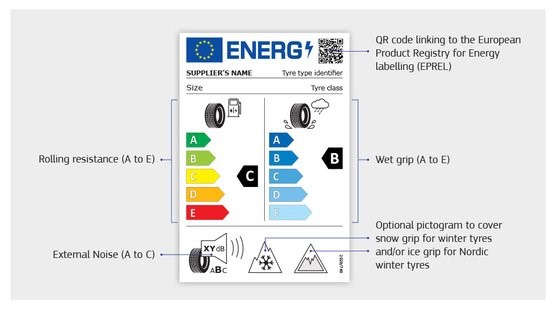
It now rates wet braking distances and fuel efficiency from A to E, with A being the best performing, and ranks external noise of the tyre from A to C, with A the quietest.

It also includes winter performance data, via the Three Peak Mountain Snowflake (3PMS) symbol, which determines whether a tyre meets tough snow performance requirements, as stipulated when driving across many European countries during colder seasons.

For C1 and C2 tyres, for cars and vans respectively, those previously in class E for fuel efficiency and wet grip will now be assigned to Class D which was previously empty, while those formerly in classes F and G will be assigned to class E. This makes the label clearer and easier to interpret.

Another addition to the EU tyre label is the stipulation that it must include a unique QR code, both on the on actual label and in the tyre manufacturers’ information that links the tyre to the European Product Database for Energy Labelling (EPREL) database, where additional tyre label information can be obtained.

As it stands, the regulation underpinning the new EU tyre labels only applies to new tyres, with revised legislation relating to retread tyres expected in 2023.

Importantly for commercial vehicle operators, mileage performance is not yet incorporated into the label, on the basis that suitable test methods are not currently available.

The label values are also based on the tyre’s performance when new and do not take into account the performance characteristics of the tyre across its lifetime.

Tony Stapleton, head of group fleet sales at Continental Tyres, said: “The new EU tyre label is designed to help people choose safer, more fuel-efficient tyres, factors which are vitally important whether you drive a car, a van or are responsible for choosing tyres for a commercial vehicle fleet.

 “However commercial vehicle customers should view the labelling as just one part of their discussions with tyre suppliers, to ensure performance factors not included in the labelling, such as the opposing requirements of mileage and durability, are factored into their choice.

Most fleets need to make sure their tyres offer a balance between these contrasting drivers, and this will greatly differ fleet to fleet depending on the type of operation and vehicles.

“For example, for construction and waste disposal fleets, tyre durability is critical, with fuel efficiency taking a secondary role, whereas in general haulage such as retail distribution, the fuel efficiency capabilities of a tyre will likely play a far greater role.”  By Graham Hill thanks to Fleet News

Share My Blogs With Others: These icons link to social bookmarking sites where readers can share and discover new web pages.
  • MisterWong
  • Y!GG
  • Webnews
  • Digg
  • del.icio.us
  • StumbleUpon
  • Reddit
  • Alltagz
  • Ask
  • Bloglines
  • Facebook
  • YahooMyWeb
  • Google Bookmarks
  • LinkedIn
  • MySpace
  • TwitThis
  • Squidoo
  • MyShare
  • YahooBuzz
  • De.lirio.us
  • Wikio UK
  • Print
  • Socializer
  • blogmarks

MP’s Challenge The Government Over 2030 Petrol/Diesel Ban

Thursday, 29. July 2021

Public Accounts Committee accuses Government of having no “clear, published plan” on how the UK will switch to an electric car future…

The viability of the Government’s plan to ban the sale of new petrol and diesel cars by 2030 has been called into question by a group of MPs, who say the transition represents a “huge challenge” for the country, and that the departments responsible for it have “lacked a clear, published plan” to set out how it will happen.

The criticism comes from the Public Accounts Committee (PAC), which evaluates the effectiveness and value of Government proposals and services. The PAC is made up of 15 MPs, eight of whom are Conservatives, although the chair is Labour’s Meg Hillier.

The PAC report says that although the Government has set “ambitious targets” for the transition, there are still big hurdles to overcome, including increasing the uptake of electric cars among buyers, lowering their cost, and upgrading the UK’s charging network.

Under current plans, the sale of new petrol and diesel cars will be banned from 2030, albeit with some hybrid cars given a stay of execution until 2035. So far in 2021, electric cars have accounted for 7.2% of sales – up from 4% across the same period in 2020.

Below, we look at each of the issues raised in the report, and what’s being done to address them.

Lowering the cost of electric cars

The cost of buying an electric car is one of the biggest issues, with the committee saying it is “not persuaded that the upfront costs are low enough for many”, and pointing out that there are currently only 13 electric car models costing less than £30,000. Any fully electric car which costs less than £35,000 qualifies for the Government’s plug-in car grant, currently worth £2500.

The plug-in car grant is expected to last until at least 2023, when funding allocated for the scheme in 2020 is due to run out. To date, the grant scheme has provided more than £1 billion to electric vehicle drivers.

The cheapest electric car you can buy currently is the Seat Mii, which costs from £22,800 before the grant is factored in.

A recent What Car? survey of more than 10,000 in-market buyers showed that one-in-five were considering an electric car as their next purchase – a significant rise compared with the 8% who answered the same way in 2019.

In our survey, 31% of respondents said the biggest concern they had over going electric was range, followed by charging (18%).

Lowering the cost of charging

The PAC report says that price differences between charging using a public charging network and charging at home “need to be addressed”, as well as the cost of replacing electric car batteries. Indeed, a National Audit Office report suggests that charging at home can cost up to 78% less than relying on the public charging network.

A recent What Car? investigation found that public charging prices vary wildly, with it costing as little as £7.49 and as much as £17.46 to charge a Renault Zoe electric hatchback to 80% of capacity, depending on location, associated fees and the type of charger used.

Similarly, while the Department for Transport estimates that, on average, it costs around 1p per mile to run an electric car (compared with around 10p per mile to run a petrol or diesel) our real-world tests show that this is only the case when you’re charging at home.

In reality, we found that an electric car can cost up to 9p per mile when all of the fees associated with public charging are taken into account, while 13p per mile is realistic for a petrol car, and 11p per mile for a diesel car.

In its evidence to the PAC, the Department for Transport said that it expects “more competition in the market and innovation which may benefit customers in terms of the price paid for electricity”.

The department also suggested that some electric cars might act as energy storage devices for smart homes, and feed energy back into the grid at peak times, thus reducing energy costs.

Increasing the availability of charging points

The PAC report says that although there has been progress made to increase the number of charging points available in the UK, “take-up has been greatest where there are high levels of traffic, charge-points and affluence.”

The report notes that rural areas are in danger of getting “left behind during this transition” if they too don’t see an expansion of their local charging networks. It should also be noted that the take-up among local authorities to support the growth of on-street residential charge points has been poor, with the National Audit Office estimating that almost a third of the £8.5 million set aside has not been used.

The report says: “We are not convinced that Government has sufficiently thought through how the charging infrastructure will expand at the pace required to meet the ambitious timetable to phase out petrol and diesel vehicles.”

It says that the Department for Transport has made a number of assumptions around the type of journeys most drivers are making, noting that, according to those assumptions, 99% of journeys are less than 100 miles, the vast majority of electric car charging is done at home and overnight, and that people will use public charging stations to top up during longer trips.

Despite those assumptions, the report says there is no estimate for how many charging points the country will need to keep up with the increase in electric cars. Data from the English Housing Survey also notes that 33% of households in England do not have access to off-street parking, so could not charge at home easily.

The PAC report notes that, while the Government has pledged to offer six rapid charging points at every UK motorway service station by 2023, it has “not focused much attention on charging for people that do not have off-street parking”.

According to Zapmap, which lists every public charging station in the country, there are currently 23,873 charging points at 15,254 locations across the UK. The biggest provider of publicly available charging points is Source London, which has a market share of 25.8%, followed by Ubitricity and Pod Point, with shares of 14.7% and 12.1% respectively.

Maintenance and energy costs

Other issues raised in the PAC report include the need to re-train dealership and independent garage technicians to work on and repair electric cars, especially as these vehicles age, and a safeguarding of the National Grid to cope with an increased demand for energy.

The Department for Business, Energy and Industrial Strategy estimates that the increased demand for electric cars will equate to a 2% increase in energy bills for households by 2030, although this is money that you would otherwise spend on filling up with petrol or diesel.

What has the reaction been?

The Society of Motor Manufacturers and Traders, which represents the views of the motor industry to Government, said: “The automotive industry shares the Government’s ambition for an electric revolution, a transformation that has already begun.

However, as the Public Accounts Committee has made clear, we need a comprehensive and holistic plan to get us there in time.

“That plan must convince consumers to make the switch, it must provide the incentives that make electric cars affordable for all, and it must ensure recharging is as easy as refuelling – which means a massive and rapid rollout of infrastructure nationwide.”

When asked for comment, a Department for Transport spokesperson told What Car?: “We’ve got a highly ambitious and world-leading approach to increasing the uptake of zero emission cars, and the progress we’re making in this area will help us to meet our targets.

“Already, we’re investing £2.8 billion in helping industry and drivers make the switch – and will continue our work to install thousands of charge points and boost the development of new technologies to meet our goals.”

The reaction to the ban from buyers has been negative, with a What Car? survey conducted in November of last year – soon after the proposal was announced – revealing that 59% of buyers disagreed with the principle behind the ban, while 29% said they did not understand which cars would still be allowed to be on sale after 2030.  By Graham Hill thanks to What Car?

Share My Blogs With Others: These icons link to social bookmarking sites where readers can share and discover new web pages.
  • MisterWong
  • Y!GG
  • Webnews
  • Digg
  • del.icio.us
  • StumbleUpon
  • Reddit
  • Alltagz
  • Ask
  • Bloglines
  • Facebook
  • YahooMyWeb
  • Google Bookmarks
  • LinkedIn
  • MySpace
  • TwitThis
  • Squidoo
  • MyShare
  • YahooBuzz
  • De.lirio.us
  • Wikio UK
  • Print
  • Socializer
  • blogmarks

Hyundai Ioniq 5 Electric Vehicle Gets A Rare 5 Star Rating By Auto Express

Thursday, 29. July 2021

The Ioniq 5 family hatchback represents a real shift forward in Hyundai’s ability to chase down premium electric rivals, helping to persuade EV buyers who are motivated by stylish design, great on-board tech and practical range and charging speeds, to invest in the Korean brand.

With stunning looks and a sense of cool that sets it apart from the pack, the manufacturer has added to the Ioniq 5’s strong kerb appeal with competitive pricing, generous standard kit and advanced active safety systems. We named it our Car of the Year for 2021, so if you’re thinking of a new purchase and you have the means, then the Hyundai Ioniq 5 is one of the best cars you can buy.

We have the car on special offer this week.

About the Hyundai Ioniq 5

Over recent years, Hyundai, along with its subsidiary brand Kia, has been at the forefront of producing well-built, practical electrified family cars. Mild- or plug-in hybrid tech is offered on models such as the Ioniq and Kona, as well as the bigger Santa Fe SUV, while the former two cars are also available with the benefits of zero-emission, all-electric drive.

But, pioneering and innovative auto makers must continue to push things forward, or risk falling into EV obscurity, and that is exactly what Hyundai has done with its latest Ioniq 5 hatchback/crossover. In a move away from the architecture used so far across its electric, hybrid and combustion-engined models, the Ioniq 5 is Hyundai’s first car to use its new Electric Global Modular Platform (E-GMP) and, as a foundation for the company’s next-level EV tech, it’s mightily impressive.

Two battery choices are available across the range, along with three individual power outputs: a 58kWh battery and a single 168bhp motor driving the rear wheels provides the entry point to Ioniq 5 ownership, while the next step up includes a 73kWh version paired with a 214bhp rear-mounted motor.

The top-spec option comprises the same 73kWh battery, but uses a second motor at the front giving a total of 301bhp and a meaty 605Nm of torque.

Buyers thinking of investing in a capable family EV now have top quality options to consider. The Volkswagen ID.3 hatchback might suit smaller households, although the ID.4 is a more direct rival to the 4.6-metre long Ioniq 5 and offers more space and day-to-day practicality than its compact sibling. Meanwhile, Ford has come up with its own brilliant all-electric model, the Mustang Mach-e, which provides the typical blue oval USP of a great driving experience, as well as being easy to live with.

Hyundai provides three trim levels for the Ioniq 5: SE Connect, Premium and Ultimate. Entry-level kit is good with 19-inch alloy wheels, LED headlights, rear parking sensors, climate control and smart cruise control all included, while inside the cabin there’s a wireless smartphone charging pad and two 12.3-inch displays – one covering the infotainment and the other a digital instrument cluster providing key info for the driver.

The Ioniq 5 range starts from just under £37,000 and rises to around £48,000. An Ultimate-spec car, particularly when paired with the most powerful 301bhp dual-motor setup, brings the Ioniq 5 firmly into Tesla territory, and will also provide food for thought for those considering an Audi Q4 e-tron in a top Edition 1 or more expensive Vorsprung trim. See our special offer above. By Graham Hill thanks to Auto Express.

Share My Blogs With Others: These icons link to social bookmarking sites where readers can share and discover new web pages.
  • MisterWong
  • Y!GG
  • Webnews
  • Digg
  • del.icio.us
  • StumbleUpon
  • Reddit
  • Alltagz
  • Ask
  • Bloglines
  • Facebook
  • YahooMyWeb
  • Google Bookmarks
  • LinkedIn
  • MySpace
  • TwitThis
  • Squidoo
  • MyShare
  • YahooBuzz
  • De.lirio.us
  • Wikio UK
  • Print
  • Socializer
  • blogmarks

Survey Reveals The Number Of Drivers That Fall Asleep At The Wheel

Friday, 23. July 2021

A potential four million drivers have fallen asleep at the wheel at some point, a new study has revealed.

Issued by road safety charity IAM RoadSmart, the findings show that one in ten of the 1,000 motorists surveyed admitted to momentarily closing their eyes because they were so tired.

In addition, more than half of drivers also said that they were very concerned about fatigue when driving long distances. Applied to the more than 40 million licence holders registered in the UK, this equates to more than 20 million drivers.

Neil Greig, IAM RoadSmart director of policy and research, said: “Fatigue behind the wheel is a very serious problem, perhaps more concerning than previously thought of.

“It is shocking to think a potential four million drivers have closed their eyes behind the wheel because they were so tired, even if it was just for a short time. The potential carnage that could result from even one accident doesn’t bear thinking about.”

Other areas of the research highlighted further issues, with one in ten drivers admitting that they had hit the rumble strip of a road, while four in ten had turned down the heating or lowered the windows in order to prevent themselves from feeling tired.

Greig added: “Driving a long distance needs pre-planning to ensure there are plenty of available rest places and to make sure there’s enough time to complete the journey if delays are encountered.

Never drive for longer than two hours without a break and take particular care if driving when you would normally be asleep. This is even more important as the country reopens after the pandemic and not all facilities may be available yet.

“Drivers can then concentrate on staying alert behind the wheel rather than staving off tiredness by trying to reach their end destination without adequate rest breaks.” By Graham Hill thanks to Yahoo News

Share My Blogs With Others: These icons link to social bookmarking sites where readers can share and discover new web pages.
  • MisterWong
  • Y!GG
  • Webnews
  • Digg
  • del.icio.us
  • StumbleUpon
  • Reddit
  • Alltagz
  • Ask
  • Bloglines
  • Facebook
  • YahooMyWeb
  • Google Bookmarks
  • LinkedIn
  • MySpace
  • TwitThis
  • Squidoo
  • MyShare
  • YahooBuzz
  • De.lirio.us
  • Wikio UK
  • Print
  • Socializer
  • blogmarks

Huge Backlog At The DVLA Due To Covid And Industrial Action!

Friday, 23. July 2021

Some drivers have been unable to get on the road due to 1.4 million DVLA applications waiting to be processed

The Driver and Vehicle Licensing Agency (DVLA) is faced with a “catastrophic” backlog of paper applications due to social-distancing rules, and industrial action linked to Covid-19.

Strikes by the Public and Commercial Services Union (PCS) have been staged in response to what it calls “unsafe” working conditions, contributing to the mass of unprocessed applications.

More than 643 of the DVLA’s 6,000-strong workforce are reported to have had Covid, although the organisation says it has followed Government advice at every stage.

Mark Serwotka, head of the PCS, told the BBC that the backlog of 1.4 million cases could have been avoided if staff were allowed to work from home, calling it a “stain” on the reputation of the civil service: “In 21 years, I have never encountered the level of incompetence and mismanagement that is on display at the DVLA in Swansea.”

“We believe that if the department of work and pensions can deal with three million universal credit claims, if HMRC can deliver furlough scheme, if we have workers in the home office ministry of justice, devolved nations, working from home handling in some cases much more secure data so could the DVLA.”

The head of the PCS also said that the actions of the DVLA have put its workers at a significant health risk, with more than 643 confirmed Covid cases and one fatality.

However, chief executive of the DVLA Julie Leonard has denied this, claiming that staff safety has been prioritized during the pandemic:

“We have taken staff safety incredibly seriously at every point in this. Had it been easy to have more people working at home, we would have done it. Staff safety really has come first.”

A provisional deal between the DVLA and PCS recently fell through without explanation, according to Serwotka, who said: “Targeted action will continue at the DVLA unless the original deal, which both parties had agreed in principle, is back on the table.”

The DVLA has faced major criticism for some time, with some motorists left unable to drive for months, and others complaining of unreturned documents. The DVLA receives around 60,000 pieces of mail daily, but says online operations – which can be used for most of its services – are unaffected. Drivers with medical conditions often have to rely on physical documents, though, while medical professionals’ letters often required by the DVLA are also subject to delays. 

The DVLA said: “There are significant delays in processing paper applications and contacting us due to ongoing industrial action and social-distancing requirements.

Paper applications are taking, on average, up to six weeks to process, but there may be longer delays for more complex transactions.”

The agency added the people can continue to drive after submitting an application, as long as they have not been instructed not to do so by a doctor or optician. It called the strike action “disappointing”, and said PCS is “targeting services that will have the greatest negative impact on the public, including some of the more vulnerable people in society”.  By Graham Hill thanks to Auto Express.

Share My Blogs With Others: These icons link to social bookmarking sites where readers can share and discover new web pages.
  • MisterWong
  • Y!GG
  • Webnews
  • Digg
  • del.icio.us
  • StumbleUpon
  • Reddit
  • Alltagz
  • Ask
  • Bloglines
  • Facebook
  • YahooMyWeb
  • Google Bookmarks
  • LinkedIn
  • MySpace
  • TwitThis
  • Squidoo
  • MyShare
  • YahooBuzz
  • De.lirio.us
  • Wikio UK
  • Print
  • Socializer
  • blogmarks

Frightening Number Of Cars Are Passing Their MOT Test That Should Fail

Friday, 23. July 2021

Nearly one is seven vehicles that passed their MOT test last year should have failed, according to a new study.

Analysis of the Driver and Vehicle Standards Agency’s (DVSA’s) MOT Compliance Survey (2019 – 2020) by What Car?, found 13.58% of vehicles that passed an MOT test should have failed.

A team of DVSA vehicle examiners retested a randomly selected sample of 1,671 vehicles, which had undergone an MOT test at test stations across the UK. It disagreed with the test outcomes in 16.82% of cases.

In 70.1% of cases, the DVSA found at least one defect which the MOT test station missed or had incorrectly recorded, while the DVSA experts disagreed with three or more defects in 56.5% of vehicles.

The DVSA examiners also felt that 3.23% of failures deemed to be worthy of a pass certificate.

Safety critical features such as the brakes and suspension were subject to the biggest discrepancy between the DVSA and MOT testers. Brakes had the highest number of misdiagnosed defects, at 17.74%, followed by the suspension (14.56%), tyres (13.22%), and lights, reflectors and electrical equipment (11.51%). 

Following its investigation, the DVSA issued 24 disciplinary action recordings and 179 advisory warning letters to the vehicle test sites it visited. Between them, they were responsible for 12.1% of all vehicles re-tested by the Government agency.

What Car? surveyed 1,425 used car buyers as part of its investigation, with 11.9% stating they knew of a local garage that has a reputation for passing cars for their MOT. For 76.8% of buyers, a prospective car’s MOT record was either ‘very important’ or ‘important’ when deciding on whether to buy.

Steve Huntingford, editor of What Car?, said: “Our investigation has shown the significant differences between the DVSA’s own testing standards and those upheld by some in the industry. This poses a serious concern, with potentially hazardous vehicles being allowed to remain on the road, putting their drivers and other road users at risk. It also complicates matters for used buyers who often rely on a vehicle’s MOT history as an indicator for a car’s safety and reliability.” By Graham Hill thanks to Fleet News

Share My Blogs With Others: These icons link to social bookmarking sites where readers can share and discover new web pages.
  • MisterWong
  • Y!GG
  • Webnews
  • Digg
  • del.icio.us
  • StumbleUpon
  • Reddit
  • Alltagz
  • Ask
  • Bloglines
  • Facebook
  • YahooMyWeb
  • Google Bookmarks
  • LinkedIn
  • MySpace
  • TwitThis
  • Squidoo
  • MyShare
  • YahooBuzz
  • De.lirio.us
  • Wikio UK
  • Print
  • Socializer
  • blogmarks

New Report Reveals The Increased Dangers Of Crash For Cash

Friday, 23. July 2021

All drivers and especially fleet operators are being advised to proactively protect their vehicles and drivers, following a crash for cash report from the Insurance Fraud Bureau (IFB).

SmartDrive Systems, a provider of in-vehicle camera systems, says the report must act as an urgent wake up call to any operators not using camera footage as part of their accident management process.

The IFB report identifies more than 170,000 insurance claims potentially linked to cash for crash gangs, out of 2.7m claims made between October 2019 and December 2020.

“A number of our fleet customers, particularly those operating vans on last mile delivery, have found themselves particular targets of this criminal behaviour,” said Penny Brooks, managing director of SmartDrive Systems.

“The term ‘fraud’ doesn’t begin to capture the nature of crash for cash offence,” she added. “These people are weaponising vehicles and attacking commercial vehicle drivers. This is physically dangerous; it is highly stressful and it can shatter a driver’s confidence. Not to mention the cost to the fleet operator. “

Crash for cash scams can range from paper-based fabrications, or vehicles being damaged behind closed doors, through to those where collisions are being caused by fraudsters.

IFB investigations have found single gangs can be behind thousands of orchestrated collisions in some areas, with the combined value of their fraudulent claims running into the millions.

The Midlands, North West and London were highlighted as particular problem areas by the IFB, with Birmingham named the most dangerous city in the UK for collision scams.

A proactive video solution can provide protection against these scams. The SmartDrive system captures 10 seconds of footage before and after a collision, giving an unarguable narrative. The driver can also manually activate the cameras for recording events or self-protection.

Footage is offloaded via the cellular network in near real time, preserving the data and speeding First Notification of Loss (FNOL), claim process and claim dismissal.

Brooks said: “We have helped our customers dismiss literally thousands of fraudulent cash for crash claims this way and save hundreds of thousands of pounds.

“If all commercial vehicles had a suitable camera system, we could drive these criminals off the road, for good. Our drivers are a precious resource and we should do all we can to protect them.”  By Graham Hill thanks to Fleet News

Share My Blogs With Others: These icons link to social bookmarking sites where readers can share and discover new web pages.
  • MisterWong
  • Y!GG
  • Webnews
  • Digg
  • del.icio.us
  • StumbleUpon
  • Reddit
  • Alltagz
  • Ask
  • Bloglines
  • Facebook
  • YahooMyWeb
  • Google Bookmarks
  • LinkedIn
  • MySpace
  • TwitThis
  • Squidoo
  • MyShare
  • YahooBuzz
  • De.lirio.us
  • Wikio UK
  • Print
  • Socializer
  • blogmarks

Used Car Buyers Prefer Diesel To Electric Cars As A Result Of The Huge Price Difference

Friday, 23. July 2021

A price premium for pure used battery electric vehicles (BEVs) is leaving many buyers reluctant to make the switch, when faced with a cheaper, second-hand diesel car.

Alternative fuel vehicles, which include mild and plug-in hybrid models as well as pure electric cars, only account for between 5-8% of Aston Barclay’s used stock.

However, for some fleet customers it can be as high as 10-12% of their total inventory, according to Martin Potter, Aston Barclay’s managing director – customer.

He says fleet vendors are realising that, while they may be currently remarketing three-year-old internal, combustion engine (ICE) vehicles, their product mix will quickly change with the majority of new fleet registrations becoming electric.

Recent research from Centrica Business Solutions showed a healthy appetite for fleet electrification, with UK businesses planning to spend £16 billion on plug-in vehicles in 2021 – a 50% uplift on last year.

It revealed that UK firms spent £10.5bn on EVs and on-site charging points during the year to March 2021 but are now planning £15.8bn of investment in the same area over the next 12 months.

Two fifths (40%) of those questioned said they had increased the total number of EVs within their fleet between April 2020 and March 2021.

Incentives for fleets and company car drivers have helped drive the record-breaking EV registrations, thanks to new benefit-in-kind (BIK) tax rates, introduced last spring.

“We’re all working very hard to understand the market and, most importantly, to understand where the consumers are coming from,” Martin Potter, Aston Barclay

Overall, there were 108,205 battery electric vehicles BEVs sold in 2020, according to the Society of Motor Manufacturers and Traders (SMMT), significantly more than the 66,879 plug-in hybrid electric vehicles (PHEVs) registered during the year.

In terms of non-plug-in mild hybrids, the SMMT data shows that 110,087 cars were registered.

Two-thirds (67%) of the registrations for BEVs and PHEVs (68%) were from fleets, last year.

Potter said: “The hybrid stock we’re selling is 44 months old, on average, 48,000 miles and the average price is around £13,000.

“That is very similar to the typical fleet stock and it’s at a price the consumer can work with, whereas you then look at the battery electric that has an average age of 20 months, 18,000 miles and £25,000 average sale price.

“The gap between what somebody has to pay for that and a diesel or even a hybrid equivalent is currently so vast it’s hard for them to justify, but that will change.”

Dylan Setterfield, head of forecast strategy at pricing experts Cap HPI, recently told Fleet News that the higher residual values (RVs) in absolute terms enjoyed by EVs are not simply because they have higher list prices; low volumes also have an impact.

RVs are supported by carefully managed remarketing strategies by the manufacturers, keeping used examples in the dealer network or negotiating bulk deals for niche second-hand use,

However, he expects the current price premium of used BEVs and PHEVs will gradually reduce over time thanks to increasing volumes.

Values of older used models may also come under pressure if newer models come with better technology or a cheaper list price.

“We’re all working very hard to understand the market and, most importantly, to understand where the consumers are coming from,” said Potter.

Covid helps drive ‘time to sell’ reduction

After welcoming back buyers to auctions halls in April, Potter told Fleet News that the return to physical sales had proved worthwhile, with conversion rates increasing and those in attendance accounting for a higher proportion of final bids. “The physical buyers were definitely buying more cars,” he said. 

Aston Barclay has been employing an “omni-channel” sales approach to remarketing its vehicles, with the mix dependent on the sector its serving.

Fleet cars, for example, are sold online but buyers are also able to bid in person in the auction hall. Cars aren’t driven through the auction hall, however, with buyers instead able to view stock prior to the sale.

Stock where condition can be more of a potential issue, such as dealer part-exchange, is being driven through the auction hall, while OEM stock is dealt with offsite and completely virtually.

Potter said: “I’m really pleased we’ve got this different approach for different sectors and without the pandemic I think it would have been really hard to do.

“The pandemic has forced people to get used to the different technologies and different ways of remarketing.”

He continued: “It’s a really exciting time for the business. More and more people are looking for diversity in getting vehicles to market to maximise their values, but most importantly is less days to sell, especially in the fleet and finance sectors.”

Once a vehicle comes off the fleet, the leasing company is no longer receiving a monthly rental so time to sell is crucial, particularly when it’s a depreciating asset.

“They want the money back in the bank so they can finance another one,” explained Potter. “We’re now able to use new technologies, products and services that can all lend themselves to reducing the number of days to sell.

“For example, we’ve got some customers using our app-based appraisal tool three or four weeks before the car’s contract is due to be terminated, which allows us to start remarketing it before its defleeted. That’s going to reduce days.” By Graham Hill thanks to Fleet News

Confusion Over The Government’s EV Plans.

The Government’s long-awaited transport decarbonisation plan has been delayed after it lacked the ambition to meet targets, including the 2030 ban on new diesel and petrol vehicles.

The plan was originally due to be published before the end of 2020 and was then pushed back to spring 2021.

It will now miss that deadline after transport minister Rachel Maclean told MPs in a Westminster debate that she was not happy with the draft plan.

She said: “I am not satisfied with the draft because it does not meet the ambition we need in order to reach those incredibly challenging targets.”

She told the debate in Westminster Hall that she was unable to give a publication date, but the Department for Transport (DfT) intended to publish the plan “soon”.

The plan is the first time the UK will lay out its approach to decarbonising every form of transport and is an essential part of achieving the legal requirement for net zero emissions by 2050 and the Climate Change Committee’s sixth carbon budget.

Maclean told MPS that the Government is developing three key policy documents over the course of 2021.

“The first is a delivery plan that will set out key Government commitments, funding and milestones… for the 2030 and 2035 phase-out dates,” she said.

“It will deal with the question whether we will have a zero-emission vehicle mandate.”

An infrastructure strategy will set out the “vision and action plan” for the charging infrastructure roll-out that is needed to achieve the phase-out date successfully and accelerate the transition to zero emission transport.

“As part of this strategy we are working with local authorities, charge point operators and other stakeholders to ensure that our future charging infrastructure is practical, accessible, reliable and achievable, alongside outlining all the key roles and responsibilities for all actors in the EV charging sectors,” continued Maclean.

“It is clear that we need more charge points everywhere and this Government will set out how that will take place.”

It will also bring forward the Green Paper on the UK future CO2 emissions regulatory framework, which will set out how the UK will phase out petrol and diesel cars and vans and support the interim carbon budgets. This will include “consulting on which vehicles exactly can be sold between 2030 and 2035”.

Maclean also said that the Government intends to “support people to charge their cars at home”.

She explained: “We are working closely with the Ministry of Housing, Communities and Local Government at the moment and we have consulted on plans to introduce a requirement for every new home to have a charge point, where there is an associated parking space. We will publish our response soon.

“We aim to lay regulations in Parliament in 2021 – this year – that will make England the first country in the world to introduce mandatory charge points in new homes, again cementing our position as the global leader in the race to net zero.”

The Government also intends to tackle the issue of public charge points not working.

When questioned by Labour’s shadow minister for green and future transport Kerry McCarthy whether there would be legislation requiring charge point operators to meet certain reliability standards, Maclean said: “We already have those powers in legislation and we intend to use them.”  By Graham Hill thanks to Fleet News

Share My Blogs With Others: These icons link to social bookmarking sites where readers can share and discover new web pages.
  • MisterWong
  • Y!GG
  • Webnews
  • Digg
  • del.icio.us
  • StumbleUpon
  • Reddit
  • Alltagz
  • Ask
  • Bloglines
  • Facebook
  • YahooMyWeb
  • Google Bookmarks
  • LinkedIn
  • MySpace
  • TwitThis
  • Squidoo
  • MyShare
  • YahooBuzz
  • De.lirio.us
  • Wikio UK
  • Print
  • Socializer
  • blogmarks

Councils Will Receive Extended Powers After December 2021 To Issue Motoring Fines

Friday, 16. July 2021

Councils outside London will be given powers to enforce so-called moving traffic offences from December, the Government has confirmed.

The powers were initially outlined by the Prime Minister, Boris Johnson, last year, in an effort to increase walking and cycling in England.

The new enforcement powers will allow local authorities, rather than the police, to enforce against moving traffic offences such as disregarding one-way systems or entering mandatory cycle lanes.

The change has already taken effect in London, where reports suggest it has significantly reduced police workload on traffic offences, allowing officers to prioritise more important matters, while also improving enforcement.

The Government is proposing that motorists be issued with a warning for a first offence, and fines for subsequent offences.

Speaking at this week’s Traffex conference, transport minister Baroness Vere said: “Local authorities will need the tools to manage roads in the way that best serves local needs, which may vary in different parts of the country, and it is this ethos of localism that lies behind our decision to give more powers to local authorities under the Traffic Management Act.”

A freedom of information request made by the RAC to all local authorities that currently have the power to enforce these offences in England and Wales – the London boroughs and Cardiff Council – found revenue from issuing penalty charge notices (PCNs) to drivers increased by 25% between 2016/17 and 2018/19.

The enforcement of moving traffic offences such as stopping on a yellow box junction, making an illegal turn or driving down a ‘no entry’ road resulted equated to £58.2m in 2018/19 for authorities – £11.5m more than in 2016/17 (£46.7m).

RAC spokesman Simon Williams said: “It’s right that councils outside London have the ability to enforce known rule-breaking hotspots, but we’re fearful that some authorities may be over enthusiastic in using their new powers for revenue raising reasons, to the detriment of drivers.

“While the Government has pledged to give councils advice on how best to let drivers know enforcement is taking place, what’s really needed is clear guidance on making sure enforcement is always carried out fairly.

“Drivers who blatantly ignore signage or highway rules should expect penalties, but there are instances which are not always clear-cut.”

Williams says that large yellow box junctions, for example, can be particularly problematic to get across without stopping, often due to their design.

“It’s important common sense is applied rather than instantly issuing penalties to drivers,” he said.

“The first thing councils should do is review the road layout at these junctions to make sure drivers can negotiate them at all times, but especially at busy periods.”

The RAC also wants councils to closely monitor the number of penalty charge notices issued, as very high volumes in one particular location is likely to indicate something is wrong, either with signage or the design of the road.

“In these circumstances, we feel it would be wrong for drivers to have to pay up,” said Williams.

“More broadly, there’s a good argument for authorities to issue warning letters in the first instance rather than fines.

“We also believe drivers should be able to appeal easily if, for example, they receive a penalty for slightly moving into a yellow box to allow an emergency vehicle through.”  By Graham Hill thanks to Fleet News

Share My Blogs With Others: These icons link to social bookmarking sites where readers can share and discover new web pages.
  • MisterWong
  • Y!GG
  • Webnews
  • Digg
  • del.icio.us
  • StumbleUpon
  • Reddit
  • Alltagz
  • Ask
  • Bloglines
  • Facebook
  • YahooMyWeb
  • Google Bookmarks
  • LinkedIn
  • MySpace
  • TwitThis
  • Squidoo
  • MyShare
  • YahooBuzz
  • De.lirio.us
  • Wikio UK
  • Print
  • Socializer
  • blogmarks