Fleets face delays of more than a year for company car orders as well as changes to original specifications as vehicle manufacturers grapple with the shortage of key components, including semi-conductors.
Jaguar Land Rover (JLR) has warned leasing companies that lead times for 53 model variants are now in excess of one year.
The cars affected include versions of the 2022 model year Jaguar E-Pace, Land Rover Discovery, Land Rover Discovery Sport, Range Rover Evoque, and Land Rover Defender.
“Although these can remain open for quoting and ordering on your systems if you choose, your supplying Retailer will not be in a position to accept orders for these derivatives due to extended lead times,” said the briefing note from JLR.
However, the manufacturer added that a large number of models are still available for order, including the Jaguar I-Pace and F-Type, as well as alternative derivatives of the delayed cars, including plug-in hybrid versions of the E-Pace, Discovery Sport, Evoque and Defender 110.
In an official statement, JLR said, “Like other automotive manufacturers, we are currently experiencing some Covid-19 supply chain disruption, including the global availability of semi-conductors, which is having an impact on our production schedules. We continue to see strong customer demand for our range of vehicles.
“We are working closely with affected suppliers to resolve the issues and minimise the impact on customer orders wherever possible.”
Fleet customers, said JLR, should address any questions to their local retailer.
Mercedes-Benz specifications removed
Facing the same supply issues, Mercedes-Benz has removed specification features from certain models “from late June production and until further notice,” in order to limit delivery time delays.
The wireless charging of mobile phones, hands-free access to the boot (by kicking under the rear bumper), multibeam LED headlights and certain audio systems are among the features to disappear from the standard specification of certain cars, with AMG-line derivatives particularly affected.
Read how a shortage of raw materials ‘threatens price and supply’ of new vehicles
A statement from Mercedes-Benz said that all customer groups are affected by the current delays.
“Regardless of the model, we take into account how long a customer has been waiting for their vehicle and try to prioritise accordingly,” it said.
“Nevertheless, handovers to customers are strongly dependent on the individual equipment and the short-term availability of parts.”
Customers can check the specification of their car can do so via the Mercedes-Benz Online Showroom (shop.mercedes-benz.co.uk), or by speaking to their retailer.
As a leading global manufacturer, Mercedes-Benz AG expects that the worldwide shortage of supply of semiconductor components will continue to affect its business in the second half of this year.
In its latest editorial, Cap HPI said component shortages of semiconductors, steel, rubber and even foam were affecting different manufacturers’ production to varying degrees.
“Manufacturers are prioritising registrations in their most profitable channels, namely retail, meaning less short-cycle rental, company cars and demonstrators are being registered,” it said.
“They are also diverting build slots to the most profitable models due to component supply issues and removing some items from cars, allowing fewer semi-conductors to be required.”
The impact to JLR and Mercedes-Benz from the semiconductor shortage comes as Toyota announced a 40% cut in worldwide production in September.
It had planned to produce almost 900,000 cars next month but has now said that will be reduced to 540,000 units.
Every car- and van-maker is being impacted by the computer chip crisis, with some delivery times for vehicles. Almost 95% of fleets responding to a Fleet News poll said they were experiencing vehicle delays.
Fleet decision-makers were warned at the start of the month that the global semiconductor shortage will have a greater impact on the automotive industry than the pandemic. By Graham Hill thanks to Fleet News
Share My Blogs With Others:These icons link to social bookmarking sites where readers can share and discover new web pages.
Four-in-five drivers mistakenly expect to be warned by their vehicle when advanced driver-assistance systems (ADAS) are faulty, research from Autoglass suggests.
Despite a clear majority (72%) of drivers understanding that ADAS can help to reduce accidents, the research warns that millions of drivers could be relying on their dashboard to tell them when something is wrong.
However, ADAS technologies currently do not have the capability to alert the driver if they have not been correctly recalibrated or recalibrated at all, for example following a windscreen replacement, or if a minor accident has caused them to be knocked out of alignment, says Autoglass.
Chris Abbotson, national sales manager at Autoglass, explained: “Advanced driver-assistance systems are dramatically improving road safety, but they can only do so if the sensors are properly recalibrated by a skilled technician.
“It’s incredibly dangerous for a driver to be in charge of a vehicle if the onboard sensors are either not recalibrated or not recalibrated correctly, as they would likely be relying on safety systems that are unable to accurately identify hazards on the road.”
ADAS technologies, which include safety features such as blind spot warning, parking sensors and lane keep assists, are found on more and more fleet vehicles in the UK and are increasingly relied upon for the safety of drivers and other road users.
ADAS sensors need to be recalibrated correctly after a windscreen replacement to ensure they are functioning as the manufacturer intended them to. As it stands, only half (48%) of UK drivers realise this is the case.
Autoglass says it is important that fleet managers check that the ADAS sensors on the vehicles in their fleet are recalibrated after any windscreen replacement and that they are recalibrated correctly to minimise the risk of accidents.
Overall awareness of ADAS features amongst drivers also remains concerningly low, with only 33% having heard of advanced emergency brake systems, and only 21% aware that vehicles can automatically recognise traffic signs.
The research highlights that more must be done to educate drivers about managing the systems to ensure these advanced safety systems function correctly, says Autoglass.
“When choosing partners for any windscreen work, fleet managers need to ensure they are working with the best technicians who have received the latest training to ensure they are capable of correct ADAS recalibration and are aware of the latest technologies in vehicles,” said Abbotson.
“All technicians at Autoglass complete the IMI accredited ADAS training to ensure they can replace windscreens and recalibrate the ADAS sensors in one appointment, minimising downtime for vehicles and reducing the risk for drivers.” By Graham Hill thanks to Fleet News
Share My Blogs With Others:These icons link to social bookmarking sites where readers can share and discover new web pages.
If you are ordering a new car next year, you and fleet decision-makers are being urged to prepare drivers now for vehicles being fitted with intelligent speed assistance (ISA) technology from next year, says FleetCheck.
The European Commission has provisionally agreed that all new vehicles sold in Europe will be fitted with a speed limiter as a legal requirement from July 2022.
The regulation also mandates all new cars that have already launched be fitted with ISA technology by July 2024.
The UK is likely to follow the new road safety regulations, despite leaving the EU, as it has retained most EU laws for new cars.
Peter Golding, managing director at the fleet management software specialist, says the move should be seen as significant opportunity to enforce a safety message on speed.
“Thankfully, macho attitudes towards speeding that were once quite common among drivers of company vehicles have reduced considerably in recent years,” said Golding. “However, speeding tickets are still pretty common, as any fleet manager will tell you.
“Our view is that the introduction of ISA technology is a moment that employers should be seizing as an opportunity to make clear that there is no corporate leeway when it comes to speeding and the dangers it represents.”
The speed limiter technology uses GPS data and/or traffic-sign-recognition cameras to determine the maximum speed allowed in an area.
It then limits the engine’s power and the vehicle’s speed to that limit, but it is possible to override the system by pressing hard on the accelerator.
Golding says that, with the first ISA cars, vans and trucks now less than a year away, this is a good moment to adopt a “zero tolerance approach” to excessive speed.
“With the long lead times currently being experienced by fleet operators, vehicles being ordered within the next few months will potentially arrive with ISA fitment, so this is very close to being a live fleet issue,” he continued.
“Our view is that this should be presented to drivers as a genuine benefit. Firstly, these are safer vehicles – reduced speed means fewer accident and fewer serious accidents. Secondly, it will potentially remove the chance of you picking up a speeding ticket.”
Research undertaken by the EU shows that drivers like ISA-equipped cars because, in everyday driving, sticking to the speed limit becomes one less thing to worry about. “We are sure that this will soon become the case among drivers of company vehicles,” said Golding. By Graham Hill thanks to Fleet News
Share My Blogs With Others:These icons link to social bookmarking sites where readers can share and discover new web pages.
Software experts have discovered numerous security flaws with a range of smart electric vehicle (EV) chargers.
They were able to remotely switch the chargers on and off, remove the owner’s access and lock or unlock the charging cable.
Devices from Wallbox and Project EV – both approved for sale in the UK by the Department for Transport – were found to be “lacking adequate security” by researchers at Pen Test Partners.
Speaking to the BBC, Vangelis Stykas, a cyber-security researcher, said: “On Wallbox you could take full control of the charger, you could gain full access and remove the usual owner’s access on the charger. You could stop them from charging their own vehicles, and provide free charging to an attacker’s vehicle.
“Project EV had a really bad implementation on their back end. Their authentication where it existed was pretty primitive, so an attacker could easily escalate themselves to being an administrator and change the firmware of all the chargers.”
He says changing the programming on the device would allow an attacker to permanently disable the charger, or use it to attack other chargers or servers.
Hackers could also infiltrate a home network, in cases where the chargers were connected by Wi-Fi.
Pen Test Partners believes that multiple chargers could also be controlled at the same time using some of the vulnerabilities it found, which could potentially be used by an attacker to overload the electricity grid in some areas and cause blackouts.
The company assessed charging units from Project EV, Wallbox, EVBox, EO Hub, Rolec and Hypervolt.
Most of the faults have now been addressed, however charge point owners are advised to install the latest software updates to the devices. By Graham Hill thanks to Fleet News
Share My Blogs With Others:These icons link to social bookmarking sites where readers can share and discover new web pages.
Up to 800 Shell electric vehicle (EV) charging points will be installed in as many as 100 Waitrose shops across the UK by 2025.
Each site is expected to have six 22kW and two 50kW rapid charging points so customers can charge their vehicles while they shop.
The first charge points are expected to go live early next year and will represent Shell Recharge’s first move into ‘destination charging’, whereby customers charge their vehicle while it is parked at a location they are primarily visiting for another activity such as shopping.
Shell’s ambition is to grow its Shell Recharge-branded network to 5,000 charge points on forecourts and other locations by 2025.
Bernadette Williamson, general manager Shell UK Retail, said: “This is great news for EV drivers across the UK, knowing they can easily, quickly and reliably charge up at Shell charge points while shopping at Waitrose.
“We want to make EV charging as hassle-free as possible and support our customers wherever they want to charge.”
Waitrose executive director, James Bailey, added: “We’re delighted to bring our customers 800 new charging points for electric vehicles, including new rapid charging capabilities, as the UK moves more and more towards a sustainable transport network.”
The charge point deal comes as a Competition and Markets Authority (CMA) investigation has found that some areas of the development of the UK’s charging infrastructure are facing problems which will hinder the roll-out of electric vehicles (EVs).
It says that this could impact the Government’s plans to ban the sale of new petrol and diesel cars by 2030 and its wider commitment to make the UK net zero by 2050. By Graham Hill thanks to Fleet News
Share My Blogs With Others:These icons link to social bookmarking sites where readers can share and discover new web pages.
The following article illustrates why branding on vans could void their insurance but I’ve included the article for all to read because it could equally apply to doing similar to your car.
Van operators are being urged to check vehicle signage or branding is recorded as a modification on their insurance policy or risk voiding their cover.
Insurance comparison website Quotezone.co.uk says many van operators are unaware that their van’s branding falls into the modification category on current policies, alongside items such as spoilers and alloy wheels.
Drivers need to keep their insurance provider up to speed with any modifications, including newly added branding or signage, because those modifications can sometimes change the van’s risk profile, it says.
Signage or branding on a van, for example, might increase the risk of a break-in if thieves think valuable equipment or tools might be stored in the vehicle.
In addition, if the vehicle is ever involved in an accident the cost of repairing or replacing the signage might increase the overall cost of repairing the van.
The insurance comparison website advises van owners to make sure forms are correctly answered when taking out a new policy, inform their existing provider if signage or a vehicle wrap is added after the policy was taken out, and if in doubt ask the provider.
Greg Wilson, founder of Quotezone.co.uk, said: “It’s worth checking how their insurer views any branding on the vehicle to ensure they’re correctly declaring everything they’re required to declare.”
Making sure the policy is always accurate ensures drivers are protected should they need to make a claim, added Quotezone.co.uk. By Graham Hill thanks to Fleet News
Share My Blogs With Others:These icons link to social bookmarking sites where readers can share and discover new web pages.
The number of people paying company car tax has again fallen substantially, with HMRC reporting 70,000 fewer people paying for the benefit.
The latest benefit-in-kind (BIK) statistics, published by HMRC today (July 29), show there were 800,000 company car drivers in 2019/20 – down from 870,000 the previous year.
New company car tax rates, including an initial zero percentage rate for pure electric vehicles (EVs), were introduced from April 2020, with many leasing companies suggesting an increased uptake in company cars.
However, any potential increase in company car drivers will not be reflected in HMRC’s figures until the next year’s data set is released.
Instead, this year’s provisional figures suggest the number of employees receiving the benefit has fallen by some 160,000 in the past five years, from 960,000 in 2015/16.
The new data also shows that the amount of company car tax collected has stayed the same at £1.75 billion, despite the dramatic decline in employees paying BIK on a company car between 2018/19 and 2019/20.
National Insurance Contributions (NICs) have increased, however, with the tax man collecting £750 million in 2019/20 compared to £730m in 2018/19.
The reduction in company cars seen over the past few years coincides with the introduction of voluntary payrolling.
HMRC claims that at least part of the reduction is due to employers moving from submitting P11D returns to collecting tax on company cars through payroll.
In 2016/17, employers were not able or required to submit more detailed information about company cars when collecting tax on this benefit through voluntary payrolling.
The following tax year employers payrolling car benefit were able to provide more detailed data about the cars being provided through their FPS (Full Payment Submission), which at the time HMRC told Fleet News would rectify the situation.
However, HMRC says suggests that “significant numbers” were not reported in all three years, even after reporting became mandatory in 2018/19.
Between tax years from 2010 to 2016 the reported number of recipients of company car benefit remained relatively stable (at just under one million).
More recently the number of reported company car users has fallen to 900,000 in 2017/2018 and then to 870,000 in 2018/2019.
Provisional figures show a further fall to 800,000 in 2019/20, with HMRC suggesting that there is likely to be a substantial number of individuals in these years who received company car benefit that (while taxed at payroll) was not properly reported.
Over the same period the total taxable value of reported company cars has increased significantly.
In tax year 2010/11 it was £3.66bn but by 2019/20 it had reached £5.42bn. This increase, says HMRC, is primarily due to increases in the average taxable value of a company car, which is itself a result of increases in average car list prices and increases to the ‘appropriate percentages’ used to calculate a company car’s typical value. By Graham Hill thanks to Fleet News
Share My Blogs With Others:These icons link to social bookmarking sites where readers can share and discover new web pages.
Orders for diesel and petrol cars at Zenith in June were surpassed by those for battery electric vehicles (BEVs) for the first time.
The top 10 FN50 leasing and fleet management company says that pure electric vehicles (EVs) accounted for more than half (54%) of orders in June, compared to almost a third (32%) in the same month last year.
Over the past 12 months, Zenith reports that 41% of orders were for BEVs.
Demand for electric vans also increased in June to account for 69% of van orders compared to 1% in June 2020. Over the past 12 months, demand for fully electric vans has built to account for almost one in three van orders.
Ian Hughes, CEO, car and van division at Zenith, says orders had increased as the wider economy reopens. “In June, year-on-year total car orders almost doubled and, we have seen an almost nine-fold increase in total van orders as customers invest in fleet and fast-track their journey to net zero through the adoption of new technologies,” he added.
“Company car and salary sacrifice car scheme drivers continue to be attracted to the significant benefit-in-kind tax savings that can be made when choosing an EV, the ever-growing choice in vehicles and confidence in the charging infrastructure.”
Zenith says that salary sacrifice is helping company car drivers to transition to BEVs. In one scheme, 85% of orders have been for BEVs, with the remaining 15% for plug-in hybrid electric vehicles.
SAL SAC HELPS NEGATE GREY FLEET
Fleet Evolution reports that, with more employees buying used cars to avoid public transport on the commute, salary sacrifice could help alleviate a potential growing grey fleet issue.
Andrew Leech, managing director at Fleet Evolution which was one of the early introducers of EV salary sacrifice schemes, says that salary sacrifice car scheme offers employees a number of benefits.
Typically, all maintenance, road tax, business insurance and breakdown cover costs are included within the monthly cost, which is deducted from the employee’s gross salary. This creates savings in income tax and National Insurance Contributions which can be significant.
While benefit-in-kind (BIK) tax is payable on the car provided, if employees select EVs with zero emissions they benefit from a tax rate of just 1% in the current tax year.
Employers, as a result, see monthly savings in NIC and VAT, as well providing employees with clean, fully maintained vehicles which helps manage their grey fleet risk.
Leech continued: “We are currently seeing that 97% of our forward orders through our salary sacrifice car schemes are battery electric or plug-in electric hybrids.
“Customers are realising the benefits of offering employees, who would not normally qualify under the company car scheme, access to low cost, low emission EVs.
“Our figures show that an electric car which travels 10,000 miles a year has transport costs of under £20 per month. And to show how cost effective EVs can be, a customer at automotive components manufacturer, Unipres, was able to travel 31,000 miles at just £320 per annum in electricity charges, which is a huge saving over conventional motoring costs.”
He added: “For employees who may be feeling under financial pressure, and who also may not want to risk public transport when they return to work, a salary sacrifice electric car scheme could be the prefect answer.” By Graham Hill thanks to Fleet News
Share My Blogs With Others:These icons link to social bookmarking sites where readers can share and discover new web pages.
Public charge points are currently outnumbered three-to-one by home units, with 80% of all charging sessions taking place at residential addresses.
But it is the public charging network which will, arguably, have a more important role in the transition to electric vehicles (EVs).
This is, primarily, for two reasons. Around 40% of households do not have off-street parking, while the availability and reliability of public charge points is also critical to build consumer confidence.
This was highlighted in the latest Department for Transport (DfT) Transport and Technology Public Attitudes Tracker report, which cited worries around charging infrastructure as the biggest disadvantage to EVs.
“People might only have to charge their EVs once or twice a week, but they still want it to be convenient and it is still a big barrier for people in terms of thinking ‘how am I going to charge?’, ‘what am I going to do?,” says Natasha Robinson, head of Office for Zero Emission Vehicles (OZEV).
“We’ve looked to help move that market through our infrastructure schemes, but this is definitely an area we’re looking for a more accelerated timetable.”
In recognition of the need to increase the public charging network, the Government announced £1.3 billion of funding to grow it in its November spending review:
£950 million to support the rollout of rapid EV charging hubs at every service station on England’s motorways and major A-roads.
£275m to extend support for charge point installation at homes, workplaces and on-street locations, while reforming these schemes so they target difficult parts of the market such as leaseholders and small and medium-sized enterprises (SMEs).
£90m to fund local EV charging infrastructure to support the roll-out of larger on-street charging schemes and rapid hubs in England.
The DfT’s latest Electric Vehicle Charging Device Statistic report found the number of public charge points had increased 18% in the past year to 19,487, with 3,530 of those being rapid devices.
The report says there is an uneven geographical distribution of charging devices within the UK, with fewer charge points in rural or remote areas.
London has the highest level of charging device provision per 100,000 of population with 63, while Northern Ireland is lowest with 17. The UK average is 29 per 100,000 people.
The locations of public charge points are split into three segments: destination, transit and on-street.
Here we look at what these segments are and some of the developments within them.
Destination
‘Destination’ charge points are found at locations where people go to for a reason other than to charge their EV, such as supermarkets, shopping centres, cinemas or restaurants.
The charge points are often installed by businesses to provide an additional benefit or incentive to customers, says John Murray, head of EVs at energy research and consultancy company Delta-EE, and the length of stay is typically 30-to-60 minutes.
“We expect this segment to continue to be led by standard-speed (22kW or less) chargers, with some rapids (22-100kW), and only a small number of high-power chargers (100kW or more),” Murray adds.
This certainly seems to be the current trend, with numerous retailers and restaurants announcing partnerships to install charge points at their sites for customer use.
One of the earliest major announcements came from a partnership of Tesco, Volkswagen and PodPoint and this will see more than 2,400 EV charging bays introduced across 600 Tesco stores by the end of this year.
The bulk of these will be 7kW chargers, while some sites will also offer 22kW and 50kW units.
Other supermarkets are following suit. In the summer, Aldi announced it was partnering with NewMotion to provide charge points at all new store locations, adding 140 chargers to the UK public charging network over the next three years.
These will support charging speeds of up to 22kW, with Fritz Walleczek, managing director of corporate responsibility at Aldi UK, saying this will ensure the retailer’s EV charging infrastructure is future-proofed to accommodate newer EV models that will have bigger battery sizes and support greater charging speeds.
Restaurant chains are another obvious location for charge points, allowing customers to top-up EVs while they eat (in a post-coronavirus world).
Marstons Inns and Taverns has, so far, had 400 50kW chargers installed at 200 of its sites by Engenie, and says these can provide customers with up to 75-100 miles of charge in 30 minutes (assuming the EV is capable of pulling that charge capacity).
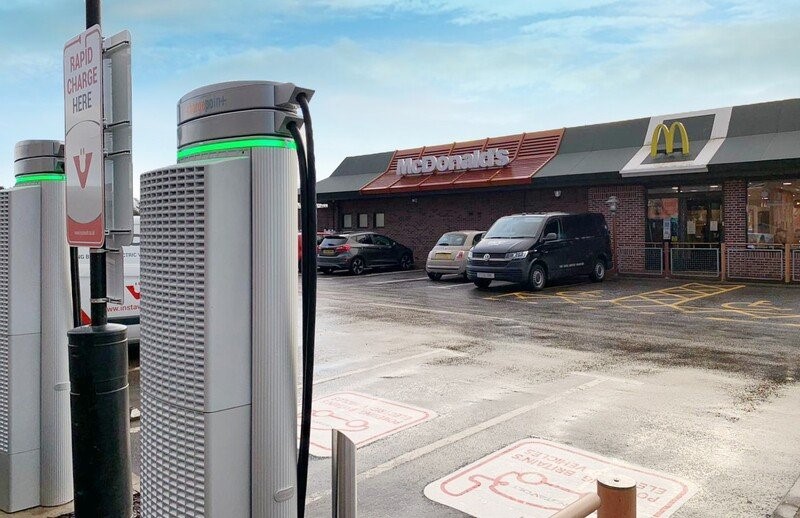
Further examples of how restaurants are embracing the technology came last summer when McDonald’s and KFC both announced partnerships with InstaVolt.
McDonald’s will introduce 125kW charging points at both new and existing Drive Thru restaurants within the McDonald’s estate where they can be accommodated.
Its first charge point went live at its restaurant in Port Talbot, Wales, last month (December) as the first step in the business’s ambition to have more EV charging points than any other company in the UK and Ireland.
“With more than 1,300 restaurants, our ambition would mean you would never be far from a charging point,” says Paul Pomroy, CEO of McDonald’s UK and Ireland.
“Drivers will be able to pop in for a coffee or a meal and get an 80% charge in 20 minutes. We are known for speed and convenience, and this partnership with InstaVolt will provide just that for EV drivers.”
InstaVolt’s deal with KFC will see rapid chargers installed at up to 450 KFC drive-through restaurants. It already has chargers at KFCs in Sheffield, Nottingham, Rotherham and Crewe.
Transit
The ‘transit’ segment refers to charge points at locations where the primary reason for the visit is to charge an EV, similar to the current petrol and diesel forecourt model.
At the moment, these account for less than 1% of the UK’s charge points and this proportion is likely to be similar in 2030, says Murray.
However, the proportion of the actual electricity they will charge EVs with will be around 20% of the UK’s total in 2030 due to their higher power than other charge points and increased utilisation.
“We expect a greater reliance on transit charging, similar to the forecourt model we see today for refuelling ICE (internal combustion engine) vehicles,” says Murray.
The Government has been looking at this sector in “quite a lot of detail over the past 12-to-18 months”, says OZEV’s Robinson.
“By 2035, we expect to see around 6,000 high-powered charge points across the motorway and A-road network,” she adds. “We’re working hard with others, such as Highways England, Ofgem, the DNOs (distribution network operators) and National Grid, to make sure we’re getting our motorway network ready for mass uptake.
“We want to ensure there is a good experience for the drivers and also, critically, for fleets, which have slightly different needs and requirements of the charging infrastructure network.”
As well as drivers who do long journeys, transit charging will appeal to those who either do not have access to a home charger or on-street charging, or just want the convenience of a fast top-up.
An example of a transit charging facility is BP’s Hammersmith Flyover site, which features four 150kW chargers and one 50kW unit.
“We believe Hammersmith Flyover is the most-visited public charging destination in the UK, recently charging an average of 115 vehicles each day with more than 2,000kWh of energy,” says Matteo de Renzi, CEO of BP Pulse.
“Ultra-fast is the new frontier of public charging, with even the latest generation of small electric cars offering 100kW charging speeds, and it is as important to private motorists without off-street parking as it is to drivers with higher mileage needs.”
Like BP, Shell is one of the fuel suppliers also installing charge points on existing forecourts.
It plans to have a combination of 200 50kW and 150kW chargers on forecourts located on major routes across the UK, in addition to a network of chargers available on local roads.
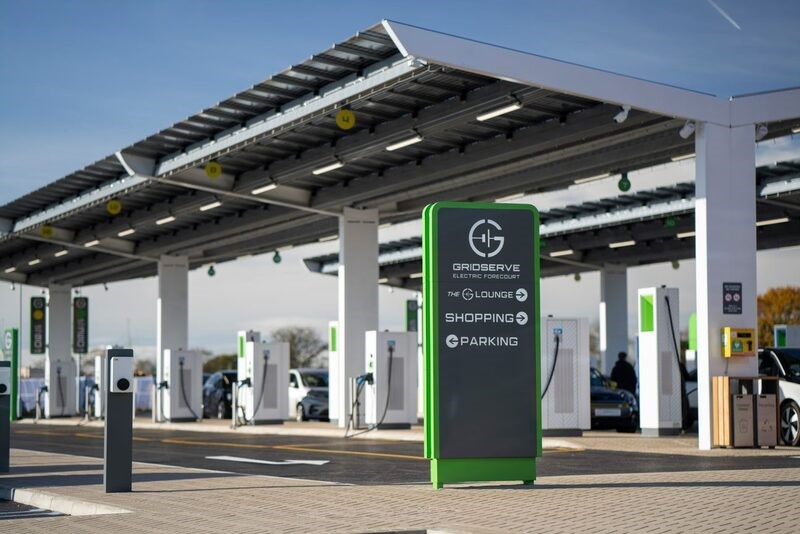
A new entrant in this sector is Gridserve, which plans to build 100 Electric Forecourts in the UK in the next five years as part of a £1bn programme.
It opened its first one in Braintree last month and this enables 36 vehicles to be charged at the same time at speeds up to 350kW.
Electricity is generated from both solar power canopies above the chargers and a network of hybrid solar farms, also operated by Gridserve.
The Electric Forecourt blurs the line between transit and destination segments, as it includes a retail space hosting partners including WH Smith Travel, Costa Coffee, Booths and the Post Office. It also has a waiting lounge, washrooms, dedicated children’s area and business meeting rooms.
On-street
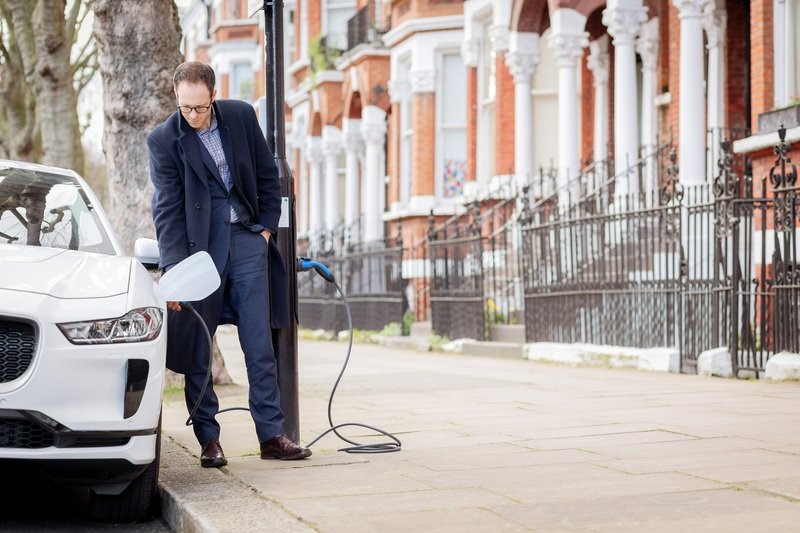
As the term suggests, ‘on-street’ charge points are found on roads or near homes, typically for the estimated 40% to 50% of UK households that do not have access to off-street car parking.
“We’ve got to support this area with our on-street residential scheme,” says Robinson. “This provides funding for local authorities to put in 7kW to 22kW charge points in locations that people can access so it unlocks the option of having an EV.”
The deployment of on-street charge points faces a number of difficulties, including costs for providers to install as well as practical constraints in space and capacity to meet likely demand.
“There are already concerns about the impact of existing chargers to the streetscape: they’re large, can be loud and often unsightly,” says Chris Pateman-Jones, CEO of Connected Kerb.
“Instead of constructing another mammoth-sized thing to plonk on the footpath and inconvenience all parents with prams out for an evening stroll, how about utilising posts and bollards that have been inconveniencing people for years which they have already learned to live with?”
Connected Kerb develops charge points which can be attached to signposts or other existing street furniture.
Some companies are developing solutions which will allow lampposts to be used to charge EVs.
Chargy, for example, became the first company to install lamppost charge points in London in 2018 in a deal with Southwark Council, while last year Siemens and Ubitricity began installing them in Richmond-upon-Thames.
“The standard lamppost is connected to a 25-amp supply,” says Richard Stobart, CEO of Chargy. “If it has gone across to LED lighting, that leaves 24 amps for charging cars.
“You will be able to get around 20 miles of driving for every hour of lamppost charging.”
In March last year, Westminster City Council teamed up with Siemens and Ubitricity to unveil the UK’s first converted lamppost charging street: Sutherland Avenue, Maida Vale, W9, which the local authority has dubbed ‘Electric Avenue, W9’.
Residents can charge their EVs at 24 lampposts at various locations along the street.
“While we cannot solve the challenge of air quality overnight, Electric Avenue W9 is an important showcase of what’s possible using existing city infrastructure,” says Cedrik Neike, CEO of Siemens Smart Infrastructure. “It illustrates how residential streets will look in the near future and accelerates the shift to zero emission vehicles.”
Another potential on-street charging solution is the app-operated pop-up charger, which sits flush to the pavement when not in use, extending only when it is needed.
Oxford became the first city in the world to trial this technology after its city council and charge point developer Urban Electric were awarded £474,000 funding through Innovate UK.
The trial ran from September 2019 to the end of February 2020 and was a success, says the council.
“Resident satisfaction and utilisation was very high and all project partners learned a great deal about the possibilities of the technology,” it adds.
The technology is being deployed in Dundee as part of a £3.8m trial, jointly funded by OLEZ (Office for Low Emission Vehicles) and Innovate UK.
“I think is a really exciting development and I think it will increase the resident charging across many cities in the UK,” says Fraser Crichton, fleet manager for Dundee City Council. By Graham Hill thanks to Fleet News
Share My Blogs With Others:These icons link to social bookmarking sites where readers can share and discover new web pages.
New car sales in the UK were down by more than 16% in June and down by almost 27% in the first half of the year, when compared with averages from the previous decade.
Fleet and business registrations were a combined 97,413 units for the month, more than a third up (34%) on the same month last year, when the UK began to emerge from the first pandemic lockdown and showrooms in England opened up at the beginning of the month.
Year-to-date fleet and business registrations now stand at 499,275 units, a 47% uplift on the first six months of 2020 (338,918 units), according to the latest figures from the Society of Motor Manufacturers and Traders (SMMT).
Combined, battery electric (BEVs) and plug-in hybrid vehicles (PHEVs) accounted for 17% of new vehicles sold (31,981 units), including retail sales. BEVs accounted for more than one in 10 registrations (10.7%).
PHEV uptake, however, continued to grow faster than BEV uptake for the third month running.
Meryem Brassington, electrification propositions lead at Lex Autolease, said: “Momentum is beginning to build along the road to recovery from the pandemic, but today’s half-year figures still represent a drop on pre-Covid levels, indicating that the car industry isn’t out of the woods just yet.
“We’ll no doubt see the impact of vehicle supply issues and semi-conductor shortages unfold in the coming months, but if we’re serious about leading the EV charge then sustained investment from policymakers to accelerate the UK’s electrification plans has to stay at the top of the agenda.”
All vehicle sizes – bar executive and multi-purpose – saw growth in June, with the strongest growth seen in the mini segment, which had been relatively weak for several months. Superminis were the most popular car class, accounting for 34% of registrations, followed by lower medium (27%) and dual purpose (24%).
Mike Hawes, SMMT chief executive, said: “With the final phases of the UK’s vaccine rollout well underway and confidence increasing, the automotive sector is now battling against a ‘long Covid’ of vehicle supply challenges.
“The semiconductor shortages arising from Covid-constrained output globally are affecting vehicle production, disrupting supply on certain models and restricting the automotive recovery. However, rebuilding for the next decade is now well underway with investment in local battery production beginning and a raft of new electrified models in showrooms.
“With the end of domestic restrictions later this month looking more likely, business and consumer optimism should improve further, fuelling increased spending, especially as the industry looks towards September and advanced orders for the next plate change.”
Every car- and van-maker is being impacted by the computer chip crisis, with some delivery times for cars lengthening from three to six months, and many new vans not expected to be delivered until 2022.
EVs becoming ‘increasingly mainstream’
Jon Lawes, managing director of Hitachi Capital Vehicle Solutions, says that the latest figures from the SMMT “unequivocally” demonstrate that BEVs are now an “increasingly mainstream” option for motorists.
“We’ve seen this sustained uptake in EVs first-hand, with HCVS seeing a 368% increase in EVs across our fleet in the last financial year – a remarkable figure during the lowest year of new car registrations since 1992,” he said.
“EVs will increasingly become front of mind as consumers and businesses look to replace their vehicles in the coming years and ensuring there are viable options in place for all lifestyles and budgets is vital to future-proof the industry as the 2030 ICE ban approaches.”
Richard Peberdy, UK head of automotive at KPMG UK, highlighted how the supply and demand imbalance has created the unusual situation of used cars rising in value, rather than depreciating.
However, he said: “Recovering fleet sales will eventually replenish the used car market and clip inflation, following 18 months of stifled investment.”
Meanwhile, Jamie Hamilton, automotive director and head of electric vehicles at Deloitte, echoed the SMMT’s concerns over the semiconductor shortage and its impact on UK new car sales.
“The ongoing global semi-conductor shortage has had a direct impact on consumers with manufacturers unable to fulfil orders in a timely manner, especially on the less popular models they have had to deprioritise,” he said.
“The ripple effect of this shortage has seen unusual activity in the used car market. Demand is high, but the limited availability of new cars means that there are even fewer used cars coming onto the market. As a result, prices have shot up. In an attempt to secure stock, some dealers have looked beyond the auction houses, turning their attentions to private sellers.
“Unfortunately, there is little respite for the industry, with the semi-conductor shortage expected to continue causing issues throughout the rest of the year and maybe even into 2022.” By Graham Hill thanks to Fleet News
Share My Blogs With Others:These icons link to social bookmarking sites where readers can share and discover new web pages.