Lake District National Park has installed a network of 28 electric vehicle charging points across its locations.
The chargers will not only support its own fleet of BMW i3s but are also open to the public. The move is one of Lake District National Park Authority’s low carbon projects to promote a cleaner and more sustainable environment across the Lake District.
To support its fleet electrification plans, Lake District National Park Authority appointed AMP EV to install Rolec’s range of AC fast and DC rapid chargers.
Emma Moody, lead strategy advisor for recreational & sustainable transport at Lake District National Park Authority said: “We are showcasing what can be done in terms of travelling more sustainably and are leading by example by using electric vehicles for our staff to get out and about in the Lake District.
“We ask visitors to travel to and around the Lake District in a more environmentally friendly way, and this improved network of charging points throughout the Park makes travelling by electric vehicle easier and more convenient.” By Graham Hill thanks to Fleet News
Share My Blogs With Others:These icons link to social bookmarking sites where readers can share and discover new web pages.
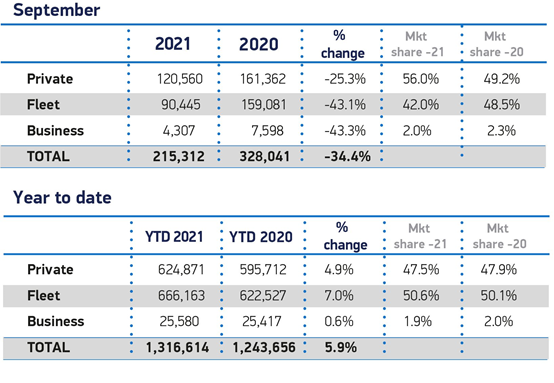
The semiconductor shortage is being blamed for poor fleet and business new car registrations, with the company car market recording a 43.4% year-on-year fall, new figures suggest.
Last month, 94,752 new cars were registered to fleet and business, compared to 166,679 units registered in September 2020, according to new data from the Society of Motor Manufacturers and Traders (SMMT).
Year-to-date, however, new company car sales are almost 7% up on where they were this time last year, with 691,743 fleet and business registrations compared to 647,944 during the first nine months of 2020.
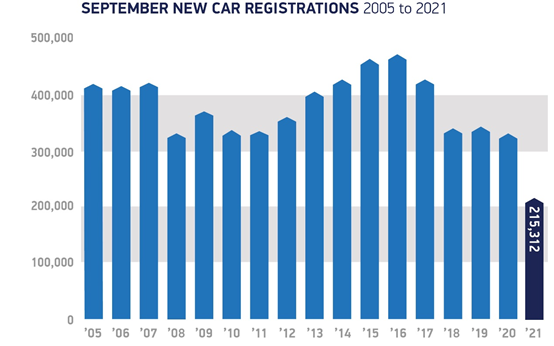
Fleet and business accounted for 44% of overall new car sales during the month. Overall, 215,312 new cars were registered in September, some 34% down on September 2020’s figures.
It was the weakest UK new car market figures for September recorded since 1998 ahead of the introduction of the two-plate system in 1999.
September is typically the second busiest month of the year for the industry, but with the ongoing shortage of semiconductors impacting vehicle availability, the 2021 performance was also down 44.7% on the pre-pandemic 10-year average, SMMT figures suggest.
SMMT chief executive, Mike Hawes, said: “This is a desperately disappointing September and further evidence of the ongoing impact of the Covid pandemic on the sector.
“Despite strong demand for new vehicles over the summer, three successive months have been hit by stalled supply due to reduced semiconductor availability, especially from Asia.”
New electric vehicle uptake
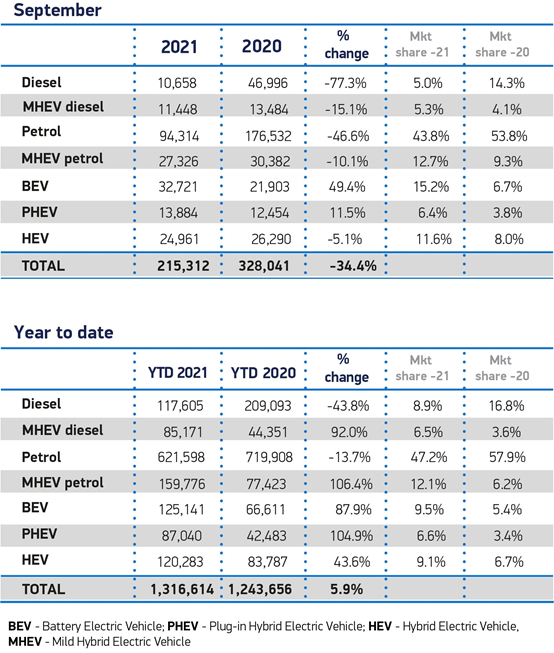
September was the best month ever for new battery electric vehicle (BEV) uptake. With a market share of 15.2%, 32,721 BEVs were registered in the month.
In fact, the September performance was only around 5,000 vehilces shy of the total number registered during the whole of 2019.
Plug-in hybrid (PHEV) share also grew to 6.4%, meaning more than one in five new cars registered in September was zero-emission capable.
Meanwhile, hybrid electric vehicles (HEVs) grew their overall market share from 8% in 2020 to 11.6%, with 24,961 registered in the month.
Hawes said that despite supply challenges, the “rocketing uptake” of plug-in vehicles, especially battery electric cars, demonstrates the increasing demand for these new technologies.
Jamie Hamilton, automotive director and head of electric vehicles at Deloitte, said: “With battery electric vehicles outpacing even plug-in hybrid this month, this demonstrates a level of consumer confidence that the charging infrastructure will be in place.
“However, gaps still remain and a more equitable rollout of public charging points would ensure EVs are also accessible to those households without off-street parking.
“Petrol and diesel shortages may have also inadvertently created some charge anxiety, so ensuring more visible charging points will only strengthen public confidence in EV feasibility.”
Meryem Brassington, electrification propositions lead at Lex Autolease, added: “The recent fuel shortage will only have further heightened awareness of the importance of transitioning to an electric future. As EVs continue to rise in popularity, industry must work collaboratively to ensure there isn’t a tipping point of demand outstripping supply.”
Vehicle supply impact to last into 2023
All drivers whether fleet or consumer face delays of more than one year for certain new car and van models, while others are being delivered with missing features, as the global semiconductor shortage worsens.
And some automotive industry executives do not see the problem ending any time soon.
One is predicting the disruption could last until 2023. Speaking at the IAA Munich auto show last month (September 7-12), Daimler CEO Ola Kallenius said soaring demand for semiconductors means the auto industry could struggle to source enough of them throughout next year and into 2023, though the shortage should be less severe by then.
The carmaker has cut its annual sales forecast for its car division, projecting deliveries will be roughly in line with 2020, rather than up significantly.
Critics are predicting the crisis will have a greater impact on automotive than the coronavirus pandemic. Almost 95% of fleets responding to a Fleet News poll said they were experiencing vehicle delays.
Fleets are being urged to sit tight and continue to place orders for new vehicles, while also being warned that existing models may have to remain on the road for in excess of an extra 12 months.
Matthew Walters, head of consultancy services at LeasePlan, said: “The impact on fleet is pretty severe.
“Last year, we saw a number of formal extensions for companies during the worst of Covid-19 where vehicles couldn’t be delivered and where vehicles couldn’t be collected. These vehicles needed to be extended outside their primary contract term.
“Now we’re in a situation moving into next year where, as an industry, we are likely to see an extension programme again.
“I think it’s a similar period of activity with our customers now, to help them understand what it means for their current order bank, when their orders will be delivered and what that means for their replacement cycles.
“The customer still needs to place orders for vehicles to get themselves in the queue and we are working with them and being open and frank as to when those vehicles are going to be delivered.”
By Graham Hill thanks to Fleet News
Share My Blogs With Others:These icons link to social bookmarking sites where readers can share and discover new web pages.
Police are appealing to fleet workshops, garages and MOT test centres to support a new initiative targeting the theft of catalytic converters and other components.
The SmartWater Group, which is spearheading the new, policebacked scheme, wants them to become accredited registration hubs, after the unique identifier proved to be a deterrent.
In a recent SmartWater trial with the National Infrastructure Crime Reduction Partnership (NICRP) and the British Transport Police (BTP), thefts of catalytic converters more than halved.
Thefts peaked in March, when 3,245 catalytic converters were stolen, but they have been declining since, with 1,378 recorded in July – a 57% fall. Key to that decrease was a joint operation codenamed Goldiron, which recovered more than 1,000 stolen catalytic converters in April.
The operation, which was coordinated by the British Transport Police (BTP) and involved experts from SmartWater’s intelligence unit, the Centre for Infrastructure and Asset Protection (CIAP), also resulted in more than 50 arrests.
Over a five-day period, officers and partner agencies visited 926 sites, stopped 664 vehicles, recovered 1,037 stolen catalytic converters and 297 items of stolen property and identified 244 offences.
Rachael Oakley, director at CIAP, says SmartWater is a “highly-proven deterrent to criminals and rogue scrap metal dealers as it makes stolen parts too hot to handle”.
The heat-resistant solution, which is invisible to the naked eye but glows yellow under UV light, leaves a long lasting and unique identifier.
Oakley explained: “The combination of the materials that is put into the solution makes each individual vial unique.
“The registration of this bottle is what’s key. Every item marked with SmartWater is registered on our database.”
NATIONAL SMARTWATER DATABASE
It can be applied by brush in 10 minutes and only a fragment of SmartWater is required to link it to a specific vehicle on the ‘National Asset Database’, which is operated by CIAP on behalf of the police.
NICRP lead and BTP Superintendent, Mark Cleland, said: “Thanks to the support of the Home Office in creating the NICRP, our joint working with SmartWater and other industry partners, and the drive by enforcement partners across the UK, we have made a real impact in tackling metal and catalytic converter crime.
“While arrests continue to be made, it is the preventative approach through the forensic marking of catalytic converters that gives motorists the opportunity to protect their property and stop the crime in the first place.”
Catalytic converters have been targeted because they contain a honeycomb coated with precious metals such as platinum, palladium and rhodium which help to filter harmful gases from the vehicles’ exhaust systems.
The RAC says that when the global value of these metals increases it usually leads to a spike in thefts. Prices of rhodium hit a record high earlier this year, up more than 200% since March 2020.
In an effort to deter criminals from targeting Toyota’s cars, the carmaker joined forces with police and SmartWater earlier this year to covertly mark the catalytic converters on more than 100,000 cars.
The initiative is costing Toyota more than £1 million and will be provided to existing owners for free.
Oakley, who met the Society of Motor Manufacturers and Traders (SMMT) with the British Transport Police to discuss the initiative, believes other manufacturers are watching with interest.
OTHER SMARTWATER APPLICATIONS
She also told Fleet News that, while catalytic converters were a focus, the forensic marking could be applied to other high-value vehicle components, which could be targeted by criminal gangs.
She explained: “We can basically react to where there might be a crime spike or a trend and if fleets are asking us to help with solutions, we can look at what we can do to make sure SmartWater can assist with that.
“Criminals will move quickly; the prices of precious metals will start to come down and they’ll move on to something else.
“What we’re seeing is that’s likely to be something like hybrid batteries or electric vehicle cables.
“We’d like to get ahead of the game by putting in the preventive measures to stop these crimes becoming the issue that catalytic converter crime has become.” By Graham Hill thanks to Fleet News
Share My Blogs With Others:These icons link to social bookmarking sites where readers can share and discover new web pages.
Michelin has launched its all-season tyre, the new Michelin CrossClimate 2.
The CrossClimate 2 builds on the success of the CrossClimate+, Michelin said, and combines the benefits of a summer tyre in terms of wet and dry braking performance, with the traction and braking benefits of a winter tyre in terms of wet weather grip and driving on snow or in low temperature conditions, it said.
Scott Clark, executive vice-president, automotive, motorsport and member of the Michelin Group executive committee, said: “Since its launch, the original Michelin CrossClimate has had a radical effect on the European all-season tyre market, which has since enjoyed annual growth more than 19%, in addition to being the only segment to have kept growing during lockdown.
“Over the next five years, it is expected to expand at a rate of more than 16% per year. Safer, longer-lasting and more economical, the Michelin CrossClimate 2 is a further illustration of the Group’s All-Sustainable strategy.”
The 3PMSF (3-Peak-Mountain with Snow Flake) logo on the tyres sidewalls confirms that it can be used in winter in countries where winter tyres are mandatory.
Michelin said this means that for drivers who take their vehicles to mainland Europe during the winter months, there will be no need to swap onto winter tyres, and back again, each year.
The CrossClimate2 is available in 105 sizes – a 40% increase compared to its processor – for vehicles with 15- to 20-inches wheels.
Michelin said its technologies ensures high performance through the whole life of a tyre, down to its tread depth marker and its low rolling resistance helps save on fuel, energy and materials.
Michelin said its CrossClimate 2 – both new and worn – came out on top in six out of nine tests (chiefly braking and traction performance tests) in 2020 and 2021. By Graham Hill thanks to Fleet News
Share My Blogs With Others:These icons link to social bookmarking sites where readers can share and discover new web pages.
These cars won’t be cheap so I’m not promoting them but they show how ranges are increasing with every new model. The Hyundai Kona with a 300 mile range was looking good so we are on target to hit ranges of 600 miles within the next 12 – 24 months.
Mercedes has unveiled the EQE saloon, which joins its growing range of electric models.
The E-Class counterpart is based on Mercedes’ purpose-built electric vehicle (EV) platform and promises a range of up to 410 miles.
Multiple powertrain options are expected to be offered, but only the EQE 350 has been detailed so far. It uses a 90kWh battery and has a power output of 292PS.
The EQE is compatible with up to 170kW chargers, enabling an 80% charge in around half an hour.
Mercedes says the car “carries the concept of the business saloon into the future” and makes use of its latest powertrain and in-car technology.
It represents the second of three electric saloons from Mercedes-Benz, sitting alongside the larger EQS.
While smaller in footprint, the EQE shares many styling and interior details with its sibling such as the black panel front grille and full width LED lighting at the rear.
Mercedes will offer the EQE with the MBUX Hyperscreen infotainment system, which spans the width of the dashboard providing a display for the front passenger as well as a central control screen and digital instruments.
The EQE is billed for arrival in summer 2022, with prices likely to start at around £60,000. By Graham Hill thanks to Fleet News
Share My Blogs With Others:These icons link to social bookmarking sites where readers can share and discover new web pages.
The increase in National Insurance Contributions (NIC), announced by the Government, will strengthen the financial appeal of choosing an electric vehicle (EV) as a company car, says Arval.
Employers pay NIC in several ways – on salaries, bonuses, and many employee benefits. The rates for those different kinds of NIC are all currently 13.8%. Following the 1.25 percentage point increase in NIC from April 2022, and subsequent Levy from April 2023, employers will pay NIC at an effective rate of 15.05%.
Employees have NIC deducted at source at different rates depending on their level of earnings, and each of those rates will also increase by 1.25 percentage points.
Richard Cox, a consultant at Arval UK, said: “The change in NI improves the position of low carbon vehicles relative to others, so while there is an increase for EVs, it is much lower than for PHEV and much, much lower than for ICE.”
Figures from Arval show that for a £40,000 internal combustion engined (ICE) car, the monthly increase in employers’ NI paid on benefit-in-kind (BIK) taxation will be £11.67, whereas for a £45,000 petrol hybrid electric vehicle (PHEV), it will be £5.62, and for a £50,000 electric vehicle (EV), just £1.04.
Cox says that the biggest impact of the NI increase for employers and employees is on salaries, where there is a combined 2.5% increased tax charge.
In contrast, for company cars the rate is half of that at 1.25%, because employees do not pay NI on benefits.
“This is good news for company cars in the sense that the increase in NI is smaller than for cash options, although again it is important to underline that the amounts involved are quite small when measured on an individual basis,” he explained.
“The amounts involved for employers are not enormous – an additional 1.25% on NI is barely more than the increases we see in BIK rates each April but will certainly add up over a large fleet.”
He added that the increase would have the least effect on companies who use a whole life cost (WLC) model for constructing their choice lists.
Cox said: “A WLC based approach means that the NI increase will be automatically absorbed because it is part of the defined company car budget, although it does marginally reduce the buying power of employees unless the employer decides to make a compensatory increase. By Graham Hill thanks to Fleet News
Share My Blogs With Others:These icons link to social bookmarking sites where readers can share and discover new web pages.
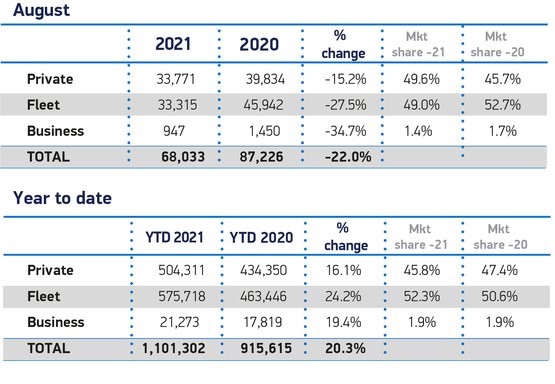
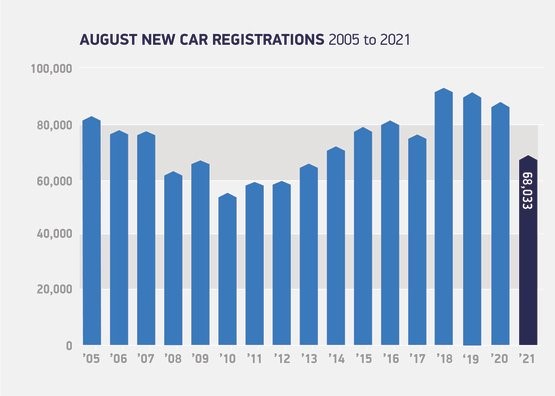
New car registrations fell by 22% in August, the lowest performance for the month since 2013.
Figures from the Society of Motor Manufacturers and Traders revealed that 68,033 cars were registered in August 2021, as the automotive sector continues to be constrained by the global semi-conductor shortage and issues caused by the Coronavirus pandemic.
While August is traditionally one of the quietest months of the year for new car registrations, ahead of the important plate-change in September, last month’s registrations were down 7.6% on a 10-year average.
Registrations by business and fleet buyers fell by double digits in the month with fleet purchases down 27.5%, a loss of 12,627 units. Private activity held up better, registrations dropping 15.2% to 33,771 units, meaning that just shy of half (49.6%) of all sales in August were driven by private consumers.
Mike Hawes, SMMT Chief Executive, said: “The global shortage of semiconductors has affected UK, and indeed global, car production volumes so new car registrations will inevitably be undermined. Government can help by continuing the supportive Covid measures in place currently, especially the furlough scheme which has proven invaluable to so many businesses.”
Jamie Hamilton, automotive director and head of electric vehicles at Deloitte, added: “As the semi-conductor shortage continues, even as far as Q2 2022, new car sales will be impacted. All eyes will be on September, with plate change months traditionally leading to some of the biggest months for new car sales. Whilst there will be consumer interest in the new 71-plate, some in the industry are tempering their expectations. Dealer pre-registrations are significant contributors to September’s figure but the motive to pre-reg may be lower-than-normal, as some manufacturers have softened dealer targets and are currently only building to order, anyway.”
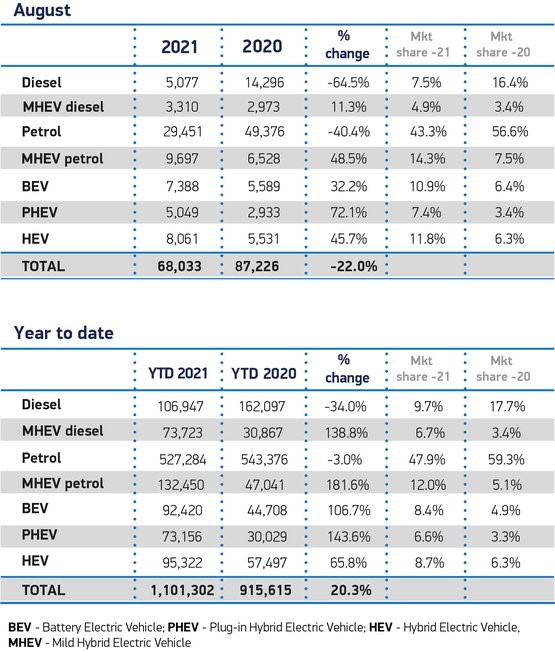
Demand for the latest battery electric (BEV), hybrid (HEV) and plug-in hybrid (PHEV) vehicles, however, surged, up 32.2%, 45.7% and 72.1% respectively. In fact, demand for PHEVs has outpaced BEVs in five of the last six months since changes to the Plug-in Car Grant, affecting BEVs, were introduced in March. There are now some 130 plug-in models on the market.
Meryem Brassington, electrification propositions lead at Lex Autolease said: “The growth in electric and hybrid vehicles is encouraging as ever. The journey to move towards net zero is set to be strengthened even more with the closing of a Government consultation later this month to set the bar on how environmentally friendly a hybrid vehicle has to be to remain on sale post-2030. These positive changes will be crucial to ensuring that even more of the vehicles on the UK’s roads post 2030 are genuinely sustainable and contributing towards the UK’s net zero ambitions.”
The mini segment was the only car bodystyle to see growth, up 30.7%, but with just 902 registrations it is a segment prone to greater fluctuations.
So far this year, UK new car registrations remain up 20.3%, to 1,101,302 registrations, an increase of 185,687 units with BEVs and PHEVs at 8.4% and 6.6% market share respectively. However, this performance is measured against the Covid-hit 2020 market, when showrooms were closed for much of the year.
Total registrations in 2021 are 25.3% below the 10-year average for the period January – August, according to the SMMT.
Lucy Simpson, head of EV enablement at Centrica Business Solutions, added: “Despite the downturn in overall registrations, it’s encouraging to see EV adoption continue to go from strength the strength, with battery and plug-in hybrid vehicles accounting for 30% of the new car market.
“With the 2030 phase-out date for the sale of new petrol and diesel vehicles now firmly set in stone, encouraging EV uptake needs to remain our top priority. The government’s recent Transport Decarbonisation Plan and other commitments have put down a strong marker for the UK’s electrification journey, however we must ensure that EVs remain accessible for all. This includes speeding up the roll-out of on-street charging to avoid large swathes of the population being left behind on the road towards an electric future.”
By Graham Hill thanks to Fleet News
Share My Blogs With Others:These icons link to social bookmarking sites where readers can share and discover new web pages.
A guide to everything you need to know about speeding, from fines to the cameras the police use.
There was a time when fixed and average speed cameras didn’t exist, and the most likely way of accruing endorsements (now better known as penalty points) on your licence was to miss seeing the local policeman pointing a ‘speed gun’ at your car as you edged above the posted limit. Those days have long since passed, and the rise in digital technology now means that drivers are faced with a plethora of different roadside devices.
How can I be caught speeding?
There are a variety of different speed-detecting technologies on British roads today. Here are the most common.
Truvelo
All speed cameras have to be coloured bright yellow by law and the Truvelo is no exception. Most commonly mounted on a pole at the side of a single or dual carriageway, the Truvelo uses a front-facing camera to record your speed, backed up by a matrix of small squares painted on the road. (Secondary evidence of speed is required with all fixed-position cameras.)
While images of motorcycle numberplates can be tricky to capture, due to their lack of front registrations, the Truvelo can identify drivers of other vehicles, adding a further layer of evidence if a prosecution is disputed. More recently, a Truvelo D-Cam has been launched for motorway applications, with front- and rear-facing capabilities.
Gatso
The name that most of us are familiar with, the Gatso first graced our road scene in 1991 and is a rear-facing camera, meaning that it records your vehicle after it’s passed the camera unit, with two images taken in quick succession. Like the Travelo, the images are supported by secondary evidence of speed provided by painted ‘dashes’ on the road surface. These dashes may be found on both sides of the road next to the camera, but the Gatso will only record your speed in the direction in which it is facing.
SPECS
SPECS (average speed check cameras and speed enforcement) units measure your speed over a set distance, via two banks of cameras. Most commonly found through roadworks, or where there is a lower than normal speed limit, they use automatic numberplate recognition (ANPR) to identify vehicles. As you pass the first set of cameras, your vehicle’s details are recorded, and if your average speed before reaching the second cameras is above a set threshold, a notice of intended prosecution (NIP) will be automatically generated. (See below.)
HADECS 3
The catchily named Highways Agency Digital Enforcement Camera System 3, or HADECS 3 for short, is most commonly found on smart motorways, mounted on the overhead gantries that carry variable speed limit alerts. The camera’s limited use of yellow cladding and the fact that it is a fraction of a Gatso/Travelo’s size mean that it can be easily missed, especially if you’re travelling at 70mph. HADECS 3 is rear facing, and once again it uses painted dashes on the road as secondary evidence of a vehicle’s speed. It also adapts to posted, mandatory speed limits that can vary depending on road conditions.
Mobile speed camera units
It’s not uncommon for the police to monitor vehicle speeds at known accident hotspots using mobile units – quite literally, vehicles with miniature Gatso cameras pointing through their rear windows. These are often found parked in laybys or above dual-carriageway or motorway bridges and have a range of up to one mile. The police also have access to handheld radar- and laser-controlled devices that can be used at a variety of locations.
How will I know if I’ve been caught speeding?
If you’ve been caught speeding with a hand-held device, or one installed in a moving police car, you could be asked to stop there and then. In this case, the police have two options: they can either give you a verbal warning and send you on your way, or they can issue you with a fixed penalty notice (FPN). But if you’ve been caught speeding by a remote device, the registered keeper of the vehicle will receive a notice of intended prosecution (NIP) and section 172 notice by post within 14 days of the offence. The section 172 notice then has to be returned within 28 days, providing details of the driver who committed the offence. A fixed penalty notice (FPN) will then be issued to the driver, or if the offence is deemed serious enough, a court summons.
What kind of penalty can I expect?
If you receive an FPN, you can either plead guilty or not guilty to the offence, with each decision triggering its own process. A guilty plea will generally carry a fixed £100 fine and three points added to your licence. Depending upon where you were caught speeding, there will be different ways to pay the fine, which can be found here.
However, you may be offered the option of paying instead for a speed awareness course (typically costing a similar amount to the fine itself), which will avoid the addition of points to your licence. Certain caveats exist, though. The police will decide if it’s appropriate to your offence (so it tends to be offered for more minor transgressions).
And it will only be offered if you’ve not been on such a course in the past three years. It’s also worth noting that not all police authorities run speed awareness courses, so this option is by no means a given.
The situation becomes more complex if you plead not guilty, though. Of course, if you’re convinced of your innocence, then it’s the right and proper course of action and it will probably involve a trip to court. But if you lose your case, you could be fined more and receive more penalty points.
Excess speed bands and your weekly income make up the fine
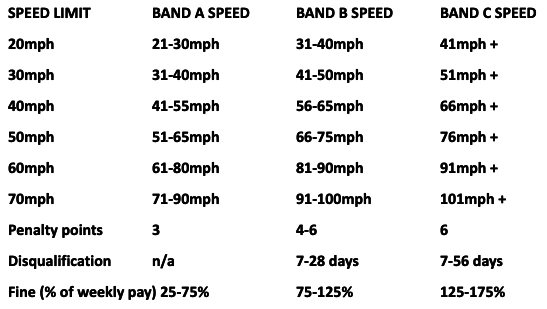
In 2017, the speeding penalty system was overhauled, with larger fines for drivers charged with excessive speed. If you are prosecuted in court, the amount you are fined and number of points you receive (or the disqualification period) will firstly be determined by the speed you were travelling over the posted limit, as shown here.
But as you can see from the last line, the actual fine is ‘personalised’ depending on your average gross weekly income.
For example, based on a driver earning the UK average income (2020-21) of £29,600:
Speeding at 81-90mph in a 60mph zone = £428-£713 fine plus 4-6 penalty points
Speeding at 66mph+ in a 40mph zone = £713-£998 fine plus 6 penalty points
There are a further three bands (D, E and F) that deal with more extreme transgressions, which may include excessive speed where the driver is: on bail; has existing convictions; in charge of a large vehicle; heavy load; towing; carrying passengers; driving through a heavily pedestrianised area.
It’s also worth noting that if you’ve only held a full driving licence for less than two years, it will be revoked if you reach six or more penalty points.
On the upside, mitigating factors, such as it being a first offence, or being of ‘good character’, may help reduce the fine and penalty. The court may even take into account speeding for a genuine emergency.
Either way, under any circumstances, there is a £1000 fine cap for all speeding offences, apart from those committed on motorways, where it increases to £2500.
How many points do I need before I lose my licence?
Even less serious speeding offences can cause you to lose your licence. If you accrue 12 or more penalty points in a three year period – potentially four minimum-fine/points offences – you could end up with a six-month ban. And this could have further repercussions. If you’re disqualified for 56 days or more (see also the more serious single-offence bans, above) you’ll need to apply for a new licence, and this may even entail retaking your driving test.
How will speeding penalties affect my car insurance?
Insurers will generally regard drivers who’ve accrued penalty points for any offence – including speeding – as a higher risk and will likely impose a higher premium as a result. While penalty points for speeding are generally only valid for three years as far as totting up endorsements and a potential ban goes, they remain visible on your licence for four years. Most insurance companies will ask you to declare any motoring offences in the past five years, and if you withhold information, it could affect a future claim, so it’s important to be honest when searching for new quotes.
Top 10 speeding trivia
Would you be surprised if we told you that the world’s first speeding fine was issued in the UK? Well, it was. Driving his new Benz, Walter Arnold was nabbed at four times the national speed limit in Paddock Wood, Kent.
That the limit was just 2mph and the year, 1896, explains a lot. To make matters worse for Arnold, he was reprimanded for not having a red flag waver walking in front of him, too.
And from one extreme to another… The UK’s fastest speeder was caught in 2015 travelling at 192mph in a Nissan GTR. A 28-month custodial sentence followed and Northamptonshire police banned him from driving for 10 years.
But you don’t need anything exotic to get your collar felt. In 2003, an off-duty policeman was caught driving his unmarked Vauxhall Vectra at 159mph on the M54.
It wouldn’t have been as much as the hapless Swiss driver had to shell out, though, after he hit 85mph in a 50mph zone driving his Ferrari Testarossa. Swiss authorities base fines on your financial worth, and with £14.1 million in the bank, this driver ended up with a £180,000 ticket.
But that was nothing compared with another Swiss millionaire who managed 180mph on local roads in his Mercedes-AMG SLS and set a new speeding fine world record at $1,001,400 (£727,166).
Both the above would have got away with it if they’d come to the Isle of Man, where no speed limits apply (although dangerous/careless driving is still an offence, as is breaching local speed limits through built-up areas). Other speed-limit-free havens are Germany’s autobahns (for now) and Australia’s Northern Territories.
But not Dubai. Driving a rented Lamborghini Huracán, a British tourist managed to trigger 33 speed cameras while joyriding through its downtown area, generating $48,000 (£34,847) in speeding fines, before fleeing the country and leaving the rental company to sort out the mess.
If you live near Bristol, though, it takes only one speed camera to extract mega-sums in fines. A camera positioned on the city’s M32 motorway captures on average 50 speeding drivers each day, and over a three-year period relieved them of £5.7m.
Showing slightly more lenience, Poland has the highest speed limits in Europe, at 140km/h (87mph), and in the US, Texas’s Highway 130 allows 85mph before fines are imposed. But the world’s highest speed limit is 160km/h, or, tantalisingly, 99.4mph, in the UAE.
But like it or not, speed cameras in the UK are now part of our motoring life, and with 7000 of them positioned around the country, only Russia, Italy and Brazil have more on their roads. By Graham Hill thanks to Autocar
Share My Blogs With Others:These icons link to social bookmarking sites where readers can share and discover new web pages.
Between 210 and 250 people were killed in accidents in Great Britain where at least one driver was over the drink-drive limit in 2019, figures from the Department for Transport (DfT) suggest.
The number of fatalities was broadly in line with figures for 2018.
An estimated 7,800 people were killed or injured when at least one driver was over the drink-drive limit. This represents a fall of 10% from 8,680 in 2018 and is the lowest figure recorded.
The total number of accidents where at least one driver was over the alcohol limit decreased by 9% to 5,350 in 2019, the lowest number of drink-drive accidents recorded.
In 2019, the number of killed or seriously injured (KSI) casualties in drink-drive accidents rose while all casualties fell.
This, says DfT, was because the number of seriously injured casualties in accidents in which at least one driver or rider failed a breath test rose, while the number of slightly injured in these accidents fell compared to 2018.
RAC head of policy Nicholas Lyes said: “While there will be much interest in the 2020 casualty figures when they come out to understand the impact of the Covid lockdowns on drink-driving, these figures still represent a rather chilling reminder that in the region of 250 people are killed by drink-drivers on Great Britain’s roads every year, a figure that’s barely fallen since 2010.
“Clearly, much more needs to do done, and one area we’d like to see progress in is around cutting reoffending.
“A report by PACTS found that nearly one-in-five drink drive offences are carried out by repeat offenders, something that could be tackled with the introduction of alcohol interlocks.”
The prevalence of drink-driving in road deaths has fallen over time. In 1979, 26% of road deaths occurred in accidents where at least one driver or rider was over the drink-drive limit. This had fallen to 15% by 1989.
Since then, the percentage of road deaths that are drink-drive related has varied between 12% and 18%. In 2019, the rate was 13%.
The proportion of killed or seriously injured (KSI adjusted) casualties in drink-drive accidents has varied between 5% and 7% since 2005. In 2019, the rate was 6%.
The central estimate of the number of drink-drive casualties of all severities in 2019 is 7,800, a fall of 10% from 8,680 compared to 2018. This is the lowest level recorded.
It is estimated that around 5% of all casualties in reported road accidents in 2019 were involved in accidents in which at least one driver or rider was over the drink-drive limit.
In 1979, 9% of road casualties occurred in accidents in which at least one driver or rider was over the drink-drive limit. This has fallen to 5% by 1992 and has mainly varied around 5% since then.
Hunter Abbott, managing director of personal breathalyser firm AlcoSense, said: “The fact that testing is at its lowest level on record should be ringing alarm bells. Police carried out just 285,380 roadside breath tests in England and Wales in 2019 – less than half the number in 2008.
“All convicted drink drivers in Northern Ireland are now automatically referred to a rehabilitation course – to educate them on the potential consequences of their actions. This should be introduced in the rest of the UK as soon as possible.”
In a poll conducted by AlcoSense, more than a third of motorists (36%) think their ability to drive is only impaired if they are actually over the legal drink drive limit. But, according to AlcoSense you are 13 times more likely to be involved in a fatal crash if you are at, but not over, the limit in England, Wales and Northern Ireland.
Even with 10mg per 100mL of alcohol in your blood (one eighth of the limit) it is 37% more likely than when completely sober, research shows, it says.
Drink-drive casualties by country and English region
The percentage of all casualties which occurred in drink-drive accidents was the highest in Wales at 6.9% followed by England at 5.1% and Scotland at 4.6%.
Within the English regions, the casualty rates varied from 7.0% in the East Midlands to Greater London at 2.9%.
Since 2010, the proportion of casualties that occur in drink-drive accidents has been higher in Wales than in England or Scotland.
Casualties in drink-drive accidents by sex
In 2019, 78% of drink-drive accidents involved male drivers or riders over the legal alcohol limit.
Some accidents will involve both male and female drivers over the limit, and sex is unknown for some drivers.
However, males make up 69% of drivers (excluding pedal cyclists and horse riders) involved in all accidents where the sex of the driver is known.
In 2019, 67% of casualties in drink-drive accidents were male compared to 60% in all reported road accidents.
Casualties in drink-drive accidents by age
A higher proportion of casualties in drink-drive accidents were aged between 25 and 59 than in all reported accidents in 2019 (63% in drink-drive accidents compared to 56% in all accidents).
The same was true for people aged 16 to 24 (23% in drink-drive accidents compared to 19% in all accidents).
Older people (aged 60+) represented a lower proportion in drink-accidents than accidents overall (8% in drink-drive accidents compared to 14% in all accidents). By Graham Hill thanks to Fleet News
Share My Blogs With Others:These icons link to social bookmarking sites where readers can share and discover new web pages.
Vehicle thefts increased in the first half of the year as lockdown restrictions began to be lifted, according to new data from Tracker.
The volume of theft activity had increased by almost a third (32%) by the end of June, compared to the start of the year, it says, with Range Rover and Land Rover models remaining the top choice among criminals.
Tracker recovered more than £4.2 million-worth of stolen vehicles from January to June, of which 4x4s accounted for £2.6m.
The highest value car stolen and recovered during this period was a Range Rover Sport worth £94,000 in May, with Range Rover and Land Rover models accounting for 29% of the total stolen vehicles recovered by Tracker in the six months.
“Our latest figures show that – just like in 2020 – as prolonged periods of lockdown eased, theft of vehicles increased,” said Clive Wain, head of police liaison for Tracker.
“May was a particularly busy month for criminals who made up for lost time. The total value of vehicles we recovered in May was almost three times higher than in January, with an average vehicle value of more than £31,000, compared to just £13,000 in the first month of the year.”
KEYLESS CARS TARGTED
Keyless cars also continue to be frequently targeted by criminals. Tracker’s latest data reports that 92% of the stolen cars it recovered January to June were taken by tech-savvy thieves compromising the signal from the vehicle’s key fob.
Added to this, insurers have revealed that keyless vehicles account for almost half of all reported ‘theft of vehicle’ claims.
The exploitation of keyless technology by criminals has become such a concern for police that the UK’s top police officer responsible for investigating vehicle crime recently issued a nationwide warning encouraging owners to better protect their vehicles.
Provisional figures from the National Police Chiefs’ Council (NPCC) show a 3.1% increase between May 2021 and June 2021 in vehicle crime, with a large part of this increase from keyless theft.
Wain continued: “Now that almost all restrictions have formally lifted, all car owners need to be aware of the risk and take steps to protect their vehicles, beyond relying on a factory-fitted alarm.
“Visible physical deterrents that help dissuade many would-be criminals include alarm systems, wheel clamps and steering locks.
“Those with keyless entry vehicles also need to safeguard their key fob, for example, keeping them inside a metal container that blocks the key’s signal so it cannot be extended to remotely unlock and start the vehicle.
“Unfortunately, even with multi-layers of protection against theft in place, the most experienced thieves and organised criminal gangs will take measures to bypass barriers if the potential payoff is worthwhile.
“Once a vehicle is stolen, a Tracker device is the best possible way to help the police quickly locate and recover it before it is broken down for parts or sold on.”
Separate research from research from Verizon Connect suggests that stolen vehicles or equipment costs fleet-based businesses an average of £12,250 each year.
For businesses with more than 100 vehicles, the cost is even higher, with the data suggesting fleets lose, on average, £21,000 each year. By Graham Hill thanks to Fleet News
Share My Blogs With Others:These icons link to social bookmarking sites where readers can share and discover new web pages.