Using Mobile Phones Just Got More Dangerous

Monday, 15. September 2014

You may not have heard the name Marina Usaceva but a court ruling, following an accident in which she was involved, could change your attitude to what you do whilst driving.      Marina was considered responsible for a fatal accident in which the other driver involved died. She had been using a mobile phone but not at the time of the accident.

Thinking of a change but unsure as to the best way to finance your car? Then you need a copy of my car finance book, Car Finance – A Simple Guide by Graham Hill. Click on the link below to buy the best car finance book on the market, available as a Kindle Book and Paper Back.

Her barrister explained that there was a 6 minute difference between the time it was shown she was using the phone and when she had the accident. Described as ‘clear water’ and provided as mitigating evidence the plea was still ignored by the judge when he sentenced Marina to 6 years imprisonment.

Evidence showed that she had sent and received texts on two phones during the 20 minutes before the accident. In summing up before sentencing Judge Sean Enright said, ‘If you were not sending texts at the time, then you were fiddling with your phone and that is what caused the collision. Mobile phone use whilst driving is a plague on our society,’

This is a clear warning that the courts will consider the use of a mobile phone whilst driving as a contributing factor to an accident, even if not being used at the time of the accident. Labour Peer Lord Ahmed was jailed for 12 weeks after admitting to texting at the time he was involved in a fatal accident on the M1 in 2009. Since then the law has tightened and sentences greatly increased.

At the time the case was ground breaking because the judge didn’t link the texting directly to the accident but described the texting as ‘prolonged, deliberate, repeated and highly dangerous.’ So the warning, as repeated by Lucy Whitaker of legal firm Rothera Dowson, is that courts are now increasingly willing to consider the use of a mobile phone, prior to an accident, as a contributing factor.

As the law stands at the moment if a driver is found to be using a mobile phone whilst driving he will usually receive a fine of £100 and 3 points on his licence. Using a mobile when involved in an accident causing a serious injury or fatality would be considered to be driving without due care and attention with a maximum penalty of 5 years imprisonment along with disqualification and potential fine.

Beyond that, death by dangerous driving carries a maximum jail sentence of 14 years and a minimum disqualification of 2 years, a discretionary re-test and possible fine. Whilst there is still no suggestion that telephones should be switched off whilst driving, if you have an accident, even whilst using a hands free phone, this could still be considered by a judge to be an ‘unnecessary distraction’ and be treated the same as if you had been using a mobile phone without hands free.

As pointed out by Lucy Whitaker, ‘There is no real ‘safe time’ to use a phone, hand held or otherwise, whilst driving.’ Be warned that it is standard practice for police to confiscate mobile phones from drivers at the scene of very serious accidents as part of the information and evidence gathering process. Casually using mobile phones without consideration of the consequences is irresponsible so stop it now.

Driver in a Mitsubishi Galant using a hand hel...

Driver in a Mitsubishi Galant using a hand held mobile phone violating New York State law. (Photo credit: Wikipedia)

In the first 3 months of this year 380 people lost their lives in accidents attributed to the use of a mobile phone, up 13% over the same period in 2013. Campaigners warn that mobile phone use could become a bigger killer in 2015 than drink driving – a sobering thought! By Graham Hill

Share My Blogs With Others: These icons link to social bookmarking sites where readers can share and discover new web pages.
  • MisterWong
  • Y!GG
  • Webnews
  • Digg
  • del.icio.us
  • StumbleUpon
  • Reddit
  • Alltagz
  • Ask
  • Bloglines
  • Facebook
  • YahooMyWeb
  • Google Bookmarks
  • LinkedIn
  • MySpace
  • TwitThis
  • Squidoo
  • MyShare
  • YahooBuzz
  • De.lirio.us
  • Wikio UK
  • Print
  • Socializer
  • blogmarks

Incorrect Economy Ratings Mean Cheaper Tyres Could Be Better Value

Tuesday, 5. August 2014

Emission Analytics have found that the economy ratings on tyres can be misleading and inaccurate. The way that the economy ratings are shown at the moment may not give the full story if their findings are to be believed.

Thinking of a change but unsure as to the best way to finance your car? Then you need a copy of my car finance book, Car Finance – A Simple Guide by Graham Hill. Click on the link below to buy the best car finance book on the market, available as a Kindle Book and Paper Back.

The company specialises in emission data and carried out a series of tests on tyres with various efficiency ratings only to find that those with a lower efficiency rating can perform just as well as those with a high efficiency rating. The test compared F- and B- rated tyres and found that between 40 – 55 mph the more expensive B- rated tyre only saved about 4% in fuel.

The gap between the two only widened when the speed increased to 70mph when the economy tyre returned a 13% saving. The company found that at mid-range speeds, F rated tyres can perform as well as B rated tyres.

Nick Molden, founder of the company, expressed concern that buyers and fleets were paying extra for tyres that weren’t providing the return they were expecting if the journeys are confined to urban routes. He went on to say, ‘Tyre-efficiency labels don’t provide enough information for buyers to make an informed choice.’ He is calling for action to better inform tyre buyers who could be making decisions based on fiction. By Graham Hill

Share My Blogs With Others: These icons link to social bookmarking sites where readers can share and discover new web pages.
  • MisterWong
  • Y!GG
  • Webnews
  • Digg
  • del.icio.us
  • StumbleUpon
  • Reddit
  • Alltagz
  • Ask
  • Bloglines
  • Facebook
  • YahooMyWeb
  • Google Bookmarks
  • LinkedIn
  • MySpace
  • TwitThis
  • Squidoo
  • MyShare
  • YahooBuzz
  • De.lirio.us
  • Wikio UK
  • Print
  • Socializer
  • blogmarks

UK Drivers To Pay To Drive On German Roads

Wednesday, 23. July 2014

I’ve just found another little snippet of information. If you are planning a trip to Germany in the future you may have to pay a toll to use their roads from 2016 if proposals announced by the German Government go ahead. Foreign drivers would have to purchase a permit costing 10 euros (£7.90) for 10 days or 100 euros for a year long permit, depending on your car’s emissions.

Thinking of a change but unsure as to the best way to finance your car? Then you need a copy of my car finance book, Car Finance – A Simple Guide by Graham Hill. Click on the link below to buy the best car finance book on the market, available as a Kindle Book and Paper Back.

Germany’s transport minister said Germans would also have to pay but would be offset by a tax cut elsewhere. They estimate that the toll will raise 2.5 billion euros over 4 years. Germany is one of the few European mainland countries that doesn’t charge cars.

Next door neighbours France and Austria have tolls but don’t distinguish between nationals and foreigners. According to the report I read it is still unsure whether Germany will be allowed to carry out its plan because of its discrimination against foreigners.

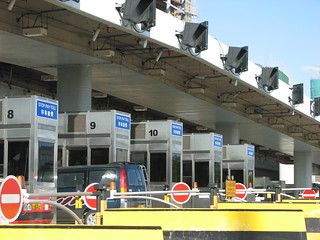
Toll Booths, Hong Kong

Toll Booths, Hong Kong (Photo credit: Ian Muttoo)

But re-reading the report it says that they will also be charging German drivers but giving tax cuts elsewhere to offset the cost. Maybe I misunderstood! Is it me? Anyway, watch this space. By Graham Hill

Share My Blogs With Others: These icons link to social bookmarking sites where readers can share and discover new web pages.
  • MisterWong
  • Y!GG
  • Webnews
  • Digg
  • del.icio.us
  • StumbleUpon
  • Reddit
  • Alltagz
  • Ask
  • Bloglines
  • Facebook
  • YahooMyWeb
  • Google Bookmarks
  • LinkedIn
  • MySpace
  • TwitThis
  • Squidoo
  • MyShare
  • YahooBuzz
  • De.lirio.us
  • Wikio UK
  • Print
  • Socializer
  • blogmarks

Graham Hill Disagrees With Vehicle Pundit Over Electric Cars

Sunday, 15. June 2014

Oh dear, I once again find myself disagreeing with the self promoted ‘Motoring’s most outspoken and opinionated colomnist’ Mike Rutherford. This time over electric cars. He has described 100% electric cars as ‘stillborn’.

Thinking of a change but unsure as to the best way to finance your car? Then you need a copy of my car finance book, Car Finance – A Simple Guide by Graham Hill. Click on the link below to buy the best car finance book on the market, available as a Kindle Book and Paper Back.

He has written a rather amusing article in which he goes head to head with Richard Bruce who is the head of the Office for Low Emission Vehicles (OLEV) over the reasons why we should persevere with electric vehicles(EV’s). Quite naturally Mr Bruce is heavily in favour of EV’s as without them his job pretty much becomes meaningless so of course he is in favour.

Mr Rutherford’s point is that they are expensive and you can’t cover more than 100 miles in one charge, both of which are reasonably true – at the moment. But not everyone needs a car to cover more than 100 miles in a single trip and for those that do there will come a time when cars will be able to cover over 1,000 miles with a single charge.

Look, I’m not a huge fan of electric cars but I’m not going to suggest for one minute that after spending £millions if not £billions in research that we should simply throw out the idea and revert to fossil fuel vehicles or mixtures of fossil fuel engines and battery power packs. That Mr Rutherford is simply dopey!

And don’t forget this is electricity we are talking about – just think back to the days of Thomas Edison, it only takes one experiment to solve the problem even though it may have taken hundreds of experiments previously. With what I have read and reported upon we are rapidly moving closer to the point where cars can cover several hundred miles on one charge, chargers can charge very rapidly and as volumes grow prices will tumble as a result.

Even now we can provide a Nissan Leaf, after allowing for the Government grant for less than £200 + VAT per month on a car that costs over £21,000. My money is on Mr Bruce and whilst he is very protective about EV’s I believe he has a good point and for many drivers EV’s represent the future so go off and have a whinge about something else Mr Rutherford. Don’t you just hate these people that can only moan and groan about things! By Graham Hill

Share My Blogs With Others: These icons link to social bookmarking sites where readers can share and discover new web pages.
  • MisterWong
  • Y!GG
  • Webnews
  • Digg
  • del.icio.us
  • StumbleUpon
  • Reddit
  • Alltagz
  • Ask
  • Bloglines
  • Facebook
  • YahooMyWeb
  • Google Bookmarks
  • LinkedIn
  • MySpace
  • TwitThis
  • Squidoo
  • MyShare
  • YahooBuzz
  • De.lirio.us
  • Wikio UK
  • Print
  • Socializer
  • blogmarks

Latest Mobile Phone Charger Contains 5 Charges

Sunday, 15. June 2014

You may remember the days when a mobile phone battery only lasted for 4 hours before it ran flat so the solution was to carry a spare battery that sat in the charger with the phone giving you 8 hours of standby time and 60 minutes of call time.

Thinking of a change but unsure as to the best way to finance your car? Then you need a copy of my car finance book, Car Finance – A Simple Guide by Graham Hill. Click on the link below to buy the best car finance book on the market, available as a Kindle Book and Paper Back.

Then the new batteries came along and increased substantially the standby time and talk time meaning that you could be out for a complete day and not think about the phone dying on you but what if you are nowhere near a USB connector or unable to plug in a charger? The answer could be a mobile charger.

You charge up the mobile charger which then stores enough electricity to charge your mobile around five times before the charger itself needs charging. Unfortunately the power pack takes around 5 hours to charge but given the extra range that it gives your mobile phone I don’t think that is too bad.

One such device is the Just Mobile Gum++ Charger which fits into the palm of your hand. It costs 69.95 Euros (£57) and can be bought online. Go and have a look by visiting www.just-mobile.eu well worth a look. Oh one last thing it can only be charged via a USB connector, it doesn’t come with a mains plug. By Graham Hill

Share My Blogs With Others: These icons link to social bookmarking sites where readers can share and discover new web pages.
  • MisterWong
  • Y!GG
  • Webnews
  • Digg
  • del.icio.us
  • StumbleUpon
  • Reddit
  • Alltagz
  • Ask
  • Bloglines
  • Facebook
  • YahooMyWeb
  • Google Bookmarks
  • LinkedIn
  • MySpace
  • TwitThis
  • Squidoo
  • MyShare
  • YahooBuzz
  • De.lirio.us
  • Wikio UK
  • Print
  • Socializer
  • blogmarks

Graham Hill Explains The Latest Tyre Developments

Friday, 13. June 2014

If you are a Formula 1 team boss you will be spending small fortunes to squeeze a little extra out of your cars in order to win races. The component parts they spend most time developing their cars around are the tyres whilst, at the same time, the tyre manufacturer providing all the tyres to the teams, is looking at ways to improve grip and thereby handling whilst reducing drag.

Thinking of a change but unsure as to the best way to finance your car? Then you need a copy of my car finance book, Car Finance – A Simple Guide by Graham Hill. Click on the link below to buy the best car finance book on the market, available as a Kindle Book and Paper Back.

Tyres are a very critical part of an F1 car and with the new limits on the amount of fuel you can start a race with the tyre manufacturer has also to consider fuel consumption. But what does all this mean to the likes of you and me?

If you are anything like me, when you need a couple of tyres, you search the Internet for the cheapest premium brand with little regard to the characteristics of the tyre and whether the tyres will provide optimum performance, grip and fuel consumption without the noise of tyres on road drowning out the soft sounds of Luther on the stereo system.

So do we know and understand enough about the tyres we have fitted on our car? I would suggest not because at some point our lives may actually rely upon our choice of tyre. So let me enlighten you with a few of the basics and some of the latest developments, some of which we should thank F1 designers for.

Our first consideration is price which can vary considerably, not only between tyres but at different times of the year. This is because the price of the three most important component parts fluctuate massively in the open market, independent of each other, these being rubber, steel and oil.

In order to make tyres more efficient, long lasting and safer more and more money has to be invested each year which adds to the cost of the tyres. Legal demands such as the fitting of Tyre Pressure Monitoring Systems (TPMS) to all cars manufactured after November 2012 adds to the cost.

The current systems rely upon a transmitter fitted to the valve and powered by a small battery but the latest developments will result in a microchip being embedded within the tyre without the need for a battery. But this type of development costs a fortune which has to be recovered out of the price that tyres are sold at.

Not only will the microchip satisfy the legal requirements it will also monitor tyre temperature and performance that will allow the car settings to be optimised. In future the chip will also interact with weather conditions to influence the car’s behaviour. As the chip tells the car about the tyre’s temperature and pressure this information could then be used to adjust braking, steering and ESP responses.

Dunlop are looking at how the chip technology could be used to manage the tyre throughout its life, telling the driver about tread wear and condition. Even better news is that the tyre manufacturers believe that the new chip technology will be cheaper to fit that the current tyre pressure monitor systems required by law.

The main problem is that of retro fit, whilst the manufacturers agree that the new technology can be easily integrated into new cars it is proving to be a challenge to fit into existing cars – but it is being worked on. As mentioned earlier the component parts of the tyre come at a highly fluctuating cost so the manufacturers are looking at ways alternatives can be used.

Currently they are working on alternatives to oil, something that has been ongoing for many years but the latest advances in replacement commodoties have been made in the development of alternative and more sustainable rubber. The new rubbers are being extracted from maize, soya and even dandelion plants.

The rubber is extracted from the dandelion roots and believe it or not, according to Continental brand manager, Peter Robb, ‘It offers the most potential for the biggest impact on tyre manufacture for years.’ One of the biggest advantages is that the plants can be grown close to the manufacturing plant reducing delivery time and costs.

They reckon that they will have tyres using this new rubber by 2020. The new type of natural rubber will also have the benefit of being harder and longer wearing and some claim that CO2 emissions could be cut by 10g/km. Also the harder compound will reduce road noise. Another area of development at the moment is airless tyres being held up by a series of vanes.

This development is being pioneered by Bridgestone but it is suggested that this is years away from fruition as the development so far has produced tyres with a maximum load capacity of 410kg and a top speed of 37mph. Way to go methinks! Another challenge faced by manufacturer is the desire of drivers to have large, more aesthetically pleasing wheels fitted to their cars.

Apparently this is particular to the UK. The rest of Europe is not so concerned so the manufacturers are trying to come up with a solution that still makes the car look attractive but makes the tyres more environmentally friendly with lower rolling resistance, lower road noise, better fuel consumption and using less materials.

Electric vehicles may lead the way with the new BMW i3 having 155/70 R19 fitted. Quieter tyres are also on the way as the demand from drivers increase and legislation tightens. Continental developed the Contisilent tyre originally for the Audi RS6 fitted with very wide and low profile tyres.

Dunlop Tyres

Dunlop Tyres (Photo credit: Wikipedia)

They managed to substantially reduce the noise by fitting a foam strip to the inner surface of the tyre circumference. This acted like a damper reducing vibrations that transmit through the suspension and body into the cabin. The manufacturers will be paying more attention to this technology as legislation becomes stricter. So there you have it a roundup of the latest tyre technology. Airless tyres and dandelion rubber. By Graham Hill

Share My Blogs With Others: These icons link to social bookmarking sites where readers can share and discover new web pages.
  • MisterWong
  • Y!GG
  • Webnews
  • Digg
  • del.icio.us
  • StumbleUpon
  • Reddit
  • Alltagz
  • Ask
  • Bloglines
  • Facebook
  • YahooMyWeb
  • Google Bookmarks
  • LinkedIn
  • MySpace
  • TwitThis
  • Squidoo
  • MyShare
  • YahooBuzz
  • De.lirio.us
  • Wikio UK
  • Print
  • Socializer
  • blogmarks

New EU Emissions Tests Will Affect BIK Tax & Car Tax

Wednesday, 28. May 2014

There is an expression, be careful what you wish for. I’ll finish it by saying – because it might bite you on the bum. Many people complained about the Government dictated fuel consumption figures. I’ve discussed this on many occasions. The figures don’t reflect fuel consumption in the real world, whatever that is.

Thinking of a change but unsure as to the best way to finance your car? Then you need a copy of my car finance book, Car Finance – A Simple Guide by Graham Hill. Click on the link below to buy the best car finance book on the market, available as a Kindle Book and Paper Back.

The figures are measured in near perfect conditions using a rolling road in a temperature controlled room etc. But whilst the conditions don’t reflect what you would encounter in the centre of Brighton or any other city come to that nor do they reflect the conditions you would encounter on the M6, north of Birmingham on a Tuesday afternoon.

The point is that it is impossible to simply come up with a ‘real world’ fuel consumption figure. What Car may seem to think that it is possible and as a result publish ‘Real World’ combined fuel consumption figures but they are simply rubbish. I drove to Birmingham twice within a week. I felt that I was driving pretty much the same.

There was a small hold up around the M25 near Heathrow on one of the trips but other than that the traffic seemed pretty much the same and I was travelling at a pretty steady speed. The big difference was that on one trip the sun was shining and the conditions were dry, on the other it was hissing down. The result was 50.9 on the first trip and 44.1 on the second.

Now according to the handbook the combined fuel consumption should have been about 60mpg but I never expected to achieve that. What it enabled me to do was compare different cars knowing that one car would return a better fuel consumption than the other without knowing exactly how they would compare in the ‘Real World’.

So to my mind whilst the results are far from what I would expect to achieve, especially the way I drive, the Government figures make the most out of a bad situation. But here’s the crunch. In 2017 the EU is pushing for a new emissions test to be introduced. In addition to emissions the test will include fuel consumption checks which experts say will better reflect real world figures.

Now this may be great if you want what some would consider to be more accurate fuel consumption figures but the change to the way that cars are tested could show CO2 emission figures up to 30% higher increasing the benefit in kind tax for company car drivers by as much as 35% (no I’m not going daft it’s to do with the CO2 banding).

Car tax will also increase as will Class 1a NI contributions by employers. It is clear that the current testing system needed reviewing (currently the New European Driving Cycle – NEDC)  because, for example when testing the cars all fuel consuming gadgets are switched off, such as lights, air conditioning etc. and whilst 10% of the test time has the vehicle idling the figures don’t reflect the new stop/start technology. But with greater fuel consumption accuracy, as is expected with the introduction of the Worldwide Harmonised Light-duty Test Procedures (WLTP), comes the bite on the bum. You have been warned. By Graham Hill

Enhanced by Zemanta
Share My Blogs With Others: These icons link to social bookmarking sites where readers can share and discover new web pages.
  • MisterWong
  • Y!GG
  • Webnews
  • Digg
  • del.icio.us
  • StumbleUpon
  • Reddit
  • Alltagz
  • Ask
  • Bloglines
  • Facebook
  • YahooMyWeb
  • Google Bookmarks
  • LinkedIn
  • MySpace
  • TwitThis
  • Squidoo
  • MyShare
  • YahooBuzz
  • De.lirio.us
  • Wikio UK
  • Print
  • Socializer
  • blogmarks

New Paint Calls Time On Car Washing

Wednesday, 21. May 2014

As I write this on a beautiful bank holiday Monday I see out of my kitchen window several neighbours with their hosepipe, bucket and sponge to hand doing that most tedious of jobs, washing the car. Well if the experiments being carried out by Nissan are successful this mundane weekend job may well be a thing of the past.

Thinking of a change but unsure as to the best way to finance your car? Then you need a copy of my car finance book, Car Finance – A Simple Guide by Graham Hill. Click on the link below to buy the best car finance book on the market, available as a Kindle Book and Paper Back.

They are currently testing a ‘self clean’ paint on a prototype Nissan Note which the makers claim is resistant to rain and dirt. The coating is sold by Florida based company, UltraTech International Inc. It works by repelling water and oils, creating a protective layer of air. Yes you did read that correctly they claim to create a layer of air.

For me that is one step too far, how on earth does it create a layer of air? Confused the hell out of me but no doubts someone will get back to me with an amazing answer based on chemical reactions or the pull of the moon against gravity. The real test will be whether at the end of the trials the car is still clean or not.

So far the tests have gone well, according to Nissan, the only manufacturer to apply the nano-paint to date. According to reports Nissan will make this an aftermarket option should the tests go well. What?

How to you make paint an aftermarket option? Carpet mats are an aftermarket option, a tow bar is an aftermarket option, things that the dealer can fit once the car is built are aftermarket options. Are they considering re-spraying the car with Nano Paint after the car has arrived at the dealership? Is it my age???? By Graham Hill

Enhanced by Zemanta
Share My Blogs With Others: These icons link to social bookmarking sites where readers can share and discover new web pages.
  • MisterWong
  • Y!GG
  • Webnews
  • Digg
  • del.icio.us
  • StumbleUpon
  • Reddit
  • Alltagz
  • Ask
  • Bloglines
  • Facebook
  • YahooMyWeb
  • Google Bookmarks
  • LinkedIn
  • MySpace
  • TwitThis
  • Squidoo
  • MyShare
  • YahooBuzz
  • De.lirio.us
  • Wikio UK
  • Print
  • Socializer
  • blogmarks

Road Markings In A Dreadful State Of Repair

Monday, 5. May 2014

Road markings are in a terrible state of repair. So says a report prepared by the Road Safety Markings Association (RSMA). Yep there is actually an association for road markings. They explain that nearly 50% of lane markings on major roads need replacing with only 16% of motorway lines considered to be excellent.

Thinking of a change but unsure as to the best way to finance your car? Then you need a copy of my car finance book, Car Finance – A Simple Guide by Graham Hill. Click on the link below to buy the best car finance book on the market, available as a Kindle Book and Paper Back.

The study was carried out over 2,500 miles of English roads which came to the conclusion that pot holes are not the only issues on our roads. The report suggested that 52% of markings on motorways, 42% on dual carriageways and 48% on single carriageways should either be replaced right now or scheduled as a matter of urgency.

National director of the RSMA, George Lee, said, ‘It’s shameful that half England’s road markings are so worn out.’ The worst road in England isn’t far from me, the M3 between Bagshot and Camberly in Surrey where they found 94% of white lines in need of work.

As usual the Department for Transport kicked out a spokesman who explained that the country’s roads were among the safest in the world, and that the Highways Agency took prompt action to repair markings as part of a planned maintenance strategy.

Apparently not Mr DfT spokesman or there would have been no need for the sodding report! Good grief, when will we ever see action rather than excuses? By Graham Hill

M65 Junction 5 - geograph.org.uk - 1187545

M65 Junction 5 - geograph.org.uk - 1187545 (Photo credit: Wikipedia)

Enhanced by Zemanta
Share My Blogs With Others: These icons link to social bookmarking sites where readers can share and discover new web pages.
  • MisterWong
  • Y!GG
  • Webnews
  • Digg
  • del.icio.us
  • StumbleUpon
  • Reddit
  • Alltagz
  • Ask
  • Bloglines
  • Facebook
  • YahooMyWeb
  • Google Bookmarks
  • LinkedIn
  • MySpace
  • TwitThis
  • Squidoo
  • MyShare
  • YahooBuzz
  • De.lirio.us
  • Wikio UK
  • Print
  • Socializer
  • blogmarks

Plans To Vary And Even Remove Roadwork Speed Limits

Sunday, 4. May 2014

I hope, like me, you understand the need to cone off road works on motorways for the safety of those who work on the roads. I don’t even mind the mile or so of cones, aimed at slowing down the drivers before the actual road works begin, having read some absolute horror stories of workers, killed or maimed by drivers trying to jump one extra place on the road before being forced over by one lane.

Thinking of a change but unsure as to the best way to finance your car? Then you need a copy of my car finance book, Car Finance – A Simple Guide by Graham Hill. Click on the link below to buy the best car finance book on the market, available as a Kindle Book and Paper Back.

Having had the misfortune of having a flat tyre on a motorway and being forced to stop on the hard shoulder whilst cars and trucks come pounding past, even at 70mph, made for one of the most frightening experiences in my many years of driving. So I understand the need for worker safety but when I start throwing toys out of the pram is when I am travelling along the long stretch of M25 restricted to 50mph followed by a long stretch of A23 at the end of the M23 restricted to 40mph when there is no bugger working. In fact I am often, at 3.00 in the morning, the only driver for miles but I still have to stick to the road work restrictions for fear that the average speed cameras report me for doing 10mph over the restricted speed.

Even when I’m convinced that the cameras aren’t able of taking pictures or measuring your average speed at night. Having suffered these constraints for a couple of years already I was very pleased to see that the Highways Agency were considering introducing variable speed limits on sections of motorways being worked upon.

English: Road works This is a road works at th...

English: Road works This is a road works at this location, in time for summer driving. (Photo credit: Wikipedia)

The new average speed limits would be assessed on a case by case basis but it is expected that limits could be raised at off peak times and times when no one was working on the restricted section of road. About bloody time! By Graham Hill

Enhanced by Zemanta
Share My Blogs With Others: These icons link to social bookmarking sites where readers can share and discover new web pages.
  • MisterWong
  • Y!GG
  • Webnews
  • Digg
  • del.icio.us
  • StumbleUpon
  • Reddit
  • Alltagz
  • Ask
  • Bloglines
  • Facebook
  • YahooMyWeb
  • Google Bookmarks
  • LinkedIn
  • MySpace
  • TwitThis
  • Squidoo
  • MyShare
  • YahooBuzz
  • De.lirio.us
  • Wikio UK
  • Print
  • Socializer
  • blogmarks