Electric Vehicles Achieve Strong Resale Values As VW Leads The Way

Thursday, 18. February 2021

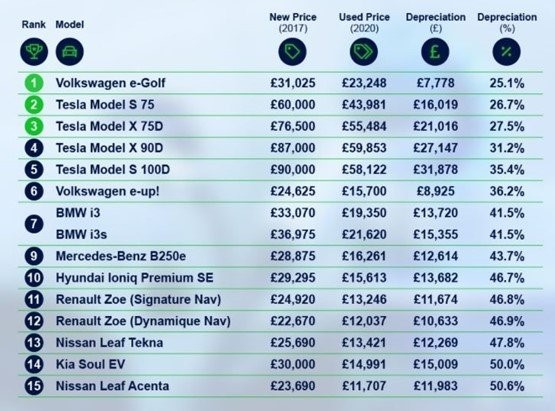
The Volkswagen e-Golf has achieved the strongest residual value in the electric car market, according to a study by CompareTheMarket.

The electric version of the Golf was ranked the top EV with the lowest depreciation of £7,778 (25.1%) after three years, with used models selling for an average price of £23,248 – three quarters of its new price three years ago.

It is followed by two Teslas, the Model S 75 (26.7% depreciation) and Model X 75D (27.5%)
https://cdn.fleetnews.co.uk/web/1/root/compare-the-market-ev-residuals_w555_h555.jpg

The research reveals how much electric and hybrid cars deprecate in value by comparing ‘new’ prices for the most common plug-in and hybrid vehicles to their used prices to reveal the vehicles which hold their value the most.

As Teslas are among the most expensive EVs and benefit from regular software updates, it could help the models retain their value, CompareTheMarket said.

According to the research, the models that were ‘the worst’ at holding their values were the Hyundai Ioniq Premium SE, which has a depreciation of £13,682 (46.7%), Renault Zoe Signature Nav, which has a depreciation of £11,674 (46.8%) and the Renault Zoe Dynamique Nav which depreciates by £10,633 (46.9%).

Find out about the latest EVs and plug-in hybrids coming to market in 2021 in our latest digital edition of Fleet News.

When looking at plug-in hybrids, the Porsche Panamera E-Hybrid was found to have ‘the best’ resale value over the last three years, with depreciation of 21%.

This is followed by Mini’s hybrid offering, the Countryman Cooper SE (31.5%) and another version of the VW Golf, the GTE Advance (36.3%).

The hybrids found to have the highest depreciation were the Kia Optima, which depreciates by £18,708 (53.2%), the Mercedes-Benz E350e (53.1%), Mercedes-Benz C5350e (51.5%), BMW 225xe Active Tourer (50.1%) and the Audi A3 e-tron (49.4%).
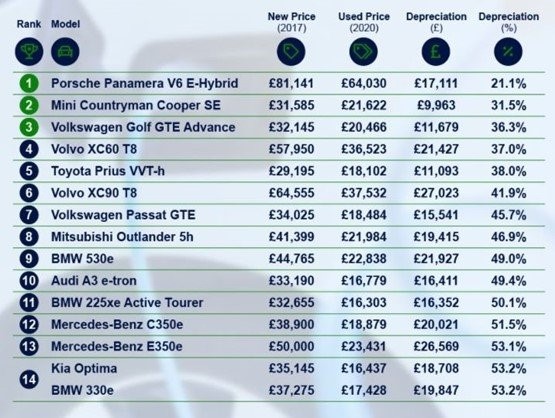
CompareTheMarket said, ‘the worst’ performing hybrids lose more of their value than electric cars, whereas ‘the best’ performing electric cars do not hold their value as well as hybrids.

Dan Hutson, head of motor insurance at CompareTheMarket, said: “EVs are becoming increasingly popular, and now that they have been in circulation for a while we are seeing them come onto the second-hand market, which is great news for people wanting to buy an EV or hybrid at a lower price.

“As the technology improves and cars become cheaper, we are sure to see greater adoption, which is the greener step forward that we need.” By Graham Hill thanks to Fleet News

Share My Blogs With Others: These icons link to social bookmarking sites where readers can share and discover new web pages.
  • MisterWong
  • Y!GG
  • Webnews
  • Digg
  • del.icio.us
  • StumbleUpon
  • Reddit
  • Alltagz
  • Ask
  • Bloglines
  • Facebook
  • YahooMyWeb
  • Google Bookmarks
  • LinkedIn
  • MySpace
  • TwitThis
  • Squidoo
  • MyShare
  • YahooBuzz
  • De.lirio.us
  • Wikio UK
  • Print
  • Socializer
  • blogmarks

Electric Car Manufacturers Turn Up The Wick – Starting With Tesla

Thursday, 18. February 2021

Tesla expanded its UK dealer network to 25 sites during 2020 and plans further network growth in 2021.

It represents a U-turn on company founder Elon Musk’s 2019 declaration that Tesla would close all its showrooms in favour of an online-only sales model.

The latest strategy follows reports of Tesla’s value reaching a record £516 billion, making it worth more than Toyota, VW, Hyundai, GM and Ford combined.

Six new Tesla locations were opened across the UK in 2020, with new showrooms appearing in Newcastle, Winchester, Gatwick, Belfast, Birmingham and Chelmsford.

A new site in Glasgow is also poised to open this year.

The Californian car maker says it has boosted its aftersales operation significantly and now has 15 service locations across the country, with more than 300 service team members.

This has led to a 130% increase in available service appointments and a 60% reduction in waiting times for appointments, according to the brand.

Tesla says it can reduce the time vehicles need to be in a workshop using remote diagnosis and can perform a service four times faster than conventional garages, enabling it to operate with a smaller footprint.

The brand achieved almost 25,000 registrations during the year, outperforming established brands such as Fiat, Mazda, Porsche and Suzuki.

Its Model 3 topped UK monthly sales charts twice during the year – once in April and then in December.

The vast majority of sales are the Tesla Model 3 – Tesla insiders suggest the Model 3 accounts for approximately 90% of UK Tesla sales YTD. That makes the Model 3 the UK’s best-selling battery electric vehicle (BEV), and the UK’s second best-selling compact executive model behind the BMW 3 Series.

Tesla’s UK Supercharger network also grew during 2020 with the addition of 180 new chargers in 20 locations, bringing the total to more than 600 chargers in 70 locations. By Graham Hill thanks to Fleet News

Share My Blogs With Others: These icons link to social bookmarking sites where readers can share and discover new web pages.
  • MisterWong
  • Y!GG
  • Webnews
  • Digg
  • del.icio.us
  • StumbleUpon
  • Reddit
  • Alltagz
  • Ask
  • Bloglines
  • Facebook
  • YahooMyWeb
  • Google Bookmarks
  • LinkedIn
  • MySpace
  • TwitThis
  • Squidoo
  • MyShare
  • YahooBuzz
  • De.lirio.us
  • Wikio UK
  • Print
  • Socializer
  • blogmarks

SUV Sales Across Europe Drop For First Time In 6 Years

Monday, 8. February 2021

SUV Sales Across Europe Drop For First Time In 6 Years

The growth in demand for SUVs across Europe has slowed for the first time in six years as smaller, electrified models start to claw back sales.

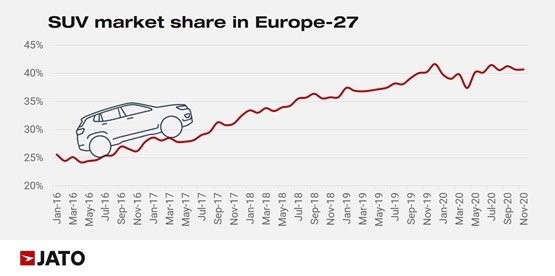
Between January 2016 and January 2020, the market share of SUVs grew significantly – from 25% to 40%.

For the majority of the year, the market share of SUVs remained stable – between 40% to 41%. However, their registrations fell by 13% in November, and 21% YTD when compared to 2019.

https://cdn.fleetnews.co.uk/web/1/root/jatoeuropeanvolumespressrelease-november2020-final-suv-market_w555_h555.jpg

Felipe Munoz, global analyst at JATO Dynamics, said: “The market has benefitted hugely from a wider SUV offering provided this year. But with the impact of Covid-19 still in full force, demand is no longer growing in parallel to new product launches, nor at such a fast pace.”

Conversely, B and C cars experienced declines below the overall average, in fact, their market share increased in November due to new arrivals and a more competitive electrified offering.

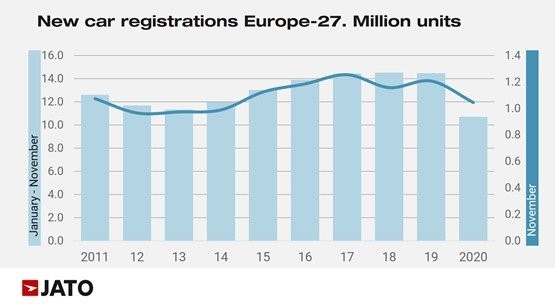
Overall, Europe registered 1,045,129 new cars – 13% less than for the same period in 2019. November 2020 has recorded the lowest volume since 2014, when just 989,500 units were registered.

https://cdn.fleetnews.co.uk/web/1/root/jatoeuropeanvolumespressrelease-november2020-final-year-on-year-registrations_w555_h555.jpg

Year-to-date figures continue to point to a downward trend, with YTD volume dropping by 26%. European consumers registered 10.71 million units between January and November – the lowest YTD figures so far this century.

Munoz added: “The global pandemic and its impact on mobility has been extremely painful for the automotive industry, indeed more painful than any other economic crisis that has hit Europe over the last two decades.”

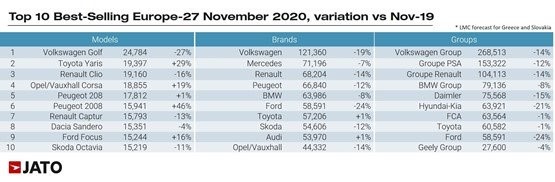
The overall ranking by models in November confirms that the Volkswagen Golf (pictured) kept its position as the most popular car in Europe. The hatchback registered 24,800 units in November – just short of 255,000 units since January.

Only two SUVs made it into the top 10 – the Peugeot 2008, followed by the Renault Captur. Further down the ranking, Ford Puma, Volvo XC40, Audi A3, Renault Zoe, Volkswagen ID3, Kia Niro, Mercedes GLA, Skoda Kamiq, Jeep Compass, Mercedes GLB, Nissan Juke, Audi Q3 Sportback, Kia Xceed, Suzuki Ignis, and BMW 2-Series, all posted healthy results.

https://cdn.fleetnews.co.uk/web/1/root/jatoeuropeanvolumespressrelease-november2020-final-best-sellers_w555_h555.jpg

By Graham Hill thanks to Fleet News

Share My Blogs With Others: These icons link to social bookmarking sites where readers can share and discover new web pages.
  • MisterWong
  • Y!GG
  • Webnews
  • Digg
  • del.icio.us
  • StumbleUpon
  • Reddit
  • Alltagz
  • Ask
  • Bloglines
  • Facebook
  • YahooMyWeb
  • Google Bookmarks
  • LinkedIn
  • MySpace
  • TwitThis
  • Squidoo
  • MyShare
  • YahooBuzz
  • De.lirio.us
  • Wikio UK
  • Print
  • Socializer
  • blogmarks

New UK EV Battery Production Plant Boost To UK’s Part In Worldwide Move To EV Domination

Wednesday, 27. January 2021

Britishvolt’s new UK battery gigaplant will start production of electric vehicle (EV) batteries from 2023 and will scale to 300,000 units a year.

Global construction specialist ISG has been appointed to lead the build of the £2.6 billion project located at Blyth, Northumberland.

Construction will start in the second half of this year (2021) and once the plant is up and running it will produce lithium-ion batteries for the automotive and renewable energy industries at the end of 2023.

Construction of further phases will continue until the end of 2027.

The Blyth gigaplant is located 20 miles north of Nissan’s Sunderland factory, which makes the Leaf EV.

Orral Nadjari, Britishvolt chief executive, said: “We’re delighted to have engaged ISG as the construction partner for our Blyth gigaplant.

“Its long expertise of delivering global projects will be crucial to meeting our exacting standards and tight timeframe.”

ISG built Jaguar Land Rover’s production facility in Slovakia and it is also currently working on two flagship schemes in London: University College’s £280 million neuroscience hub and the Oak Cancer Centre at the Royal Marsden Hospital.

Paul Cossell, ISG chief executive, said: “This landmark project to build the UK’s first gigaplant is one of the most visible signs that we are confidently stepping up to meet the challenge of new zero emissions by 2050 and closely aligned with the government’s key commitment to cease petrol and diesel car manufacturing by 2030.

“The construction phase alone will directly support thousands of jobs in the North East and create a wealth of training and upskilling opportunities for local communities.”

The gigaplant is being designed by Italian design company Pininfarina.

It will be built on a 95-hectare site, formerly the site of the Blyth Power Station.

The plant will exclusively use renewable energy, including the potential to use hydro-electric power generated in Norway and transmitted 447 miles under the North Sea via the world’s longest inter-connector from the North Sea Link project.  By Graham Hill thanks to Fleet News

Share My Blogs With Others: These icons link to social bookmarking sites where readers can share and discover new web pages.
  • MisterWong
  • Y!GG
  • Webnews
  • Digg
  • del.icio.us
  • StumbleUpon
  • Reddit
  • Alltagz
  • Ask
  • Bloglines
  • Facebook
  • YahooMyWeb
  • Google Bookmarks
  • LinkedIn
  • MySpace
  • TwitThis
  • Squidoo
  • MyShare
  • YahooBuzz
  • De.lirio.us
  • Wikio UK
  • Print
  • Socializer
  • blogmarks

As Electric Vehicles Increase Government Looks Set To Introduce ‘Tax Per Mile’!

Wednesday, 27. January 2021

The Government is being urged to work with the fleet sector to ensure any changes to motoring taxation are carried out in a timely, effective and proportionate way.

Reports suggested that the Government was considering reviving road pricing plans to counter lost tax revenues from the increasing adoption of electric vehicles (EVs).

The fleet sector has already shown it is receptive to road pricing as a replacement to other road and fuel duties. Fleet News has been calling for the Government to launch a feasibility study since its Fleet Industry Manifesto report in 2015.

The National Infrastructure Strategy, launched to coincide with the Spending Review, emphasised the need for motoring tax revenues to ‘keep pace’ with the uptake of EVs. It did not, however, mention road pricing as a potential alternative to the current regime.

Gerry Keaney, chief executive of the British Vehicle Rental and Leasing Association (BVRLA) says any changes need to be fair to the fleet industry.

He recognises that the Government’s future motoring tax strategy must strike a “fine balance” in maintaining vital revenues and encouraging people into newer and cleaner vehicles.

But he stressed: “The Government must avoid placing a crushing tax burden on businesses and individuals that are unable to upgrade their cars, vans or trucks and are already struggling to cope with the economic implications of Covid-19 pandemic and EU exit.” 

The Government has already spent £280 billion to help support the economy through the pandemic and will spend a further £55bn next year to support the recovery.

“We will very soon need a system that can levy tax on both conventionally fuelled and battery electric vehicles fairly,” Nicholas Lyes, RAC

In total, taxes on UK motoring, including vehicle excise duty (VED), fuel duties and VAT, raise around £40bn per year or 7% of total revenue to the Exchequer. Of this, benefit-in-kind (BIK) tax payments, covering the provision of company cars, raise close to £1.8bn.

Darren Handley, head of infrastructure grants at the Office for Low Emission Vehicles (OLEV), told attendees at Virtual Fleet and Mobility Live that, while the question of future motoring taxation is one for the Treasury, it should not necessarily follow that lost fossil fuel revenues will be recouped from EV drivers.

He said: “If you look at a parallel with something like health and smoking, any reduction in tax (take) from (a reducing number of) smokers isn’t regained by taxing somebody who is healthy.”

Covid-19 impact on tax revenues

In Budget 2020, the Treasury outlined expected tax receipts from fuel duty each year up to 2024/25. It expected to collect £27.5bn this tax year, a £200m decline on £27.7bn in 2019/20. But, then it was predicted to increase to £28.1bn the following year (2021/22), before reaching £30.5bn in 2022/23, £31.2bn in 2023/24 and £31.7bn in 2024/25.

VED receipts are expected to fall by £100 million to £7bn in 2021/22, before increasing by £200m each year for the next three years, reaching £7.6bn in 2024/25.

Revenues, however, have already been impacted by Covid-19, with lockdown restrictions reducing fuel duty by £2.4bn in April and May compared with the same time last year.

Nicholas Lyes, RAC head of roads policy, said: “While not paying car tax is clearly an incentive to go fully electric at the moment, we will very soon need a system that can levy tax on both conventionally fuelled and battery electric vehicles fairly.

“If this isn’t addressed, we risk finding ourselves in a situation where petrol and diesel drivers continue to pay all the tax for using the roads which is unsustainable.”

Four-in-10 drivers believe that some form of ‘pay-per mile’ system would be fairer than the current system of fuel duty, says the RAC, while half (49%) agree that the more someone drives, the more they should pay in tax.

Insurance and Mobility Solutions (IMS), which is part of Trak Global Group, has successfully piloted road pricing projects in several US states.

Dr Ben Miners, chief innovation officer for IMS, explained: “Road user charging (RUC) and electronic toll collection (ETC) are both important solutions to fairly generate revenue from road users.”

ETC focuses on specific concessions or fixed points with a roadside/infrastructure approach, whereas RUC focuses on the broader transportation network with an infrastructure-free, wireless infrastructure, process.

Miners said: “The additional flexibility of RUC enables new virtual tolls to be introduced and transform any road segment or fixed asset into a ‘tolled’ road, which eliminates lengthy construction times and shortens time-to-market.”  By Graham Hill thanks to Fleet News

Share My Blogs With Others: These icons link to social bookmarking sites where readers can share and discover new web pages.
  • MisterWong
  • Y!GG
  • Webnews
  • Digg
  • del.icio.us
  • StumbleUpon
  • Reddit
  • Alltagz
  • Ask
  • Bloglines
  • Facebook
  • YahooMyWeb
  • Google Bookmarks
  • LinkedIn
  • MySpace
  • TwitThis
  • Squidoo
  • MyShare
  • YahooBuzz
  • De.lirio.us
  • Wikio UK
  • Print
  • Socializer
  • blogmarks

Michelin Tyres To Go Digital By 2023 With Embedded Chips.

Wednesday, 27. January 2021

Michelin has announced it will incorporate Radio Frequency Identification (RFID) chips into all its car tyres by 2023.

The manufacturer said RFID technology is a cost-effective way of tracking tyres and a ‘significant contributor’ to predictive maintenance services.

It will also enhance driver safety by allowing Advanced Driver Assistance Systems (ADAS) such as ESP to adjust responses according to specific tyre characteristics, says Michelin.

Michael Ewert, vice president of Global Sales for Original Equipment at Michelin, said: “Since RFID technology ensures this exact tyre identification, it is conceivable in the future that drivers will see a tyre status display next to their fuel gauge.

“RFID in tyres makes many new business models possible and can also further increase safety when driving. We are convinced it represents a significant step forward in the tyre industry.”

The technology could also be used to improve recycling rates, allow proof of recycling and help improve the efficiency of energy recovery programmes.

Michelin says it is working with car manufacturers to develop algorithms that could pave the way for several new advances as cars become more connected.

Dealers and workshops will also benefit as exact tyre identification and data will be easily accessible, reducing fitting errors and helping with stock control, it says.

Up to 15 million chips a year will be encased in rubber at Michelin’s Homburg plant in Germany before they are installed in new tyres on site or shipped to other Michelin factories in Europe, China, Thailand and Brazil.

Michelin recently warned fleet managers to ensure they are selecting the right replacement tyres for their cars and vans, to avoid unnecessary costs. By Graham Hill thanks to Fleet News

Share My Blogs With Others: These icons link to social bookmarking sites where readers can share and discover new web pages.
  • MisterWong
  • Y!GG
  • Webnews
  • Digg
  • del.icio.us
  • StumbleUpon
  • Reddit
  • Alltagz
  • Ask
  • Bloglines
  • Facebook
  • YahooMyWeb
  • Google Bookmarks
  • LinkedIn
  • MySpace
  • TwitThis
  • Squidoo
  • MyShare
  • YahooBuzz
  • De.lirio.us
  • Wikio UK
  • Print
  • Socializer
  • blogmarks

Report Reveals That Inappropriate Tyres Can Increase Running Costs And Invalidate Your Insurance/Warranty

Friday, 15. January 2021

Drivers are being urged to ensure they are selecting the right replacement tyres for their cars, to avoid unnecessary costs.

Michelin warns that inappropriate or incorrect fitments could negatively impact fuel economy and tyre life, as well as affecting vehicle handling and performance characteristics.

In some cases, incorrect tyre fitment can risk invalidating the vehicle manufacturer’s warranty.

Michelin’s fleet team points to a rise in the instances of vehicles driving on inappropriate tyres, such as cars running on van tyres (or vice versa), the mixing of standard and run-flat technology products, or incorrect tyres which don’t have the required speed or load rating for the vehicle.

Some manufacturers of 4x4s and high-performance vehicles also stipulate specific marked, homologated tyres for their vehicles.

Brian Porteous, Michelin’s technical manager – Car, Van, 4×4 and Government Contracts, said: “It is crucial that any replacement tyres you select are compatible with each other, compatible with the vehicle and deliver the appropriate handling and performance characteristics.

“Vehicle manufacturers work incredibly hard to fine-tune their cars and vans to handle a certain way, and all of that can be upset if you fit a tyre which, although the correct size, might be intended for a different vehicle altogether. Driving on inappropriate tyres can also lead to reductions in fuel efficiency, passenger comfort and tyre life, plus a noisier ride.”

To help fleets and consumers maximise safety and avoid incorrect tyre selection, Michelin has published a six-point guide which is applicable regardless of tyre brand preference.

  • Tyres must meet the vehicle manufacturer’s requirements of load and speed, plus any local regulatory requirements such as: vehicle speed, E marking, winter marking, directional fitment etc.
  • If a vehicle manufacturer requires specific marked, homologated tyres, then these must be fitted. It is sometimes possible to use other tyres, but not always – consult your vehicle handbook
  • It is essential for vehicle stability that the best grip is maintained at the rear. If all tyres are not being replaced together, the new tyres must be fitted to the rear
  • The tyres on each end of an axle must be of the same type. Differences in tyre performance, particularly towards the end of a tyre’s life, make this critical for vehicle stability and predictability
  • Winter tyres must always be fitted in full vehicle sets. Do not mix summer and winter tyres across a vehicle
  • Run-flat technology tyres must always be fitted in full vehicle sets and to the appropriate wheel type. The vehicle manufacturer’s guidance must be followed as there are often differences in vehicle characteristics to work effectively with the run-flat tyre capability

Peter Wood, Michelin key account manager, added: “As technology has evolved, so has tyre choice. Customers can now select between summer, all-season, winter, extra load, run-flat technology and even acoustic tuned tyres, to name just a few of the options.

In one size alone, there can be several different load and speed ratings to suit various vehicle types, plus options for different seasons and driving styles.”  By Graham Hill thanks to Fleet News

Share My Blogs With Others: These icons link to social bookmarking sites where readers can share and discover new web pages.
  • MisterWong
  • Y!GG
  • Webnews
  • Digg
  • del.icio.us
  • StumbleUpon
  • Reddit
  • Alltagz
  • Ask
  • Bloglines
  • Facebook
  • YahooMyWeb
  • Google Bookmarks
  • LinkedIn
  • MySpace
  • TwitThis
  • Squidoo
  • MyShare
  • YahooBuzz
  • De.lirio.us
  • Wikio UK
  • Print
  • Socializer
  • blogmarks

Green Number Plates To Make Parking Cheaper For EV’s

Friday, 15. January 2021

The first electric vehicles (EVs) were given green number plates from Tuesday, December 8, with the Government suggesting the move could unlock incentives for drivers and fleets.

Ministers gave the go-ahead for the new number plate design for pure electric vehicles (EVs) in June.

The new number plates can be retro-fitted to any existing vehicles, including cars, vans, buses, HGVs, taxis and motorcycles as long as they emit no CO2 emissions at the tailpipe.

They will consist of a green flash on the left-hand side of the plate and can be combined with the Union flag and national identifiers already permitted by the regulations.

Transport Minister Rachel Maclean says that the green number plates build on last month’s announcement to end the sale of new petrol and diesel cars and vans in the UK by 2030.

She also believes that EV operators could benefit from local initiatives such as cheaper parking and cost-free entry into zero-emission zones.

She said: “Not only will green number plates raise awareness of the increasing number of cleaner vehicles on our roads, they could also unlock a number of incentives for drivers.

“It’s clear there has never been a better time to make the switch to a zero-emission vehicle.”

Ashley Barnett, head of consultancy at Lex Autolease, told Fleet News says that today’s introduction of green number plates to identify zero-emission vehicles on the UK’s roads will boost driver advocacy even further and will go a long way to keep up the momentum behind the Government’s Road to Zero strategy.

“The deadline to achieve net-zero emissions by 2050 looms ever closer, so anything that simply and clearly communicates the benefits of electric vehicle adoption – from better parking spaces to accessing emissions-restricted zones – to a wider audience is a welcome shot in the arm,” he said.

A survey by Nissan suggests that a third of motorists in the UK would be more likely to buy an EV, because of the new green number plates

.

Andrew Humberstone, managing director of Nissan Motor GB, said: “The age of the electric vehicle is now approaching rapidly and these new green registration plates will soon be a common sight on our roads.”

The Nissan survey, carried out by respected pollsters YouGov, found that with the introduction of green number plates, and the prospect of further incentives linked to EV ownership, 32% of people would be more likely to buy an electric car.  By Graham Hill thanks to Fleet News

Share My Blogs With Others: These icons link to social bookmarking sites where readers can share and discover new web pages.
  • MisterWong
  • Y!GG
  • Webnews
  • Digg
  • del.icio.us
  • StumbleUpon
  • Reddit
  • Alltagz
  • Ask
  • Bloglines
  • Facebook
  • YahooMyWeb
  • Google Bookmarks
  • LinkedIn
  • MySpace
  • TwitThis
  • Squidoo
  • MyShare
  • YahooBuzz
  • De.lirio.us
  • Wikio UK
  • Print
  • Socializer
  • blogmarks

Crash Repair Market Has Suffered A Major Drop In Business

Friday, 8. January 2021

The total market value for UK primary vehicle body repairs has fallen by 26.6% to £3.57 billion in 2020, as a direct result of the Covid-19 pandemic, new research suggests.

Furthermore, the report on the UK vehicle body repair and motor insurance market, published today (Monday, November 30) by independent market research company Trend Tracker, says accident repair volumes will not return to pre-Covid levels until 2022.

The Emerging from Covid-19 – The UK Vehicle Body Repair and Motor Insurance Market 2020-2023 Market Study reports that accident repair volumes declined by 30% in 2020.

However, it says that as repair costs have continued on an upward trajectory, predominantly due to the increased complexity of Advanced Driver-Assistance Systems (ADAS) and an increasing number of vehicles with hybrid or electric powertrains, the financial loss to the sector is calculated at 26.6%.

Mark Bull, director of Trend Tracker, said: “Anecdotally, the volume demand for insurer-funded accident damage repairs fell by approximately 80% overnight as the initial nationwide lockdown came into effect in March, however they had steadily recovered to approximately 75% of pre-Covid levels as Government restrictions eased, until November that is.

“The Trend Tracker research has monitored repair volume and values throughout the year to calculate quantitative figures that show a projected annual loss of £1.3bn in 2020 to the UK vehicle repair industry.”

Of the £1.3bn market contraction, which can readily be viewed as a direct saving to motor insurers’ claims expenditure, £5.6 million is attributed to a loss of parts sales, £4.1m as lost labour sales and £2.6m as lost paint sales, with the remainder being additional and consumable items.

“We would expect traffic volumes to return to greater levels during 2021,” Mark Bull, Trend Tracker

Meanwhile, offsetting some of the financial loss to the vehicle body repair market, the cost of repairs continues to rise year-on-year.

Since 2018 to the first half of 2020, overall repair costs generated via the Solera Audatex system have increased by 10.2%, from an average of £1,860 to £2,050 per repair.

Taking a longer-term view, since 2013 overall repair costs generated via the Solera Audatex system have increased by 48.5% and they show no sign of slowing, due primarily to ever-increasing vehicle complexity.

Bull explained: “While we know that 2020 has been devastating for many businesses across all sectors, the vehicle body repair sector was very much on the road to recovery until lockdown 2.0 came into effect.

“However, with the excellent news that a vaccine will be available shortly, we would expect traffic volumes to return to greater levels during 2021, which should correlate to a V-shape recovery in terms of the number of accident damage claims.

This is encouraging for bodyshops, although we predict that pre-Covid work volume will not return until 2022.”  By Graham Hill thanks to Fleet News

Share My Blogs With Others: These icons link to social bookmarking sites where readers can share and discover new web pages.
  • MisterWong
  • Y!GG
  • Webnews
  • Digg
  • del.icio.us
  • StumbleUpon
  • Reddit
  • Alltagz
  • Ask
  • Bloglines
  • Facebook
  • YahooMyWeb
  • Google Bookmarks
  • LinkedIn
  • MySpace
  • TwitThis
  • Squidoo
  • MyShare
  • YahooBuzz
  • De.lirio.us
  • Wikio UK
  • Print
  • Socializer
  • blogmarks

Argument Flares Over The True Carbon Emissions Of Electric Vehicles Compared To Petrol And Diesel

Friday, 8. January 2021

The Government should focus on decarbonising the fuel, not the vehicle, a new report into the future of Britain’s automotive industry has said.

The ban of the sale of new petrol and diesel cars from 2030 “wasn’t helpful”, said the Decarbonising Road Transport: There is no Silver Bullet report, commissioned by companies including Honda, Aston Martin, Bosch and McLaren.

It encouraged manufacturers to follow the lead of Polestar and Volkswagen in being more transparent about the emissions generated during the production of each model, after research found the manufacture of EVs generates 63% more CO2 than its petrol or diesel equivalent.

The report said a Polestar 2 would need to run for around 49,000 miles before its carbon footprint became smaller than that of a diesel Volvo XC40.

However, this figure – and much of the interpretation in included in the press release – has been disputed, with analyst Michael Liebrich saying this figure is actually nearer 16,000 miles.

Dr Uwe Gackstattar, president of Bosch Powertrain Solutions, called on the Government to leave engineers to come up with the solutions.

Andy Palmer, former CEO of Aston Martin, said it was vital to understand there were many routes to net zero.

He added: “You can demand zero CO2 from the tailpipe, but a lot of CO2 is then produced in manufacturing.

“And while synthetic fuels are not CO2-free at the tailpipe, they can be at production and expulsion. There are lots of solutions and it’s important we make that distinction.”

The report said making all new vehicles zero emissions at the tailpipe works only if the energy grid is zero emission and addresses only those new vehicles sold each year, which is around two million.

Introducing renewable fuels impacts on all vehicles in the legacy car parc – around 40 million – 10% of which are more than 20 years old.

Report recommendations

The report made six recommendations:

  • The focus should be on the decarbonisation of the fuel, not the vehicle in order to meet the country’s climate change ambitions.
  • The decarbonisation of the legacy fleet is as much of a problem as new vehicles. We need to address both.
  • We need to recognise the differing technology needs of different vehicle types.
  • Encourage greater transparency from automotive OEMs on the whole vehicle CO2 footprint of their products
  • Ensure a clear link between renewable energy generation and transport decarbonisation
  • Taking a technology neutral approach to decarbonisation. Allows industry to continue to innovate, offering customers a range of solutions to meet their needs.

The report points out battery electric vehicles face a number of challenges, but “play an integral role in the decarbonisation of road transport”. It added: “They are becoming increasingly viable for a growing number of people.”

Andy Eastlake, managing director of the Low Carbon Vehicle Partnership, which provided some specific information to report author Clarendon Communications, said: “We need to do more than just electrify the fleet.

“We are still selling diesel and petrol cars, the engines of which could play out until 2050, so we have to look at decarbonising fuel.”

In a later statement, LowCVP said the recent media interpretation of the report does not in any way reflect the organisation’s position.

“Lifecycle analysis (sourced from Polestar in the report) has not been properly contextualised in several media reports,” it said.

“These highlight a single snapshot to suggest only modest emissions benefits arising from EV adoption.

“As stated in the report, energy grids in UK and elsewhere are rapidly decarbonising and EV battery and associated production processes are also improving so the lifecycle impacts of electric vehicles are on a sharply improving trajectory.

“LowCVP has been a lead proponent of efforts to incorporate the full life-cycle analysis of road transport CO2 emissions and other sustainability factors into policy decisions and will continue to do so.

“However, this is a complex area and analysis of life-cycle impacts should be seen as a key part of the process towards achieving zero emissions transport and not – as in this case – as a misleading tool to undermine progress.”

‘Driving an EV is better for climate’

Fiona Howarth, CEO of Octopus Electric Vehicles, added: “Studies have consistently shown that EVs emit significantly less lifetime emissions than internal combustion engine cars.

“In 95% of the world, driving an EV is better for the climate than a petrol car and in countries like Sweden and France, where most electricity is low carbon, emissions are around 70% lower – a massive environmental benefit.

“Unlike their fossil fuel counterparts, EVs also get cleaner as we decarbonise our energy grids.”

“If we’re serious about tackling the climate emergency, there is no question that we should all aim to walk, cycle and take public transport where possible, but if you’re going to drive make it electric.”  By Graham Hill thanks to Fleet News

Share My Blogs With Others: These icons link to social bookmarking sites where readers can share and discover new web pages.
  • MisterWong
  • Y!GG
  • Webnews
  • Digg
  • del.icio.us
  • StumbleUpon
  • Reddit
  • Alltagz
  • Ask
  • Bloglines
  • Facebook
  • YahooMyWeb
  • Google Bookmarks
  • LinkedIn
  • MySpace
  • TwitThis
  • Squidoo
  • MyShare
  • YahooBuzz
  • De.lirio.us
  • Wikio UK
  • Print
  • Socializer
  • blogmarks