Could Vegans Be Forcing A Ban On Leather Interiors?

Friday, 24. January 2020

Could a vegan steak bake change the car industry? It might sound tenuous, but the phenomenal success of the unlikely offering from Greggs, along with myriad other vegan products from national chains that have been rolled out for ‘Veganuary’ this month, demonstrate that catering to the growing demand for animal-free products is big business.


The growing interest in veganism is driven by animal welfare, health and environmental concerns. It’s not just about eating only plant-based food but entirely avoiding using animal-based products – such as leather upholstery in cars.


Leather has long been used as a luxury material for car interiors – and it remains a popular choice among many. But the past few years have seen a major push by premium car firms to develop vegan leather alternatives, with some firms in the process of phasing out leather options entirely.


There are growing public calls for car firms to offer vegan options: six-time Formula 1 world champion Lewis Hamilton, for example, recently asked his employer Mercedes-Benz to phase out leather entirely.


Non-animal-based leather alternatives aren’t a new concept: for example, Mercedes has offered a synthetic material called Artico since 2003, Toyota uses a material called Softex and Ferrari offers Mycro Prestige as a vegan leather option on some models.


Yvonne Taylor, the director of corporate projects for animal rights organisation People for the Ethical Treatment of Animals (PETA), told Autocar that, compared to industries such as fast food, fashion, aviation and hospitality, the car industry “has been slower to capitalise on the demand for vegan products”, adding: “this is ironic, given that many of the biggest companies has been using vegan leather for its high quality and durability for years.”


Taylor wants car firms to offer entirely vegan interior options for every model, saying that leather isn’t a byproduct of the meat industry, as many people think, but a “global, $100 billion-a-year industry that slaughters more than one billion cows, sheep, goats and pigs [annually].”


According to Taylor, a PETA investigation into cattle ranchers in Brazil who supply leather producers that sell producs to car firms, found evidence of factory farming, extreme crowding and animal cruelty.


For the car firms, it’s been a question of market demand: Mercedes says that leather remains the most popular choice for upholstery in its cars, although it is developing new vegan leather alternatives. And other premium firms are reacting to the change in consumer demand, too.


Land Rover has been one of the leaders in this area, working with partners on a range of non-leather fabrics: the Evoque and Velar are offered with a premium wool-polyester blend from Kvadrat, a synthetic suede by Miko and a eucalyptus fibre textile. In a recent interview, Land Rover’s chief colours and materials designer Amy Fascella said: “Premium car customers still love luxury, but they’re also dialling back the consumerism and doing some good if they can.”


Tesla has phased out the use of leather entirely from its upholstery options, in part because of pressure brought by PETA after it bought shares in the California-based EV maker. And Volvo’s new sister brand Polestar will offer only leather-free interiors, using a water-based PVC material called Weavetech that was developed in-house. Polestar boss Thomas Ingenlath says it demonstrates that “our care for the environment goes beyond the electric drivetrain”, with the aim to “promote and accelerate the shift of the car industry towards leather-free interiors.”


The drive by the car industry towards reducing carbon emissions is also prompting a move away from leather – and that’s partly why the forthcoming Volkswagen ID 3 and Ford Mustang Mach-E EVs will use only animal-free materials.


Taylor says the production of animal-derived materials such as leather is “as toxic to the Earth as it is cruel to animals.” Indeed, the UN estimates animal agriculture – including the leather and wool industries – creates 14.5% of global greenhouse gas emissions.


Taylor refers to cattle and sheep as “the Humvees of the animal kingdom”, due to the volume of methane they produce, and adds that turning animal skin into leather involves using environmentally harmful toxic materials.


The leather industry believes its product has a strong and necessary future, however.


The director of Leather UK, Dr Kerry Senior, said: “The reality is that more than 90% of the world’s population eat meat, and that consumption is rising. While this is the case, more than seven million tonnes of hides and skins will be produced every year, which will need to be dealt with. The most efficient and elegant solution to that problem is the production of leather. Leather is unarguably a byproduct of the meat industry.”


He also pointed out that vegan alternatives to leather all use synthetic chemicals themselves in their production.


The challenge for car firms is finding premium materials that they can produce in volume and that feel similar to and can be as durable as leather over potentially a decade or more of hard use in a car. To test its Weavetech fabric, Polestar artificially aged it for 6000 hours, including submerging it in a ‘boiling water-like environment’ for four weeks.


New production processes are creating new options, too, with new materials often shown on new concept cars.


With demand for leather remaining strong, the car industry is unlikely to stop offering such interiors in the immediate future – just as Greggs still sells real steak bakes. But as demand for vegan and similar ethical products grows, car firms will be keen to stake a claim on that business.


Some of the ideas being developed:


Volkswagen ID Roomzz – apple skin leather:  This electric large SUV concept features a leather-style fabric made by mixing polyurethane with apple skin left over from juice production.


Bentley EXP 100GT – grape leather: Red wine and upholstery don’t usually mix well, but Bentley’s 100th anniversary concept used a material made from grape skins that are a waste product from wine production.


Mercedes-Benz Vision AVTR – recycled bottles: The futuristic Vision AVTR features Dinamica microfibre, a material made from old clothing, plastic bottles and flags. Similar fabrics are already in use in some production cars, including a number of Volvos and the new Renault Zoe.  By Graham Hill thanks to Autocar

Share My Blogs With Others: These icons link to social bookmarking sites where readers can share and discover new web pages.
  • MisterWong
  • Y!GG
  • Webnews
  • Digg
  • del.icio.us
  • StumbleUpon
  • Reddit
  • Alltagz
  • Ask
  • Bloglines
  • Facebook
  • YahooMyWeb
  • Google Bookmarks
  • LinkedIn
  • MySpace
  • TwitThis
  • Squidoo
  • MyShare
  • YahooBuzz
  • De.lirio.us
  • Wikio UK
  • Print
  • Socializer
  • blogmarks

Mitsubishi Suspected Of Emissions Cheating In Germany

Friday, 24. January 2020

Mitsubishi has come under investigation in Germany amid reports that some of its models are fitted with an emissions cheating device.


German police raided 10 sites in several locations including Frankfurt, Hanover and Regensburg as part of the investigation. Among the companies being investigated is parts supplier Denso, producer of diesel injectors and pumps for Mitsubishi models, which is said to be co-operating with investigators.


Three properties searched belong to manufacturing group Continental AG, which is reported to be listed as a witness in the case.


An official statement from German prosecutors said: “There is a suspicion that the engines are equipped with a so-called shutdown device.” A similar component identified on 11 million Volkswagen Group models in 2014 sparked the notorious Dieselgate scandal.


A Mitsubishi spokesman in Germany confirmed to motoring magazine Automobilwoche that the company was under investigation but emphasised that Mitsubishi Europe, as an importer, isn’t involved in development or production of new cars.


An official statement said: “Mitsubishi Motors will of course collaborate and contribute to this investigation.”


The engines in question are 1.6-litre and 2.2-litre four-cylinder diesel units that were sold as conforming to Euro 5 and Euro 6 emissions requirements. German police have asked anyone who has acquired a car with either motor since 2014 to contact them. By Graham Hill thanks to Autocar

Share My Blogs With Others: These icons link to social bookmarking sites where readers can share and discover new web pages.
  • MisterWong
  • Y!GG
  • Webnews
  • Digg
  • del.icio.us
  • StumbleUpon
  • Reddit
  • Alltagz
  • Ask
  • Bloglines
  • Facebook
  • YahooMyWeb
  • Google Bookmarks
  • LinkedIn
  • MySpace
  • TwitThis
  • Squidoo
  • MyShare
  • YahooBuzz
  • De.lirio.us
  • Wikio UK
  • Print
  • Socializer
  • blogmarks

Call For All Motorists To Have An Eye-Test In 2020

Friday, 17. January 2020

Drivers should book an eyesight test in 2020, says GEM Motoring Assist.


This, according to the road safety organisation, would help in reducing collisions and injuries on the UK’s roads.


GEM road safety officer Neil Worth, said: “What better time than the year 2020 to get your vision checked properly and ensure the risks you face as a driver or rider are as low as possible?


“You should only drive when you’re sure you can see properly.


“After all, poor eyesight is linked to more than 3,000 fatal and serious injury collisions every year.


“We continue to be concerned that there are too many people driving whose eyesight has deteriorated to a dangerous level.


“This puts their own safety at risk, as well as the safety of others sharing the same road space.”


The eyesight test was introduced to the driving test in 1937 and has only been changed in minor ways over the years to reflect changing number plate sizes.


It is the only eyesight test drivers are required to take until they reach the age of 70.


Opticians should examine a driver’s field of view, as is done in America, to check whether motorists can see and react to what’s happening around them, according to GEM.


Worth added: “So this year we are encouraging drivers to ensure their eyesight goes beyond 20/20.


“After all, 20/20 is only an expression of normal visual acuity, but the requirements for safe driving go beyond clarity of central vision.


“A detailed professional eye examination will mean any problems can be identified and – in the vast majority of cases – corrected, meaning the risks are reduced considerably.


“So many people are staying behind the wheel into their eighties and beyond.


“This, coupled with the greater volume of traffic and an increase in distractions, both inside and outside the vehicle, points to the clear need for more regular and detailed eyesight testing.”


“Asking someone to read a number plate at 20.5 metres (67 feet) cannot on its own be a measure of their fitness to continue driving.


“A proper eye test will also measure peripheral awareness, eye coordination, depth perception, ability to focus and colour vision.”


GEM has called for drivers to have an eye test every two years, ensuring there are no safety concerns about their vision and to deal with any issues at an early stage.


The organisation is also calling for every new driver to produce evidence of a recent eye test when first applying for a licence, and to obtain a mandatory vision test every 10 years in line with licence renewal. By Graham Hill thanks to Fleet News

Share My Blogs With Others: These icons link to social bookmarking sites where readers can share and discover new web pages.
  • MisterWong
  • Y!GG
  • Webnews
  • Digg
  • del.icio.us
  • StumbleUpon
  • Reddit
  • Alltagz
  • Ask
  • Bloglines
  • Facebook
  • YahooMyWeb
  • Google Bookmarks
  • LinkedIn
  • MySpace
  • TwitThis
  • Squidoo
  • MyShare
  • YahooBuzz
  • De.lirio.us
  • Wikio UK
  • Print
  • Socializer
  • blogmarks

What Should You Do If You Hit An Animal Whilst Driving?

Friday, 17. January 2020

More than half of all drivers have either hit or had a near miss with an animal on UK roads, new research from GoCompare Car Insurance suggests.


Two-thirds (68%) of respondents, meanwhile, said they would not know what to do if they hit a larger animal, such as a deer or a badger while driving.


The animals most likely to be involved in an incident with a car are:


  • Bird e.g. pigeon (27%)
  • Cat (23%)
  • Large game bird e.g. pheasant (20%)
  • Deer (18%)
  • Dog (17%)
  • Rabbit (17%)


When asked what kind of road the accident happened on, two-thirds (68%) of drivers said they had been on a country road, followed by one in four (24%) on a town or city road.


While the animal running out into the road was the biggest reason for the incident (66%), driving at night was blamed by 22% of drivers. Driving too fast or being distracted contributed to 8% of the incidents.


The research also showed that animal-related accidents can happen at any time of day with broad daylight (32%) being the most common of the driving conditions, followed by evening/dusk (29%).


When asked what action they took, 39% of drivers admitted to driving on after hitting an animal, with those living in Scotland (47%) being the least likely to stop.


What is clear from the research, however, is the impact that hitting an animal or having a near-miss can have on the driver and the car.


When asked how they felt after hitting or nearly hitting an animal, only 16% of the drivers involved said they weren’t affected by the incident at all.


Men were nearly three times more likely to feel unaffected (21%) than women (8%). More than half (55%) admitted they were shaken by the incident, while 28% said they have slowed their driving down as a result. Fewer than one in ten (8%) said the incident had affected their confidence when driving.


In terms of vehicle damage, 18% of drivers who hit an animal sustained damage to their vehicle, with 10% resulting in an insurance claim.


Comparing genders, men were twice as likely to badly damage their car after hitting an animal compared to women.


Animal involved with car incident Percentage of drivers reporting
Bird 27.5%
Cat 22.7%
Gamebird 20.0%
Deer 17.8%
Rabbit 17.1%
Dog 16.9%
Squirrel 16.0%
Fox 15.7%
Hedgehog 11.9%
Sheep 10.3%
Badger 8.9%
Cattle 6.6%
Horse 6.6%
Other or unidentified 5.8%


Lee Griffin, founder and CEO of GoCompare said: “Sadly, as our research shows, accidents and near misses with animals on our roads are something most drivers have experienced.


“While some encounters may not be dangerous, a close call with an animal on the road can happen anywhere and at any time. They can leave drivers badly shaken or worse, lead to accidents and expensive repair bills.


“Animals are unpredictable and as a result, these incidents are unexpected but are increasingly common, as we all spend more time in our cars.


“Often the type of animal isn’t the issue. The action taken by a driver to avoid a bird can be just as dangerous as hitting a large mammal.


“Drivers on country roads need to take particular care, especially when driving at dusk or in the dark at this time of year when daylight time is shorter.


“But the reality is that we all need to be more aware of the likelihood of meeting an animal of some kind on the road.


“Being mindful of our speed and the distractions around us will help reduce the risk of a serious accident if the worst does happen.”


What is clear is that many drivers wouldn’t know what to do in the event of an accident involving an animal, but GoCompare has spoken to Adam Grogan, head of wildlife at the RSPCA.


He said: “Each year the RSPCA receives and attends several thousand calls regarding road traffic accidents involving deer. As a result of this, we always urge people to be cautious when driving in an area with known wildlife nearby and pay heed to warning signs indicating that wild animals may be around.


“If you do hit an animal while driving, we would advise people to stop and check (if it’s safe to do so), as the animal may be more seriously injured than they appear.


“If you find an injured wild animal, contact the RSPCA’s 24-hour emergency line on 0300 1234 999 for further advice on what to do.


“Always report any deer-vehicle collisions to the police and try to remember to record any deer-vehicle incidents at Deer Aware.


“Animals can scratch and bite when frightened, particularly if they are injured, so be cautious and apply common sense.


“Please do not try to handle or transport any injured deer, foxes, badgers, otters, swans, geese or birds of prey; keep a safe distance from them and call our emergency line for assistance.


“Always wear gloves when handling all other animals and please take them to a vet for treatment where possible.


“We also urge people to take care in dangerous locations, like a busy road, and ask people to always report any animal obstructing a highway to the police and call for help if you can’t reach the animal safely.”


Find out more about what to do if you find an injured wild animal on the RSPCA’s website.


Richard Leonard, head of road safety at Highways England, added: “We urge drivers to look out for animal warning signs which let you know that animals are known to be about in the area, or likely to be roaming across the road.


“You may be well-travelled and on a known route where you’ve never seen an animal before – but there may one in nearby foliage or woodlands.


“We want everyone to reach their destination safely – so my top tip is if you see an animal warning signs slow down, remain vigilant and keep your distance.”


Key points


  • By law, you are required to tell the police if you’ve hit a dog, horse, cattle, sheep, pig or goat.
  • If you hit any animal, it’s best to report it to the police, particularly if it could be a pet, so that the owner can be informed.
  • If you see a dead animal by the roadside, you can contact the local council


By Graham Hill thanks to Fleet News and GoCompare

Share My Blogs With Others: These icons link to social bookmarking sites where readers can share and discover new web pages.
  • MisterWong
  • Y!GG
  • Webnews
  • Digg
  • del.icio.us
  • StumbleUpon
  • Reddit
  • Alltagz
  • Ask
  • Bloglines
  • Facebook
  • YahooMyWeb
  • Google Bookmarks
  • LinkedIn
  • MySpace
  • TwitThis
  • Squidoo
  • MyShare
  • YahooBuzz
  • De.lirio.us
  • Wikio UK
  • Print
  • Socializer
  • blogmarks

Survey Reveals The Top Ten Worst Driving Habits

Friday, 17. January 2020

UK drivers have revealed that ‘not indicating’ is the most annoying driving habit.


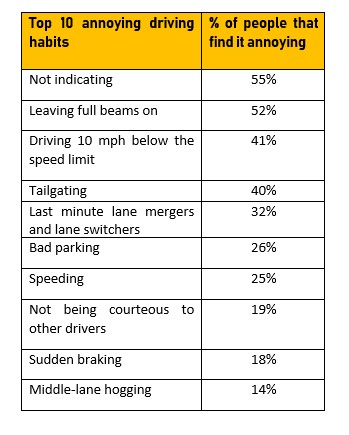
In a survey compiled by Click4Reg, drivers outlined the top 10 things that regularly irritate them on the road.


Not indicating was voted as the worst driving habit by 55% of respondents.


More than half (52%) also felt that ‘leaving full beams on’ was annoying, placing it second. The study shows that women find this habit more annoying than men (55% of women stated it annoyed them, compared to only 49% of men).


Driving 10 mph below the speed limit seems to infuriate many UK drivers, with 39% finding it frustrating.


Of those that voted in the survey, 87% also admitted doing at least one of the annoying habits.


Looking at the difference between genders, 39% of females stated that their worst driving habit was bad parking while nearly half of men (43%) admitting their worst habit was speeding.


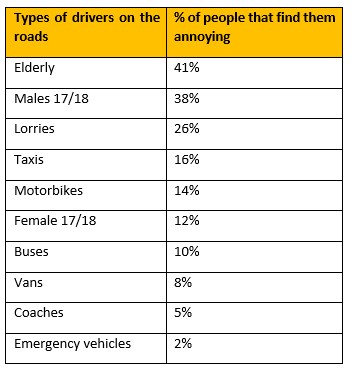
The study also asked its participants which drivers they found most annoying on the roads. Elderly drivers were picked as the most irritating, despite young drivers being much more likely to cause a crash.


Young male drivers were rated the second most annoying and lorry drivers appeared in third, with 26% finding them irritating.


By Graham Hill with thanks to Fleet News and Click4Reg.

Share My Blogs With Others: These icons link to social bookmarking sites where readers can share and discover new web pages.
  • MisterWong
  • Y!GG
  • Webnews
  • Digg
  • del.icio.us
  • StumbleUpon
  • Reddit
  • Alltagz
  • Ask
  • Bloglines
  • Facebook
  • YahooMyWeb
  • Google Bookmarks
  • LinkedIn
  • MySpace
  • TwitThis
  • Squidoo
  • MyShare
  • YahooBuzz
  • De.lirio.us
  • Wikio UK
  • Print
  • Socializer
  • blogmarks

RAC Patrols Called Out To A Pothole Breakdown Every Hour

Friday, 17. January 2020

The RAC saw a 20% upturn in pothole-related breakdowns in the last quarter of 2019, compared to the same period the year before.


It attended more than 2,000 breakdowns in the three months to the end of 2019 believed to be as a result of potholes – 300 more than during the same period in 2018.


The breakdown data, released to coincide with National Pothole Day, also showed that of all the breakdowns experienced by RAC members in 2019, just short of 9,200 were for pothole-related faults such as distorted wheels, broken suspensions springs and damaged shock absorbers.


While this was down from 13,000 in 2018, a year which saw a dramatic increase in potholes following the so-called ‘Beast from the East’, it still represented 1.1% of all breakdowns attended.


Between October and December 2019, 0.9% of all breakdowns were for pothole-related faults, up from 0.8% in the previous three months (July to September 2019) and up from 0.8% in the fourth quarter of 2018.


RAC head of roads policy Nicholas Lyes said: “We might so far be experiencing a milder but wetter winter than in the last couple of years, but our figures clearly show the problem of potholes has not gone away.


“Our patrols are still attending on average around one pothole-related breakdown every hour of the day.”


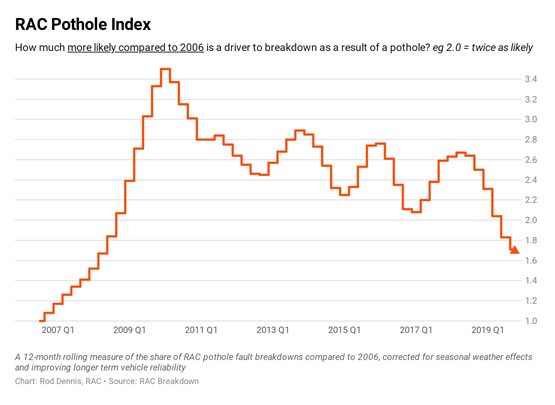
The RAC’s Pothole Index, which is an accurate long-term indicator of the health of the UK’s roads, suggests the widespread problem of potholes and poor-quality roads remains as the Index currently stands at 1.7, down from 1.8 in the third quarter of 2019.


This means drivers are 1.7 times more likely to break down as a result of pothole-related damage than they were back in 2006 when the RAC first started collecting data.


Lyes continued: “We anticipate the Government will pledge further funds to help cash-strapped councils mend potholes in the March Budget, but such pledges are only chipping away at the problem, and they’re unfortunately not addressing the root cause of why so much of the UK is still characterised by crumbling road surfaces.


“What we need is for central Government to think differently about how councils are funded to maintain the roads under their control.


“Short-term commitments of cash, while welcome, are not enough on their own – councils need the security of long-term funding so they can plan proper preventative road maintenance.”


Lyes believes a solution to the UK’s long-term pothole problem is possible. “From this year, the money raised from vehicle excise duty in England will be ring-fenced to help fund motorways and major A-roads over successive five-year periods,” he said. “But as yet, there is no similar model for local roads where the vast majority of drivers begin and end their journeys.


“We believe this could easily be changed by ring-fencing 2p a litre from existing fuel duty revenue to generate £4.7bn of additional funding over five years.


“Pothole-free roads shouldn’t be a ‘nice to have’ in 2020, drivers should surely be able to expect the vast majority of roads they drive on to be of a good standard, especially given they pay around £40bn in motoring-related tax every year.”


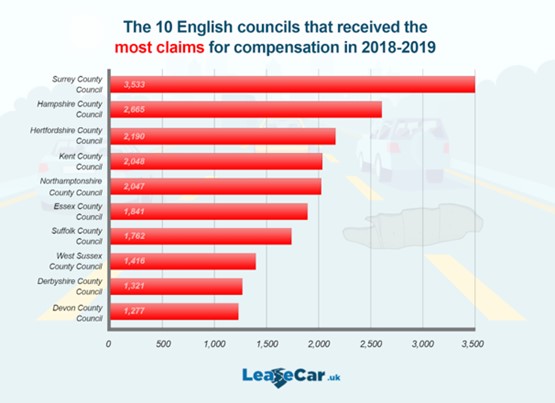
Researchers from car leasing giants LeaseCar.uk have revealed the English councils that received the highest number of compensation requests from vehicle owners due to pothole damage over 2018-2019.


They have also revealed the amounts paid out to motorists, with Surrey topping both lists.


A total of 37,578 relevant claims were made across England during the period in question, with poorly maintained roads meaning councils compensated motorists to the tune of £3.5 million.


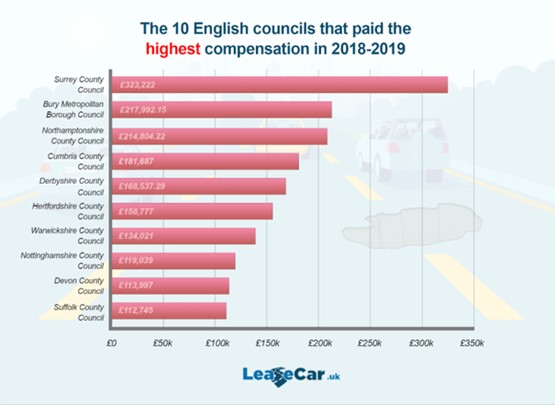
Surrey County Council received by far the most claims for pothole damage – 3,533 – and paid out the most in compensation – £323,222.


Hampshire (2,665), Hertfordshire, Kent and Northamptonshire County Councils also faced over 2,000 claims each throughout 2018-2019, with counties such as Essex (1,841) and West Sussex among those comfortably topping 1,000.


Other local authorities paying out substantial amounts of compensation include Bury Metropolitan Borough (£217,992.15) in Greater Manchester.


Cumbria, Derbyshire, Nottinghamshire, Northamptonshire (£214,804.22), Warwickshire, Suffolk and Devon also paid out six figure sums.


The only councils that didn’t have to use a single penny of taxpayers’ money to compensate motorists were the Greater London Boroughs of Islington and Sutton.


Rotherham Metropolitan Borough Council, Sefton Borough Council on Merseyside and St Helens Council were among others to keep compensation for pothole damage to a minimum.


They paid out just £353, £582.60 and £594 respectively, with the local authorities in Harrow, Hounslow, Redbridge and Waltham Forest also received bills of less than £1,000.


Only two claims were issued, meanwhile, against Richmond upon Thames Borough Council – 21 less than any other area in England.


A spokesperson for LeaseCar.uk said: “Taking greater steps to repair and prevent potholes would improve safety for road users and be popular among the voters across the country that councillors are accountable to.


“It could also ultimately reduce councils’ costs by bringing down the number of successful compensation claims by long suffering vehicle owners.


“We’d advise any driver who drives over a significant pothole, or is worried their vehicle may have been damaged, to urgently check their tyres and suspension.”


The data was obtained by Freedom of Information request and covers the period January 1 2018 to October 17 2019.


The full breakdown of English councils and their claims for compensation is available here.


To report a pothole, or to find out if you suffer from damage from one and wonder if you can claim for compensation, visit the RAC’s pothole online guide.


By Graham Hill with thanks to Fleet News

Share My Blogs With Others: These icons link to social bookmarking sites where readers can share and discover new web pages.
  • MisterWong
  • Y!GG
  • Webnews
  • Digg
  • del.icio.us
  • StumbleUpon
  • Reddit
  • Alltagz
  • Ask
  • Bloglines
  • Facebook
  • YahooMyWeb
  • Google Bookmarks
  • LinkedIn
  • MySpace
  • TwitThis
  • Squidoo
  • MyShare
  • YahooBuzz
  • De.lirio.us
  • Wikio UK
  • Print
  • Socializer
  • blogmarks

Car Parking Firms Forced To Relax Rules On Fines

Thursday, 9. January 2020

The last thing you want to do is have to key in your car registration  number when you are nipping down the shops.


What is worse is when you key in the registration and get a character or number wrong resulting in a fine for not having paid the fee. You then have a fight on your hands but that is about to change.


Car park operators have been told by the British Parking Association not to penalise motorists who make a mistake when typing vehicle details.


It has published a revised code of practice for parking on private land, which includes guidance on grace periods, self-ticketing as well as motorist keying errors.


The enhancements, it says, will ensure Approved Operator Scheme (AOS) members are delivering a high standard of service for motorists.


A minor keying in error is categorised as one letter or number incorrect or letters and numbers in the wrong order.


A major keying in error is one that has multiple number and letter keying errors, the first three digits only have been recorded or a completely incorrect registration number is used.


Steve Clark, BPA head of business operations, said: “Following consultation with key stakeholders, including consumer groups and Government, we are delighted to release the latest version of our leading AOS Code of Practice.


“We recognise that genuine mistakes can occur, which may result in a parking charge being issued even when a motorist can demonstrate they paid for their parking. In recognition of this we have further clarified the situation for all parties.”


He added: “Motorists will still need to appeal, but we expect our members to deal with them appropriately at the first appeal stage.”


The BPA continues to work closely with Government on The Parking (Code of Practice) Act. The Act, it says, supports its call for a standard setting body, a single code of practice, and a single independent appeals service.


John Gallagher, lead adjudicator at Parking on Private Land Appeals (POPLA), welcomed the publication of the revised code.


He said: “The revised code will bring greater clarity for motorists and parking operators alike on issues such as simple keying errors and grace periods.


“The introduction of a section on keying errors, requiring parking operators to cancel Parking Charge Notices in certain circumstances and reduce the amount to only administration costs in others, is particularly welcome.


“This addition to the code means that, for the first time, POPLA will be able to make decisions on keying errors without referral back to the operator.


“We would like to thank the BPA for listening to our feedback on this and other issues – and involving us in ongoing discussions on the best way to ensure a fair system that protects motorists.” By Graham Hill thanks to Fleet News

Share My Blogs With Others: These icons link to social bookmarking sites where readers can share and discover new web pages.
  • MisterWong
  • Y!GG
  • Webnews
  • Digg
  • del.icio.us
  • StumbleUpon
  • Reddit
  • Alltagz
  • Ask
  • Bloglines
  • Facebook
  • YahooMyWeb
  • Google Bookmarks
  • LinkedIn
  • MySpace
  • TwitThis
  • Squidoo
  • MyShare
  • YahooBuzz
  • De.lirio.us
  • Wikio UK
  • Print
  • Socializer
  • blogmarks

We Are Moving Closer To Green Number Plates

Thursday, 9. January 2020

A consultation was launched in October 2019 into the merits of issuing zero emission cars with green number plates. The idea was to be able to identify the greenest of vehicles so that local authorities could, as an incentive, offer drivers cheaper or free parking, possible use of bus lanes etc.


The plates may be all green, have a green verticle bar down one edge or have a large green dot on one side of the plate. Simple plate recognition could identify the cars. Now where did I put my pot of green reflective paint? And that could be the problem. Drivers either modifying their number plates to appear like a ‘green’ number plate or buy a set of dodgy plates made up as though the car is zero-emission.


If the Government gets it right the new plates could also capture snob appeal making drivers of cars with green number plates ‘Holier than though’ to impress the neighbours and work colleagues.


A big boost to the sale of zero-emission cars will be lower lease rates which a couple of manufacturers and leasing companies have already addressed. So far in 2020 we have seen the VW eGolf at its lowest ever rate as well as the Nissan Leaf. Contact GHA Finance for the latest deals and offers.


A personal view from Graham Hill:


As part of this study, the Government is proposing to invest £1.5 billion into the drive towards total zero-emission cars. This includes home chargers built into every new house and increasing the number of charge points.


Now I’m not being funny but I don’t have a tank and pump installed at home to top up my petrol car. Why, because I can pop into my local petrol station and top up in a matter of minutes. The average time is 8-12 minutes. The latest BP 150kW Ultra Fast Chargers take, according to BP and independent checkers around 15 – 20 minutes to provide a complete charge. 10 minutes should provide about 100 miles of charge.


So why are we hell-bent on creating a national network of  home, street and car park chargers when all we should be doing is investing in even faster chargers and batteries capable of withstanding the fast charging. Inevitably there will be many who will charge at home or in car parks as the cost of charging will be cheaper so even if cars are a little longer at charge points it won’t cause congestion as fewer cars will use them as many will be charging at home.


My idea would be a set of charge pads that drivers drive over. The number recognition system tells the charge point whether you have an account or not and a screen entry on the dashboard allows you to select the charge and cost. If you don’t have an account you enter card details into the charge pod.


You then sit in the car for say 10-15 minutes whilst the car is charged. A screen drops down in front of you with advertising on it. The charge to the advertisers could subsidise the cost of electricity. Doesn’t sound like rocket science to me! By Graham Hill

Share My Blogs With Others: These icons link to social bookmarking sites where readers can share and discover new web pages.
  • MisterWong
  • Y!GG
  • Webnews
  • Digg
  • del.icio.us
  • StumbleUpon
  • Reddit
  • Alltagz
  • Ask
  • Bloglines
  • Facebook
  • YahooMyWeb
  • Google Bookmarks
  • LinkedIn
  • MySpace
  • TwitThis
  • Squidoo
  • MyShare
  • YahooBuzz
  • De.lirio.us
  • Wikio UK
  • Print
  • Socializer
  • blogmarks

We Need Honesty & Clear Direction Over Diesel From The Government

Thursday, 2. January 2020

Only one in 10 new car sales could be diesel in as little as five years, says a leading academic.


Currently, one-in-four of new cars sold is powered by the fuel, a dramatic decline from the parity with petrol it enjoyed just a few years ago.


Its popularity is also on the wane in the company car market, where it has traditionally dominated thanks to its tax-friendly CO2 performance.


New figures show that the proportion of diesel cars on the FN50 fleet – the UK’s top 50 leasing companies by risk fleet size – fell from almost two-thirds (63.4%) to close to half (50.5%) over the past 12 months.


In terms of vehicles they had ordered in the past year, the flight from diesel was still more pronounced. Almost half of the cars ordered in 2019 were petrol (47.6%), while only two-fifths (38.8%) were diesel.


David Bailey, Professor of Business Economics at the Birmingham Business School, said: “There seems to be no end to the decline in diesels.”


Overall, diesel new car sales are down by more than a fifth in the past year. Some 515,000 units have been sold year-to-date, compared with 650,000 during the previous 12 months, data from the UK automotive trade body, the Society of Motor Manufacturers and Traders (SMMT), shows.


Forecasters say that, with the sharp falls seen in the sale of new diesel cars since 2017, it could lead to an undersupply of used vehicles in 2020 and 2021, which would help sustain residual values. However, it’s unclear whether the decline in new diesel car sales will be mirrored in the used car market. The most recent figures from the SMMT show that demand for used diesels grew by 1.4% in the third quarter, with some 858,442 changing hands.


“A big shift away from diesel is still taking place,” said Bailey. “In late 2015, diesel accounted for more than 50% of the market, by March last year it was down to 32% and it has fallen further since then.”


The UK is not alone in turning its back on the fuel; its decline is being seen across Europe. In the key market of Germany, diesel’s share has fallen below 30% from having accounted for half the market and to a similar level in France, where three-quarters of new car sales were once diesel.


Bailey said: “We are seeing this continuing decline and, while I originally thought the market share for diesel by 2025 would be down to 15%, I now think that’s quite optimistic – it may be as low as 10%.”


Despite its popularity in Europe, diesel has not enjoyed similar market penetration in other countries. “It’s negligible in North America, it’s only 4% at best in China and virtually insignificant elsewhere,” he said.


“If you go back to the turn of the century, diesel as a share of the market in Europe was only 10-15%. We then gave (the fuel) loads of tax breaks, because we thought it was good for the environment.”


Dieselgate followed however, and concerns over the fuel’s impact on air quality has put its market share on a downward trajectory.


Bailey told delegates at a recent Vehicle Remarketing Association (VRA) seminar the trouble is “people are completely freaked out over diesels”.


He said: “They are concerned about falling resale values, they are worried about tighter regulations in cities, higher taxes and its impact on the environment.”


He says Government policy has not helped either, labelling it a “complete shambles”.


“One part of Government has been saying ‘clean diesels are good’, while another part whacks a load of tax on them.”


Government has, however, introduced tax breaks for diesel company cars, which meet strict emissions limits defined by the RDE2 standard.


Company car drivers are exempt from the 4% benefit-in-kind (BIK) diesel surcharge, while fleets benefit from not having to pay the higher first-year rate of VED on new diesel cars.


The NOx limit for the RDE2 standard, which is measured on the road, is up to 1.43 times the Euro 6 lab limit of 80mg/km for diesel and 60mg/km for petrol. Cars achieving this limit are labelled Euro 6d.


Cars achieving RDE1, which allows for a margin of error two times the actual limit, are classified as Euro 6d-temp.


RDE2 will apply to all new registrations from January 1, 2021, before the margin for error – the conformity factor – is removed by 2023.


Peter Golding, managing director at FleetCheck, believes that 2020 could turn out to be a make or break year for diesel, with the success of Euro 6d cars key. However, he acknowledges the outlook is not promising when Bristol’s proposed diesel city centre car ban will not apply to older petrol vehicles, with potentially worse emissions than the latest RDE2 diesels.


“RDE2, effectively, puts diesel on a roughly equal footing with petrol from an emissions point of view,” he said. “The question is whether everyone from legislators to the general public are willing or able to make that distinction.”  By Graham Hill Thanks To Fleet News.

Share My Blogs With Others: These icons link to social bookmarking sites where readers can share and discover new web pages.
  • MisterWong
  • Y!GG
  • Webnews
  • Digg
  • del.icio.us
  • StumbleUpon
  • Reddit
  • Alltagz
  • Ask
  • Bloglines
  • Facebook
  • YahooMyWeb
  • Google Bookmarks
  • LinkedIn
  • MySpace
  • TwitThis
  • Squidoo
  • MyShare
  • YahooBuzz
  • De.lirio.us
  • Wikio UK
  • Print
  • Socializer
  • blogmarks

Stolen Prestige Cars Sold Unbelievably Cheaply.

Thursday, 2. January 2020

Car thieves are stealing some of the most desirable cars and selling them on the black market for as little as £1,000, according to vehicle protection and management technology provider AX.


The most sought-after vehicles – usually those with a higher street value – include models from prestige brands such as Audi, BMW and Mercedes.


Despite costing from between £18,000-£100,000 to buy new, the vehicles are stolen and quickly sold on for a fraction of their retail or used value – sometimes for just £1,000.


The investigation by AX further exposes the activities of car theft gangs as Home Office figures show the number of vehicles stolen in Britain has almost doubled in the last five years.


According to an AX source, criminals have put a black-market value of just £1,000 on an Audi A1, while a Range Rover, which costs upwards of £80,000 when new, will go for £1,500-2,000. Once the theft has occurred, the vehicles are typically sold rapidly to a known network which then exports or dismantles them for parts.


The BMW 3 Series, a popular model for fleets, was given a  black market value of just £1,500-£1,800.


Director of Investigative Services at AX Neil Thomas said: “The list is quite shocking, despite my 30 years working in the police force. We know how the criminals operate but, with the UK theft figures in mind, it’s a sharp reminder of the problem car owners and the industry faces.


“Rather than the cars that are stolen most in the UK, this list represents the criminals’ wish list of preferred targets. A typical, current Ford Fiesta, for example, would change hands for little more than £200.


“Business and private owners alike are affected by the increase in thefts, so it’s paramount to take precautions to avoid being targeted, or ensure vehicles have robust covert technology so that they can be recovered. Most tracking devices are simply removed after being stolen.”


Last month, AX revealed that criminals are using WhatsApp groups to plan and execute car thefts as the UK vehicle crime wave continues, while further research also indicates the growing use of messaging application Telegram for organised vehicle theft.


In 2017-18, nearly 112,000 cars were taken illegally, up from 75,308 in the 2013-14 financial year.  By Graham Hill Thanks To Fleet News

Share My Blogs With Others: These icons link to social bookmarking sites where readers can share and discover new web pages.
  • MisterWong
  • Y!GG
  • Webnews
  • Digg
  • del.icio.us
  • StumbleUpon
  • Reddit
  • Alltagz
  • Ask
  • Bloglines
  • Facebook
  • YahooMyWeb
  • Google Bookmarks
  • LinkedIn
  • MySpace
  • TwitThis
  • Squidoo
  • MyShare
  • YahooBuzz
  • De.lirio.us
  • Wikio UK
  • Print
  • Socializer
  • blogmarks