All You Need To Know About Speed Cameras

Sunday, 21. March 2021

Following on from the last post the latest cameras are not the only one’s you should be wary of as speed cameras become more important as fewer police are seen on our roads catching speedsters.

In this report, prepared last year, there is everything you need to know about UK speed cameras, the types, how they work and what to look out for.

Speed cameras are unavoidably part of the UK motoring map, whether you think they’re a good thing or not. Those that use them would prefer they were known as safety cameras, as they’re designed to make UK roads safer, but whatever you want to call them, recent fake news reports about cameras on motorways like the M1 and M25 being set so they snap more motorists breaking the speed limit, show that they can still be misunderstood.

This guide helps you to know what to look out for where UK speed cameras are concerned. With police forces battling reduced funding, especially for road policing, speed cameras play a vital role in keeping a watchful eye on UK roads. Combined with local safety camera partnerships, they are a good visual deterrent and a reminder to check your speed when driving.

Some motorists see them as a revenue earner, though, as they can only catch speeders and are unable to spot unlicensed drivers, uninsured cars, drink and drug-drivers or general bad driving like road traffic officers are able to.

History of the speed camera

The first speed camera appeared in the UK in 1991 on the M40 motorway in West London. The cameras used rolls of film, which had to be developed and processed, and this also meant that there was a limit on how many speeders they could catch – it’s thought that the first camera used up its 400-exposure roll in 40 minutes after it was first switched on.

Over the years, new tech has been introduced, including forward-facing cameras and digital technology – so there’s no more need to change rolls of film, and means live cameras can be operated 24/7, uploading images directly to a central control room. Average speed cameras have also been introduced to monitor vehicle speed over longer distances, rather than just in one location, while traffic light and wrong-turn cameras have also been introduced.

We’ve also seen the introduction of cameras that no longer need a flash to snap speeding vehicles at night, while the latest mobile cameras operate over far longer distances than before. In this instance, if you’re speeding, the mobile camera could well have spotted you long before you’ve spotted it.

UK speed camera types explained

Here’s our guide to the different types of camera used on UK roads, and later we tell you what to expect if you think you’ve been caught speeding. The most common cameras in the UK are Gatso and Truvelo speed cameras, but there are more than a dozen different types of speed camera in use on UK roads in total. So without further ado, here’s what you should be looking for.

Gatso speed cameras
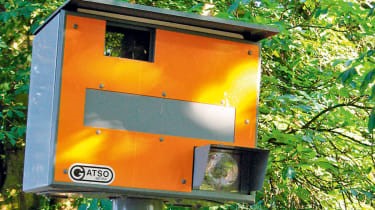
Gatso static speed camera

The Gatso was the first type of speed camera seen in the UK, and it’s still the most common type you’ll find. First introduced in 1991, the Gatso – short for Gatsometer, the name of the Dutch company that makes them – is a rear-facing camera.

That means it faces up the road and takes a picture of the rear of a speeding vehicle, so it can catch motorcycles as well as cars, vans and trucks.

A Gatso camera is easy to spot, as speed cameras must be painted yellow by law (in Scotland they have yellow and red diagonal stripes), although they can be obscured by road signs, street furniture and poorly maintained hedgerows.

Gatsos are usually mounted at the side of the road on a pole, although they can also be used in mobile units or on overhead gantries, such as you’ll find on the motorway.

Gatsos use radar to measure a vehicle’s speed, but the law says that there needs to be secondary proof of speeding. This is why all Gatso locations have dashed lines painted on the road in front of them.

These dashes are spaced evenly and are used to measure distance over time, so when a Gatso is activated it takes two pictures a fraction of a second apart, which can then be checked to see if an offence has been committed. The camera features a flash, and this goes off with each photo that’s taken.

On single carriageway roads, two sets of dashed lines are usually painted at a Gatso location. That means vehicles using either side of the road can be measured for speeding, but only in the direction that the Gatso is pointing. That means a camera site can only catch vehicles travelling away from it – if you are speeding towards one and it flashes, a ticket can’t be issued. Gatsos are also reliant on the dashed lines in the road – if the lines aren’t present, then the photos alone cannot be used to prosecute speeders.

While the first Gatso cameras used photographic film to record speeders, a new generation of digital camera arrived on 2007. These use a hard drive to store images and can be run 24/7 with a direct link to a control centre where the images are stored.

Truvelo speed cameras

Truvelo digital static speed camera

The other common type of speed camera in the UK is the Truvelo, which is named after the South African company that makes it. While Truvelo cameras look similar to a Gatso because they are painted yellow and mounted on a pole, the chief difference between a Truvelo and a Gatso is that most Truvelo sites are forward facing.

As with a Gatso, a Truvelo camera uses a flash to get a clear image of a speeding vehicle’s number plate, but it also has a special filter on the flash that stops it from dazzling drivers. While this means that motorcycles (which lack front number plates) are harder to identify when speeding, the Truvelo can be used to identify the driver of a speeding vehicle.

The Truvelo only takes one picture, because the speeding offence is registered by sensors in the road which activate the camera. However, as with a Gatso, the photographic evidence needs backup, so small white squares are painted on the road where the sensors are to act as secondary evidence that a vehicle is speeding.

In recent years, the Truvelo has evolved into the Truvelo D-Cam. This is a digital version of the Truvelo that can be mounted forward or rear facing, can also be used at traffic lights, and can even be set up to watch up to 3 lanes at a time.

The D-Cam comes in a distinctive housing, while some have a flash unit separate from the camera itself – which again makes no visible light.

HADCES speed cameras
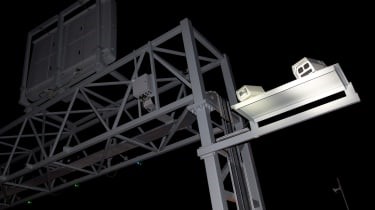
Smart motorway speed camera

HADECS 3 stands for Highways Agency Digital Enforcement Camera System 3, which is the name given to the speed camera system that is being used on smart motorways across the country.

Hadecs units come in two small housings that are mounted on the side of motorway gantries. Thanks to their limited use of yellow to give away their location, and the fact they are about half the size of a Gatso or Truvelo camera unit, some people have called them stealth speed cameras, as they can be difficult to spot when travelling at 70mph.

Like other speed cameras, there are lines painted on the road that are used as secondary proof of speeding. And like a Gatso, Hadecs is a rear-facing radar camera, and it flashes when it picks up a vehicle travelling at more than the speed limit.
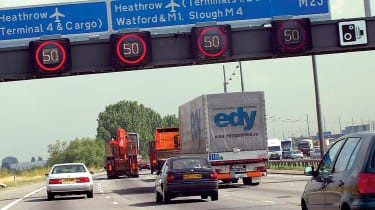
Speed cameras

The innovation that allows Hadecs to be used on a smart motorway is its ability to adjust its detection speed according to the variable speed limit that’s posted. It does this by receiving information from sensors further along the carriageway, so when you see a lower limit posted on a smart motorway, the Hades cameras ahead can catch you for breaking it.

As well as speeding, Hadecs cameras can be set up to monitor up to five lanes, and they can detect vehicles that are using closed motorway lanes. As they are radar-based, they are able to work in all weather conditions, too.

SPECS speed cameras
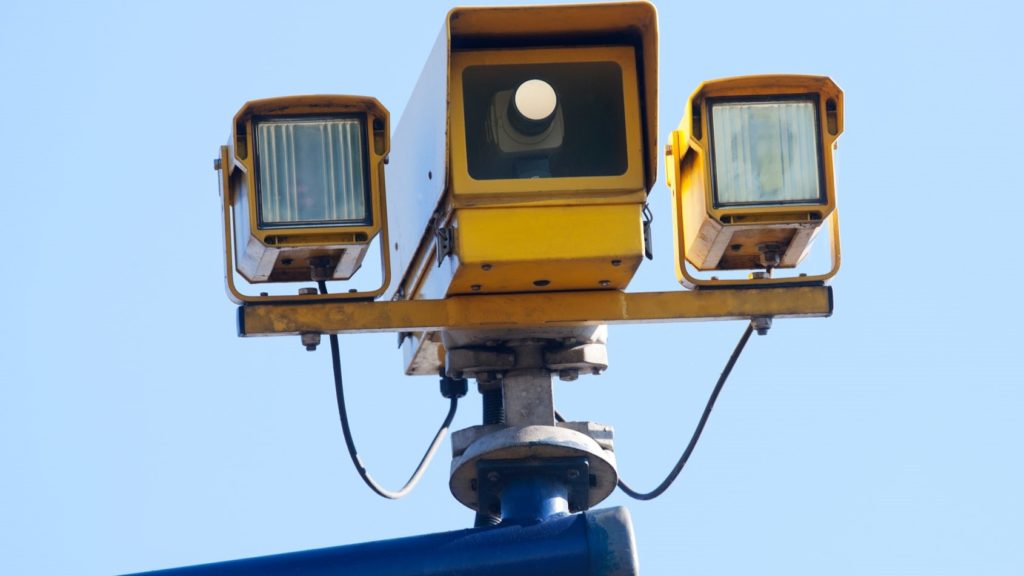
The SPECS camera system works differently because it measures vehicle speed over a far greater distance than a Gatso or Truvelo camera. You’ll see two or more sets of cameras to monitor vehicle speed for an extended distance, and this can be for as little as 200 yards or up to 99 miles – as the SPECS cameras on the A9 in Scotland do. SPECS cameras are often referred to as average speed cameras and are popular for use in roadworks where a lower speed limit than usual needs to be enforced.

SPECS uses Automatic Number Plate Reading (ANPR) tech to register vehicles as they pass. The first camera logs the vehicle with a time and date stamp. Once the vehicle has passed the second camera, the time stamps on the two images are compared, and if the time taken to cover the distance means the average speed is higher than the posted limit, then a ticket is issued.

You will usually find SPECS camera systems on motorways, especially in roadworks. And while some people think that weaving between lanes can help you pass them undetected, the truth is that the SPECS system can monitor multiple lanes. It’s also no use slowing for the cameras and then speeding between them, because the system measures your average speed between the two locations, not just how fast you’re going as you pass either camera.

Mobile speed camera vans
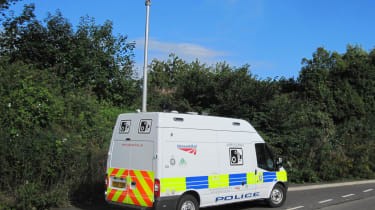
https://media.autoexpress.co.uk/image/private/s--cOPPpVNo--/f_auto,t_content-image-mobile@1/v1562247469/autoexpress/2019/03/mobile_speed_camera_van.jpg

As well as these fixed speed cameras, many regions use mobile cameras to provide temporary coverage in areas where speeding is known to occur. Mobile units are usually located in vans that are marked as a safety camera vehicle with a bright livery, and they feature opening windows or panels to point the cameras through.

You will usually find them parked at the side of the road, in laybys (although not where parking restrictions apply) and also on bridges over roads.

The kind of cameras these mobile units use include mini Gatso cameras that use radar technology but there are also handheld radar or laser gun cameras. A laser gun uses a narrow laser beam that is reflected off a vehicle to measure its speed. These devices are quick and effective, being able to register a vehicle’s speed in as little as half a second and up to a distance of a mile away.

A radar gun works similarly to a laser gun. It has a wider beam and only works up to around 300 yards, while it will only come back with a reading after around 3 seconds, but it’s still an accurate way of registering a car’s speed.

Mobile camera vans can be set up in any direction to catch speeders, and can just as easily be set up to catch speeders approaching the camera site as going away from the site. As with fixed camera locations, a mobile camera site must have road signs indicating its presence, but apart from that, mobile cameras can be set up at any time.

In terms of location, mobile units are usually found in places notorious for accidents or speeding in the past, and are not normally pitched up in random places. Some local speed camera operators have been known to issue information on radio and social media to inform road users of where mobile camera units are operating on particular days.

Other speed cameras

Gatsos, Truvelos, SPECs and Hadecs 3 are the most common types of speed camera on UK roads, while other cameras that are available do a similar job. These are in addition to cameras which are used for traffic monitoring, catching vehicles that jump traffic lights (which incidentally aren’t required by law to be painted yellow) and cameras used by government agencies to check road tax and other ANPR-based activities.

Whichever way you look at it, the best way to ensure you’re not caught speeding is to remain aware of the speed limit and stick to it.

The big Speed camera questions answered

How do I know if a speed camera caught me?

If you have passed a speed camera that has flashed, the only way you will know for certain that you have been caught is when the registered keeper of the vehicle receives a Note of Intended Prosecution (NIP). This will arrive within 14 days of the offence taking place and will explain what happens next. This 14-day rule is in place so that companies, such as vehicle lease firms and car hire firms, can determine who was driving the vehicle at the time of the offence.

If you are the one that was caught speeding, then you will face a minimum fine of £100 and three points on your licence. If your driving licence is clean, then you may be offered the option of taking a speed awareness course instead of the penalty points.
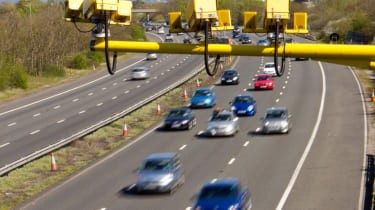
Speed cameras variable speed

As of 2017, the maximum fine for a speeding offence is up to £2,500 on the motorway. The amount you pay and the number of points you could face will depend on how much you were exceeding the speed limit by, as well as your level of income.

Do all speed cameras flash?

Most speed cameras flash when they capture an image, but you might not see the flash of a Truvelo forward-facing camera. That’s because forward-facing Truvelo cameras have a special filter over the flash to prevent dazzling oncoming drivers. If a camera is operating in good light conditions, the flash may not necessarily go off, either.

How do mobile speed cameras work?

Mobile speed camera units must be parked legally, either at the side of the road, in a layby or on a bridge, and operators must make motorists aware of their presence with the use of speed camera warning signs. That means they can operate in areas where the signs are already fixed, or they need to put up temporary signs nearby.

A speed camera van usually has openings at the rear or the side of the van for the cameras to have a clear line of sight of the road they are checking. Depending on the camera being used, the speed camera van can detect speeding vehicles up to two miles away on a clear day, especially with the latest camera technology being used.

The camera is operated either by a police officer or by a certified camera operator associated with a local speed camera partnership.

How can I avoid a speeding fine?

Of course, the easiest way of avoiding points and a fine is to check your speed at all times and keep within the speed limit. But with so much street furniture and so many distractions bombarding the average motorist, it’s not too hard to get caught out by a change in speed limit.

If you want added security, then a speed camera locator is the best piece of kit to use. We tested a batch of speed camera locators in 2018, with products from Road Angel and Snooper performing well, while apps from TomTom and Sygic were also well received.

Speed camera detectors use GPS location technology to warn you of fixed camera locations. In addition, the best units also feature laser and radar detecting technology to warn you of mobile speed camera sites, as well as those fixed locations that aren’t logged on to the device’s database. The best speed camera locators can show you your speed, as well as calculating your average speed within a SPECS average speed camera location.  By Graham Hill with a big thanks to Auto Express

Share My Blogs With Others: These icons link to social bookmarking sites where readers can share and discover new web pages.
  • MisterWong
  • Y!GG
  • Webnews
  • Digg
  • del.icio.us
  • StumbleUpon
  • Reddit
  • Alltagz
  • Ask
  • Bloglines
  • Facebook
  • YahooMyWeb
  • Google Bookmarks
  • LinkedIn
  • MySpace
  • TwitThis
  • Squidoo
  • MyShare
  • YahooBuzz
  • De.lirio.us
  • Wikio UK
  • Print
  • Socializer
  • blogmarks

New Hand Held Speed Cameras See You Long Before You See Them

Sunday, 21. March 2021

The latest TruCam ll speed cameras can read a number plate from 1.5km away but UK police forces who are currently being equipped with them are calibrating theirs to 750 metres.

Constabularies across the country have confirmed trials of the TruCam II Speed Enforcement Laser, each of which costs around £10,000. The devices work both in the daytime and in the dark thanks to a new night-mode feature.

The TruCam can automatically focus on a car approaching from half a mile away, with vehicle data uploaded to a database, after which a penalty charge notice is sent to the registered keeper. This means police don’t need to pursue and pull over speeding drivers.

Using an integrated laser, the TruCam measures the time and distance between vehicles. It contains a digital camera that can collect and store HD video evidence of a speeding offence. The device itself is actually capable of reading number plates from up to 1.5km away, but UK police are calibrating theirs to 750 metres, in line with tolerances set by the UK Government.

Various police forces – including Gloucstershire, Northumbria and Warwickshire constabularies – have begun using the TruCam II. Macclesfield South Police – part of Cheshire Police – reported on Twitter that it had deployed the device multiple times without catching anyone, but on a recent outing someone was caught in excess of 35mph in a 30mph zone.

The TruCam II was approved for use by UK police forces back in June, with the rollout now underway. The previous generation TruCam – which could only be used during daylight hours – has been used by some forces in the country for more than six years.  By Graham Hill thanks to Auto Express

Share My Blogs With Others: These icons link to social bookmarking sites where readers can share and discover new web pages.
  • MisterWong
  • Y!GG
  • Webnews
  • Digg
  • del.icio.us
  • StumbleUpon
  • Reddit
  • Alltagz
  • Ask
  • Bloglines
  • Facebook
  • YahooMyWeb
  • Google Bookmarks
  • LinkedIn
  • MySpace
  • TwitThis
  • Squidoo
  • MyShare
  • YahooBuzz
  • De.lirio.us
  • Wikio UK
  • Print
  • Socializer
  • blogmarks

Europeans Caught On Camera Speeding In The UK And Brits Doing The Same In The EU Will No Longer Be Fined Thanks To Brexit

Sunday, 21. March 2021

The UK’s departure from the EU means British drivers snared by speed cameras on roads in Europe will no longer be sent fines. And those Britons, resident in the EU, who return to the UK in foreign registered cars will also avoid fines.

As a member of the EU, Britain had signed up to a directive that allowed member states to share the contact details of those caught by speed cameras.

The directive was introduced because data revealed that a high percentage of speeding offences were committed by foreign drivers who were escaping the financial penalties.

Naturally Britain’s departure from the EU on January 1st meant that for the foreseeable future British holidaymakers and second-home owners driving in EU countries will not be issued fines if they are snared.

The same goes for drivers of EU-registered cars travelling on roads in the UK who are caught speeding or committing other driving offences caught on camera.

Since Britain signed up to the directive and began the data sharing in 2019, hundreds of thousands of British holidaymakers have been fined.

In France alone some 444,378 fines were sent to British drivers in 2019 which according to French driving site Caradisiac was the equivalent of between €30 to €60 million.

With such big sums of money at stake it’s no surprise some EU countries are intent on negotiating bilateral agreements with the UK to ensure contact details are shared in future.

“We will initiate bilateral negotiations with the UK, in order to reach an agreement like we have with Switzerland,” a French Interior Ministry spokesperson told Caradisiac.

But the UK is unlikely to be a in rush to enter into those talks, not least because of the ongoing pandemic that has crippled travel to and from the EU, but also because it just might not be worth it financially.

The UK avoided signing up to the cross-border directive for many years because it believed it just wasn’t profitable to process the fines abroad given the relatively small number of European-based drivers caught speeding in the UK.

But Beware: For certain EU countries like Spain and France where British holidaymakers and second-home owners often travel by car, it’s a different matter.

British drivers who are pulled over by local police in the EU for speeding or other offences will still have to pay their fines, however.

It is also the case that in the UK British police have the right to take a ‘Roadside Deposit’ if the driver doesn’t have a UK address. But with the vast majority of speeders being caught by cameras with so few police on our roads we could lose some substantial fine income.

France’s ministry of interior lamented the fact that Britain was no longer in the EU. In a statement to The Local a spokesperson said: “The purpose of the directive is to put an end to the impunity of motorists who commit offences in a Member State other than that of their residence, to improve road safety throughout the EU and to guarantee the equal treatment between drivers whether or not they are residents of the Member State where the offence was committed.

Through this exchange system, Member States can identify the owners of vehicles with which the infringement has been committed in their territory and send them notifications of infringements.”

Reminder

The 2015 European Directive, nicknamed Cross-Border Directive does not only target drivers caught on camera speeding or running red lights.

It covers six other offences:

  1. failure to wear a seat belt
  2. driving while intoxicated
  3. driving under drugs
  4. the non-wearing of a helmet by two-wheeler drivers
  5. driving on a prohibited lane
  6. mobile phone use while driving

By Graham Hill thanks to The Local

Share My Blogs With Others: These icons link to social bookmarking sites where readers can share and discover new web pages.
  • MisterWong
  • Y!GG
  • Webnews
  • Digg
  • del.icio.us
  • StumbleUpon
  • Reddit
  • Alltagz
  • Ask
  • Bloglines
  • Facebook
  • YahooMyWeb
  • Google Bookmarks
  • LinkedIn
  • MySpace
  • TwitThis
  • Squidoo
  • MyShare
  • YahooBuzz
  • De.lirio.us
  • Wikio UK
  • Print
  • Socializer
  • blogmarks

How To Claim For Pothole Damage As Claims Increase!

Sunday, 21. March 2021

Local councils across England have been handed £500 million to fill millions of potholes over the course of the next financial year.

In the 2020 Budget, the Chancellor announced a £2.5 billion Potholes Fund for the 2020/21 to 2024/25 financial years. The Department for Transport has confirmed that the 2021/22 money has now been allocated. With potholes costing an average of £50 to fill, it’s expected that around 10 million craters on thousands of roads will be repaired.

The South-West received £90,031,000 – more than any other region. The South-East has been allocated £82,693,000, the East of England has been given £68,534,000 and the North-West has received £66,467,000.

The East Midlands, West Midlands and Yorkshire and the Humber have been allocated £57,358,000, £54,486,000 and £51,940,000 respectively. Finally, the North-East has received £28,492,000.

The £500 million allocated for just one year of the Potholes Fund is more than the entire £296 million Pothole Action Fund that covered 2015/16 to 2020/21.

Transport minister Baroness Vere said: “The funding allocated today will help councils ensure roads in their area are kept up to standard, and that the potholes that blight road users can be dealt with promptly.”

Jack Cousens, head of roads policy for the AA, said the UK’s local road network is “in desperate need of repair”.

“Last month, just 15 per cent of our members told us that residential roads were in a good condition,” he added. “However, studies show that residential roads in England get resurfaced on average every 119 years. If your street is lucky enough to be chosen we’d recommend a socially distanced celebration, as it will probably be a once in a lifetime event!”

How To Claim For Pothole Damage

Thinking about a claim for pothole damage compensation? Read our handy pothole claims guide for the key dos and don’ts.

Potholes, and the damage they can cause, is a growing problem for motorists in the UK. Local councils point to years of underinvestment and squeezed resources as reasons for cutting spending on essential pothole repair work, but that doesn’t help when you’re facing a hefty bill for pothole damage to your car. But is there any way of gaining compensation? This is our guide to making pothole claims.

The total damage caused by hitting potholes costs unfortunate UK motorists an incredible £730 million every year, with the average individual pothole repair bill totting up to almost £110 per motorist. Potholes can cause damage to tyres, wheels, the suspension, exhaust and even the bodywork, while drivers of low-slung sporty models with expensive low-profile tyres on big alloy wheels can fare much worse than the average car, too. The number of potholes could also be a factor in the growing popularity of high-riding crossovers and SUVs.

However, according to the Asphalt Industry Alliance it would take councils 14 years just to catch up with all the backlog of pothole repairs needed to UK roads if they carry on fixing them at the current rate. One council has even attempted to skirt the pothole problem by increasing the minimum ‘official depth’ of a pothole from 40mm to 60mm in an attempt to defer essential pothole repairs until the problems worsen.

Making your claim for pothole damage

Given the amount of money raised by government on road tax and fuel tax, it’s perfectly understandable when damage caused by the pothole menace makes motorists want to hold authorities to account.

However while it is possible in some cases to hold a local council (or the Highways Agency when main roads are affected) responsible for car damage caused by unrepaired potholes, it’s not as straightforward as many would like.

Section 58 of the Highways Act 1980

Local authorities typically refuse all claims as a first step, quoting Section 58 of the Highways Act 1980. Section 58 offers a ‘catch all’ defence, and means the council is saying it took all reasonable steps to maintain the road, and that potholes were dealt with in a timely manner.

Unfortunately council officers use Section 58 routinely in rejecting claims, even when they know this isn’t true. They do so on legal advice, as lawyers know most pothole damage claimants will give up at the first hurdle.

From then on, it’s down to you to do the detective work to determine whether the council has indeed carried out its inspections and maintenance to the required standard – which generally means in accordance with the Well-Maintained Highways Code of Practice.

This may be time-consuming and difficult, as you’ll probably need to use Freedom of Information requests to determine whether the council has failed in its statutory obligations. Specialist websites like the warranty industry-funded Potholes.co.uk can offer detailed help and support, but meanwhile here’s what you need to do if you fall foul of a damaging pothole on the road:

Pothole damage – essential steps to make a successful claim

1. Take notes and photographs at the scene

When it’s safe to do so, pull over to make a note of the exact location of the pothole that damaged your car. You should also record its size, depth and shape, and contact details for any witnesses. It may help a later claim if you can take supporting photographs on your mobile phone to record as much of the information as possible. Never take chances with safety at the scene of the incident though, or things could get very much worse when the next car comes around the corner!

2. Repair the damage

If you need immediate roadside repairs then you can’t do much else but follow the advice of your breakdown service or the garage you’ve called out. If repairs can wait, then it’s worthwhile getting several quotes from different repairers so you can show as part of any subsequent claim that you’ve acted to achieve the best price.

3. Report the pothole

Be a good citizen and do your bit to help make sure fellow motorists don’t fall into the same trap by alerting the council (or Highways Agency). There’s an easy way to do that by using the official online pothole reporting service.

4. Submit your claim

Write a calm letter to the local council (or Highways Agency) outlining the incident where damage was caused, the extent of the damage, and that you hold the council liable. They should respond within a couple of weeks, most likely with a Section 58 defence – but you never know, and might be lucky!

5. Decide whether to pursue your claim

Now for the tricky bit. You will have to use your investigative powers to determine whether the council has indeed fulfilled its statutory Section 58 obligations. You are entitled to ask relevant questions about the scheduling and quality of inspections and repairs on the road in question. You must subsequently determine whether you have a realistic case for pursuing your claim.

If so, write again to the council outlining your grounds for argument. It may be that the council agrees to pay up on receipt of your evidence, but if they don’t you are then faced with a choice of court action. A small claims court action is very cheap and easy via the latest web-based system called Money Claim Online, but whether it’s worth pursuing or not will depend on the cost of repairs, the amount of time you can afford, and the level of your moral outrage.  By Graham Hill thanks to Auto Express

Share My Blogs With Others: These icons link to social bookmarking sites where readers can share and discover new web pages.
  • MisterWong
  • Y!GG
  • Webnews
  • Digg
  • del.icio.us
  • StumbleUpon
  • Reddit
  • Alltagz
  • Ask
  • Bloglines
  • Facebook
  • YahooMyWeb
  • Google Bookmarks
  • LinkedIn
  • MySpace
  • TwitThis
  • Squidoo
  • MyShare
  • YahooBuzz
  • De.lirio.us
  • Wikio UK
  • Print
  • Socializer
  • blogmarks

Pandemic Mental Health Issues Claimed To Be Affecting All Drivers Especially Company Vehicle Drivers.

Thursday, 11. March 2021

All drivers and especially fleets need to be aware of the growing impact of the Covid-19 pandemic on mental health and subsequent safety risks to drivers, says FleetCheck.

The warning follows a new poll from the Mail on Sunday, which revealed that 40% of people believed their mental health had become worse during the pandemic.

Peter Golding, managing director at FleetCheck, said: “This is just the latest in a series of polls and pieces of research showing how the last nine months have had a very negative effect on the mental health of many, many people.

“We know that mental health problems of all kinds can have an impact on driver performance on the road. With people saying that feelings of anxiety, stress and depression are particularly apparent, there is a genuine case for fleets to act.”

Golding says employers should be fulfilling their basic requirement of checking that drivers are fit to drive, and mental wellbeing should be part of the assessment.

He said: “It should be taken as a given that anyone who feels that their mental health has deteriorated to a point where they should not be driving should be taken seriously, and employers should also make it clear that such situations will be dealt with sympathetically.

“Probably the starting point for most fleets would be to seek professional human resources and medical guidance in order to ask drivers a few questions regularly in order to flag up any immediate issues that need attention.”

At the Fleet200 Executive Club virtual meeting in November, 2020, fleets discussed how Covid-19 caused a rise in drivers’ mental health issues. They also discussed how it impacted their operations and the changes they have implemented.

In an interview with Fleet News, behavioural sciences researcher at the Transport Research Laboratory (TRL), Rosie Sharp, said driver engagement could be key in improving mental health and wellbeing of drivers.

FleetCheck was examining the introduction of basic mental health tools into its Vehicle Inspection App, which incorporated questions about the driver’s health, as well as daily walkaround safety checks, says Golding.

Golding said: “We modified the app last year to cover coronavirus symptoms and now seems like a good moment to add further questions about mental health. We are taking advice and hope to be able to do this soon.”  By Graham Hill thanks to Fleet News

Share My Blogs With Others: These icons link to social bookmarking sites where readers can share and discover new web pages.
  • MisterWong
  • Y!GG
  • Webnews
  • Digg
  • del.icio.us
  • StumbleUpon
  • Reddit
  • Alltagz
  • Ask
  • Bloglines
  • Facebook
  • YahooMyWeb
  • Google Bookmarks
  • LinkedIn
  • MySpace
  • TwitThis
  • Squidoo
  • MyShare
  • YahooBuzz
  • De.lirio.us
  • Wikio UK
  • Print
  • Socializer
  • blogmarks

Government May Limit The Sale Of Petrol & Diesel Cars Ahead Of 2030 Total Ban

Thursday, 11. March 2021

Sales of internal combustion engine (ICE) petrol and diesel cars could be curtailed ahead of the Government’s planned 2030 ban, when it publishes the finer details of its strategy in the spring.

Since announcing it would end the sale of new petrol and diesel cars and vans in 2030, with a five-year grace period for some hybrids, the Government has yet to provide clarity on how it will be achieved.

Speaking at the Westminster Energy, Environment & Transport Forum policy conference for low emission vehicles in December, Katie Black, joint head of the Office for Low Emission Vehicles (OLEV) at the Department for Transport (DfT), indicated that the Government wants to avoid a situation where car makers are “selling the maximum amount of petrol and diesel cars right up to the 2030 milestone”.

She said: “We do see it as a risk, and we will be looking publicly at ways to mitigate that. What you probably want is a gradual phase out, a gradual shift across the fleet. And we’re looking at how a regulatory regime could support that.”

No further details were given as to how sales might be restricted, but a key part of Government strategy will be to promote and encourage private buyers and fleets to opt for electric vehicles (EVs) as soon as they can.

This includes an investment of £1.3 billion to strengthen the UK’s charging infrastructure and to extend the plug-in car grant.

Dylan Setterfield, head of forecast strategy at Cap HPI, said: “It is hard to see how volume restrictions in ICE cars could work from a practical perspective, given the range of customers, routes to market and complex factors impacting vehicle lead times.

“In any case, the industry is already doing this independent of government. Diesel availability has already declined as manufacturers discontinue diesel in their smaller cars and, given they will be under ever-stricter emissions targets, it is also in their interest to move customers into EVs by removing the competing fuel types.

“The weighty cost of research and development is likely to result in some hard choices now between investment in ICE or EV, with petrol and diesel the likely losers in many cases.”

Black confirmed the Government is planning to publish a delivery plan, setting out the steps that need to be taken to meet the phase out dates.

But, she admitted there were still many factors that needed to be considered, including on-street charging solutions and supporting the used car market.

Green Paper Planned

To ensure the phases are met, and to support interim carbon budgets, the DfT will publish a Green Paper in the coming months on the post-EU regulatory regime for CO2 emissions from new vehicles. This, according to Black, will cover both overall fleet efficiency and delivering the move to 100% zero emission vehicle sales for cars and vans.

There will also be a consultation to define the meaning of “significant zero emission capabilities” in order to outline what vehicles may be sold between 2030 and 2035.

These are likely to be limited to range-extender EVs, which feature a small petrol engine to charge the battery while the vehicle is driven exclusively by its electric motor, or plug-in hybrids.

Nick Molden, founder and CEO of Emissions Analytics, believes regular hybrid vehicles, which have a limited zero-emission range, actually have a lower environmental impact than plug-in hybrids.

With all new cars already exceeding the Government’s air quality targets, introduced as part of the Real Driving Emissions (RDE) test, Molden believes the issue now lies in the poorer CO2 emissions performance of most new cars against the EU’s 95g/km target.

He said electrification is the best way to reduce CO2 emissions, but it has to be deployed “effectively” to make the most of “scarce” battery resources.

“In our strong opinion, full hybrids, for a good period forward, is the sweet spot while the supply chain issues around batteries are sorted out,” Molden stated.

Following a recommendation by the National Infrastructure Commission that the sale of new diesel HGV lorries should be banned by 2040, Black confirmed a consultation will be launched this year on the phase-out of diesel HGVs.

She said: “HGVs are at a much earlier much an earlier stage than cars and vans. We can see what the technological solutions are for those, but, with HGVs, the picture is a lot less clear.

“As we look at the roll-out of charging infrastructure, we really need to make sure that we’re taking into account HGV requirements there and not thinking about cars and vans exclusively.”  By Graham Hill thanks to Fleet News

Share My Blogs With Others: These icons link to social bookmarking sites where readers can share and discover new web pages.
  • MisterWong
  • Y!GG
  • Webnews
  • Digg
  • del.icio.us
  • StumbleUpon
  • Reddit
  • Alltagz
  • Ask
  • Bloglines
  • Facebook
  • YahooMyWeb
  • Google Bookmarks
  • LinkedIn
  • MySpace
  • TwitThis
  • Squidoo
  • MyShare
  • YahooBuzz
  • De.lirio.us
  • Wikio UK
  • Print
  • Socializer
  • blogmarks

IAM Roadsmart Has Revealed The TRUE Cost Of A Drink-Drive Conviction Ahead Of Pubs Re-Opening!

Thursday, 11. March 2021

Motorists caught drink-driving as the post-lockdown rush to the pubs starts, could end up being £70,000 out of pocket when all the personal financial costs of their conviction are taken into account, a road safety charity has warned.

IAM Roadsmart – formerly the Institute of Advanced Motorists – points out that those who are convicted of a drink-driving offence face fines, legal fees, higher car insurance premiums, alternative transport costs and potential loss of earnings.

Research by the organisation suggests fines associated with the conviction could be £5,000, the previous maximum fine – though a conviction now brings a limitless financial penalty. Legal fees following conviction after a not guilty plea come in at an average of £11,000, while increased car insurance premiums typically run to £13,500 over five years, the period for which drivers must tell insurers about a conviction.

During a ban, offenders can also expect to rack up £2,000 in taxi or public transportation bills while they don’t have a car, plus a loss in earnings of £38,500 over 15 months is possible based on the average UK salary, and unemployment following a conviction.

Official Government figures show there were 250 fatal drink-driving accidents in 2017 – the highest number since 2010. This was despite 2017 only seeing 326,000 roadside breath tests, compared with 737,000 in 2010.

Around a fifth of drink-driving convictions and a third of roadside breath tests take place the morning after the night the suspect has allegedly been drinking, between the hours of 7am and 1pm.

December 2018 saw a 16 per cent rise in drink-driving offences compared with the same month the previous year. Typically, around 20 per cent of drink-driving offences for any given year take place in December.

Drink-driving kills, so during the post COVID celebration period don’t be tempted to have a drink before getting behind the wheel – it’s irresponsible and incredibly dangerous.”

Neil Greig, director of policy and research at IAM Roadsmart, said: “Drink-driving wrecks lives and is totally unacceptable in any circumstance. However, some people still think they are safe to drive when they’ve had just a couple of drinks or are using home (lockdown) measures, which can quickly push them over the limit.

“The £70,000 impact of being convicted of drink-driving is very sobering. This should be more than enough – let alone the thought of causing any other suffering for yourself, your family or the other people you put at risk on the road – to stop those drivers who are tempted to have an extra drink and get behind the wheel.”

We are all desperate to get out and socialise with friends and family in pubs and bars but don’t let the celebrations lead to you having a few too many and getting behind the wheel of your car. There have already been too many deaths and even if you don’t have an accident don’t find yourself counting the cost of losing your licence.  By Graham Hill thanks to Auto Express.

Share My Blogs With Others: These icons link to social bookmarking sites where readers can share and discover new web pages.
  • MisterWong
  • Y!GG
  • Webnews
  • Digg
  • del.icio.us
  • StumbleUpon
  • Reddit
  • Alltagz
  • Ask
  • Bloglines
  • Facebook
  • YahooMyWeb
  • Google Bookmarks
  • LinkedIn
  • MySpace
  • TwitThis
  • Squidoo
  • MyShare
  • YahooBuzz
  • De.lirio.us
  • Wikio UK
  • Print
  • Socializer
  • blogmarks

Only 5% Of Car Mechanics Are Qualified To Work On Electric Vehicles

Thursday, 11. March 2021

The vast majority of mechanics are not yet qualified to work on EVs as the 2030 deadline looms, experts are warning.

Only five per cent of mechanics working in dealerships and garages across the UK are qualified to work on electric vehicles, according to a leading industry body.

In response to the Government’s announcement that a ban on the sale of new petrol and diesel cars is to be accelerated from 2040 to 2030, the Institute of the Motor Industry (IMI) has pointed out that 95 per cent of the country’s mechanics have yet to complete the necessary qualifications to safely work on electric vehicles.

This means at present, there are between 13,000 and 20,000 qualified technicians working on 380,000 plug-in vehicles across the UK. The IMI is concerned that as EV and PHEV adoption increases, the number of vehicles will further outweigh the number of mechanics who can work on them. The organisation issued a similar warning in 2018, when only three per cent of mechanics were trained to work on EVs.

Covid-19 has only exacerbated the issue, the IMI says. In 2019, 6,500 certificates for working on EVs were issued in the UK. In Q2 2020, though, the number of certificates issued was down 85 per cent on the same period last year.

The organisation is now calling for support and incentives to be given to automotive firms to increase the number of technicians being trained to work on EVs, as well as improve and implement recruitment and apprenticeship schemes.

The organisation also warned that year that the existing Electricity at Work regulations weren’t comprehensive enough for automotive mechanics, merely referencing “systems in vehicles”.  By Graham Hill thanks to Auto Express

Share My Blogs With Others: These icons link to social bookmarking sites where readers can share and discover new web pages.
  • MisterWong
  • Y!GG
  • Webnews
  • Digg
  • del.icio.us
  • StumbleUpon
  • Reddit
  • Alltagz
  • Ask
  • Bloglines
  • Facebook
  • YahooMyWeb
  • Google Bookmarks
  • LinkedIn
  • MySpace
  • TwitThis
  • Squidoo
  • MyShare
  • YahooBuzz
  • De.lirio.us
  • Wikio UK
  • Print
  • Socializer
  • blogmarks

MOT Tests Set To Go Through Major Changes

Thursday, 11. March 2021

DVSA says reducing emissions will help meet climate-change targets and improve air quality; MoT tests will also be updated to check modern safety kit.

The MoT test is to be made stricter, with cars having to meet more stringent emissions targets in the future, according to the Driver and Vehicle Standards Agency (DVSA). The annual roadworthiness check will also be updated to ensure recent developments in safety technology are inspected to ensure proper operation.

Neil Barlow, head of MoT policy at the DVSA, said: “The MoT will need to change if it is to stay useful, both in terms of safety systems and emissions.”

“Manufacturers put loads of effort into designing some pretty whizzy tech that goes on modern cars with internal combustion engines”, Barlow said. “We will probably want to be better at checking that those systems will be working as designed.”

Barlow added that while “there isn’t anything immediate” in the pipeline with regard to toughening up the test, he is “keen that we get towards” tougher emission tests and inspections of safety systems.

The MoT test is unlikely to become so strict that cars would have to meet the emission limits they hit when they went through the type approval process, as engine wear and other aspects of degradation mean cars often get less clean as they age.

“Obviously that won’t be back to factory design, and has to be a solution that’s cost-effective for industry”,  Barlow said. He added: “There’s no change planned that there’s a date for, but this is the direction of travel – emissions will be an important thing to check….It probably is clear as we look ahead, that if we want to keep driving down overall emission levels…we’ve got to check that cars are performing as they were designed.”

Such a toughening-up of emissions checks would partly be driven by national emission targets for the collective benefit of the country, Barlow said: “Those Government targets are for us, aren’t they? They’re for us and our health. It’s not about fulfilling draconian Government aims, it’s about improving our health, and if we can keep vehicles working better as they were designed, that must be a good thing.”

Advanced safety systems to be checked at MoT time

Turning to safety, all new cars sold in Europe from 2022 will have to have several safety systems, including intelligent speed assistance (a form of speed limiter) as well as autonomous emergency braking and lane-keeping assistance. Systems such as these, where fitted, could form part of the MoT test in the future, though which technologies would be checked have yet to be decided.

“We talk about emergency braking”, Barlow said. “From a motorists perspective, you might say ‘well I would expect that to be tested’. But what are its failure modes? What do we find with the experience of this being in service for a while? Does it actually go wrong? In what ways does it go wrong?

“The stuff we want to test is the stuff that does go wrong. There’s no point in testing stuff that proves to be incredibly reliable. I’m not saying that [AEB] is one or the other of those.. but we need to make sure it’s evidence based, what we include in the test.”

Barlow stressed that fundamental checks such as ensuring tyre-treads are of the correct depth would always be core to the MoT, saying: “The basics are really important, and we don’t want to lose those”.  By Graham Hill thanks to Auto Express.

Share My Blogs With Others: These icons link to social bookmarking sites where readers can share and discover new web pages.
  • MisterWong
  • Y!GG
  • Webnews
  • Digg
  • del.icio.us
  • StumbleUpon
  • Reddit
  • Alltagz
  • Ask
  • Bloglines
  • Facebook
  • YahooMyWeb
  • Google Bookmarks
  • LinkedIn
  • MySpace
  • TwitThis
  • Squidoo
  • MyShare
  • YahooBuzz
  • De.lirio.us
  • Wikio UK
  • Print
  • Socializer
  • blogmarks

Low Traffic Neighbourhoods – Frightening Revelations Of Money Wasting

Thursday, 11. March 2021

Auto Express Exclusive: the high cost of Low Traffic Neighbourhoods

We find out that rash planning means Low Traffic Neighbourhoods, which were designed to improve residents’ lives, are doing more harm than good!

Local councils across the country have spent millions of pounds of taxpayers’ money on traffic reduction schemes that have been riddled with problems, including increased pollution, delayed emergency service vehicles and divided communities. Auto Express has uncovered how local authorities spent or plan to spend millions on Low Traffic Neighbourhoods (LTNs), despite numerous complaints, alterations and reversals of such schemes.

After hearing about issues relating to LTNs, we began researching these projects, sending a series of Freedom of Information requests to the UK’s local authorities in November last year.

We asked if councils had installed or plan to install any LTNs, how much they have spent or plan to spend on them, if any schemes have been altered or reversed, and what penalties had been issued to drivers contravening the new rules.

What are Low Traffic Neighbourhoods?

Giving road space over to pedestrians and cyclists isn’t new, but the recent rise in Low Traffic Neighbourhoods (LTNs) owes everything to the coronavirus pandemic.

With public transport problematic due to social distancing and Covid-19, in May last year the Government announced a £250million ‘Emergency Active Travel Fund’. Local authorities could apply to create schemes that encouraged walking and cycling.

Four types of scheme have been popular with councils, and all have the potential to make driving more difficult: widened pavements to allow for greater social distancing; new cycle lanes to encourage people onto bikes; ‘School Streets’ to bar motor vehicles from schools at pick-up and drop-off; and Low Traffic Neighbourhoods, which divert motorists from residential roads onto busier boundary routes.

LTNs can be created by closing off roads with bollards or planters, or can be enforced with signs telling drivers not to use the streets. Automatic Number Plate Recognition (ANPR) cameras can issue fines to vehicles who pass them, or those that aren’t registered to an address within the LTN.

The first tranche of money released by the Government saw £42million issued to councils for temporary schemes; the second tranche, worth £175million and released in November, was for more permanent projects. The Scottish Government, meanwhile, has funded similar ‘Spaces for People’ programmes, while London’s LTNs fall under its Streetspace scheme, with money coming from both central Government and Transport for London.

While all these programmes have the potential to make driving more difficult, LTNs have been the most controversial and problematic type of scheme to arise from the Active Travel Fund.

Costs we uncovered

Number of schemes completed138
Number of schemes planned76
Number of schemes reversed13
Number of schemes altered25
Cost of completed schemes£7,681,005
Cost of alterations£86,099
Cost of planned schemes£7,150,421
Cost of reversing schemes£51,762
(Cost of reversed schemes*£922,721
Total cost so far£14,969,287

*Reversed schemes accounted for in cost of completed schemes

Failed schemes, wasted money

Wiltshire Council spent £412,000 on an “exciting and ambitious project” that saw Salisbury city centre closed to through traffic on 21 October last year. Of that total, £250,622 went on “consultancy and monitoring” fees for the LTN, £64,800 was spent on its construction, £92,250 worth of enforcement cameras were installed, and changes to road signage cost £4,328.

Yet that money would seem to have been entirely wasted, because Wiltshire had to spend a further £10,000-£15,000 suspending the scheme “indefinitely”, returning Salisbury to its pre-LTN state “due to impacts on local businesses during 2nd lockdown”, and a lack of “pivotal” support from Salisbury City Council. Wiltshire said it was “disappointed and surprised” by the city’s decision, because “early evidence” showed the scheme was having a “positive impact”, and the city council had “previously provided clear backing for this scheme”.

Two LTN schemes in Redbridge, London, costing £297,971 were scrapped after little more than a month following residents’ complaints, with a further £29,762 spent reinstating the roads. The City of Westminster Council, meanwhile, held a local consultation and decided not to implement its Paddington and Hyde Park scheme, but it still spent a projected £137,897 on design, engineering, consultation and other fees.

Of the 138 schemes we learned had been implemented, 25 had been altered at a cost of £86,099, while a further 13 had been scrapped after feedback and complaints from residents and emergency services.

Wakefield Council in West Yorkshire spent £40,000 installing then reversing an LTN, while Nottingham City Council spent £33,250 on two LTNs, before deciding that the “application of temporary barriers was not entirely successful” following feedback from residents.

The total costs for the LTN reversals we uncovered run to at least £974,483, but some authorities had yet to calculate how much had been spent on installing failed schemes. Wandsworth Council, for example, spent £17,000 suspending seven LTNs, but would not tell us how much the cancelled projects had cost to implement because their calculations were in “draft format”. Yet the council still has plans for a further nine schemes, despite the cancellations, and a report uncovered by The Daily Telegraph that showed levels of nitrogen dioxide – a harmful gas present in exhaust fumes – decreased in some streets after the LTNs were scrapped.

Emergency services face delays

Councils were quick to spend money released by central Government, but the impact closing roads has on access for emergency vehicles appears to have been ignored in some cases. Islington Council in London had to alter an LTN road by removing a bollard “after feedback from emergency services”. Wandsworth Council told us the seven LTNs it reversed were cancelled partly due to “concerns with emergency access”.

E-mails seen by Auto Express show London Fire Brigade having to “object” to Ealing Council’s proposals to use “immovable concrete blocks” in the road to create LTNs. Firefighters had to explain to planners that the blocks “may have a negative effect on any emergency attendance made to incidents within these areas”.

The Metropolitan Police, meanwhile, told Ealing that one LTN brought concerns about “an impact on [officer] response times for the surrounding area”. The police added the LTN “could also create a crime ‘hot spot’ where criminals will use these types of closures to evade police”. The Met Police also told Transport for London and other councils that roads closed with bollards had “delayed response times to crimes”.

London Fire Brigade and the Metropolitan Police were at least consulted prior to the installation of Ealing’s LTNs, but the chief executive of London Ambulance Service (LAS) wrote to the head of the council, saying: “I appreciate you were under the impression that the LAS had been fully consulted on LTN schemes ahead of implementation, but, sadly, I am afraid this was not the case.”

One incident in Ealing saw an LAS manager ask the council to permanently remove LTN barriers after paramedics were delayed when attending a call-out, and were unable to park near an elderly patient’s home. The 95-year-old lady had to be transported “some distance” in the rain to the ambulance.

The manager said the crew was also “delayed getting to the patient’s address” and requested ANPR cameras replace the barriers. A local councillor told the authority’s highway department the incident was an “indignity”, although fortunately the delay didn’t cause any harm to health.

Ealing Council admitted it didn’t consult with LAS at the same time as the police and fire brigade, apologised for not doing so, and made a “number of changes” following feedback. Ealing told us it had “been assured by emergency services that no delays have occurred which have impacted on their response times”. The council also insisted “all emergency services were consulted and continue to be engaged” but admitted “There was an issue with an incorrect E-mail” during the consultation”.

A million a month in fines

Local authorities spent handsomely on LTNs, but a lot is being recouped from fines issued to drivers entering streets that they are no longer allowed to use. Data obtained by Auto Express shows that in a single month, Ealing Council issued 7,125 penalty charge notices worth £926,250 (£463k if drivers paid within 14 days).

It’s a similar story for other councils in London. Drivers in Lewisham were charged £3m in LTN penalties between June and October last year, while Enfield Council had taken £1.25m from 33,968 fines issued since mid-September. Merton Council raised up to £53,040 from 408 LTN fines between May 2020 and January this year. Elsewhere in south London, Lambeth Council spent £301,828 on surveillance cameras in five LTNs, justifying this by saying: “Most people in Lambeth don’t own a car, but all motorists on our borough’s streets are required to drive legally and obey the law at all times.”

Councils in London have greater powers than most local authorities, because they are able to issue penalties for moving traffic offences. But with new rules set to allow more councils to issue such fines, authorities across the country may soon enforce their LTNs with £130 fines. Salford City Council admitted exactly that to Auto Express, stating it will issue LTN fines “dependent on the availability of Part 6 Traffic Management Act powers”.

Pricey planters

One method that councils use to close roads to cars is to place planters – wooden boxes filled with earth and flora – across the carriageway, but they don’t come cheap. The Royal Borough of Greenwich in south-east London spent £31,740 on planters at the five LTNs that cost the council a total of £106,439. Redbridge Council, to the north-east of the capital, spent £4,800 storing planters used in its two cancelled schemes.

But the council with the greenest fingers we found was Lambeth in south London, which plans to spend £90,390 on planters across four LTN sites. The council said that this includes purchase, installation and up to three years’ maintenance, plus it’s a fraction of the £893,758 that Lambeth has earmarked for LTNs overall.

LTNs: A rush job?

Authorities at all levels were under pressure to respond to coronavirus, but problems related to LTNs may be linked to central Government conditions. Department for Transport (DfT) guidance issued to local authorities said projects paid for by the Active Travel Fund had to reallocate road space to pedestrians and cyclists in a “swift and meaningful” way.

The DfT also stipulated work on the schemes had to commence within four weeks of funds being received, and be completed within just eight weeks of starting, with the DfT saying it would “claw the funding back by adjusting downwards a future grant payment” if these conditions weren’t met.

Some of the amounts awarded for LTNs are huge. Birmingham City Council is spending an estimated £525,000 on a number of programmes, mainly comprising road closures, and two schemes in Sheffield are projected to cost £672,000.

Manchester City Council, meanwhile, expects to spend £2.5million on road closures (among other changes) for a ‘Filtered Neighbourhood’ scheme. This is being paid for out of the ‘Mayor of Greater Manchester’s Challenge Fund’ rather than the active travel fund, however, meaning it is not subject to the same tight timescales as many LTNs, and Manchester City Council highlights the six-month trial scheme was subject to “extensive public consultation.”

Could LTNs work better?

Low Traffic Neighbourhoods are intended to reduce pressure on public transport, bring pollution down by discouraging car use, improve physical health by getting people walking and cycling, and lead to quieter, more pleasant communities. A 2014 scheme in Waltham Forest, east London, for example, was initially met with resistance from the community, but has since been hailed a success.

The scheme created a ‘20-minute neighbourhood’, a community-minded environment that allows people to meet most of their daily needs within walking distance.  A recent survey from consultants Redfield & Wilton, meanwhile, found that 63 per cent of respondents living in an LTN said their lives had improved, while 47 per cent of those not living in an LTN thought a scheme would make their lives better.

What do the authorities say?

The DfT said that “well-designed cycling and walking schemes can bring environmental and health benefits for everyone”, but warned: “It is essential that proper consultation is undertaken with local stakeholders before they are introduced.” The DfT added: “Many schemes were introduced on a trial basis and are expected to be further developed and optimised in response to feedback”.

TfL told us walking and cycling rose by 29 per cent between April and June 2020, and it “worked closely with boroughs to deliver much-needed extra space for walking and cycling, including through temporary cycle lanes, wider pavements and low traffic neighbourhoods.” TfL said “the vast majority” of London’s hundreds of schemes are “working as intended” and that when LTNs need altering, it is “working hard to make the changes work for everyone and we’re supporting them in making adjustments where feedback shows they could improve”.

David Renard from the Local Government Association said that councils are working hard to “tackle congestion, make our air cleaner and improve the quality of life in their communities”. He added that “councils are democratic organisations and continually review all kinds of services and schemes. Being responsive to the needs of our communities is one of councils’ great strengths”.

Case study: what’s it like living in a Low Traffic Neighbourhood?

Eliska Finlay lives in Crystal Palace, south London, where an LTN by Croydon Council diverted traffic away from residential streets and onto larger boundary roads.

“I first discovered this was happening when I saw planters being put down on roads I normally use”, Eliska said. “There was no involvement, no letters sent to affected residents to let them know this was going to happen.” Eliska’s LTN includes a bus gate; cars aren’t allowed through it, but motorists who fail to spot the blue sign advising them that a road they had been previously allowed to use is closed get a £130 fine. Croydon Council predicts these penalties will help it take £4m a year from LTNs, according to an internal report seen by The Daily Telegraph.

“I’m inside the LTN, so I’m benefitting from it, but I feel cut off from parts of my own neighbourhood. People on the other side of the bus gate, my friends, now can’t come down to me if they’re on their way to other places. It has created a mental and physical division.

Every time I drive anywhere I worry I’m going to be stuck in traffic, because on the boundary roads around our LTN the traffic has been horrendous. We’ve got two schools in our LTN, and this has had an incredible impact on teachers.”

Eliska says LTNs have been “extraordinarily divisive” within the community. “The way this has been implemented has pitted neighbour against neighbour. We have to argue with each other about the merits of these policies.”

One issue campaigners have with LTNs is that they create quasi-gated communities and cul de sacs on leafy residential roads, loading larger highways with yet more traffic, increasing both congestion and pollution for people living on main roads that take traffic from closed roads. “It’s completely environmentally unjust”, Eliska says, “because people on the boundary roads will just have to grin and bear it for the greater pleasure, enjoyment and health of the people on the inside.”

A spokesperson from Croydon Council said it had seen “more local families out walking and cycling, which is fantastic” since the LTN was introduced, but the council admitted “some residents have told us they want it removed. We’re hoping the new proposal will address their concerns by removing the planters in the road to give better access for emergency vehicles and local residents – subject to future consultation with residents.”

The council added that fines from LTNs go towards free travel for older and disabled residents, as all such penalties must be put back into local transport provision.  By Graham Hill with huge thanks to Auto Express

Share My Blogs With Others: These icons link to social bookmarking sites where readers can share and discover new web pages.
  • MisterWong
  • Y!GG
  • Webnews
  • Digg
  • del.icio.us
  • StumbleUpon
  • Reddit
  • Alltagz
  • Ask
  • Bloglines
  • Facebook
  • YahooMyWeb
  • Google Bookmarks
  • LinkedIn
  • MySpace
  • TwitThis
  • Squidoo
  • MyShare
  • YahooBuzz
  • De.lirio.us
  • Wikio UK
  • Print
  • Socializer
  • blogmarks