Latest DVLA list of banned UK registrations reveals which 71-plates are too rude for the road.
The Driver and Vehicle Licensing Agency (DVLA) has released its latest list of banned number plates, revealing which 71-reg combinations are deemed too offensive to be seen on the UK’s roads.
Registrations referring to the Covid-19 pandemic aren’t allowed this time around, with CO71 VD, CO71 ONA, CO71 RNA and AN71 VAX all on the list of suppressed plates. Combinations with connotations of violence have also been banned, including BR71 GUN, BR71 KLL and BR71 WAR.
There also appears to be a ban on overt or potentially offensive political statements made in number plates – drivers aren’t allowed to display EU71 BAD, FA71 ST, AN71 USA, TA71 BAN or any combination starting with NA71.
It’s hard to fathom why someone may want PR71 CK, BA71 ARD or AS71 HOL on show at each end of their car, but nevertheless these have also been forbidden as a precaution, along with EA71 NOB, EA71 POO and FR71 GGN.
Some serious thought goes into deciding which number plates need to go on the DVLA’s list of suppressed registrations. Twice a year, the public body tasks its best and brightest with finding every combination of the newly released format that shouldn’t see the light of day.
The criteria for plates to be banned is if they “may cause offence, embarrassment or are in poor taste”. The DVLA points out that it’s only a small minority of combinations that end up on the suppressed list, with the vast majority of registrations being publicly available.
That said, drivers who were hoping to have BO71 LOX, FA71 NNY or GU71 LTY attached to their vehicles will be disappointed this time round, as will those wanting PE71 RVT, TT71 XXX or HA71 SH.
The DVLA sent the newly updated list of banned number plates to Auto Express under a freedom of information request. By Graham Hill thanks to Auto Express
Share My Blogs With Others:These icons link to social bookmarking sites where readers can share and discover new web pages.
New product: Breath Alcohol Tester – Kenwood Car Audio CAX-AD100
KENWOOD’s premium analyser is quick to respond and has a highly accurate measurement. The sensor is heated to accelerate the reaction, plus heating removes dirt and impurities adhering to the sensor.
Supports straw method and open blow method 2-way measurement
Supports 2-way measurement of straw method and open blow method. The straw method is less affected by the environment than the open blow method that blows exhaled air directly. This enables more accurate measurement.
Stylish design & compact design
Compact design that fits in one hand with a clean and slim design, so you can easily use it at home, or when you are on a business trips.The sensor cover has to be closed when you are not using the unit, so it protects the highly sensitive sensor.
5000 times long-term sensor and life notification function
The sensor can measure up to as many as 5000 times. When you exceed this amount of measurements, the sensor replacement mark will flash to inform you of the lifestatus.
Measurement timing Electronic sound
At the time of measurement, the countdown of the digital display starts, and the timing is notified by electronic sound.
LCD display of alcohol value during exhalation
Clear measurement is possible with a digital display from 0,00mg / l without cutting the low concentration area of alcohol
* 0.05mg / l or less is displayed as 0.05 mg / l
Power saving design and automatic power off function
Power-saving design that can measure 1200 times with 2 AA alkaline batteries. Even if the power is left on, the power will be turned off automatically after 1 minute, so you avoid depleted batteries. By Graham Hill thanks to Kenwood
Share My Blogs With Others:These icons link to social bookmarking sites where readers can share and discover new web pages.
Lake District National Park has installed a network of 28 electric vehicle charging points across its locations.
The chargers will not only support its own fleet of BMW i3s but are also open to the public. The move is one of Lake District National Park Authority’s low carbon projects to promote a cleaner and more sustainable environment across the Lake District.
To support its fleet electrification plans, Lake District National Park Authority appointed AMP EV to install Rolec’s range of AC fast and DC rapid chargers.
Emma Moody, lead strategy advisor for recreational & sustainable transport at Lake District National Park Authority said: “We are showcasing what can be done in terms of travelling more sustainably and are leading by example by using electric vehicles for our staff to get out and about in the Lake District.
“We ask visitors to travel to and around the Lake District in a more environmentally friendly way, and this improved network of charging points throughout the Park makes travelling by electric vehicle easier and more convenient.” By Graham Hill thanks to Fleet News
Share My Blogs With Others:These icons link to social bookmarking sites where readers can share and discover new web pages.
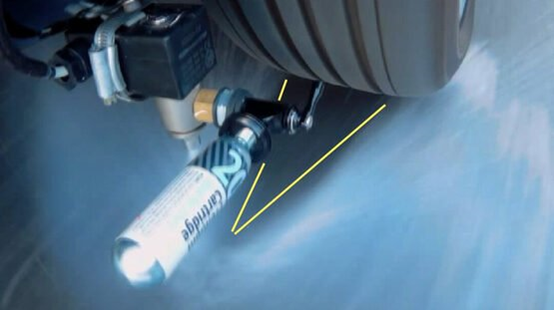
A new device has been developed to prevent vehicles from aquaplaning and losing traction control due to adverse road conditions.
The Run Dry Traction System (RDTS) works by firing a jet of compressed gas close to the front of the wheel, removing surface water in front of the tyre to ensure the vehicle has a dry patch of road ahead, to ensure grip is not compromised by road contaminants such as water, sand and gravel.
The device has been developed by Professor Mike Blundell and Ravi Ranjan from Coventry University’s Research Centre for Future Transport and Cities, following a two-year research project.
Professor Mike Blundell, professor of vehicle dynamics and impact at Coventry University, said: “Our tests demonstrate that RDTS has the potential to make a huge impact on vehicle safety in a whole host of conditions.
“The prospect of producing something that could even save lives on the road is extremely exciting and after some initial success with testing, we’re now eager to look into manufacturing potential and further research to take this concept to the next level.
“A device like this really could be the difference between life and death if it can help vehicles to stop safely within certain distances and that’s why we’re so keen to continue developing this concept.”
The prototype product aims to prevent aquaplaning and loss of traction in a variety of road conditions.
Aquaplaning, also referred to as hydroplaning, happens when a layer of surface water builds up between a vehicle’s tyres and the road surface, leading to a complete loss of grip.
This can occur with as little as 2-3mm of standing water on the road surface when vehicles are travelling at a variety of speeds and is a leading cause of road traffic accidents. By Graham Hill thanks to Fleet News
Share My Blogs With Others:These icons link to social bookmarking sites where readers can share and discover new web pages.
The average price of a litre of petrol and diesel rose in September to make a tank £12 more expensive than a year ago, according to new RAC Fuel Watch data.
Unleaded increased by 1.5p to 136.83p while diesel rose by 2.5p to 139.25p, making the price of petrol 22p a litre more expensive than a year ago (114.61p 30 September 2020) and diesel 21p dearer (118.10p).
RAC said both fuels are at prices last seen eight years ago in autumn 2013, with petrol only being 5.65p off the all-time high of 142.48p and diesel 8.68p off the record of 147.93p.
The rise at the pumps has not been driven by the fuel delivery crisis but by a 10.65% increase in the price of oil from $71.29 to $78.88 throughout September, said the RAC.
Simon Williams, fuel spokesman at the RAC, said: “Not only are motorists struggling to put fuel in their vehicles, but they are also having to pay through the nose for it as the rising cost of a barrel of oil is causing further pain at the pumps.
“As life moves ever closer to normal as the world gets to grips with Covid-19, demand for oil is outpacing supply, and with producer group OPEC+ deciding on Monday not to release more oil, the barrel price has now broken through the $80-mark for the first time in more than three years.
“This looks likely to spell further misery for drivers at the pumps as we head towards Christmas, especially as some analysts are predicting the price could even hit $90 before the end of the year.
“If this were to happen, we could see the average price of unleaded hit a new record of around 143p per litre. Diesel would shoot up to 145p which is only 3p off the record high of 147.93 in April 2021.”
According to the RAC, for those who have filled up a 55-litre family car with petrol at the end of September, they would have paid £75.26 – up 85p in September and £12.22 on 12 months ago.
A full tank of diesel is now £76.59 – up £1.40 in September and £11.63 more than a year ago, the data found.
The RAC said prices at four major supermarkets were 4p a litre cheaper than the UK average while at motorway services they were 15p more expensive for petrol at 151.55p and 156.35p for diesel.
Asda sold the cheapest unleaded at 132p while Sainsbury’s offered the lowest price diesel at 134.28p.
Williams added: “Drivers have had to endure the average price of petrol going up for 10 out of the last 12 months and now, because of the supply crisis, many have had great difficulty getting hold of it just so they can go about their daily lives.
“While we’ve heard of some smaller retailers taking advantage of the situation by charging very high prices for their fuel, these cases appear to be few and far between, with most retailers acting responsibly.
“As forecourts’ fuel stocks return to normal drivers will inevitably switch from worrying about whether they can get the petrol or diesel they need to just how much a fill-up is costing them.
Regional pump prices
Unleaded
01/09/2021
30/09/2021
Change
UK average
135.29
136.83
1.54
East
135.88
137.03
1.15
East Midlands
134.90
136.49
1.59
London
136.21
137.91
1.70
North East
133.70
135.79
2.09
North West
134.87
137.04
2.17
Northern Ireland
132.02
133.56
1.54
Scotland
135.22
135.99
0.77
South East
136.09
137.98
1.89
South West
135.71
137.27
1.56
Wales
134.67
136.01
1.34
West Midlands
135.18
136.49
1.31
Yorkshire and The Humber
134.28
136.29
2.01
Diesel
01/09/2021
30/09/2021
Change
UK average
136.71
139.25
2.54
East
137.38
139.58
2.20
East Midlands
136.27
138.65
2.38
London
137.46
139.95
2.49
North East
135.44
138.10
2.66
North West
136.38
138.97
2.59
Northern Ireland
132.78
135.46
2.68
Scotland
136.50
138.89
2.39
South East
137.77
140.34
2.57
South West
137.28
139.69
2.41
Wales
136.37
138.92
2.55
West Midlands
136.83
139.20
2.37
Yorkshire and The Humber
136.09
139.03
2.94
By Graham Hill thanks to RAC & Fleet News
Share My Blogs With Others:These icons link to social bookmarking sites where readers can share and discover new web pages.
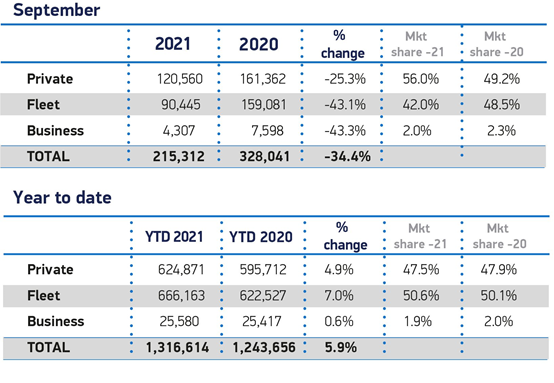
The semiconductor shortage is being blamed for poor fleet and business new car registrations, with the company car market recording a 43.4% year-on-year fall, new figures suggest.
Last month, 94,752 new cars were registered to fleet and business, compared to 166,679 units registered in September 2020, according to new data from the Society of Motor Manufacturers and Traders (SMMT).
Year-to-date, however, new company car sales are almost 7% up on where they were this time last year, with 691,743 fleet and business registrations compared to 647,944 during the first nine months of 2020.
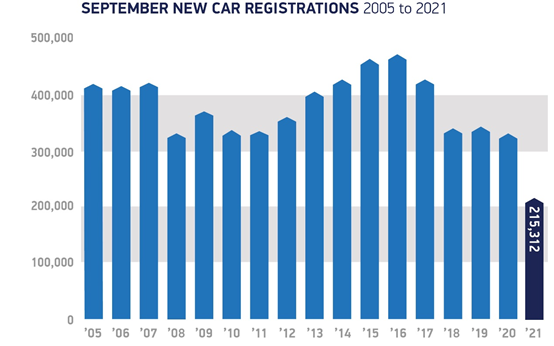
Fleet and business accounted for 44% of overall new car sales during the month. Overall, 215,312 new cars were registered in September, some 34% down on September 2020’s figures.
It was the weakest UK new car market figures for September recorded since 1998 ahead of the introduction of the two-plate system in 1999.
September is typically the second busiest month of the year for the industry, but with the ongoing shortage of semiconductors impacting vehicle availability, the 2021 performance was also down 44.7% on the pre-pandemic 10-year average, SMMT figures suggest.
SMMT chief executive, Mike Hawes, said: “This is a desperately disappointing September and further evidence of the ongoing impact of the Covid pandemic on the sector.
“Despite strong demand for new vehicles over the summer, three successive months have been hit by stalled supply due to reduced semiconductor availability, especially from Asia.”
New electric vehicle uptake
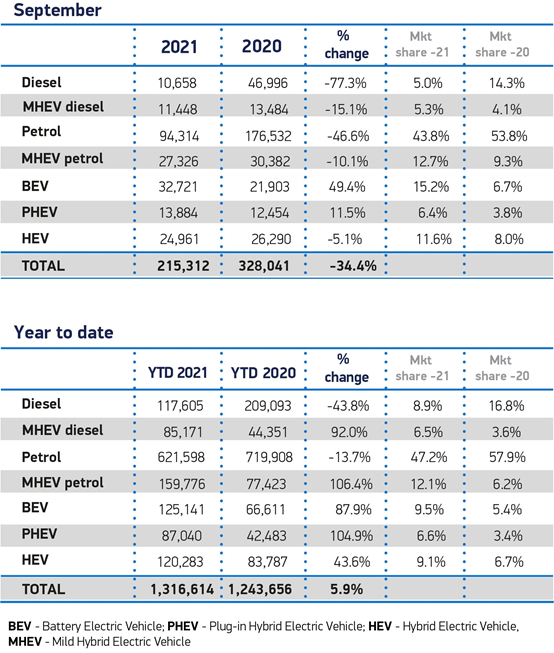
September was the best month ever for new battery electric vehicle (BEV) uptake. With a market share of 15.2%, 32,721 BEVs were registered in the month.
In fact, the September performance was only around 5,000 vehilces shy of the total number registered during the whole of 2019.
Plug-in hybrid (PHEV) share also grew to 6.4%, meaning more than one in five new cars registered in September was zero-emission capable.
Meanwhile, hybrid electric vehicles (HEVs) grew their overall market share from 8% in 2020 to 11.6%, with 24,961 registered in the month.
Hawes said that despite supply challenges, the “rocketing uptake” of plug-in vehicles, especially battery electric cars, demonstrates the increasing demand for these new technologies.
Jamie Hamilton, automotive director and head of electric vehicles at Deloitte, said: “With battery electric vehicles outpacing even plug-in hybrid this month, this demonstrates a level of consumer confidence that the charging infrastructure will be in place.
“However, gaps still remain and a more equitable rollout of public charging points would ensure EVs are also accessible to those households without off-street parking.
“Petrol and diesel shortages may have also inadvertently created some charge anxiety, so ensuring more visible charging points will only strengthen public confidence in EV feasibility.”
Meryem Brassington, electrification propositions lead at Lex Autolease, added: “The recent fuel shortage will only have further heightened awareness of the importance of transitioning to an electric future. As EVs continue to rise in popularity, industry must work collaboratively to ensure there isn’t a tipping point of demand outstripping supply.”
Vehicle supply impact to last into 2023
All drivers whether fleet or consumer face delays of more than one year for certain new car and van models, while others are being delivered with missing features, as the global semiconductor shortage worsens.
And some automotive industry executives do not see the problem ending any time soon.
One is predicting the disruption could last until 2023. Speaking at the IAA Munich auto show last month (September 7-12), Daimler CEO Ola Kallenius said soaring demand for semiconductors means the auto industry could struggle to source enough of them throughout next year and into 2023, though the shortage should be less severe by then.
The carmaker has cut its annual sales forecast for its car division, projecting deliveries will be roughly in line with 2020, rather than up significantly.
Critics are predicting the crisis will have a greater impact on automotive than the coronavirus pandemic. Almost 95% of fleets responding to a Fleet News poll said they were experiencing vehicle delays.
Fleets are being urged to sit tight and continue to place orders for new vehicles, while also being warned that existing models may have to remain on the road for in excess of an extra 12 months.
Matthew Walters, head of consultancy services at LeasePlan, said: “The impact on fleet is pretty severe.
“Last year, we saw a number of formal extensions for companies during the worst of Covid-19 where vehicles couldn’t be delivered and where vehicles couldn’t be collected. These vehicles needed to be extended outside their primary contract term.
“Now we’re in a situation moving into next year where, as an industry, we are likely to see an extension programme again.
“I think it’s a similar period of activity with our customers now, to help them understand what it means for their current order bank, when their orders will be delivered and what that means for their replacement cycles.
“The customer still needs to place orders for vehicles to get themselves in the queue and we are working with them and being open and frank as to when those vehicles are going to be delivered.”
By Graham Hill thanks to Fleet News
Share My Blogs With Others:These icons link to social bookmarking sites where readers can share and discover new web pages.
Police are appealing to fleet workshops, garages and MOT test centres to support a new initiative targeting the theft of catalytic converters and other components.
The SmartWater Group, which is spearheading the new, policebacked scheme, wants them to become accredited registration hubs, after the unique identifier proved to be a deterrent.
In a recent SmartWater trial with the National Infrastructure Crime Reduction Partnership (NICRP) and the British Transport Police (BTP), thefts of catalytic converters more than halved.
Thefts peaked in March, when 3,245 catalytic converters were stolen, but they have been declining since, with 1,378 recorded in July – a 57% fall. Key to that decrease was a joint operation codenamed Goldiron, which recovered more than 1,000 stolen catalytic converters in April.
The operation, which was coordinated by the British Transport Police (BTP) and involved experts from SmartWater’s intelligence unit, the Centre for Infrastructure and Asset Protection (CIAP), also resulted in more than 50 arrests.
Over a five-day period, officers and partner agencies visited 926 sites, stopped 664 vehicles, recovered 1,037 stolen catalytic converters and 297 items of stolen property and identified 244 offences.
Rachael Oakley, director at CIAP, says SmartWater is a “highly-proven deterrent to criminals and rogue scrap metal dealers as it makes stolen parts too hot to handle”.
The heat-resistant solution, which is invisible to the naked eye but glows yellow under UV light, leaves a long lasting and unique identifier.
Oakley explained: “The combination of the materials that is put into the solution makes each individual vial unique.
“The registration of this bottle is what’s key. Every item marked with SmartWater is registered on our database.”
NATIONAL SMARTWATER DATABASE
It can be applied by brush in 10 minutes and only a fragment of SmartWater is required to link it to a specific vehicle on the ‘National Asset Database’, which is operated by CIAP on behalf of the police.
NICRP lead and BTP Superintendent, Mark Cleland, said: “Thanks to the support of the Home Office in creating the NICRP, our joint working with SmartWater and other industry partners, and the drive by enforcement partners across the UK, we have made a real impact in tackling metal and catalytic converter crime.
“While arrests continue to be made, it is the preventative approach through the forensic marking of catalytic converters that gives motorists the opportunity to protect their property and stop the crime in the first place.”
Catalytic converters have been targeted because they contain a honeycomb coated with precious metals such as platinum, palladium and rhodium which help to filter harmful gases from the vehicles’ exhaust systems.
The RAC says that when the global value of these metals increases it usually leads to a spike in thefts. Prices of rhodium hit a record high earlier this year, up more than 200% since March 2020.
In an effort to deter criminals from targeting Toyota’s cars, the carmaker joined forces with police and SmartWater earlier this year to covertly mark the catalytic converters on more than 100,000 cars.
The initiative is costing Toyota more than £1 million and will be provided to existing owners for free.
Oakley, who met the Society of Motor Manufacturers and Traders (SMMT) with the British Transport Police to discuss the initiative, believes other manufacturers are watching with interest.
OTHER SMARTWATER APPLICATIONS
She also told Fleet News that, while catalytic converters were a focus, the forensic marking could be applied to other high-value vehicle components, which could be targeted by criminal gangs.
She explained: “We can basically react to where there might be a crime spike or a trend and if fleets are asking us to help with solutions, we can look at what we can do to make sure SmartWater can assist with that.
“Criminals will move quickly; the prices of precious metals will start to come down and they’ll move on to something else.
“What we’re seeing is that’s likely to be something like hybrid batteries or electric vehicle cables.
“We’d like to get ahead of the game by putting in the preventive measures to stop these crimes becoming the issue that catalytic converter crime has become.” By Graham Hill thanks to Fleet News
Share My Blogs With Others:These icons link to social bookmarking sites where readers can share and discover new web pages.
The RAC has called on the Government to consider reinstating hard shoulders on motorways.
A recent RAC poll found six in 10 drivers think that all-lane-running smart motorway schemes should be scrapped entirely, and the hard shoulder should be reinstated, whist retaining the technology that manages traffic flows and detects breakdowns.
It is not disputed that the technology deployed on smart motorways has reduced the risk of an accident between two moving vehicles, because it allows speed limits to be varied and traffic flows managed by the series of cameras covering the smart motorway network.
However, where hard shoulders have been removed, recent evidence suggests that the risk of a major accident involving a moving and stationary vehicle has increased, with stationary vehicles often stranded in a live line with the occupants of the vehicle akin to ‘sitting ducks’, hoping that vehicles approaching from behind will spot the hazard that their vehicle is posing and take evasive action in time, before the lane can be closed and traffic diverted to other live lanes.
In response to a number of tragic accidents and concerns raised by coroners, the Government requested an ‘Evidence Stocktake’ last year which recommended an 18-point action plan which included many features to enhance safety measures, such as reducing the distance between refuge points from 1.6 miles to 1 mile and the introduction of radar systems to detect broken down vehicles.
These recommendations appear to support the consensus amongst most drivers that more can be done to protect the safety of road users on smart motorways.
In addition to the recent actions of the RAC, the campaign group Smart Motorways Kill (SMK) suggested earlier this year that they would be seeking judicial review of the decision to implement smart motorways.
If such a review is sought, pending the outcome, the consequences could have a significant impact as reinstating hard shoulders would amount to 204 miles, or as Grant Shapps referenced, the land acquisition required would be the equivalent of 700 Wembley Stadiums.
Shapps has also previously commented that smart motorways are too expensive to scrap with the Government favouring taking steps to increase safety measures rather than reverting to the traditional hard shoulder.
Highways England have previously announced their intention to add a further 300 miles of smart motorway by 2025.
Based on the statistics, whilst this could lead to a lower incident rate overall, as traffic flow is more appropriately managed, the risk of a serious incident with a stationary vehicle is increased, with the risk of serious injury or unfortunately the risk of fatality, to the occupants.
There has been mounting pressure on insurers for many years to lower motor insurance premiums and the potential increase in the cost of claims from such accidents on smart motorways is unfortunately likely to ultimately be felt by the consumer as the costs of these claims are passed on by way of increased premiums.
The true cost of smart motorways may still yet to be seen. By Graham Hill thanks to Fleet News
Share My Blogs With Others:These icons link to social bookmarking sites where readers can share and discover new web pages.
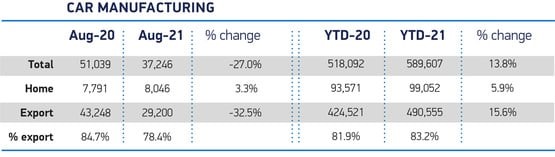
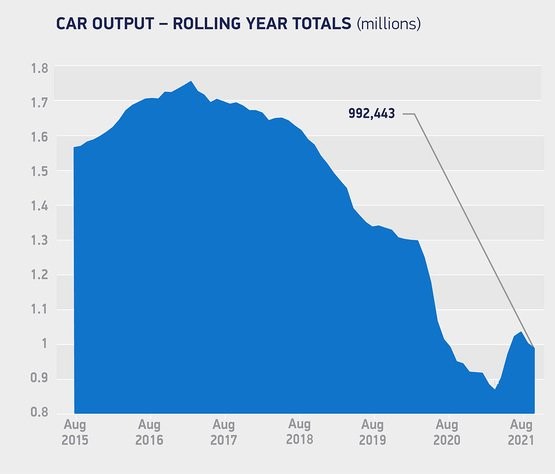
UK car production fell for the second consecutive month, in August, as the global semiconductor shortage continued to affect the automotive sector.
Figures from the Society of Motor Manufacturers and Traders (SMMT) show that 37,246 cars were built in UK factories during August, a decline of 27%.
While manufacturing for the UK market increased by 3.3% in the month, the rise was equivalent to just 255 additional units and exports fell by 32.5%. The decline was driven by falling exports to faraway markets including Australia, the US and China. Exports to the EU held up better, down 4.9%, accounting for almost seven in every 10 cars exported in August.
Despite the challenges, production of the latest electric, plug-in hybrid and hybrid cars surged to a new high, representing more than a quarter (27.6%) of all cars made. Since January, UK car factories have turned out 137,031 alternatively fuelled cars – 51,679 more than the same period in 2020.
Production in the year-to-date remains up, by 13.8%, to 589,607 cars. The performance, however, must be set in context against a Covid-hit 2020 as it remains significantly lower, by 32%, than in 2019.
The total is 42.8% down, equivalent to 440,920 fewer units, when compared against the five-year average for the first eight months of the year.
Mike Hawes, SMMT chief executive, said: “Another significant decline for UK car production is extremely worrying both for the sector and its many thousands of workers nationwide. While not the only factor at play, the impact of the semiconductor shortage on manufacturing cannot be overstated. Carmakers and their suppliers are battling to keep production lines rolling with constraints expected to continue well into 2022 and possibly beyond.
“Job support schemes such as furlough have proven such a lifeline to automotive businesses yet its cessation today comes at the worst time, with the industry still facing Covid-related stoppages which are damaging the sector and threatening the supply chain in particular. Other countries have extended their support; we need the UK to do likewise.”
Richard Peberdy, UK head of automotive at KPMG, added:
“Chip shortages continue to bite, but manufacturers will no doubt be reviewing how many cars they make – so lower levels of production will likely persist.
“Fewer cars rolling out of plants has helped to bump-up retail prices and carmakers, alongside retail networks, will want to hold on to the margin they’ve gained since the start of the pandemic.
“While production disruption will be hurting efficiency, a reduced volume focused on more profitable models will be an attractive balance that manufacturers won’t want to let go of. Over the short term, it’s helping to cover the costs of huge underutilised plants while they review options to right-size.
“Bigger price tags on forecourts could help to open a window for Chinese-owned carmakers in the UK, which may be more competitive on cost. At the Munich mobility show last month we saw this potential for a shake-up in the market, with an impressive exhibit of SUV, electric, autonomous and hydrogen models.” By Graham Hill thanks to Fleet News
Share My Blogs With Others:These icons link to social bookmarking sites where readers can share and discover new web pages.
ABB has launched the Terra 360, a 360kW electric vehicle (EV) charger.
The company claims the new device is the “world’s fastest” electric car charger.
It can deliver 62 miles of range in less than three minutes and can charge up to four vehicles at once.
“With governments around the world writing public policy that favors electric vehicles and charging networks to combat climate change, the demand for EV charging infrastructure, especially charging stations that are fast, convenient and easy to operate is higher than ever,” said Frank Muehlon, president of ABB’s E-mobility Division. “The Terra 360, with charging options that fit a variety of needs, is the key to fulfilling that demand and accelerating e-mobility adoption globally.”
Available in Europe from the end of 2021, ABB says the Terra 360 is designed with the daily needs and expectations of EV drivers in mind.
Its lighting system guides the user through the charging process and shows the State of Charge (SoC) of the EV battery and the residual time before the end of an optimal charge session.
As well as serving the needs of private EV drivers at fueling stations, convenience stores and retail locations, ABB expects the Terra 360 chargers to be installed at commercial premises to charge electric fleet cars, vans and trucks.
The devices are fully customisable and can be branded. There is also the option to include an integrated 27-inch advertisement screen to play video and pictures.
ABB has sold more than 460,000 electric vehicle chargers across more than 88 markets since 2010. By Graham Hill thanks to Fleet News
Share My Blogs With Others:These icons link to social bookmarking sites where readers can share and discover new web pages.