Plans To Install 190,000 Kerbside Chargers Unveiled.

Thursday, 25. November 2021

Connected Kerb, the electric vehicle (EV) infrastructure company, has announced plans to install 190,000 public on-street EV chargers, worth up to £1.9bn, by 2030.

The company has secured new partnerships for 10,000 public on-street EV chargers across the UK in 2021, the majority of which will be deployed across West Sussex and Kent, announced today (November 8).

It said the investment will revolutionise access to EV charging for drivers without off-street parking and help support mass market charging for workplaces and fleets.

Dr Chris Pateman-Jones, chief executive officer at Connected Kerb, said: “Our rollout of public chargers – one of the most ambitious the UK has ever seen – encapsulates that future, helping individuals and businesses to confidently make the switch to electric, reducing their carbon footprint and cutting air pollution.

“Targets are important – for an industry so critical to the decarbonisation of transport, we need goals to work towards and objectives to which we are all accountable. However, they need to be met with action.

“With deals confirmed for 10,000 chargers this year alone and 30,000 more expected next year, we are demonstrating that we’re getting on with the job and delivering the change that needs to happen – not just talking about it.”

Deals for a further 30,000 chargers are expected conclude next year, as part of the company’s ambition to ‘level up’ charging across the UK.

Transport minister, Trudy Harrison said: “Providing reliable and affordable on-street charging is vital as we work to decarbonise transport and level up across the country.

“It’s great to see Connected Kerb and local authorities working together as the Government commits £2.5bn towards electric vehicle grants and the development of EV infrastructure in our towns and cities.”

The UK government’s Office for Zero Emission Vehicles meets 75% of the cost of installations through the On-Street Residential Charging Scheme (ORCS), while Connected Kerb provides the remaining 25%, it said.

Kent County Council has also announced it has chosen Connected Kerb to deploy at least 600 chargers by 2023.

Charge point installations have been announced today as part of tenders with councils including: Coventry (300 chargers), Cambridge (360) and Plymouth (100), and recently, Milton Keynes (250), Warrington (30), Medway (30), and Glasgow City Council, East Lothian Council, Shropshire County Council and Hackney Council, as part of the Agile Streets trial (100).

Lord Gerry Grimstone, minister for investment at the Department for International Trade and Business, Energy and Industrial Strategy, said: “Connected Kerb’s significant investment in electric vehicle chargers will support the UK’s commitment to green growth and ambitious net zero targets.

“Investments like this will be vital to help reduce emissions and limit the rise in global temperatures whilst driving jobs, growth and levelling up across the country.”

Neil Isaacson, CEO of Liberty Charge, also welcomed Connected Kerb’s ambition to install 190,000 charge points in the UK by 2030.

“We are pleased to see that it shares our vision that EV charging needs to be accessible to all, anywhere and at anytime. Our industry has a key role to play, today, in tackling the chronic deficit in on-street charging in the UK, and supporting local authorities in providing their residents with reliable, safe and high-quality vehicle charging to inspire the confidence required for EV adoption,” he said.

“At Liberty Charge, we understand the vast breadth and depth of the challenges that local authorities are facing with regards to restricted budgets, legislation, location of chargers, resident pressure (both for and against EV installations), quality and longevity of equipment, the diversity of technology and simply the time required from planning to installation. And we believe it is vital that we instil trust that our ambitions can be delivered.

“That’s why, working in partnership with Virgin Media O2, we’re already installing charge points and committing to ongoing maintenance, helping local authorities to give confidence to drivers looking to adopt EVs. And, crucially, helping them to make a difference to the environment and communities in which they live.

“Our recent initiatives include Hammersmith and Fulham, Waltham Forest, Wandsworth, West and North Northamptonshire Councils, and Croydon.”  By Graham Hill thanks to Fleet News

Share My Blogs With Others: These icons link to social bookmarking sites where readers can share and discover new web pages.
  • MisterWong
  • Y!GG
  • Webnews
  • Digg
  • del.icio.us
  • StumbleUpon
  • Reddit
  • Alltagz
  • Ask
  • Bloglines
  • Facebook
  • YahooMyWeb
  • Google Bookmarks
  • LinkedIn
  • MySpace
  • TwitThis
  • Squidoo
  • MyShare
  • YahooBuzz
  • De.lirio.us
  • Wikio UK
  • Print
  • Socializer
  • blogmarks

With Christmas Shortages Still Being Predicted Government Announces Review Of HGV Driver Training

Thursday, 25. November 2021

The Government has launched a review into HGV driver training with the aim of reducing the burden for existing and returning heavy goods vehicle (HGV) drivers.

HGV drivers currently need to undergo five days of periodic training every five years to ensure they remain fully qualified to drive heavy goods vehicles (HGVs) and buses professionally and up to date with road safety standards.

The training is an EU initiative and is compulsory within what is known as the Driver Certificates of Professional Competence (DCPC) regime.

Some drivers are left to pay for the training themselves and are not paid whilst attending their training course. Feedback from industry suggests this puts off many drivers who have left the profession from returning.

The review will look at how the process can be updated to reduce the burden on drivers – both returning and new – and ensure it does not act as a barrier to working in the sector.

The announcement is the latest in a long list of measures introduced by the Government to tackle the shortage in HGV drivers, which the Road Haulage Association (RHA) estimates is some 100,000 drivers.

Covid-19 and Brexit have exacerbated the issue in the UK, leading to the Department for Transport (DfT) extending drivers’ hours temporarily, before introducing a raft of measures as the crisis deepened.

They included a streamlined HGV driving test, which ministers claim will provide additional capacity for 50,000 HGV tests per year, recruiting more examiners and issuing temporary visas for foreign drivers.

Transport secretary Grant Shapps said: “We’re listening to industry leaders who have told us about the issues HGV drivers face with CPC arrangements.

“Now we’ve taken back control of our own laws and regulations, I’m delighted to say we’re launching a review into these training rules.

“We understand it’s vital for drivers to remain fully qualified – but we’re looking to ensure they can do so in the most efficient way possible whilst maintaining road safety standards.

“No driver should be out of pocket or out of work through no fault of their own.

“This is the latest in a raft of 30 measures we’ve taken to support this vital sector and encourage drivers to return to the job or kickstart a new career in the industry. These measures are working.”

A recent freedom of information (FOI) request from Driver Hire Training suggested that almost two-thirds (62%) of HGV test centres across the UK had a waiting list of at least 11 weeks, with some test centres facing a 24-week wait.

The research revealed that the average waiting time across all UK test centres was nine weeks.

The highest waiting times were found in Aberdeen, Lerwick and Machrihanish, where there is a currently a waiting time of 24 weeks for a HGV driving test. Cumbria, the Isle of Wight and South Yorkshire were revealed as the UK counties with the average shortest waiting times of just one week.

Shapps said: “There is no backlog of HGV licence applications and we’re seeing over a thousand more people than normal apply for a licence each week.”

Government says that the number of weekly HGV tests available has increased by 90% and training for up to 5,000 new drivers through skills bootcamps has been announced.

The DVLA, says the Government, has processed over 40,000 HGV and vocational licence applications in four weeks, with applications that do not require complex medicals being turned around in five working days.

DVSA is providing 1,350 more tests than normal a week at sites all over the country, with vocational licence applications being processed in normal five-day turnaround times with no backlogs, says the Department for Transport (DfT).

Over the past three weeks, it reports around a 90% increase in the number of people requesting application packs for vocational licences each week.

Temporary lorry park sites identified

The Government is working with key stakeholders to identify a number of lorry parks across the country where short-term facilities such as temporary toilets, showers and catering can be delivered in the coming months. 

The Government also emphasised the expectation that councils consider new proposals for these vital facilities constructively and has committed to review guidance that will assist this.

This follows the £32.5 million recently committed in the Chancellor’s budget to provide better facilities right across the country for HGV drivers, in an effort to improve standards of roadside parking and facilities for hauliers and further safeguard driver wellbeing, comfort and safety.

In addition, £500,000 will also be added to the existing Mode Shift Revenue Support Fund for 2021 to 2022, in another boost to the country’s supply chains.

The £20m grant scheme provides funding to private-sector freight companies to encourage them to move more freight from the country’s roads to either the railways or inland waterways.

The additional funding equates to taking a significant 29,000 lorry loads of goods off the roads up until the end of March 2022 and will help to generate more environmentally friendly modes of transporting freight, says DfT.

Director of policy at Logistics UK Elizabeth De Jong said: “The measures announced today will support our members in their efforts to attract and retain new HGV drivers to the sector.

“Inadequate driver facilities across the roads network have led to a negative impression of our industry, creating a barrier to entry to our sector and are an issue that Logistics UK has been campaigning on for many years; we are pleased that the Government has listened to our concerns and will move forward with a rapid programme of improvements.

“Logistics UK and its members also welcome the review of Driver CPC, to ensure that continuous education for drivers is as effective as possible while upholding all necessary safety requirements.

“Meanwhile, the extra funding for the Mode Shift Revenue Support scheme will help the industry to reach net-zero emission targets while reducing road congestion.” By Graham Hill thanks to Fleet News

Share My Blogs With Others: These icons link to social bookmarking sites where readers can share and discover new web pages.
  • MisterWong
  • Y!GG
  • Webnews
  • Digg
  • del.icio.us
  • StumbleUpon
  • Reddit
  • Alltagz
  • Ask
  • Bloglines
  • Facebook
  • YahooMyWeb
  • Google Bookmarks
  • LinkedIn
  • MySpace
  • TwitThis
  • Squidoo
  • MyShare
  • YahooBuzz
  • De.lirio.us
  • Wikio UK
  • Print
  • Socializer
  • blogmarks

Don’t Overpay For Your Photo-Licence To Be Renewed

Thursday, 25. November 2021

The Driver and Vehicle Licensing Agency (DVLA) says that drivers have missed out on £2.3 million of savings by not renewing their photocard driving licence online.

DVLA figures show that between April 2020 and March 2021, around 23% of the two million renewal applications it received were sent in either by post or via the post office. This is despite the online service being quicker and cheaper, it says.

Going online is the cheapest way to renew a photocard driving licence. Renewing a photocard driving licence using Gov.uk costs £14 and the driver will receive their new licence in five days. Posting an application to DVLA costs £17 and will take longer.

Customers who apply online can also track the progress of their licence by visiting the track your driving licence application page on the Gov.uk website.

Drivers are legally required to renew their photocard driving licence every 10 years and will receive a reminder from DVLA before their current licence expires.

Julie Lennard, DVLA chief executive, said: “Our online services are the quickest and easiest way to deal with DVLA and customers usually receive their driving and vehicle documents in just five days.

“Remember to always use Gov.uk when using DVLA’s online services.”

To renew online or find out more about renewing a licence visit Gov.uk. By Graham Hill thanks to Fleet News

Share My Blogs With Others: These icons link to social bookmarking sites where readers can share and discover new web pages.
  • MisterWong
  • Y!GG
  • Webnews
  • Digg
  • del.icio.us
  • StumbleUpon
  • Reddit
  • Alltagz
  • Ask
  • Bloglines
  • Facebook
  • YahooMyWeb
  • Google Bookmarks
  • LinkedIn
  • MySpace
  • TwitThis
  • Squidoo
  • MyShare
  • YahooBuzz
  • De.lirio.us
  • Wikio UK
  • Print
  • Socializer
  • blogmarks

How Accurate Is Your Speedometer?

Thursday, 25. November 2021

Have you ever noticed a discrepancy between your vehicle’s speedometer and the speed stated by your GPS system? If so, you’re in good company.

But which is correct? Your speedometer or your GPS? In nearly all such cases, the speedometer is incorrect – reporting a higher speed than your car is actually travelling at.

You might imagine that manufacturers ensure their speedometers are as accurate as possible. So why the discrepancy?

A car’s speedometer works by measuring the rotations of the driveshaft, axle or wheel – rather than the speed you actually travel from one point to another. The car takes the recorded rotations, applies a healthy dose of mathematics and spits out a speed.

But the accuracy of a speedometer depends on the wheels remaining the same diameter as they were when they rolled off the production line. If the tyres or wheels are changed, this will change the speedometer reading. A larger diameter will result in a faster recorded speed. Fitting smaller tyres or having under inflated tyres will result in a slower recorded speed.

Even a tiny change in diameter – of say, a few millimetres – will result in an incorrect speed being recorded. This likely error margin is factored in to how car makers calibrate their speedos.

So why is my GPS satnav accurate?

GPS satnav systems calculate your speed by using satellites – and assuming the signal is strong, they should be accurate. Some sat navs installed at manufacture are integrated with the car’s own measurements to provide a more accurate speed reading.

Under UK law – which is based on a European Union standard – speedometers must never underreport a vehicle’s speed, while it must never over report by more than 110% of the actual speed + 6.25mph.

So if you’re going 40mph, your speedometer may read up to 50.25mph – but it can never read less than 40mph. In order to stay within the law, carmakers calibrate their speedomters to slightly overreport their vehicles’ speeds.

This of course means many motorists are travelling slower than they think – which is arguably good news for avoiding accidental speeding tickets and for making our roads safer.

You may well find your sat nav’s GPS is a more accurate determinant of your speed – although you should stick to your car’s speedometer reading to be on the safe side. By Graham Hill thanks to StartRescue.

Share My Blogs With Others: These icons link to social bookmarking sites where readers can share and discover new web pages.
  • MisterWong
  • Y!GG
  • Webnews
  • Digg
  • del.icio.us
  • StumbleUpon
  • Reddit
  • Alltagz
  • Ask
  • Bloglines
  • Facebook
  • YahooMyWeb
  • Google Bookmarks
  • LinkedIn
  • MySpace
  • TwitThis
  • Squidoo
  • MyShare
  • YahooBuzz
  • De.lirio.us
  • Wikio UK
  • Print
  • Socializer
  • blogmarks

Survey Asks If Cars Have Too Much Distracting Technology, What Do You Think?

Friday, 19. November 2021

Three-quarters (76%) of drivers think that too much technology in a vehicle can be distracting, according to research conducted by Dacia.

The carmaker found that more than half (61%) of respondents would rather have a more affordable car with just the technology they actually use.

For drivers that have a long list of technological features on their own car, around a third think that there are too many fitted in the first place, while 69% think that in-car technology has become too complicated.

The research revealed that on average, drivers only use around 40% of the technological features fitted to their vehicles, with drivers aged between 25 and 34 regularly using the largest number of features in their car.

The features drivers want their cars to be fitted with over anything else are parking sensors, sat-nav and DAB radio.

Luke Broad, brand director for Dacia UK and Ireland, said: “We believe in providing our customers with everything that is essential, all for the best value – it keeps us faithful to our DNA.

“Features and technology on our cars should be in line with our customers’ demands so they pay for only what they need.

“At Dacia, we get the balance right, offering the most advanced features and technology that are essential for the driver’s comfort and pleasure but maintaining the best value.

“This survey shows that our vehicles are perfectly aligned with our customers’ expectations, and we still offer a unique proposition that resonates with the times.”

Across the New Duster range two of the UK’s most commonly used features of DAB radio and Bluetooth are fitted as standard, while one step up the range to Comfort and Prestige models brings a reversing camera and parking sensors, some of the UK’s other favoured technological features, while Media Nav brings satellite navigation – another UK favourite. The New Duster also now features an 8.0-inch infotainment screen.

This is reflected in the Sandero and rugged Sandero Stepway specifications, with all versions featuring DAB and Bluetooth, as well as parking sensors on the Comfort specification.

The same 8.0-inch touchscreen infotainment system from the New Duster is also available to Sandero customers. By Graham Hill thanks to Fleet News

Share My Blogs With Others: These icons link to social bookmarking sites where readers can share and discover new web pages.
  • MisterWong
  • Y!GG
  • Webnews
  • Digg
  • del.icio.us
  • StumbleUpon
  • Reddit
  • Alltagz
  • Ask
  • Bloglines
  • Facebook
  • YahooMyWeb
  • Google Bookmarks
  • LinkedIn
  • MySpace
  • TwitThis
  • Squidoo
  • MyShare
  • YahooBuzz
  • De.lirio.us
  • Wikio UK
  • Print
  • Socializer
  • blogmarks

Are You Frightened To Drive On A Smart Motorway With No Hard Shoulder?

Friday, 19. November 2021

The Royal Society for the Prevention of Accidents (RoSPA) is backing the Transport Select Committee’s call to increase the numbers of emergency refuges on all-lane-running smart motorways.

MPs on the committee have said that the construction of new all-lane running motorways should be paused until safety concerns are addressed.

The new Transport Select Committee report on smart motorways concluded there was not enough safety and economic data to justify continuing with the Government’s plans to roll out an additional 300 miles of all-lane running motorway by 2025.

All-lane running smart motorways use the hard shoulder as a permanent ‘live’ running lane for traffic. These motorways have broken white lines, with the former hard shoulder lane only being closed in an emergency.

Between 2015 and 2019, 39 people died on UK smart motorways where there is no hard shoulder or the hard shoulder can be used as a running lane, according to figures from National Highways.

Rebecca Needham, road safety officer at RoSPA, said: “One of the most hazardous aspects of the UK smart motorway network is the removal of the hard shoulder. This is because it limits the options of a driver that needs to exit live traffic if they get into difficulty.

“Statistics show that on all-lane running motorways, around 40 per cent of breakdowns occur in a live traffic lane.”

On all-lane running motorways the emergency refuges are spaced at up to 1.6 miles apart. This is the standard for all new Smart Motorway schemes from 2013 onwards.

Needham continued: “RoSPA is deeply concerned by the spacing of emergency refuge areas on all lane-running smart motorways.

“Currently, emergency refuges are spaced more than a mile and half apart, meaning that some drivers who break down may be forced to stop in a running lane because they cannot reach the emergency refuge.”

“We support the calls of the Transport Select Committee to retrofit emergency refuge areas to existing all-lane running motorways to make them a maximum of 1,500 metres apart, decreasing to every 1,000 metres where physically possible.” By Graham Hill thanks to Fleet News

Share My Blogs With Others: These icons link to social bookmarking sites where readers can share and discover new web pages.
  • MisterWong
  • Y!GG
  • Webnews
  • Digg
  • del.icio.us
  • StumbleUpon
  • Reddit
  • Alltagz
  • Ask
  • Bloglines
  • Facebook
  • YahooMyWeb
  • Google Bookmarks
  • LinkedIn
  • MySpace
  • TwitThis
  • Squidoo
  • MyShare
  • YahooBuzz
  • De.lirio.us
  • Wikio UK
  • Print
  • Socializer
  • blogmarks

Survey Reveals Poor Knowledge Of The Highway Code Ahead Of Changes How Would You Fare?

Friday, 19. November 2021

Changes are expected to be made to the Highway Code in early 2022 which will introduce a ‘hierarchy of road users’, with more vulnerable users such as pedestrians and cyclists prioritised.

The move, which is part of a £338 million Government package to further boost active travel across the UK, comes as research carried out by Venson Automotive Solutions reveals a worrying number of people do not know enough of the current Highway Code.

According to the Venson survey, just one in three drivers (27%) know that vehicles are only required to stop at zebra crossings if pedestrians are already on the crossing.

If Parliament approves the proposed Highway Code changes, drivers will have to give pedestrians greater priority by stopping to give way to pedestrians waiting to cross as well as those already on the crossing. Three-quarters of respondents (74%) of Venson survey respondents agree this would be a good change.

Another popular new rule would require cyclists to move into single file to allow vehicles to pass – almost two-thirds (60%) of respondents agreed with this rule.

The least popular proposed new rule would allow cyclists to pass slower moving vehicles on either side, including when approaching junctions – just 26% agreed this rule should be brought in.

“Knowing the Highway Code is essential in making our roads safer places,” said Alison Bell, marketing director at Venson Automotive Solutions. “However, there is clearly confusion about what is and isn’t law.

“Take for example undertaking, there are circumstances where undertaking is necessary, such as a congested road, but only if it’s safe to do so.

“One cause of undertaking is middle-lane hogging, an offence in itself that’s punishable with an on the spot £100 fine and three penalty points.

“One of the new proposed changes in the law next year that’s likely to catch people is out, is using of the horn to invite pedestrians and cyclists to cross the road.”

She continued: “Depending on the severity, and whether or not the rules are legal requirements, breaking the rules of the Highway Code could lead to prosecution, points on your licence, fines or even a custodial sentence.

“Generally, if a rule states something ‘must’ or must not’ be done it is backed up by law and pleading ignorance is no excuse. Learning the existing and incoming rules deserves every driver’s time.

“However, for businesses operating a fleet of vehicles it’s especially the case, as they have a duty of care to ensure company drivers are aware of their responsibilities, and the upcoming changes to the rules – whether they agree with them or not.”

Venson Automotive Solutions Survey results:

Which of the following are true?

79% – It is illegal to overtake on the left of a vehicle on a motorway or dual carriage (FALSE)

45% – It is illegal to have the interior light on in your car whilst driving (FALSE)

35% – You must let bus drivers out at bus stops (FALSE)

29% – It’s okay to break the law to let an emergency vehicle past (FALSE)

53% – It is illegal to splash a pedestrian whilst driving through a puddle at the side of the road (TRUE – Road Traffic Act 1988)

27% – Traffic does not have to give way at a zebra crossing until a pedestrian has moved onto the crossing (TRUE – Highway Code rules 19 and 195)

New changes to the Highway Code are being proposed, including priorities at crossings and junctions and cyclists in relation to vehicles. Please tick all those you agree with.

74% – You should give way to pedestrians waiting to cross a zebra crossing and pedestrians and cyclists waiting to cross a parallel crossing.

60% – Cyclists should ride in single file when drivers wish to overtake and it’s safe to let them do so. When riding in larger groups on narrow lanes, it’s sometimes safer to ride two abreast.

58% – Don’t turn at a junction if it causes a cyclist going straight ahead to stop or swerve.

51% – At a junction, you should give way to pedestrians crossing or waiting to cross a road into which or from which you’re turning.

50% – You should remain behind cyclists and motorcyclists at junctions, even if they’re waiting to turn and are positioned close to the kerb.

47% – Don’t wave or use your horn to invite pedestrians or cyclists to cross; this could be dangerous if another vehicle is approaching.

33% – When traffic lights are red and there is an advanced stop line, cyclists may cross the first stop line to position themselves in front of other traffic but mustn’t cross the final stop line.

26% – Cyclists may pass slower-moving or stationary traffic on the right or left, including at the approach to junctions.

By Graham Hill Thanks To Fleet News

Share My Blogs With Others: These icons link to social bookmarking sites where readers can share and discover new web pages.
  • MisterWong
  • Y!GG
  • Webnews
  • Digg
  • del.icio.us
  • StumbleUpon
  • Reddit
  • Alltagz
  • Ask
  • Bloglines
  • Facebook
  • YahooMyWeb
  • Google Bookmarks
  • LinkedIn
  • MySpace
  • TwitThis
  • Squidoo
  • MyShare
  • YahooBuzz
  • De.lirio.us
  • Wikio UK
  • Print
  • Socializer
  • blogmarks

Supermarket Installed Electric Vehicle Chargers Double In Numbers In Less Than 2 Years

Friday, 19. November 2021

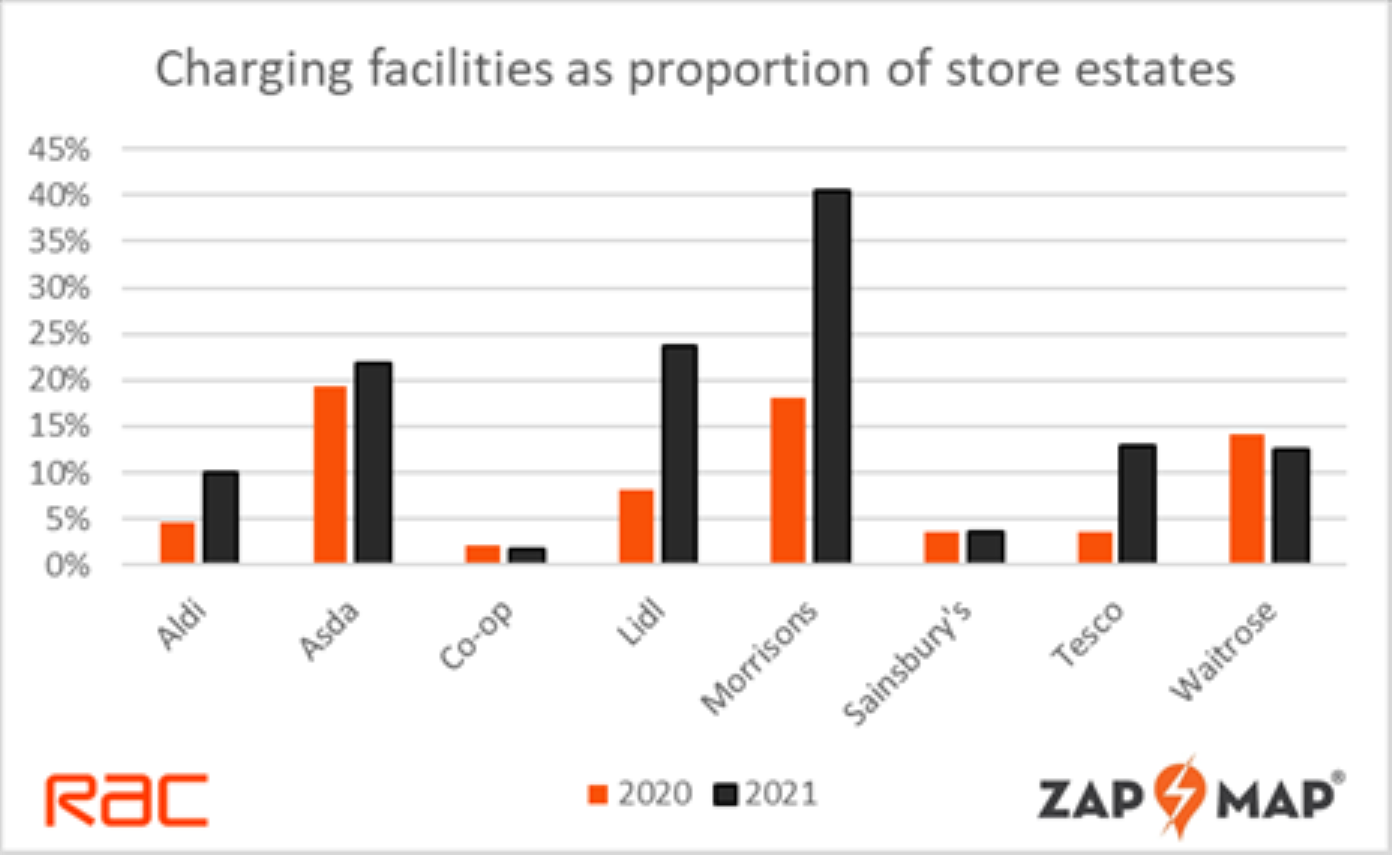
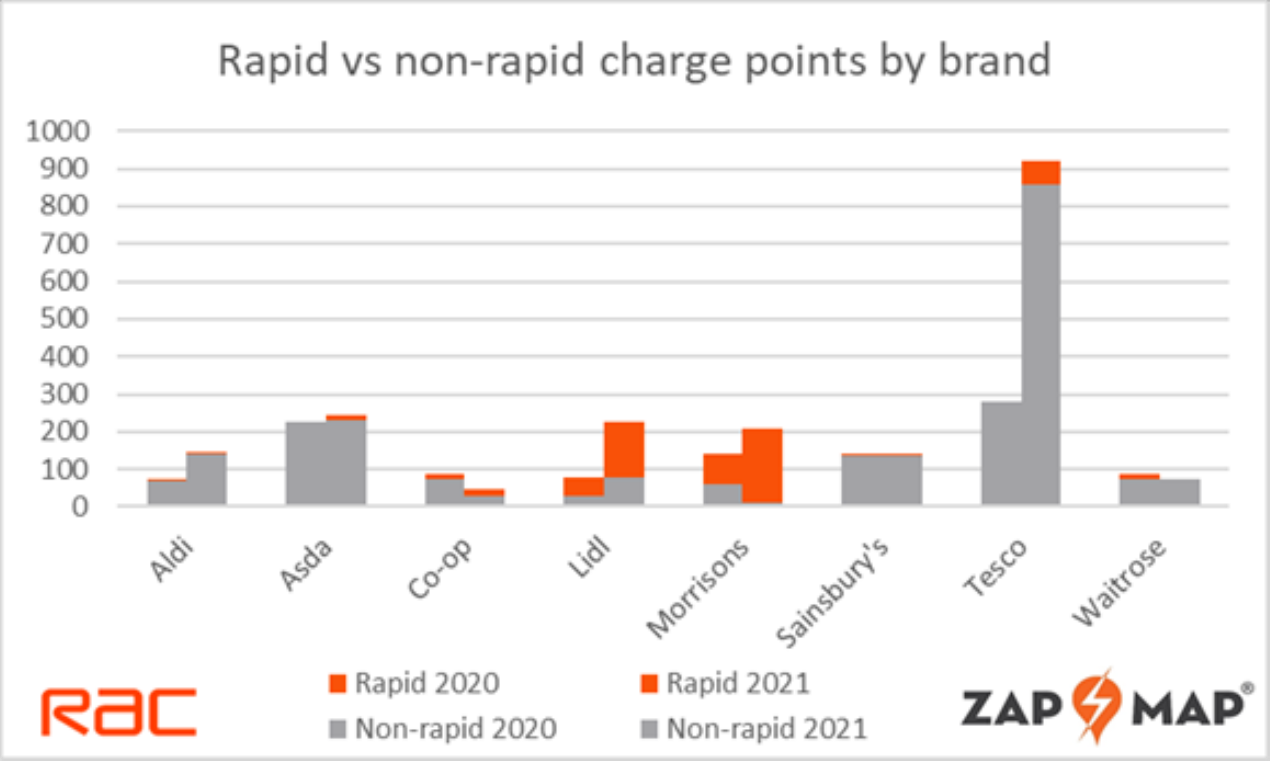
Rapid chargers at supermarkets have more than doubled in less than two years and now number in excess of 450, according to new data from Zap-Map and the RAC.

Analysis shows almost 1,000 new electric vehicle (EV) charge points have been installed at supermarkets in the past 21 months.

It takes the total number of EV charger units on their sites to 2,059, up 85% from 1,112 in January 2020, equating to 8% of all the UK’s 26,000 publicly accessible charge points – up from 6.5% in early 2020.

The total number of stores now offering charging facilities for battery-electric and plug-in hybrid vehicles has also more than doubled from 607 in early 2020 to 1,300 in 2021.

Tesco has added more EV chargers than any other supermarket by installing 641 devices, giving it a total of 922 across its 4,008 stores – 676 more than its nearest EV charging rival Asda which has 246 chargers.

This means the supermarket giant now has charging facilities at 514 of its sites – 372 more than at the start of last year. However, due to the size of its portfolio it means only 13% of its stores have the capability to charge an EV.

Morrisons installed chargers at 112 stores over the 21 months studied by Zap-Map and the RAC giving it a total of 201 sites with EV facilities; it means 40% of its estate now offers EV charging, the greatest proportion of any supermarket.

Its nearest rival Lidl has chargers at a quarter (24%) of its stores after adding EV facilities at 141 locations to give it 203 sites in total.

The data shows few supermarkets other than Tesco, Morrisons, Asda and Lidl have, to date, decided to invest heavily in EV chargers for their customers.

RAC director of EVs Sarah Winward-Kotecha said: “While the majority of drivers going electric will be fortunate enough to be able to charge easily on their driveways at home, for the remainder it won’t be so easy so having access to free, or affordable, charging facilities at supermarkets is very important, and could even help accelerate EV take-up in the first place.

“Rapid charge points, in particular, make it possible to run an EV easily without access to a home charger as drivers can get their cars topped up in the time it takes them to do their weekly shop.

“We call on all the supermarket chains to let their customers know what to expect when it comes to EV charging provision and recognise the vital role they play in encouraging many more drivers to opt for electric cars next time they change their vehicles.”

Morrisons has more rapid chargers than any other supermarket

Some 280 more rapid charge points have been installed at supermarkets from the start of 2020 to September 2021, meaning there are now 454 devices.

Morrisons is leading the way with rapid devices at 40% (197 locations) of its 497 stores compared to nearest rival Lidl which has 150 rapid charging locations, representing 17% of its 860 stores.

Tesco currently lags behind Morrisons and Lidl with when it comes to rapids with just 64 – and all but two of those were added since early 2020.

Melanie Shufflebotham, co-founder of Zap-Map, said: “Over the past 12 months there has been more than 130,000 new drivers of 100% electric cars on UK roads and usage of public charging has surged since the lockdown has eased.

“To support the increased demand, more charge points will be needed in the future, so it is encouraging to see the progress made by the supermarkets.

“These facilities will be good both for ‘top-up’ charging and as a replacement for home charging.

“As we move towards 2030, it will be important for supermarkets not only to accelerate this roll-out but also to ensure that the consumer experience is as good as possible by providing ‘open access’ and simple payment options.”

InstaVolt doubles the number of chargers at Banbury hub

InstaVolt has announced an expansion of its Banbury charging hub as part of its continued infrastructure growth plans across the UK. This increase will expand the site to 16 rapid chargers, making it one of the UK’s largest charging hubs serving the motorways.

The new expansion will see eight Alpitronic chargers, capable of charging at speeds up to 150kW, installed by spring 2022 in response to increased popularity of EVs, with queues reported at the site over the summer, and addressing consumer concerns about accessibility to chargers.

The new installation will offer wider bays for easier access, with two extra-long bays featured in the upgraded site. This will allow for electric vans and larger fleet vehicles to use the site as popularity for these vehicles increases.

The site on the M40 which currently features on-site facilities including a Costa Coffee and a Miller and Carter steakhouse, will see a significant upgrade of its overall services, with additional lighting to be included to enhance drivers’ experience while charging, it says.

InstaVolt’s CEO Adrian Keen said: “We have been listening to drivers’ feedback and have responded accordingly, offering more spacious bays, while also providing additional lighting to enhance the customer experience.

“Drivers need to have confidence in convenience, reliability and customer service, which is why InstaVolt prioritises these when installing new chargers.

“The InstaVolt network is growing, and we are constantly reviewing a number of our existing locations for future expansion opportunities.”

By Graham Hill thanks to Fleet News

Share My Blogs With Others: These icons link to social bookmarking sites where readers can share and discover new web pages.
  • MisterWong
  • Y!GG
  • Webnews
  • Digg
  • del.icio.us
  • StumbleUpon
  • Reddit
  • Alltagz
  • Ask
  • Bloglines
  • Facebook
  • YahooMyWeb
  • Google Bookmarks
  • LinkedIn
  • MySpace
  • TwitThis
  • Squidoo
  • MyShare
  • YahooBuzz
  • De.lirio.us
  • Wikio UK
  • Print
  • Socializer
  • blogmarks

Government Starts To Prepare For Crashed Driverless Cars

Friday, 12. November 2021

The Government has launched a consultation on creating a road crash investigation team as self-driving technologies become more prevalent.

The aim of the new Road Collision Investigation Branch (RCIB) would be to learn lessons from road traffic collisions, including those involving self-driving vehicles.

The RCIB would operate much like the similar independent bodies that already exist for air, maritime and rail accidents.

It would carry out thematic investigations and probe specific incidents of concern to establish the causes of collisions and make independent safety recommendations to help further improve road safety across the country.

Roads Minister Baroness Vere said: “The UK’s roads are among the safest in the world, but we’re always looking at ways to make them even safer.

“A new investigation branch would play a huge role in this work by identifying the underlying causes of road traffic collisions, so we can take action to prevent them from happening again.

“It would also provide us with vital insight as we continue to modernise our road network to ensure better, greener and safer journeys.”

The Department for Transport (DfT) consultation on proposals to set up a Road Collision Investigation Branch (RCIB), is being launched now due to the huge developments which are taking place across the transport sector, such as the rollout of increasingly automated and electric vehicles (EVs), it says.

Director of the RAC Foundation Steve Gooding said: “After excellent progress across many years, sustained road safety improvement has been hard to achieve over the past decade, both in the UK and further afield.

“We should be challenging ourselves on whether we are understanding all we can about the causes of road collisions and what could be done to prevent them – our research to date suggests that more could be learnt – which is why today’s consultation is so important and so welcome.”

Jason Wakeford, head of campaigns at the road safety charity Brake also welcomed the move. He said: “Currently, information about the perceived cause of a road crash is recorded by police at the time of a collision, but only provides basic insights which simply are not adequate to properly investigate and determine the most effective countermeasures to tackle future road casualties.

“Brake has long advocated for an independent agency to provide the necessary evidence to learn from crashes and so we applaud the Department for Transport for launching today’s consultation.”

The consultation will run until December 9, 2021.By Graham Hill thanks to Fleet News

Share My Blogs With Others: These icons link to social bookmarking sites where readers can share and discover new web pages.
  • MisterWong
  • Y!GG
  • Webnews
  • Digg
  • del.icio.us
  • StumbleUpon
  • Reddit
  • Alltagz
  • Ask
  • Bloglines
  • Facebook
  • YahooMyWeb
  • Google Bookmarks
  • LinkedIn
  • MySpace
  • TwitThis
  • Squidoo
  • MyShare
  • YahooBuzz
  • De.lirio.us
  • Wikio UK
  • Print
  • Socializer
  • blogmarks

Local Councils Still Not Convinced That They Need To Spend On Charging Infrastructure

Friday, 12. November 2021

A freedom of information request has revealed that 52% of UK councils made no investment in electric vehicle (EV) charging infrastructure last year.

While some parts of the country have made sizable investments in EV infrastructure, others have spent nothing, and/or received no government funding to do so.

The findings are presented in a new report from DevicePilot, which argues that the UK is not yet ready for the inevitable arrival of universal EV ownership.

“Universal EV ownership is not a target, it’s an inevitability,” said Pilgrim Beart, DevicePilot CEO and co-founder.

“In the next ten years, more than half the cars on the road will be electric. To facilitate this transformation, the UK must install tens of thousands of chargepoints reaching every corner of the country.

“EVs are vital to the UK’s carbon emissions targets, but while some parts of the UK are on schedule to meet greater EV demands, others areas lack the funding to do anything whatsoever.

“I have a lot of sympathy for councils whose budgets have been stretched to breaking point by the pandemic and budget cuts, but we cannot continue to let the divide between the EV haves and have nots grow further. It should be the UK’s short-term goal to ensure everyone in the country can reap the benefits of EVs, not just the privileged few.”

The report reveals that nearly two thirds of UK councils (60%) received complaints about the availability, reliability or number of charging points over the last 12 months.

It also highlghts that, on average, UK councils received 15% less funding from the Government for EV charging infrastructure in the last 12 months compared to the same period in 2020.

London councils spent more than double the national average on EV charging in 2021 (£204k) and are planning to install 39 new chargers per 100,000 people in 2022, compared to a national average of just nine per 100,000 people.

Nearly half of councils (46%) reported that they don’t know how many chargepoints they will install in 2022, or are planning to install zero

On average, councils are planning to install 52 charging points in their area by the end of 2022 (up from 28 in 2021). The average cost of a council-bought chargepoint in the UK is £6,000.  By Graham Hill thanks to Fleet News

Share My Blogs With Others: These icons link to social bookmarking sites where readers can share and discover new web pages.
  • MisterWong
  • Y!GG
  • Webnews
  • Digg
  • del.icio.us
  • StumbleUpon
  • Reddit
  • Alltagz
  • Ask
  • Bloglines
  • Facebook
  • YahooMyWeb
  • Google Bookmarks
  • LinkedIn
  • MySpace
  • TwitThis
  • Squidoo
  • MyShare
  • YahooBuzz
  • De.lirio.us
  • Wikio UK
  • Print
  • Socializer
  • blogmarks