Tracker has revealed that the Range Rover Sport has been named the most commonly stolen and recovered vehicle for the third consecutive year.
Analysis of data by the stolen vehicle recovery (SVR) company, Tracker Network UK, shows that Range Rover and Land Rover models dominated in 2021, with a total of seven models accounting for almost half (44%) of all stolen cars recovered by Tracker last year.
Mercedes-Benz accounted for almost one in five (18%) vehicles the company recovered.
With keyless car entry systems becoming increasingly commonplace, Tracker says it is no surprise that keyless theft has risen to an all-time high; 94% of all vehicles recovered by Tracker in 2021 were stolen without the thief having possession of the keys.
Clive Wain, head of police liaison for Tracker, says that due to the pandemic, global demand for car parts has created a boom in ‘chop-shops’ – buildings which house stolen vehicles for stripping down so their expensive parts can be sold on.
Furthermore, according to Wain, the lack of parts for new car manufacturing resulted in a surge of sales in the second-hand car market, creating a lucrative business for car thieves to fill the shortage.
“Prestige models have always been the go-to for criminals who exploit the demand for these desirable cars in territories like Europe, Middle East and Africa,” he added.
“We are continuously intercepting shipping containers packed with stolen vehicles at ports around the country and 2021 was no different. However, due to the pandemic lower value cars have also seen an increase in theft rates.”
The BMW X5, which has held the top spot in Tracker’s league table six times in the last ten years, slides down from fourth place in 2020 to fifth position in 2021.
The Audi A4 makes its first appearance since 2011, holding position nine alongside the Mercedes-Benz C-Class. The Audi Q7 sneaks in at number 10, the first time to feature in the Tracker league table since its inception in 2009.
Wain concluded: “Whatever the value of a car, an important barrier to stop thieves is using traditional physical security devices like steering wheel locks and wheel clamps.
“In addition, placing the key fob into a signal blocking pouch which is lined with layers of metallic material, will stop a key’s signal from being intercepted by would-be thieves.
“However, thieves are increasingly determined and employ sophisticated methods too. In the event of a vehicle being stolen, an SVR solution will significantly increase the chances of it being quickly recovered and returned before it’s sold on, stripped for parts or shipped abroad.”
By Graham Hill thanks to Fleet News
Share My Blogs With Others:These icons link to social bookmarking sites where readers can share and discover new web pages.
In my book Electric Car – The Truth Revealed I announced the fact that portable chargers were available to charge up to a maximum of 75 miles but they were heavy and cost an eye-watering £8,000. At the time I mentioned that a new portable charger was being worked on and that it would be much cheaper. It will finally be here later this year.
One of the major obstacles facing those considering transitioning to electric cars and fleet-decision-makers seeking to electrify their fleets is the question of not having access to home charging.
Where an organisation doesn’t operate a back-to- base model in which vehicles are charged at a depot, this means a driver is reliant on off-street, destination or rapid charging, all of which are potentially less convenient and/or more expensive than charging at home.
This is an issue ZipCharge aims to tackle with its Go unit.
Founded by Richie Sibal and Jonathan Carrier, the London-based company has developed a portable charger.
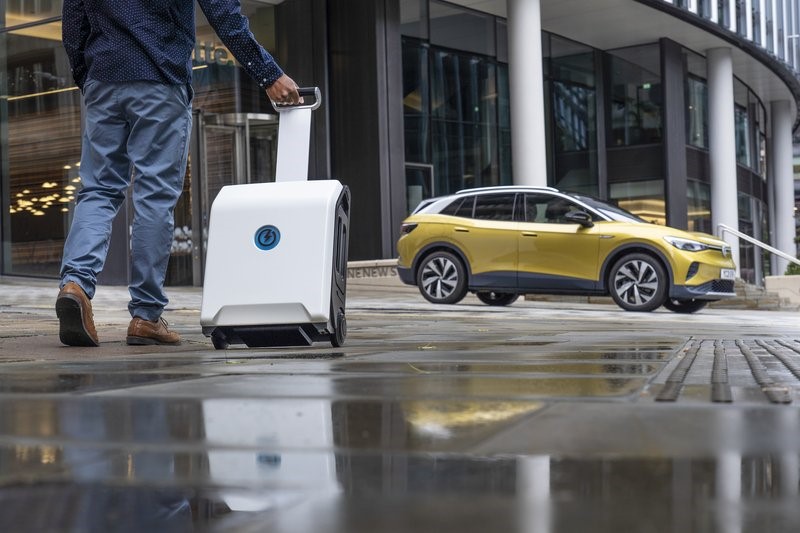
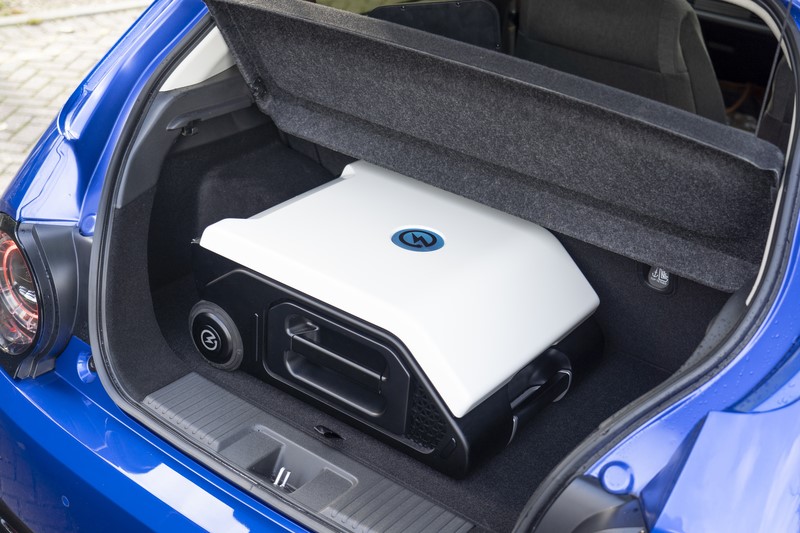
It is the size of a small suitcase, weighs from 25kg and contains lithium-ion batteries with capacities of either 4kWh or 8kWh.
This can be charged at a domestic three-pin socket before being transported – it is wheeled and has a retractable handle, again, similar to a suitcase – to the vehicle where it will take either 30 or 60 minutes to transfer its charge to the BEV, dependent on the version of Go being used.
This is, says Carrier, enough charge to power a BEV for up to 20 miles (4kWh version) or 40 miles (8kW), which means it can be used in place of a home charger or in a number of other situations to help a fleet increase efficiency and reduce charging costs.
“ZipCharge Go was entirely conceived with the fleet market in mind,” says Carrier.
“We’ve done a significant amount of work over the past year-and-a-half speaking to a range of different prospective customers.
“We’ve been fortunate that we’ve had the privilege of speaking to car rental fleets, to car-sharing, to return-to-base operations through to logistics providers.
“We’ve had the opportunity to learn from them – not to pitch our solution, but to gain an understanding of what their needs are.”
Automotive industry experience
Both Carrier and Sibal are steeped in automotive industry experience. Sibal has spent more than 20 years in electronics, software and systems engineering and leadership at manufacturers including McLaren Automotive, London Electric Vehicle Company (LEVC)/London Taxi, Lotus Sportscars and Gordon Murray Automotive.
Carrier has worked for a similar time in product planning, commercial and strategy at OEMs and start-ups including McLaren Automotive, JLR, Mazda and Fiat. The pair worked together at McLaren.
“My career has been in product planning and product strategy, which means I’ve been involved in conceptualising a product from the ground up, working with the designers and engineers to say who is the market? What’s the car for? How will they use it? How do you deliver it?,” says Carrier.
“In the car industry we’re absolutely focused on total cost of ownership (TCO) and, particularly, fleet users.
“I’ve done it with cars like the Jaguar XE, for example, and we’ve applied exactly the same philosophy in the conceptualisation of a car as we have to this charger and, therefore, incorporating the needs of the fleet market.”
Sibal began developing the product in March last year, with Carrier joining in October.
“Many fleets will typically operate on a daily mileage of somewhere between 20 and 50 miles, and our 8kWh can deliver up to 40 miles, so it’s well suited to the daily operational needs those fleets have.
“However, we recognise that not all fleets are homogenous in terms of their driving distances and profiles, so we don’t see the Go as a solution for every fleet in every circumstance.”
He says that as well as a replacement for a home charger, the Go can be used in a variety of ways to help fleets optimise their operations.
Destination charging
Carrier says this includes using the Go for destination charging to fit the process into a vehicle’s daily operation.
“If you take fleets that have a 30-minute to one-hour dwell time where an engineer may, for example, be mending a boiler or servicing a photocopier, they can use that time to charge their vehicle using Go no matter where they are parked,” he says.
“Allowing a fleet to charge during its normal operations increases the range of a vehicle, not only by the mileage from a Go unit, but by the distance the vehicle would have to drive to a charge point.
“It also increases the efficiency of the asset because it charges while the employee is doing their job, so it reduces downtime as well.
“This is a far more efficient way of deploying charging. It fits around how a fleet would otherwise operate the vehicle and increases the efficiency of the asset which, ultimately, improves the customer service of their end operation.”
The Go also has a three-pin plug socket which means it can be used to power tools and equipment which would otherwise be powered by electricity generated by diesel.
“It can reduce CO2 emissions that way as well,” says Sibal. “4kWh is quite a lot: a domestic home uses about 4.4kWh a day if it doesn’t have electric heating.”
Carrier says the Go can also be used to complement depot-based chargers which may reduce any need for a costly upgrade to a depot’s grid connection or reduce the number of chargers which may be needed.
The unit will also be able to integrate with transparency and efficiency.
Sibal adds: “We’re designing the back office from scratch, which allows us to develop a rich API (application programming interface) that will allow our cloud network to interact with any fleet network in accordance with their requirements.
“Just like fleet managers have fleet management software, if they take a take a large number of the units, we will provide them with charger management software.
“That will allow them to learn and optimise the deployment of the chargers to where they can be most effective for their fleets.
“Therefore, the API interfaces with their fleet management software, not only for utilisation and TCO tracking but, critically, as and when they deploy their vehicles, how and when the ZipCharge Go should be deployed and to which vehicles to maximise its utilisation and therefore the efficiency gain a fleet can realise.”
First units due Q4 2022
ZipCharge will begin trials with select partners from next spring with a delivery of the first units to customers expected in quarter four.
“We are looking for fleet partners who would be willing to work with us so we can get some realworld learning and feedback,” says Carrier.
“We want some tangible data that we can share publicly that says ‘this is the real impact and benefit’ and then, hopefully, that becomes a trigger for other fleets to go ‘that’s worth looking at’.”
Go will be available to buy either outright (price has yet to be announced) or leased through a subscription from £49 a month.
Further product development is due to follow.
“We have a roadmap over the next six-to-eight years, where we have forecast and planned in improvements in battery chemistry and energy density,” says Carrier.
“This means we can either make that 4kWh unit lighter with the same energy, or keep the weight the same and increase the energy density.
“We have plans for a range of different products as well as how those are deployed, but we are not talking about those at the moment.
“They are all a part of delivering our vision and that vision is to democratise EV charging so we can allow anybody to charge no matter where they park.” By Graham Hill thanks to Fleet News
Share My Blogs With Others:These icons link to social bookmarking sites where readers can share and discover new web pages.
Users of autonomous vehicles should be legally protected in event of a collision, a new report suggests.
The Law Commission of England and Wales and the Scottish Law Commission have published a joint report, making recommendations for the safe and responsible introduction of self-driving vehicles.
Under the Law Commissions’ proposals, when a car is authorised by a regulatory agency as having “self-driving features” and those features are in-use, the person in the driving seat would no longer be responsible for how the car drives. Instead, the company or body that obtained the authorisation – typically the vehicle manufacturer should face regulatory sanctions if anything goes wrong.
The report recommends introducing a new Automated Vehicles Act, to regulate vehicles that can drive themselves and suggests that a clear distinction should be made between features which just assist drivers, such as adaptive cruise control, and those that are self-driving.
Nicholas Paines QC, public law commissioner, said: “We have an unprecedented opportunity to promote public acceptance of automated vehicles with our recommendations on safety assurance and clarify legal liability. We can also make sure accessibility, especially for older and disabled people, is prioritised from the outset.”
Modern vehicles are fitted with many driver assistance systems and the report anticipates that, in future, these features will develop to a point where an automated vehicle will be able to drive itself for at least part of a journey, without a human paying attention to the road. For example, a car may be able to drive itself on a motorway, or a shuttle bus may be able to navigate a particular route.
The report follows a consultation into the legal ramifications of autonomous driving technology.
The Law Commissions recommend a new system of legal accountability once a vehicle is authorised by a regulatory agency as having self-driving features, and a self-driving feature is engaged.
The person in the driving seat would no longer be a driver but a “user-in-charge”. A user-in-charge cannot be prosecuted for offences which arise directly from the driving task. They would have immunity from a wide range of offences – from dangerous driving to exceeding the speed limit or running a red light.
However, the user-in-charge would retain other driver duties, such as carrying insurance, checking loads or ensuring that children wear seat belts.
If the vehicle drives in a way which would be criminal or unsafe if performed by a human driver, an in-use regulator would work with the carmaker to ensure that the matter does not recur. Regulatory sanctions would also be available to the regulator.
In the case of autonomous taxis or minibuses, where there is no driver, any occupants of the vehicle would simply be passengers. Instead of having a ‘user-in-charge’, a licensed operator would be responsible for overseeing the journey.
Matthew Avery, chief research strategy officer at Thatcham Research, an organisation which was part of the consultation for the Law Commissions’ report, said: “The transition to safe introduction of automation with self-driving capabilities is fraught with risk as we enter the early stages of adoption.
Today’s report is a significant step, as it provides important legal recommendations and clarity for the safe deployment of vehicles with self-driving features onto the UK’s roads.
“In the next 12 months, we’re likely to see the first iterations of self-driving features on cars on UK roads. It’s significant that the Law Commission report highlights driver’s legal obligations and they understand that their vehicle is not yet fully self-driving. It has self-driving features that, in the near future, will be limited to motorway use at low speeds.
“The driver will need to be available to take back control at any time, won’t be permitted to sleep or use their mobile phones, the vehicle won’t be able to change lanes and if the driver does not take back control, when requested, it will stop in lane on the motorway. It is critical that early adopters understand these limitations and their legal obligations.”
The report has been laid before Parliament and the Scottish Parliament. It will be for the UK, Scottish and Welsh Governments to decide whether to accept the Commissions’ recommendations and introduce legislation to bring them into effect. By Graham Hill thanks to Fleet News
Share My Blogs With Others:These icons link to social bookmarking sites where readers can share and discover new web pages.
Gridserve is looking to increase its cost of charging again since it increased its cost of charging an electric vehicle (EV) on its network in January, blaming spiralling costs impacting the energy sector.
In January pricing for medium power chargers – typically 60kW – which are primarily located at motorway service areas is increasing from 30p to 39p per kWh with immediate effect.
However, it said that pricing for high power chargers – up to 350kW – located at its newly developed Electric Hubs (of which it currently has 13 in construction), is 45p per kWh.
It is also keeping pricing at 39p per kWh – even for 350kW chargers – at its Electric Forecourts thanks to onsite solar generation and battery storage which gives the company more control over energy and distribution costs.
Gridserve says that it recognises the better the economics are for using EVs versus petrol or diesel, “the quicker people will make the switch”.
It is why the company says it is investing in new solar energy and battery projects which help to protect customers against the type of price hikes and instability that is currently affecting the energy market.
Gridserve says it wants to revolutionise EV charging across the UK, following the acquisition of Ecotricity’s Electric Highway network in June 2021.
It is expecting to open more than 20 ‘electric hubs’, each featuring 6-12 x 350kW ultra high-power electric vehicle (EV) charge points with contactless payment, at motorway service stations across the UK by Q2 2022.
The majority should be installed by the end of March, with a further 50 additional electric hub sites set to follow.
Two Electric Forecourts situated adjacent to major transport routes and motorways, including a flagship site at Gatwick Airport and Norwich, are also in construction, due to open in 2022.
Several additional Electric Forecourt sites now also have planning permission including Uckfield, Gateshead, Plymouth and Bromborough, with more than 30 additional sites also under development as part of the company’s commitment to deliver over 100 Electric Forecourts.
Gridserve’s price hike follows InstaVolt raising its prices from 40p/kWh to 45p/kWh from December 1, as a result of the increases in the wholesale price of energy.
BP Pulse also increased its prices from December saying that the charging network was “no longer able to absorb the rising costs”. By Graham Hill thanks to Fleet News
Share My Blogs With Others:These icons link to social bookmarking sites where readers can share and discover new web pages.
A reduction in car travel by a quarter is needed by 2030 if the UK is to stay on track to achieve net zero emissions, a new report suggests.
Transport is the fastest growing source of global greenhouse gas emissions and biggest polluting sector of the UK economy, says Greener Transport Solutions.
It is calling for an urgent re-think on the UK’s transport decarbonisation strategy as it publishes a new report: Pathways to Net Zero – Building a framework for systemic change.
The report concludes that technological solutions will be insufficient to hit net zero in the UK. Urgent focus must now be given to traffic reduction, it says.
Transport emissions in the UK are only 3% lower than they were in 1990. People have driven more and in larger vehicles as engines have become more efficient.
The Major of London has pledged 27% reduction in car miles by 2030. The Scottish Government has pledged a 20% reduction.
Research for the Green Alliance shows that a reduction in car kms of 20-27% by 2030 will be needed.
Global greenhouse gas (GHG) emissions must halve by 2030 to stay within 1.5C. However, after a reduction caused by lockdowns GHG emissions have bounced back and are set to rise strongly this year.
Latest figures from the International Energy Agency show that carbon emissions rose to their highest levels in history in 2021 after the world rebounded from the Covid pandemic with heavy reliance on fossil fuels.
CO2 emissions linked to energy climbed 6% last year. Transport has the highest reliance on fossil fuels of any sector and accounts for 37% of CO2 emissions from end‐use sectors.
Claire Haigh, founder and CEO of Greener Transport Solutions, said: “At a time of rising geopolitical uncertainty, insecurity of supplies, and escalating fuel and gas prices, it becomes more critical than ever to design policies in a way that avoids unintended consequences and ensures a fair and just transition to net zero.
“We need a massive shift to clean technologies, but we must also reduce energy demand. Energy demand reduction supports the three key goals of energy policy: security, affordability and sustainability.
“Our climate is heating up at great speed. We have less than a decade to get on track. We cannot rely on technological solutions alone. Traffic reduction will also play a critical role.”
Greener Transport Solutions is a not-for-profit organisation dedicated to the decarbonisation of transport. By Graham Hill thanks to Fleet News
Share My Blogs With Others:These icons link to social bookmarking sites where readers can share and discover new web pages.
The average price of both petrol and diesel climbed to new records again on Wednesday, but wholesale prices have fallen offering some possible respite for fleets.
Unleaded is now 159.57p a litre while diesel increased by another 2p to 167.37p – making for a rise of more than 5p in two days.
A tank of petrol is now almost £88 while diesel has now gone over £92.
RAC fuel spokesman Simon Williams said: “Diesel unfortunately appears to be on a clear path to £1.70 a litre. As this is an average price, drivers will be seeing some unbelievably high prices on forecourts as retailers pass on their increased wholesale costs.
“But there was a hint of better news yesterday on the wholesale market with substantial drops in both petrol and diesel which could lead, in a week or so, to a slight slowing in the daily pump price increases and records being broken less frequently.”
Oil prices have jumped more than 30% since February 24, touching $139 (£105) a barrel at one point this week.
The oil price had fallen back to about $106 a barrel at one point on Wednesday (March 9), but was trading at around $114 today (Thursday, March 10).
Fleet News has teamed up with Allstar to bring you the fuel prices locator, enabling you to compare fuel prices and find the cheapest petrol or diesel in your area.
Even one penny per litre can make all the difference when filling up your fleet vehicles, potentially saving your company thousands of pounds a year. By Graham Hill thanks to Fleet News
Share My Blogs With Others:These icons link to social bookmarking sites where readers can share and discover new web pages.
Friends of the Earth and Client Earth are both taking the UK Government to court over what they claim is a failure to tackle climate change.
Both are arguing that the Government has failed to set out sufficient policies in its Net Zero Strategy to reach net zero emissions by 2050, breaching its legal duties under the 2008 Climate Change Act.
Friends of the Earth also says that the Heat and Buildings Strategy, published at the same time as the Net Zero Strategy, did not consider impact on legally protected groups under the Equality Act.
Sam Hunter-Jones, senior Client Earth lawyer, said: “On releasing the net zero strategy in October 2021, UK Prime Minister Boris Johnson said the Government had centred its plans on the principle of ‘leaving the environment in a better state for the next generation’ and releasing them of the financial burden of adapting to a warming planet.
“However, its own baseline forecasts show that the UK’s projected emissions in 2037 will be more than double the levels the Government is legally required to adhere to.”
Hunter-Jones says the Government is also relying heavily on “unproven technologies” while overlooking viable current solutions that would have immediate impact, including solutions recommended by its own advisors, the Climate Change Committee.
Friends of the Earth claims the pathways to reach net zero in the Net Zero Strategy are theoretical, because they are not supported by Government policy which shows how they can be fulfilled.
It argues that this means the Net Zero Strategy is not lawful, and crucially, does not allow parliament and members of the public to hold government accountable for any failures.
Friends of the Earth also claims that the Government failed to consider the impact of its Heat and Buildings Strategy on protected groups.
Factors such as age (both the elderly and the very young who will live with the greatest future climate impacts), sex, race, and disability can make people more vulnerable to climate impacts. This unaddressed inequality needs transparency and political accountability, it argues.
A refusal so far to disclose its equality impact assessment for the Net Zero Strategy has raised similar concerns, it says.
Katie de Kauwe, lawyer at Friends of the Earth, said: “A rapid and fair transition to a safer future requires a plan that shows how much greenhouse gas reduction the chosen policies will achieve, and by when. That the plan for achieving net zero is published without this information in it is very worrying, and we believe is unlawful.
“We know that those who do least to cause climate breakdown are too often the hardest hit. Climate action must be based on reversing these inequalities, by designing the transition with the most vulnerable in mind.
“Not even considering the implications of the Heat and Building Strategy on groups such as older and disabled people, and people of colour and ethnic minorities is quite shocking, given these groups are disproportionately impacted by fuel poverty, for example.”
She added: “The bottom line is that the Government’s vision for net zero doesn’t match the lacklustre policy that is supposed to make it possible.
“We are very concerned at the potential consequences of such a strategy for people in this country, and across the world, given the climate emergency. This is why we are taking this legal action today.”
Following filing of the claims with the High Court, the Government will submit its defence, and the Court will then decide whether to grant permission for a full hearing.
Rowan Smith, solicitor at Leigh Day, said: “Under the Climate Change Act 2008, the Secretary of State has a legal obligation to set out how the UK will actually meet carbon reduction targets.
“Friends of the Earth considers that the Net Zero Strategy lacks the vital information to give effect to that duty, and so any conclusion, that targets will be achieved on the basis of the policies put forward, is unlawful.
“Friends of the Earth is concerned that this places future generations at a particular disadvantage, because current mistakes are harder to rectify the closer we get to 2050. That is why this legal challenge is so important.”
UK CLIMATE RISK ASSESMENT
The Government published the UK’s Third Climate Change Risk Assessment earlier this week, recognising the unprecedented challenge of ensuring the UK is resilient to climate change.
The five-year assessment, delivered under the Climate Change Act 2008 and following close work with the Climate Change Committee (CCC), identifies the risks that climate change poses.
For eight individual risks, economic damages could exceed £1 billion per year each by 2050 with a temperature rise of 2°C, with the cost of climate change to the UK rising to at least 1% of GDP by 2045.
The report comes three months after the UK hosted the COP26 climate conference in Glasgow, bringing together nearly 200 countries to limit temperature rise and keep 1.5 alive.
Climate adaptation minister Jo Churchill said: “The scale and severity of the challenge posed by climate change means we cannot tackle it overnight, and although we’ve made good progress in recent years there is clearly much more that we need to do.
“By recognising the further progress that needs to be made, we’re committing to significantly increasing our efforts and setting a path towards the third National Adaptation Programme which will set ambitious and robust policies to make sure we are resilient to climate change into the future.” By Graham Hill thanks to Fleet News
Share My Blogs With Others:These icons link to social bookmarking sites where readers can share and discover new web pages.
Outright purchase fleets are worried that the residual values of petrol and diesel cars and vans could fall substantially from 2025, pushing them towards electric vehicles (EVs) instead.
Fleets that order new vehicles now are likely to dispose of them between 2026 and 2028, only a few years before the sale of new petrol and diesel cars and vans will be banned.
Andy Kirby, customer success director at FleetCheck, said: “There is a general feeling that, as we head towards the 2030 end of ICE production, no-one really knows what is going to happen to used vehicle buyer sentiment and therefore RVs.
“There are extremes of belief – some saying that petrol and diesel demand will hold up because those vehicles offer definite advantages and will be in limited supply, while others believe that they will be seen as yesterday’s technology and discarded.
“Because of this uncertainty, there is a feeling that ICE is increasingly a gamble when it comes to future RVs. The logic is that EV demand is now a solid bet for the future, while petrol and diesel will certainly fall away at some stage.”
The situation is being made more acute by the current long delays affecting vehicle supply.
Kirby added: “If you order a car today and are given a delivery date of late 2022 then, if you are operating on a four year cycle, that takes you right up to 2026 as a disposal date, which feels very near to the 2030 deadline. The fear is that the used market will be quite different by then.
“The situation is even more marked when it comes to van operation. We have some fleets who operate LCVs on a six year cycle. That means if you place an order now, you’ll be potentially looking to sell that van in 2028, when it is likely that electric will be the fleet norm.
“When faced with these kinds of scenarios, we are increasingly seeing people choose electric today become it looks like the safer RV bet. This is a way of thinking that can only become more dominant as time passes.” By Graham Hill thanks to Fleet News
Share My Blogs With Others:These icons link to social bookmarking sites where readers can share and discover new web pages.
The expansion of the ultra-low emission zone (ULEZ) to include Greater London and higher charges for all but the cleanest vehicles are being considered ahead of a possible road pricing scheme for the capital.
The Mayor of London says that ‘bold action’ is required now to improve air quality and cut congestion, but also wants Transport for London (TfL) to investigate the merits of road user charging technology.
It comes as a new report, published today (Tuesday, January 18) by Element Energy and commissioned by the Mayor of London, sets out the action required to move London towards net-zero carbon emissions by 2030.
The Mayor of London, Sadiq Khan, said: “Nearly half of Londoners don’t own a car, but they are disproportionally feeling the damaging consequences polluting vehicles are causing.
“We have too often seen measures to tackle air pollution and the climate emergency delayed around the world, because it’s viewed as being too hard or politically inconvenient, but I’m not willing to put off action we have the ability to implement here in London.”
The report sets out that to achieve required reduction in car use in the capital will need a new kind of road user charging system implemented by the end of the decade at the latest.
Such a system, says the Mayor, could abolish all existing road user charges – such as the congestion charge and ULEZ – and replace them with a scheme where drivers pay per mile, with different rates depending on how polluting vehicles are, the level of congestion in the area and access to public transport.
Subject to consultation, it is likely there would be exemptions and discounts for those on low incomes and with disabilities, as well as consideration around support for charities and small businesses.
However, recognising that the technology to implement such a scheme will take time, Khan says that action must be taken now.
The potential approaches under consideration in the short term are:
Extending the Ultra Low Emission Zone (ULEZ) beyond the north and south circular roads to cover the whole of Greater London, using the current charge level and emissions standards.
Modifying the ULEZ to make it even more impactful by extending it to cover the whole of Greater London and adding a small clean air charge for all but the cleanest vehicles.
Introducing a clean air charge: a low-level daily charge across all of Greater London for all but the cleanest vehicles.
Introducing a Greater London boundary charge, which would charge a small fee to non-London registered vehicles entering Greater London, responding to the increase in cars from outside London travelling into the city seen in recent years.
TfL says it will launch a public consultation on the short-term options, speaking to local government and businesses about the way forward.
Subject to consultation and feasibility study, the chosen scheme would be implemented by May 2024.
Gerry Keaney, chief executive of trade group, the British Vehicle Rental and Leasing Association (BVRLA), welcomed the Mayor’s plans, which he said complemented the BVRLA’s ongoing support for shared mobility models and a “clear roadmap” for road pricing.
“Importantly, this announcement gives the industry time to implement the changes that are essential to making the targets reality,” explained Keaney.
“London does not only have an emissions problem, it has a congestion problem too. We need fewer, cleaner private cars on the road.
“Car clubs, alongside rental and leased vehicles provide the solution to this while keep people mobile and offering positive alternatives to public transport.”
The ULEZ currently covers an area up to, but not including, the North Circular Road (A406) and South Circular Road (A205). It was expanded in the autumn and is now 18 times larger than the original central London ULEZ, which had occupied the same area as the congestion charge zone.
Masternaut estimated that the cost to fleets of that last expansion of the clean air zone (CAZ) could be as high as £54 million.
Christina Calderato, director of transport strategy and policy at TfL, said: “Road based transport has for many years been a major contributor towards poor air quality and carbon emissions and we are determined to reverse this through a wide range of programmes across TfL.
“The world-leading road user charging schemes we’ve delivered throughout the last 20 years have been really effective in addressing congestion and tackling air quality across London, but it is clear that as a city we need to go further.
“These new approaches will allow us to take further steps towards a net-zero city and we will ensure that Londoners and those who regularly visit London are involved as we progress this work in more detail.”
The merits of a national road pricing scheme to plug a potential £40 billion shortfall from road taxes, including fuel duty, were expected to be investigated as part of the Government’s Net Zero Strategy, but were omitted from the final report.
Arguing the environmental benefits of road pricing, Khan says he wants greater support to reduce carbon emissions in London. It will also raise revenue for TfL, which recently had emergency funding from the Government extended until February 4.
Ministers agreed a £1.08bn funding package to help TfL recover from the coronavirus pandemic in June.
The bailout, which provided financial support for the hard-hit transport authority until December 11, followed two emergency support packages agreed in April and October 2020, and took Government support to TfL since March 2020 to more than £4bn.
Tanya Sinclair, policy director for the UK and Ireland at ChargePoint, said: “We support road pricing, so long as it is designed with drivers and fleet operators in mind.
“Road pricing needs to be considered in the context of all the taxes, incentives and payments drivers make. It’s a balancing act – the UK Government needs to make sure that it isn’t giving out grant incentives with one hand and then taking them back through road pricing.
“The road pricing formula must encourage drivers to make cleaner vehicle and driving choices and no EV driver should pay more or lose out as a result of road pricing. However, this doesn’t mean EVs should pay nothing. They use the road like any other vehicle and should contribute appropriately, especially when it comes to reducing overall congestion.” By Graham Hill thanks to Fleet News
Share My Blogs With Others:These icons link to social bookmarking sites where readers can share and discover new web pages.
ZenAuto says it has seen a 172% increase in searches for electric cars on its car leasing website since September 2021, while Google searches peaked at a five-year high.
Zenith’s personal leasing division says this has been driven by the fuel supply shortage in September 2021, and the UN climate COP26 summit that took place in Glasgow in November 2021.
According to a poll of 4,000 motorists run by ZenAuto, one in five (19%) said the fuel crisis made them more eager to switch to an electric vehicle (EV) sooner, while a third (35%) said that COP26 had encouraged this.
Drivers in Bristol (30%), Belfast (25%), and Sheffield (17%) were found to be the most likely to move to an electric car sooner than they’re previously planned, as a direct result of the fuel crisis.
In contrast, drivers in Manchester were the most likely to report a change in their attitude to EVs following the COP26 summit, with nearly half (45%) saying it had made them more likely to switch to an EV sooner. Motorists in London weren’t far behind (44%), with a high number of Bristolians (39%) also agreeing.
Vicky Kerridge, head of consumer experience and brand at ZenAuto, said: “Whilst the fuel crisis and COP26 clearly had an impact on the attitudes of non-electric car drivers in the UK, encouraging many to want to make the switch sooner, there are still some concerns that are holding a number back from being able to commit to an e-car.”
Two-thirds (68%) of non-EV drivers said they were put off by the initial cost of the vehicles, and more than half (58%) said prices would need to significantly reduce for them to buy in the next six months.
Access to charging points is also a top concern, with almost half (46%) feeling that the number of points in their area would need to significantly increase for this to be a viable option for them, and 38% saying they would want a free charging point provided for their home.
Kerridge said: “As a company, we’re doing all we can to help make the switch an easier and cheaper process for those wishing to do so.” By Graham Hill thanks to Fleet News
Share My Blogs With Others:These icons link to social bookmarking sites where readers can share and discover new web pages.