New Technology Reduces Waiting Time At Temporary Traffic Lights

Saturday, 20. June 2020

A new ‘smart’ traffic light system is helping to reduce waiting times for drivers across the South East.


Seven towns across Kent and East Sussex have benefited so far from new technology, which was successfully trialled by electricity firm UK Power Networks in Maidstone, last summer.


As the Covid-19 pandemic continues, the firm has worked with local councils to use the new smart traffic lights across Marden, Orpington, Crowborough, Twickenham, Maidstone and Dover.


The temporary traffic lights, which are sometimes necessary, to cater for roadworks use something called the ‘autoGreen’ radar system. It automatically detects congestion and makes continuous adjustments to the phasing of the traffic lights to maximise traffic flow, all without the need for an operator’s intervention.


Each site is different, it says, but this form of artificial intelligence adapts to the situations it monitors, creating safer, more efficient and less stressful journeys and local environments.


The trial in Maidstone revealed that in heavy traffic autoGreen reduced journey times between 8% and 12%, rising to 27% to 41% in congested conditions, with some 15-minute periods cutting journey times by half.


Other benefits to motorists and councils included less impact on surrounding infrastructure and reducing the environmental impact of queuing traffic. It also improved safety for workers on site, by reducing their exposure to pollution, safety risks and occasional abuse, it said.


Paul Dooley, streetworks performance manager at UK Power Networks, explained: “Our trial in Kent using this technology was well received.


“We were able to demonstrate the tangible benefits and help to alleviate environmental concerns. There was a greater increase in cars passing per hour. This in turn led to shorter journey times along with an overall improvement in air quality.”


Dooley says that the system accurately tracks vehicle movements and uses this information to optimise the operation of the lights, varying the decision-making algorithms and timings.


He concluded: “Our long-term aim is for this type of smart traffic lights to be deployed whenever we need to do roadworks that affect traffic, across Kent and the other areas that we serve, in future.”  By Graham Hill thanks to Fleet News

Share My Blogs With Others: These icons link to social bookmarking sites where readers can share and discover new web pages.
  • MisterWong
  • Y!GG
  • Webnews
  • Digg
  • del.icio.us
  • StumbleUpon
  • Reddit
  • Alltagz
  • Ask
  • Bloglines
  • Facebook
  • YahooMyWeb
  • Google Bookmarks
  • LinkedIn
  • MySpace
  • TwitThis
  • Squidoo
  • MyShare
  • YahooBuzz
  • De.lirio.us
  • Wikio UK
  • Print
  • Socializer
  • blogmarks

Council To Fine Drivers Who Keep Their Engines Running

Saturday, 20. June 2020

Drivers who leave their vehicle’s engine running while parked face a £20 fine after Lambeth Council introduced the penalty to improve air quality.


Drivers who allow their vehicle engines to run “unnecessarily” when parked in the London borough will be asked to turn off their engines, and if they fail to cooperate, will be issued with the fine from Monday (May 18).


The move builds on previous anti-idling events in the borough to raise awareness and educate drivers on the effects of idling, it said.


Councillor Claire Holland, Lambeth’s deputy leader  and cabinet member for sustainable transport, environment and clean air, said: “Cleaning up toxic air is an absolute priority for this council.


“Poor air quality is a huge health risk to our residents, and engine idling is a major contributor. We are determined to tackle the issue and are confident these new measures will help encourage people to change their behaviour so that everyone in Lambeth – particularly young children due to the effects on their development – is able to breathe clean air.”


In Lambeth, Waterloo, the Southbank, central Brixton, Clapham and the Vauxhall Gyratory have been identified as idling hotspots.


Outside schools, hospitals, taxi ranks and coach bays have also been flagged as key locations for drivers committing idling offences.


Between February 2018 and September 2019 wardens in Lambeth told 2,044 drivers to switch off their engine while stationary, of which 2,017 drivers complied with their advice and 27 people did not.  By Graham Hill thanks to Fleet News

Share My Blogs With Others: These icons link to social bookmarking sites where readers can share and discover new web pages.
  • MisterWong
  • Y!GG
  • Webnews
  • Digg
  • del.icio.us
  • StumbleUpon
  • Reddit
  • Alltagz
  • Ask
  • Bloglines
  • Facebook
  • YahooMyWeb
  • Google Bookmarks
  • LinkedIn
  • MySpace
  • TwitThis
  • Squidoo
  • MyShare
  • YahooBuzz
  • De.lirio.us
  • Wikio UK
  • Print
  • Socializer
  • blogmarks

Euro NCAP Announces Biggest Changes To Safety Tests For 10 Years

Saturday, 20. June 2020

Euro NCAP has announced a series of new safety tests into its programme, which have been labelled as “game-changing” by Thatcham Research.


Vehicles launched in 2020 will undergo the new tests later this year, which are designed to “address long-standing needs in occupant protection, improve post-crash protection and promote the latest advanced driver assistance technology.”


A key change is the implementation of a new moving barrier to the moving car frontal crash test. It replaces the offset-deformable barrier test, which has been used by Euro NCAP for the last 23 years.


This new test evaluates the protection of occupants inside the car while also assessing how the car’s front-end structure contribute to injuries in the collision partner.


“The objective is to encourage makers of larger vehicles to share some of the burden of the impact with smaller vehicles. Historically SUVs and other big cars have offered very good protection to their occupants. However, the smaller vehicles they sometimes crash into can fare less well,” said Matthew Avery, director of research Thatcham Research and Euro NCAP board member.


In the new compatibility test, if the larger vehicle is too stiff in an impact scenario, it will be penalised accordingly. Avery says this levels the playing field for all vehicle sizes, which is a “win-win for road safety”.


Side impacts account for the second highest frequency of death or serious injuries. The latest updates to this area of the safety assessment include adjustments to the near-side barrier test speed and mass, increasing the severity of the test.


Euro NCAP will, for the first time, evaluate far-side impact protection, focussing on driver protection and the potential interaction between driver and front seat passenger. With the latter test, the protection offered by new-to-market countermeasures such as centre airbags can be adequately verified.


The organisation has also added new, more challenging, test scenarios to rate AEB technology for cars and vulnerable road users, including back over situations and turning at a crossing. In addition, the first step is taken to evaluate Driver Status Monitoring systems, designed to detect driver fatigue and distraction, as part of the Safety Assist assessment.


Post-crash safety too plays a vital role in crash survival. In partnership with CTIF, the International Association of Fire & Rescue Services, Euro NCAP developed new rating rules to promote better post-crash safety.


Manufacturers will be rewarded when rescue information is accurate and easily available. Euro NCAP also checks ease of extrication, electric door handles, etc. and endorses advanced eCall functions.


Avery said: “These are the biggest changes to Euro NCAP’s impact testing protocols in a decade. Chief amongst them is the new ‘compatibility’ impact test. For the first time there will be two moving elements to the head on collision: the test vehicle and barrier.


Most importantly we will not only look at the intrusion occurring to the vehicle being tested, but also to the new Mobile-offset Progressive Deformable Barrier.”


In addition, a new ‘THOR’ mid-sized dummy will be used in the tests. Avery continued: “The THOR dummy is the most advanced we’ve ever worked with. It makes the new test especially challenging for carmakers, as the dummy more closely represents a human.


The previous dummy we used was designed for impact scenarios that are less common today, while the THOR dummy is far more complex and sensitive and can record abdominal injuries.


“As a result, carmakers not only have to tune vehicle restraints and structures to accommodate for THOR’s sophistication, but there is also the new barrier to consider.” By Graham Hill thanks to Fleet News

Share My Blogs With Others: These icons link to social bookmarking sites where readers can share and discover new web pages.
  • MisterWong
  • Y!GG
  • Webnews
  • Digg
  • del.icio.us
  • StumbleUpon
  • Reddit
  • Alltagz
  • Ask
  • Bloglines
  • Facebook
  • YahooMyWeb
  • Google Bookmarks
  • LinkedIn
  • MySpace
  • TwitThis
  • Squidoo
  • MyShare
  • YahooBuzz
  • De.lirio.us
  • Wikio UK
  • Print
  • Socializer
  • blogmarks

More Drivers Are Avoiding Various Motor Fines

Saturday, 20. June 2020

The volume of motoring fines and penalties incurred by company car and van drivers increased by 3% in 2019, new figures from Lex Autolease show.


This compares to a 60% year-on-year cumulative increase over the past three years, suggesting a slower rate of increase than in previous years.


This was also reflected in the value of fines incurred by drivers, which did not grow for the first-time last year, bucking the trend of yearly increases from £10.7 million in 2016 to £17.1m 2019.


The percentage of drivers caught by bus lane cameras fell for the first time by 17% year-on-year, with fines issued for congestion charges and council parking also falling by 6% and 4% respectively.


Mersey Flow and Dartford Crossing fines also saw a year-on-year decrease with the total number of penalty notices issued falling by more than two fifths (44%) from 54,618 in 2018 to 30,391 in 2019.


However, the picture is not entirely positive, says the country’s largest vehicle leasing company.


The percentage of motorists penalised in private car parks rose by 6% year-on-year to £6.2m, and illegal junction-box stops and red-route driving fines increased by almost a fifth (19%) to £6.3m during the same period.


Lex Autolease analysed data from more than 361,000 company cars and vans to identify trends in behaviour and driver safety.


Kim Morris, motor operations director at Lex Autolease, said: “Company car drivers are often more likely to incur fines and penalties on the roads when compared to ordinary motorists, as the pressure to hit deadlines and attend meetings on time can sometimes lead to poor driver behaviour.


“The majority of fines can be easily avoided and if not closely monitored can quickly add up to expensive outgoings for employers – especially those with larger fleets.”


She believes that the emphasis fleet managers have placed upon driver health and safety in recent years is starting to pay off, with a considerable slowing in the rise of the number of fines incurred and a decrease in the number of fines for commonplace offences, including bus lane driving and congestion charges.


However, she said: “Our analysis shows that there’s still more businesses can do to educate their employees to bring these numbers down further.


“Continuing to invest further in driver education can help to modify employees’ driving habits and in turn save businesses unnecessary outgoings each month.”


She concluded: “As the new tax changes for alternatively-fuelled vehicles gather momentum, driver education will become even more important for fleets to make sure avoidable fines and penalties do not offset the cost saving benefits of low or zero emission vehicles.”  By Graham Hill thanks to Fleet News

Share My Blogs With Others: These icons link to social bookmarking sites where readers can share and discover new web pages.
  • MisterWong
  • Y!GG
  • Webnews
  • Digg
  • del.icio.us
  • StumbleUpon
  • Reddit
  • Alltagz
  • Ask
  • Bloglines
  • Facebook
  • YahooMyWeb
  • Google Bookmarks
  • LinkedIn
  • MySpace
  • TwitThis
  • Squidoo
  • MyShare
  • YahooBuzz
  • De.lirio.us
  • Wikio UK
  • Print
  • Socializer
  • blogmarks

Latest Diesel Engines Are The Cleanest Ever And Cleaner Than Petrol

Thursday, 11. June 2020

I’ve included the following report because it illustrates a point that I’ve been making for some time now that diesels are now cleaner than petrol cars and as we are years away from all cars being electric should they still be demonised and disregarded by drivers?


The fact is that whilst sales of petrol vehicles now massively exceeds the sale of diesels, if you are environmentally aware but not in a position to drive an electric vehicle should you immediately opt for petrol? Petrol emits more CO2 than diesel so if we’re not careful we will see the opening up of holes in the ozone layer – remember those? So read the report, aimed at the fleet industry, and draw your own conclusions.


Once the fuel of choice for the company car driver, diesel’s dominance among fleets has been on the wane for some time.


Its reputation tarnished and the attraction of tax-busting hybrid and battery electric vehicles (BEVs) difficult to ignore, numbers have continued to dwindle.


Industry leaders say they cannot see a way back for the embattled fuel and this is despite diesel beginning its fightback last year, when the first cars complying with the latest emissions standard began joining UK fleets.


Cars qualifying for the so-called RDE2 standard do not attract the 4% diesel company car tax surcharge, while fleets benefit from not having to pay the higher first-year rate of VED.


Shaun Sadlier, head of consultancy at Arval UK, says the savings from choosing a RDE2 diesel company car can run into “thousands of pounds” over a typical three-to-four-year lease contract.


“Fleets operating RDE2 cars also benefit from lower Class 1A NICs and first-year VED costs in comparison with a non-compliant model,” he said.


Mercedes-Benz, Jaguar Land Rover (JLR) and BMW were among the first to offer RDE2 cars. Rob Morris, national fleet operations manager, at Mercedes-Benz, says that its RDE2-compliant engines were a “popular choice” with customers.


All Mercedes-Benz cars produced from this month (June) will meet the stricter standard.


Vauxhall has become the first volume manufacturer to offer the emissions standard across its range.


James Taylor, general sales director at Vauxhall, told Fleet News: “That means all new Vauxhalls avoid the 4% diesel surcharge on benefit-in-kind (BIK), offering savings to our customers of up to £22 and £43 per month for 20% and 40% taxpayers, compared with the same (non-compliant) models.”


STRICTER LIMITS


The on-the-road Real Driving Emissions (RDE) test was introduced alongside the new emissions testing regime, the Worldwide harmonised Light vehicle Test Procedure (WLTP), in two stages.


RDE1 was introduced in September 2017 for new car type approvals and applied to all new car registrations from September, last year. Vehicles compliant with this standard are designated Euro 6d-Temp. The stricter RDE2 standard came into force from January for new type approvals and will be applicable to all new cars, which will be labelled Euro 6d, from January 2021.


Cars certified to RDE1 (Euro 6d-Temp) must emit less than 2.1 times the Euro 6 NOx limit of 80mg/km for diesel and 60mg/km for petrol engines. This conformity factor tightens to 1.43 times for RDE2-compliant (Euro 6d) vehicles.


In 2023, it’s expected conformity factors will be removed, aligning laboratory and on-road emissions limits.


Alongside Vauxhall, other Groupe PSA brands have become RDE2-compliant, including all Citroën and DS diesel models, plus the majority of Peugeots now also meet the stricter emissions standard.


RDE2 models include all 1.5-litre and 2.0-litre BlueHDI-powered Citroëns and DSs, with manual and EAT8 automatic transmissions.


BlueHDi versions of the Peugeot 3008 and 508 have also qualified, along with the new 208 and 2008.


Martin Gurney, who is responsible for fleet and used vehicle sales for Peugeot, Citroën and DS in the UK, says Groupe PSA has been “working hard” to ensure its vehicles are compliant ahead of schedule.


He added: “These early announcements should reassure customers that we are committed to engineering clean and efficient powertrains for all drivers. The fact that most of our diesel models already meet the forthcoming RDE2 standards speaks volumes about the development that goes into our engines.”


BMW continues to add RDE2 models, while Hyundai says it will add further RDE2 engines to its line-up to join the i10, later this year.


Other manufacturers, such as Audi, Škoda, Renault and Kia, which do not currently have any RDE2 cars, say launches in the second half of the year will see compliant models come through.


But will a wider choice of cars, which avoid the 4% surcharge, be enough to halt the demise of diesel?


DIESEL’S DECLINE


The leasing industry is reporting growing interest from savvy fleets, but all admit the focus is shifting to zero emission motoring.


Figures from the Fleet News FN50 show that the proportion of diesel cars on the FN50 fleet – the UK’s top 50 leasing companies by risk fleet size – fell from almost two-thirds (63.4%) to almost half (50.5%) in 2019.


In terms of vehicles they had ordered, the flight from diesel was still more pronounced. Almost half of the cars ordered last year were petrol (47.6%), while only two-fifths (38.8%) were diesel.


Jon Lawes, managing director of Hitachi Capital Vehicle Solutions, has seen a growing fleet interest in RDE2 diesel cars.


However, he says this is when there is a direct comparable alternative available for the model they want.


He explained: “WLTP has been responsible for the wholesale rise of CO2, irrespective of RDE categorisation, and, therefore, we’ve seen a continued negative shift in perception of diesel vehicles.”


WLTP CO2 values for company cars registered after April 6, which are typically higher than those derived from the old emissions testing regime for comparable vehicles, are now used for tax purposes.


Their use has coincided with a new company car tax regime to try to take account of the hike in emissions, which also includes a new zero percentage rate for battery electric vehicles (BEVs).


PLUG-IN INCENTIVES


Lawes says he expects a “continuing overall decline” in diesel market share as more fleets opt for plug-in hybrid or BEV alternatives.


However, he did offer a glimmer of hope for diesel powertrains. “We expect RDE2 models will cause this decline to plateau as this will provide a favourable cost-effective option for some sectors and drivers.”


David Bushnell, principal consult-ant at Alphabet (GB), said: “For those high mileage drivers, where diesel is still probably the number one choice for fleets, the selection of an RDE2 vehicle will clearly make sense in terms of personal taxation and national insurance costs.


“It’s also an existing technology that many drivers are comfortable using. But, even here, we’re seeing mild hybrid technology coming in to reduce drivetrains’ CO2 output.”


However, he says the “clear additional tax benefits” for choosing plug-in hybrid and battery electric vehicles, revealed in the Budget, will prove hard to ignore.


Chris Chandler, principal consultant at Lex Autolease, has seen a similar trend. He said: “The cost savings and environmental benefits of a plug-in hybrid or full electric alternative are more attractive at the moment.


“The main question we’re being asked by fleets on a daily basis is how they can start – or accelerate – their transition along the ‘Road to Zero’.


“The availability of RDE2 vehicles and how to optimise diesel fleets seems to be far lower down fleet managers’ agendas.”


GROWING INTEREST


Chandler’s comments appear to be backed up by the results of a recent Energy Saving Trust survey.


It revealed that one-in-three UK fleet managers expect half of their company car fleet to be electric by 2025, and seven-in-10 fleet managers are preparing to buy an electric car within two years.


Matthew Walters, head of consultancy and customer data services at LeasePlan UK, said: “From our conversations with fleet managers, it’s evident WLTP is still the main consideration when it comes to compliance-related tax savings and how this impacts the vehicle selection process.”


He expects sales of internal combustion vehicles (ICEs) to fall as electric vehicles become more available and increasingly affordable.


Lex Autolease has seen a significant increase in demand for plug-in hybrid and full electric vehicles over the past 12 months, especially since the 0% BIK tax announcement.


Chandler says a “good awareness” of wholelife costs in the market is driving the shift towards low and zero-emission driving.


He said: “Rather than pay 25-30% tax on a RDE2-compliant diesel vehicle, company car drivers seem to be more focused on taking advantage of the tax benefits of plug-in hybrid and pure electric cars.”


As a result, the UK’s largest vehicle leasing company, Lex Autolease, says it doesn’t anticipate increased availability and understanding of RDE2-compliant models will significantly slow the decline of diesel.


Chandler added: “RDE2-compliant models will simply account for a growing proportion of the existing diesel market.”  By Graham Hill thanks to Fleet News.

Share My Blogs With Others: These icons link to social bookmarking sites where readers can share and discover new web pages.
  • MisterWong
  • Y!GG
  • Webnews
  • Digg
  • del.icio.us
  • StumbleUpon
  • Reddit
  • Alltagz
  • Ask
  • Bloglines
  • Facebook
  • YahooMyWeb
  • Google Bookmarks
  • LinkedIn
  • MySpace
  • TwitThis
  • Squidoo
  • MyShare
  • YahooBuzz
  • De.lirio.us
  • Wikio UK
  • Print
  • Socializer
  • blogmarks

Sanitisation – Another Cost To Bear?

Thursday, 11. June 2020

Sanitisation costs for cars and vans bei g delivered and returning from garages are beginning to appear.


Dealers and garages are currently “working out” who pays the cost of sanitisation on cars and vans that are delivered to their new owners or undergo service, maintenance and repair (SMR).


There appears to be general agreement among all parties that vehicles will need sanitising thoroughly before they are handed over or handed back after service and maintenance to the customer or employee with a company car.


But who is to pay for cleaning products, PPE equipment and the time taken? These costs can’t simply be absorbed by the dealers and garages.


Tim Meadows, vice president and commercial director at Epyx, said: “This is a development that we are just starting to see through our 1link Service Network SMR platform, which is used by fleets totalling four million vehicles, as lockdown starts to ease.


“Sanitisation is becoming recognised as an essential part of almost any visit by a vehicle to a workshop. The car or van is potentially touched by many people as part of almost any SMR process, and the potential spread of infection needs to be minimised.


“However, that sanitisation has a cost and is starting to appear as a formal charge on some job sheets. The question is, who pays?”


Meadows says that garages “understandably” see it as an additional cost that they shouldn’t have to bear. “Their customers, equally understandably, feel the same,” he said.


The issue is especially acute where, on lower Service Maintenance and Repair bills, it could be interpreted as a disproportionate amount, added Meadows.


“If you are having £1,000 of work done, then a potential £10 item doesn’t stick out but, if your car is in the workshop for a MOT test or even just having a small repair, it becomes more noticeable.”


Leasing companies that already work on very small margins are working with dealers and manufacturers to arrive at a compromise to avoid increased delivery costs


Meadows continued: “Some of the fleets that use 1link Service Network have hundreds of thousands of maintenance jobs every year and adding £10 to each suddenly becomes a very large sum of money.


“Equally, this is a significant cost for garages to absorb. However efficient they become at sanitisation, this is something that takes time and money.”


Meadows believes that one thing that the industry had seen during the coronavirus crisis is a “very strong spirit of co-operation”.


“Everyone recognises that they are facing the same issues and they need to resolve them together,” he said. “We are sure that sensible solutions will be found to this problem.”


I agree, it’s not the end of the world, an extra £10 for most jobs is not over the top, it’s more the concern on the part of the customer that the sanitisation has been carried out. So many changes to our lives, not just in the short term but forever. By Graham Hill thanks also to Fleet News

Share My Blogs With Others: These icons link to social bookmarking sites where readers can share and discover new web pages.
  • MisterWong
  • Y!GG
  • Webnews
  • Digg
  • del.icio.us
  • StumbleUpon
  • Reddit
  • Alltagz
  • Ask
  • Bloglines
  • Facebook
  • YahooMyWeb
  • Google Bookmarks
  • LinkedIn
  • MySpace
  • TwitThis
  • Squidoo
  • MyShare
  • YahooBuzz
  • De.lirio.us
  • Wikio UK
  • Print
  • Socializer
  • blogmarks

Government Group Calls On More Technology And Police To Reduce Deaths On Roads

Thursday, 11. June 2020

The Government is being urged to invest in roads policing and fast track technology to catch drivers who flout traffic laws.


Some 1,800 people die on UK roads each year – more than twice the number of deaths from homicides and terrorism combined. A further 25,000-plus people are seriously injured.


However, over the past decade, the number of roads policing officers has decreased substantially.


While the total number of police officers has fallen by around 13% since 2010, there was a 22% reduction in the number of dedicated roads policing officers between 2010 and 2014, and a further reduction of 18% since 2015.


In 2019, dedicated roads policing officers made up only around 4% of total force strength.


Furthermore, of those dedicated officers, many are often ‘double-hatted’, with responsibilities for carrying out more than one policing function.


The Parliamentary Advisory Council for Transport Safety (PACTS), in a report published today (Thursday, June 4), criticises successive cuts in roads policing.


It wants the Government to specify roads policing within its pledge to fund 20,000 additional police officers.


PACTS executive director, David Davies, explained: “The number of road deaths is more than twice the deaths from homicide and terrorism combined and breaches of road traffic laws are the biggest single cause of road deaths. This needs to be recognised in the Government’s priorities and resources for policing.”


Many of the casualties on UK roads result from a failure to comply with traffic laws – knowingly or otherwise, says the report.


Around two-thirds of collisions involve excessive speed, a driver over the legal alcohol limit, failure to wear a seat belt, or a combination of these factors. This does not take into account other offences, such as drug driving or hand-held mobile phone use.


Since 2010, the long-term decline in the number of road deaths and serious injuries has largely ceased, with many suggesting this is at least partly due to reductions in roads policing.


International research of the effectiveness of roads policing in increasing compliance with traffic laws and reducing road casualties, has been shown to cut some collision types by around a quarter.


A detailed analysis by PACTS of the ‘fatal 4’ offences (speeding, not wearing a seatbelt, driving under the influence of drink or drugs, and using a handheld mobile phone behind the wheel) since 2010, shows that where enforcement has been increased, compliance has improved and casualties have dropped; but where cutbacks have affected enforcement, there has been little or no improvement.


The PACTS report – Road Policing and its Contribution to Road Safety – investigates links between roads policing, compliance with traffic laws and road casualties, and looks for ways to enhance the effectiveness of roads policing, ahead of a Whitehall review,


It says that the wider use of technology to “monitor, deter, detect and prosecute” should be exploited to help police target high-risk individuals and assist in improving compliance with seat belts, mobile phones, drink driving and other safety requirements – not just speed.


It is calling for a review of Home Office type approvals to allow for the development and implementation of technologies such as cameras with more than one purpose and evidential roadside testing equipment.


The report says that there is “clear public support” for enforcement of traffic laws and a desire for more visible roads policing.


“Use of speed cameras is supported by the majority, but with sensitivity,” it adds.


Figures from Lex Autolease showed that the volume of motoring fines and penalties incurred by company car and van drivers increased by 3%, last year.


Davis said: “The public support more enforcement. Roads policing provides double value: tackling those who drive dangerously often disrupts wider criminality.


“For example, Essex police found that almost half the drug-drive offenders had previous arrest records for serious crimes such as burglary, drug dealing and violent crime.”


GEM Motoring Assist has welcomed the recommendations made in the PACTS report.


GEM chief executive Neil Worth said: “Our members support more enforcement. The public supports more enforcement. The report highlights the success of roads policing in improving levels of compliance with traffic laws and reducing road casualties. Effective roads policing has been shown to cut some types of collision by around a quarter.


“We welcome this report and urge the Government to make roads policing a national priority.


“There should be no further cuts to roads policing – in fact we want an increase in the number of specialist roads policing officers who can support communities in ensuring there is no place for the minority of lawbreakers who pose such a threat to safety and security on our roads.”


The report also suggests the public should be involved to improve road safety, with schemes such as Operation Snap, which allows drivers to upload dash cam video evidence, proving “popular, manageable, and effective”.


Chief Constable Anthony Bangham, National Police Chiefs’ Council lead for roads policing, welcomed the PACTS report.


“It comes at a time when a number of key institutions, including the Government and Her Majesty’s Inspectorate of Constabulary and Fire & Rescue Services are also interested in how we police our roads,” he said.


“There are more than twice as many road deaths as homicides in the UK every year. This shows how significant road death still is.”


A road safety charity, the Parliamentary Advisory Council for Transport Safety (PACTS) promotes evidence-based policies to improve to road, rail and air safety.


It works with Government, Parliament, experts and stakeholders, and its founders were responsible to for the 1981 legislation which made it compulsory to wear a seatbelt in the front seat of a car. By Graham Hill thanks to Fleet News


Share My Blogs With Others: These icons link to social bookmarking sites where readers can share and discover new web pages.
  • MisterWong
  • Y!GG
  • Webnews
  • Digg
  • del.icio.us
  • StumbleUpon
  • Reddit
  • Alltagz
  • Ask
  • Bloglines
  • Facebook
  • YahooMyWeb
  • Google Bookmarks
  • LinkedIn
  • MySpace
  • TwitThis
  • Squidoo
  • MyShare
  • YahooBuzz
  • De.lirio.us
  • Wikio UK
  • Print
  • Socializer
  • blogmarks

3 Million MOT Extensions Allowed Since TheStart Of Lockdown

Thursday, 11. June 2020

A Freedom of Information (FOI) request submitted by MoneySuperMarket has revealed that more than 3m (3,025,345) cars and vans had their MOT extended since March 30.


Broken down by EU class, that is 2,788,594 passenger vehicles and 236,751 light goods up to 3000kg – roughly 65,000 cars per day. MoneySuperMarket predicts there could be another 1m cars with MOT extensions by June 1.


MOTs are automatically being extended by six months if it was due to expire on or after March 30 and if its eligible. However, it has recently been updated on May 27, that a MOT extension will no longer apply if you take your vehicle for a MOT and it fails. Your vehicle will need to be fixed and pass its MOT before you can use it again.


The Driver and Vehicle Standards Agency (DVSA) highlights that safety remains its top priority and drivers are at risk of prosecution if found to be driving unsafe vehicles. Vehicles must be kept in a roadworthy condition and garages remain open for essential repair work.


Car servicing and repair company, Kwik Fit, has said it expects to see a significant demand in MOT requests post the six-month extension period, as current trends suggest that most drivers will wait until the MOT extension is over before arranging for their MOT to be completed.


As a result, there will be a significant demand for MOT tests in October, November and towards the end of 2020, putting pressure on capacity, the company says.


According to statistics provided by MoneySuperMarket, of all MOTs due this year, 18% were due in April and May. Data based on drivers using the MoneySuperMarket car monitor, showed that October is expected to be the busiest month as 15% of all MOTs are due in within the month.


However, Kwik Fit says it is taking measures to increasing capacity at more than 500 MOT test centres across the UK and would encourage drivers to book the MOT in advance of the extended due date, especially if the vehicle is being used more regularly during that time.


Kwik Fit estimates that 25% of fleet drivers who could have deferred their MOT have still had a test on their vehicle. However, most drivers it would have expected during the weeks since the introduction of the MOT extension have chosen not to visit, due to the restrictions in place for lockdown.


New research by Kwik Fit also revealed that almost 1.1 million unroadworthy vehicles are set to return to the roads as lockdown begins to ease. An estimated 1,096,000 vehicles which would have received a six-month extension, would have failed a test with dangerous or major defects had they undergone a MOT.


Dan Joyce, fleet director at Kwik Fit, said: “Of the fleet vehicles which received an automatic extension, our experience tells us that around one in five would have failed a test if they had received one.


“Therefore, our on-going message to drivers whom have been using their vehicle or will now start to use their vehicle again whilst lockdown restriction are eased over the coming weeks and months, is to consider the roadworthiness and general condition of the vehicle prior to using it again more regularly.”


Kwik Fit have continued to offer MOT slots throughout its network during the MOT extension period and says that although volumes have significantly reduced during this time, it has seen some demand for MOT’s from key workers and people using their vehicles to continue with essential journeys during lockdown.


Three quarters of a million MOT tests still carried out in April

But despite the MOT extension, three quarters of a million tests were still carried out in April, figures from Motorway.co.uk have revealed.


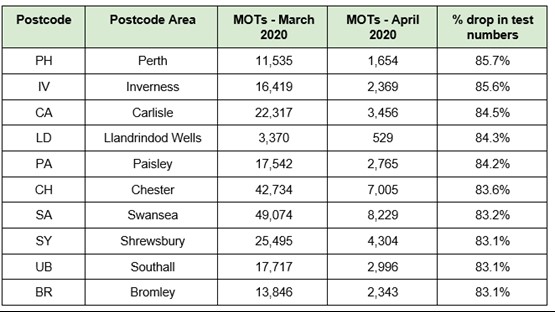
A Freedom of Information (FOI) request to the Driver and Vehicle Standards Agency (DVSA) made by the car selling comparison website showed that 746,157 MOTs were carried out in April 2020, down 80% on March 2020 – where 3,723,524 motorists took their vehicles for a MOT.


Perth in Central Scotland saw the biggest drop in MOTs last month, with tests down 85.7%, in comparison to March. Inverness saw 85.6% fewer MOTs in April, than in March.


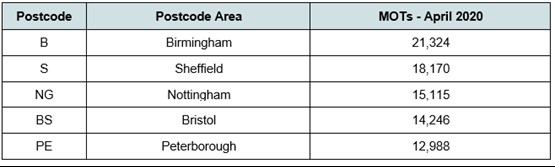
More than 20,000 motorists in the Birmingham area (21,324) took their vehicles for a MOT in April, and 18,170 tests were carried out by garages in the ‘S’ postcode area (Sheffield) last month.


Alex Buttle, director at Motorway.co.uk, said: “These figures from the DVSA show that despite motorists having the opportunity to postpone their MOT test, many have chosen not to do so. There could be several reasons why; with general car maintenance, ongoing value and safety issues likely at the forefront of many drivers’ minds.


“Saying that, the number of MOTs in April was still substantially lower than March figures, and we expect to see a similarly low level of testing in May, as lockdown restrictions have only been eased slightly this month.”


Automotive aftermarket ready to deal with MOT demand when 6-month exemption is lifted

New automotive aftermarket sector-specific guidance to ‘keep millions of vehicles roadworthy’ has been published by the Garage Equipment Association (GEA), Independent Automotive Aftermarket Federation (IAAF), Institute of the Motor Industry (IMI), Scottish Motor Trade Association (SMTA) and the Society of Motor Manufacturers and Traders (SMMT).


The UK automotive aftermarket sector has signalled its readiness to cope with increased demand for MOT tests, service, maintenance and repair with the publication of Covid-19: Industry Guidance and Best Practice for Automotive Aftermarket.


Although workshops have been allowed to stay open throughout the lockdown, helping to keep vehicles roadworthy for essential journeys, guidance will help companies of all types and sizes in the aftermarket operate safely while minimising the risk of Covid-19 transmission.


Mike Hawes, chief executive at the Society of Motor Manufacturers and Traders, said: “It is timely that the aftermarket can assure customers and colleagues that it is ready to re-open safely to ensure workers’ vehicles remain roadworthy.”


The best-practice guidance covers the entire aftermarket sector, including workshops, warehouses, mobile operations and parts distributors and covers every aspect of their operations, from clear communications with customers and colleagues to social distancing, sanitisation and hygiene, and collection/delivery of vehicles from vulnerable owners.


It is designed to complement government advice and help the aftermarket sector demonstrate safe practices for employees and customers across all points of interaction. It comes as vehicle mileages start to climb and the sector calls for an end to the six-month MOT extension.


Hawes said: “With government advice stating that workers should avoid public transport when returning to work, the use of private cars is likely to rise more sharply than it already has over recent weeks. Given many of these vehicles have been idle for weeks, a reconsideration of the six-month MOT extension needs to be made as soon as possible.”


The vital role of the aftermarket sector in supporting safe mobility of the UK workforce has been underlined as the IMI echoes the SMMT call for the six-month exemption to be scrapped.


Steve Nash, chief executive officer at the Institute of the Motor Industry, said: “There are serious risks in the extension remaining in place now. If vehicles are coming back onto the roads in volume it is vital for all road users’ safety that they are roadworthy.


“The other issue is that if all motorists wait up to six months from when their MOT expired to get their vehicle tested, there is going to be a big backlog of tests in the Autumn and Winter which could significantly overwhelm the sector. That’s without considering the likelihood of the market shrinking because many businesses are unlikely to be able to survive without work coming in.


“The SMMT’s proposal to scrap the extension makes a lot of sense for road safety and will be a vital boost for a currently beleaguered sector.” By Graham Hill thanks to Fleet News

Share My Blogs With Others: These icons link to social bookmarking sites where readers can share and discover new web pages.
  • MisterWong
  • Y!GG
  • Webnews
  • Digg
  • del.icio.us
  • StumbleUpon
  • Reddit
  • Alltagz
  • Ask
  • Bloglines
  • Facebook
  • YahooMyWeb
  • Google Bookmarks
  • LinkedIn
  • MySpace
  • TwitThis
  • Squidoo
  • MyShare
  • YahooBuzz
  • De.lirio.us
  • Wikio UK
  • Print
  • Socializer
  • blogmarks

Virtual Speed Awareness Courses Introduced To replace Classroom Courses

Wednesday, 13. May 2020

DriveTech is helping to fill the gap with online speed awareness courses after a classroom-based option was halted due to coronavirus.


Having reconfigured course delivery online via the Microsoft Teams platform, it has delivered classes to 22,000 motorists helping them avoid a police prosecution.


The National Police Chiefs’ Council (NPCC) lead for Roads Policing suspended classroom-based speed awareness courses for 12 weeks in March.


More than 1.2 million drivers attended a speed awareness course last year. The courses usually cost between £80 and £100, but motorists avoid paying a Fixed Penalty Notice or picking up penalty points on their driving licence.


DriveTech, which works in partnership with police and UKROEd, had to move rapidly to rebook around 50,000 classroom delegates bookings prior to the lockdown, to avoid motorists facing the alternative of prosecution, points and fines.


With revised digital course content needed, and DriveTech’s body of 175 trainers needing upskilling to deliver the virtual online experience, it says that the challenge was considerable.


Five weeks on from the first day of digital course delivery on March 27 (a week after lockdown measures affected venue participation), DriveTech says it is delighted that online course capacity is now matching the former levels of classroom supply.


Des Morrison, director of police business at DriveTech, said: “We reflect now on a pretty hectic few weeks, but it is satisfying to now see our digital delivery performing well and with some excellent customer feedback – both from our police force customers, delighted by our professional response in a crisis, and delegates.”


DriveTech is now delivering the three mainstream courses digitally – National Speed Awareness, National Motorway Speed Awareness, and What’s Driving you? and delegate feedback, as measured by Net Promoter Scores (NPS) has been at world class levels, it says.


In addition to placing the first priority on satisfying a backlog of delegates already booked onto a venue-based course, DriveTech is now taking bookings for new delegates from across the country.  By Graham Hill thanks to Fleet News

Share My Blogs With Others: These icons link to social bookmarking sites where readers can share and discover new web pages.
  • MisterWong
  • Y!GG
  • Webnews
  • Digg
  • del.icio.us
  • StumbleUpon
  • Reddit
  • Alltagz
  • Ask
  • Bloglines
  • Facebook
  • YahooMyWeb
  • Google Bookmarks
  • LinkedIn
  • MySpace
  • TwitThis
  • Squidoo
  • MyShare
  • YahooBuzz
  • De.lirio.us
  • Wikio UK
  • Print
  • Socializer
  • blogmarks

Pothole Related Breakdowns Increase During First Quarter Of 2020

Wednesday, 13. May 2020

The number of vehicles requiring recovery due to pothole damage has increased rapidly according to the RAC.


It rescued almost 3,500 motorists with pothole damaged cars in the first quarter of 2020, an increase of 64% on Q4 2019.


The number of cars damaged by potholes requiring recovery, between January and March, is 4.5% higher than in the same period last year, despite the Coronavirus lockdown reducing the number of vehicles on the road in the last nine days of the March.


Breakdowns resulting from damaged shock absorbers, broken springs and distorted wheels – that are most likely to be attributable to poor road surfaces – made up 1.6% of all the RAC’s call-outs for its individual members.


This was considerably up on Q4 2019 when the figure stood at 0.9% and marginally up on the same period a year ago – 1.5%.


The RAC’s Pothole Index suggests the overall standard of the roads has improved a little as the Index currently stands at 1.6, down from 2.3 in the same period last year and slightly down on Q4 2019 (1.7).


This does mean however that drivers are still 1.6 times more likely to break down as a result of pothole-related damage than they were back in 2006 when the RAC first started collecting data.


RAC head of roads policy Nicholas Lyes said: “The jump in pothole-related breakdowns from the last three months of the year to the first quarter of the next year is always the largest as winter weather has the greatest effect of all in wearing down our roads.


“Many parts of the country suffered very wet weather conditions throughout February. It’s still likely that the storms and floods were major factors in why the number of pothole-related breakdowns was higher than the same period last year.


“In his Budget in March, the Chancellor committed to funding our local roads and it is clear that the economic recovery as the UK emerges from the COVID-19 pandemic will need to be built on solid infrastructure – which of course needs to include good quality roads.


“Moreover, it will also be interesting to see if lower traffic volumes during the UK’s lockdown will help prevent further deterioration of roads as fewer wheels going over weaknesses in the asphalt should contribute to less surface wear.”  By Graham Hill Thanks To Fleet News

Share My Blogs With Others: These icons link to social bookmarking sites where readers can share and discover new web pages.
  • MisterWong
  • Y!GG
  • Webnews
  • Digg
  • del.icio.us
  • StumbleUpon
  • Reddit
  • Alltagz
  • Ask
  • Bloglines
  • Facebook
  • YahooMyWeb
  • Google Bookmarks
  • LinkedIn
  • MySpace
  • TwitThis
  • Squidoo
  • MyShare
  • YahooBuzz
  • De.lirio.us
  • Wikio UK
  • Print
  • Socializer
  • blogmarks