Business travel hit a post-lockdown peak in August with every sector of the UK economy enjoying its highest weekly increase at some point, according to new data from Allstar Business Solutions.
The analysis of its customer data found average fuel consumption peaked in the week beginning August 17 at 125% above the lockdown baseline.
However, fuel consumption for August overall dropped 4.4% compared to July, which Allstar attributes to the August bank holiday, although last year the fall was more significant at 9% for the same month.
Allstar’s latest Business Barometer Monthly Snapshot, which is tracking business mileage and credit card data as an economic indicator of recovery by sector, found the long-term trajectory also remains upwards, with businesses travelling 1.06 billion more miles in August than June.
Paul Holland, managing director of UK Fuel at Fleetcor, Allstar’s parent company, said: “Although at first glance seeing a drop in business fuel consumption in August may suggest a slowdown, this followed a sharp rise in June and July.
“The decrease in business travel can also be attributed to August traditionally being a quiet month thanks to the bank holiday weekend, as well as increased domestic and foreign holidays as some coronavirus regulations were eased.
“Early indicators seem to suggest a stronger start to September as children return to school.
“It’s encouraging to see all sectors witnessing their highest weekly growth spikes during the last month; highlighting a continued hunger for businesses to get back on the road as the recovery continues.
“While the number of people on holiday clearly had a downward impact towards the end of the month, it doesn’t appear this will have a long-lasting effect.”
The week commencing August 17 was, on average, the most active for businesses on the road since the start of lockdown.
Arts, entertainment and recreation witnessed a 407% increase in mileage – just days after government lockdown restrictions were eased for some leisure businesses.
Manufacturing (161%), construction (141%) and financial services (106%) also saw their most significant post-lockdown growth during that week.
In comparison, hospitality and catering saw its largest weekly growth (211%) during the week commencing August 24, potentially due to people becoming increasingly comfortable with returning to restaurants towards the end of the ‘Eat Out to Help Out’ scheme.
The same is true of wholesale and retail businesses (161%), while education saw its largest spike in business travel (258%) during the week commencing August 31, likely due to preparations for students returning to the classroom. By Graham Hill thanks to Fleet News
Share My Blogs With Others:These icons link to social bookmarking sites where readers can share and discover new web pages.
More than 8,000 fatal and serious injuries could be prevented over the next 20 years if an investment package of £1.2 billion was made, says the Road Safety Foundation and Ageas.
The funding would improve around 3,000 miles of roads and would also boost the UK’s economic recovery and save society almost £4.4bn over the same period, according to a report published today by the organisation.
Dr Suzy Charman, executive director of the Road Safety Foundation and author of the study, said: “This 20th annual report shows that less than 1% of roads were significantly improved between 2013-2015 and 2016-2018.
“This report identifies an investment package of £1.2bn… with great returns: every £1 invested should benefit society by an average of around £3.60.
“We’ve already demonstrated that infrastructure safety measures can be developed and implemented very quickly, providing jobs and saving lives.
“At a time when we need to boost our economic recovery and protect the NHS, what better way of saving our society an estimated £4.4 billion over the next 20 years. Let’s move forward and save lives by improving these roads.”
The ‘Looking Back – Moving Forward’ document reports that:
60% of all deaths are concentrated on 13% of Britain’s roads
There were significant reductions in the number of fatal and serious crashes on 22 routes between 2013-2015 and 2016-2018; the total number of fatal and serious crashes on these 400km of road fell by two-thirds from 251 to 86, with an estimated Net Present Value of £351m over 20 years
765km of 38 persistently higher risk rural routes have been the location of more than 1,400 fatal and serious crashes between 2013 and 2018. The value to society of preventing these would have been almost £700 million.
The data from the report has been used to update the interactive ‘Dangerous Roads Map’.
This reveals Britain’s riskiest roads and highlights where targeted investment could save lives.
In the foreword to the report, Lord Whitty, chair of the Road Safety Foundation, said: “British progress has depended largely on rising European vehicle standards.
“Similar advancements have not been seen in infrastructure safety.”
Whitty praised the government’s Safer Roads Fund, launched in 2016, as an influential step.
He added: “Systemic management of infrastructure risk is now required by law elsewhere in Europe.
“Highways England and Transport for London have set ambitions that no-one should be hurt on their networks by 2040 but must now target infrastructure risks systemically along busy routes.” By Graham Hill thanks to Fleet News
Share My Blogs With Others:These icons link to social bookmarking sites where readers can share and discover new web pages.
The following article mentioned specifically fleet managers being responsible for offences that drivers are convicted for. But beware if you are a director, owner or partner of a company that either provides company cars or pays an allowance for employees to use their own cars on business (either a car allowance or mileage allowance) as the same rules apply to the person responsible.
Fleet decision-makers could face the same penalty points as their employees should they be convicted of a driving offence, the Licence Bureau is warning.
The supplier of driver licence validation services says it is witnessing an increasing number of these cases being recorded on its system.
Responsible parties can incur the same penalty points as the actual vehicle driver due to the often unknown and much misunderstood ‘cause or permit to drive’ legislation.
Licence Bureau says that it means even though the initial offence was committed by a third party, it was ultimately the fleet manager’s responsibility.
Steve Pinchen, sales director of Licence Bureau, explained: “This much unknown rule has some very serious implications indeed for individuals and businesses alike.
“Those responsible for business fleets – of any scale – really do need to do their homework and ensure that they have all bases covered when it comes to compliance. Not only that, but there is a cultural aspect here too where everyone must be attuned to minimising road safety risk.”
According to the Road Traffic Act 1988/1991, ownership of a vehicle involved in an offence is irrelevant. This therefore implicates both owned business fleet and grey fleet operators.
The Act also cites that causing or permitting driving otherwise than in accordance with a licence can incur three to six points with fine up to £1,000.
The points remain for four years on licence from date of offence. The ‘person responsible for the fleet’ can have the points added to their own personal driving licence.
At present, the majority of these ‘dual penalty recipient’ offences recorded on Licence Bureau’s system relate to ‘causing or permitting using a vehicle uninsured against third party risks’ – an offence which carries six to eight penalty points.
Pinchen said: “Beyond the actual penalty points there are the knock-on implications for elevated risk profiles within the business and what that might mean for insurance premiums; professional and personal impacts for fleet managers; as well as potential for reputational damage for the company.”
Other offences recorded on Licence Bureau’s system include ‘using a vehicle with defective tyres’ which carries three penalty points for each individual implicated, and ‘using a mobile phone while driving a motor vehicle’ which carries three to six penalty points.
The volume of motoring fines and penalties incurred by company car and van drivers increased by 3% in 2019, according to figures from Lex Autolease released earlier this year. By Graham Hill thanks to Fleet News
Share My Blogs With Others:These icons link to social bookmarking sites where readers can share and discover new web pages.
Renault has launched ‘Be Mindful, Don’t Idle’ education campaign to improve air quality around schools after new research showed the scale of the problem.
More than 8,500 schools, nurseries and colleges in England, Scotland and Wales are located in areas with dangerously high levels of pollution, but the return to school could see the problem intensify with 62% of parents saying they are more likely to drive their children to and from school as a result of the recent pandemic.
The increased dependency on the car comes as more than a quarter (27.2%) admit to leaving their engines running – known as idling – during the school run, according to a detailed new study by Renault. Men are 50% more likely to do it than female drivers, representing 32.7% and 22% respectively.
Renault studied the habits and attitudes of more than 4,000 ‘school run’ parents and motorists. Of the reasons given for leaving their engines running nearly a third cited doing so because they are only stationary for ‘a short while’ and 26% wanted to keep the heater or air-con on.
Almost two-thirds (60%) of all drivers said they were unaware that it is illegal under Rule 123 of the Highways Code. Authorities can now issue £80 fixed penalties under Road Traffic Regulations 2002 and Section 42 of the Road Traffic Act 1988 in Scotland.
A lack of parking near schools is the biggest infrastructural challenge to idling.
Overall 23% said they needed to be ready to move their car into a suitable parking space. Naturally, this issue is worse in urban areas – 60.9% – compared to rural locations with just 11.5%.
The report underlined the reasons for the ‘school run’, with 30% dropping their children off by car because it’s on their way to work, 18% because of safety concerns and 12% have no other means of getting them to school.
The issue of idling is greatest within built-up urban and suburban areas according to Renault. Half of those live in cities, yet 12% of those in rural areas admit to doing it regularly. Idling for just 10 seconds wastes more fuel than restarting the engine.
A 2019 study by Kings College London revealed that children in London travelling to schools across the capital are exposed to air pollution five times higher than at any other time of the day.
Renault found that London accounted for the highest number of idling offenders – 22.5%.
“The fact that the majority of people don’t realise that idling is illegal just highlights the scale of the problem,” explained Matt Shirley, senior manager, electrification and new mobility.
“Every minute a car is idling it produces enough emissions to fill 150 balloons. It goes without saying, if the 27% of school run journeys stop idling, there would be a significant improvement in the air quality for their children.
“This is not about demonising the school run, our study underlines the importance, even more so since lockdown, of the car. We just want parents and guardians to be mindful of the detrimental impact of idling, and to alter their behaviours for their own children and those around them.”
New analysis by Queen Mary University of London (QMUL), on behalf of Global Action Plan (GAP) and the Philips Foundation, shows that if outdoor air pollution is halved, there could be up to a 20-50% reduction in the number of children with poor lung function across the UK and Republic of Ireland.
The analysis also finds the reduction in air pollution seen during the country-wide lockdown lead to asthma attacks in children all but disappearing.
Given the most positive improvements to children’s lung resilience is likely to be realised if changes are enacted around the 2,000 schools in the most polluted hotspots across the country, a coalition has formed comprised of Global Action Plan, the Philips Foundation, Living Streets, Modeshift Stars and Mums for Lungs, with the support of Philips, the National Education Union, and NAHT.
The group is calling for nationwide action by the Government and local authorities to improve air quality at schools, driven by a legally binding target to meet World Health Organization limits.
To support the movement, Global Action Plan and the Philips Foundation, with the endorsement of Philips, have launched “The Clean Air Schools Framework”. The framework is a free online tool that gives teachers, headteachers, parents and local authorities a bespoke blueprint of actions for tackling air pollution in and around the school from its database of 50 actions.
The coalition is especially urging all local authorities to use the framework, highlighting actions taken in the London Borough of Hackney, which is one of the leading community grassroots initiative proactively tackling air pollution and pioneer of School Streets (one of the framework’s key actions).
The first four School Streets launched in the borough showed that traffic reduced by an average of 68%, the number of children cycling to school increased by 51% and vehicle emissions outside schools (NOx, PM10 and PM2.5) are down by 74% as a result of the schemes. By Graham Hill thanks to Fleet News
Share My Blogs With Others:These icons link to social bookmarking sites where readers can share and discover new web pages.
Speed limits on parts of four motorways are to be cut before October in a trial to reduce pollution.
Highways England said the limit will be reduced from 70mph to 60mph in areas that have seen higher than recommended levels of nitrogen dioxide.
The reduced speed limit will be introduced on M6 junctions 6 to 7 by Witton, M1 junctions 33 to 34 by Rotherham, M602 junctions 1 to 3 by Eccles and M5 1 to 2 by Oldbury.
Each locations is up to 4.5 miles long and the new speed limits will be operational 24 hours a day.
The reduced speed limits will be assessed after 12 months to see if they are having an impact, or if the air quality level is compliant.
Ivan Le Fevre, head of environment at Highways England told the BBC: “Ultimately the air quality challenge will be solved ‘at the tailpipe’ by vehicle manufacturers and changes in vehicle use.
“Until this happens we will continue our extensive programme of pioneering research and solutions.”
Recent Department for Transport figures show the proportion of cars sticking to the speed limit is at its highest on 60mph roads.
The data measures speed and compliance at sites where the road conditions are free-flowing, for example roads with no junctions, sharp bends, speed enforcement cameras or other traffic calming measures.
In 2019, 50% of cars were found to exceed the speed limit on motorways, 54% on 30mph roads and just 9% where limits were 60mph.
The DfT says the statistics provide insights into speeds at which drivers choose to travel when free to do so, but are not estimates of average speeds across the whole network.
It notes that the average car speeds under free flow conditions were close to the speed limit on motorways (69mph) and 30mph roads (31mph) – and under the speed limit on 60mph roads (50mph). By Graham Hill thanks to Fleet News
Share My Blogs With Others:These icons link to social bookmarking sites where readers can share and discover new web pages.
Road safety charity Brake has welcomed the Government move to introduce life sentences for killer drivers.
The Ministry of Justice originally pledged to introduce the punishment in 2017 and it will form part of major sentencing reforms to be unveiled by the Lord Chancellor in a white paper this week.
Joshua Harris, director of campaigns for Brake, said the charity has long advocated for an overhaul of UK road law to deliver justice for victims and to help keep roads free from dangerous drivers.
He added: “Crash victims have waited three long years for this announcement. Road crime is real crime and it is high-time that the Government, and the law, recognised this.
“Years of Government inaction have added to the suffering of road victims who have not been delivered the justice they, and their loved ones, deserve.
“The Government must now implement these tougher sentences as first priority, delivering on their overdue promise to road crash victims, and then urgently initiate a review of the flawed legal framework for road justice.
“Driving is a privilege not a right and yet our flawed legal system continues to allow convicted dangerous drivers on the roads where they can endanger others.
“We all want safer roads but we will only achieve this if the law treats road crime with the seriousness it deserves.”
The measures around driving include plans to:
increase the maximum penalty for causing death by dangerous driving from 14 years to life
increase the maximum penalty for causing death by careless driving whilst under the influence of drink or drugs from 14 years to life
create a new offence of causing serious injury by careless driving.
Paul Loughlin, senior associate solicitor at Stephensons, said:“The impact of dangerous and careless driving often has far reaching consequences, not only for those involved but also for their families and friends.
“Much of the criticism surrounding legislation in this area is that it doesn’t provide sufficient justice for those who are killed as a result of dangerous driving, or those seriously injured as a result.
“These proposals would transform the sentencing guidelines for this offence and go a long way to redress the balance for victims.
“On the flip side, we have often seen prosecutors taking a harder line in cases where there has been a serious injury and the driving standard would ordinarily be considered to be ‘careless’ rather than ‘dangerous’.
“The absence of the ability to charge with causing serious injury through careless driving has seen inconsistent charging decisions being made to plug a gap.
“There are clear examples of cases being ‘bumped up’ from a straight forward careless driving charge to the more serious charge of causing serious injury through dangerous driving with more emphasis being placed on the extent of the injury caused, irrespective of the fact that the standard of driving would ordinarily be considered to be ‘careless’.
“The introduction of this new offence should more suitably plug that gap and ensure more appropriate charges being laid for this type of offence.”
Department for Transport figures show 1,748 people were killed on the roads of Great Britain last year, a figure which has flatlined since 2012 when 1,754 people were killed. By Graham Hill thanks to Fleet News
Share My Blogs With Others:These icons link to social bookmarking sites where readers can share and discover new web pages.
A new study by Field Dynamics has found that fewer on-street electric vehicle (EV) chargepoints may be required than previously expected, to support a mass uptake of EVs.
Working in partnership with Zap-Map, the Net Zero data consultancy has found that better residential charging services can be achieved by siting chargers in more focused locations.
Field Dynamics’ managing director Ben Allan said: “Placing public chargers is a difficult process as it requires the balancing of many conflicting priorities. But now there is a bedrock of robust data that planners can use to select their sites, placing fewer chargers at lower cost while providing a much more inclusive service”
The research found that there are around eight million households, outside of London, that do not have off-street parking and 90% of those are more than a five-minute walk from the nearest public EV chargepoint.
Field Dynamics said such proximity from a chargepoint could reduce the appeal of switching to e-mobility for those households, due to inconvenience or impracticality.
Brighton and Hove Council have achieved 67% coverage of households that require on-street charging provision by placing just 139 chargers, however.
This suggests that most councils will require a few hundred charger sites to ensure there is access to a charger within a five-minute walk for those residents who will need to access this critical service, rather than placing them on every street.
Zap Map COO and joint MD of Zap Map Melanie Shufflebotham said: “Providing convenient public charging for households with no off-street parking is a key element in the mass uptake of electric vehicles (EVs).
“This unique analysis combining the Zap-Map and Field Dynamics data sets provides both a high-level comparison between towns and also identifies down to a street level where there is a real gap in charging provision. We believe this data will be a great tool for organisations when making decisions on where to install additional charge points.” By Graham Hill thanks to Fleet News
Share My Blogs With Others:These icons link to social bookmarking sites where readers can share and discover new web pages.
The UK government is working on a new hydrogen strategy that will “deliver a world-leading hydrogen market”, according to a top civil servant.
During an Environmental Audit Committee session yesterday (September 10), business secretary Alok Sharma confirmed that the forthcoming energy white paper will include plans for hydrogen and that will be followed by a detailed strategy early next year – ahead of the UK hosting the 26th UN Climate Change Conference (COP 26) in Glasgow in November.
Julian Critchlow, director general for Energy Transformation and Clean Growth at the Department for Business Energy and Industrial Strategy (BEIS), said that the strategy will bring together the supply and demand side, and answered criticism that the UK is lagging behind other countries, such as Germany, Japan and Australia, in hydrogen development.
He said: “Far from being behind we believe that we’re actually putting the detailed and specific policy levers in place to be able to deliver a world-leading hydrogen market.”
However, for the UK to achieve its goal of net zero greenhouse gas emissions by 2050 it will need to achieve hydrogen capacity of about 270 terawatt-hours, up from 27-terawatt-hours today.
Critchlow said that from a transport point of view, the Government sees hydrogen “having a big role”, especially for heavier vehicles.
He highlighted the £23 million programme with OLEV, which is looking at funding vehicles and refuelling stations, and the ultra-low emission bus scheme for hydrogen buses, along with the Prime Minister’s commitment for 4,000 new zero emission buses.
Business leaders have been campaigning for the Government to clarify its future hydrogen strategy and believe more needs to be done.
Jonny Goldstone, MD of Green Tomato Cars, one of the businesses backing the Hydrogen Strategy Now campaign, said that businesses need confidence in the development of the infrastructure.
Currently, there are six hydrogen refuelling stations across the South East, with only one of those located in East London.
Goldstone, who has hydrogen, electric and hybrid vehicle in his 250-strong company-owned fleet, said: “We want London to lose its reputation as the ‘Big Smoke’.
“Our hydrogen vehicles emit zero CO2 emissions, whereas other vehicles are pumping out high volumes of carbon emissions every day. A widespread take-up of zero-emission hydrogen and battery electric vehicles is essential to improving air quality across the capital.
“We have 50 hydrogen cars and we’re looking to expand that number. But we want to have the confidence that the infrastructure will be there to allow us to operate consistently and efficiently for our drivers and customers.
“The refuelling network needs to expand to enable demand for hydrogen vehicles to increase, which in turn will lead to manufacturers producing more and greater customer uptake.” By Graham Hill thanks to Fleet News
Share My Blogs With Others:These icons link to social bookmarking sites where readers can share and discover new web pages.
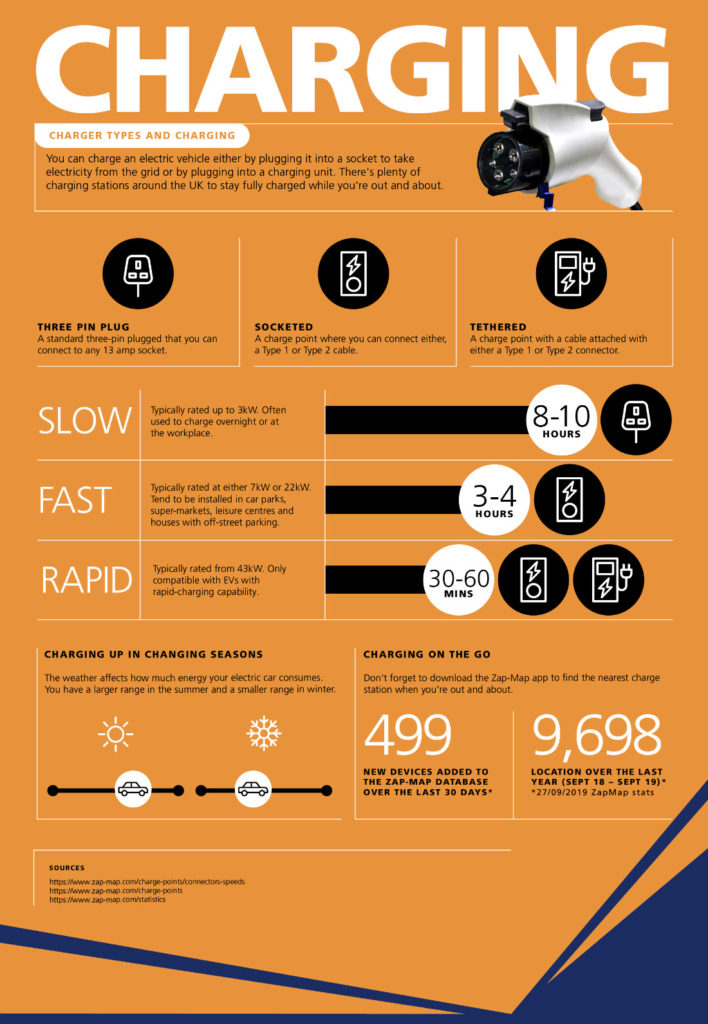
There are now more than 30,000 charge points across the UK in over 11,000 locations – that’s more public places to charge than petrol stations, with around 10,000 charge points added in 2019 alone.
There are thousands of free electric car charge points in the UK, often located in supermarkets, shopping centres, public car parks, hotels and sometimes service stations.
Be aware there could be restrictions such as a set period of time or a requiring a purchase in-store, so it’s best to check.
There is an app called zap-map.com that shows all of the charge-points in the UK and also allows you to plan journeys if you are concerned about the range of your car and your ability to reach your destination without charging your car en-route.
How long does it take to charge an electric car?
How long it takes to charge an electric car is one of the most frequently asked questions. Whilst filling up with gasoline takes a few minutes, the time it takes to charge an EV from low to full is much longer.
However, it can be more convenient. Typically electric cars are charged when the car’s not in use, like overnight at home, in the same way you would a mobile phone, or during the day whilst you’re working.
How much you charge, or need to charge, will also change – with gasoline, the majority of people drive their cars until the fuel gauge shows low on fuel and we fill the tank up to full again.
This behaviour stems from the inconvenience of having to go to a petrol station. With electric cars and the convenience of charging at home, you may find you ‘top up’ the battery each day as it’s used rather than waiting for it to get low – again similar to a mobile phone.
Another factor that may impact the number of times you need to charge your electric car or van is temperature.
Lithium-ion batteries perform better in warm weather, so you might notice a slight drop in the range your EV can travel in the colder winter months.
In summary, how long it takes to charge an electric car depends on:
Your car’s battery size
How many miles you do between charges
Your charging behaviour, i.e. topping up often vs charging from low to full less often
The power rating of the charger you’re using – you can read more below on different types of chargers and their kWh ratings
To give you an idea of how long it takes to charge a specific car’s battery from zero to full, try this handy charging calculator:
Did you know?
Electric vehicles often come with battery warranties based on the number of charging cycles (1 cycle is equal to 1 full charge and 1 full discharge), with many manufacturers offering anything from 60,000 to 100,000 miles on their battery warranties as standard.
Half price evenings and weekends
Exclusive to electric car drivers, the 100% renewable(1) GoElectric tariff offers half price electricity evenings and weekends for both your household and your electric car.
This is a scheme offered by EDF Energy, there will be others available if you shop around.
Charging Point Socket Type And Speeds
Slow chargers
Slow chargers have a maximum of 3.6 kW available, and typically take between 6-12 hours to recharge a pure electric car. These chargers are ideal for overnight charging.
Fast chargers
Fast chargers are rated at 7-22 kW and usually take between 3-7 hours to recharge an EV depending on the battery size of the car.
7 kW chargers are a popular choice for the workplace and at home and there are several models available to buy and lots of different installers who can fit them for you.
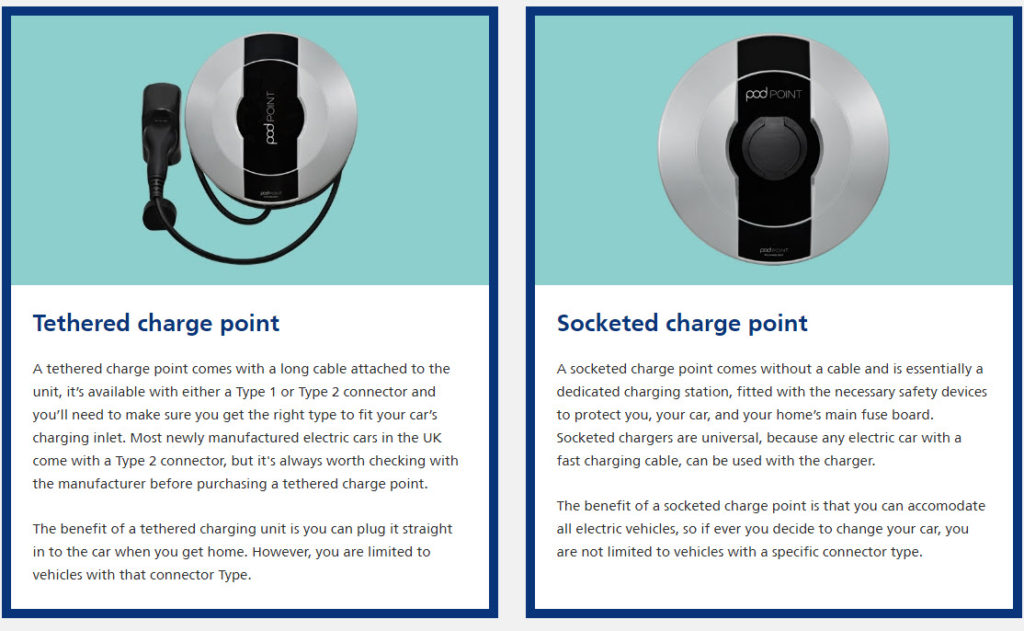
It can be confusing, but all you need to do is decide what power rating you want and choose either a tethered or socketed charge point.
Rapid chargers
Rapid are the quickest (43 kW+), generally capable of charging cars to 80% in 20-40 minutes, depending on how big the battery is and how much charge it’s holding to start with, so they’re a great way to top up during long journeys.
You can often find them in motorway service car parks, petrol stations, larger shopping centres and supermarkets.
Wireless chargers
Wireless charging is super convenient and allows for the transfer energy between a pad on the ground and a compatible EV – no need for cables at all.
While it’s not in the UK yet, Norway will install the world’s first wireless electric car charging stations for Oslo taxis and BMW is due to release their new wireless charging solution with their new plug-in hybrid 530e iPerformance very soon.
What power rating should I use for my home socket?
When it comes to home charging, 3-7 kW chargers are the most popular and are widely recommended for the UK market.
Many UK households have a single-phase (AC) electricity supply and can support the additional 7 kW load. Some households, with three-phase (AC) supply can support a more powerful fast charger up to 22 kW.
However, this is far more common in countries like Germany with a more robust electricity network.
Always check with the installer that your fuse board has enough spare capacity to support the additional load of a home charging station.
If there is not enough spare capacity, then you may have to pay to upgrade your distribution board.
Rapid chargers offer you a much quicker charge, perfect for longer journeys, when a quicker charge is needed, but it’s not advisable to only use rapid charging because this can increase the degradation of your battery over time.
Electric car charging cables
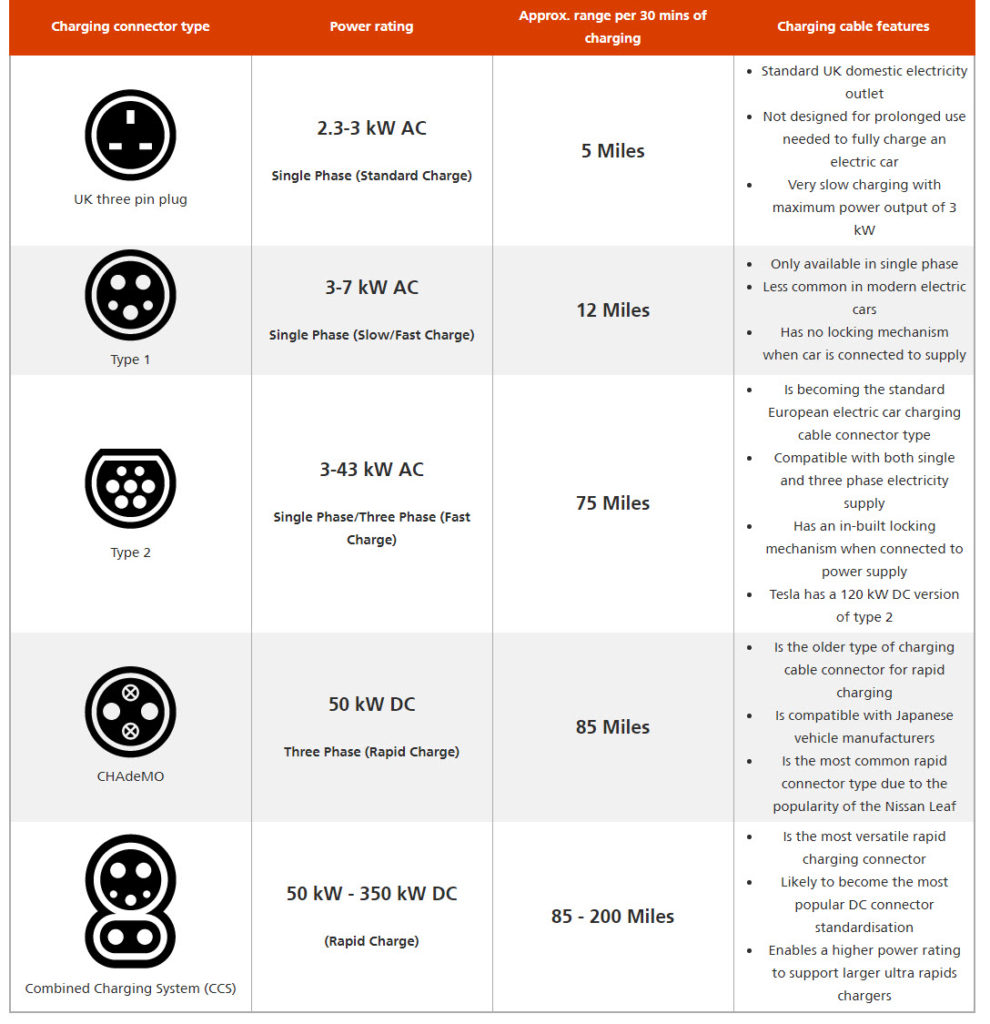
Charging cables have connectors you plug into the vehicle and/or the charge point. The type of charging connector depends on the vehicle and the power rating of the charge point.
Electric car charging points grant
The Electric Vehicle Homecharge Scheme (EVHS), contributes up to 75 per cent towards the cost of buying and installing an electric charger, up to a maximum of £500, if you have a home with off-street parking suitable for an electric car charger and an eligible electric vehicle.
Similarly the Workplace Charging Scheme (WCS), contributes up to 75 per cent to a maximum of £500 for each socket, for up to 20 charge points across all of the sites they operate.
By Graham Hill with huge thanks to EDF Energy
Share My Blogs With Others:These icons link to social bookmarking sites where readers can share and discover new web pages.
The possibilities of connected consumer vehicles are wide—and maybe a bit overwhelming. How can all these needs and wants be met at the same time?
One of the key challenges, if we are to move to driverless cars, is to enable the car to ‘think’. Whilst we may not be able to get a computer to think we can increase the speed of transfer and processing of data in order for the car to decide on a course of action without the involvement of a human brain.
So with the help of Ericcson let’s see how 5G can move the industry further.
5G Is Unbelievably Fast
Let’s start with the simple facts first: from a peak speed perspective, 5G is 100 times faster than 4G. This means that during the time it took to download just one piece of data with 4G the same could have been downloaded 100 times over a 5G network.
You can just imagine how this speed is important for a connected car when it comes to the amount of data that will need to be shared.
According to Dr. Joy Laskar, CTO of Maja Systems, future autonomous cars will generate nearly 2 petabits of data, which is equivalent of 2 million gigabits. “With an advanced Wi-Fi connection, it will take 230 days to transfer a week-worth of data from a self-driving car,” Laskar said.
With 5G, that time would go from 230 days to just over 2 days.
Lower latency
5G also means low latency, as in a matter of milliseconds.
Latency is the amount of time it takes to send information from one point to another. We encounter it everyday when we drive, and make a decision to break suddenly: latency is the amount of time between our brain sends the instruction to our foot to push down on the brake in this example.
When it comes to networks, we usually talk about the difference between the 20 milliseconds of our current 4G networks to the 1-5 milliseconds of the 5G network.
However, there’s even a larger difference when it comes to self-driving cars.
Human reaction speed is a bit above 200 milliseconds, leading to accidents every day. 5G’s 5 millisecond latency is practically real-time, which can be used to provide the user with additional safety information before it is visible, for example roadworks, fast moving emergency vehicles and visually hidden pedestrians about to cross the street.
These cooperative Advanced Driver Assistance Systems (ADAS) will help the driver to drive safely and avoid accidents.
5G’s increased reliability
Reliable communication means guaranteed delivery of time-critical information. For example, for remotely driving an autonomous vehicle in real-time in case its autonomous function fails.
There is no other alternative than cellular networks for enabling such services. 5G cellular technology is designed from day one for ultra-reliable communication with low latency to enable complex machine centric use cases, including autonomous cars in dense urban as well as high speed scenarios.
We expect adoption of fully autonomous capabilities in limited areas initially leveraging 5G signal coverage, with long-term evolution towards fully autonomous transport eco-system for maximizing safety, efficiency, and sustainability.
Exciting new case stories & innovation
Thanks to these three elements—increased speed, lower latency, and increased reliability—a whole new generation of exciting use cases can be unlocked.
In Europe, the 5GCAR project, led by Ericsson, is helping to develop an overall 5G system architecture.
As part of their work, they identified a number of new use cases that need 5G to unlock the future of transportation, from lane merge coordination to long range sensor sharing and increased protection for pedestrians.
Industry 4.0
5G won’t just make connecting cars easier: it will make manufacturing cars easier as well.
5G is about to change manufacturing as we know it through secure and almost real-time connectivity that will result in transformative productivity, speed and efficiency improvements. The car industry will be among the first to benefit.
But don’t just take our word for it: ask Mercedes-Benz. We recently teamed up with Telefónica Germany to enable 5G car production via a private 5G network for Mercedes-Benz at the company’s Sindelfingen plant in southern Germany.
Jörg Burzer, Member of the Divisional Board of Management of Mercedes-Benz Cars, Production and Supply Chain, said: “With the installation of a local 5G network, the networking of all production systems and machines in the Mercedes-Benz Cars factories will become even smarter and more efficient in the future. This opens up completely new production opportunities.”
So why should you care about 5G? Well, 5G connectivity has the potential to allow accident-free, stress-free and emission-free driving…and we think that’s a future we can all be excited about. By Graham Hill Thanks To Ericcson
Share My Blogs With Others:These icons link to social bookmarking sites where readers can share and discover new web pages.