Are You Up To Speed With Speeding Fines And Penalties?

Friday, 24. September 2021

A guide to everything you need to know about speeding, from fines to the cameras the police use.

There was a time when fixed and average speed cameras didn’t exist, and the most likely way of accruing endorsements (now better known as penalty points) on your licence was to miss seeing the local policeman pointing a ‘speed gun’ at your car as you edged above the posted limit. Those days have long since passed, and the rise in digital technology now means that drivers are faced with a plethora of different roadside devices.

How can I be caught speeding?

There are a variety of different speed-detecting technologies on British roads today. Here are the most common.

Truvelo

All speed cameras have to be coloured bright yellow by law and the Truvelo is no exception. Most commonly mounted on a pole at the side of a single or dual carriageway, the Truvelo uses a front-facing camera to record your speed, backed up by a matrix of small squares painted on the road. (Secondary evidence of speed is required with all fixed-position cameras.)

While images of motorcycle numberplates can be tricky to capture, due to their lack of front registrations, the Truvelo can identify drivers of other vehicles, adding a further layer of evidence if a prosecution is disputed. More recently, a Truvelo D-Cam has been launched for motorway applications, with front- and rear-facing capabilities.

Gatso

The name that most of us are familiar with, the Gatso first graced our road scene in 1991 and is a rear-facing camera, meaning that it records your vehicle after it’s passed the camera unit, with two images taken in quick succession. Like the Travelo, the images are supported by secondary evidence of speed provided by painted ‘dashes’ on the road surface. These dashes may be found on both sides of the road next to the camera, but the Gatso will only record your speed in the direction in which it is facing.

SPECS

SPECS (average speed check cameras and speed enforcement) units measure your speed over a set distance, via two banks of cameras. Most commonly found through roadworks, or where there is a lower than normal speed limit, they use automatic numberplate recognition (ANPR) to identify vehicles. As you pass the first set of cameras, your vehicle’s details are recorded, and if your average speed before reaching the second cameras is above a set threshold, a notice of intended prosecution (NIP) will be automatically generated. (See below.)

HADECS 3

The catchily named Highways Agency Digital Enforcement Camera System 3, or HADECS 3 for short, is most commonly found on smart motorways, mounted on the overhead gantries that carry variable speed limit alerts. The camera’s limited use of yellow cladding and the fact that it is a fraction of a Gatso/Travelo’s size mean that it can be easily missed, especially if you’re travelling at 70mph. HADECS 3 is rear facing, and once again it uses painted dashes on the road as secondary evidence of a vehicle’s speed. It also adapts to posted, mandatory speed limits that can vary depending on road conditions.

Mobile speed camera units

It’s not uncommon for the police to monitor vehicle speeds at known accident hotspots using mobile units – quite literally, vehicles with miniature Gatso cameras pointing through their rear windows. These are often found parked in laybys or above dual-carriageway or motorway bridges and have a range of up to one mile. The police also have access to handheld radar- and laser-controlled devices that can be used at a variety of locations.

How will I know if I’ve been caught speeding?

If you’ve been caught speeding with a hand-held device, or one installed in a moving police car, you could be asked to stop there and then. In this case, the police have two options: they can either give you a verbal warning and send you on your way, or they can issue you with a fixed penalty notice (FPN). But if you’ve been caught speeding by a remote device, the registered keeper of the vehicle will receive a notice of intended prosecution (NIP) and section 172 notice by post within 14 days of the offence. The section 172 notice then has to be returned within 28 days, providing details of the driver who committed the offence. A fixed penalty notice (FPN) will then be issued to the driver, or if the offence is deemed serious enough, a court summons.

What kind of penalty can I expect?

If you receive an FPN, you can either plead guilty or not guilty to the offence, with each decision triggering its own process. A guilty plea will generally carry a fixed £100 fine and three points added to your licence. Depending upon where you were caught speeding, there will be different ways to pay the fine, which can be found here.

However, you may be offered the option of paying instead for a speed awareness course (typically costing a similar amount to the fine itself), which will avoid the addition of points to your licence. Certain caveats exist, though. The police will decide if it’s appropriate to your offence (so it tends to be offered for more minor transgressions).

And it will only be offered if you’ve not been on such a course in the past three years. It’s also worth noting that not all police authorities run speed awareness courses, so this option is by no means a given. 

The situation becomes more complex if you plead not guilty, though. Of course, if you’re convinced of your innocence, then it’s the right and proper course of action and it will probably involve a trip to court. But if you lose your case, you could be fined more and receive more penalty points.

Excess speed bands and your weekly income make up the fine

In 2017, the speeding penalty system was overhauled, with larger fines for drivers charged with excessive speed. If you are prosecuted in court, the amount you are fined and number of points you receive (or the disqualification period) will firstly be determined by the speed you were travelling over the posted limit, as shown here.
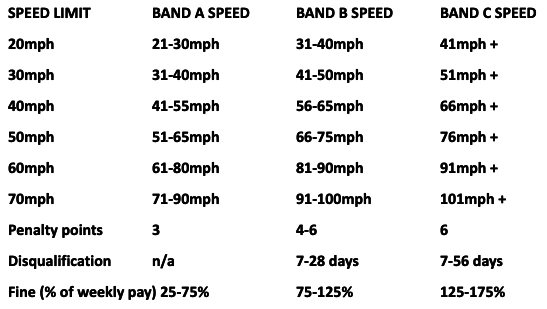
But as you can see from the last line, the actual fine is ‘personalised’ depending on your average gross weekly income.

For example, based on a driver earning the UK average income (2020-21) of £29,600:

Speeding at 81-90mph in a 60mph zone = £428-£713 fine plus 4-6 penalty points

Speeding at 66mph+ in a 40mph zone = £713-£998 fine plus 6 penalty points

There are a further three bands (D, E and F) that deal with more extreme transgressions, which may include excessive speed where the driver is: on bail; has existing convictions; in charge of a large vehicle; heavy load; towing; carrying passengers; driving through a heavily pedestrianised area.

It’s also worth noting that if you’ve only held a full driving licence for less than two years, it will be revoked if you reach six or more penalty points.

On the upside, mitigating factors, such as it being a first offence, or being of ‘good character’, may help reduce the fine and penalty. The court may even take into account speeding for a genuine emergency.

Either way, under any circumstances, there is a £1000 fine cap for all speeding offences, apart from those committed on motorways, where it increases to £2500.

How many points do I need before I lose my licence?

Even less serious speeding offences can cause you to lose your licence. If you accrue 12 or more penalty points in a three year period – potentially four minimum-fine/points offences – you could end up with a six-month ban. And this could have further repercussions. If you’re disqualified for 56 days or more (see also the more serious single-offence bans, above) you’ll need to apply for a new licence, and this may even entail retaking your driving test.

How will speeding penalties affect my car insurance?

Insurers will generally regard drivers who’ve accrued penalty points for any offence – including speeding – as a higher risk and will likely impose a higher premium as a result. While penalty points for speeding are generally only valid for three years as far as totting up endorsements and a potential ban goes, they remain visible on your licence for four years. Most insurance companies will ask you to declare any motoring offences in the past five years, and if you withhold information, it could affect a future claim, so it’s important to be honest when searching for new quotes.

Top 10 speeding trivia

Would you be surprised if we told you that the world’s first speeding fine was issued in the UK? Well, it was. Driving his new Benz, Walter Arnold was nabbed at four times the national speed limit in Paddock Wood, Kent.

That the limit was just 2mph and the year, 1896, explains a lot. To make matters worse for Arnold, he was reprimanded for not having a red flag waver walking in front of him, too.

And from one extreme to another… The UK’s fastest speeder was caught in 2015 travelling at 192mph in a Nissan GTR. A 28-month custodial sentence followed and Northamptonshire police banned him from driving for 10 years.

But you don’t need anything exotic to get your collar felt. In 2003, an off-duty policeman was caught driving his unmarked Vauxhall Vectra at 159mph on the M54.

It wouldn’t have been as much as the hapless Swiss driver had to shell out, though, after he hit 85mph in a 50mph zone driving his Ferrari Testarossa. Swiss authorities base fines on your financial worth, and with £14.1 million in the bank, this driver ended up with a £180,000 ticket.

But that was nothing compared with another Swiss millionaire who managed 180mph on local roads in his Mercedes-AMG SLS and set a new speeding fine world record at $1,001,400 (£727,166).

Both the above would have got away with it if they’d come to the Isle of Man, where no speed limits apply (although dangerous/careless driving is still an offence, as is breaching local speed limits through built-up areas). Other speed-limit-free havens are Germany’s autobahns (for now) and Australia’s Northern Territories.

But not Dubai. Driving a rented Lamborghini Huracán, a British tourist managed to trigger 33 speed cameras while joyriding through its downtown area, generating $48,000 (£34,847) in speeding fines, before fleeing the country and leaving the rental company to sort out the mess.

If you live near Bristol, though, it takes only one speed camera to extract mega-sums in fines. A camera positioned on the city’s M32 motorway captures on average 50 speeding drivers each day, and over a three-year period relieved them of £5.7m.

Showing slightly more lenience, Poland has the highest speed limits in Europe, at 140km/h (87mph), and in the US, Texas’s Highway 130 allows 85mph before fines are imposed. But the world’s highest speed limit is 160km/h, or, tantalisingly, 99.4mph, in the UAE.

But like it or not, speed cameras in the UK are now part of our motoring life, and with 7000 of them positioned around the country, only Russia, Italy and Brazil have more on their roads. By Graham Hill thanks to Autocar

Share My Blogs With Others: These icons link to social bookmarking sites where readers can share and discover new web pages.
  • MisterWong
  • Y!GG
  • Webnews
  • Digg
  • del.icio.us
  • StumbleUpon
  • Reddit
  • Alltagz
  • Ask
  • Bloglines
  • Facebook
  • YahooMyWeb
  • Google Bookmarks
  • LinkedIn
  • MySpace
  • TwitThis
  • Squidoo
  • MyShare
  • YahooBuzz
  • De.lirio.us
  • Wikio UK
  • Print
  • Socializer
  • blogmarks

Drivers Warned About Driving Licence Renewal Extension Coming To An End!

Thursday, 16. September 2021

TTC is warning drivers and fleet managers to focus on the legislation change surrounding licence extension periods affecting all drivers.

TTC said the changes, that came into effect on September 1, is catching some drivers out with fines of up to £1,000.

In response to the Covid-19 pandemic, the Driver and Vehicle Licensing Agency (DVLA) announced a grace period that saw all driving licences due to expire between February 1 and December 31, 2020, extended by a further period of 11 months.

As a result, any driving licences that were originally due to expire in October 2020 were valid until September 2021.

The Government also granted a seven-month extension to drivers whose photocard driving licence expired between the start of February and the end of August.

TTC is urging drivers to check their driving licence expiration date and re-apply to the DVLA immediately, while advising fleets to pay extra attention to driver licence compliance in the coming weeks.

Jim Kirkwood, chief executive of TTC Group, said: “The past 18 months have seen a host of regulatory shifts for drivers, as the Government has responded to the pandemic.

“As we return to a more normal regulatory environment, it is important drivers aren’t caught out by the end of this extension period.

“The range of solutions offered by Licence Bureau allows fleet managers to perform online driving licence verification checks both easily and quickly, and they will be immediately notified of any drivers whose licences have expired.

All drivers should make sure that they have a valid driving licence or risk a £1,000 fine. By Graham Hill thanks to Fleet News

Share My Blogs With Others: These icons link to social bookmarking sites where readers can share and discover new web pages.
  • MisterWong
  • Y!GG
  • Webnews
  • Digg
  • del.icio.us
  • StumbleUpon
  • Reddit
  • Alltagz
  • Ask
  • Bloglines
  • Facebook
  • YahooMyWeb
  • Google Bookmarks
  • LinkedIn
  • MySpace
  • TwitThis
  • Squidoo
  • MyShare
  • YahooBuzz
  • De.lirio.us
  • Wikio UK
  • Print
  • Socializer
  • blogmarks

All New Homes To Have Electric Car Charge Point Installed

Thursday, 16. September 2021

England will be the first country in the world to introduce mandatory electric car charging points for new-build homes.

All new homes in England will have to be fitted with charge points for electric cars, as the government seeks to facilitate the infrastructure improvements necessary for the planned mass-adoption of EVs.

The Department for Transport announced a public consultation on the subject last summer, which has now concluded with the  government confirming it will seek to pass legislation in parliament later this year. The changes will force homebuilders to install charge points so potential owners can easily charge their plug-in hybrids and electric cars at home.

The move will also mean buyers of new-build homes won’t have to make use of the Government’s home charger subsidy scheme.

The rules don’t affect new-build houses without off-street parking, but the Government is also investing heavily in research projects that have included wireless charge points, and charge points that rise up from the pavement.

The drive towards EVs comes as the UK Government aims to meet stringent targets for air quality and pollution caused by internal combustion engine emissions. From 2030, the £1.5 billion Road to Zero strategy will see the sale of all new cars without electrification banned.

Details of this remain thin on the ground, but it is understood new cars will have to be able to travel for 50 miles under battery power in order to be allowed to remain on sale, essentially removing all cars but pure electric cars, plug-in hybrids, and hydrogen cars from new-car showrooms.

The new rules set to come before parliament later this year will require all-new EV chargers to be the ‘smart’ charging variety, which makes best use of peak and off-peak electricity rates and could see EV’s act as a hive-like network of power storage when large amounts of electricity are generated by wind turbines, for example.

As well as Road to Zero, the Government has also announced the UK is to be carbon neutral by 2050. With transport accounting for around a quarter of all greenhouse gas emissions, improving and reducing emissions from cars is a key target on the path to achieving this ambition.

Announcing the plans to mandate charge points in new-build homes, Transport Secretary Chris Grayling said: “Home charging provides the most convenient and low-cost option for consumers – you can simply plug your car in to charge overnight as you would a mobile phone.”  By Graham Hill thanks to Auto Express.

Share My Blogs With Others: These icons link to social bookmarking sites where readers can share and discover new web pages.
  • MisterWong
  • Y!GG
  • Webnews
  • Digg
  • del.icio.us
  • StumbleUpon
  • Reddit
  • Alltagz
  • Ask
  • Bloglines
  • Facebook
  • YahooMyWeb
  • Google Bookmarks
  • LinkedIn
  • MySpace
  • TwitThis
  • Squidoo
  • MyShare
  • YahooBuzz
  • De.lirio.us
  • Wikio UK
  • Print
  • Socializer
  • blogmarks

Latest Report On Smart Motorways Reveals Unexpected Safety Results.

Thursday, 16. September 2021

The Office of Road and Rail (ORR) has published a new report that backs up claims by National Highways that smart motorways are the safest roads in the country in terms of fatalities.

‘Smart’ or ‘all-lane running’ (ALR) motorways have been under the microscope since 2019, when it was revealed that National Highways (formerly Highways England) had not fully investigated the dangers of removing the hard shoulder.

Following a BBC Panorama investigation in 2020, which found 38 people had been killed in collisions due to stranded vehicles in live lanes during a five-year period, the Government outlined a series of measures to improve ALR motorway safety costing £500 million.

A year on, Grant Shapps, the Secretary of State for Transport, commissioned a Progress Report from National Highways to set out progress on those actions, and to develop proposals about how several of them can be accelerated, going above and beyond what was originally committed to.

The Progress Report, published in April 2021, showed that fatal casualties are less likely on all lane running motorways than on conventional ones.

Shapps made a request to the ORR to undertake quality assurance of the data and evidence underpinning the conclusions arrived at regarding all lane running (ALR) motorways.

The ORR report found no errors in underlying calculations and says the comparisons about the relative safety of ALR motorways were “made in an appropriate way”.

It did highlight some issues in the tools used to underpin risk modelling that National Highways should address and made some some further recommendations to deepen the use of comparisons and enhance the understanding of risk exposure.

Shapps said: “The ORR’s report contains several recommendations for improvement that will strengthen our understanding of road safety. National Highways have agreed to all its recommendations and developed an action plan in response which is already underway.

“My commission for assurance into smart motorway safety data by the ORR is another step towards improving road safety and instilling public confidence in the safety of our roads, which make a crucial contribution to economic and social development in this country.”

Edmund King, AA president, added: “We are pleased that this further analysis of the performance of ‘smart’ motorways has been made public.

“The ORR report shows that there was a ‘limited amount of data available’, so it is perhaps difficult to fully evaluate the performance of ‘smart’ motorways, hence it will be essential to have continuous monitoring and evaluation.

“We believe that controlled motorways with a hard-shoulder are the safest option and for other stretches, installing more emergency laybys on the existing network, in our view, will help improve both safety and driver confidence.

“Analysis shows that the forecast benefits have not been realised in some places, resulting in slower journey times, lower speeds and lower levels of economic benefit compared to assumptions.”

The full ORR report ‘Quality Assurance of All Lane Running Motorway data’ can be viewed here: https://www.gov.uk/government/publications/orr-quality-assurance-of-all-lane-running-motorway-data-report  By Graham Hill thanks to Fleet News

Share My Blogs With Others: These icons link to social bookmarking sites where readers can share and discover new web pages.
  • MisterWong
  • Y!GG
  • Webnews
  • Digg
  • del.icio.us
  • StumbleUpon
  • Reddit
  • Alltagz
  • Ask
  • Bloglines
  • Facebook
  • YahooMyWeb
  • Google Bookmarks
  • LinkedIn
  • MySpace
  • TwitThis
  • Squidoo
  • MyShare
  • YahooBuzz
  • De.lirio.us
  • Wikio UK
  • Print
  • Socializer
  • blogmarks

On Street EV Charging Trial In Lambeth To Prove How Successful It Can Be

Thursday, 16. September 2021

Connected Kerb has installed 22 on-street electric vehicle chargers in Lambeth as part of a project to demonstrate how affordable and accessible public charging can be deployed.

They feature contactless payment via the Connected Kerb app.

The installation of the 7kW units is designed to help drive greater EV adoption among communities traditionally under-represented in the transition to EVs.

Households which have access to a driveways make up 80% of EV owners with the remaining 20% owned by those in houses or flats with no access to off-street parking.

Chris Pateman-Jones, CEO of Connected Kerb, said: “People often think electric vehicles are the preserve of a fortunate few with detached houses and driveways, but this couldn’t be further from the truth.

“All communities, regardless of where they live, their social background, or whether they have a driveway or no, have lots to gain.

“Unfortunately, some communities are being failed by a classic chicken and egg scenario.

“Without high EV adoption, charge point operators won’t build public charging and without reliable charging, why would anyone go electric?”

The project forms part of the London Borough of Lambeth’s wider strategy to work with multiple charge point operators to install more than 200 charge points by 2022, with the aim of ensuring every household with no access to off-street parking is within a five-minute walk of their nearest charge point.

Approximately one-third of residents in Lambeth live on estates managed by the council and the majority of housing in the Borough does not have off-street parking.

Danny Adilypour, cabinet member for sustainable transport, environment and clean air at Lambeth Council, said: “As the first London council to declare a climate emergency, we’re committed to accelerating the transition to cleaner transport across our Borough – particularly by encouraging active travel and public transport.

“For residents who need to use private vehicles, we recognise how important access to EV charging is to provide the confidence to switch to cars with zero emissions at the tailpipe.

“Projects like this help us do just that, while also helping us reach our net zero targets and improve air quality on our streets, protecting the health of our communities.”

The project was funded in part through the UK Government’s On-street Residential Charge Point Scheme, available to all local authorities in the UK.

Through the scheme, 75% of the costs were financed by the Office for Zero Emission Vehicles and the remaining costs were covered by the council.

The chargers have been installed at the following locations in the London Borough of Lambeth (2 x 7kW charge points at each site):

  • Pellar House, Vauxhall Gardens Estate.
  • Cotton Gardens Estate
  • Poynders Gardens
  • Hillside Gardens
  • Oaklands House, Springfield Estate
  • Greenleaf House, Tulse Hill Estate
  • Coachman House, Oaklands Estate
  • Weir Estate
  • Westgate Court, Canterbury Gardens Estate
  • Jeston House, York Hill
  • Albert Carr Gardens

In a separate project, Connected Kerb is working with Kent County Council to provide a blueprint for local authorities to deliver EV charging infrastructure in hard-to-reach communities.

In the project’s first phase, Connected Kerb is installing 40 charging units across 20 Kent parish sites.  By Graham Hill thanks to Fleet News

Share My Blogs With Others: These icons link to social bookmarking sites where readers can share and discover new web pages.
  • MisterWong
  • Y!GG
  • Webnews
  • Digg
  • del.icio.us
  • StumbleUpon
  • Reddit
  • Alltagz
  • Ask
  • Bloglines
  • Facebook
  • YahooMyWeb
  • Google Bookmarks
  • LinkedIn
  • MySpace
  • TwitThis
  • Squidoo
  • MyShare
  • YahooBuzz
  • De.lirio.us
  • Wikio UK
  • Print
  • Socializer
  • blogmarks

AA To Develop Electric Scooter Concept For Use In Urban Areas To Get Broken Down Drivers Running Again

Thursday, 16. September 2021

The AA has expanded its partnership with urban eco-mobility organisation Silence UK to produce a concept electric ‘e-moto’ scooter.

The ‘e-moto’ scooter is set to support future mobility and breakdowns in ultra-low emission zones (ULEZ) and urban environments.

The concept scooter has been adapted to carry the necessary tools to get urban drivers back on the road quickly, said the AA.

Gavin Franks, business services director at the AA, said: “As an organisation, we are always striving to find innovative methods which will transform our service for many of our customers and enable us to evolve as the automotive landscape does.

“Through the use of Silence UK e-moto scooters we could potentially reduce our emissions and improve our roadside support service.”

The concept AA Silence UK e-moto scooter and its capabilities will be showcased at this year’s Fleet and Mobility Live.

Delegates attending Fleet and Mobility Live will gain access to expert sessions offering vital insight on how to make the transition to electric vehicles (EVs).

John Edwards, one of the founders of Silence UK, said: “The AA have been our partner from day one, so this concept is a natural extension of our relationship.

“Our all-electric scooters are exceptional business tools, already playing key roles in fleets across Europe.

“We are really looking forward to seeing the difference they make to AA customers.”

Earlier this year, the AA developed a towing solution to cut the waiting time for EV and 4×4 drivers who require recovery.  By Graham Hill thanks to Fleet News

Share My Blogs With Others: These icons link to social bookmarking sites where readers can share and discover new web pages.
  • MisterWong
  • Y!GG
  • Webnews
  • Digg
  • del.icio.us
  • StumbleUpon
  • Reddit
  • Alltagz
  • Ask
  • Bloglines
  • Facebook
  • YahooMyWeb
  • Google Bookmarks
  • LinkedIn
  • MySpace
  • TwitThis
  • Squidoo
  • MyShare
  • YahooBuzz
  • De.lirio.us
  • Wikio UK
  • Print
  • Socializer
  • blogmarks

Driving Standards Shown To Deteriorate Following Lockdown

Thursday, 16. September 2021

One in 10 drivers think it’s perfectly acceptable to answer a video call while they are driving, new research has found.

And worryingly, almost half think it’s fine to use their mobile phone while behind the wheel while seven percent admit to catching up with their favourite shows on long journeys, new research from dash cam company Nextbase has found.

Last year, a survey conducted by leasing company Venson Automotive Solutions highlighted a fall in driving standards as an increasing number of drivers headed back out on to the road.

On its latest findings, Nextbase head of road safety Bryn Booker said: “The continued use of technology while driving is worrisome, and the latest regulations are looking to crack down on these driving behaviours in order to further reduce the risk for road traffic incidents.”

The research of more than 1,000 drivers also found that 11% still believe it is fine to get behind the wheel after having a drink if ‘you feel fine to drive’.

Further research on bad driving habits picked up during lockdown revealed that 61% of UK drivers believe they are ‘Covid Drivers’, one in five (22%) said they now steer one-handed, 12% confessed to getting easily distracted when driving, while 15% said they drive far too quickly.

Company drivers should be made fully aware of new regulations that have come into force since the pandemic, the company says.

One of the new laws means it is illegal for anyone to pick up and use their mobile phone while driving, this also applies to scrolling through a playlist or using social media.

It also raises the question around using a mobile phone as a sat-nav, drivers must set the route before turning on their cars and turning on their engine. Setting a destination while driving could cost incur six penalty points and a £200 fine.  By Graham Hill thanks to Fleet News

Share My Blogs With Others: These icons link to social bookmarking sites where readers can share and discover new web pages.
  • MisterWong
  • Y!GG
  • Webnews
  • Digg
  • del.icio.us
  • StumbleUpon
  • Reddit
  • Alltagz
  • Ask
  • Bloglines
  • Facebook
  • YahooMyWeb
  • Google Bookmarks
  • LinkedIn
  • MySpace
  • TwitThis
  • Squidoo
  • MyShare
  • YahooBuzz
  • De.lirio.us
  • Wikio UK
  • Print
  • Socializer
  • blogmarks

Touchscreen Technology Improvements To Lower Distractions!

Thursday, 16. September 2021

As the great in-car touchscreen debate rumbles on, manufacturers remain totally committed, despite the fact that drivers are forced to take their eyes off the road to use them, even if only for a second or two.

A well-thought-out combination of actual buttons for key, primary functions and the touchscreen for secondary functions can help, but things like searching for music albums, playlists or tracks in the infotainment system are still distracting.

To improve on those shortcomings, Nissan has chosen electrostatic feedback buttons for its new Ariya, grouped on the main dashboard and on the centre console.

The technology generates what feels like a kick to emulate the sensation of pushing a mechanical button even though that isn’t happening. Sounds are generated at the same time to help distinguish one ‘button’ from the next. Nissan says the system has been tested by people with different size fingers and fingernails, a wide range of pressure forces, angles and gloved hands.

Haptic-feedback technologies, where the screen generates a sensation like a buzz or vibration in your fingertip when a button is hovered over or touched, can improve things. Hyundai showed off some research and found in trials that mixing audio with haptic feedback made a big difference to the ease of navigating around a touchscreen.

Audi introduced its MMI touch response in 2017 with electromagnet actuators behind a sprung display to deliver a mechanical pulse to your fingertip when a ‘button’ is pressed. Mercedes-Benz’s new ‘Hyperscreen’ also gives haptic feedback, generated by 12 actuators behind the screen.

A few ways of creating haptic feedback have been developed over the years, not all of them suitable for touchscreens.

Small eccentric-rotating-mass (ERM) motors spin an eccentric weight to generate vibration, while piezo actuators contain materials that change size when a current is passed through them, generating a high-frequency vibration if the current is varied very quickly. The faster an actuator can accelerate, the more intense the sensation – something that piezo technology does well.

Ultrasound can generate a haptic response before your finger touches the screen’s surface by disturbing the air close to the surface.

An electrostatic-haptic-surface technology called Tanvastouch has also been developed by US firm Tanvas for a variety of applications, including vehicles. It can go in a screen or surfaces in the cabin, including upholstery, to give haptic feedback. It generates friction between your fingertip and a surface to coincide with graphics so that fine textures, ridges and bumps can be felt as your finger moves over the features.

You can feel what you see, with sliders clicking into place and differentiation between different visual textures on the screen, for example. The technology is so refined that it has even been demonstrated in online shopping applications, allowing you to get a sense of how different materials used in clothing feel in real life. It might also prove to be the secret ingredient missing since cars got too complicated for buttons and touchscreens took over the world.  By Graham Hill thanks to Autocar

Share My Blogs With Others: These icons link to social bookmarking sites where readers can share and discover new web pages.
  • MisterWong
  • Y!GG
  • Webnews
  • Digg
  • del.icio.us
  • StumbleUpon
  • Reddit
  • Alltagz
  • Ask
  • Bloglines
  • Facebook
  • YahooMyWeb
  • Google Bookmarks
  • LinkedIn
  • MySpace
  • TwitThis
  • Squidoo
  • MyShare
  • YahooBuzz
  • De.lirio.us
  • Wikio UK
  • Print
  • Socializer
  • blogmarks

DFT Release Drink Drive Figures For 2019

Wednesday, 8. September 2021

Between 210 and 250 people were killed in accidents in Great Britain where at least one driver was over the drink-drive limit in 2019, figures from the Department for Transport (DfT) suggest.

The number of fatalities was broadly in line with figures for 2018.

An estimated 7,800 people were killed or injured when at least one driver was over the drink-drive limit. This represents a fall of 10% from 8,680 in 2018 and is the lowest figure recorded.

The total number of accidents where at least one driver was over the alcohol limit decreased by 9% to 5,350 in 2019, the lowest number of drink-drive accidents recorded.

In 2019, the number of killed or seriously injured (KSI) casualties in drink-drive accidents rose while all casualties fell.

This, says DfT, was because the number of seriously injured casualties in accidents in which at least one driver or rider failed a breath test rose, while the number of slightly injured in these accidents fell compared to 2018.

RAC head of policy Nicholas Lyes said: “While there will be much interest in the 2020 casualty figures when they come out to understand the impact of the Covid lockdowns on drink-driving, these figures still represent a rather chilling reminder that in the region of 250 people are killed by drink-drivers on Great Britain’s roads every year, a figure that’s barely fallen since 2010.

“Clearly, much more needs to do done, and one area we’d like to see progress in is around cutting reoffending.

“A report by PACTS found that nearly one-in-five drink drive offences are carried out by repeat offenders, something that could be tackled with the introduction of alcohol interlocks.”

The prevalence of drink-driving in road deaths has fallen over time. In 1979, 26% of road deaths occurred in accidents where at least one driver or rider was over the drink-drive limit. This had fallen to 15% by 1989.

Since then, the percentage of road deaths that are drink-drive related has varied between 12% and 18%. In 2019, the rate was 13%.

The proportion of killed or seriously injured (KSI adjusted) casualties in drink-drive accidents has varied between 5% and 7% since 2005. In 2019, the rate was 6%.

The central estimate of the number of drink-drive casualties of all severities in 2019 is 7,800, a fall of 10% from 8,680 compared to 2018. This is the lowest level recorded.

It is estimated that around 5% of all casualties in reported road accidents in 2019 were involved in accidents in which at least one driver or rider was over the drink-drive limit.

In 1979, 9% of road casualties occurred in accidents in which at least one driver or rider was over the drink-drive limit. This has fallen to 5% by 1992 and has mainly varied around 5% since then.

Hunter Abbott, managing director of personal breathalyser firm AlcoSense, said: “The fact that testing is at its lowest level on record should be ringing alarm bells. Police carried out just 285,380 roadside breath tests in England and Wales in 2019 – less than half the number in 2008.

“All convicted drink drivers in Northern Ireland are now automatically referred to a rehabilitation course – to educate them on the potential consequences of their actions. This should be introduced in the rest of the UK as soon as possible.”

In a poll conducted by AlcoSense, more than a third of motorists (36%) think their ability to drive is only impaired if they are actually over the legal drink drive limit. But, according to AlcoSense you are 13 times more likely to be involved in a fatal crash if you are at, but not over, the limit in England, Wales and Northern Ireland.

Even with 10mg per 100mL of alcohol in your blood (one eighth of the limit) it is 37% more likely than when completely sober, research shows, it says.

Drink-drive casualties by country and English region

The percentage of all casualties which occurred in drink-drive accidents was the highest in Wales at 6.9% followed by England at 5.1% and Scotland at 4.6%.

Within the English regions, the casualty rates varied from 7.0% in the East Midlands to Greater London at 2.9%.

Since 2010, the proportion of casualties that occur in drink-drive accidents has been higher in Wales than in England or Scotland.

Casualties in drink-drive accidents by sex

In 2019, 78% of drink-drive accidents involved male drivers or riders over the legal alcohol limit.

Some accidents will involve both male and female drivers over the limit, and sex is unknown for some drivers.

However, males make up 69% of drivers (excluding pedal cyclists and horse riders) involved in all accidents where the sex of the driver is known.

In 2019, 67% of casualties in drink-drive accidents were male compared to 60% in all reported road accidents.

Casualties in drink-drive accidents by age

A higher proportion of casualties in drink-drive accidents were aged between 25 and 59 than in all reported accidents in 2019 (63% in drink-drive accidents compared to 56% in all accidents).

The same was true for people aged 16 to 24 (23% in drink-drive accidents compared to 19% in all accidents).

Older people (aged 60+) represented a lower proportion in drink-accidents than accidents overall (8% in drink-drive accidents compared to 14% in all accidents). By Graham Hill thanks to Fleet News

Share My Blogs With Others: These icons link to social bookmarking sites where readers can share and discover new web pages.
  • MisterWong
  • Y!GG
  • Webnews
  • Digg
  • del.icio.us
  • StumbleUpon
  • Reddit
  • Alltagz
  • Ask
  • Bloglines
  • Facebook
  • YahooMyWeb
  • Google Bookmarks
  • LinkedIn
  • MySpace
  • TwitThis
  • Squidoo
  • MyShare
  • YahooBuzz
  • De.lirio.us
  • Wikio UK
  • Print
  • Socializer
  • blogmarks

Vehicle Thefts Increase With Range Rover Top Of The List – Still

Wednesday, 8. September 2021

Vehicle thefts increased in the first half of the year as lockdown restrictions began to be lifted, according to new data from Tracker.

The volume of theft activity had increased by almost a third (32%) by the end of June, compared to the start of the year, it says, with Range Rover and Land Rover models remaining the top choice among criminals.

Tracker recovered more than £4.2 million-worth of stolen vehicles from January to June, of which 4x4s accounted for £2.6m.

The highest value car stolen and recovered during this period was a Range Rover Sport worth £94,000 in May, with Range Rover and Land Rover models accounting for 29% of the total stolen vehicles recovered by Tracker in the six months.

“Our latest figures show that – just like in 2020 – as prolonged periods of lockdown eased, theft of vehicles increased,” said Clive Wain, head of police liaison for Tracker.

“May was a particularly busy month for criminals who made up for lost time. The total value of vehicles we recovered in May was almost three times higher than in January, with an average vehicle value of more than £31,000, compared to just £13,000 in the first month of the year.” 

KEYLESS CARS TARGTED

Keyless cars also continue to be frequently targeted by criminals. Tracker’s latest data reports that 92% of the stolen cars it recovered January to June were taken by tech-savvy thieves compromising the signal from the vehicle’s key fob.

Added to this, insurers have revealed that keyless vehicles account for almost half of all reported ‘theft of vehicle’ claims.

The exploitation of keyless technology by criminals has become such a concern for police that the UK’s top police officer responsible for investigating vehicle crime recently issued a nationwide warning encouraging owners to better protect their vehicles.

Provisional figures from the National Police Chiefs’ Council (NPCC) show a 3.1% increase between May 2021 and June 2021 in vehicle crime, with a large part of this increase from keyless theft.

Wain continued: “Now that almost all restrictions have formally lifted, all car owners need to be aware of the risk and take steps to protect their vehicles, beyond relying on a factory-fitted alarm.

“Visible physical deterrents that help dissuade many would-be criminals include alarm systems, wheel clamps and steering locks.

“Those with keyless entry vehicles also need to safeguard their key fob, for example, keeping them inside a metal container that blocks the key’s signal so it cannot be extended to remotely unlock and start the vehicle.

“Unfortunately, even with multi-layers of protection against theft in place, the most experienced thieves and organised criminal gangs will take measures to bypass barriers if the potential payoff is worthwhile.

“Once a vehicle is stolen, a Tracker device is the best possible way to help the police quickly locate and recover it before it is broken down for parts or sold on.”

Separate research from research from Verizon Connect suggests that stolen vehicles or equipment costs fleet-based businesses an average of £12,250 each year.

For businesses with more than 100 vehicles, the cost is even higher, with the data suggesting fleets lose, on average, £21,000 each year.  By Graham Hill thanks to Fleet News

Share My Blogs With Others: These icons link to social bookmarking sites where readers can share and discover new web pages.
  • MisterWong
  • Y!GG
  • Webnews
  • Digg
  • del.icio.us
  • StumbleUpon
  • Reddit
  • Alltagz
  • Ask
  • Bloglines
  • Facebook
  • YahooMyWeb
  • Google Bookmarks
  • LinkedIn
  • MySpace
  • TwitThis
  • Squidoo
  • MyShare
  • YahooBuzz
  • De.lirio.us
  • Wikio UK
  • Print
  • Socializer
  • blogmarks